
13th Colony Distillery
Whiskey Flight Overview
Southern Georgia isn't the first place most whiskey travelers think of, which makes 13th Colony Distillery one of those discoveries that feels like you've stumbled onto something special. In this episode, Drew Hannush heads to Americus, Georgia, to visit one of the state's oldest operating whiskey distilleries and sit down with president Maxwell Darby. Along the way, they explore how a hobby project turned into one of Georgia's most respected whiskey brands, why heat changes the aging process, and how a forgotten experiment led to one of the distillery's most sought-after releases.
In This Episode
• The unlikely beginnings of 13th Colony Distillery
• How a family hobby became one of Georgia's oldest whiskey distilleries
• Aging whiskey in the South and managing Georgia's climate
• The story behind the iconic 13th Colony bottle
• Double Oak bourbon and the accidental discovery that created it
• Why 13th Colony moves barrels around the warehouse
• In-house distillation and experimenting with barrel entry proof
• The Southern Rye and using French oak spirals
• Distillery-exclusive white whiskey and bottle-your-own experiences
• The connection between 13th Colony and Georgia history
• Things to see around Americus, Plains, and Andersonville
• Plus, Drew shares his three reasons why 13th Colony deserves a spot on your Whiskey Lore Wish List
📍 13th Colony Distillery
Americus, Georgia
Transcript
Drew H (00:08):
Welcome to Whiskey Lores Whiskey Flights, weekly home for discovering great craft distillery experiences around the globe. I'm Drew Hannush, the bestselling author of Experience in Kentucky Bourbon, experiencing American Whiskey. And today we are going to be hitting our last stop on our deep south journey through Tennessee, Alabama and Georgia. We're headed about two and a half hours due east from Connecuh Ridge and Clyde Mays back into the state of Georgia where our next distillery destination is 13th Colony. And while this branch of the trip is a virtual journey, still a good reminder if you're planning to follow a similar path that you're going to be switching your clocks forward once you get to the Alabama Georgia line. So make sure to plan about a four hour drive instead of a three hour drive. We like to add some padding of about 30 minutes in there just in case traffic and that sort of stuff, even though you're driving through a beautiful countryside.
(01:08):
And if you decide you want to grab lunch along the way, you could investigate Troy's selection. We talked about some of those places in the Connecticut Ridge episode. Or once you get to the Georgia Reservoir, you're about to cross the state line. You're at the halfway point to your destination. You might check out a local favorite. You fall a sandwich company. It's about a block north of US 82. And define 13th Colony. Once you get to Americas on US 280, you're going to bend north on Dudley Street. Rather than turning right when 280 cuts off, just go another block north and you're going to see a long gray warehouse on the right. You'll see that 13th Colony Tree logo. Plenty of parking in front of the distillery. Now, our host today is Maxwell Darby. He is the president of 13th Colony. We're going to dive into just how family this family distillery is.
(02:06):
Find out how they got their double oak bourbon so dark and we'll learn the story behind that beautiful 13th colony bottle. Max, welcome aboard. Great to get to talk to you today.
Maxwell D (02:18):
Absolutely. Happy to be here.
Drew H (02:19):
Talk a little bit about the origins of 13th Colony, because as I understand it, there was not really a lot of distilling going on in Georgia when you got started and it sounds like you didn't actually start with the intention of doing a distillery.
Maxwell D (02:37):
I would say that's probably correct. So the origin is really interesting to me because it's what happens when a bunch of people who probably shouldn't start a distillery start a distillery. So what happened was probably around 2006 is when the actual idea for this was probably born. My father at the time, I can't remember the article, but he had read an article somewhere about someone making whiskey and he just got it inside of his head that we have got to start making whiskey to give out to our friends.
(03:10):
And the jok behind this was that he had no idea what the legal ramifications of that looked like or the economics of that looked like. He was just like, "Let's make one barrel and we'll give it out to friends as a gift." Well, basically it became like an obsession for him. He realized you can't just go make a barrel of whiskey like the government gets a little upset with that. So he was like, "What do we have to do to do this? " And somewhere along the way and it was around 2009, it was finally decided by him and a partner of his, "Let's just build a distillery." But there was no real plan. This was a hobby distillery. We're going to make barely any barrels. We'll make a litle bit of vodka and gin to keep the lights on. That's it.
(03:58):
And that's where we actually got started. We started with some vodka and gin in 2009. They started doing some distilling and actually putting some product away on the whiskey side. We also did some sourcing of some whiskey as well at the same time. We were sourcing the same mashville. And the idea was just, let's just keep it small, do what we can and we'll see what happens from there. The issue became actually for us, the first thing that became popular was our vodka. So it was around mid to late 20teens. Our vodka in Georgia started selling extremely well and no one had ever heard of 13th Colony on the whiskey side. We were making so ... I mean, I bet we weren't selling more than three or four barrels worth of whiskey a year at that time.
(04:44):
But then as the kind of clear spirit side was going, we had all this inventory, all these barrels that were just sort of sitting there and aging. And my dad was like, "Hey, I think we need someone," because this was a secondary business for him. He's like, "I think we need someone to come down here and actually run this business full time." And so I raised my hand because I was like, "Look, I love whiskey." And I was like, "Let's see what you got." And when I came down, I remember going through the barrels for the first time with Graham, our master distiller and I was like, "Wow, we actually have really good whiskey.
Drew H (05:18):
It
Maxwell D (05:18):
Just seems like we don't know what to do with it. " And I think everyone kind of agreed. It was like, we're good at sourcing it and aging it and making it, but we're not really great at knowing how to sell it to anyone. So that's when I got involved was around 2020 and we started really picking up steam at that point and everything just kind of took off from there. So we are technically at 17 years of age, we are the oldest operating distillery in the state as far as whiskey is concerned. Now there were distilleries that actually came before in Georgia, but most of them had either gone out of business or sold to other companies by that point in time. So just nobody else was around.
Drew H (06:03):
Yeah. The laws were already open then at that point that you could do it. Yeah.
Maxwell D (06:08):
Correct. But it was really interesting that we were sort of the first but nobody knew about us. And so we were like this hidden gym that no one had a clue about unless you were in Southwest Georgia, which I dare anyone to look on their map, you will go, "I've never heard of any of these places in Southwest
Drew H (06:28):
Georgia." Well, it's funny because it leads to that question of did the next distillery that open up start claiming that they were the first because they didn't know you were there.
Maxwell D (06:39):
Well, I think there was a lot of claiming we're the first from Atlanta or
Drew H (06:45):
We're
Maxwell D (06:45):
The first from Savannah or wherever you were. I think there's also another distillery actually not far from us. It was a rum distillery, which technically we opened pretty close to the same time, but we were the only one doing whiskey at the time. They were doing rum and we were like, "Well, you're the first rum distillery for sure." But I think we might have opened six months or eight months before them. So it was a little bit like potato potato of whose first was
Drew H (07:15):
That. Yeah. Were you doing any kind of customer interactions up to 2020?
Maxwell D (07:22):
So the funny thing is for a long time, it was a few years back, well, it was a little bit before 2020, but tasting rooms weren't even allowed in Georgia for a while, we didn't have a tasting room at all. There was no way to interact with us except for buying our products off of a shelf and most of our stuff was just in South Georgia. So what happened was a few years later, there's some brands like ASW came out I think in the kind of mid 20 teens-ish tasting rooms became a thing, but we didn't actually open a tasting room until probably 2021 or 2022. And part of that was our whole business had been built on not having a tasting room. And by the way, Americas, Georgia is a little off the beaten path so it's not always easy to get someone down there for a tasting experience anyway.
(08:12):
But eventually we found that people were like, "I'll come if you'll build a tasting room." And we were like, "Oh, okay, sure."
Drew H (08:18):
Yeah. Well, you got to staff it. And that's the thing is, are you going to do just tastings of your spirits or are you doing cocktails and all that stuff and do you have enough traffic in the area or how do you draw people out? I've been there and the only reason I've been there is because I was going to the National POW Museum at Andersonville. And so I was in the area. I also knew that Jimmy Carter was from that area from Plains. I didn't know how close it was, but I always remember hearing Americas kind of mentioned along with, it's kind of like when you watch Little House on the Prairie back in the day, they would talk about Walnut Grove, but they'd talk about Mankato because that was the big town that was ... So you've got planes, but you've got Americas, which was kind of the bigger town there.
Maxwell D (09:08):
100%.
(09:09):
That's exactly how it is. I mean, people know, and by the way, that POW Museum, wonderful museum. I recommend anyone that's in town go to it. It's heart wrenching, but at the same time, wonderful museum and Andersonville as well. But I would say that that's how people know us. They're like, "Well, they'll find Plains, Georgia." And most people that visit the area, that's where they're going for. Andersonville, the POW, Jimmy Carter and then they find out, they go, "Wait, you have a distillery here?" And we're like, "Yeah, we've got one here." And we were really off the beaten path as far as we didn't even really promote it in Americas in the early days. We sort of were just hidden away in the back of a warehouse area that nobody even knew about. And since there were no tastings, even the locals were like, "We didn't even know you were back
Drew H (09:55):
Here." Wow. Yeah. So is your family originally from that area?
Maxwell D (10:01):
Yes. We always say this is how 13th Colony even got its name. My family has basically lived in Southwest Georgia for probably 200 years plus at this point. And funny enough, my father's side and my mother's side have both been here for like 200 plus years. So there was a lot of just history with us here. My whole family's in the area. I always say I'm always running into someone I'm related to and I don't even know I'm related to them half the time. But at the same time, what's nice about that is we really wanted to promote Georgia as the distillery. And my dad was, I wouldn't say he was the single most creative person back in the day. He just wanted to call it Georgia distillery. The
Drew H (10:45):
State
Maxwell D (10:46):
Of Georgia just doesn't allow you to call things Georgia, whatever. We decided on 13th Colony because obviously Georgia was the 13th of the original colonies and we figured people will just sort of ... It's an exchangeable name
Drew H (10:59):
For the name of Georgia. Yeah. The tree for your logo, what does the tree represent?
Maxwell D (11:06):
So my father who grew up in an area called Edison, Georgia, which is probably I'd say an hour away from Americas, when he was a kid, he used to go to a church that was out in the country away from where he lived and his parents would drive him past it all the time and there was this one tree that he just thought was a beautiful tree his whole childhood growing up. And so he said, "That's what I want for the logo is I want to put this memory from when I was a kid basically onto the logo." So the tree, a lot of people are like, "Oh, does it represent the oak and all this stuff?" And I'm like, "Sure it can. "
Drew H (11:43):
But
Maxwell D (11:43):
Really it's a childhood memory of my father of a tree that he just loved. And you can still, it's hard to explain where it is, but you can actually still drive past this tree today and see it down from where he's from.
Drew H (11:56):
Okay. I bring this up and I know I've probably mentioned this on the podcast before, but one of the things that you might tie to this at some point in your storytelling, when they built the first six frigates for the Navy, they used Georgia Oak and the Georgia Oak was so tough that when the British were shooting cannonballs at these ships, the cannonballs just bounced off. And they're like, "What did they make these ships out of? " They made them out of Georgia Oaks. So when you see old iron sides, it got its name because that Georgia Oak was so impenetrable in terms of taking on cannonball fire from the British ships.
Maxwell D (12:41):
Look, I always say it's just built different in Georgia. I don't know how to explain it. It must be in the water or in the soil or something.
Drew H (12:48):
Yeah, absolutely. Kind of going back to those early years and talk about the idea of hiring a master distiller, was that really kind of something that, or did you start distilling on your own?
Maxwell D (13:02):
So our distillery has always done the same. We do a combination of both things. So we've always sourced distillate, but we've also made our own. And what we did is we basically determined, and I think most people know, we work with MGP a lot, but we basically were making similar distillate. It was the same Mashville, same things. What happened was when we got Graham, our master distiller, we had known Graham. In fact, at the time, Graham was dating my stepsister. So we had known Graham for years already. He was like a family person for us. We were lucky because Graham had a little bit of a history of, I guess the best way to put it would be bathtub moonshine basically
(13:49):
Where he had obviously done some of this, he had been a chef, he was a classically trained chef, he was into kind of home brewing and home distilling and doing things in that way. And like I said, originally it was, we're just trying to make two or three barrels to give off to some friends. So hey Graham, why don't you just come down and make a couple of barrels. That'll be fine. And it just sort of went from there. And he was lucky enough that Graham, I know, got involved with a lot of different master distillers who were out of Kentucky and other areas and actually spoke to a lot of them, got some training from a lot of them. I wish he was here. He could probably give you the list of people he's spoken to, but he trained for years in the early days and just got better and better and better about doing it.
(14:34):
And so I would say Graham is sort of a, he's been with us since the very beginning. We've known him years before he even came to us, but I think his classical background as a classical chef is a huge addition because the way we think of whiskey is we think about it like food. We think about you're spicing the whiskey as far as like if you're going to do finishes, how are you going to spice it up? Really making whiskey is just cooking. It's basically cooking grits. We always say we're going to go cook some grits because you're going to take that mash, you're going to cook it up, you're going to go through that fermentation process, but it's no different than some of your typical cooking recipes. And so having someone who just understood flavor, has a good palette, understood what we were trying to do, it was amazing and we just got better and better as we went.
Drew H (15:28):
So interesting to think of this starting with liquid that was being distilled in Indiana and brought down, kind of gave you an opportunity to learn how things age in your climate. So what were the eye openers for you in terms of Georgia and aging whiskey?
Maxwell D (15:47):
Well, I think the thing that surprised us, I think everyone, I think if we go back in time and I were to ask my father, I think what surprised them all the most was we could bring something to Georgia and maybe we brought it in at 120 proof in the barrel or maybe we brought in at 115 or 125, wherever it may be that we had brought it in at. And suddenly within two or three years, the proof points were just jumping through the roof. They were jumping way up. And then we also started seeing like the color we were getting after like just one year you're like, wow, this looks like a three or four year old whiskey. And it was sort of this, why is this ... It feels like it's aging quickly and we definitely found that that's exactly what was happening.
(16:30):
The other thing on the negative side we found though, and it took years to get there, was in Georgia, unless we start to find ways and we don't do this, we don't put anything in cold storage, don't put anything in low temperatures, we put it in an open warehouse, no air conditioning, and we let it go.
(16:48):
But the issue we were finding is one, evaporation rates were through the roof. We have some 14 year old barrels that are basically bone dry. There's
Drew H (16:58):
Nothing
Maxwell D (16:58):
Left in them anymore.
(17:01):
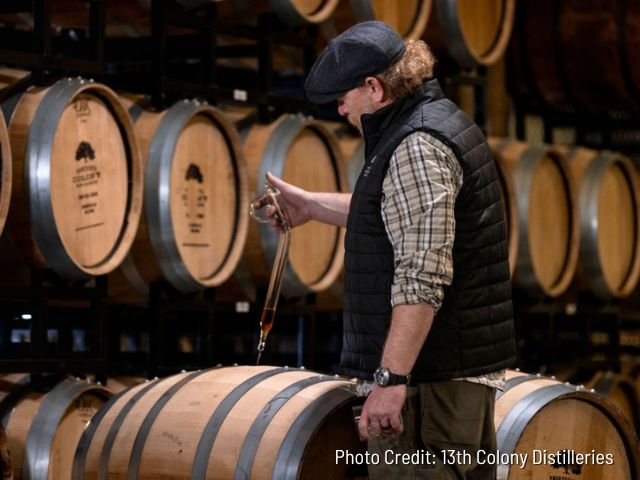
We also found though that you could overage in Georgia quickly and that was actually the bigger risk is it could get too tannic, it could get too oaked. And so you had to be very good about moving the barrel around the warehouse because since we don't climate control, we have to understand every part of that warehouse. Where's it a little cooler? Where's it a little bit hotter? Where's the best airflow? And the guys just got really good at this. It's like we put sensors all over the warehouse just to find out what's the temperature at this time of day. And we would just keep a log of it
Drew H (17:34):
And
Maxwell D (17:34):
Then go back through and kind of understand here's our hotspots, here's our cold spots, here's where we need to move things around. And the other thing we did regularly is I'm not sure this is good for a person to do, but we tasted barrels very regularly.
Drew H (17:49):
So
Maxwell D (17:49):
We pulled them down often. We tasted them with the idea of do we think it's overoaking? Do we think it's overaging? Let's move it. So everything was done by like get out there, teach people the palate, teach people the location and make sure you understand how you're rotating around the barrels as you go.
Drew H (18:08):
So this brings up a very interesting issue that you have to deal with. You can't really have a Kentucky style rig house because you're going to have to be pulling those barrels in and out. How do you get your setup so that you can easily move these barrels around?
Maxwell D (18:24):
So for a long time we've tried a lot of different setups over the years and what we came to, which was easiest because it's more just open warehouse is palletizing and stacking just became easier. People can argue one way or another. Is it better to lay it on its side? Is it better to put it palletized? And we do a little bit of both. We haven't seen a huge difference in that, but what we have seen a big difference is we need to be able to move these quickly and move them often. And that's the big thing for us is like it's a lot of movement of the barrels around the rickhouse. So we're constantly saying it's better to keep them on the pallets palletized so that we can go take that forklift and move that to that new section quickly rather than constantly trying to pull it out of a racking system.
(19:11):
I think the racking systems help you with getting more space in a lot of ways, but we've just decided we'll give up space to get what we need out of the barrel.
Drew H (19:20):
Okay. So did you make some adjustments and you're distilling whiskey on site now, not just vodka and ...
Maxwell D (19:28):
Correct. In fact, we don't ... Yeah, we are just doing just whiskey now on site. We're also still sourcing obviously because if you ever come to our facility, it'll be very obvious. I bet we don't make more than about 50 barrels a year locally. That's a pretty normal for us. What we're actually starting to do with those barrels is most of the stuff on our market now are distillate that we've gotten from our partners and then we bring them down and age them. But again, same distillate we're typically using, but we've actually recently changed to where we're trying a new distillate internally and we're looking in the future, it might be something that you can find only at the distillery if you come there. We're going to be putting out some single barrels into the market that might be Georgia only. In fact, we even have a product coming out called our barrel symphony product that's coming out in about a month.
(20:20):
It's basically a bourbon and rye blend and some of that is our stuff and some of that is MGP stuff mixed together.
Drew H (20:28):
Okay.
Maxwell D (20:29):
So it's a little bit of, you'll see some blends of our stuff, you'll see some single barrels and there'll probably be some kind of distillery only stuff in the future. I
Drew H (20:36):
Was wondering whether because of the fact that you were getting such high proofs coming off after a very short period of time, if you had actually moved to a lower proof point for barrel entry.
Maxwell D (20:51):
We do different proof points.
Drew H (20:53):
So
Maxwell D (20:53):
We've done some lower, we've done some higher. A lot of that is experimentation for us. Typically 120 is our normal, but we've done some at 110, 115.
Drew H (21:03):
We've
Maxwell D (21:03):
Done some at 125. So we're testing out even for like things like our double oak bourbon, have some barrels that we've put to the side that we've double oaked that were lower in proof when they went in. And part of that is because we've had a very, a lot of our double oak comes out in the 130 proof range. We'd be interested to see what it looks like if it's in the 120 proof fringe. Does that really change the flavor? Do we see that it's a more approachable bourbon for maybe the more average consumer? We like to experiment and we don't mind just sort of being like, "Well, we'll throw our experiment into the mix somewhere." So I would say we've had barrels go in and lots of different proof points, but 120 is our norm, but we've started to do some lower ones.
Drew H (21:46):
Okay. It seems risky to go and age something in oak in Georgia and then age it again in another barrel. What is your process for doing this double oak? And it's a very dark whiskey, so that's probably partially due to the high proof point as well.
Maxwell D (22:07):
Yes. First off, as soon as you double oak it, the color on it just turns into motor oil. So it's really funny. So we kind of accidentally discovered our double oak and then we figured out what we did and we just do the same thing over and over. So what we basically did is Graham years ago when I first started my first trip through our barrel house basically, I asked Graham, this is before we were sophisticated, we now have software and all this stuff. Back then we had spreadsheets of what barrels were sitting out where that's how we did
Drew H (22:41):
It.
Maxwell D (22:42):
And so I'm holding a clipboard with a bunch of spreadsheets with barrel numbers and lot numbers and everything else and he's showing me around and I see this lot of barrels and it just looks dusty and looks old. And I go, "What are those?" And he's kind of flipping through his sheet. He's like, "Man, I can't even remember." And he's flipping through and he goes, "Oh yeah, I double oaked those a couple of years ago." And I was like, "Well, let's just pull it down and see what it tastes like. " And it ended up tasting amazing. But it was funny because the notes he had had on it from like a year and a half earlier when it had only been double oaked for about six months was, "Oh, it's not so great." But it's almost like it, he was like, "It's too oaky," is what he actually said when he had his first ones.
(23:25):
But somehow after another year and a half of that second oak, just a little bit of that aging, it kept it very oaky but brought all these other flavors out with it
Drew H (23:34):
And
Maxwell D (23:35):
Sort of toned down just the over oak
Drew H (23:38):
And
Maxwell D (23:38):
Made it a oaky flavor bomb basically. So what we learned is there was kind of a, "We should just leave it in there longer than we think we should." And so because he was like, "I thought it would be horrible. It'd be too tanicky, but it wasn't." But I will tell you the secret to that is finding barrels that are the right barrels before it goes into that double. If it's already aging too quickly, if it's already tanicky and oaky, it's not a really good option for us from the double oak side.
(24:11):
We look for ones that are a little bit lighter actually that they start out very kind of light and fruitful and simpler flavors, but when we put it in that double oak, it enhances that oak, brings out all that fruit flavor that comes with it so you get all those dark fruits with it. So a lot of people ask, "Why don't you just make more double oak?" And we say, "Not only does it take a lot of time to make it, but we have to find just the right barrels to keep the consistency of the product and sometimes you just don't have those barrels."
Drew H (24:43):
Yeah. Are you doing a lower char on the second barrel?
Maxwell D (24:47):
No, we actually do the same char on both. It is char three
Drew H (24:51):
On
Maxwell D (24:51):
Both. I would say it's a really straightforward process. I mean, it's six to seven years in the first barrel and then two to three years of the second barrel and then we taste it and we decide whatever barrels between eight and 10 years are they taste exactly what we think they should taste like they go into the blend.
Drew H (25:10):
Okay. You also do a white whiskey, which I think is intriguing that you would go with a whiskey rather than a moonshine and so you are actually aging that. So what was your aging process for that?
Maxwell D (25:25):
Well, it's funny. So in order technically by law, in order to do a whiskey like that, you have to age it for one day.
Drew H (25:33):
So
Maxwell D (25:33):
Literally we have to pour it into a barrel, leave it for a day and pour it back out. Now part of the reason we did that is we had a lot of people coming down saying, "I wish I could taste what your mash bill tastes like, basically your white dog before you put it in the barrel."
(25:50):
And so we've made this a distillery only thing, but we said, "If you want to do that, sure, we'll just make it and we'll put some in a bottle for you and that way you can purchase it and see what it tastes like for yourself." And often we'll do it if people request it on their tasting event, we'll say, "Sure, we'll throw some on there if you want to taste it. " But it's kind of just a way that we just saw a lot of interest when we opened our tasting room of people saying, "I just wish I could try the distal at once."
Drew H (26:14):
And
Maxwell D (26:15):
We were like, "We could do that for you.
Drew H (26:16):
" Okay. I'm assuming then that is 100% Georgia distilled.
Maxwell D (26:22):
Yes.
Drew H (26:22):
Okay.
Maxwell D (26:24):
Yeah. That all comes straight out of Graham's back pocket.
Drew H (26:27):
Okay, very good. You also do a Southern rye. So where do we get the term Southern on top of this rye? What's making it southern?
Maxwell D (26:37):
I think my father and them when they started this, they just thought everything was like, look, we're a Southern family. They love the South. So if he could put Southern on everything, he would put Southern in front of everything he does. But I think a lot of that was the homage to the aging process, right? That this isn't just aging, not to offend anyone from Kentucky or anything, but if you're from South Georgia, you believe you might be the only people that live in the South. So to him, this was a litle bit like, no, this is what actual Southern age things taste like. So that's sort of where the naming convention came from was to hark into
Drew H (27:15):
That. Okay. And so what is special in your process on that?
Maxwell D (27:21):
So that one's interesting because one of the things we do is we use French Oak spirals when we do that. And for anyone who doesn't really know what a spiral is, it's pretty simple. It's a piece of wood about a foot and a half, two feet long. It's cut into a spiral shape and then toasted in charred. Usually we do a lot of toasted ones. We do some charred ones. The reasoning for that is it's basically the same as putting up ... I mean, it's like having a barrel stave except that spiral cut to that wood allows more area, surface area for the liquid to actually touch.
(27:58):
So that's why we do it. And the other reason we do that is we had done secondary barrels in the past. With the double oak, obviously we do all that in a secondary barrel, but when we tried doing things like French oak barrels or maple barrels in the past, what we didn't like was it was a very overpowering flavor. The French oak takes over or the maple takes over. And so now your bourbon just tast very flavored, like extremely flavored. And our goal was always everything should be bourbon first and secondary finish is in the background. We wanted that to be the feel, right? Your whiskey and your bourbon should taste like whiskey and bourbon first and then you get that secondary finish. We went to spirals because we found we could control better how much of that flavor from that secondary wood was actually getting into the liquid.
(28:51):
So we could control how many ... Do we want to use one spiral or two spiral? Did we want to cut a spiral in half and only use half a spiral? And that's where that really came from is we talk about cooking and we think of it like cooking. We thought of the spirals as sort of like salt and pepper.
Drew H (29:08):
Do
Maxwell D (29:09):
You want to dash it up just a little bit to bring out some extra flavor?
Drew H (29:12):
Okay. What kind of special things are you producing there that people might want to know about in terms of ... And what do they get to taste when they're on the tour?
Maxwell D (29:23):
Yeah. So on the tour, you typically are going to get to taste all of our sort of everyday products as far as the southern bourbon, the southern rye, our 113 maple bourbon. We typically will have a special pour on a lot of ours where it might be, if you're lucky, maybe it's the double oak. It could be a single barrel that we've done. We usually have a couple of different single barrel and some of our limited options, like our cash strength versions of everything. There will usually be bottles of those there available to buy. So if you're stop and buy, good chance you might find some of that. We do have a bottle of your own experience as well, which I actually think is a lot of fun.
Drew H (29:59):
Nice.
Maxwell D (30:00):
We will change it out every month or two. We will pick a couple of different barrels, usually one rye barrel and one bourbon barrel and it's just a single barrel and you can come in and pour your own bottle and label it up and take it home with you. We switch those out pretty often so you get a different experience every time you come.
Drew H (30:18):
Okay. We got to talk about the bottle because the bottle is the thing that just ... Describe the bottle then where did the idea for this bottle come from?
Maxwell D (30:30):
Okay. The easiest way to describe the bottle to me is take birthday bourbon and instead of it being bubbly, make it more straight edged.
Drew H (30:40):
That
Maxwell D (30:41):
Kind of decanter bottle.
Drew H (30:43):
Yes.
Maxwell D (30:44):
Part of this came because honestly it ended up just being my father way back in the day, he got this mold. It came from, as you can imagine, it was originally one of the molds that was in consideration for the birthday bourbon. And we actually bought the mold because it never got used. Oh
Drew H (31:05):
Wow.
Maxwell D (31:06):
And he just liked it because it looked like a decanter and he thought, what a cool look. You don't forget that bottle when you see it. Now it's a catch 22. I understand it's a very big bottle. Takes up some space on a shelf, but it is eye catching. So we always say it's hard because we get told all the time, "Your bottle's too big." But then we get told, "But I see it and I know it's your stuff right away."
Drew H (31:28):
Yeah.
Maxwell D (31:29):
Now the funny thing is I can tell you the lie I like to tell. I say this because it just makes for a fun story. It's not really a lie. It's more of a ... It's not what we were thinking when we did it, but it makes a lot of sense. So Graham was actually in the Coast Guard and one of the interesting things about those types of bottles is you could use them way back in the day on ships pretty well because as the ship actually goes side to side, the bottle will slide but it won't tip over. So we always say it's a great bottle if you're on a boat and since Graham was in the Coast Guard, that's where we came up with the idea. But then we tell people that's an absolute lie, but it sounds really fun as a story.
Drew H (32:12):
Well, I mean, it ties in now to the old iron sides. You could say, "Boy, back in the day if they'd have had these bottles, they wouldn't have had to worry though. The cannonballs are hitting and it's not upsetting your whiskey." Yeah, your whiskey's going
Maxwell D (32:26):
To be fine. Don't worry about it.
Drew H (32:28):
Yeah. No, that's really interesting because so many distilleries are going for tall statueesque bottles because it's a strategy to get them up to the top shelf because you can't put them on a lower shelf. But yeah, it creates a little bit of an issue, but they look so nice.
Maxwell D (32:50):
I would say they are eye catchers is the nice thing. I tell people, I understand it might take up room on your bar, but it will be very different than probably anything else on your
Drew H (33:00):
Bar. Yeah. Well, let's talk about how people get there because I would think that if you were a whiskey fan and you were making that long journey, I'm from Michigan originally. We used to drive to Florida to see my aunt and so we went down I- 75 a lot. It is a main way to get into Florida. So a lot of people going that way, whether you're going east or west coast of Florida. And in fact, even if they wanted to cut across the Panama Beach or Destin, they could probably make a cut through there. How far off are you from I- 75?
Maxwell D (33:40):
So it's actually not that bad. It's maybe 35 minutes off of I- 75. We always tell people the best way to plan a trip America's is a great little spot to stop for a night. So if you're coming down I- 75 heading to Florida, I would always tell people, "Plan a Florida trip. That's the best way to do it. " Stopping in Americas, there's a great hotel called the Windsor Hotel there for starters. It's a historic hotel that still looks like it's stuck from the 1800s and it's amazing. So a really fun place to stay. There's actually a big history of Al Capone actually being in the area
(34:18):
And that was actually a hotel he stayed at. So there's some fun with that too. I tell people you should stop there, stay the night, come on the distillery tour, and then you can leave the next day and head to Florida. But you've got some local things there to do as well. The POW Museum's amazing. Andersonville Prison Museum, amazing. Going over to Plains to see all the Jimmy Carter stuff, pretty awesome to do as well. So I tell people like, spend just a day there and then take the rest of your trip to Florida. But I would agree you can also, if you're coming on the western side, not doing I- 75, but if you're going down, I believe it's 431, more on the Georgia Alabama border heading towards Panama City, it's about an hour from there. But if you've got some time and you want to come over for about an hour from there, you can swing over to Americas.
(35:06):
We're sort of stuck in between those two areas right there.
Drew H (35:09):
Nice. I always like to find a place to eat that the locals eat at. What would be a place that I would want to check out?
Maxwell D (35:19):
Let me think about this. The station is a place a lot of the people go locally. I know that much. I would say the hotel itself, the Windsor has a great place called Rosemary in Time. It's a really fun place to eat because the flooring is this beautiful old tiling from like the early 1900s, late 1800s, really cool atmosphere to eat at. It's really funny, I will tell you, America's is probably not known for its restaurant scene. It's such a small town in the way that the best thing to do is find like a barbecue joint that looks run down, pick up some peaches from the side of the road or some boiled peanuts. That's really the way to enjoy the
Drew H (36:02):
Food. All right, good, good. I was going to say, you need to be making something with peanuts in it because that's whenever I think of Jimmy Carter, I think of peanut farmer.
Maxwell D (36:11):
100%. Yeah, lots of peanuts down in this area. It's funny, we have a family farm not far from the distillery about 15 minutes away. We do grow a lot of corn there, so we will use a lot of our corn and our own distillate because it's just easier to do. But amazingly, we've never grown peanuts on that farm a single day, which I think is hilarious, but it's very big peanut area. Well,
Drew H (36:34):
The other thing would be when I was growing up, we always heard about Jimmy's brother Billy and his Billy beer. You could make some whiskey out of Billy beer. That would be interesting.
Maxwell D (36:47):
Maybe we should call up the estate and be like, "How do we get ahold of some of that?
Drew H (36:51):
" Yeah, exactly. Exactly. Well, Maxwell, thank you so much for taking time today and letting us get to know more about the distillery. And as I say, it's an area that maybe it takes a little going out of the way to get to, but I think South Georgia actually has some really interesting distilleries that are worth checking out as well. And you could actually just kind of do a little circle there or Coneco Ridge is not that far away, nor is John Emerald. So there's plenty of places to check out in the area for whiskey fan.
Maxwell D (37:24):
100%, 100%. And yeah, we would love to have anyone down. The one thing we can guarantee is you'll get a good Southern hospitality experience. Our team loves to chat. You can come just hang out at the bar and talk to them.
Drew H (37:37):
Perfect. Well, thank you, Maxwell. Appreciate it. Cheers. Cheers. Well, I hope you enjoyed this virtual flight to 13th Colony Distillery in Americas. If I peaked your interest in making a trek down to Southern Georgia, or if you're interested in visiting any of the thousand whiskey distillery destinations that we have in the book, Whiskey Lords Travel Guide to Experiencing American Whiskey, I encourage you to pick up a copy. It's the only book on the market that gives you options of distilleries to visit in any of the 50 states and provides travel tips, tasting advice, and everything you need to know to get the most out of your distillery adventures. Plus, you'll also get online access to make your own travel wishlists of your favorite distilleries. No whiskey fan should be without it. Find it on Amazon or hurry up and get your signed copy for Father's Day.
(38:27):
Time is running out. Get the signed copy at whiskeylore.org/shop.
(38:35):
As we prepare to leave Americas and make our way to our next distillery destination, if you're still on the fence about a visit the 13th Colony, let me give you my three reasons why I think you should have this distillery on your Whiskey Lore wishlist. First, you've heard about Southern Hospitality. Well, this place is well known for their welcoming atmosphere. They're very heavily involved in their local community. They say support local. Well, this is a distillery that lives by that rule. Second, if you want to get a firsthand taste of what their in- house distilled whiskey tastes like, find their white whiskey available exclusively at the distillery and end your week with a tour to do a tasting comparison with their aged whiskeys. And third, highly recommend taking a side trip off the beaten path to get to this distillery in central South Georgia and also check out 1861 and Still Pond.
(39:27):
And if you're an American history buff, check out Andersonville. You won't be disappointed and maybe even read John Ransom's Andersonville Diary before your trip. Well, I decided I might just tack on one more stop on this Deep South trip. Got plans to head down to Florida. Then we got New York coming up after that and a special episode is planned for July the 4th. Make sure you subscribe to the Whiskey Lord podcast so you don't miss a moment. I'm your travel guy, Drew Hanish, and until next time, Cheers and Sloan Jeva.
(40:03):
For transcripts and travel information, including maps, distillery planning information and more, head to whiskeylore.org/flights. Whiskey Lord's production of Travel Fuels Life, LLC.
About 13th Colony Distillery
Tours and tasting room available.
Take a Whisky Flight to 13th Colony Distillery
Map to Distillery
Note: This distillery information is provided “as is” and is intended for initial research only. Be aware, offerings change without notice and distilleries periodically shut down or suspend services. Always use the distillery’s websites to get the most detailed and up-to-date information. Your due diligence will ensure the smoothest experience possible.