
145 - Spy Trail Distillery: Talking Revolutionary War Spies and Black Tea Bourbon
Listen to the Episode
Show Notes
What do George Washington's Revolutionary War spies have to do with a modern Long Island distillery?
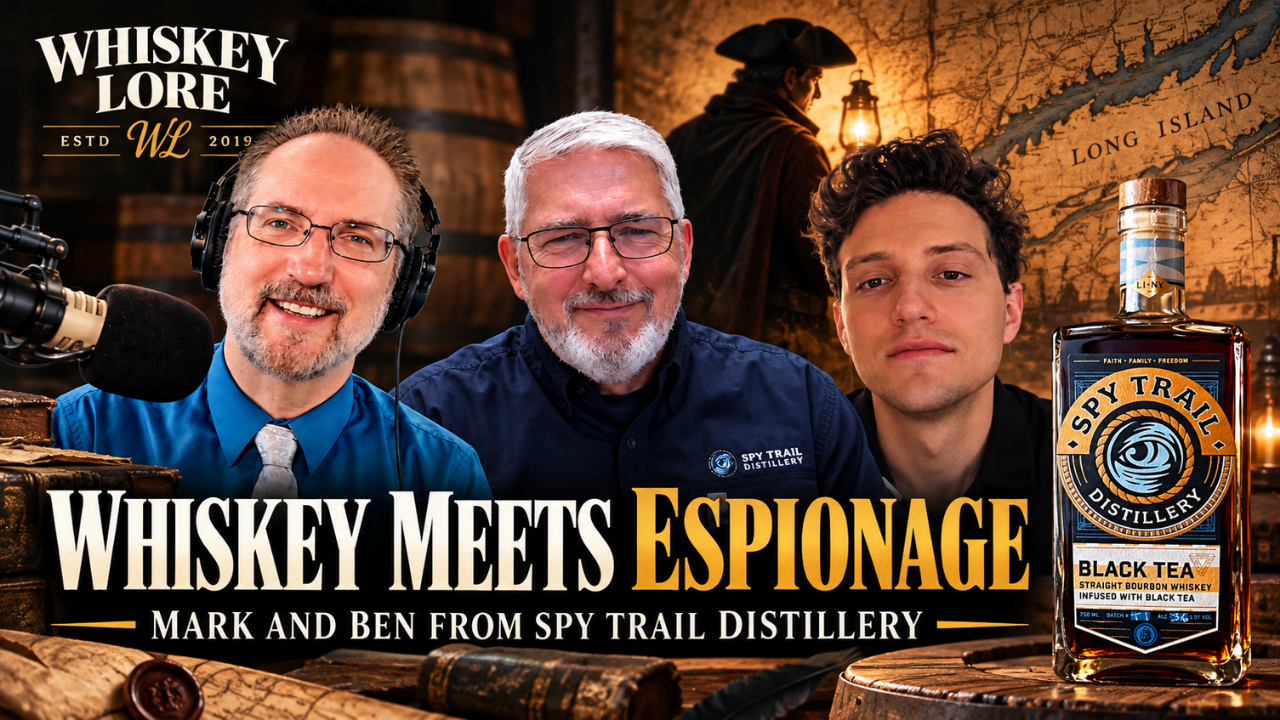
For Mark and Ben Grendel of Spy Trail Distillery, the connection runs through the history of their own community. The Culper Spy Ring used ordinary farmers, tavern owners, and other local residents to carry intelligence between British-occupied New York and George Washington's headquarters. Today, that history provides the inspiration for a family-owned distillery and its companion cocktail lounge, The Cipher Room.
Mark shares how a visit to a North Carolina distillery housed in an old jail led him to consider selling his manufacturing business and entering the spirits industry. We discuss the challenges of starting a distillery, his Holstein still, and the decision to create a four-grain Bourbon and a vodka distilled from Long Island wine.
We also get into a subject I always appreciate hearing distillers discuss openly: sourcing whiskey while their own barrels mature. Mark explains how Spy Trail selects and blends Bourbon from other New York distilleries, along with his plans for whiskey aging in Hungarian oak barrels.
Then Ben takes us inside The Cipher Room, where the cocktail menu combines local ingredients with stories of Revolutionary War espionage. We talk about the Culper Spy Ring, the historical liberties taken by AMC's TURN: Washington's Spies, and the mystery surrounding Agent 355.
And, of course, there's whiskey to taste. I'm sampling Spy Trail's Black Tea Bourbon, an experiment that began as a summer cocktail idea and became one of the distillery's popular offerings.
Along the way, we'll discover how visitors can explore Long Island's spy history through local tours before stopping in for a cocktail.
In this episode: The Culper Spy Ring, the founding of Spy Trail Distillery, sourced versus house-distilled whiskey, Hungarian oak maturation, The Cipher Room, historical cocktails, and Black Tea Bourbon.
Transcript
Drew H (00:14):
Welcome to Whiskeylore: The Interviews. I'm your host, Drew Hanish, the bestselling author of Whiskeylore's Travel Guide to Experiencing Kentucky Bourbon: Experiencing American Whiskey, and the book that bust 24 of Whiskey's Biggest Myths: Whiskeylore Volume One. And on this week's podcast, we're going to be heading back to Long Island, New York to dive into not only the story of the Spy Trail Distillery and its Sister Cocktail Bar, The Cipher Room. We're also going to be tasting some black tea bourbon, and we're going to dive into some of the history behind the distillery's name, a history that was told over a decade ago in the novel by Alexander Rose, and then later revealed in a brilliant historical drama on the AMC Network. It's a story that is based around the world of revolutionary war espionage with, at its heart, patriots, farmers, tavern owners, and the future president of the United States.
(01:13):
If you love history, you haven't seen the series, it's one I highly recommend. It's called Turn Washington Spies. And while it has been taken off Netflix, I think you can still find it on Amazon or you can purchase three seasons of it. For some reason, they haven't produced the fourth on video yet, or you could just wait for it to come back to Netflix or purchase the book. And today we're going to dive into some of that history, but we're also going to learn about the distillery, the unique cocktails being made at the cipher room, and the trail that inspired the name of the distillery and wanted to pair very nicely with a visit to the distillery. It's time to learn about this family business as we dive into the story with our guests, Ben and Mark Grendel. Gentlemen, welcome to the show.
Ben G (02:04):
Thank you. Thank you.
Drew H (02:07):
The name of the distillery immediately caught my attention when it came up on Instagram and I was doing my research last year. You guys are actually really new to the distilling world. Talk about how this all developed and we'll get a little bit more into the spy trail story on top of that, but how did this distillery come about?
Mark G (02:32):
Well, a few years ago, friends of ours that have a house down in North Carolina invited us to come down, visit. We were headed down anyway for a concert and they said, "Hey, before you head over to the concert, let's stop by a distillery that's built in an old jail." I said, "Sure, why not?" So we were together with a couple other friends. They were all part of a bourbon tasting group that we have here locally. I shouldn't say just a bourbon tasting group, a tasting group. We do all kinds of spirits. So we're all together walking through this distillery and I just kept joking. It was a joke at first. I'm like, "Oh, we could do this." And they're all laughing and my wife's shaking her head because she knows where this is going. I've been in manufacturing my whole life. The last business I had was about 23 years old.
(03:20):
I was kind of getting a little bit burnt out, tired of it. And we were talking about it joking. Then we came home. I said, "You know what? It's not something I want to take a look at. See if we want to do it." Did some research, went to some classes. Actually, ADI happened to have a conference a couple of weeks later in Vegas. So I jumped on a plane, went to Vegas, sat in some seminars, met with vendors, came back home, said to her, "I think I want to sell our business and then jump into this." And her answer was, "You've had worse ideas and I can get behind this one."
Drew H (03:56):
So
Mark G (03:58):
That's kind of how it happened. And typically we just jump into the deep end. I just start something and run with it. So shortly after that, started looking for some equipment and Moonshine University, which unfortunately is shutting down shortly, happened to have a course a few months later, their distillers course. So I said, "You know what? I'm going to go to that one and that will be my final benchmark if it's still something I think we should jump into and go with." So sat there with those guys and the instructors and the consultants that they have and the vendors that come in throughout the week and spoke. And at that point, actually changed some plans. Instead of flying directly home, I flew out to Seattle to a distillery that was selling equipment to go look at it and literally flew from Louisville to Seattle and looked at the equipment and came back home and sent them a deposit.
Drew H (04:57):
Wow.
Mark G (04:57):
And then the whole process started getting permits and everything else here locally and federally and whatever else. So kind of a whirlwind. It's been a whirlwind for the last few years, but that's kind of how I create things and it's not always the best way to create things, but it's been interesting.
Drew H (05:14):
Yeah. It's interesting that you basically are pulling in a still from elsewhere. So it kind of made your decision for you as to whether you were going to do... It's a Holstein still, as I understand.
Mark G (05:26):
So we have a four plate column on one part of it, and then we also have a 12 plate column for the higher proof, the vodka. And so you're working, it's typically the way any other hybrid column still is, you're doing your initial mash and then the mash goes in. And instead of doing a stripping run, I have the ability to reflux and get to our proof and utilize the plates and the caps that are inside the four column part of the still, the four plate column.
Ben G (05:58):
So
Mark G (05:59):
Typically I only use two of the four plates for bourbons and rice because we only want so much rectification, but I have the full reflux capability so I don't need to do a stripping run and then going into a final run. We can manipulate all that with our temperatures and flow rates and steam pressure.
Drew H (06:19):
So when you get the equipment in and you're looking at it and you're going, "Okay, it's here now. I have to make something on this." Did you have some people that you could kind of lean on in terms of when you had questions coming up and that sort of
Mark G (06:34):
Thing? Absolutely. Absolutely. So I mean we did work with a consultant also before the equipment even came in, we started looking at, okay, what type of spirits are we going to make? So the mash bill, for instance, on the bourbon, what do you do? You go and you try out a whole bunch of different bourbons that are already made, different mash bills, and you know what your flavor profile is going to be. We wanted to do something a little bit different, so we opted for a four grain mash bill for our bourbon. And originally the rye that I first started to distill, we went with Washington's rye recipe that they're doing down in Mount Vernon still to this day,
(07:14):
Ended up being too close to our bourbon mash bill and flavor profile. So we opted now, we shifted to a different rye mash bill after the initial batch that we did. But yeah, we went to figure out what's the flavor profile we're looking for, what type of bourbon are we going to make? What are we looking for in our bourbon? And everybody makes some sort of a clear spirit in the beginning to get things going. And so the funny part is that the still that I bought came from a distillery out in Seattle that basically made only vodka. They made vodka from wine. They purchased wine from the wineries out on the West Coast and they created the vodka from that wine. So when we were talking to them, I said, "Well, we're in wine country here on Long Island. We have multiple wineries and nobody else is doing that, especially here on the island." So I said, "What's going to set us apart?
(08:08):
How are we going to be different than everybody else?" So I purchased wine, for instance, roses typically from the East End wineries on the island and I redistill the roses to create our vodka. So we tried to say, when we started out, we said, "What's going to make us different? How are we going to differentiate ourselves from the market?" So four grain mash bill was part of it, distilling vodka from wine as opposed to a potato or a grain was the other thing. And then from there we said, "Okay, so now this is what we're going to do." And then I spoke to some other distillers and then I contracted with a consultant who came down to us for the week and we sat and we talked obviously ahead of time, but then came up with the mash bill said, "This is our mash bill." And then he came down, we went through the whole mashing process and tweaked our numbers to get the right percentages and weights so that the equipment runs properly and did a crash course in that.
(09:07):
I mean, before that, I sat on a small little test still making moonshine,
(09:14):
Understand the process, understand how the alcohol evaporates, understand the cooling, understanding reflux in a small scale and cuts and what tastes horrible, what's too oily, things like that. So we did that ahead of time naturally. I mean, it's all part of while we're getting permits and building and waiting for bureaucracy, you get all these small little things out of the way, hopefully. Not that we're not still learning, don't get me wrong. We're constantly tweaking right now, so we're still
Drew H (09:45):
Learning. Yeah. The learning curve on whiskey, it just continues to go on and on and on. You have straight bourbon out now. Did you start distilling much earlier before you opened your doors and this is your
Mark G (09:57):
Distillate? We did source some bourbon from other upstate distilleries to start blending while ours is aging. So there was no way we were just going to survive on vodka and gin alone in the beginning.
(10:12):
So we did source some and we're blending those still right now to create our bourbon. So everything that we do is in-house as far as the blending aspect. We just don't go to somebody and say, "Hey, here's our label," and slap it on there and they make it. So we know our flavor profile that we're looking for and we sit and we sample barrels and figure out which barrels we're going to use. We typically use four to five barrels in a batch. And we just did that this weekend and we sampled about 12 different barrels, 15 different barrels probably. And out of those, we picked eight barrels that we used to make our next two batches. And from those barrels, we only use a percentage of each to get that flavor profile that we're looking for.
Drew H (11:02):
Okay. And you're already doing a four grain from what I understand. So is your mash barrel going to be somewhat similar to the one that you're using now or is it going to evolve? Yes. So the
Mark G (11:15):
Flavor profile should carry over. Another difference that we are doing in our distillation process is I also use a European oak, a Hungarian oak barrel
Drew H (11:28):
For
Mark G (11:29):
Our bourbon and rye as opposed to an American oak. So again, it's a different terra where the wood grows, you're going to have a different flavor profile. The grain consistency on the Hungarian oak is a little bit tighter, different flavors that are going to come out from the different region of the world.
Drew H (11:50):
What did you determine in terms of the charring for that?
Mark G (11:54):
Oh, we're going with a three. We feel that three is kind of a universal catchall. Two probably take too long for us to age everything. Four, we don't like a very smoky, heavy oat flavor profile. So three is kind of the industry standard at this point. So that's what we opted for on those barrels.
Drew H (12:20):
Let's talk about the name of the distillery, which caught my attention immediately because I'm a huge fan of Turn Washington Spies, the AMC series that was on about four years ago. A series that I have to say as a history lover and somebody who doesn't like when it gets too Hollywoodized for about three seasons, that show did a really great job of trying to stay to the story with some embellishment. It got a little off the rails, I think, in season four, but it still was a great show. Were you aware of that show? And of course you've kind of grown up in that area. How much of that spy trail story was there even before that series came out?
Mark G (13:07):
Yeah. Well, when the series came out, my wife Robin and Ben actually were the ones that watched it first. They were watching it and had mentioned that I should watch it. It was interesting. So we all watched the series. We just live literally off the spy trail in our residence and the history is all around us. We then went to some of the locations in Setaket that the local heritage society has tours. There's another woman that does tours about the whole spy trail aspect. So we just started jumping into that and that was long before we even had the thought of doing a distillery. And then like we said, coincidentally, the son joins the army during ROTC in college and he actually ends up dealing with cyber warfare. So it's kind of just ironic how everything came together.
Ben G (14:07):
My mom always, we have so much historical properties on the island because of how old everything is. So she would love to go see the churches and the houses. So she would always go to those tours and she kind of saw some of the churches was one of her biggest things and they are some really, really cool old churches. And actually one is on one of the battle sites. So we always though it was a really cool thing. And when we had family from overseas come in, we'd always try and show them kind of some of that local history even before this was ever an idea.
Drew H (14:38):
Was the spy trail that's out there now, did that start before or after the show?
Mark G (14:46):
Long before.
Ben G (14:48):
Yeah.
Drew H (14:49):
It did start before. Okay. Did they do a lot of filming up in that area?
Ben G (14:54):
No, they did not. It was very little.
Drew H (14:57):
I'm sure Sataket looks a lot different than just a church up on a hilltop.
Ben G (15:01):
Yes.
Drew H (15:04):
I went through there with, boy, it's been 30 years since I've been through there. We went to Teddy Roosevelt's Sagamore Hill in Oyster Bay. And so I have a little familiarity with that. And we took the ferry actually across, the car ferry from Setauket area, Port Jefferson across to Connecticut. So fun experience to do that. But it's funny with a father who's so into history, I don't remember him talking about the Spy Ring. Give people a little sense of what this, this is not James Bond. We're going back to George Washington's time for this.
Ben G (15:42):
The cool thing about the Spy Trail is actually how recent it was founded. So they only discovered and deciphered most of it in the 1920s. So it's still a more recent idea. So there's still a lot that's actually unsolved. So there's still always new info coming out, which I think is a cool thing. But to talk about why it's different, it was what's called the Culper Spy Ring. So it was Samuel Culper was his code name. And then he had a list and ring of spies all the way from that Port Jefferson area you were talking about to Manhattan and even across the sound, they had a old whaler who would pass messages from the sound to Connecticut and then all the way to Manhattan by horseback and by boat. So they were all very, very common people. So it was tavern owners, store owners, farmers, and they would pass all these secret messages along from any info they found out about the British to George Washington actually.
Drew H (16:49):
They actually all had codes for who they were. Yeah. I love that aspect of it. They start the series out really with Abraham Woodhall, who is Samuel Culper, and you kind of see how this whole network kind of builds up and gets started and really how important it became to... These are the things that I want to read the Alexander Rose book and I haven't done it yet and I need to, that ties into even Benedict Arnold and the discovery of his treachery as he was feeding information to the British.
Mark G (17:33):
Partially also Nathan Hale was part of it. I think it's called The Secret Seven by Brian Kilmeade was actually a very good book also on the history of it.
Drew H (17:44):
When you're developing a distillery around this kind of theme, how do you integrate that into what you're doing in terms of your branding and also the experience that people will have?
Mark G (17:59):
Our label, our logo was all developed in conjunction. You have the spy, you have the eye for the spy, you have a nautical rope around the outside for our maritime history here on Long Island. A friend of ours had said when we're starting a brand, every brand needs a story. And we said, "What's better to bring out?" 90% of the people that come in and visit us don't even know about the Spy Trail, and they're all locals. So we tried to just give them a short, brief history about it. We have some information on our website about it. In the Cypherome cocktail menu, there's an overload of information in there. Everything in our brand is tied into the history of the Spy Trail and the local history.
Drew H (18:50):
Do you have a favorite person that you kind of follow from that story? Somebody like Ben, is there somebody that stands out to you as kind of a favorite person in that whole spy ring that piques your curiosity?
Ben G (19:06):
Yeah, actually kind of who my dad mentioned, Nathan Hale, because he was kind of one of those main messengers going from Satauka to Manhattan on horseback. He carried over 500 messages and you could only imagine how many times he was stopped by the British, but every time he got away and he was never discovered just kind of because of the mundane approach to what he was doing of just delivering supplies to a tavern. So just thinking about that, just being a common person that just stepped up and actually did something super remarkable and how many times he was stopped by the British and got away is just very, very impressive.
Drew H (19:46):
And he's a footnote in the series.
Ben G (19:49):
Yeah.
Drew H (19:50):
And that's another reason why I think really digging into that story and getting beyond what a series can do in telling the story, they really don't even associate him necessarily with the spy ring.
Ben G (20:03):
Yeah. There is multiple characters that are kind of left out, which like you were kind of saying, I think a little bit for the drama aspect, but a lot of it is an under talked about topic in general.
Drew H (20:17):
I think what's interesting about it is in my talk with Canadians, they're not overly happy with how John Graves Simko was portrayed in that he's one of the best villains I've ever seen in any show that I have watched, and yet he's a national hero up in Canada. So he was kind of given a rough treatment there. Are there other characters in there that you feel like people should know a little bit more about?
Ben G (20:49):
I think Caleb Brewster is also a cool one that I think is also a little bit under talked about. Just being the whaler and sailing ships through the night is very, very impressive when before we had any technology or powered boats or even headlights just going completely through the dark and the sound is one just very impressive in general.
Drew H (21:12):
Yeah. They had him in the turtle and I wonder where the turtle submarine that they used actually did fit into the story because I know there was a turtle, but I've never really looked into whether... And I don't think it was Caleb Brewster that was probably riding that across, but it was a nice way to fit it in. Yeah.
Mark G (21:35):
I think the show was probably about 50% accurate and 50% embellished from what we've spoken about with some historians and people that are pretty knowledgeable about the spy trail history on the island. So they all like it, but they wish it was a little bit more to historically accurate, but like I said, it could have been much worse.
Drew H (21:58):
Well, I mean, I've seen some stuff on the History Channel. In fact, that was one of my comments was that that show actually was much more accurate than many of the History Channels shows that I've seen Sons of Liberty when they covered that. It's like they've got George Washington standing up at the Continental Congress giving this great speech, and it's like the guy just sat in the corner the whole time, was as humble as he could possibly be. So yeah, some things become very obvious and others can kind of sneak by you. It kind of gives you an opportunity though over time to tell people the actual story and humanize it more from a local perspective.
Ben G (22:42):
Yeah. And we always say it's definitely really nice that it brought a lot of attention to the topic, not from Long Island perspective, but also everywhere. They kind of know Long Island has that history that was unappreciated or unshown beforehand.
Drew H (22:59):
Yeah. So one of the characters from the show is there's a lot of mystery around. I don't think they really have ever determined who Agent 355 was. You built Agent 355 though into your experience. Talk about that.
Mark G (23:18):
Well, so that's actually just going to get released shortly. We just started putting that together. So we basically have a member's club that is called the 355 Society, which will be special events just for members only at the distillery, at the cipher room, special cocktail releases, special barrel releases. In a sense, it's a loyalty club to a certain extent,
Ben G (23:50):
But
Mark G (23:50):
It's definitely going to be an experience for a select group that want to join and get inside bottles, barrels, dinners, events, talks, things like that.
Drew H (24:09):
And Agent 355, why this particular person and who do you think it is?
Ben G (24:15):
So it's definitely a lot of mystery around that one. So yeah, like you said, they still have never discovered who it was. A lot of people say it was a woman and that's why it probably did get lost because she was probably known and very, very secretive. Unsuspecting, I should say. Yeah.
Drew H (24:34):
Anna Strong is sometimes being given pointed to, the show kind of points to her as being potentially that person and she had her own little bit of, whether it's lore or true, I'm not sure about her signaling boats with her sheets that she was putting out.
Ben G (24:54):
That one is truth. Yeah.
Drew H (24:56):
Okay. All right.
Mark G (24:57):
I believe actually they did sheets in the show, but I believe it was actually petticoats in history.
Drew H (25:03):
Okay. Well, let's talk about, you've got the distillery, you're setting up a distillery. Now you've decided to branch out already and do something else in a separate location. How did this idea of the cipher room come about?
Mark G (25:20):
Being that I had another business, I already had the building that we're in right now. So we own the building, so it's easier to build in a building that you own than what you rent just from the regulations and the permitting process. But it is an industrial complex, so it's not a residential area where people just driving through and going and stopping and have a drink. So from day one, we basically said we're probably going to need a secondary location. Being a farm distillery license gives us the ability to have a secondary branch office that's not in the distillery,
(25:53):
But that requires us to use 75% New York State grains products in our process. So we were fine with that because we're all about supporting local. It's not so much a joke, it's the truth. I say it's hard enough to do business on Long Island as it is with the expenses, try to support each other as much as possible and do everything as local as we possibly can. So knowing that we were at some point always going to do a secondary location, we kind of said, all right, what kind of a location are we going to do? And honestly, it first started out as a typical distillery or a brewery tasting room type of a feel and vibe. That's the direction we were starting to go.
Ben G (26:38):
And
Mark G (26:38):
Then Ben jumps in and everything changed. So I'll let him take over from there.
Ben G (26:46):
Yeah. So my background as he was starting the distillery, I was in school and then I spent my last two years of school in Brooklyn actually. So New York City is very much a cocktail capital of the world. And I was bartending at the time a bit and I really enjoyed the cocktail scene there. And definitely coming onto Long Island, we have many, many amazing restaurants, but we really don't have any cocktail bars. And I think cocktails are a really, really great way when done properly to express and show how good a spirit can be and show many different expressions of that spirit. So when we were talking about that offsite location, we were like our spirits, what's going to set us apart? And I definitely think our cocktails are something that does that because they are very different from your typical restaurant cocktails or sports bars or classics.
(27:44):
Of course, we have all the classic cocktails as well, but we really wanted cocktails that show and showcase our spirits very differently. So when we were thinking about the cipher room, we knew it was going to be a cocktail bar, but we also wanted it to be a lounge and we wanted it to be upscale and kind of show that history as well and the spirits. So our menu, every page that we have on the menu on the right side is your spirits or cocktails and your left side is the history. So everything is just very thematic and everything's meant to be tied in together.
Drew H (28:16):
The idea of cocktails, we know they were mixing something with their whiskey back in the 1700s. The question was, was it really a cocktail? When did that name come about and the rest? So how do you go about developing kind of themed cocktails for the cipher room?
Ben G (28:37):
So I mean, just the way we think about ingredients and spirits, we think about ingredients in cocktails, supporting local, using as many local produce and producers as possible. So I always try to use other New York distilleries, Liquors and Amaro's and stuff like that. And especially ingredients are very seasonal. So when we're going through the cocktails, they're very much just supposed to be representative of our supply on the island. So a lot of those, this first menu, like Brewster's Knight Fall Crossing is kind of one of the ones I love to talk about because it uses our bourbon, is very bourbon forward, but also we use a bit of walnut orjat and then we make an apple cordial from a cider that's also made in New York. So kind of all things that kind of tie together. And then we add a smoke bubble, so it's trying to be indicative of that spy history and of that crossing.
Drew H (29:37):
Do you find that people come in and they want to try something new and unique that is associated with you, or do you find people kind of gravitating towards the old tried and drew?
Ben G (29:49):
Definitely from our first three months of sales and data, it's very much cocktail forward. I was saying we really don't have many cocktail bars out here. So when When people come in, I'd say it's probably a pretty even fifty fifty split of, oh, they know this is Spy Trail Distillery's tasting room, and some just think it's a bar. So it's a cool opportunity to show that, oh, we make these cocktails, but yes, we also make all of our own spirits, and this is a perfect way to try.
Drew H (30:19):
And are you just focusing on the bourbon or do you have rye whiskeys that you're using as well?
Ben G (30:25):
Just bourbon.
Drew H (30:26):
Just bourbon at this point. Okay. And
Mark G (30:28):
The
Ben G (30:28):
Vodka and
Mark G (30:28):
Gin also.
Drew H (30:29):
Yes. And the vodka and gin. So you sent me a bottle of the black tea, straight bourbon whiskey, and this was one I had no expectation for. I wasn't quite sure what I was going to get once, because I have had whiskeys that have a black tea note, but usually that black tea note comes in on the finish. So the idea of having something that is really black tea focused, talk about your process of making this whiskey, first of all.
Mark G (31:03):
So we came up with that one as a summer project last year, thinking that it would go great with lemonade to make a bouzillano palmer in that aspect. It ended up being such a big hit that it just automatically rolled into a full-fledged product line on its own. Probably goes hand in hand with our straight bourbon almost in sales, does really well. There's so much you can do with it because of the flavor profile. It lends itself to working really well in cocktails that Ben creates, but even just an old-fashioned, it's a different old-fashioned than your typical. The minute I mention lemonade with it, people are like, oh, their eyes light up. Oh, I could see that. So how did it come about? Well, again, what's going to set you apart? And my wife's a big tea drinker, so we said, you know what? How do we wrap this around?
(32:07):
And we tried a significant amount of teas in the development process to see what would work, what doesn't work. Landed on this particular tea that we're using now. And basically, we literally have a large tea bag that we're steeping in a stainless steel drum of our bourbon.
Ben G (32:31):
Wow.
Mark G (32:33):
And then we let it sit there for a while and we do need to add a little bit of sugar because cold steeping a black tea gets very stringent. So you do need a little bit of that, but that also lends it nicely to the old fashioned that we're talking about because now you can cut back on any kind of simple syrup that you might be using and it's already all there and you just go with some nice bitters and you're good to go. So yeah, it's just one of those things that I'll be honest with you, we weren't sure how it was going to go over, but it's gone over so well that we have to keep making it, which is a good problem to have.
Drew H (33:10):
I'm telling you that while this is being made in Long Island, when I nose and taste this, I think it's perfect for the southern market, but the sweet tea drinkers, boy, it brings a lot of that. I get a lemongrass note on the nose, the oak coming through and a little bit of a smoke note that just goes with that black tea note that's in there. Once it's on the palate, there's a lot of sweetness to it. So it was interesting because in a way it almost crossed between a liqueur and a whiskey to me in a way with the amount of sweetness that is on the palette, but then it dries out on the finish with, again, the black tea note.
Mark G (33:59):
You get a lot of tea on the back end of it.
Drew H (34:01):
Yeah. It stays with you. It does not go away. So that's great, a nice really long finish. So what are you finding in terms of the perfect cocktail for this?
Ben G (34:15):
So like you were saying, actually, the black tea old fashioned, when old fashioned drinkers come in, we always try to recommend it to them because one, it's our own spin on it. So I think it really does create a great old fashioned because we also make all of our own bitters in-house. So we have 10 bitters that we make ourselves and they really pair super well. And then I actually have one high ball that's coming off our summer menu because we're going into our fall menu now, but it's like a, we call it the Crimson Cipher. It uses some strawberry amaro, some strawberry cordial that I make from local strawberries that are grown about 20 minutes from us. And then we carbonate the whole cocktail and it really is not overly sweet by any means, super refreshing, super crisp, and super flavor forward. But I think the black tea pairs really well with any of those darker red current type berry fruits.
Drew H (35:13):
Okay. And is there a speakeasy element to your cipher room? No.
Ben G (35:20):
Not really. Yeah. The building is actually right off of 25A, which is the historic spy trail, which is a really nice touch, but it's a standalone building, big windows, nothing
Drew H (35:32):
Too speaky. Okay. I'll welcome in those secret passwords.
Ben G (35:36):
Yeah, exactly.
Mark G (35:39):
We do have some things to decipher in the bookshelf and some things to decode to figure out, but unfortunately the building didn't lend itself to doing a secret bookcase that opens up to a private room or something. That didn't work out that way, but we're super happy with the way it came out.
Drew H (36:01):
So where are we headed in terms of what you're producing with whiskey? Are you looking at releasing a rye and a bourbon and how long are we probably looking at for those?
Mark G (36:12):
So as I mentioned a little bit earlier, the distillates we're making now are going into Hungarian oak barrels. We're also using American oak barrels for some of our distillates. So in the future, I'm going to say three years from now, hope to have what tentatively is going to be our European oak line of bourbon and rye. All the ryes I have been laying down are in European oak at the moment. We're going to determine if we're going to do some in regular American... Yeah, I said in European oak. We'll have to determine if we're going to make it into American oak also. So we have a rye in the future, again, three plus years. We definitely don't do anything younger than four years.
(37:07):
So we're as a minimum of four years. The bourbons we blended this weekend, we're all four year olds with some five year olds, but you have to use the youngest age statement, so they're all technically four year. So we're not going to rush it. We're going to get to it. We're going to let the barrels do their thing. We're going to let everything ride. And if the barrel's not ready, it's not ready. It's going to sit. This is not an industry to be in a rush. We never started with small barrels. A lot of people that are young will start with a 15 or 30 gallon barrel to hope to have it out in two years to have that bourbon technically in two years. From day one, I said, "If we're going to do this, we're going to do it right." And to me, going in those small barrels is just not the right way to do it.
(38:01):
It needs time. The chemical process needs to do its thing. So we're still a few years away from anything major coming out in that aspect, but we will be, like I said, Ben last summer developed a gin recipe that we've now distilled and a significant amount of cocktails being used with that and we can touch on that. So again, it's a very local gin. Heritage wise, it's called Sound Gin because some of our botanical blend comes out of the Long Island Sound and out of the Great South Bay. So again, tying into local markets that we work with. We are going to be working on a rum this winter. So Ben's been pushing for a rum to give him some more ingredients to work with at the cipher room. So that will be coming out. Don't know when. Again, it comes out when it comes out.
(39:09):
I'd love to say I have a timeframe for it, but the gin took a little longer than we were hoping for, but we're super happy with the way it came out. And like I said, it is what it is.
Drew H (39:21):
So are you doing tours at the distillery?
Mark G (39:24):
Yes and no. I'll be completely honest with you. The distillery basically is myself and one other person. Usually we're here. It's not a huge distillery. We have one big rectangular room that we do everything in.
Ben G (39:35):
So it's
Mark G (39:35):
Not like you're going from a room to a room, to a room, to a rick house, to a bottling facility. So yeah, if people stop by, sure, we're absolutely going to talk to them and show them our processing tasting and whatever else, but we don't technically do a tour.
Drew H (39:49):
Okay. How would be the best way for somebody to engage with the Spy Trail first and then finish up at the Cipher room? Is there a good starting point for this?
Mark G (40:00):
Sure. I mean, I would absolutely encourage people to take a look at a company called Tri-Spy Tours. A woman named Margot runs all the tours. She is a wealth of knowledge. We've had her here when we've done distillery events with a history talk and she talks about the Spy Trail when we have an event at the distillery. We're going to be talking to her about doing things for our 355 Society. So she's a wealth of knowledge. She does tours throughout the year. She does a biking tour, a walking tour, a kayak tour actually, which we haven't been able to get on because it sells out so quickly. You literally need to follow her social media to find out when the tour opens. So we'd like to do that one someday with her. But yeah, and then you can come down the road to us and meet Ben behind the bar.
Drew H (40:55):
Fantastic. Well, Mark and Ben, I appreciate you walking us through and giving us some background on the distillery itself and the cipher room. And it sounds like there's stuff to do, definitely. We just talked to Twisted Cow not too long ago about what they're doing over and you guys are using two different distilling processes and very interesting to see what is going on on the island. Long Island is growing its distilling capacity, which is fun to see. So congratulations on getting everything up and running and I wish you the best down the road.
Ben G (41:32):
Thank you. Thank you. And thank you for having us.
Drew H (41:35):
I hope you enjoyed my conversation with Mark and Ben from the Spy Trail Distillery in Long Island. If you're thinking about a trip to New York sometime soon, make sure to put the distillery on your Whiskey Lore Distillery wishlist by heading to whiskeylore.org/NewYork and join me next week as I think I finally got chapter four of The Lost History of Bourbon shaped and ready for production this week. It was not for a lack of material to write. Instead, I had found so many fascinating rabbit holes to go down, starting to fall into paralysis by analysis, trying to figure out what to keep and what to toss out. If you're curious as to some of the things that I cut from the book, make sure to join the speakeasy and check out the new section we've got called Research Rabbit Holes. You can join us at patreon.com/whiskeylore.
(42:20):
Have yourself a great week. I'm your host Drew Hanish, and until next time, cheers and Sloan Java. For show notes and transcripts, head to whiskeylore.org/interviews. Whiskey Lore is a production of Travel Fuels Life, LLC.