
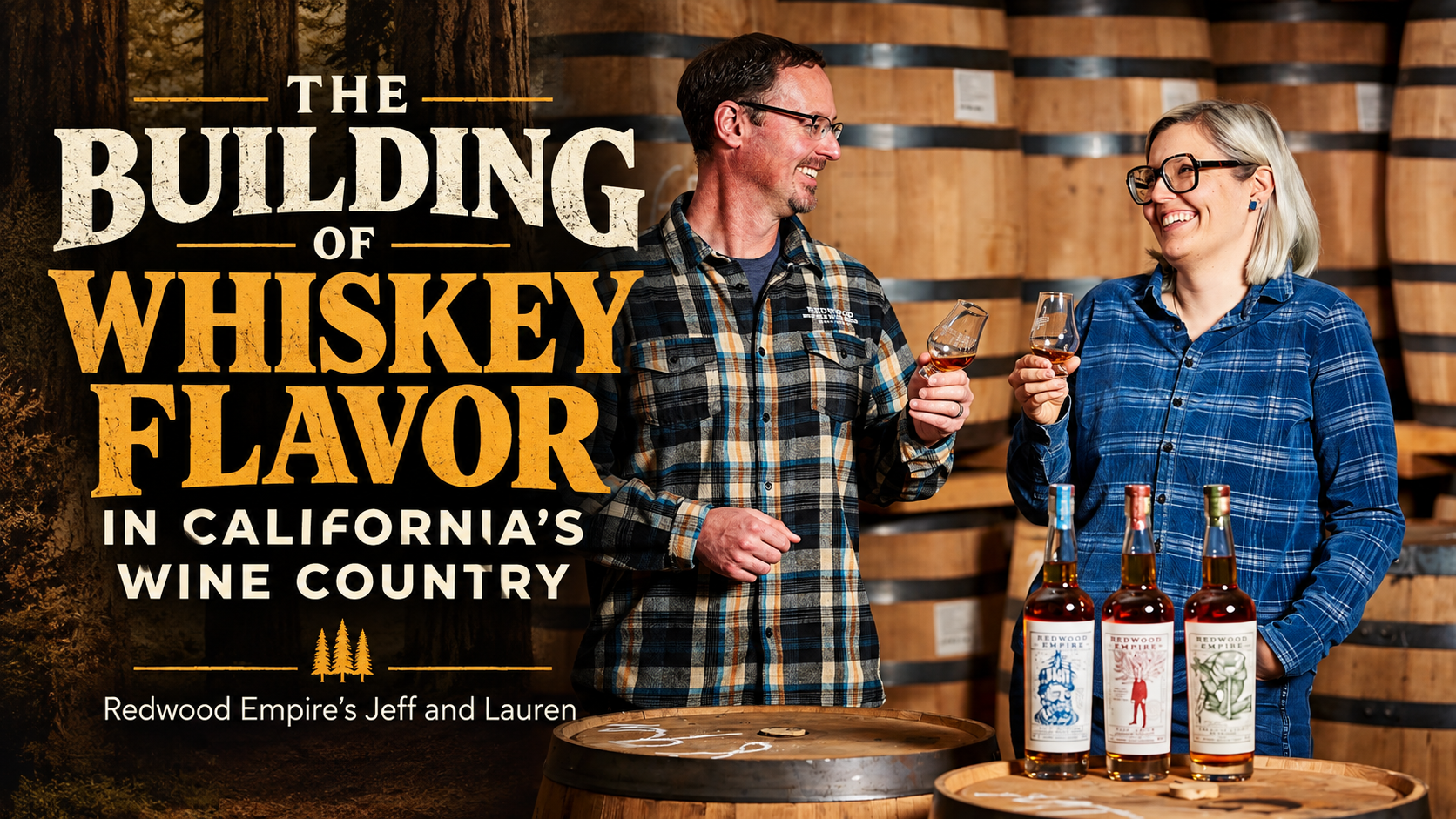
144 - REDWOOD EMPIRE: The building of whiskey flavor in California's Wine County
Listen to the Episode
Show Notes
What happens when a California whiskey maker approaches Bourbon, rye, and single malt with the mindset of a winemaker?
Drew Hannush welcomes Redwood Empire Master Distiller Jeff Duckhorn and Head Distiller and Master Blender Lauren Patz for a conversation about the distillery's evolution from a small operation in Sonoma County to a growing American whiskey producer. They explore the advantages of sourcing and blending whiskey from multiple distilleries, the influence of Northern California's climate on maturation, and why Redwood Empire favors a softer, more nuanced approach to American whiskey.
Along the way, Jeff and Lauren explain the stories behind their tree-inspired whiskey names, including Pipe Dream, Emerald Giant, Lost Monarch, and the new wheated Bourbon, Colonel Armstrong. They also discuss the growing American Single Malt category and their experiments with specialty malts.
The conversation culminates in a tasting of Hyperion, Redwood Empire's ambitious new blend of Bourbon, rye, wheat whiskey, and American Single Malt. Named for the world's tallest known living tree, Hyperion brings together some of the distillery's oldest sourced and self-produced whiskeys in a release designed to showcase the possibilities of blending.
In This Episode
- How Redwood Empire grew out of a Northern California wine business
- Jeff Duckhorn and Lauren Patz's different paths into whiskey production
- Why Redwood Empire embraced sourcing whiskey from the beginning
- The transition from its original Headframe still to a larger Vendome column still
- How California's relatively temperate climate affects whiskey maturation
- Why the distillery favors complexity, balance, and a softer drinking experience
- The living redwood trees behind the names Pipe Dream, Emerald Giant, Lost Monarch, and Colonel Armstrong
- How a four-state, four-grain blend creates the flavor of Pipe Dream Bourbon
- Why Colonel Armstrong uses 30% wheat in its Bourbon mash bill
- The role of wheat in softening and balancing Emerald Giant Rye
- How specialty malts are helping define American Single Malt whiskey
- Tasting Hyperion, a blend of four different American whiskey styles
- Redwood Empire's plans for tours, tastings, and educational experiences on Mare Island
Go Deeper with the Whiskey Lore Speakeasy
Enjoy the complete 73-minute conversation with Jeff and Lauren, including additional discussions about maritime influence on maturation, barrel char and stave seasoning, and the role of wheat in whiskey.
The extended interview is available to Whiskey Lore Speakeasy members, with a seven-day free trial at Patreon.Patreon.com/whiskeylorecom/whiskeylore.
Visit Redwood Empire
📍 Redwood Empire
Mare Island, Vallejo, California
Learn more about Redwood Empire's whiskeys and current visitor experiences at RedwoodRedwoodEmpireWhiskey.comEmpireWhiskey.com.
Transcript
Drew (00:00:17):
Welcome to Whiskey Lore: The Interviews. I'm your host, Drew Hanish, the bestselling author of Whiskeylore's Travel Guide to Experiencing Kentucky Bourbon: Experiencing American Whiskey in the book The Bust 24 of Whiskey's Biggest Myths: Whiskeylore Volume One. And last year, about this time, I was on a hot and heavy project of contacting every distillery across the nation that I could get to write profiles about for my Experiencing American Whiskey book, and quite a few distilleries stuck out to me, and I bookmarked them because I was hoping to get them on the podcast so we could get to know them better. And this week, I would like to introduce you to the team at Redwood Empire, a fascinating whiskey company out of California that leans into nature themes with their marketing and bottles. And I'm looking forward to talking about their latest bottle they put out called Hyperion, and we'll be doing a little tasting as well.
(00:01:12):
My guests are master distiller Jeff Duckhorn and head distiller and master blender, Lauren Pats. Jeff and Lauren, welcome to the podcast.
Jeff (00:01:20):
Thanks for having us, Drew.
Lauren (00:01:21):
Excited to be here.
Drew (00:01:23):
Kind of start off by talking about the origins. Now Jeff, I know you've been there since the very beginning. How did Redwood Empire come about?
Jeff (00:01:34):
Yeah, I mean, I'll try to be brief because it is a bit of a meandering story, but we are in a traditional whiskey region here. We're more kind of in wine country and of course that's where our roots began. We were and still are an active wine producer and brand owner and sold the big brand in 2012. Our owner was really looking to diversify his portfolio. And you can think way back to 2012, craft beers were just kind of starting to come online and he was really interested in getting into that space. And so we carved out a little space in the active winery and built a little craft distillery and just got up by 2015 and just started making stuff and really didn't have a whole lot of strong plans on what we were going to specialize in. I made some brandy early on, did some gin, but pretty quickly knew that whiskey was the thing that was going to really pay the bills and push our trajectory forward.
(00:02:31):
So just started laying down, playing with different mash bills and different grains and talking to local cooperages. I mean, that's one of the nice things about being here is there is a lot of different synergy things that are different, but also have a lot of similarities between wine and spirits. And so that was a great start
Drew (00:02:52):
For us. Yeah. I would think being in wine country, first of all, and you brought it up, making brandy might be the first thing. And since you were doing this at the very beginning of the bourbon boom that we've gotten into in this whiskey boom, did you have a point where you're going, "Boy, we could go this way or that," or was whiskey really just a thing that was standing out to you in terms of what the market was looking for?
Jeff (00:03:20):
I think it was a little bit of both. I mean, the brandy, I think we pretty quickly realized that the size of the prize, so to speak, was pretty small. I think a lot of us craft distillers have categories that we hope someday will be something more than they are today, gin for a while. Rum is the little thing that could and probably never will. And then of course American brandy. And part of that's also cost. I mean, it's pretty expensive to make a quality brandy from scratch. Your raw material costs are a lot higher. So looking at all those things and then just again, looking at the category and watching just the juggernaut of bourbon and then all the other American whiskeys coming along with it was pretty tantalizing for us.
Drew (00:04:06):
Well, and if you are a brand that has wine in the portfolio, there might be this feeling of moving into using finishing barrels.
Jeff (00:04:16):
We dabbled a little bit. I think Laura and I share similar philosophy on that, that a little bit goes a long way. And I think there's been a lot of experimentation over the years and it can go sideways.
Lauren (00:04:30):
Wine barrels more than any other type of finishing are the most finicky and the most kind of care that you have to give. Sometimes with the fortified cherry and port and stuff like that, there's some built-in handrails to make sure that you're not going to have spoilage or off notes, stuff that have the potential to play a negative role in what you're trying to achieve. And wine is much more difficult in order to execute at a really, really high level. And that is one thing that we were lucky with is having access to freshly dumped wine barrels. So we have done a few projects like that in the past with single barrel programs, but we haven't really moved into bigger, larger volume projects doing that.
Drew (00:05:13):
Now you come out of more of a wine background from just how you grew up.
Lauren (00:05:18):
Yes. I was part of a wine making family. I always say my parents had a winery, my third sibling, and by far the most successful so far. But certainly when I was in elementary school and things like that, right as we're coming back to school, we would go out into the vineyards and collect samples for checking bricks to see when we're going to move forward with harvesting and stuff like that. So it was pretty integral to my youth and childhood. We always had a lot of hospitality going on at our house and that's a huge part of this industry. I mean, food and beverage is really about people. It should be people industry.
Drew (00:05:59):
Well, how did you then start getting involved in blending whiskey?
Lauren (00:06:05):
Well, I originally wasn't going to go at all into food and beverage. I studied classics and I really thought I was going to go into kind of higher level academia, get my PhD, become a professor. But I was like, I'm going to take one summer and I'll work harvest for a summer and then come back and do school after that. And I was looking on winejobs.com and there was a position for a distillery manager. And at the time I was actually working in a chocolate factory and I had done a lot of pairings there and spirits again were kind of coming in in a big way and people were interested in tasting those things. So I had already kind of
(00:06:45):
Started my due diligence into how to taste whiskey as opposed to just simply drinking it. And there was interest there. So I was like, oh, this sounds like something I could get on board for. And so they hired me and within a year I was full-time on the production floor and a year after that I was the head of production. So it was just a good fit skillset wise, even though I love creating things, I love having a tangible physical product at the end of the day to share with people. I'm also pretty type A when it comes to details and organization. So in my experience, that's really what you need in order to be able to execute operationally, but still be making a luxury craft item.
Drew (00:07:27):
So when you're doing blending, do you find yourself recalling more from your distilling experience or more from your pairing experience?
Lauren (00:07:36):
That's a great question. I don't think anyone's ever asked me that before. I think the very beginning is always the distilling experience because I'm evaluating the quality of the liquid on a technical level. So what is this? Is it a good representation of the spirit category that we're trying to achieve? Does it hit the markers there? And then is it in line with what our in-house goals are for the product that we are blending for? And then after I've evaluated the components that we have available to us in order to put these blends together, that's where a little bit more of the artistry and the blending aspect plays a role. How do these individual pieces fit together and what picture are they making together?
Drew (00:08:27):
So you were distilling on a pot still?
Lauren (00:08:30):
Originally, yes. I was at a smaller distillery just down the road from Redwood Empire. So I was with them for seven years as their head distiller. We made all kinds of things. So a lot of gin, a lot of... We did vodka from actual potatoes, color changing spirits. It was a really incredible opportunity to make a pretty wide range of products. And then also we were making whiskey as well. So we made a rye whiskey and then 100% wheat whiskey, which is partially responsible for my obsession with wheat and why I've increased all of the wheat in our mash fills since I've come on board in 2021. And so that's always been passion of mine, but I also developed our entire bourbon program as well.
Drew (00:09:19):
I find it interesting because there's experience between the two of you with three different still setups, which gives you, I'm sure, a lot of detail that you can kind of call back when you're trying to figure out things or seeing how this piece of equipment works versus another, which we could probably dive deep into the mechanics of each of these stills and how they differ from each other. But when you started Redwood Empire, it was a head frame still. Now you've bought Savage and Cook, which had their own setup. Correct. So let's talk about the change in the stills because I think in talking with Head Frame not too long ago, they're almost more like a coffee still. There's no doubler, but instead you're actually finishing on another column.
Jeff (00:10:08):
Yeah. Which is a really cool concept and I think something that you'll probably see more of in the future would be my guess. But for us, I mean, when we were out looking for a still, we're a winery. We were getting into this segment. We're not exactly sure what we were going to focus on. Head frame and John came to us with a promise of kind of this Swiss army knife of distilling that could do a lot of different things. And that sounded pretty cool to us and it really did deliver on that. I mean, we made some beautiful brandy on it. It had botanical baskets in the back for gin. We did make some vodka on it. It did have a couple of columns where you could continue to rectify and we were able to get up to 190. It didn't do a lot of that, but it was fun to at least trial that.
(00:10:49):
But it was great for what it could do. The main thing was lacking was size and capacity. It was one foot diameter, 20 feet tall. Our output really was about four barrels a day on a full 12-hour shift. We were really, really slaving away to squeeze out those four barrels, which I think when Lauren came on board, we definitely increased production. I think our largest year, we were a little over a thousand barrels a year, which is by no means small. I think a lot of small craft distilleries would dream of being that large. But when you start to talk about real volumes and some of our contract partners we work with, they're making that much in a day.
Drew (00:11:36):
So you started out actually in accounting before moving into distilling. How did you go about learning how to distill from that point?
Jeff (00:11:45):
Yeah, I mean, good question. I have always loved to make stuff. If you talk to most people, they have their professional career and then they have their hobbies and they typically have some counterpoints there. Majority of my career has been spent staring at numbers, working with numbers, doing accounting, finance, things like that. I appreciate that. I love a good pivot table and spreadsheet, but
(00:12:08):
I also like to get out and balance it out. I've always loved to make stuff on the side. I've been home brewing for pretty much since my early 20s and fell in love with all sorts of different fermentations, be it bread or kombucha or other things. That helped me to at least understand the basics of distillation, which is fermentation, which is arguably the most important part. If you can't get that right, then everything else is not going to fall in place. And so understanding cleanliness and fermentation is a big part of that, your raw materials. I feel like I had at least some of that from a hobby standpoint, and then you just fill in the gaps. I mean, for most of us craft distillers, you talk to 10 of us and we're all going to have radically different backgrounds. There isn't a lot of formal education available.
(00:12:58):
So it's either some sort of on the job training, it's some sort of apprenticeship, or it's just piecing it together. And that's a lot of what I did. We brought in some consultants. I went out and I got to work with Dave Pickrell when he was still with us and Jermaine Raban, and you just seek these things out and then just do a ton of reading. And really at the end of the day, it's a lot of trial and error and a lot of error. I mean, we threw out a lot of stuff in 2015. People always ask like, "Oh, I want to taste some of your oldest whiskey." I'm like, "No, you don't." That's one of the misnomers in whiskey lore is your oldest stuff is your best stuff. And that's maybe the case after a couple years of figuring it out, but the first stuff you make off your brand new shiny still is definitely not going to be your best stuff.
Drew (00:13:45):
Yeah. I love hearing that honesty of how many distilleries actually will hold out that first barrel for a long period of time. They'll have people sign it. There's a whole ceremony around it. And then it's like, okay, once you actually bottle this, what's it... And I've talked to some who have said, "We're never going to open that barrel because we know what's in that barrel and it's just going to stay here until it evaporates completely. It'll be our little inspiration to always do better kind of thing. Lauren
Jeff (00:14:21):
Got to come in and taste some of those early projects and she's like," Yeah, I think we'll leave those in barrel.
Drew (00:14:29):
"Yeah, that's fun. And it's funny because you mentioned people coming from different forms of life to get into distilling. And you're right. What has amazed me is there's a lot of attorneys that get into distilling. So it'd be interesting to see and maybe get a list of these distillers and see what they focus on in terms of this is what's important to me in terms of distilling and this is what's important to me. An accountant you would think would be going, okay, we need to save on costs and we need to do all of this stuff. Do you feel like you have to kind of throw that mindset out when you're doing this or does some of that still creep in?
Jeff (00:15:10):
No, I think some of that definitely applies. I think that's one of the reasons we shifted away from brandy is pretty quickly got a handle on what our cost of goods were going to be and what our finished product would have to sell for. And it's easier to identify those things early on and kill them versus having thousands of barrels of brandy that we can only sell at $100 a bottle, which nobody really wants. And so we still use that day to day, but I think it's more just structure. I think that's what Laura and I definitely have a lot of differences, but I think one of the things we do share a passion for is structure. And I think accounting is one of those things that every month you're closing the books and starting from scratch and you have a timeline and there's a lot of structure to that.
(00:15:51):
And in our world, that is absolutely critical to have structure around what you're doing. I mean, there's definitely a level of creativity and that's very important and we love leaning into that, but if you make the most interesting, coolest thing in the world but have no idea how to reproduce it because you weren't structured in your methodology for how you created it, then it's not super helpful.
Drew (00:16:15):
Yeah. I know there was always a desire to get to a bigger still. So now you have a bigger still with the new distillery. Talk about that acquisition because I understand that you actually were using that equipment prior to acquiring the distillery. And talk about that still setup because are we still on a continuous head frame system or have we moved on to a more of the doubler column still kind of idea?
Lauren (00:16:46):
Yeah. So we had a working relationship with Savage and Cook before coming on and taking over the space. They had some excess capacity in their annual production. So a few years before we even kind of got to the point of talking about taking over the space, they were producing, I think it was around a thousand barrels of whiskey for us for a couple of years. So there was a pretty solid proof of concept and understanding. Both Jeff and I came out multiple times and kind of walked through with the team what their process was. So there was some familiarity and some confidence that had been built up over time and some trust in the equipment in the system. It is a 24 inch Vendome column still, so it is a continuous column. There is a doubler, so there's a pot involved in that process for the final finishing element of the distillation run.
(00:17:42):
But the real big thing is just the massive increase in capacity. I mean, the basics of distillation, regardless of what type of equipment you're working on, stay the same, which is just that alcohol has a lower boiling point than the rest of what's in the mix. And so you're able to kind of remove that through either heat or pressure. So that stays the same. It's just a matter of scale. So here we have silos instead of having to bring in totes of grain.
(00:18:10):
We have a mill. We didn't even have a mill
(00:18:13):
Before at our previous location. Everything had to come in pre-milled, which limited some of our grain choices and suppliers. And now we just have a lot more freedom, which for us in particular is great because we are open to that freedom as predominantly a blending house. I mean, we make all different types of mash bills. We do all sorts of experimentation at every step of the production process as well as the blending side of things. So yeah, I mean, it's been a huge increase for us. The equipment itself, there are some slight differences, but it's not apples and oranges.
Drew (00:18:52):
Yeah. Yeah. It would probably be more apples and oranges when you were going from pot still over to a column still. Absolutely.
Lauren (00:18:59):
For sure.
Drew (00:19:03):
And my brain doesn't completely wrap around how the head frame still works versus the Vendome in terms of doing any kind of cuts that you would be trying to do. When you're in that finishing still, are you still doing some kind of choice in terms of where you're taking a cut coming off of it?
Lauren (00:19:26):
The tails cut for sure is the largest kind of part that we have access
Jeff (00:19:32):
To. Moving from the head frame to the Vendome, yes, there are different stills, but they're both column stills. And for us, the raw materials and the barrels stayed the same. And so we were continuing to source the same local grains from a farmer just right up the road, even closer now where we're currently at with Adam's grain. And all of the raw grains are coming from the Sacramento Valley area, and that didn't change with the change of the still. And then we were continuing to use the same cooperage. And so while we haven't released anything yet with the spirit that we've made here, because obviously it's only been a couple years and it's been since 22 that they were making distillate for us off this still, we feel very comfortable that it's going to be more of a gentle transition because of so many of the things are staying the same.
Drew (00:20:24):
So let's talk about the personality of Redwood Empire and what you really were trying to achieve. First of all, let's talk about the idea that when you started this out, you weren't producing enough whiskey to really be able to just release a national product off of four barrels a day. So talk about the concept of sourcing and how you worked that into your plan.
Jeff (00:20:50):
Yeah. I mean, that's something that we embraced really before we even got the still up and running. I mean, that's something, again, I think being a distillery in wine country, a lot of our wines are also, we're bringing in bulk wine or fruit from different vineyards. And so that's just something that we never really... It just didn't really come up. It's much more natural in the wine industry. So as we were getting our production space built out in 2014, we brought in our first trucks of white dog MGP from back from Indiana, 5,000 gallons of white dog in a tanker at still strength at closer to 140 group. And we brought that in and we laid down a bunch of barrels and we proofed it down and we filled barrels. And so really from the beginning we were doing that and then we fired up our still and we started making stuff and continued to partner with MGP and continue to bring in stuff.
(00:21:44):
So it was just kind of unnatural for us early on. I think we identified that just with the equipment we had and the goals we had, we were just not going to be able to get to where we wanted to go with what we were making off the still alone. And so yeah, I mean, I don't know. I guess it was just one of those things where we never really second guessed it. And I think it's been nice to see that the sourcing model has gone from really kind of a taboo thing to more of just the consumer is just like, let me taste for myself and see how it tastes. And at the end of the day, that really should be what dictates the quality, not necessarily where it's coming from, I think. So that was something we leaned into early on and then yeah, we just started making stuff and aging.
(00:22:30):
And now as we're kind of on the other side of that, it's exciting to see that we actually do now own more distillate that was distilled here in California, either at our new home or at our original home than we have source material. So I think as we move into the future, that narrative will start to change. But Laura and I have always been very honest about our appreciation for sourcing and how it's allowed us to grow Redwood as quickly as we have and at the level of quality and price point and consistency that we wouldn't have been able to do otherwise without having this access to a lot of great distillate.
Lauren (00:23:10):
I think it's our responsibility as producers, as makers to have a point of view to be offering something to this industry and not just trying to take something from it. And so we have sourced, transparency has always been really important to us, but I stand behind that. No one is making spirits even close to the way that we make spirits in terms of the complexity of the blending that we're doing. I mean, we're purchasing from several different distilleries, different mash bills. Last year we made around 40 different mash bills in house. And so there is just an incredible amount of complexity on the blending side of things, which gives us that sense of ownership and the actual ownership of the liquid that we're putting together and really helps kind of allow us to spread our messaging and our story, which is really much more about the finesse of whiskey, this very, very thoughtfully crafted, layered, but maybe a slightly more soft and subtle approach towards American whiskey.
Drew (00:24:13):
Well, now I know you're aging everything in house now. The question is when you started out, were you buying pre-aged whiskeys to kind of get you started and then moving into slowly working away from that? Talk about that and the importance of aging in California.
Jeff (00:24:35):
Yeah. I mean, definitely early on we went out and bought both white dog and started into contracts, but also bought aged whiskey. We got to go out and buy some MGP bourbon that was approaching 10, I think it was approaching probably eight, nine year at the time and got to watch that continue to evolve and it was phenomenal. It was really cool actually to bring those barrels in. They lived in Indiana for eight years and then we brought them into California and to watch those continue to mature in our climate and really to diverge from what some of the other older MGP tasted like that had lived its whole life in Indiana and it was aging much more rapidly. I mean, I think Laura and I are both very appreciative of the climate that we're in here. We've come to really lean into it and it is temperate.
(00:25:24):
I mean, we are by no means Kentucky or Texas to be more extreme, but we're also not Scotland. I think people do, there's a misnomer that we're right on the coast and it's foggy all the time. I mean, we do get into the 80s and 90s here during the summer, and so we do get some heat impact. And so for us, it's a really nice balance of both worlds, but it is a slower maturation because it isn't the extremes of other parts of the country. So it just takes longer, but we're losing less per year. And so there's more opportunity for time to really do all the magical stuff that it can do in the barrel.
Drew (00:26:06):
It's interesting that I just had Highland Park on and we got to talking about maritime influence in the aisle of Orkney on the northern end of Scotland and how much influence that actually does have inside of a barrel while it's age. So what is maritime climate actually doing in your mind to that barrel? Is it imparting some kind of a sea influence or is it strictly the aging temperature and humidity that is what's making it special?
Lauren (00:26:45):
Yeah. I think from our experience from where we're at, the biggest impact really is the climate impact. So as you mentioned, the temperature and the humidity and the fluctuations of both of those things and how that allows the liquid to either expand or contract into the wood or beyond. And that is kind of like the whiskey breathing over time and what it can pick up from the wood, what's filtered out from it, either via bonding out of the charcoal on the inside or evaporating as part of that angel share that we cry over so desperately. Every percent that leaves we're like, "Please come back." But we actually have a fairly little loss, again, kind of due to our climate here. So it's a softer, it is slower. I think that because we allow for it to kind of achieve completion in our minds and into our palettes, it does have slightly longer in barrel to have better kind of integration and homogenation over that time period and really allow some of that chemical structure of the different molecular compounds to shift and change either via oxidation or just again, kind of the wood impact.
(00:28:02):
So it's to me less about salt or fish or
Drew (00:28:09):
Any
Lauren (00:28:09):
Of that element that's in there. But the temperate nature of the climate here really does absolutely have a fairly significant impact, not only on the yields at the end, but also on how flavor is developed during that aging process.
Drew (00:28:25):
You guys started a little further up in Sonoma County. So have you noticed changes just in moving or are your barrels still in the same spot? And Lauren versus where you were before, have you seen a change?
Lauren (00:28:42):
From where I was before was 10 minutes away from the distillery in Grayton. So there was very little difference between those. But we were probably 30 minutes away from the ocean at our previous location. And so not a huge drastic change in terms of climate. There is some changes for the buildings like concrete versus wood and things like that, that play a role in how the outside temperature impacts the indoor temperature. But we have yet to taste very significant differences in flavor between the two barrel aging locations that we currently have.
Drew (00:29:25):
How has your char level changed? Has it stayed consistent from the early days or do you find with this milder temperature that you need a different char?
Lauren (00:29:36):
We're char level three, so it's not char level four. I have worked extensively with char level four previously, and I think that char level three for us really does play well with this slightly softer kind of aging process. We also toast our barrels as well. So there's a char and a toast for deeper penetration, wood sugar caramelization. And just kind of overall ability to reach in deeper into that wood and pull out the things that we might want from it. So I'd say the biggest difference in our barrel decisions is our seasoning program. So seasoning being the part of the coopering process where after wood has been cut and milled, it's just laid out as staves to bear witness to the elements, suffer under UV, water, snow, lots of fungal activity that goes on that does some pretty magical things to the lignin and wood.
(00:30:34):
And we started off at the industry standard and then we were for a while doing 36 month seasoning. And for the entire time we were in Grayton, that was pretty much our standard. And then here we kind of fluctuate between that and 24 months. So really allowing that wood time to kind of evolve. For us, one of the biggest influences from that is the leaching of tannins. So again, just to kind of reinforce this slightly softer approach, this less kind of intense texture and sensation in mouth, we let it sit out for quite a bit longer than I would expect most distilleries do in order to remove as much of that tannin as possible. And so it won't be pulled when we add whiskey to it.
Drew (00:31:24):
So let's talk about your naming strategies for these whiskeys because you have very creative names, maybe a little story behind each of these and give people kind of a sense of where do I start? Because I'm seeing these bottles on the shelf and I looked on the website and I see quite a line up there. Ground us in one in particular first, and then let's kind of go through some of your main names and how they came out.
Jeff (00:31:53):
Well, I mean it really starts with our brand name. When we were looking to launch this project, we really wanted to draw everything back to our sense of place in the North Coast and Northern California. And our owner was very excited and happy to see that Redwood Empire was actually available as a name to trademark. And for people that are local to this area, it is a name that's used quite a bit. Actually, I went to Redwood High School where Lauren and I live, there's credit unions, there's a garbage company. I mean, it's a pretty heavily used name, the Redwood Empire, because it is a real geographic place that is the only place in the world where coastal Redwood trees grow. And that's essentially north of the Golden Gate Bridge up to the Oregon border, but just tight band right along the coast because these trees need plog to live.
(00:32:49):
That's where they get a lot of their moisture from. And so for us, I mean it was just a very natural extension of how we wanted to drive our brand awareness back to our place in the world. And so that's kind of where it started. And then as we were starting to think about products, it was like, well, we could go a level deeper and go to the individual tree level. And if you ever get a chance to go into some of these old growth Redwood forests, they are absolutely phenomenal and they're just very special. And there's always a handful of trees that are above spectacular. They're the tallest, the whitest, the oldest, the bumpyest looking. And those get the really cool names. And so no matter what park you go into, there's always a few trees in there. And sometimes the individual forest is named after that tree, one of the trees in there.
(00:33:38):
So that's kind of where we started going out and cherry picking and looking what was available and what would be trademarkable and also just what was fun for our branding. So that's where names like Pipe Dream, our flagship product and Emerald Giant, our rye whiskey and Los Monarch Blend, that's where these come from. They're actually still living both growth revenue trees. Yeah.
Lauren (00:34:01):
And those that Jeff mentioned, I would say those are the core of our brand. Those were kind of the first three that we really released with this sort of messaging behind it and a real strategy liquid and brand messaging wise. So Pipe Dream, Emerald Giant and Lost Monarch. And then we just recently added a new everyday skew to that lineup, which is the Colonel Armstrong, which is our wheated bourbon offering. So those four are our everyday drinkers. They're really good representations of who we are and very accessible, both from a flavor profile and price point. So those are always a good place to start for us. We do have a fair amount of skews because we have a fair amount of experimentation in house. And so it's always a pleasure to give consumers access to what our rickhouse actually looks like when we're going through there and putting blends together or just kind of show what we do on the distillation side from developing really unique mash bill recipes to different finishing techniques.
(00:35:07):
And that's why there's a fair amount of skews is because we just kind of want to share what has gone into the development and our understanding of whiskey.
Drew (00:35:17):
So with the pipe dream being a bourbon, kind of describe, I'm assuming we're not necessarily going for a hundred percent Kentucky stamp on this.
Jeff (00:35:28):
No, not at all. Pipe dream is definitely one of our most complicated products. It was one of the hardest ones for me to make because we're talking about bourbon and bourbon, everybody has an opinion of what bourbon should taste like. And so for us as an upstart California whiskey company, there's some guardrails there that you have to be aware of of if you're going to call this bourbon, what are you satisfied? And so it was a real challenge for us. I mean, fortunately by that point we had an incredible array of whiskeys to choose from and bourbon whiskeys to choose from. We already had multiple distilleries that we were sourcing from and we had our own bourbon that was aging along nicely. And so I think our goal was just to come up with something that would be unique and complex. And I think softness and kind of a little bit more nuance was something that we adopted pretty early on that really was a direction we wanted to go in.
(00:36:30):
We were never out to be the biggest, boldest whiskey out there in the world. We're at a nice craft 90 proof, which I think Laura and I both agree for us is really a starting point. Anything really below 90, depending upon what you're drinking, especially for whiskey sometimes can just be a little bit thin. So 90 was a nice starting point for us, but I think our spirits at 90 do drink a little bit softer, more approachable than some of the other things out there. And there's definitely intent behind that. So I think a lot of it's the art of the blend and the diversity of the material and then just the overall age of the spirits
Lauren (00:37:06):
Involved. Yeah. For the pipe dream in particular, it's a fun one because we call it a rule of fours because the big questions that people ask somehow ended up all being fours. So it's a four state blend. So there's
Drew (00:37:19):
Nothing
Lauren (00:37:20):
That we release that doesn't have some of our own distillate in it. So California, Indiana, Kentucky and Tennessee are the four states that are going into that pipe dream blend. It's a blend of four to 14-year-old liquid and all of the ages and years in between that. So again, just kind of double downing on how complex this blend in fact is. And then it is also four grains. So predominantly corn, but secondary grain for the most part right now is fry at around 18% and then a little bit of wheat and malted barley in there as well.
Drew (00:37:56):
Complexity and bourbon don't always go together. I think that's one of the staples of Kentucky bourbon is that it's not necessarily looking for complexity as maybe upping this or upping that. So what are some of the tasting notes that kind of would surprise me if I get a bottle?
Lauren (00:38:15):
To me, every bourbon has to be two things. It has to have texture on the palette and a softness that finishes longer and it has to have an element of sweetness to it. Those are because that is the essence of corn, right? That's what corn is bringing to the table and we really are trying to kind of celebrate and communicate what's going on with corn. And so anything else that you do in terms of building flavor is your own kind of twist on it. In general, because we are going in this slightly softer, slightly more subtle aspect, we do go into slightly more floral. There is some apple blossom and some ripe apple notes in there and also a creaminess as well. You always have to have some of that straight whipping cream in there because that's what gives the longevity on the palate. So less about the hardcore caramel buttered toffee, less that and more kind of lighter, a little bit of ester, some brightness in there to offset some of how rich and thick some bourbons can be.
Drew (00:39:26):
Okay. And then your Colonel Armstrong is a high wheat. I don't think I've ever heard anybody... I see high rise all the time, but I never see anybody really saying high wheat. How high a wheat are we talking about? And kind of give me a feel for how that came about.
Jeff (00:39:41):
Yeah. I mean, wheated bourbon has definitely become more and more of a thing. Papi kind of started that and Weller and there's some others out there. Even Makers is a pretty high wheat recipe. But I mean, it's something that we've, even before Lauren showed up, we were experimenting with wheated bourbons and just understanding that wheat has a very unique flavor profile and is very interesting and it's unique and it's a nice counterpoint to that corn flavor profile that Lauren was talking about earlier. So starting in 16, we started sourcing it from different distilleries and then started making our own with the intent to come up with something that's just a nice counterpoint to... A lot of bourbons, core bourbons, the rye is typically the secondary grain and that rye is providing a bit of sharpness and some punchiness, whereas wheat it's more of a stone fruit and a softness and it's even a little bit of an effervescence, but it's a very different flavor profile than what you would get with rye being your secondary grain.
(00:40:45):
There is no legal qualification for something to be called a high rye or wheat bourbon. There isn't a percentage that you have to achieve. We both feel personally that 20% is a nice starting point, but 30% is really where it starts to get interesting. And so that's where we drive for with our kernel Armstrong is it's 30% wheat. So a pretty significant portion of the blend of these different mashables is that wheat grain. So that's doing a lot of heavy
Drew (00:41:15):
Lifting. Wheat is interesting to me because it's one of those things that sometimes when I have wheat whiskeys, they just don't really have a flavor profile that jumps out at you at all until they've been in the barrel for a long period of time. But you're in a milder climate. So what are your considerations in what you're bringing in for wheat whiskey and for what you're distilling yourself? Are you distilling some wheat in-house as well?
Lauren (00:41:41):
Well, there's no wheat whiskey in the Kernel Armstrong. They're all wheated bourbons. So they are all bourbons that have a wheat component in them. That being said, I started my distilling career making wheat whiskey. Your review of wheat whiskey is one I've heard multiple times about kind of how wheat doesn't necessarily pack as big of a punch that certainly rye does and that corn does to some degree. And that is because it is very soft. It is very soft, very subtle, very gentle. And that is one of the things that I really love about it. It has this real restraint to it and it's more of a natural sweetness. So when I think of corn and how it kind of comes across as it's very sweet, almost cloyingly sweet, while wheat is more like a honey sweetness, right? There's texture there, there's sweetness there, but it doesn't have the same kind of intensity or overwhelming factors to it.
(00:42:42):
We have increased wheat in all of our mash bills across the board. I'll take responsibility for that, although Jeff is on board for it too. He didn't say no. So we're a team for sure. We have wheat
Jeff (00:42:55):
Whiskey in barrel before you
Lauren (00:42:57):
Arrived. That's true. Not a lot of them. One. No, two. So every year we do do a small portion of wheat whiskey and do have that. That's actually a component that is in the Hyperion, which I think we might get a chance to talk through and taste in a little bit, but there is some wheat whiskey in that. I think that wheat whiskey has a lot to do with your distillation method as well as your fermentation method. And then if you actually want it to kind of come through in your finished product, the balance between the other raw ingredients that you're using and then also kind of a softer barrel treatment. I like it a little bit less aged. In general, I prefer American whiskey around 10 years or younger because I prefer spirit forward whiskey as opposed to a barrel forward whiskey. I really like to taste the distillate itself and kind of what it brings to the table.
Drew (00:43:59):
I'm with you 100% on that. I will say that one of the reasons why I will always ask people who are making my wheat whiskeys what the deal is with them is because for me, sometimes I have to understand, I have to have the hook into what it is that I should be looking for in what I'm drinking to really start to appreciate what it is for what it is. And it's been a mind blower for me how many people are now into wheated bourbons and I'm going, I still don't a hundred percent get it myself. I'm a rye guy, but I wasn't a rye guy when I started out either. It took actually finding what was it about rye that was interesting and as soon as I could figure that out, I could approach that whiskey from that mindset and suddenly then I could find how to appreciate it.
(00:44:57):
It's almost like going into sample some food and if it's a culture or a type of food you've never had before, sometimes somebody giving you a little clue into what is it I should be looking for here in this so that I'm not shocked or put off by whatever it is that I'm... I've noticed that the wheated bourbons, I tend to have more age on them, but that doesn't necessarily mean it could be that I'm coming at it from a rye perspective or I'm coming at it from just a bourbon perspective and not really getting what wheat whiskey is all about.
Lauren (00:45:36):
They are softer, right? And so longer age in barrel is going to provide more of either tannin structure or more of the barrel forward. So it has more intensity of flavor typically. That's what you're kind of getting with age. But I like the softness. I like subtlety. You know what I mean? For me, it is not an absence of depth in order for it to be kind of on that gentler spectrum, but I think it can be read that way. If you're used to getting punched in the face all the time, if someone just gives you a little caress to the cheek, you're like, "What's this?" So for me, that's kind of the biggest difference between adding that wheat in there. I also think by adding wheat and having it in place of some of the corn, it opens up room for the other grains to actually have a place and a part in that flavor.
(00:46:31):
So I think by reducing some of the corn and having wheat in there, it actually allows more of the rye and more of the malted barley to show if you're going to be adding those into your mash bill. So it's super interesting. I mean, I'll defend wheat till I'm dead, but I just think it's such a unique tool that we have as distillers when crafting flavor.
Drew (00:46:57):
And there's such a history behind it. I mean, people don't really understand that wheat whiskey goes all the way back, even in bourbon, all the way to early Bourbon County, they were using wheat because they had plenty of it around. So that was one benefit to get it in there, but it kind of got lost over time the same way that rye got lost over time and people just kind of lost touch with it. So it's fun seeing the rediscovery. Talk about the Emerald Giant and what your philosophy is behind that. Is this 100% rye? What were you looking for in terms of a rye whiskey?
Jeff (00:47:33):
I mean, it is a very high rye blend, and it goes back to emerald giant was... The roots of that are really back to that Indiana, that MGP juice, which has been in so many successful products over the years. And it's a really wonderful blend, that 95% rye, 5% malted barley. And so we started bringing that in and developing an appreciation for it and also taking things in market and used with that. But we wanted to put our own wrinkle on it. And so we did start adding some wheat to what we were making our rye early on and understanding that wheat even at that 5%, drawing the rye back to 90%, 5% malted barley, and then adding 5% wheat that just adding an extra little peak of interest there and a little bit of that softness coming through. And so we did that with our own distillate.
(00:48:21):
And then as Bardstown started making distillate for us, we continued that mash bill. And so our emerald giant is technically a very high rye rye whiskey at a little over 90% rye, but it does have probably about 5% malted barley and maybe three to 4% wheat at this point. That's just giving a little bit of a drawback and a little bit more intrigue. And then at this point we have the great benefit of being able to use older stocks of rye. So we're up to probably close to 10 years on our oldest stocks of rye at this point. So that's also giving it some nice counterpoint that's softening up that rye a little bit. So I really love emerald giant as a training tool or a gateway for people that are maybe thinking about trying rye or have been maybe hurt by rye in the past
Drew (00:49:09):
Because
Jeff (00:49:11):
It's a little deceptive. I mean, it has all the backbone and structure of a strong rye. You get that on the nose up front and then people are almost always surprised when they taste it that pop up front of rye is there and it's got all those great characteristics that you know and love for rye drinkers, but then it has a little bit of a drawback and a little bit of softness on the back palette and the malt and the wheat. And then our barrel choices, of course, are using that older seasoned wood or just helping give it a little bit more softness on the back. I think it's just a great representation of what rye whiskey can be if you give it a little bit more restraint and just a little bit more balance. It's just a really wonderful, flavorful rye.
Lauren (00:49:59):
I think Jeff and I both would probably prefer rye over bourbon for a couple of reasons. One is that you have more flavor diversity between offerings. So with bourbon, nine times out of 10, you're going to be in a safe space. You know what I mean? You can rely on what that expectation might be, but with rye, almost you don't know what you're going to get until you pop a bottle and take a sip of it. I do believe that our approach towards rye is heavily divergent from what industry standard is right now. For a long time, I think rye has been really focused on sensation and aggression and just being super intense and that isn't super in line overall with how we approach. And so we really try to focus on the flavor of rye. What is it that you're actually getting when you're using rye?
(00:50:47):
So it has this very herbal, borderline, medicinal earthiness to it that's really unique and special. And for anyone who's had a nice slab of pumpernickel kind of reminiscent of that.
Drew (00:51:01):
This is something that I would love to see more of is a move into stepping more into wheat with rye because I think honestly they compliment each other in terms of wheat springing the mouth feel. It's probably taming a little bit some of the aggression of the rye. But I also find that as long as there's not corn in the mash bill with a rye, it doesn't give you the burn as well as the spice and so it's not as aggressive. Have you done any kind of experiments with just those two to see what they do?
Lauren (00:51:36):
We have done high wheat ryes, so barely legal ryes, like 51% rye and then somewhere in the 40s percent of wheat and then a little bit of malted barley. So we have done recipes like that as well.
Jeff (00:51:51):
Lauren and I both got to play with triticale early on and really appreciate that as this really unique hybrid grain. It's a hybridization of both wheat and rye, and it's really a tuper. You get the benefits of both and it's a very unique grain. Over the years we both have experimented with it, played with it, and we have stuff in barrel and we have done some releases that have some higher triticale in them. And so that's another direction you can take these two together and really create something fun and interesting with that triticale.
Drew (00:52:26):
You're the first one to explain to me what the flavor is behind that, and now I'm absolutely fascinated. I'll have to check out one at first opportunity I get. The one thing that is in our blend that we're going to be talking about here in a moment that we haven't really talked about is your American single malt. So talk about the philosophy behind the American single malt. I tend to think of single malts as coming off pot stills rather than coming off of column stills. Have you been distilling it on the Vendome? Have you been distilling it on the head frame or have you kind of just been sourcing a lot of that?
Jeff (00:53:06):
No, no. We've been making it since day one. I mean,
Drew (00:53:09):
That's
Jeff (00:53:10):
Kind of one of my dirty little secrets that I kept in the distillery early on. Part of the reason I get to do what I do is I was making beer at home and I started bringing it into work and trying to show our owner that I could craft things and make things beyond spreadsheets. I've always loved making beer. And so when I got the opportunity to start making fermenting professionally and I went from a 10 gallon setup to a 1500 gallon setup, I kept making beer. And so once a quarter we would make 100% malted barley based product and then ferment it, distill it and chuck it into barrel. We were just kind of experimenting, really no plan long term to release something other than just really an appreciation of making beer and then we'd strip some off and drink it and put it in a keg or whatever.
(00:54:07):
So I just started doing that early on and I've always gravitated toward more malt forward beers and less hop driven, so like red ales or even darker quarters and stouts. And so putting in a significant amount of specialty malts. Lauren came in and she's like, "Ooh, that's a lot of chocolate." So
(00:54:28):
We've pivoted a little bit, but every quarter we would do something different and that really goes for our entire lineup. We've always experimented with the malt component. We put malt in just about everything we make, but that malt's always rotating. We have access to beautiful locally made floor malt from Admiral Maltings, which is right down the road from us in Alameda. They started around the same time we did and it's a couple years after. So Lauren and I both use them and they make wonderful malts locally. And then we've gone out and sourced things from around the country and even across the pond, brought stuff in from the UK. And so that's constantly something that we've experimented with over the years. And it's kind of, I would say, part of the secret sauce of pretty much everything we do, but we do quarterly continue to make single malts.
(00:55:17):
We're making them on the head frame and now we started new on the vendor. We got to bring in our first silo of malt last year, which was really exciting, a whole truckload from back east of a more pale style malt, so 50,000 pounds, and that was really cool to see that come in. So it's something we can take in flavor.
Drew (00:55:37):
So we'll probably see a little more in the way of offerings on American Single Malt.
Jeff (00:55:42):
I mean, it's up to the consumer right now. I think it's kind of the Wild West right now. I mean, it is now finally a category, this American Single Malt, and I think it's now up to us as distillers to start to define what it is. I think that's really where it continues to be confusing for the consumer is a lot of people that are traditional scotch drinkers, they grab an American single malt and they're probably going to be put off by what's in the bottle because it's not a scotch. I mean, most of us are not using peated malt in our products, and so it's a very different flavor profile. I think you're starting to see some regionality, Northwest versus Texas versus Northeast. I think that's something that will probably help define it. But I think a lot of us are more leaning into this beer style and using some of the really cool malts that are available in the beer industry.
(00:56:29):
And so I think for me, I think going after traditional beer drinkers and explaining how this is kind of beer that has grown up and it's elevated, I think is a way that we can approach it. But yeah, it's really the Wild West right now, so it's interesting to see. We do have one product out market called Foggy Burl that is our 100% American single malt, but it's very much a hand sell and people either love it or hate it. I think that's something fun about what we get to do is not everything we make is for everybody. I think that's exciting to have an array of products that are going to speak to different people.
Drew (00:57:09):
I think the thing with a scotch drinker, because I've been really kind of trying to figure out... I get when American distilleries say we don't want to just make American scotch and totally get that. But then you're trying to figure out where you're positioning this and how you're going to bring a scotch drinker into drinking it. The one thing that I have noted, and you guys would have an advantage on this, is that sometimes with American single malts, for me, when I'm coming from a scotch and moving over to one, it's not so much the flavor profile overall of the make, it's much more about the barrel. Because when you are drinking a scotch, you want a light influence of the barrel on the spirit. You want to know what the spirit tastes like. The barrel is there to maybe add a little character to it, but not to dominate the character of it.
(00:58:07):
I do find that with a lot of American single malts is that it's very much number three, number four char in aggressive temperatures is going to create a very heavy oak influence or char influence that kind of defeats what that subtle barley is doing. I guess in a way, barley and wheat are in that same little family that you could overdo it by being too aggressive with a char or something like that and it just dominates it too quickly, but that's kind of the feeling I get.
Jeff (00:58:42):
Yeah, I would definitely agree. We have primarily used new oak for our single malt to date. We haven't done a little bit with secondary X bourbon and whatnot, but I think because of the longer term aging or would be a little softer and then also our climate, our malts are definitely more malt forward and less barrel forward for sure.
Lauren (00:59:06):
Also the type of malt we're using. We use almost now distiller's malt, so we're using almost all specialty malt. So there's a significant amount of flavor in that distillate just as new make. And so that's part of the reason why we've chosen to use new barrels is because it is so flavor forward as a spirit and that's part of the decisions that we've made, not to kind of go for this more neutral base spirit that then is influenced by aging or finishing and stuff like that. So it is different kind of than the production methods that you would find traditionally in international single malts. So it's already pretty bold, specifically for us, bold. And so having it be in a new barrel sometimes helps with finding real balance between those flavors. We have done, I don't think we've really, not 10 years, but I think seven years is kind of the older end of the spectrum for us on the malt.
(01:00:08):
And so we haven't had it dip into too much barrel as opposed to finding the balance between the
Drew (01:00:16):
Two. Yeah. I've even found that some of the scotches that I drink that are non-age stated, that they're saying they're six, seven, eight years old, I like because I just like the flavors I get out of barley. So to each his own, everybody's got their own way to approach it. But yeah, it's going to be fun watching this category evolve. So let's talk about Hyperion because this is, first of all, I'm guessing it's named after a tree?
Lauren (01:00:45):
The tallest tree in the world.
Drew (01:00:47):
So for a tree with such a grandiose stature, what did you decide to put into the bottle?
Lauren (01:00:55):
Just Hyperion as a concept for us is something that I think is worth getting into just briefly before we dive into this specific iteration. Hyperion is going to be the most kind of ambitious exploration of whiskey that we will be offering. It will be very different every year. And so this first approach towards Hyperion, both of us really wanted it to be kind of a celebration of our origins and an explanation, an introduction to who we are as a brand and as makers. So it has a lot of our oldest sourced liquid and our oldest produced liquid in it. So some of our beginning offerings that we have put together, and also it tells the story of who we are as blenders. I mean, because a lot of our skews are bourbon or rye, even though we try to give as much information as possible, as much transparency as possible, I'm not sure everyone is as familiar with our blending program and how complex even our everyday skews are from a blending perspective.
(01:02:06):
And so this one, you can't shy away from it. So instead of talking about a mash bill as the raw materials that are put together to create a whiskey, we talk about a blend bill because those are really the defining factors of how the flavors will end up in that finished product. And they really are much more of an explanation than a mash bill would be for this specific product.
Drew (01:02:33):
This is an interesting whiskey for me because on the nose, I get all the older characteristics you might expect. I get a little leathery note, I get a little bit of a oak note, baking spice coming through. But I was having a lot of fun last night as I was doing a tasting because I kept trying to let my mind drift away from what I was tasting and then come back to it. And I kept discovering all sorts of really interesting flavors in this. I must have been in a mood for really darker, heavier notes because I was getting dark chocolate fudge kind of notes in there. I was getting plum in there, very brown sugary kind of notes. And then when I came back to it the next time, I was getting cola notes. So kind of like cherry and vanilla notes were coming through on it.
(01:03:22):
I mean, there is a lot of stuff going on in this whiskey.
Jeff (01:03:25):
There's a lot. This is definitely one of the more complex whiskeys you're ever going to have and pretty unique out there in the world. I don't think there's really much like it out there. I mean, it's a blend of four different types of whiskey. So it's bourbon, rye, wheat whiskey and single malt. So it's all four categories are represented. The malt being the least represented, but also that is the one category that's 100% from us. And so even at, I think it's around 10%, that malt is doing a lot of heavy lifting because it's our very flavorful malts that are doing that. I think it's roughly 30% of the other three categories. But yeah, I just love the roller coaster effect you get. I think you nailed it too. It's also, I find that sip to sip that you find different things there. I mean, the wheat is very prevalent there and I love how it just kind of rolls through and then the other elements come up.
(01:04:25):
The rye is for sure there. It's a very fun representation of what American whiskey and blended whiskey can be if it's really given its due and it's honored for what it could be. So for us, it was a very fun thing to put together.
Drew (01:04:45):
The interesting thing was I sipped it today now for the first time and I could feel the rye heat on the palate. It wasn't overly aggressive, but it was just kind of riding through the experience and then it went into Tootsie Roll on the finish. I'm like, I know that flavor. What is that? Oh yeah, that's definitely Tootsie Roll going on there. So yeah, I mean these are just not normal. I would say a scotch drinker actually would enjoy this whiskey because it brings so many of those interesting complex flavors on the end. It may be a little sweet for them because usually scotch drinkers don't want something that's got maybe that much of a brown sugar note, molasses note to it, that sort of thing. But still, I think it would be something they would enjoy.
Lauren (01:05:37):
It's just so fun. You know what I mean? To me, this is why I appreciate and love distilling and blending. It's this very creative, fun approach towards building something to share. And I really believe that Hyperion is a sharing from us, a sharing of what we have, all of the components that don't necessarily make it into our other skews. This is an avenue for us to be able to share and show a little bit more of who we are and what we're about and be playful with it. It gets supposed to be just very joyful. And I think you hit the nail on the head with all of your notes. The chocolate is coming from the mall. That's the chocolate mall that he was referencing. And even at, I think it is like 10, 13% of the overall blend bill, it's still very prevalent and you get it and it's rich and fudgy and just so there.
(01:06:38):
And then cherry cola is actually one of our house flavor profiles for all of our distillate internally. It really does. And sometimes it's a little bit more like raspberry, sometimes it's a little bit more plummy, but our house flavor profile is like this red fruit note and also some herbaceousness. So those are very much in all of our bottled and bond offerings, everything grain to glass that we do, it has some of that present in there. So excellent work picking
Drew (01:07:12):
That out. I have to admit, when I first started drinking it, I was just enjoying it. I was like, I don't even want to look for tasting notes. I just want to pour myself. And I actually put it in the tumbler and the tumbler was making the... It was harder to nose in the tumbler for me. I sometimes have to work to get scents out of particular whiskeys, but now that I got it in my little kapita, it's starting to come across there. So yes, very nice drinker and it'll be interesting to see where you go next year with it. I mean, do you have guardrails of some form that you want to stay within or are you just going to be - Not at all.
Lauren (01:07:52):
No. I have a vision for what I want to do next year and I think I'm working on you trying to get you on board for it. We started
Jeff (01:08:00):
Discussing it. The next step will be probably putting some mock blends together and seeing where things are, but we have some pretty unique things in barrel right now outside of whiskey. We have brandy, we have rum. So who knows? Could be some of that.
Drew (01:08:16):
Fantastic. Well talk about, I know some changes have come to your onsite experiences. Talk about when somebody comes to the area, what they can do when they come to visit the distillery.
Jeff (01:08:29):
Yeah. I mean, so we took over this space on this very unique place called Mera Island, which is a historic naval shipyard and naval base that was in operation till 96. And over the last 30 years has gone through kind of a revitalization. So we've just now kind of moved in. We moved in here at the beginning of 2025 and so we've been here about a year and a half. We inherited a beautiful production space that Lauren and I are very excited about to be able to ramp up our production. And then we also inherited a really unique hospitality venue that we've been, over the last year and a half, kind of identifying what's working for us, what's not working. It has been operating as a bar and restaurant. There isn't really a whole lot here specifically on the island. We have Vallejo about 10 minutes away and that's an actual town that's got restaurants and lots of stuff going on.
(01:09:25):
Here on the island, there's one brewery, one coffee house, one wine bar, and then there's us. And so we've been talking through it internally, trying to identify what the best use for the space and brand building. And we are going to move away from the specific restaurant and bar model and move more to a traditional tasting room model because we really want to highlight Redwood Empire and what we're doing here and our spirits and our brand and not so much be just a bar and restaurant. And so that's where we're going to pivot to. The goal is to reopen under that vision probably sometime late October, early November would be my guess. We're just identifying, going to do a little bit of internal work, take the opportunity to tune things up while we're closed for a little bit. And then reopen. We've started a whiskey club that has been very successful and we're still in our first year of that, but seeing a lot of success out of that.
(01:10:26):
We've been doing quarterly releases that are distillery exclusives, which has been a very fun thing for Laura and I to finally have an outlet for some of these very unique things we've made over the years like a purple corn bourbon and maybe some brandy that we made early on. And so the goal is to continue with the club, have a great experience where somebody can come in, try some of our whiskeys, go for a tour, get behind the scenes and then walk away with bottles. So that's where our ultimate goal is.
Lauren (01:10:58):
Yeah. And on a personal level, education is very important to me and I love enriching our community and consumers so that they can better appreciate the industry and the products that they're consuming. So we do do a lot of that internally. And this year was the first year that we were able to offer a masterclass series. So going through and really doing kind of a deep dive into several different topics. Our last one is going to be in November and it's going to be a blending workshop. So we did barrels, we've done Whiskey 101, we've done all of these different deep dives. And so the idea is that that will all culminate into your understanding and knowledge throughout the process. They are kind of built to build up on each other. And that's been really rewarding and well received.
Drew (01:11:53):
Well, it's great to meet both of you. And I am now much more knowledgeable about what it is that you're trying to achieve there. And I've now tasted your latest experiment. And I have to say, I am very impressed with that. And I look forward to seeing what you guys do in the future and wish you the best of luck.
Jeff (01:12:18):
Awesome. Thank you, Drew. Look forward to seeing you out of here.
Lauren (01:12:20):
Thank you.
Drew (01:12:21):
Cheers.