
Browne Family Spirits Tasting Room & Distillery
Wish List (Log in)
Drew (00:00):
Want to get more out of your whiskey lore experience, you'll get extended commercial free whiskey flights, archives of whiskey stories, and behind the scenes content exclusive discounts on whiskey lore books, and right now, a chance to boost your favorite distilleries with extra votes in this year's Whiskey Lore. Fan favorite independent craft distillery Bracketology. We're getting close to the final four, so you want to get your votes in. Just become a member of the whiskey lore speakeasy at patreon.com/whiskey lore. Welcome to Whiskey LO's Whiskey Flights, your Weekly Over Discovering great Craft Distillery experiences around the globe. I'm your travel guide Drew Hanish, the bestselling author of experience in Kentucky Bourbon second edition, the Lost History of Tennessee Whiskey and the new book, the Bus 24 of Whiskey's Biggest Myths Whiskey Lore Volume won the Great Western Swing of the great 48 tour continues about 4,000 miles total on this trip.
(01:01):
I am as far west as I could possibly go on this journey without really adding a lot more miles to this trip. I'm about to hit the 24th distillery of my great 48, so we're getting to the halfway mark and of course I'm trying to hit one distillery in each of the lower 48 states. This is an interesting trip because I'm getting to see parts of states that are very different from what I expected them to be like. Now I've been to Crater Lake before in Oregon, so I did get kind of a feel for what I had seen the day before, but this particular day, leaving Bend and heading North, it really just turned to grasslands after a while, windmills and grasslands as I was going up US 97 between Bend and Spokane, a whole lot of nothing and I'm glad that I gassed up when I was in Bend and got some food because I had no idea that I was about to head out into the middle of absolutely nothing.
(02:07):
And it was about the time that I got to a town called Grass Valley and I used the term town very loosely. I mean there's a collection of houses and a couple of businesses, including luckily a little convenience store that I went into. That was it. In fact, when I got to Grass Valley and I parked, I looked up on the side of the building and it said Last food for 60 miles and I was getting a bit hungry, so I was very happy that I found this particular spot. They were just about to close too, so it was perfect timing. Unfortunately all they really had left in their little warmer was some overcooked pizza rolls, but anything was going to do for me at that time. I still didn't really see any kind of food options coming up ahead. My motel, instead of doing hotels, a lot of motels on this trip in the little town of Morrow was going to be where I stopped for the evening and got rest the next morning.
(03:07):
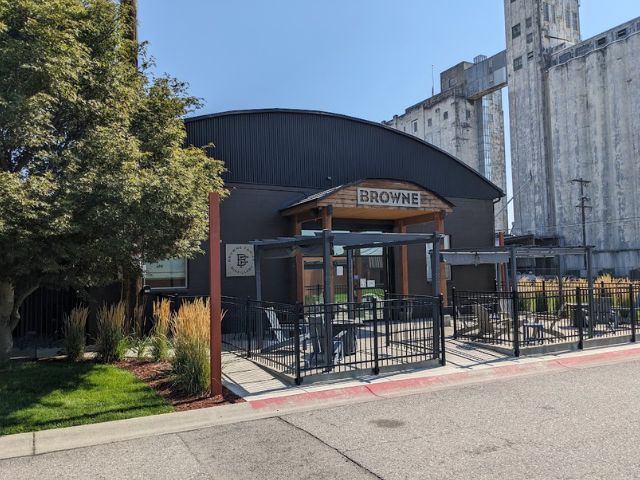
It was more of the same, got up to Bigs Junction right at the Columbia River and I expected to start seeing evergreen trees. No, no, no, lots of brown cliff sides grasslands and basically I 84 just jets along right alongside the Columbia River. So it was scenic, but it was not the scenery I was really expecting in Washington state. And my next move was to go up from I 84 to 82 and then across on US 3 95 because there's not an interstate highway that goes directly to Spokane now, brown family Spirits is actually over on the east side of Spokane. So I took a little side road to get over there and boy, you can't miss the place. There is this huge grain mill and when I'm talking about a huge grain mill, this thing is this dwarfs the distillery. It is just absolutely massive.
(04:06):
So I pulled over onto a side street and then David Dard actually came out, he's the general manager and greeted me in the street. We walked into the distillery, got a chance to meet the team. Now the master distiller, Aaron Klein Helter was not there on that particular day and I knew that in advance and said we would do a Zoom recording once I got back home. And so I got a chance to actually learn some from David who puts together their cocktail menus. And then he took me through a guided tasting and I was just absolutely amazed by some of the flavors that I was getting. So we're going to talk about that a little bit here in this interview episode. And thank you to Becky Garrison. She was a guest on the Whiskey Lore podcast, our interviews series back in episode number one 16.
(04:58):
I was saying I'd love to go to a Washington State distillery, but one that is on the eastern side of the state and she said this was one I definitely wanted to check out, so let's get right into it. I had a conversation with Aaron over Zoom and he was actually nice enough to send me some samples as well. And so I'm going to actually do a little tasting of one of the very interesting spirits that he sent me after we get through the interview, so stay tuned for that. But I wanted to start off our conversation by talking a little bit about that transition. Aaron was actually with the previous owners, and so I wanted to have him guide us through the background on the distillery.
Aaron (05:39):
So it used to be Warrior Distillery and that was owned by Rich and Mary Clemson. They owned previously a pasta business and did fairly well in that business and when they decided to sell it off, they started Warrior and that's kind of how started this distillery. And then in 2021 Precept Brands, which we are one of the brands under the Precept Brown, bought the facility and since 2021 we have been pushing along making brown family spirits.
Drew (06:11):
Okay, so about what time did you get involved Right from the beginning?
Aaron (06:15):
I joined Warrior in 2020. Brown was purchased the facility in 2021, and since 2021 I've been with Brown. So it's been about five years now I think.
Drew (06:26):
So interesting to have that changeover in ownership, but you still have all these spirits kind of nice for Brown to be able to come in and already have a supply of spirits to go and a distiller who already knew the processes that you were going through at that point. Was that part of what drew them to purchase that distillery?
Aaron (06:46):
I would say I was an asset in some context. Being from Kentucky and having a pretty extensive background in distillation, Washington has distilleries but not a plethora of distillers such as Kentucky. And it was a little bit of a shift going from this very small intimate family owned distillery to now having to learn and navigate this corporate infrastructure and how a lot of unknowns of how they would manage, what would it be shifting or changing. But honestly, it's been terrific. Brown has been a great company to work for. They've really taken the product and the name to another level, so we're constantly advancing and trying new products and I still get a lot of ability to experiment with flavor profiles and mash bills and you don't always get that in a corporate environment, so being able to maintain that has been very beneficial for sure.
Drew (07:53):
When you first heard that they were interested, did you go Brown Family winery or vineyards? Am I going to be making brandy all of a sudden?
Aaron (08:02):
No, no, no. But it was pretty interesting. I had gone all the way back to Kentucky, packed up a U-Haul. The remainder of my stuff drove all the way back to Washington and I think not two days from being back in Washington. The original owner is Rich and Mary were like, whoa, we sold the company. So
Drew (08:21):
Wow.
Aaron (08:22):
It was a little nerve wracking. I've never really gone for the large corporate infrastructure. I've always gravitated towards more family owned or smaller intimate distilleries. Previously I worked for Jeff the Creed, another family owned distillery, significantly larger than we are here at Brown as far as processing ability. And then prior to that I was at Kentucky Artisan, so another very small intimate distillery. So that's kind of what I've always gone for. I like the functionality of it. So going from that to Brown was a little bit of a shift, but it ended up being a good one.
Drew (09:01):
So what was being made for Warrior Distillery when you first came on board?
Aaron (09:07):
When Warrior wasn't function, we did a lot of flavored spirits. I think we had probably 30 different flavored spirits and that seemed to be what the demographic of Washington really kind of gravitated towards and we kind of continued that on into Brown. But we do a lot more what I call sophisticated and artisanal flavor profiles. Some of 'em we do use flavoring just for consistency and ease of use, but then we do have products like our vanilla bean, our espresso, cold brew vodka, and our warm spice whiskey that we take the raw ingredients and we macerate it into the whiskey or the vodka to really give it this hands-on artisanal good quality flavor profile.
Drew (09:51):
When you first came to that, what was your feeling about what you could bring in terms of your Kentucky background that would be acceptable to the pallets that are in Washington state?
Aaron (10:06):
That's a good and very difficult question to kind of answer. I've been asked a lot in the past, what is Washington and what makes you different from Kentucky and all these things and how have you brought Kentucky to Washington? And the best way I can explain it is Kentucky is an epicenter. It's bourbon and it's tradition and all these things. So I wouldn't say I brought a flavor profile, but a technique of working and a knowledge of grain and how to utilize it based off the profiles that they offer to try to create what I think is an exceptional whiskey and provide exceptional whiskey for our brand.
Drew (10:49):
One of the things that I noticed when I was there was immense flavor. I was getting really interesting flavors out of all of the different whiskeys that I tried and very expressive. I mean, sometimes when I taste a Kentucky bourbon, I basically will go, alright, here's the four flavors I'm kind of pulling out of it here. I was stretching beyond. It was funny because I don't normally tend to sometimes put an exact one for one comparison of something, but I forget which whiskey it was, but I was tasting it and I was like, this is a baby Ruth. I mean it had this little chocolate note to it and it was the peanuts and that caramel coming through. And then the next one I tasted, I was like, well, this is a payday. And I was like, I can pull that flavor up from my memory. And I was trying to think what's the difference between a baby Ruth and the payday and it's basically one has chocolate, one doesn't. But what was amazing to me was that sometimes as I say, I'll sit down with a bourbon or a rye whiskey more so with bourbon and kind of go, okay, here's what I expect. Where do you think this growth of the flavor profile comes from? Is it coming from your cuts? Is it coming from the weather? Is it coming from the water? What could it be?
Aaron (12:11):
I think it's a little bit of everything. Honestly, to me, I think mainly it's going to be the grain that we source. We source from one farmer. Our grains are from an organic farm. He does all the milling for us, it's very fresh. We get it in weekly, ready to go. It is probably a combination of the climate that we get here in Eastern Washington. Totally different than Western Washington, totally different than Kentucky. Kentucky has a lot of obviously temperature fluctuations, high humidity. We're very pretty consistent and neutral. We go through very hot summer periods and then very, very cold winter periods, but we're not having those frequent, not as many frequent daily fluctuations that is really stressing those barrels out in a consistent pattern. And then obviously, yes, I do believe our distillation practices, we use a hybrid pot column, hybrid setup, so with a pot, obviously you have the potential to get more flavorful whiskeys than you would if you were using continuous system and we're having to make more precise cuts because we are using a batch system and we're going through the full spectrum of alcoholism, flavor components. So we try to be very consistent with our cuts. We know what to look for when we get into our tails, how far we want to go into our tails, so we're getting some of that body and depth from those high boilers and then keeping it consistent to try to maintain just the flavor profile that we have put out for people.
Drew (13:50):
One of the things that I think people just assume is that distillers are sitting in there all day just sipping whiskey and let's see, okay, it's going from heads to tails. Let me take a swig here and see how things are going. Do you use more watching maybe percentages as they go along is there's a smell you're looking for? Do you take little tastes here and there?
Aaron (14:14):
When we're making our cuts, we're watching basically three things. We're watching the temperature within the pot and up the column. We know exactly at what temperature the product's going to start coming over. Then once it starts coming over, we're doing that initial mostly smell test because we're getting those heads with the methanol, the ethyl acetate, the acetone, all those things that can make you sick or offer very unwanted flavor profile. And we're letting that product come over for a slightly determined period of time smelling and tasting through that until we determine that we're out of that head section in a safe manner. And we've now entered into our heart section, and then as we're going through the heart section, we're tasting a little bit but not as much. We know that we're in the good part and then we get into a certain temperature range and alcohol percentage that we know we're getting into our tails. We're consistent about smelling and tasting in that because we know that we're going to get a very vegetative and harsh flavor profile that we don't necessarily want in our flat finished product.
Drew (15:23):
Well, it's getting closer. My friends yesterday I spent six hours on the phone talking to 12 different distilleries in nine different states, talking to them about their distillery experiences because I'm working on a brand new book that is a travel guide to over 1000 whiskey distilleries across the United States. Now in the past it has been very hard to try to find out where distillery experiences are, and I've met so many great distillery owners and distillers and tour guides across the country. Finally, I'm going to put together something that's going to help you find these great distillery experiences as well. And in a couple of weeks I'm going to be opening up pre-orders for this book with a goal of having it out in the market by early December. I'll let you know as soon as the pre-order is ready, just in time for the holiday season, get ready for Whiskey Lord's Travel Guide to experiencing American whiskey. One of the things that we talked about earlier on was the fact that in Kentucky when you were there, when I went there early on, I was noticing that it was bourbon and rye. So now you're coming up to a state where there's a lot of distilleries that make single malt, you're making a single malt now and you're actually doing an on grain single malt. Was that something that you brought about when you started working there or was that something that was already being produced?
Aaron (17:01):
When we were a warrior, we were doing single malt off grain. We were using the lauter ton to filter off the wart and then we would ferment with just the liquid. Since then, we have switched to fermenting on the grain, and there's a couple reasons I would say I personally like the interaction of the yeast with the physical grain itself. Again, this is probably one of those topics where you could talk to many distillers and they're all going to have their own opinions, but even when we made a few rounds of single malt when I was at Jeff the Creed and it was on the grain as well, so it's not uncommon or taboo I would say, but it's trying something new and maybe not traditional and seeing what you get out of it and really setting yourself differently than maybe other producers or distillers. One thing that I'm just really big about here at this facility is experimental mash bills and what can I attain? I don't know if David allowed you to taste some of our farm theories with the colorful barrels. I hope he did.
Drew (18:08):
Oh, I didn't get a chance. No.
Aaron (18:10):
But I really like to do, every year I do two new mash bills with hopefully Washington Source materials only. So I've done a hybrid sweet potato whiskey, even though it's not technically a whiskey, but it incorporates, we processed for eight hours here at the distillery, 500 pounds of sweet potatoes, and then we incorporated that with certain percentages of grain and then fermented that altogether to feel like what flavor profile could we achieve that way? We just recently did one that I called summer days where we went to a local orchard and harvested 400 pounds of peaches and we did peaches with some wheat and roasted oats just to create something completely unique and different that I think people out there are looking for something very creative. The bourbon's still king, it seems like, but they were going to get to a point where people want maybe. So how do we achieve that? Well, you got to roll the dice and try for new things.
Drew (19:19):
I was going to say sweet potatoes is really interesting. I don't think I've ever heard anybody doing sweet potatoes, regular potatoes, yes, but
Aaron (19:25):
It's terrific and I don't honestly don't even know how to describe the flavor profile of it. It is very sweet. Almost like the way I can express it is those little chalky candies that came in those little tubes. But it's got this just super unique profile that I've never experienced with any other whiskeys. So I'm excited to see how they evolve over time. And if people like 'em,
Drew (19:52):
Will those end up being distillery exclusives?
Aaron (19:54):
They will be a spirit club and tasting room exclusive products initially.
Drew (20:00):
Okay. What is Spirit Club?
Aaron (20:02):
Spirit Club? It's kind of like a wine club that we offer here at the distillery where we offer either exclusive products or seasonal products to these members on a first come basis throughout the year. They also get some benefits within the tasting room as far as some mild discounts and things of such.
Drew (20:26):
You have three different labels, monogram collection First Look and Lab series. Are those steady product lines for you and what's the difference between each?
Aaron (20:36):
They are. Our monogram is going to be our top tier. Our first look reserve is going to be the one right below that. And then lab series monogram is going to be our cast strength. We have a cast drink rye, the Distillers rye cast drink single malt, which is our bitner, and then we do one called the A TB, which is our Cabernet barrel finished bourbon where we actually get the Cabernet barrels from one of our wineries and kind of marry the wine side of the business whiskey side of it to create this profile. Below that is the reserve that is just going to be our single mall. It's our rye whiskey and our bourbon and the five to six year age statement range. That's just some of our older juice as of now. And then obviously we have our wholesale variety, which is going to be in the four to five year age range.
(21:24):
So the reserve offers a little bit slightly different flavor profile and longer age. The wholesale market's going to be a little below that. And then the lab series is kind of just experimental flavor profiles such as our cold brew vodka, our vanilla bee, and our warm spice lemon huckleberry. And we do these a couple times a year kind of based on season fall and winter. We try to offer more of a whiskey based flavor profile because winter kind of pairs well with whiskey and dark spirits. And then the summer we'll maybe do like a gin or a vodka that way it goes well with the warmer months
Drew (22:11):
When you are talking to somebody and you want to maybe point out one that you really should try. When you come here, do you have a favorite? They're all your babies, but is there one that stands out that you go, yeah, this is the one that I want people to experience?
Aaron (22:26):
Yeah, there is. It's not even the released ones though. It's all the farm series. They all have unique stories and the flavor profiles are you're never going to taste anything like 'em. I'm willing to bet my job on it. It got to such a point where I was tasting people so much with it. I had to basically lock the barrel down from myself and put a sign on it that said out of order and put a wood bun in there instead of a rubber one because it would keep me from getting in it. But yeah, we have one called special G 100. It is a hundred percent malted rive from our local malt house here in Spokane Valley. They had this grain. I was approached by my rep, he's like, we just did this. It was kind of an experimental one, but it's pretty unique like you to try it. And I got love it. I'm like, man, this is really, really nice. But coming off the still it worried me because, and nobody will understand this, but the smell off the still the new make smelled like you took a hospital and you took all the hospital equipment, the rubber gloves, all these things, and you squeezed it into this liquid. And it was a very medicinal and pharmaceutical, it was very odd. I'm like, well, there's thousands of dollars I just wasted.
(23:52):
But by surprise, I put it in the barrel of Char four Kelvin and it's just evolved so great. It is super dark chocolate notes coffee, it's bitter, it's full body. It lingers on the palette and it's so good. So that one. And then we did a hawkin heirloom varietal green corn bourbon where I had a farmer in Washington grow me a couple acres of heirloom bridal green corn, and I made a bourbon out of that with some specialty grains. And so these two, they've not been released, but they willed this month actually. So if anybody wants to try to get a bottle, it's going to be very limited. Cast strength went in at a lower strength into the cast, and that way I was, for several reasons, you can achieve the extraction of different sugars at a lower cast strength. And I wanted more of the barrel contact to be with the finished spirit instead of diluting it down. So we'll have a very limited number of these bottles probably in the range of 30 to 50 cases. So if you can get your hands on one, I highly suggest it.
Drew (25:05):
Very nice. So when can people come out and do tours of the distillery?
Aaron (25:10):
We are available. We don't technically do tours on a paid service or anything of that nature. It's not something that we really promote, but if you want to come in and you're just curious about the process and want to see the facility, I'll geek out with you, walk you around, I'll let you stick your hand in the mash and taste it. All the things. I'll thoroughly enjoy that. I think it's great for people to be knowledgeable about the process and how we do things. So if that's something that anyone ever wants, come down and we'll do it.
Drew (25:46):
Okay. And you have a cocktail tasting area there as well with a bunch of original cocktails there, as I understand.
Aaron (25:54):
We do. We do. Our tasting room manager, David, is terrific. We just got voted recently, got a silver for best cocktails at our facilities. But David's coming up with these new flavor profiles for these cocktails yearly every season he's putting out something new, obviously we're into fall, so he was playing around with a pumpkin and martini and these other very cool expressions that are all terrific. We offer our full lineup of spirits. And then we also offer our variety of our wines that we produce as well. So we have quite a bit to give people.
Drew (26:35):
Was it as shocking to you to see Eastern Washington when we get this Seattle view of evergreen and damp climate? Was it a shock to you initially when you got there first time?
Aaron (26:49):
Oh, for sure. When I applied for the position and the old owners wanted to meet, I came out to the facility to meet them and see the facility. I didn't even know where Spokane was. Never lived outside of Kentucky, didn't know where Spokane was. It's very unique. Washington's great and its bordering states are terrific. We have mountains and we have five ski resorts within two hours of us. So I do a lot of backpacking, a lot of skiing in the winter, a lot of snowshoeing. I picked up paragliding when I moved here, so I got all these hobbies. This year has been a lot of fly fishing, going over to Idaho. I've met some people that get into fly fishing, so we do that. It's got a lot to offer. Kentucky's great in its own way, but it's flat and tree and hot and humid. So Watson kind of provides me all these nice luxuries for the hobbies I like. So yeah, stay very busy. We got Coeur d'Alene, which is a very well-known area just across the border into Idaho. It's beautiful, beautiful lake, great restaurants. You got Leavenworth three hours away, which is a little Bavarian town that's super popular and it holds the Enchantments, which is one of the most popular trail systems in the us. There's all kinds of
Drew (28:13):
Things. It's great. Well, Aaron, thank you so much for walking me through the, it was great tasting your spirits and getting a feel for the area, and I appreciate your time and best of luck moving forward.
Aaron (28:26):
Thank you.
Drew (28:28):
Cheers.
Aaron (28:28):
Cheers.
Drew (28:29):
And as promised, I want to do a little tasting of this specialty spirit. It is not a whiskey, but it is classified as a specialty spirit because a sweet potato is not a grain, so it cannot be referred to as a whiskey. However, it is very whiskey. And this idea of doing sweet potatoes as a spirit I've heard of using potatoes, they do that over in Ireland a lot. It's used a lot for making vodka, but making a aged spirit out of sweet potatoes. And so I was really curious when I opened this up. And the nose is not disappointing at all. It is not what you would think it would be though. It does not remind me of sweet potatoes at all. In fact, what I get on the nose, it's much more of like a minty herbally note as well as, and it took me a moment to really pull this out.
(29:25):
It was such a familiar smell to me. But it smells like my dad's Williamsburg orange cake. It's got some of this vanilla frosting note to it. It's got citrus notes coming through orange and lemon. It's got a little bit of nuttiness. I almost get an amaretto kind of a nose off of this thing. And then the taste goes through phases. This is where I actually do get the sweet potato just a little bit, but then it goes into this herbally thing. It's just crazy. It's botanicals herbally, some of that citrus comes back in and then the flavor just keeps evolving until you get to the finish. And it's a long finish. And it is the sweet potato actually showing back up at the end. So everything that I'm tasting there is bringing me a lot more than just a flavor or two. So if you are in Eastern Washington Spokane region, I would highly recommend checking out brown family spirits.
(30:28):
Alright, we're going to move on to our next location. I'm actually just going to hop across the border. It's not that far away to get to. In fact, I'm not even going to go back to the freeway on my way to a distillery in northern Idaho in the panhandle that is also kind of going off the standard whiskey distillery page in using honey. And so we'll find out more about that coming up next week. I'm your host, drew ish. Thanks for joining me. And until next time, cheers and Slava for transcription travel information, including maps, distillery planning information and more. Head to whiskey lord.org/flights. Whiskey lords of production of Travel fuels Life, LLC.
About Browne Family Spirits Tasting Room & Distillery
Tours available.
Other tasting room locations:
Walla Walla 31 E Main St. Walla Walla, Wa 99362
Bellevue 10245 Main St Unit 103. Bellevue, Wa 98004
Seattle 413 1st Ave S. Seattle, Wa 98104
Tacoma 2508 N. Proctor st. Suite B. Tacoma, Wa 98406
Take a Whisky Flight to Browne Family Spirits Tasting Room & Distillery
Map to Distillery
Note: This distillery information is provided “as is” and is intended for initial research only. Be aware, offerings change without notice and distilleries periodically shut down or suspend services. Always use the distillery’s websites to get the most detailed and up-to-date information. Your due diligence will ensure the smoothest experience possible.