
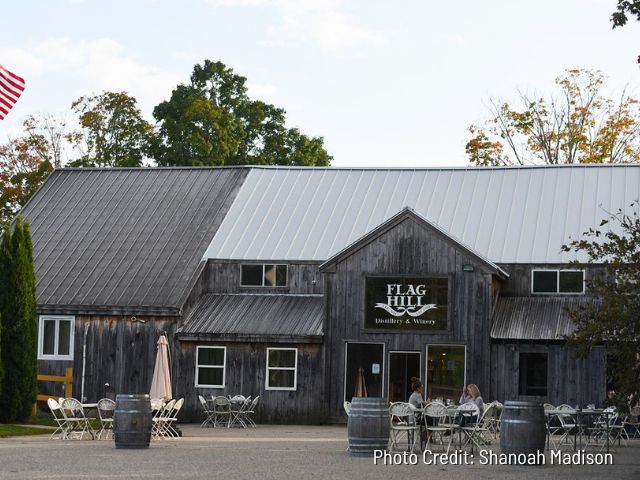
Flag Hill Distillery
Wish List (Log in)
Drew (00:08):
Welcome to Whiskey Lores Whiskey Flights, your weekly home for discovering great craft distillery experiences around the globe. I'm your travel guide Drew Hanish, the Amazon bestselling author of experiencing Kentucky Bourbon Whiskey lore volume one where I bust 24 of Whiskey's biggest myths, and the book that is going to change distillery travel habits across the United States in 2026. Whiskey LO's Travel Guide to Experiencing American Whiskey, which will be on sale on Amazon and through your favorite online book sellers on January 13th, and you may even find it out at your favorite distillery. Just got a couple more distilleries left on this northeastern swing of the great 48 tour before I head back down into New York and Ohio, and I've filled up on plenty of clam strips. I definitely will be missing them though as I leave this area. Also, I've done a really good job of avoiding toll roads.
(01:06):
It can be done, although I will say New Hampshire I 95 is a toll road, and so you end up finding a lot of back road time to get through there, but some beautiful scenery and I really have to highly recommend the idea of getting off the beaten path a little bit and checking out the back country of New England, especially in October when these colors are just absolutely incredible. I'm about to head towards my northern most point on this trip, quiche Vermont. That'll be tomorrow, but today it is absolutely sunny. Beautiful. I decided since I was a little bit early getting into Flag Hill Winery and distillery that I was going to maybe drive through the campus of the University of New Hampshire. It's pretty looking at campuses in the fall and seeing all the activity, although I will say it was probably uneventful and kind of annoying to have to drive 20 miles an hour through the whole thing and then drive the same route back out.
(02:14):
But it was fine. Definitely something to see. And then I drove down State Road 1 55 through the back country to get to Flag Hill. You see a row of trees as you arrive, you could see the vineyards off in the distance. I wanted to take some pictures actually of the entrance for the book experiencing American whiskey. And so that will be profiled on the New Hampshire page. And I also saw some construction going on, so I will have questions about what is going on there. It looks suspiciously like a new still house. Once I got inside the building, I met with David Brulin who said he would go track down Brian Ferguson, the owner for interview. And while he was off doing his search, I decided to look around the gift shop. I was looking and seeing the big event space that they have. I was eavesdropping a little bit on a couple who were doing a tasting in the tasting area.
(03:14):
They were sampling wine, and as I peeked at the shelves, I saw they had a single barrel, 18-year-old brandy. They also had rye weeded bourbon, American single malt Le Coors, a bunch of white wine and something called heavy rum. So I have lots of questions to ask. As Brian arrived, we went back into one of their back rooms, and you could tell they do weddings around this place because this room looked like it was perfect for bride and bridesmaids to do their prepping for the ceremony, all joined around a table. And I want to start off by asking Brian to give us a little bit of the backstory on how he, as a Pennsylvanian found his way first down to the islands in the Caribbean to do distilling and then back up to New Hampshire where suddenly he now owns a winery and distillery
Brian (04:13):
Am originally from a little town you've never heard of called Athens, Pennsylvania. It's in the middle of nowhere. Great place, just very small. And I had been making beer and wine when I was probably too young to be making beer and wine legally, having a whole lot of fun doing it.
(04:33):
And then I started working for Finger Lakes Distilling in upstate New York. I was in college at the time knowing that I was going to be well. I actually thought I was going to be a brewer when I went to college. That was my plan, was to open up a brewery. And my freshman year decided I wanted to be a distiller instead. Spent most of my weekends driving home to a place in, I grew up in Pennsylvania. And then from there it was another hour drive to Finger Lakes distilling worked for them for a while as their assistant distiller moved to Grand Cayman. I was the head distiller for Cayman Spirits Company for about a year, and then took this job here in Lee New Hampshire for a fly kill distillery.
Drew (05:12):
Talk about a yo-yo job back and forth. So what were you making in the Caymans
Brian (05:18):
Rum?
Drew (05:19):
Rum, okay.
Brian (05:20):
Yeah, making rum down there. It was a great opportunity. I just didn't like the heat, honestly. Living on an island is cool for about a month. And then after that I was like, all right,
Drew (05:31):
I was going to say you're down there with all the illicit funds.
Brian (05:34):
Yeah,
Drew (05:36):
All the big
Brian (05:36):
Bankers. Unfortunately, I didn't get any of those to bring back with me, but it would've been nice. It would've made the next stage easier. But then when I moved back here, well, I moved back to the US with my wife, and we were just trying to get, I didn't intend to stay at Flag Hill for a very long time. My plan was just to get back in the US someplace within driving distance where we grew up. And then after a year or so of working here, I had told the prior owner that I was starting a distillery in Pennsylvania with a partner, and I was basically giving him a two years notice. And he was like, don't do that. Buy this place instead. So that's a very long story I won't get into. But basically in 2015, my wife and I purchased fly Kill Distillery, and then we started retooling. We have a winery here as well. We started retooling the winery to make wines that we wanted to make, and we started focusing our whiskey production in the direction that I thought it should go, which was predominantly focused on a lot of different bourbons. That was an element of it.
(06:41):
But the other big thing is I had learned through prior experience that anything, whether it's cooking, whether it's wine, really wine showed me this more than anything. You can only make a product as good as the ingredients that you start with. You can't make something better than the sum of the parts, essentially. So we started growing grain here with the idea that we were going to grow grains, unlike a traditional farmer would grow grains. If you are typical Midwestern corn farmer, you're going to make on a good year, 400, 4 50 bucks a ton. And so you're really worried about yield. That's your primary concern. The finer points of quality don't matter as much, as long as your don's numbers are not over 1% because the grain elevator's not going to dock you. So they are not incentivized on such a low margin product to put a lot of energy into things that'll produce higher quality. So that applies in general, most commodity farmers, and there's nothing wrong with that. That's what the market is. But we make decisions here that may result in us spending an extra 400 to a thousand dollars or more per acre
Brian (08:00):
To
Brian (08:01):
Grow that corn. And if I was selling it for 450 bucks a ton on a good year, I'd be out of business pretty quick. But the benefit is we get to turn a ton of corn into a little over $7,000 in whiskey. So the math is different for us. So we really focused in on making the best whiskeys we could by starting with the best ingredients that we could.
Drew (08:27):
So you've come into a vineyard and you're now going to start growing grain in there, but it was a dairy farm originally. Were they growing anything here that you know of previous to the owners that came in or,
Brian (08:41):
Yeah, so predominantly hay. They did have hay fields here, all what we call the ag fields that we grow all of our grain on currently. A lot of those were hay for a lot of years pasture for dairy cattle. And I do believe that there was some cycling of other grain crops in there, probably, I don't know this for certain, but I would assume for silage, silage feed. And what I would say is that the soils, because it had been a dairy for so long, were very rich, and they'd only been hayed. So they were very, very rich when we started out. And then we got a couple freebie years in the beginning because the soils were so rich, and then we made the decision to switch over to no-till. And it took us a couple years of figuring out, and now that we've figured out no-till, our quality overall is exceptional.
Drew (09:38):
So explain.
Brian (09:39):
So one of the big things with no-till is that we are like, it sounds, we're not tilling the soil and the value to this. There's a lot of different values and there's some drawbacks, but I don't want to make it sound like it's all roses, but one of the big values is you're leaving all the roots that are in the ground, in place, all that structure, and that is feeding all those microorganisms that live in the soil
Brian (10:05):
And
Brian (10:05):
All those microorganisms are very, very, very important. So if you were to walk out in our fields, you could probably do it today. You'll just see an unbelievable amount of life on top of the soil, in the soil. There's just life everywhere. And that means that we have a lot of diversity of species, and that means there's a lot of diversity of microbiology, which means that we have a lot of cool chemistry happening in the soil that results in the better ability to grow things. So that's kind of one thing. Then there's a bunch of other things. There's drought tolerance that you pick up from soil structures that you pick up. You get benefit in your soil structure, organic matter increases. There's all these things. There's one other element to this, which is we use diversified cover crops in between, and that also makes a difference. So it's the agronomic system that we use is, I don't want to call it complex, not really that it's that complex, but it's very different from traditional farming. And those things all lead to higher soil qualities, which lead to higher grain qualities, which lead to higher whiskey qualities.
Drew (11:22):
How did you get into, because now you've gone from distiller to having to manage a farm really
Brian (11:29):
Well, I'm not a farmer. I don't do any of that. We have farmers. Okay, you keep
Drew (11:35):
Hands off, but you keep close contact with them in terms of
Brian (11:39):
Yeah, so he can drive a tractor.
Drew (11:42):
Okay, what can I grow? What should we be growing? That kind of thing
Brian (11:47):
To kind
Drew (11:47):
Of get a feel.
Brian (11:48):
So our vineyard manager has an agricultural background and understands a lot of these things. And we got lucky that our vineyard manager was able to step into growing our grains, and he does a great job, really understands what we're doing and what we're trying to accomplish. And the general gist of it is we focus on a couple things. We're focusing on soil quality, which helps, like I was saying. And then the other thing that we're doing is we're trying to avoid, this is not a, what I'm about to say, I'm not saying because I have a strong opinion against pesticides or fungicides, any one direction. But here's what I do know, that yeast are fungus and fungicides and fungus don't go well together. So what we do is we rotate our crops on a three-year cycle. Again, this is a little more expensive to do. It doesn't really, you got to have more land, you get less yield, all these things that go along with this. But because we don't ever have, we break the life cycles of these molds and fungis, we don't ever have to spray our grain, which means that we have no downward pressure, no residual downward pressure whatsoever on the fermentation, which results in higher quality whiskey. Again, higher quality whiskeys
Drew (13:05):
Not
Brian (13:05):
A statement of whether these things are good or bad, just in general.
Drew (13:09):
You got to work in your ecosystem
Brian (13:11):
And just in general, again, if you get a little bit of residual fungicide on a rye grain,
Brian (13:20):
It
Brian (13:21):
Could potentially stress out yeasts ever so slightly in ways you may not even notice. But that's going to cause a decrease in quality. So by being able to have complete control over the agricultural system that produces the feedstock, the grain for our whiskey, we can then control the output quality of the whiskey better.
Drew (13:46):
Yeah. Let's get into this a little bit because it is fascinating to me. I was talking about the fact that I had gone to Newfoundland and they talked about finding grapevines, and I'm going, Newfoundland, how are they growing grapes in Newfoundland? I wouldn't think of that as being a place where they, and I believe that's what historians kind of talk about as well, is that how far did they go south? Obviously they're probably not finding a lot up there, but it gets to that question of growing grapes in New Hampshire. It's not a place that we would think normally that a grape would grow, because when you talk about the scotch whiskey industry, they go, well, they couldn't grow grapes up there, so they were growing them, so they were using grain instead. So how do you get a grape to grow in New Hampshire?
Brian (14:38):
Yeah, so it's referred to in the wine industry as cold climate fruit and cold climate fruit is not all, but a lot of it is hybrid varietals. These hybrid are vitus, veniro, the one, the grapes that you're familiar with, Riesling, pinot noir, Merlott cab Franc, CAPSA, et cetera, et cetera, et cetera. So the ones that you're familiar with, crossbred with Native American varietals like vi labrusca, vitus ripa. And what we get out of that is grapes that have great wine making characteristics, great profiles to make wine with, but they are much more cold, tolerant and much more tolerant to disease and things of that nature in general. So if we were growing Riesling here, we would be spraying the fruit every three to seven days roughly, to keep healthy fruit throughout the season. And with the Native American grapes, these hybrid grapes that are crossbred with Vera, we're able to oftentimes spray five times a year. So it really reduces the requirements for what it takes to, they're just, they're more hearty. They're more tolerant.
(15:56):
And what you get when you cross breeded these other things. So the other thing you get that's kind of interesting is you get higher acids, again, building blocks for aromatic compounds, these precursor aromatic compounds, and then you also get on the red wine side. It's a struggle. It's not necessarily, we are not a good red wine region. To be very clear. There's proteins that develop in the grape skins, and those proteins are, they really love the tannins that are in the grape skins. And as they start to bind together, the way I describe it though, this isn't what's actually happening. It has to do with charge. But I tell people just so it's simple, basically these units, these bound proteins and short-chain tannic acids are becoming too heavy for the chemical matrices that they're wrapped inside of,
Brian (16:47):
And
Brian (16:48):
Then they precipitate. So day one, we have really tannic red wines, but by day 30, those tannins is the bottom of the tank predominantly and
Drew (16:56):
In
Brian (16:57):
The wine solution anymore. So we're not a red wine region, but when it comes to white wines, we have this unbelievable ability to make these really intensely aromatic whites that are just so pretty on the nose. Lo crescent, I can sit next to it for an hour and not even taste it. I can just smell it. It's just so pretty. So there's some really, really cool wines that come out of the northeast or northern climates in general. And a lot of California winemakers and northwestern winemakers have started playing around a little bit with some of these hybrid grapes because there's so many interesting flavors inside of them. You could do so much with them, the negative bean, the acid. So a lot of our wines wind up off dry to semi-sweet, somewhere in that range. It can be challenging in the northeast to make a completely dry wine that maintains all those aromatic properties.
Drew (17:47):
Yeah, I'm guessing your growing season is a lot shorter.
Brian (17:50):
Not really. Our growing season's about the same as is it most regions. So one of the other things, and I know this is a whiskey podcast, and we're off into the wine.
Drew (17:59):
I know, but we talk whiskey every week. So it's kind of fun to talk about brandy a
Brian (18:03):
Little. So one of the other things that really benefits us, so this is something that people don't think about, but how you harvest your gray, that was arguably one of the most important moments is harvest.
(18:15):
And we have plenty of growing degree days. We get the fruit, plenty mature. In fact, we had fruit this year that was 25 bricks coming through the door. It stops making sugar, the fruit stops making sugar at 22 or 23, I can never remember the number, but 22 to 23 bricks. So we're two to three bricks higher than what the fruit naturally makes. So of course, you can get totally mature fruit. It has nothing to do with the growings length of season. The benefit that we have being in the Northeast is if you are in New England listening to this, everyone in New England knows what it's like to wake up on a September morning and at 3, 4, 5 o'clock in the morning, you need a hoodie on or a jacket because it's 40 degrees out. And then September 15th, noon or one, it's 80 degrees out. And this could not be a more perfect scenario for maturing the fruit and then being able to go pick that fruit. We usually start around three to four in the morning, depending on the day, and we're usually done between seven and 8:00 AM as the sun comes up and it starts to get on that fruit we're done picking for the day, we've got that fruit at the coldest part of the morning,
(19:21):
And it's just basic chemistry, like the less heat energy and solution, the lower the probability of a chemical reaction, the lower the probability of a chemical reaction, the high probability that we keep those aromatics in the wine.
Drew (19:35):
Yeah. How's the shift been from going from, would you say that this distillery slash winery is predominantly one or the other, or kind of a blend of both?
Brian (19:50):
As of right now, it depends on how you measure it. By volume or by revenue. True.
Drew (19:56):
Yeah. Okay. I mean, what do people discovering when they come up here? Are you mostly getting the wine crowd and then they're discovering the whiskeys while
Brian (20:05):
They're, so it's very interesting. I actually should let David talk about this because he spends, up until very recently, he spends
David (20:11):
Much more time in the tasting room than I do. Yeah, well, so I think it also depends where you're talking about. So the experience I get when you're in our tasting room is that most people that come here are coming for a wine tasting. And I think part of that is a couple things. The first thing is that I just think the idea of a wine tasting is more culturally common with people's mind as opposed to let's go somewhere and sip some different spirits.
(20:41):
And that behavior is predominantly driven by women. And in general, it is women that come in here and they're looking for wine. That doesn't mean that there aren't women that come in, say, pour me all the whiskeys, or men that come in and say, pour me all the wines. It's just the dominant thing. And so for people that come in, we often get the reaction, oh, we want to do a wine tasting. Oh, you do spirits. But the opposite happens in a weird way where people come in for a wine tasting and they look at, say, one of our laurs, certainly our whiskeys, and they say, wait a minute, you make that because they didn't come to Flag Hill to learn and try our products
(21:24):
They had at a restaurant, they saw, oh, there's a local whiskey. I like whiskey. Let me try the whiskey. And they don't even put two and two together. They don't really think about it in the same way that people think about the winery side of things. We also do a lot of weddings and events. So we have a lot of people as well that come in who say, oh, yeah, I came here five years ago. I didn't even know you guys actually produced wines and spirits. So we do a lot of different things here, and they all kind of feed into each other. And that's, I think, I'm sure Brian could say is they feed into each other in a weird way. So it's hard to know. But I do think we're probably more widely known around the state as a distillery for people that are into that. But in terms of coming to Flag Hill, it's mostly winery, and it's kind of interesting that way. Yeah, I agree with that. I've never had someone walk in and go, oh, you make that wine here. It's always the like, wait a minute, we have that liquor on our shelf at home. It was given to us as a gift or something like that. So it's really funny.
Brian (22:19):
Yeah, I would agree with that. We started as a winery originally, so it was a challenge for us to separate brand from the winery in a sense. So there's been a lot of years of talk here on site of how do we make sure that the spirit side of what we do is more prevalent, more known, and we're actually in the process of building a new distillery building. And when that building is complete and open to the public, which hopefully will be in January of 2026, when that's open to the public, it will be signed and look like a distillery building. So there's big traditional big windows. There'll be still in the windows, things that scream distillery, which will help drastically in the amount of people driving by going, oh, that is a distillery. Which has been a kind of an uphill battle for us in New Hampshire, which it still seems shocking to me. We've been in business as a distillery for over 20 years, and to still have people who are basically neighbors not know that we make
Drew (23:28):
Whiskey,
Brian (23:29):
Great whiskey, not just whiskey, we make really exceptional whiskey. Anytime we send it out anywhere. It does very, very, very well. And it's kind of like you don't know. I'm sure the people that live in Rome don't go visit the Vatican very,
Drew (23:45):
Right? Yeah. So I think my biggest confusion coming in the door would be if I have an interest in wine, but I also have an interest in spirits, what am I going to taste? Because do you have people crossing over? Do you
Brian (23:58):
Do
Drew (23:58):
Something for people to be able to, because when I go for wine tasting, usually they're sitting up three or four different wines for me to go through in a progressive tasting. And I'm thinking, how do you go in a progressive tasting from wine to whiskey or whiskey to wine?
Brian (24:14):
Basically, the way our laws work, they're different in New Hampshire for spirits than they are for the winery. So being both, we have to merge the two. The way we do that is we allow for five tastings, they can choose any combination of five, three wines, two spirits, all spirits, no wines, whatever they want to do. And then typically we go dry wine to sweet wine, and then spirits, we go vodka whiskey, things like that into L Cares. And usually if somebody has gin, I typically pour that last because gin is gin and it'll ruin everything
David (24:54):
Else for the rest of the day. I mean, it's really nice, but you don't want those hints of juniper when you move on to something else.
Brian (25:01):
A single mountain juniper don't go super well together, in my
Drew (25:04):
Opinion.
Brian (25:04):
Yeah.
Drew (25:05):
So what are you making in terms of what's kind the progression of what you started making here for whiskey?
Brian (25:10):
Yeah, so we started originally here. We started making vodka that was like every distillery, vodka, gin, cordials, brandies that we were aging when I got here in 2013, we started making rum and whiskey, and we have some really, really cool old rums that we call them rum for whiskey folk.
Brian (25:32):
So
Brian (25:33):
It took some things I learned in the Caribbean. So we've kind of created a hybridized wondering process here. So instead of taking spent stillage and letting it essentially rock in the hot Jamaican sun for six months, and what you're doing there is you, you're building up tons and tons and tons of diversity in gram-positive bacteria that you then add back to subsequent fermentations, and then you create all these funky, unique flavors.
Drew (26:03):
It's almost a weird sour mashing over time.
Brian (26:07):
Yeah, exactly. It's like a really long drawn out sour mashing. And so the rum that comes from that, and the way we distill it, we do a double pot distillation with it, and it tastes not when it comes off the still, but when it comes out of the barrel, it has very single multi type characteristics, I guess.
David (26:28):
Yeah. Almost like a sherry finished wine finish. It has a little bit of raisiny notes and some of those gingery spice notes.
Brian (26:39):
Yeah, it's like free
David (26:41):
Spice. Also why I taste in, I think it's like a Sherry finish scotch kind of
Brian (26:45):
Reminds me like highland single like sherry finish,
David (26:49):
But not the really rich fruit versions. Correct, correct.
Brian (26:54):
And then we make some cordials. We make a gin from apples. The gin has done really, really well. It's in between London Dry and the newer botanical style gins. It's like a marriage of those two concepts. And then what we really are into and what we spend a lot of our time focused on is our whiskey whiskey production. We make a lot of different whiskeys, bourbon, rye, wheat, wheated, bourbon, single malt. We make up an Irish style pot, still whiskey, although that's not on the shelf yet. And then we have a flavored whiskey called Maple Bourbon, and that's a crowd pleaser and we sell a lot of that. That helps keep the lights on so we can do a lot of the other fun stuff. And then we make some older whiskeys. We've got a 10-year-old bourbon though, we're out of stock currently. And then we're releasing an 11-year-old rye whiskey in the next probably a couple months. And then we have another thing that we just released, which we call Breakfast bourbon, which again, creating a new category of spirits, but a good idea.
Drew (28:04):
I was going to say, we've had breakfast beers
Brian (28:06):
Before, so I guess we
Drew (28:07):
Just need to have a breakfast. So describe what makes it breakfast.
Brian (28:11):
So you should drink it in the morning. So one of the big things is we, there's kind of a couple elements to it, how we came to the name Breakfast Bourbon when we were trying to come up with unique concept for whiskey. And then just from brewing beer, I've made a beer in the past and I knew a lot about different brewing malts and kind what they do and what they lend to beer. So we played around with a mash bill and we wound up with something that had distillers malt, but it also had it's bourbon. So 71% corn,
David (28:51):
69, 60
Brian (28:52):
9% corn. It's over 50% corn. And then we have chocolate malt in it, and we have oats in it and oats and whiskey.
Drew (29:04):
That's where the breakfast is probably coming in.
Brian (29:06):
So that was the start of the thaw of the cutesy name for
Drew (29:11):
It.
Brian (29:12):
And oats add this creaminess to whiskey, which is really cool. If you've never had whiskey that have oats in 'em, it can really add a unique element to, especially in bourbon, in my opinion,
Drew (29:23):
Mouth feel, especially
Brian (29:24):
Just like this kind of creamy, it's hard to describe other than creamy, I guess the best descrip I've got for it. And what we did was when it first came off the still, it smells like if you grew up poor like I did, you'll know what this is. It smells like Reese's peanut butter puff cereal. Okay. When it comes off the still. And that coupled with it being made with oats, and we thought that Breakfast bourbon was a funny name for it. It also made the release party really easy. We had a brunch, probably never been to a brunch and bourbon party.
Drew (30:03):
Yeah, exactly.
Brian (30:05):
A lot of DDS that day. The whiskey itself is super, super unique and it has a lot of elements of bourbon, but it has a lot of these subtle, amazing cafe mocha latte
David (30:27):
Type. Oh yeah. Well, you get that little coffee chocolatey notes mixed with that change in the texture from the oats. So I have to clarify, I'm like, it's still a bourbon. People I think sometimes think I'm saying it's a coffee flavored
Brian (30:43):
Whiskey,
David (30:43):
And I'm like, it's still a bourbon. But within the context of the flavors of bourbon, it is a mocha latte. It has the cocoa espresso and then creamy latte
Brian (30:52):
Quality
David (30:52):
To
Brian (30:52):
It. It is a very unique whiskey since we have released it. I have drank way more often than I was drinking prior to us
Drew (31:01):
Releasing that. So it's a dangerous one to have around.
Brian (31:05):
Yeah, it's very, very fun. If you are a bourbon fan, I highly recommend trying it. It is just a fun, it's a fun whiskey. It's super, super
Drew (31:13):
Cool. So if somebody's coming to the area and they want to tour around the distillery, of course next year things may change a bit because you're going to have a bigger facility to show off any particular time of the year that's best to come out here. And what kind of things might people do as activities along with the visit out here?
Brian (31:38):
So January, come in January, not drinking in January. Snow the love of God. Okay, I see. Stop not drinking in January,
Drew (31:51):
Please. Or come by your supply in January.
Brian (31:54):
That's fine too. Save it for later too. That's for the rest of the year.
(31:57):
We talk about this all the time. If you're coming to New England or if you live in New England, every time of the year has its benefits. If you ski New Hampshire, skiing is phenomenal. So the winter is awesome, and you come up here on your way through, stop see us. We've got tiny homes. We call it River Crest Villas. You can stay on site with us on the farm, see what we're doing, have the full experience, do a tour tasting, get some food, have a great time. The spring is just beautiful here. We have a lot of fruit trees on the property in general. There's a lot of fruit trees in the area. It's just a gorgeous time of the year to see things come alive, especially if you live in a southern state where you are used to the status quo of the same kind of colors all year. Our spring greens here are just like Ireland, spring greens. It is really, really, really cool. And then in the summer, there's so many things that go on in the area. There's all kinds of festivals, and we've got a couple music venues in the area. Portsmouth is a very, very old town like Port Harbor
Brian (33:08):
Town,
Brian (33:09):
And it's unbelievable. In the summer, it's a great place to go visit. So if you came to see us, stayed with us for a night, go spend a little bit of time down there, go up and hike the white mountains. The white mountains are over 4,000 feet with a lot of 'em having 25 to 3000 foot of elevation game in the hike. And so come buy a whiskey, go hike it up to the top of Franconia ridge loop or one of the great trails and just see it's epically beautiful. It's hard to describe
David (33:37):
How incredible it's having spent time in other parts of the country is New England is very
Brian (33:42):
Small.
David (33:44):
When I leave my house in New Hampshire to go to my dad's in Massachusetts, I drive through Maine because that's the fastest way to get there. And we're in New Hampshire, but we are very short distance, like an hour tops unless rush hour to get to Boston. Boston has amazing things to do easily. You can just spend an hour going in the opposite direction and be in the most beautiful mountains in the area possible. You want to go to the beach, we have the beach even less. And you can go north along that beach and see the main coast, which is very unique. I mean, very unique. It's not Sandy. It is the cutest little towns going over rocky hills and just over drop offs to waves crashing against the stones and everything. Yeah, the coastline's amazing. New England is great. That way you can go into Vermont and it's just like green rolling mountains. I mean, there's just so much in such a small area.
Brian (34:40):
And the other thing I have to talk about is the water. If you are a water person at all, the North Atlantic, the Gulf of Maine is an incredibly rich marine ecosystem, and the whale watching is amazing. Come to New England, it's awesome. It's amazing here. I came here. You're a brochure. Yeah. I came here with the intention of only being here for a couple years and now I can't imagine living anywhere else. Absolutely love it here. And then the fall is amazing too. Your hair right now in the fall, I mean, you can
Drew (35:10):
Attest to it. Oh, this is gorgeous around here. Yeah.
Brian (35:12):
Yeah. The colors
Drew (35:13):
Are perfect. Perfect week, but the grass is still green, yet all the colors on the trees, it's beautiful. It's
Brian (35:18):
So much color, and it's like the temperatures are beautiful. It's not too hot, it's not too cold. You can still hike this time of year. It's amazing. Yeah. Anytime of year. It just depends on what you're into.
Drew (35:29):
My favorite piece of advice is come to New England, avoid the toll roads by seeing the beautiful little towns in between. Exactly.
David (35:37):
As long as you're not in a rush.
Drew (35:38):
As long as you're not in a rush, yes. But if you're on vacation, hopefully everybody's, and if you want to speak a little French, you can just go a couple hours north. That's true. You got, that's true too.
Brian (35:48):
Yeah. Not far at all.
Drew (35:49):
Yeah, absolutely. Well, Brian, David, thank you so much for taking time today and talk it through your spirits and getting me a little bit deeper in knowledge on some brandy stuff as well and the vineyards. And good luck with the start of the distillery project
Brian (36:08):
Over there. Yeah, thank you so much for the invitation, and best of luck with your travels all over the country. It's pretty awesome. Good talking to you. Yeah, it was great talking with you. Thanks so much. Cheers.
Drew (36:17):
Well, I hope you enjoyed this flight to Flag Hill Distillery and winery in New Hampshire. And if I piqued your interest in traveling to the distillery, make sure to pick up a copy of Whiskey Lord's Travel Guide to Experiencing American Whiskey, the Ultimate Field Guide to exploring all of the great distillery tastings, tours, and cocktail experiences across all 50 states. It's on sale on Amazon, and through your favorite online bookseller on January 13th as we prepare to Leaf Flag Hill and make our way to Vermont Spirits in Quechee, Vermont. If you are on the fence about a visit to Flag Hill, let me give you my three reasons why I think you should have this distillery on your whiskey lore wishlist. First, this is a great chance to taste the fruits of the land literally, and enjoy a whiskey or pair of whiskey with a wine tasting.
(37:07):
Second, if you're planning on a wedding, well, they get all sorts of great reviews here, and it does strike me as an ideal location. Definitely in the warmer months. It is also a great spot to make as a destination distillery with their River crest villas, tours, tastings, food, and quick access to you to the coast, Boston Orb, the White Mountains. And third, I got a chance to walk through the new Stillhouse, and it was cool to see. It was at the very moment they were having the mural painted inside of the New Hampshire countryside. It looks like it's going to be a great addition, definitely less cramped in terms of space than their current distilling facility. Well, it's time to hit the road. As we head to Vermont and the state's oldest distillery, I got a bit of a surprise as we're going to be talking about bourbon, but there's also something else being made up there in New England that I haven't talked about on the show before. Make sure you subscribed to the Whiskey Lore podcast so you don't miss a moment as the great 48 tour carries on your travel guide Drew Hanish. And until next time, cheers. And for transcripts and travel information, including maps, distillery planning information and more, head to whiskey lore.org/flights. Whiskey lore is a production of Travel Fuels Life. LLC.
About Flag Hill Distillery
Tours available.
Take a Whisky Flight to Flag Hill Distillery
Map to Distillery
Note: This distillery information is provided “as is” and is intended for initial research only. Be aware, offerings change without notice and distilleries periodically shut down or suspend services. Always use the distillery’s websites to get the most detailed and up-to-date information. Your due diligence will ensure the smoothest experience possible.