
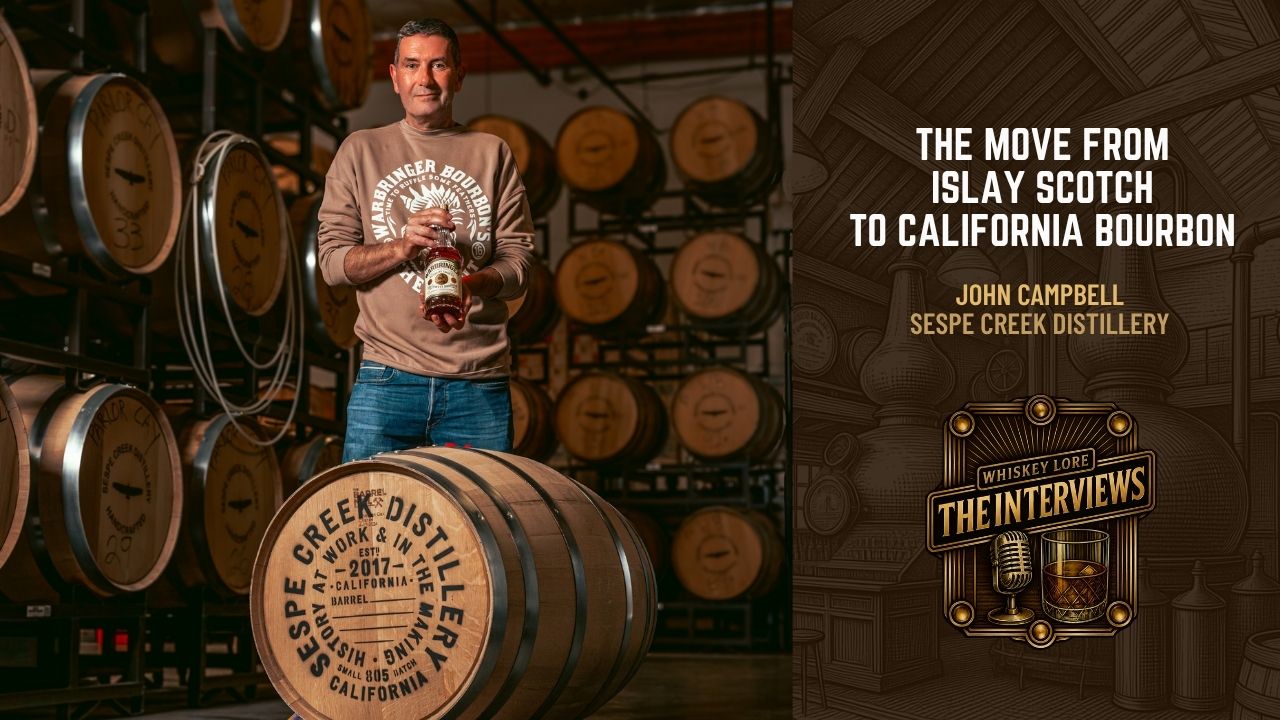
135 - SESPE CREEK DISTILLERY: John Campbell's Move From Scotch to California Bourbon
Listen to the Episode
Show Notes
Welcome back to a former guest, John Campbell, who we met back in Interview 63 when we chronicled his 27 years at the legendary Laphroaig Distillery on Islay. Back then, he was taking on the challenge of making Lowland Scotch at Lochlea. Today, he's making an even bigger jump, leaving the island of malt whisky for a chance to make California Bourbon.
There are few who have made the modern journey from Scotland to America, so today’s interview affords me the great opportunity to pepper John with questions about the move to Sespe Creek in Oxnard, California.
John will discuss the personal and professional changes involved in moving from Laphroaig to a distillery making mesquite-smoked Bourbon, vodka, and rum. He'll reveal the reason he was approached for the COO and Master Distiller position, and we'll talk about making Bourbon in pot stills, his five-year plan, and capturing the brand's "Southwest" identity in a spirit.
Listen to the full episode with the player above or find it on Spotify, Apple or your favorite podcast app. Or listen and get bonus content as a member of the Whiskey Lore Speakeasy at patreon.com/whiskeylore. The full transcript and resources talked about in this episode are available on the tab(s) above.
For More Information:
Transcript
Drew H (00:19):
Welcome to Whiskey Lore The Interviews. I'm your host, Drew Hannush, the bestselling author of Whiskey Lore's Travel Guide to Experiencing American Whiskey, experiencing Kentucky Bourbon and the book that busts 24 of Whiskey's Biggest Myths, Whiskey Lore Volume One. And today I am honored to have as a repeat guest on the show, a man who shocked me about four years or five years ago when he left my favorite distillery in Isla LaFroig after 27 years there and headed to a small farm distillery south of Glasgow, known as Locklee. And then he surprised me again 18 months ago when suddenly I find out he's in sunny California. So big welcome to John Campbell. John, thank you so much for being on the podcast again.
John C (01:05):
Yeah, no, good to be here again, Drew. And yeah, been moving about the last few years.
Drew H (01:10):
Is this a bit of a culture shock now getting to sunny California?
John C (01:16):
It's been a huge change. I think that was the opportunity though as well, to get the cultural change and also living in another country, working in another industry as well. So being able to stretch myself both personally and professionally is a good thing, I think, especially a man of my age. If you're not going to do it now, then you're never going to do it at all. So
Drew H (01:43):
Yeah. Exactly. Get that adrenaline pumping. Make sure you're still around, right? Yeah. Yeah. It's interesting. The first thing I have to ask is that I grew up in the mountains of North Carolina, but then I moved to Philadelphia. And when I lived in Philadelphia, it was always cloudy. And then I moved to Dallas, Texas, and that sun was beaming in every morning. And I found myself actually getting annoyed by sun after a while. Have you come across that yet?
John C (02:14):
No, no.
Drew H (02:15):
No?
John C (02:16):
No. I got sick of rain in Scotland, but I've not got sick of sun yet because it's basically 73 and sunny every day, so it's just perfect weather. So
Drew H (02:29):
Those
John C (02:29):
10 days where it's really hot and there's maybe 10 nights where it's cold and that's it. The rest, it's just perfect weather. So nope. I can't imagine me ever getting sick of it. Like weather-wise.
Drew H (02:46):
But you miss those little showers that just creep up on you in Scotland, I'm sure. It's fun to walk outside and just all of a sudden be doused with rain for five minutes and then it's gone.
John C (02:55):
No, I've done that.
Drew H (02:56):
No. Okay.
John C (02:59):
I do go home as well from time to
Drew H (03:02):
Time,
John C (03:02):
So I still get my fix of rain. It's funny, you're just doing work and you just, whatever the weather is, you just got on work. But personally, it's just good to be able to do what you want to do and weather's not going to be part of the equation. Whereas in Scotland, it's always part of the equation. It's the one thing you look at and plan around the weather almost, but it's very rarely it catches you.
Drew H (03:30):
This is part of what I find interesting about us having this conversation is I have not really talked to anybody. I'm trying to think. There are American distillers who moved over to Ireland when the Irish whiskey industry was starting to really grow. So I've talked to people who've gone from different climates in America over to Ireland, not so much in terms of Scottish distillers coming over into America and shifting from barley and the rigid rules of scotch whiskey to the bourbon world where you have a little bit more flexibility, still rules. Yep. Was that part of what excited you about coming over was kind of getting a chance to stretch and experiment a little more?
John C (04:18):
Yeah, no, absolutely. There's quite a few elements, I guess, in the professional decision. And that was definitely a huge part of it, to try and test myself, try, do something. We make bourbon vodka and rum at the distilleries. So things I haven't been a part of before, it's basically just been single malt, single malt, single malt, Scotch whiskey up until now. So yeah, no, I'm enjoying that learning that I've got over the last 18 months and still learning. Also, just different distribution system here. So having a different role within this business as well and trying to basically get all our ducks in a row to be ready to be successful, legislative hoops to jump through and just cultural things as well. Again, just how things are done in America versus how they're done in the UK or Scotland. So it's been really, really, really good.
(05:25):
I've really enjoyed the challenge so far.
Drew H (05:30):
Has the family followed you over then and they getting used to the new atmosphere?
John C (05:36):
Yeah, no, some have. I've got four sons. So three are in Scotland and one is in California, the youngest one's with me.
Drew H (05:48):
And
John C (05:50):
Ensuring his integration into elementary school was huge as well, but he's there now too and very settled in, got a transatlantic accent now. So
Drew H (06:08):
You go. He's
John C (06:09):
All good. And he's being understood, which is good because at first he wasn't being understood and that was tough for him.
Drew H (06:17):
It's funny, Scotland is, when I go over at first, I find myself straining a little bit to kind of catch on, but it's an accent that gets into your ear and then it seems to hit you and you pick it up pretty quickly.
John C (06:33):
And it's just different words for the same thing. So simple things like water is a good example. So he'll say water now just to get understood when in Scotland it's the tea that gets enunciated rather than the A. So it's just different. So you would say water in
Drew H (06:56):
Scotland
John C (06:57):
And you say water in America. So it's the same word, but just he's got sidewalk all sorted out and all of these just other names for the same things and trying all these different things like beach volleyball and stuff like that. So that's
Drew H (07:16):
Cool. Nice. Yeah. Well, and then there's a big word you got to learn like it's the trunk instead of the ... And also driving on the other side of the road, which he doesn't have to worry about, but you kind of have to get yourself attuned to.
John C (07:30):
Pass my test as well, so that's good.
Drew H (07:32):
Well, that's good.
John C (07:33):
Yeah. Yeah, yeah. Driving license, US driving license. So yeah, I'm trying to integrate as much as possible and just fully absorb all of the elements of being in America and what is American and what it feels like. Well, California anyway, so I don't know
Drew H (07:52):
If all
John C (07:53):
The same things or not, but
Drew H (07:55):
... Yeah, I like to say in the US, I mean, you have certain states that have a personality of their own. Massachusetts has a person. New Jersey has a personality of its own. Utah has a personality of its own, and California definitely has a probably more so than anywhere else. Yeah,
John C (08:13):
Texas as well. Texas is definitely-
Drew H (08:14):
And Texas. Yeah.
John C (08:16):
So yep, every state is different. And I've been to lots of them as well and done lots of the national parks, so that's good. So yeah, it is awesome.
Drew H (08:29):
This is where we get into talking about American single malt and how some people here will say, "Well, are you just creating another, making an American scotch?" But there are so many different climates across the United States that it'd be very hard. Maybe Seattle, you could pull off something close, but even there.
John C (08:50):
Yeah. No, that's probably the closest to Scotland, but Seattle gets a summer.
Drew H (08:57):
Absolutely.
John C (08:58):
So yeah, no, but as Pacific Northwest.
Drew H (09:02):
So let's kind of get into process a little bit and how you're having to shift your mind into this kind of American way of thinking. You still have a pot still, as I understand. Yeah.
John C (09:13):
No, that was easy transition as well with this distillery because the founder based the distillery on Lafroic. So that joins a lot of dots for everyone now, if you're listening. And that's the reason why I was offered the role as well, because there are a lot of strategic things that Sesape Creek Distillery and our brands, a lot of it's based in Laferro, especially the burden. So watering of bubbiness. We smoke corn on site like Lafrod pizzas, malted barley. We'll mash with ferment. It's kind of long fermentations as well. And as you say, it's potstyle distillation, which not a lot of barbins do. The majority are continuous distillation. So we do take out a cut and then we'll barrel and age on site and bottle as well. So the whole cabural's done on site. So that was good as well for me. And being able to understand the philosophy straight away, the founder loved Lafrey, talked to the founder and understood what the aims were.
(10:32):
I think as a distiller, once you know what the goal is and how you're going to get there, it's just a case of trying to bring your experience in to hopefully improve things.
Drew H (10:46):
So you're not starting from ground zero. You've got stocks already that are aging and kind of a formula for where you're going with what will probably be your flagship.
John C (10:57):
Yes, absolutely. And I think it's kind of like Lafrod this way too. My job's not to change it. My job's just to try and make things better. And at LaFrog, it's slightly different. At LaFrog, your job is to almost raise the bottom
Drew H (11:15):
Because
John C (11:16):
The top is the top and that's awesome. So you're almost trying to improve consistency and bring in the quality band from top to bottom closer.
(11:31):
So I think that's like the role of the frog. Here, there will be slight changes, but it'll be more about now that I understand the kind of philosophy and the strategy and how the barbon wants to be made. Again, I can just bring in some things that will make it feel more of cool and what it's supposed to be. An example of that would be slightly more red corn getting used in the recipe will be a change that will come, just to give you an example. And the reason why more red corn, it just brings a more earthy note. And a lot of the vegetal kind of jalapeno oil notes, which will help in a southwest bourbon if you're getting more of that kind of jalapeno oil notes coming through and it's going to change, but it'll be small changes. The base will be the same.
(12:28):
The mesquite smoke is still the main characteristic you're looking for. And I'll be working around the edges really and trying to improve everything and get a consistent recipe going forward.
Drew H (12:45):
So is it a bloody butcher corn that you're working with?
John C (12:48):
Yes.
Drew H (12:49):
Okay. Yeah. And we were just talking about that the other day. I was down in Alabama and I was talking with a distiller about the fact that of all of these grains that are being grown in the area, that one's the toughest because the animals love to eat it and they'll come in and yeah, because it's so flavorful and that tells you something as a whiskey maker, the quality of what that's bringing to your spirit.
John C (13:15):
Yeah, no, we like that. So there's a couple of things coming from Texas, the red corn and the mesquite wood that we use to flavor the red and yellow corn that we use as well. So again, just trying to stick with the whole Southwest philosophy right now to try and improve things. Another change that we will do will bring in some California rye because we're using rye from outside the Southwest just now. So that will be another change that we'll bring in just so that we're, again, just being through to our roots. And the thing is, I mean, we're between Los Angeles and Santa Barbara, we couldn't be farther away from that, I guess, emotionally as a brand where more Bakersfield, I guess, which is country and western cowboys, a lot of that sort of stuff, a bit of MMA in the background as well with Warburger.
(14:10):
So that's the influences that we have. And also being the ... I don't know if this is too cheeky, but like the Lafariga bourbons as well. So do you know what I mean? It's going to got a big, bold, powerful flavor that might not suit everyone, and it's certainly not a Kentucky bad one
(14:31):
With the way that we basically produce the corn and also the way we take the cups as well. So there's so many cool influences that make us taste different, I guess, is the upshot of all of that.
Drew H (14:46):
Yeah. It's really interesting that the first thing that I got to try was the unaged.
John C (14:53):
Oh, yeah.
Drew H (14:54):
And I have to say that when I tasted the unaged, it was an adjustment for me because I smelled it and then I tasted it the smell, I'm picking some stuff up. I tasted and I went, "Whoa. Oh, what is this? " It was definitely something that I had to kind of adjust to. But what's interesting is after I let the bottle sit for a while and then came back to the bottle, when you say that this has some Lafroix influence, one of the things I found interesting was I was picking up this licorice Anis note and somehow how it was mixing with the smoke was giving me what seemed like a medicinal note. And I'm like, "I know there's not a medicinal character to this, but sometimes you get two flavors that go together and make something different." And I wonder if you picked up on that at all.
John C (15:48):
Yeah, no, one of the things, whether it's the aguardiente that we produce or the bourbon is if you pour it and let it sit for 10 minutes, it does kind of settle into itself a bit better as well. So definitely we've found that and that's the benefit of all the different things just like there are so many processes that impact the flavor all the way through. And again, this is very light lofroid. Yes, you get the pea smoke with Lafrog and you get the mesquite smoke with watering it, but if you peel back that layer, there are so many other layers below that. And that's the thing. Certainly with batch 22 that we worked on a lot is getting all these other layers more sequenced and then bigger feeling in the mouths or like more viscous feeling and then the back end as well, just like the sequencing so that it all flowed across your palette and then left a lovely kind of lingering aftertaste in the back end.
Drew H (16:59):
So there's a certain amount of blending you're doing at this point probably between barrels. I see that you said it's very small batch. So how small is a small batch and would we expect to have variations from one batch to the next?
John C (17:12):
Probably about a thousand cases each batch. So they will get bigger as well. Well, we're moving to a thousand cases of our next bottling because things are going pretty well and it'll be subtle small differences, but we're trying to keep ... It'll be over multiple
Drew H (17:31):
Bottles.
John C (17:31):
So there shouldn't be huge variation. It should be a variation on the same thing. The fundamentals
Drew H (17:38):
Should
John C (17:38):
Remain the same, but there'll be slight tweaks going forward.
Drew H (17:43):
You had mentioned something a moment ago, and I kind of wanted to get into it because one of the big questions I have is that the shift from making scotch to making bourbon, one of the big changes is on grain distilling versus off grain distilling. Are you on grain distilling there or are you doing off grain?
John C (18:03):
Yeah, no, on grain, yep.
Drew H (18:05):
On grain, okay. Yeah. How much of a change is that for you in terms of a mindset? Does it affect your ... You think it affects the flavor in a different way?
John C (18:17):
It must, because especially on the stripping run, it'll change a boiling point. So then that will change the flavors you produce because you've got all these solids in it. Finishing run, not so much because there's no solids in that one at all. So yeah, no, it definitely changes it. And then just how it's heated. We use steam jackets as well. So it's heating from the outside. It'll have a completely different boiling perspective. So therefore, you will produce a different spirit because of that.
Drew H (18:59):
Okay. And I'm thinking about where you're taking your cuts. Does the smokey character usually come towards the end when you're starting to get into those congeners at the end and how do you decide where you're going to make that cut?
John C (19:15):
Yeah, no, that's a good question. I am unsure of the correct answer to that, but it's almost like the cuts are the cuts now for us.
Drew H (19:27):
Okay.
John C (19:28):
I can't see as getting to that short term, it's maybe a longer term project, like looking and understanding cuts and could we improve them because they take them relatively high. So you probably could get more smokiness if you wanted because they cut off relatively high as well and none of it gets recycled here at all in this finishing run. Yeah. There's a small amount of heads that gets recycled, but the tails and the finishing run does not get recycled at all. It just gets thrown down a drain and that is a lot of alcohol, which as a
Drew H (20:11):
Scotland
John C (20:12):
Kind of puts me in a
Drew H (20:14):
Corner- Have you crazy?
John C (20:17):
No, we'll understand that, but it's a longer term project. We've got bigger stuff to sort out
(20:25):
Right now because we just need to put what we're doing at the very front end into the back end. And what I mean with that, what we're blending together, because they've tried different experiments here and we are marrying together some of these flavors like sound mash. There's a very, very small amount of sound mash. The majority's kind of just a wet mash that we use. There's salt fermentations, there's different yeasts as well. So there's so much potential variability that I am just trying to remove and declutter, I guess, so that we understand this is kind of where we are now. These are all the good things we've learned from all out because it's a very young distillery, so you should be trying all the different things to see what you can come up with, but equally still try and get longer term strategy fixed and understand where it is you're heading towards.
(21:28):
And this is from a flavored point of view in the spirits. So we do understand that now from warbling. The other thing that's really interesting with a very young distiller, and when I say very young, it's kind of eight, nine years old,
(21:46):
We don't understand our maturation profile too. And that's been really interesting to me. So that's the two things that I'm really concentrating on is getting the recipe more from the blending at the front end to basically into the mash and how we're going to do the mash so that then we've been consistent with everything we're producing and then understanding the maturation profile. So what is it like after six months? What's it like after a year? What happens at a year and a half, two years? And just what are the ups and downs, the peaks and trocs, what are the different flavors starting to come in? So I've been with six or seven years worth of barbecue and we're trying to look at all the samples and try and, even though they might be produced slightly, definitely try and understand what's happening profiling wise. So once we understand the maturation profile and we get the recipe set, then the burden should be very, very consistent after that.
(22:50):
And it might say different batches, but you won't notice that. So that in itself is, I would say a five-year project. So yes, we are where we are just now and it's good. I mean, it's a wardwind whiskey we're producing, but like I still think we can get better and more consistent as
Drew H (23:15):
Well. It's an interesting challenge in trying to figure out barrel char, because you're working with new barrels now instead of working with used barrels and combining that with, we hear all the advantages of Kentucky with the big weather swings and you're not getting weather swings there. No. So are you doing any modification in the warehouse temperature control or are you just kind of letting it go? Thank you so much for making the last five years of Whiskey Lore so enjoyable for me. And to give you more of what you enjoy more consistently, I want you to know I've added a new bit of structure to the podcast. You're now going to hear two episodes a week, Monday's focusing on history, Thursdays on Travel and Process. And soon I have two new series coming about that I think you're really going to enjoy. One is called The Legends of Whiskey Lore, and in that we're going to honor the greats who've come before the modern whiskey industry.
(24:21):
And if you enjoyed my series on the history of Irish whiskey, I'll soon be starting a never before told epic story of the birth of bourbon. Stay tuned. And with all of that in place, I am now also opening the door to a small number of partners who feel like they would be a natural fit for the fans of Whiskey Lore. That's not a step I take lightly. My goal here is not to interrupt your experience. I want to enhance it by introducing things that improve your whiskey experience, your travel planning, and for the distillers who listen to the podcast, finding tools and services to help you move forward. And for the right partners, it's a great opportunity to be associated with a trusted environment where listeners are engaged, learning, and actively exploring whiskey in a much deeper way. So if you have a product, service, or brand that genuinely fits this world, I would love to hear from you.
(25:20):
You can reach out to me through an Instagram DM or email me directly at drew@whiskey-lore.com. It's time to make history together. It's an interesting challenge in trying to figure out barrel char, because you're working with new barrels now instead of working with used barrels and combining that with, we hear all the advantages of Kentucky with the big weather swings and you're not getting weather swings there. No. So are you doing any modification in the warehouse temperature control or are you just kind of letting it go?
John C (26:02):
Yeah, we're letting it go. But even here, it's funny, they're six high, the casks, we're storing them six levels and the temperature at the bottom might be nice and just perfect temperature, but the temperature at the top of the building still gets hot anywhere. So there is a temperature variation between top and bottom. So the stuff at the top is maturing slightly differently as well. And again, that is something we will ... I'll be able to quantify that probably more in a year or two than I can just now. I can just tell you it's different and the temperature profile is very different at the top of the building than compared to the bottom because it's basically an industrial unit we're in auction
Drew H (27:02):
Arm.
John C (27:02):
So it is kind of low, big, an open unit, but like flat ceilings and some of them have windows in them as well. So that changes things, I guess. So it's very interesting as how things are evolving. Again, the cask chair was chosen ahead of me. That might be something that we look at in the future again, but yeah, no, that'll be, again, a few years away, but it's alligator char we use.
Drew H (27:37):
I was going to say the other thing is you're probably missing your dunnage warehouses three high and cool and earthen floors versus ... Are you palletizing them there?
John C (27:50):
Almost, yeah. It's not palletized. They are on their sides, but they're on racks, I would call them. And they're two barrels in each rack and then they go six high. So it's just small racks that hold two barrels. And then we just set two on top of two and top. So we've got 12 in a row
Drew H (28:11):
Coming
John C (28:12):
Forward. So yeah, it's just different. Again, that's a cool thing about this. You're just learning different ways. And yes, I can use some things with all my experience now to improve everything, but yeah, we just needed some fundamental stuff across the board in all parts of the business. So yeah, there's been bigger fish to fry than maturation storage, but it will come. We'll get there
Drew H (28:44):
Eventually
John C (28:45):
One day we'll get down to smaller things like that. One
Drew H (28:49):
Thing that I thought after nosing this whiskey is that experience you have when you walk into La Freigh after having gone to other Scotch whiskey distilleries and the different smell, because you've gone from like fruity notes into this seaweedy kind of smoke note that you smell when you get in there. I wondered whether you were going through withdrawals while you were at Locklee, not getting smokey character when you're walking around. And that's why you said, "I got to go and find a place where I'm back around PPMs and smoke notes." How different does it smell in that distillery versus LaFroid? Much more wood smoke rather than kind of a sea smoke, I guess.
John C (29:37):
It's like, yeah, maybe I'm just thrown to the coast and smoke. That's me. And that'll be the two fundamentals of my life, which I'm pretty happy about that if that's the case. So Cespee Creek is more kind of barbecue and around a campfire and It is, and maybe more in the forest, especially with the rye element. So whereas lethrogus campfire in the beach all day long and the seaweed and all of that. So we're more barbecuing the forest. I think that's maybe the nicest visualization of Cesby Creek.
Drew H (30:18):
You brought up Texas and I thought that's got to be the first market that you're trying to get the whiskey into, I would think. Boy, that's perfect for them.
John C (30:27):
Yeah, no, California and Texas are the two priority markets. We have historical markets as well that we are reengaging with as well. Yes. I was in Texas last week and they just love it. The barbecue element just hits a note with Texas and they get it straight away and they go, "Oh yeah, it does taste like barbecue." Yeah. We've got around Oxnard saturated with Warbringer and our other two brands as well, the vodka in the rum. But yeah, we need to start spreading out. We've got some nice traction up in the Bay Area as well, and I'll be heading up there again soon. And then further south San Diego, we've got some nice traction. So we are getting movement in our home state as well, which is the case, I think. Working on that closely with our new distribution
Drew H (31:26):
Team. The thing you're probably going to have to get most used to is American barbecue and how choosy people are about ... I live near North Carolina where it's vinegar-based barbecue. I live in South Carolina where it's mustard-based barbecue. And if you go to Kansas City or you go, that's like ketchup barbecue. Everybody's got their thing. And in Texas, they don't do pork. They do mesquite and cattle.That's their thing. So you could maybe use that as your clue in as to why Texas is going to gravitate towards you even faster than anybody else will.
John C (32:08):
Yeah. No, and we've gained a lot of traction in Colorado as well this year, which that's the two kind of markets that have really picked up on us. Really not sure why Colorado, like Denver's a great city. And it maybe just, again, fits the profile of the cowboy, all of that sort of stuff. And again, up in the Pacific Northwest, we've got Washington State, and then we're just about to move into Oregon now too. So we are going to build in a profile slowly, and that's deliberate as well. We have nothing against the East Coast at all. And there are small amounts getting there, but the main reason is we want to build relationships, grow sustainably, and we just don't have enough stock right now to be pushing too hard. Not in the bourbon front anyway. Vortica, we can go as fast as you want.
(33:19):
And it is doing well. It's one best Vodka in America twice in the last five, six years. So yeah, no, it's world's best Vodka once as well. So it is different. And it's pretty popular in LA, but really not much traction outside that. And we're hoping to build that as well strategically this year, moving into markets that we're getting traction with our bourboning.
Drew H (33:49):
It's that whole three-tier system. You're getting the face full of it.
John C (33:53):
Yeah, not in four tiers in Texas. So it's license as well. So yeah, it's what it is. It's just, there are lots of things that seem simpler in the UK, but they're actually really hard as well. So based on my history, and yes, it can be tougher in Texas, but it can be easier in Texas as well. That's how you do business in that state, and that's how they want you to do it. So you either do it or you don't.
Drew H (34:24):
Yeah. When in Rome or when in Texas is- Totally. They would say, yes.
John C (34:30):
It's the same with the controlled states. So like with Washington state, it's a controlled state. So there's just different ways in doing business up on the West Coast here too. So it's what it is. It's just good that people are starting to enjoy what we're doing, a bit of who we are and building trust with the brands. That's really, really important.
Drew H (34:54):
Well, let's talk about the flagship because it's interesting. Warbringer, first of all, mostly origin of that name.
John C (35:02):
One of the co-owners is a guy called Josh Burnett, and he was the youngest ever heavyweight MMA champion. So his single battles are called Wardmaster, because that was his name in the ring. So we thought, well, he's Wardmaster, we'll be Ward Bringer. So it's just about going to bring in something different to Barbon as well and just being a wee bit hedge and just a wee bit different. It's linked to mainly to the Wardmaster.
Drew H (35:34):
I was going to say, you need to give a bottle to Joe Rogan if he starts talking about it.
John C (35:39):
We have. So that's been one of the things in the past. We have been in the Joe Rogan show. He really liked
Drew H (35:46):
It
John C (35:47):
And we sold out because we didn't have everything behind the scenes ready to go. So that was been my job the first year to work behind the scenes to make sure that we have stock and that we're able to go. We will not refuse catching a light, but that can bring a lot of problems too like it has for us in the past. But yes, so Josh releases these single barrels, the ward master single barrels, and they sell out really, really fast. We're also doing single barrels with two other MMA fighters or UFC. So there's a guy just retired called Donald Cowboy Serone, and he does single barrels as well. That's my job after this today to
Drew H (36:34):
Get
John C (36:35):
Ready.
Drew H (36:37):
Nice.
John C (36:37):
And there's another lady, I think she's Flyway, world champion, Valentina Bullet Chef Chenko, and she is going to be doing single barrels from this year too as well. And she picked a bloody butcher for her first one.
Drew H (36:53):
Okay.
John C (36:54):
Yeah.
Drew H (36:54):
So
John C (36:54):
There's single battle element through the MMA side of things as well. So again, that's all just the whole part of bringing the water and bringing the fight to kind of what we do every day. So hopefully that explains a name without ... Yeah, we're not going out looking for fights, but we just bring in the hard work, getting the good fight every day.
Drew H (37:18):
Yeah. I was going to say the way they had the cock fighting down here in the south, and see that rooster and go, "Oh, is this a local brand?" Yeah,
John C (37:27):
We've got the rooster and it's in the back because that's jumped.
Drew H (37:31):
Rooster
John C (37:31):
Is part of what we do as well.
Drew H (37:34):
The aging on it, putting it in a barrel, kind of took off some of those more disarming kind of notes that I was getting when I first knows the ... So I guess one of the questions that I would have on it, it's not listed as a straight bourbon. What is the age on this or around what age probably is this? Yeah,
John C (37:55):
No, most of it's kind of 40 year old, but the reason it's not as straight burbin is the bloody butcher was only 18 months old.
Drew H (38:03):
Oh, okay. Okay. That's
John C (38:04):
Why it's not got straight right on it. Eventually it probably will be a straight bourbon, but just that I wanted that jalapeno oil earthy note and the marriage self casks that we've pulled together here. Again, one of the things in the future that's coming is it will be at the very least a straight barbon.
Drew H (38:26):
And I noticed you went to 98 instead of a hundred because part of me was thinking too, now you have the bottled and bond designation here in the US and would you consider going to that? Or was there something about 98 that just was like, yep, that's it. It's got to be?
John C (38:43):
Again, that's an historical reference that
Drew H (38:47):
I haven't been
John C (38:48):
About with as yet, but yeah, no, it's where we ended up ... Yeah, I don't know why. I'm not sure, but I haven't actually tested 92, 94, 96, 9800 to see which is
Drew H (39:04):
Best
John C (39:05):
As yet. Yeah. I don't want to play about too much because there are historical customers if I start playing about with alcohol levels. Some people deem alcohol as value. So if I start lowering alcohol, even when we're getting a better product, they might think they're getting less value. So I've seen that Lafrog as well. So I'll wait. And that, again, another experiment for the future once we've got kind of fundamental sorted out, we will start understanding all of these things.
Drew H (39:40):
That was a great insight that you gave me during our last conversation that over there LaFroig is 40%, whereas over here it's 43% and that that 3% makes a big difference in terms of the flavor.
John C (39:55):
Yeah, for Lethrog it does. It's fruitier in the US because of that extra 3% alcohol. It just feels different on your pallet. It's amazing how alcohol levels affect what you feel.
Drew H (40:10):
So on this one, you also used a sherry cask. So I do get kind of the light fruit notes out of it. What's kind of your process with that? And are you sourcing local barrels for this or is this something that you're going over to Spain for?
John C (40:28):
No. So it's basically, it's a charred food barrel. Again, just like American oak, as we'd use, but we'll season the barrel with pedro him and sherry that we'll
Drew H (40:38):
Buy
John C (40:39):
From spay. So that's how we can still call it a bourbon. So we basically pump from one barrel into another barrel, leave it a couple of weeks and pump it back basically. So it's kind of like a finish, but it's just to give ... The petroleum and the sherry does a couple of things. It gives it the fruit at the beginning, just as you're saying, might not necessarily get it, but it helps. So we bet with the cherry Coke, Dr. Pepper feel in the liquid, and then also the viscosity of the liquid as well. So it just gives it more mouse feel, the Pedro M&S cherry.
Drew H (41:26):
And that mouthfeel definitely comes through. It's really interesting because it's a whiskey that evolves on the palate, and it's like the bourbon character isn't really upfront, but then once you feel the coating, I get like Tootsie Roll chocolate kind of notes out of it, which is really interesting. And then kind of that little caramel note on it as well. So it's like the bourbon is there, but it's not ... What's interesting is that I think Scotch drinkers would probably gravitate to this as a bourbon because it's not as sweet. It's more savory. It's got those savory elements that they would probably be more familiar with. And the sweet just kind of comes in and tickles the end of the tasting experience.
John C (42:17):
Yeah. No, I would agree that because of the port still destillation as well, it's kind of more of a, it is a hybrid. It can feel like a hybrid between Scotch and it is a burban, but it can feel like a hybrid between Scotch and bourbon. So I do think you're right. I think you could get people coming in from Scotch whiskey and especially if you like the petered stuff, which everyone has nowadays in Scotland that you could gravitate. And this is different. I think you'll also find that bourbon drinkers, which there are certainly a lot of in the US, they will like it as well. Maybe not so much in the first sip, but the second step, because the second sip, you get more fruit and you get more of the sweetness and you can feel it on your lips and everything in the second sip.
(43:10):
And then the aftertaste, there's a bit of the sweetness comes back there and mixes with that smokiness to give you the barbecue type feeling at the end. And it's a slight bit of citrus as well.
Drew H (43:22):
Yeah. It's a lot of framing. It's a lot of getting them ... Because this is what I do when I go to do a tasting and I'm getting bourbon fans to get used to drinking scotches is this whole idea of saying, okay, I always say, don't tip your toe in the water with a smoky scotch. Go all in. But when you go in, just forget everything you know about whiskey and start fresh thinking savory, not sweet. And it's amazing how many people ... And then if you say barbecue on top of that, I mean, barbecue and bourbon are best friends. So it just makes sense that somebody is going to be a bourbon drinker and would really enjoy this if they didn't go into it thinking it's going to be sweet like their regular bourbon would be.
John C (44:12):
It's really good in cocktails as well. You get a great smokey old fashioned or Manhattan without adding the smoke. So it works really, really well. It's quite malleable. We've found this as well. So it's a good sipping whiskey. Equally, you can put a couple of rocks in there. It'll work with that. And then it's very good in cocktails, certainly batch 22 because it will mix, but it still true to itself and you get that nice smoky aftertaste coming through. Slightly different in a cocktail. You get more of a charcoally type feel to the smoke in the cockpit. Yeah. No, it's still very recognizable.
Drew H (45:02):
This would be a good alternative to the Bloody Mary. Just get some tomato juice and throw some of this in there and get like that smoky character because I think tomato with corn and smoke would actually be-. Yeah. Yeah. Go with a breakfast burrito and be perfect.
John C (45:22):
Yeah, here you go. That's full southwest now.
Drew H (45:24):
Yeah, there you go. Yeah. So when you get to the point where you're going to get a chance to start experimenting, do you have kind of something in the back of your mind that you're like, "Man, I really want to try this out? "
John C (45:39):
Just some of the things we've talked about as well, just like changes in alcohol are probably quite a big thing. We will do different things. We'll probably try a single malt as well.
Drew H (45:54):
So
John C (45:54):
There are different types of whiskey that we will produce as well. The bardman and the vodka are two main things that we'll do right now. And we do the aguardiente or the white dog and it's mainly just available in Southern California and they use that in cocktails because it's a bit like a mescal as well. So it kind
Drew H (46:18):
Of
John C (46:19):
Tastes kind of like a mescal, which is hopefully getting people interested as well. How does it go from tasting like a mezcal to being a mesquite smoked burbon? But to me, that's the easiest reference for it.
Drew H (46:35):
I
John C (46:35):
Want to keep trying different things, different mash types as well. I really want to get the consistency, not that things are badges now, but just like things are consistent and then understand the age profiling so that we do at the sweet spot. We're the best that we can be all the time.That's why I'm concentrating on these goals just now. And then you can start experimenting from that to maybe add elements because we did a sound mash, but at a three week fermentation and it was awesome, but it's just not practical.
Drew H (47:16):
I
John C (47:16):
Hear you.
Drew H (47:17):
Three
John C (47:17):
Week fermentations are not ... Unless we buy a ton of washbacks, it's just not that practical because we're normally a four day fermentation. So times in that by cutting your production by 80% is not going to work. We're hoping to build production.
Drew H (47:39):
You just had me thinking back to LaFreug and Karchas and what you were doing with that series and this idea of doing maybe one-offs that maybe just barrel influence or whatever it may be just to bring some interesting flavors that you could do in between while you're on your way to that five-year mark when you can start
John C (48:01):
Playing a little bit. We definitely will. And sorry, so that's a good point. I think it'll be part of the tasting room plans at some point to do a Campbell selection or something, whatever, and then it'll well show different elements. So I've just talked about the sound mash that took three weeks. It was really tasty. People might want to do that. And we can maybe release a single bottle of that for maybe the tasting room here and for maybe a selected market in the future. Maybe we could do single barrels with retailers or ... I don't know. I don't understand. There's so much possibility, I guess, with that. But yes, it will be a good tool. Cartage was a great tool to understand flavoring that folks liked as well. And that didn't work. And that might, let's try something different. So yes, part of the longer term, again, that would be nice to do stuff like that as well.
(49:11):
Yeah.
Drew H (49:11):
So at this point, it sounds like you're getting close to having a tasting room open to the public?
John C (49:18):
Yes. Hopefully in the next couple of months. Got the meeting this week with the city, hopefully that gets approved. There'll maybe be a few things to tidy up, sort out, get in place. It'd be great to get that going because that would make a huge difference to us being able to spread our message as well. And there are a lot of tourists in this neck of the woods as well. And to give Oxnard something else, something different that it doesn't really have just now as well for tourism. We've got the local tourism board online and waiting to go to support us as well. So it's a real good, strong community here supporting us really, really well. And we're obviously trying our best to support the community as well.
Drew H (50:12):
Are you thinking of doing tours there or will it mostly just be the tour? Yeah,
John C (50:16):
It'll
Drew H (50:17):
Start
John C (50:17):
Off probably tours only by
Drew H (50:20):
Appointment
John C (50:22):
And maybe around the weekend and hopefully grow from there. It'll just depend on demand and yeah, we'll see. I would imagine it'll be really busy when the Cowboys training camp comes to Oxnard.
Drew H (50:37):
So
John C (50:37):
The Dallas Cowboys come here every year. So you only train for two or three hours a day, so you've got to find something else to do the rest of the day if you're a Dallas Cowboys fan.
Drew H (50:46):
Well, when the fans get there, they'll have a taste of home and then they can take it home with them.
John C (50:51):
Well, that's the thing. So strategically, that's a good spot for us to be in. And there are lots of places around Dallas now and Fort Worth that do stock war bringers. So it'll just help a
Drew H (51:01):
Lot. John, absolute pleasure talking to you again and digging in. And thanks for sharing your experience of shifting over into the California sun from the rain clouds of Scotland. It's a fun journey to watch and it's going to be fun to see what you pull off while you're there.
John C (51:22):
Yeah. No, and yeah, I'm really excited. Looking forward to what we can achieve here. I think there's a lot of potential and we just need to try and realize that. So yeah, no, thanks for having me on again. Good to be on. Good to see you again.
Drew H (51:38):
Yeah, absolutely. Yeah.
John C (51:39):
Always good to catch up.
Drew H (51:40):
Slounge, cheers? Yes. We'll have to switch it to Cheers now that you're in the US, I guess.
John C (51:47):
Yeah.
Drew H (51:48):
I mean, you got
John C (51:49):
A California toast, that's true. Yeah.
Drew H (51:51):
There you go. Thank you, John. Okay,
John C (51:54):
Take care.