
WFX - The Whisky & Gin Lover's Guide to Scotland (Whiskey Flight Interview)
Listen to the Episode
Show Notes
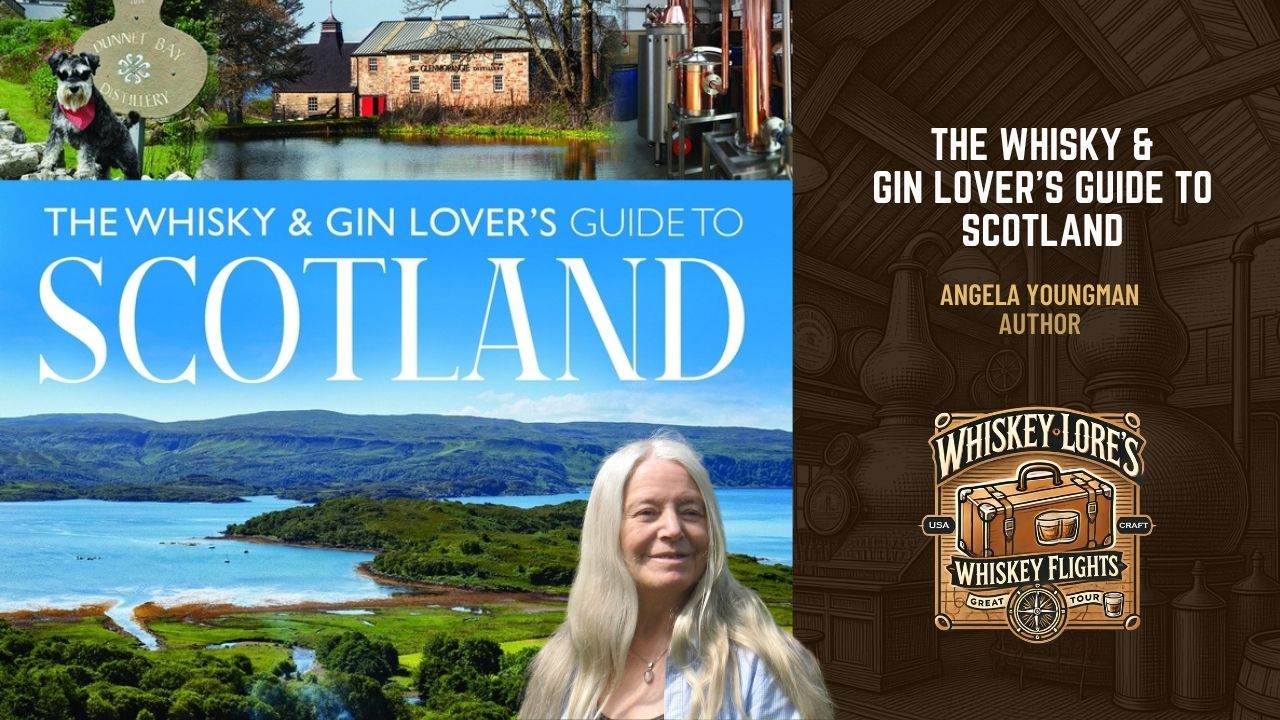
Scotland has long been one of the great whiskey pilgrimage destinations, but planning the perfect whisky journey across the Highlands, Islands, Speyside, Campbeltown, and beyond can feel overwhelming. In this bonus episode of Whiskey Lore’s Whiskey Flights, I sit down with travel writer and author Angela Youngman to explore the people, places, legends, and distilleries that make Scotland such a magical destination for whiskey lovers.
Angela’s new book, The Whiskey and Gin Lover’s Guide to Scotland, inspired a conversation that ranges from iconic experiences like The Scotch Whisky Experience in Edinburgh to hidden gems, Scotland’s growing gin scene, whisky festivals, island travel, and the realities of navigating Scotland’s winding roads, ferries, and remote distillery regions.
If Scotland has been sitting on your whiskey travel bucket list, this episode is the ticket to inspiration and practical advice that will help you start planning your own adventure.
And for members of the Whiskey Lore family, the extended episode includes deeper discussions on whisky history, ghost distilleries, movie connections like The Angels’ Share, travel recommendations, and more Scotch whisky lore. Find it at patreon.com/whiskeylore and ride along for the full experience.
For More Information:
Transcript
Drew H (00:08):
Welcome to Whiskey Lore's Whiskey Flights, your weekly home for discovering great craft distillery experiences around the globe. I'm your travel guy, Drew Hannush, the Amazon bestselling author of Whiskey Lore's Travel Guide to Experiencing American Whiskey and Experiencing Kentucky Bourbon. And it's hard to believe, but it has been three months since our last Whiskey Flights episode. In between I've been diving a lot into history, doing some longer form interviews. But next week we're going to be back on the road getting you inspired to travel with some destinations here in the United States and got some fun overseas travel to do as well. So we're going to get you all ready to start planning out some fun adventures both here and abroad. But today in our preseason kickoff, want to step away from the focus on individual distilleries and look at a country as a whole, one that we haven't looked at for quite a while, Scotland.
(01:08):
And I have a special guest. We did an interview on Google Meet. I want to share that with you right now. Let's get inspired to some distillery travel in Scotland. Today we're in for a long overdue journey to the distilleries of Scotland, guiding us along the way as a travel writer and English author. She is a member of the International Travel Writers Alliance, Angela Youngman. She's just released a latest book, which is called The Whiskey and Gin Lover's Guide to Scotland. Beautifully presented an insightful exploration of the land defined by castles, whiskey, and some of the most breathtaking scenery you'll find anywhere in the world. Summer right around the corner. No better time to jump in and start getting some Scottish inspiration into your travel plan. So let's dive right in. Angela, welcome to the show.
Angela Y (02:00):
Pleasure to be here.
Drew H (02:02):
So what got you into travel writing?
Angela Y (02:05):
Curiosity, partly. I was offered some travel lighting work and it just sort of spread from there. I'm a freelance journalist and have been for many, many years. I've made my career as that. And I can get all kinds of spinoffs.
(02:20):
Through my work as a travel journalist, I can spin off that knowledge, the skills that I've learned, and of course the information into all kinds of different areas, bringing in a constant supply of work. So that's how it all started. With this particular book, it's partly the result of many years of work and trips around the country, particularly up to Scotland, finding out the unexpected and talking to unusual people result, a lot of knowledge. So when my publisher said, "Can you do a book on this fairly quickly?" I said, "Yeah, I know how to do it. I know the contacts. I know the stories. No problem. And I like whiskey.
Drew H (03:05):
Nice. That's a big plus. Which side do you lean more towards? Whiskey or gin or are you equal opportunity?
Angela Y (03:14):
About equal. Depends on the taste.
Drew H (03:17):
I
Angela Y (03:17):
Might taste some nothing or like that, or I don't like that particular gin or vice versa.
Drew H (03:24):
What was the first distillery that you ever stepped into?
Angela Y (03:30):
I can remember one of the first that I went to was up in Scotland in Edinburgh and we visited the Scotch whiskey experience. Oh, that's interesting because it's very close to Edinburgh Castle. In fact, it's within sight of it. So I started investigating more and it's sort of grown ever since.
Drew H (03:53):
And talk about that place and what it's all about.
Angela Y (03:57):
It's a lovely building set right in the very heart of Edinbrella. It's literally within about five minutes walk of the castle. So it's a great way for visitors to discover whiskey in the land where it was created close to one of the most visited monuments in Edinburgh. It offers the experience that's different. A lot of people go in there thinking, oh, well, this is just going to be a quick tour. It takes longer than you think. Exploring the whole history, the making of scotch whiskey, what makes it special, and having a fairly extended tasting session. And it ends in what is absolutely mind-blowing. It's their area of historic whiskeys. They don't want to talk about the price of those whiskeys.
Drew H (04:50):
They are totally
Angela Y (04:52):
Irreplaceable and they're locked up so securely. I can imagine. You just see the pictures, you see the bottles inside and they are priceless. They go back years upon years upon years, some centuries old. So it's a total immersion into what makes Scotch whiskey from understanding the different areas, highlands as opposed to the Lowlands, the islands, as opposed to the borders. You get an idea of what makes a different type of whiskey, peaty or non-peaty. And from that, you can sort of go on and explore. There's other ones around Edinburgh itself making a great place to actually discover some of the different types of whiskey.
Drew H (05:43):
What I loved about that place was that if you are ... Because I did not do the actual tour because I had just toured Scotland. So I was like, okay, well, maybe I've heard the stories as I've traveled around, but it was a great place to end up my trip because after you've been to a number of distilleries and then you come back there in the lower floor is this wonderful whiskey bar that has bottle after bottle after while ... So I felt like if there was a place I didn't get to go, I could at least find a bottle of something to taste while I was down there.
Angela Y (06:20):
Yeah. It's
Drew H (06:22):
Something,
Angela Y (06:22):
Isn't it?
Drew H (06:23):
Yeah.
Angela Y (06:23):
It's playing something different you never tried before and you think, oh, I've got to try that. I've got to try that.
Drew H (06:29):
Absolutely. What's the thing that kind of sticks out in your mind when you go to a distillery? Is it doing the tour? Is it kind of the stories that you're hearing? What's the thing that kind of draws you in?
Angela Y (06:43):
The thing that draws me in is the people. The people that I'm talking to, the people I'm meeting, the stories they've got to tell me. The history of the place, I'm a historian by training from years ago. So I always look for that history. And when you're talking to them, you start discovering little stories behind their whiskey or their gin or whatever else they're making, because quite often they're making three or four different products on the same place and the history, how it links into the community, links sometimes into the national history and you think, oh yeah, these are fascinating. The enjoyable fun of sampling, a range of whiskeys at the end. And that really is what makes me sort of go. It's never the same every time you go. There's always something different no matter which whiskey distillery you're in. It's not a case of, "Oh, here's another distillery." If you look, you'll find something unusual.
Drew H (07:48):
Well, I had fun going through your book and seeing, you hear stories when you go to these different distilleries and as you say in the book, some you can believe some of them probably a couple too many drams before- That's
Angela Y (08:05):
Right.
Drew H (08:06):
Yeah. You had a couple interesting ones and since we're whiskey lore and love to dive into historical stories and that sort of thing, the story of Athol Bros. So what is an interesting concoction here? Kind of talk about what the concoction is and maybe the bits of lore around it.
Angela Y (08:25):
Well, no one would like to know exactly what the recipe was if it is true. Basically the earl of Athol back in 1475 is said to have served the attackers with Athol bros a type of whiskey. It rendered them extremely drunk. In fact, it totally inebriated the defenders simply walked in and collected them rebellion over and left them with this one, this particular part of the story. It's definitely legend, but it's a fun one. You got the story of a giant who lived in the land who kept stealing all the grain and the grain supplies. So apparently according to legend, a young hunter called Dugal set out to stop him, discovered the giant's stores including his whiskey stall, poured oats into the whiskey and honey result something rather strung and again allowed him to destroy the giant. Your guess is as good as mine.
Drew H (09:42):
I was going to say it doesn't sound that bad actually, oats, honey, and whiskey. If you stirred it, right? It'd be an interesting cocktail. Might be a little mushy with the oats in there.
Angela Y (09:55):
You'd think that the giant would have noticed all these oats in his whiskey.
Drew H (09:59):
Yeah, exactly. Exactly. Well, it's funny too because oats are now starting to make a comeback in terms of becoming an ingredient within making whiskey. So interesting to see that. That's why it stood out to me. Yeah. One of the other fun things, well, me, when I get involved in travel, I had done my James Bond tour and gone to all these different places where James Bond movies were filmed. And there's something about being in the place and then watching the movies again and taking you back. I think one of the movies that people probably haven't seen over here in the States that is a fun one inspiring you to distillery travel is the Angels share. Did you get a chance to go to the distilleries where that was filmed?
Angela Y (10:51):
Not myself, but I know of one of the distilleries that was involved where they actually did a lot of the filming, Glen Goin and a good place to go and visit, enjoyable
Drew H (11:04):
One. Beautiful scenic right on the Highland Lowland line, which is interesting that you can walk from the parking lot and be in the Lowlands and then just walk across the street and you're suddenly in the Highlands. Look at this. How did that happen?
Angela Y (11:19):
That's right.
Drew H (11:19):
Yeah. Did you have curiosities about particular distilleries that you wanted to definitely visit when you started on this project?
Angela Y (11:29):
I was interested in the ones that the ghost distilleries. Have you heard of these?
Drew H (11:34):
The ones that have shut down?
Angela Y (11:36):
Yeah. Literally, as we say in the UK, put in mothballs.
Drew H (11:40):
They
Angela Y (11:41):
Didn't destroy them. They just closed them and said, "We're just going to put them in mothballs and leave them be. " And they are literally that. Doors closed, everything's just left as it is and that's it. And in recent years, there has been a trend towards reopening some of these. Some are with the basis of the community saying, "We've got all these got these buildings. We need some jobs. We need work. Let's open them," and they're finding ways of actually doing it or the distillers themselves, the original ones saying, "We've got these. This could be a good market, something new. Let's go and reopen them." So they're doing that. Port Ellen, they've recently opened theirs and there's quite a few others that are being reopened and it's quite fascinating to see the buildings coming back to life as they should be and actually delivering something for the community.
(12:44):
They're delivering jobs and they're developing new whiskeys. Although I have to admit, the traditional whiskeys that were made there before the distilleries were closed are now regarded as something of an investment. People will pay large sums to try and get those particular whiskeys simply because they were unique.
Drew H (13:09):
It's kind of the personality of each of these distilleries and you wonder if they can recapture that magic.
Angela Y (13:16):
Exactly. Yeah.
Drew H (13:18):
And
Angela Y (13:18):
Then there's the unusual ones that I discovered along the way. I'd never heard of Lindors before.
Drew H (13:27):
Ah, yes. Yeah.
Angela Y (13:29):
And during my research for the book, I came across them and it turns out they are the original distillery where the monk John Calls made whiskey, the equivalent of whiskey for the King of Scotland and actually for the first time wrote it down, had a written recording that he was actually making whiskey. So being able to talk to the people there about their links with John Core and the way in which the modern distillery actually looks out over the spot where he made it. Okay. It's in rurins now thanks to Henry VIII, but it makes a lovely spot and a lovely story.
Drew H (14:19):
Yeah, it's a lot of fun to ... We've had Drew on the podcast before and I got a chance to visit there and he's done so much research on that. It's great to see the stories coming back. To look out over the hill and know that William Wallace was fighting up on that hill, all the history that just surrounds there. That's right.
Angela Y (14:41):
Yeah.
Drew H (14:41):
Yeah.
Angela Y (14:42):
It's
Drew H (14:42):
Fantastic. You talked about some of the distilleries that have kind of popped back up. Port Ellen, unfortunately I got there and it was still under construction so I didn't quite get a chance to see it. What were some of the other ones that you noticed coming back online?
Angela Y (15:00):
Rosebank. Gaddis opened near Edinburgh and is quite a big one that has reopened and is proving extremely popular, not surprisingly. Other ones? Let me think.
Drew H (15:16):
Bora. Did you get a chance to go to that one? That one's up near Pine Leash on the way up to John O'Growth. No, I didn't. No. Okay.
Angela Y (15:25):
Time and weather
Drew H (15:27):
Prevented. I would love to go to that distillery. It's another one that I saw that was under construction when I was there and they're talking about the story, the old distillery and unfortunately didn't get a chance to see it. How far out did you go? There's islands to travel and the rest. I'd love to go to Shetland, but boy, that's a journey to get to.
Angela Y (15:50):
Yeah. I never went up that far, but I've been out on Mull, Tobi Morley and out in Western Scotland. A lot of my travels were in the borders and Edinburgh, Fulker, Sterling,
Drew H (16:08):
A
Angela Y (16:08):
Particular region.
Drew H (16:10):
So talk about travel across Scotland and do you usually tend to go by car or do you travel by train? What do you think is a good way to go?
Angela Y (16:24):
I've done both over the years. A lot depends on time, how long you want to stay in an area and whether the distilleries are accessible by train.
(16:38):
If you're going into a town like Edinburgh, Glasgow, Sterling, generally it's a lot easier and quicker to head by train simply because it takes a long time parking and then getting in and out. It also offers the opportunity of getting to a lot of distilleries in a short space of time because you're in a central location and a lot of them you can walk to from one place to another. If you're going to try and explore, for example, a large area such as the highlands, as you discovered, it can be a long tween one and the other. The roads are nicely windy and twisting and turning. You can get caught out by the weather if you go at the wrong time in the area in the winter. Well, it does snow up there quite a lot of times. Storms, you can find travel becomes hazardous and you're told not to drive.
(17:40):
Some of the roads can be also single track, which means you have to wait for someone else to come down and just hope you're not meeting up with them on a corner. And a lot of people don't realize that. They don't realize just how far it is between one place and another when you're crossing Scotland. If you're trying to go onto one of some of the islands as well, an equal problem because you've got to allow for fellas and you've got to allow for the fairly times, usually have to book in advance. It can take, for example, say a day if you're going trying to go from Jono Groats up to the Shetlands just to do that small part
(18:26):
Because the fellas have to go and it all depends on the fellas being able to go again depending on the weather. So you have to be flexible and you have to think ahead and plan. That's my recommendation is plan in advance. If you've got limited time and you want to drive, the best way to do it is concentrate on an area that is not necessarily compact but has a lot to offer in a short area. For example, Spaceside, an area that covers from Inverness to Aberdeen and you've got a lot of very specialist distilleries within that. And you could also not just the distilleries, but you can explore the industries that support them because there they've got a specialist, Coopers. So find out how the ballots are made and talk to the battlemakers, Campbelltown, another good area, because a collection with a long history in a relatively small area.
(19:34):
And again, you can cover a lot of ground and try quite a few types of whiskey without losing too much of your time simply traveling. It's a great way of seeing the countryside, seeing the area and discovering Scotland, but if you want to find as many distilleries as you can,
(19:54):
You've got to wait and travel.
Drew H (19:59):
I risked it on my last trip because I was really focusing on islands and boy, you got to hold your mouth just the right direction when you're scheduling these things. Make sure that you ... Because it really was, I was on Isla and I'm watching the ferry schedules and I have my schedule journey off the island, but I'm watching the weather and it's just the weather's getting worse and worse and worse. And you're like, "Am I going to get off of this island?"
Angela Y (20:27):
Exactly.
Drew H (20:28):
And if you tightly plan things together like my next day was supposed to be on the aisle of Aaron, which means now I have to cross one ferry to get to entire Peninsula and then another ferry to get over to Aaron. And I mean, it's probably better to maybe if you're going to island hop, have a place that you can sit and maybe have an open day to be able to go.
Angela Y (20:56):
That's right. You need that time because you just don't know what's going to happen. The weather can change, you're stuck with tide times that can affect it. You've got to allow space and time when traveling in Scotland, especially around the islands. And at that thought, if you're trying to go to one of the festivals like the Islay Festival, you've got to book up way in advance Try and go on spec just on though, "Oh, we'll just go slip over there." You probably won't make it and you wouldn't even find the feather.
Drew H (21:33):
Yeah.
Angela Y (21:34):
You wouldn't even get any space because they're already booked up. There's no accommodation on the island, everything's booked.
Drew H (21:40):
Are there other festivals around? I think you cover some of the festivals in the book.
Angela Y (21:44):
Yeah, there are. There's a big one in Spaceide, which is good to go to. Most of the festivals are generally around the springtime and a few late autumn. We don't tend to find much in the summer. So you can technically try and do a couple say in the spring. The great way of discovering quite a number of whiskeys in a short space of time simply because they will have a large number of distilleries on the spot offering samples and talking to you. Often also they'll arrange or include, if you're lucky, tours of some of the local distilleries. So it is a good way of doing that, but the key thing, book in advance, because they get booked up very, very quickly and they are very, very popular. The Isla Festival, for example, that attracts visitors worldwide and they not only do the whiskey, but they have additional things like music, dance.
(23:04):
So you can sort of enjoy cultural experience and see how whiskey fits into the overall culture. So you're expanding your knowledge at the same time, but again, timing is crucial.
Drew H (23:20):
Well, and then that brings in the question of trying to find someplace to stay while you're there because I think especially for travelers over here, we have a branded hotel on every corner and when you're traveling around Scotland, you're not going to find branded hotels except in the larger cities. So what's kind of your planning for, first of all, just standard distillery travel where you're just going to visit a couple of distilleries maybe in an area like Spaceide or Campbelltown versus for a festival when lodging is probably really going to get eaten up pretty quickly
Angela Y (24:05):
Over here we do have a range of branded chains, but those are far less available the more remote you go. There's a lot more emphasis on individual, very much personal hotels, bed and breakfast, place where you can just stay with local families, or if the weather's nice, you can try camping. But for the whiskey sector, there are also specialist hotels that have developed in certain areas where you can actually go and stay on one occasion, one place, actually on the spot you're part of the distillery. Bollerdale house, you've got to go up to the Heberties for it,
(24:56):
One of the islands, so you've got to allow quite a lot of extra time, but you can go up to Bollerdale, part of the Isle of Russe distillery and stay actually effectively in the distillery. One of the villas on the island, part of the distillery, it's been turned into a mini hotel where you can sort of enjoy looking out your window at the distillery, have a tour of the distillery, enjoy whiskey with your meal that's been created on the spot, literally a few feet from where you're happily eating and then travel on the next day or stay longer and explore the island. There's other places like Craig Alchi in Spaceide where it happens to be the oldest pub in the area and they've made a big thing about their whiskey heritage. They've got a lot of accommodation available and you can explore not just spaceide whiskeys, but other whiskeys they brought in from outside the area to try a Valiotine.
(26:17):
To be honest, pubs are always a good way of finding accommodation. We have a number of rooms and the landlords are usually quite happy to chat away quite happily about the whiskey in their pubs.
Drew H (26:34):
I even found the bed and breakfast. I stayed at one while I was driving up through Karen Gorm on the way to Spaceside and it was near Dalwini. It wasn't too far from Dalwini. In fact, they offered to drive me over there if I wanted to, that way I didn't necessarily have to worry about having a taste and then getting on the road afterwards, which that's another concern, which is how strict they are over there in terms of drinking and driving.
Angela Y (27:08):
Yes. One thing which you can take advantage of when you're driving, most of the distilleries have sample packs available to take away with you if you're a driver. We are very strict over here about drinking and driving and you can find yourself stopped by the police and being asked to take a breath test to check you're not over the limit. So you can enjoy your tour of the distillery. You say you're driving, here's your sample pack, take it away and enjoy it at your leisure when you're not driving so you don't lose out.
Drew H (27:51):
It's a great option. I always try to find the alternate transportation though if I can do it because sometimes the driver's packs are like their basics, whereas when you're on the tour, they may pull out some extra things for you to taste that you don't necessarily get in a bottle in the shops. "Oh,
Angela Y (28:12):
We've just made this. You fancy trying it's our new specialist thing, or we're thinking about this, here's some trials, and that's always too good to miss.
Drew H (28:25):
I guess that's where you really want to try to make sure that if you want to take advantage of as much of that as possible, maybe you go to Spaceide and you just kind of centralize yourself there. What would be great is being able to find some kind of dependable transportation that takes you out to these distilleries. But I guess that could be a bit of a challenge again when you're in somewhat remote areas of finding a rideshare or a taxi to take you around.
Angela Y (28:56):
Well, there's no such thing as rideshare.
Drew H (29:00):
No. Okay. That's good to know. You've got to
Angela Y (29:02):
Book a taxi and allow for the time. You can get buses. Some of the distilleries say, or this public transport buses or a train sometimes to an area, but that can take quite a while.
Drew H (29:23):
You
Angela Y (29:23):
Have to allow much longer than you would even if you were driving because obviously it stops along the way. These are not fast, fast modes of transport. A bus might take half an hour longer than if you're driving just to get from A to B. So you've got to allow that.
Drew H (29:42):
I would imagine though there are, because I've bumped into a couple of them actually some tour companies that will take you around and give you that experience without you having to drive.
Angela Y (29:54):
That's right. You can hunt around. There's plenty of them on the internet. I And visit Scotland, usually has quite a few references, quite a few ideas of companies which will take you around an area. You can arrange a bespoke tour or join a guided tour around a selection of distilleries. They do all the work. You just enjoy the drink and the
Drew H (30:21):
Experience. And you get to see the scenery as you go instead of me clinging to the wheel saying, okay, remember left, left, you drive on the left.
Angela Y (30:31):
Exactly. You don't have to worry what's coming in front of you. Oh, this is a very narrow road. Oh my God, can I get down there? Which can be quite terrifying. I know for American drivers who sort of, oh Lord, it's that close to the edge of a building. You sure wouldn't go down there.
Drew H (30:53):
I have had some harrowing experiences. One that gets me is Bunahaban. It's a very narrow road. I don't know how trucks get down it. Part of the road is breaking away. And then it's like ditches on both sides. And then you just pray that another car isn't going to start coming at you to where you're going to have to back up. And you're backing around
Angela Y (31:18):
The corner as well. So you're really thinking, oh no, what's going coming around that corner? What's behind me?
Drew H (31:24):
Yeah. In terms of what you covered in this book, I started looking and I was saying, "Boy, there's some names in here that I just don't know or didn't realize." Well, two things that you cover that I've not really looked into before. You also looked at gin distilleries and you also had some bottlers, which I thought was interesting. So let's talk about Campbelltown and besides going to the distilleries there, which now there's going to be four distilleries, which is nice that expands what you can do there, but there's other experiences in town as well.
Angela Y (32:02):
That's right. Yeah. Which almost widens your knowledge, widens the interest because these extra facilities are there. At Campbelltown, as you say, they can go into the Explore Bottlers. You can go and talk to the people who have the history, the heritage. There are hotels which have very much made the whiskey industry and distilling as such all the different facets of it central to their business. So you can talk to them and find different things. You can even go to an area like Lockhelmand or Loch Ness and find distilleries on the banks. So you can enjoy those quite scenic and unusual locations. You might not see Nessy, but you can talk to the gin distillery, you can talk to the people who are dealing with the hotel, you can stay there and you can actually go on the lake on the lock and experience the whole culture around that area.
(33:19):
It offers different views, different ideas and different insights into an industry that is totally central to that particular area.
Drew H (33:28):
The interesting thing to me is that I don't necessarily think gin first when I go to Scotland, but apparently there's quite a few distilleries that are focusing on gin there. Are they kind of working it in with whiskey or are there a lot of just gin distilleries that I just haven't been aware of?
Angela Y (33:49):
Both.
Drew H (33:50):
Yeah.
Angela Y (33:50):
A lot of the gin industry has really sparked up over the last 20, 30 years. It's been a big renaissance in the UK as a whole. And in Scotland, gin's always been part of the heritage, but what has happened is that the whiskey distilus, they're making whiskey and they're using very much the same techniques, just adding on a little bit extra, and turning part of the basic alcohol into gin. They can use local herbs, the local juniper, for example, local items like seaweed, those essences into creating the gin in the same way that they might be giving extra taste to the whiskey. So they're doing it almost in tandem. And by doing that, they're creating extra income stream for the whiskey distillery by providing something different. They're also providing the fact that the gin can be made more quickly and be available more quickly than the whiskey, which might have to wait four or five years before it is made available to the public.
(35:18):
So it balances out quite nicely. Alongside that, you do have quite a number of artisan gin distillus who sprung up everywhere and they might only make two or three variations, but they are expanding the whole market and offering tourists experiences. Okay, you can go make your own gin in many places and sample the gin on the premises.
Drew H (35:49):
Is there a gin distillery that stands out to you that if people are thinking, "If I have one or two gin distilleries that I could go to, " which one would you probably suggest to them?
Angela Y (36:03):
That's a hard question to answer because there's so many and they're all so different. They've all got different tastes. There's no two gins that they're the same. They might use a similar base of say London gin, but every gin is totally different. I've had some lovely ones from up on the islands, Donut Bay. They do some lovely gins and they're one of my favorites, I have to admit. And then you get small artisan ones that are just offering perhaps one gin that's unique to them. So I think beyond Dunn Bay, I think I'd just say experiment, try and taste and see what comes out.
Drew H (36:53):
Yeah. Well, and that's something that next time I'm in Scotland, I'm going to be much more aware of because I've always been ... The opinion that I had at one point was that if you want beer, you go to Ireland. If you want whiskey, you go to Scotland. If you want gin, you go to England. But what I'm finding is that there's a nice mix of all three in all three places.
Angela Y (37:25):
I'd be careful what you say there. Don't just say beer, go to Ireland because the beer industry in the UK is incredibly diverse nowadays. There's so many artisanal brewers, so many craft brewers that the tastes are incredible and totally different. You've also got the cider industry, which again, is totally different, which is expanding. Traditionally, that was down the west country, but it's grown. You even get cider now being made up in Scotland and in the north country in North Umberland, for example. So you have a lot of different ones. So beware what you say there. That is very much, yes, Scotland, but there are distilleries opening in the UK down in England. I believe I seem to remember I've heard of some in Wales now. You've got the whole cider sector. You also have specialists who are just developing new types of drinks or specialist drinks literally scattered across the country.
Drew H (38:50):
And
Angela Y (38:50):
Then of course you've got the wine industry. There are people up in Scotland who are experimenting with wine, not just fruit wine, but grapes as well.
Drew H (39:01):
Yeah.
Angela Y (39:03):
So it's
Drew H (39:03):
Very,
Angela Y (39:04):
Very diverse.
Drew H (39:05):
Well, it kind of comes back to this thing too, where even when we talk about the five regions of Scotland that within those regions, they really have kind of diversified. You can find pedid whiskeys in Spaceide, you can find non-peated whiskeys on Island. There's a great variety.
Angela Y (39:23):
Yeah. It's no longer a case of, oh, this is the Highland version. This is the lowland. It's so totally diverse. You've literally got to try something from everywhere and be prepared to experiment because everyone's got something different now to offer. Distilleries are being really adventurous and not content with just doing something traditional. They want to be experimental and want to try.
Drew H (39:52):
Yeah. Well, how long will it be before we see a whiskey and gin guide to England since you're there? And I mean, it's kind of a mystery. Everybody goes to Scotland first when they think of whiskey, but there is such a growing industry in England. And again, gin has been well established there, but I think people are kind of missing that there is so much going on there in terms of whiskey as well.
Angela Y (40:23):
I'll talk to my editors and see what comes up. So certainly something I do know I have literally just completed and they're with the publishers at the moment, similar guides to vineyards across the UK and the cider sector in the UK. So those are coming out.
Drew H (40:47):
Nice.
Angela Y (40:48):
Probably within the next year.
Drew H (40:49):
Excellent. Well, we will keep our eyes out for that. So where is a good place for people to find your book?
Angela Y (40:56):
Basically Pennantsword are a major publisher. You can find them on the Pennantsword website. They're available widely on the internet, Amazon, and of course booksellers and distilleries in Scotland. I do know that distilleries were and bookshops in Scotland were requesting a lot of signed copies. They may well have some still.
Drew H (41:25):
Well, good. Well, thank you, Angela, for taking us around the island and giving some travel tips here and giving us a little flavor of Scotland. Get everybody inspired to start getting their travel plans together and visit.
Angela Y (41:40):
My pleasure.
Drew H (41:42):
Cheers.
Angela Y (41:43):
Cheers.
Drew H (41:44):
Well, I hope you found some inspiration in today's episode and if Angela peaked your interest in traveling to Scotland, grab a copy of her book, then head to whiskeylore.org/Scotland to see a list of current tourable distilleries. Sign up for a free membership, then add your favorite distilleries to your Whiskey Lower wishlist. And when you're ready to travel, head to your member page, you'll find all the booking links right there for your favorite distilleries. All you have to do to start your journey is head to whiskeylore.org/scotland. And as I prepare for my next distillery destination, if you're still on the fence about a visit to Scotland's distilleries, let me give you my three reasons why I think you should be planning your trip to the Highlands, Lowland, Spaceide, Island, or Campbelltown. Okay. Wait a second. Now, honestly, do you need a reason to travel to Scotland?
(42:36):
All right. These are some of my favorites. First, the people of Scotland are amazing. They'll share their country along with any whiskey fan and every distillery tour will not only be fun, informative, and full of great whiskey to taste, it's also a nice laid back experience where you get to know the area and the culture. Second is the scenery. Whether you take a boat, train, or go by tour guide or ride around in a rental car, the views from the borders all the way up to the islands are incredible. If you are a fan of castles, make sure you grab a historic Scotland Explorer pass for prepaid access to some of the most famous castles and attractions on the island. And third, well, I got to put the Scottish breakfast. Yes, even the haggis in the black pudding, you can skip those if you want, but I do enjoy those.
(43:30):
You fuel up in the morning, take some snacks for the rest of the day and then find one of the many pubs around the country for a hot meal and a taste of some amazing spirits. Now that I got you all inspired next week we're going to head back to the United States for our first whiskey flight of the new season. But Scotch whiskey fans, you need to check out Monday's episode. We're going to do a deep dive into the history of the Talisker distillery. We're going to do a tasting of some historic whiskeys and you're going to get some insights into how to approach the tasting of long age whiskeys. Get your ticket to ride along. All you have to do is smash that subscribe button on your favorite podcast app or become a member of the Whiskey Lore family by heading to patreon.com/whiskeylor.
(44:18):
I'm your travel guy, Drew Hannush, and until next time cheers and Slange Va. The transcripts of travel information, including maps, distillery planning information and more, head to whiskeylore.org/flights. Whiskey Lore's a production of Travel Fuels Life, LLC.