
Cooperstown Distillery
Whiskey Flights Overview
Most people come to Cooperstown for baseball, but they may leave talking about whiskey. In this episode, Drew Hannush strolls through the village that gave rise to America's pastime before heading to Cooperstown Distillery to meet founder Gene Marra. Together, they explore the marriage of baseball and spirits, the philosophy behind New York whiskey, and why one chef-turned-distiller believes cold-weather maturation creates flavors you won't find anywhere else.
In This Episode
• How a restaurateur and chef found his way into distilling
• Why Cooperstown became the perfect home for a baseball-inspired distillery
• The story behind the famous baseball decanters and sports-themed bottles
• New York grain and Gene Marra's vision for distinctive bourbon
• Using three barrel sizes to shape flavor and maturation
• Four-grain bourbon and the role of oats in creating a creamy mouthfeel
• New York rye whiskey and balancing spice with corn sweetness
• Touring the cellar and tasting whiskey straight from the barrel
• An award-winning American single malt and the Solera sherry finishing system
• Why Gene believes New York whiskey offers something different from Kentucky bourbon
• Baseball memories, Yogi Berra, and growing up near Yankee Stadium
• Exploring Cooperstown, Main Street, memorabilia shops, and the National Baseball Hall of Fame
• Plus, Drew shares his three reasons why Cooperstown Distillery deserves a spot on your Whiskey Lore Wish List
📍 Cooperstown Distillery
Cooperstown, New York
Transcript
Drew (00:00):
Whiskey Lore fans. If you're a member of the speakeasy at patreon.com/whiskey lore, you'll get an extra 20 minutes of interview time in this week's episode. Sign up for a seven day free trial at patreon.com/whiskey lore. Welcome to Whiskey LO's Whiskey Flights, your weekly home for discovering great craft distillery experiences around the globe. I'm your travel guide Drew Hanish, the bestselling author of the Experiencing American Whiskey, experiencing Kentucky Bourbon, a whiskey lore volume one where I bust 24 of Whiskey's biggest myths. And today, having left Vermont headed across the Green Mountains and gotten into New York state, I was shocked by how many distilleries I was passing by and I recognized the names because I had been researching them all for experiencing American whiskey. And so here we go. I'm getting kind of a firsthand, I didn't get a chance to stop at any of them unfortunately, because I was really tight on time.
(01:08):
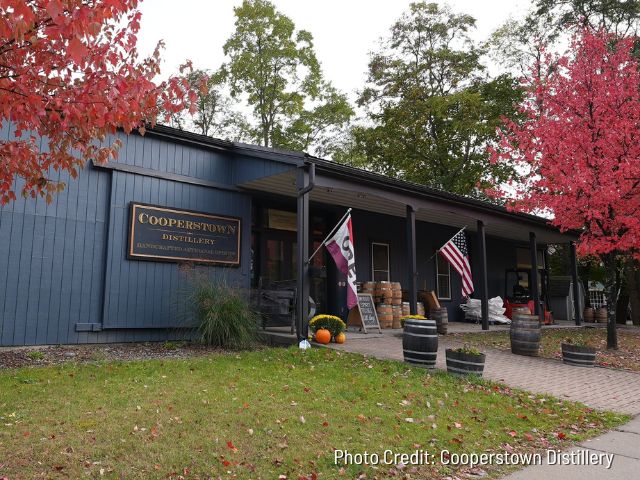
This is one of the issues you run into when you're planning out maybe a trip like I was doing. It was sort of aggressive going to a lot of distilleries in a short period of time. If you don't build in a little cushion for yourself and you see something else you want to do, you kind of got to let it go and just roll on the next place. And Cooperstown is where I landed. And so Cooperstown is one of these towns that I just want to walk around a little bit and experience. So I had a few minutes before my interview with Jean Mara, the founder of Cooperstown Distillery. So I thought, check out Main Street, and it was beautiful with the leaves all filled out and their autumn colors, and unfortunately it was starting to drizzle on me a bit. So I ducked my head, burst into the Cooperstown Distillery tasting room, which is on Main Street.
(02:02):
Beautiful little spot there that feels like an old time saloon with a big bar where you can come up and do some tastings and then big glass mirror behind it. And all sorts of what I would say looks like memorabilia, these baseball to cancers that they have with different baseball players, signatures on them is very cool. And so we'll talk a little bit about that during the episode. I also stopped into a couple of baseball card shops while I was there. I don't think I've done that since. I probably went there back in 2001 because there's not a lot of baseball cards shops around. At least I don't tend to look for them anywhere else I go. So I enjoyed that kind of getting back into the nostalgia of baseball and then headed over to the distillery where Gene Mara walked me around and gave me kind of the view of things and how they're making their whiskeys and looked at the pot stills and went downstairs and went through their cellar and tasted a couple of whiskeys from the barrel and made our way back upstairs here to where we're going to jump into our interview and talk a little bit about baseball whiskey and all the things he's doing here.
(03:15):
So I wanted to start off our interview by finding a little bit of the backstory and how Jean got involved in making whiskey in a baseball town.
Gene (03:26):
Well, I'm a chef by trade culinary grad and a restaurateur, firstly, all my life. Got into the wine business for quite a few years in the state of Georgia, which was then a very fledgling wine industry, and which is now very prolific in the state of Georgia. Came to Cooperstown to help some people with a restaurant. We lived together in Florida on an island called Boca Grande on the west coast of Florida. They were fourth generation Cooperton, had a restaurant, needed some help, and I was consulting with them and fell in love with the town. Spent two summers here, and during that time I started to venture out into the realm and the world of distilling, craft, distilling. I took some extracurricular classes at Cornell University, they do a great distilling workshop seminar up there. Kind of fell in love with the whole model of running a craft distillery, making craft spirits. And I'm a native New Yorker, decided that it might be a very interesting opportunity marrying spirits with baseball, which of course spawned our first decanter bottle, which was our great baseball bottle. And I think we're well over 200,000 bottles now,
Drew (04:55):
13
Gene (04:55):
Years later. And it's been a storybook experience ever since. We've now established a footing in the craft world for fine whiskeys, but even more so we've ventured out into this decanter series and this decanter line of spirits that are in different type bottles, all sports themed because we've kind of developed a strategy predicated on Cooperstown being the home of the baseball hall of fame and now it's sports excellence. And we've extrapolated from that into a football bottle, a golf bottle, soon to be released, a soccer bottle. And who knows what's going to come down the road after that.
Drew (05:43):
Well now when I walked down the main street of Cooperstown, there's actually all these memorabilia shops and you actually have a see all of a sudden, oh, there are your decanters and whiskey. So for baseball fans who are whiskey fans, it's kind of like a perfect mashup right there between the two.
Gene (06:05):
Couldn't agree more. And we've of course gotten into the spirit world in a whole nother realm as well because of the strong history of New York with grain and plentiful grain here in our home state of New York. And so our new kind of emphasis, if you will, has been on producing world-class whiskeys from bourbon to rye to single malt to even American whiskey, 100% New York product. And we're really, really proud of that stuff.
Drew (06:40):
Was there a specific style of whiskey that you had front of mind in terms of something you really wanted to create?
Gene (06:49):
Not really. I've always been a pioneer, even in my culinary realm, I've always kind of struck out on my own. I knew that I wasn't crazy about Kentucky Bourbon because it all tasted the same to me, and I still maintain that.
Drew (07:07):
It
Gene (07:08):
Doesn't make me very popular in the state of Kentucky, but I just knew that there was a better way to do it. I think we knew from the start that our climate is what dictates the profiles of our whiskey. We always like to talk about bourbon because obviously it's our national whiskey, but I always felt like, you know what? We can make better bourbon than Kentucky. And I thought, let's first find out if our climate is what I think it might turn out to be in terms of cold weather maturation. So we've ventured into a whole realm of three size barrels because it is a cold weather process here. And then having visited Kentucky innumerable times, I saw what they were doing down there with the way they aged. And it was pretty simple. You take whiskey, you put it in a barrel and you leave it in a rick house for two or three years,
Drew (08:11):
Right?
Gene (08:11):
Kentucky's bourbon is influenced strongly by the fluctuations in climate. So it's super hot and then it's pretty darn cold and contraction, expansion, contraction, expansion in the barrel sort of dictates the past to a good whiskey. So I started thinking, you know what? There's got to be more to it than that because having been a chef all my life, I started to look at what constitutes the profile and a Kentucky bourbon and why are they all similar? And I've deduced from my own culinary background that it has a whole lot to do with the corn component of Kentucky Bourbon in some cases, 90% in their mash bills. And I said, you know what? What's going on down there is what we call in the culinary world mail yard. And so mail yard is caramelization,
(09:10):
And it was discovered in the 18 hundreds by a very prominent French chemist slash chef, and I don't recall his name. And he determined that sugar natural sugars in particular were what dictated flavor profiles in lots of things, including meats, including desserts, et cetera. And so I started to look at it and I said, you know what? What's going on down in Kentucky is that liquid is cooking because it's 160, 170 degrees, 180 degrees, the top fifth floor of a Rick house in Kentucky. You got all this corn, heavy corn fructose syrup. Basically it's going through mallard. So you're getting a really heavy caramelization and not a whole lot more because once you have mallard, you establish a flavor paradigm that sticks with the liquid and it doesn't like to pick up other nuances, Esthers, whatever you want to call cogens, anything. Whereas here in New York, you were down in our Rick house down at Subterranean, even on the hottest summer day, which we had a couple this year, in fact, it was over a hundred not for very long. It stays 55 degrees down there. So there's no mallard,
Drew (10:33):
There's
Gene (10:33):
Zero,
(10:34):
There's not a chance for mallard, which in my humble opinion is a really prominent aspect of why New York bourbon is so distinctive. So instead of this flash caramelization that is occurring in the barrel, you're getting a really slow maturation, which is why the 53 gallon barrels have to be blended back with thirties and fifteens in our regime of how we create whiskey because they take so long to mature. Not only that, but because we don't get mallard, we get a really different profile from the osmosis of the lignin in the oak staves, and they give off completely different congeners esters, and they tend to lean a little more towards fruit and nut than they do sweetness and sugar. So in a New York bourbon and in particular Cooperstown Distillery bourbon, because of our Rick house, you're getting a really completely different set of flavor profiles that you wouldn't pick up in any other bourbon unless you're in the state of New York.
Drew (11:58):
So you've thrown the gauntlet. I have not tasted your bourbon yet.
Gene (12:01):
That's right.
Drew (12:02):
So it's time to dive in, I think
Gene (12:04):
It is,
Drew (12:04):
Yes.
Gene (12:05):
Yes.
Drew (12:06):
And then we'll talk a little bit more about barrels,
Gene (12:09):
Probably casting,
Drew (12:10):
Is it okay?
Gene (12:13):
It's pretty nice, but it's hot. Not too late.
Drew (12:16):
It is hot, but it's not overly hot. Not for that proof, no. Yeah.
Gene (12:21):
Taste the apple.
Drew (12:23):
Yes. Which is interesting because, alright, what's the mash bill on this?
Gene (12:28):
So interesting mash bill, we're a four grain mash, and we always have been predominantly for the last 10, 11 years. So at 65 corn, 18% rye, 70% oats, and 5% malted barley. And we think that our mash bill because of that makes this bourbon. And particularly with the oat profile, a very creamy middle palette. And because of the maturation and the slow transpiration that occurs in the barrel is a perfect word, you get these fruity notes that you don't normally get. You get some nut notes that you don't normally get, and you can drink Kentucky bourbon all day long and they all taste the same, in my opinion. I know I'm going to get castigated for that, but that's how I feel. And in our bourbon, you get lots of interesting complex profiles that you don't normally get.
Drew (13:28):
I think if you ask a Kentucky distiller to compare bourbon against scotch, they will admit that bourbon has a much shorter flavor profile. It's very dependent on the barrel. They'll also say that 70, 80%, depending on who you're talking to, depends on the flavors from the barrel. So if you're going to depend that much on the barrel, then you are going to start getting a very vanilla caramel as dominant grains. Maybe an oak note that maybe that nuttiness coming through. But I actually got a little chocolate, I think chocolate on the finish.
Gene (14:07):
Exactly.
Drew (14:08):
Yeah.
Gene (14:08):
So let's talk about that though, because that's inherently one of the biggest equations that everyone should use when they're evaluating bourbon. So the other thing that distinguishes Cooperstown Distillery from a lot of other New York state distilleries, and in fact from virtually most distilleries is we use three sizes of barrels. We use fifteens, thirties, and 50 threes. We also have, in my opinion, probably the finest barrel maker Cooper in North America, right in our backyard. And then when you segue that into how we really make all of our whiskeys, which is a final blend of a certain amount of liquid from a 15, a certain amount of liquid from a 30 and a certain amount of liquid from a 53, it makes for a really interesting complex blend that you don't get out of a single barrel, for instance, or even a barrel that's maybe two barrels of different sizes. So we have three sizes, and it really has a profound effect on how our whiskey comes out because we find with the fifteens, which by the way we call accelerators because in two years we get a beautiful profile out of a 15 gallon barrel, but it's a small amount of liquid.
(15:30):
So you have to enhance it with more volume, which is where the 50 threes come in. And they take forever to mature because of the cold weather climate. By the way, anybody that knows anything about bourbon knows that in Kentucky they knew nothing but 50 threes because in two years their barrels are ready most of the time. So we use the thirties for what we call a moderator. They're right in the middle. They kind of shoulder nuances that the fifteens pick up and they nuance what the 50 threes are eventually going to turn into. So we have a really unique process here where not only is our mash bill unique for our bourbon, but with the three barrel blending process that we propagate is very much a part of what defines our bourbon. And then the fort grain mash, of course takes it to another level.
Drew (16:24):
Nice. The next thing I want to jump into is the rye, because we got a chance to taste some of the rye that you had in the barrel.
Gene (16:31):
Again, all local rye, which is nice stuff. I don't know. Some of it's heirlooms, some of it's just plain oil, whatever they throw in the ground type rye.
(16:43):
But a long time ago when we first started making rye, which is now six or seven years, I think about seven years, I think I decided that because rye was tough to work with and because a lot of the a hundred percent rye that I tasted out there were too lean, you couldn't extract a lot in the sensory profile to determine that it was a real distinctive rye. And I said, what's wrong with that? What's wrong with that picture? And I said, well, when you make a hundred percent rye, you're prone to limit your profiles to a certain dictated structure because it's very confined because of the rye itself, the grain. So we started playing with the elements of adding a different grain, and we finally hit on 20% corn addition to our mesh. So we're at 80 rye, 20 corn. We could have used barley, I suppose we could have used anything in many ways,
Drew (17:46):
Oats, now that I'm thinking about it, would've been created an interesting oats
Gene (17:50):
Would've been very interesting. Yeah,
(17:52):
Corn was around, it's readily available. And so we ended up with corn, which of course does a lot of things to the rye that you don't taste in a hundred percent rye. It opens up all kinds of avenues for your sensory to perceive. Rye is an interesting component of our whiskey portfolio. We really love our rye. It really, in my opinion, is what I like to call textbook rye. It goes into the bottle at 102, doesn't taste like 102. It's very rich, it's very structured. And I think a lot of that has to do with the corn.
Drew (18:29):
Everything that I taste here is very drinkable. Even when we were tasting the, is it 109 downstairs and soft on the pallet? No burn?
Gene (18:41):
No. And I think part of that is what we're getting out of our blending of barrels. You get so much dimension because you're getting the best out of a 15, you're getting the best out of a 30 and the best out of a 53 and not singularity. In other words, there's always nuance that comes out of a barrel.
Drew (19:04):
So when it comes to your favorite style of whiskey, what would that be?
Gene (19:08):
Well, I'm partial to our single malt, which we haven't tasted up here, but we tasted downstairs right out of the barrel, out of the Sora.
Drew (19:15):
Yeah.
Gene (19:15):
So I don't know if
Drew (19:16):
You want to talk about that, which was they finished, I mean basically through the Sora, it's going through the roso and picking up lots of those wonderful raisin notes and pulling in a lot of that
Gene (19:27):
Sherry cask, the
Drew (19:30):
Dark fruit notes,
Gene (19:31):
The Solaris system that can, our distiller has really pioneered, has been a significant reason that our single malt is so incredibly assertive, I guess.
Drew (19:47):
And so you're doing these off of a pot still? You were showing me. That was the first thing we walked back and looked at when we did the,
Gene (19:53):
That's our Carl pot still. The only thing that goes through that, I mean the single malt only goes through the Carl, the small Carl. That's only a 60 gallon sill. So you talk about small batch.
Drew (20:06):
Yeah,
Gene (20:06):
I mean it is small batch, but the reason we put the single malt only through the Carl is, as I told you earlier in the day, even the manufacturer, the Carl family said, this is probably the best steel you can have to make high, high quality product. It's like, I like to analogize it to my chef days, which I have 50 years in that business. So if you make a recipe for 10 and then you make a recipe the same recipe, but you have to make it for a hundred, it's going to taste the same. It is just not, period. I've done it enough in my life. It's very difficult to maintain standardization when you take the quantity up like you do. So we got a 60 gallon still. If it were a 500 gallon still, it'd be an entirely different beast. It's different. That's why the single malt, we don't put the single malt through any other still.
Drew (21:13):
It's another mouth feel whiskey to me. I love this. It definitely has a really nice mouth feel
Gene (21:16):
To it. I love this single, I mean, by the way, you might not know this, but we've won New York State single Malt Distillery of the year, two years in row on this single malt.
Drew (21:26):
Nice. Okay.
Gene (21:28):
The New York State Spirits Competition. So beautiful. It's a nice accolade. Here's a great backstory.
Drew (21:34):
Okay,
Gene (21:35):
So the single malt is our newest venture in the whiskey portfolio. It's only barely four years now. When we first made it, it needed a little work and we tweaked it, and by the two and a half year mark, maybe the three year mark, I thought, you know what? We had just won single mall Distillery of the year for the state of New York. And I said, let's really venture out there in competition. So we entered into the London Spirits International Competition.
Drew (22:10):
Wow.
Gene (22:12):
And I wrote them a footnote because I was really concerned that they would disparagingly critique us predicated on what they thought we were trying to do, which was mimic scotch. And I said, I just want you to know upfront, we are not trying to in any way be like a scotch whiskey. We are an American single malt, which has its own profiles, its own distinctiveness, its own character. So they award us a gold medal, by the way.
Drew (22:45):
Nice.
Gene (22:46):
And then they wrote me back a footnote and said, we're glad you told us that, but we found your single malt whiskey to be utterly delightful.
Drew (22:56):
Nice.
Gene (22:57):
I mean,
Drew (22:58):
Yeah, from little Cooperstown, New York. Alright, so in terms of people coming to visit the distillery, of course you've got your tasting room downtown
Gene (23:11):
And we have another one in Saratoga Springs.
Drew (23:13):
Okay,
Gene (23:14):
Excellent. Which is a mirror image of what's downtown.
Drew (23:17):
So when they go out for horse racing, they got something, the
Gene (23:20):
Oldest racetrack in America.
Drew (23:21):
Yep.
Gene (23:22):
Yep.
Drew (23:24):
When do you do tours here?
Gene (23:25):
Every Saturday.
Drew (23:26):
Okay.
Gene (23:27):
Three o'clock, 3:00 PM
Drew (23:29):
Very good. And then they can do tastings downtown anytime?
Gene (23:32):
Well, no, after tour
Drew (23:33):
You do a beer too.
Gene (23:34):
One of the perks of the to is you get to taste everything we make, which
Drew (23:38):
Oh, okay.
Gene (23:39):
By the way, I might also add, since you're here and it might as well saturate you with information, we have more SKUs than any craft distillery in the United States.
Drew (23:48):
Wow.
Gene (23:49):
We're pushing because we have so many baseball iterations.
Drew (23:53):
Yes.
Gene (23:53):
We're pushing 60 SKUs,
Drew (23:55):
So you have quite a number of signature bottles that I see. So are each of those their own sku?
Gene (24:03):
Yes.
Drew (24:04):
Okay.
Gene (24:05):
And they're all TTB registered,
Drew (24:08):
Approved,
Gene (24:08):
And approved.
Drew (24:09):
I mean, because really not much of a label to those other than at the base and then it has a signature
Gene (24:15):
On it. Correct. I mean, to be frank, the aspect of merchandising for these is the name that's on it because the whiskey or the liquid, because some of it's vodka, the liquid's all the same. The only thing that we make differently is every now and then, for instance, with the Greg Norman signature bottle, the autographed Greg Norman, which costs more than just the standard issue. Greg Norman bottle, this is a big ER driver replica. He sourced his own, he didn't come here. We sent him samples and he picked out the 4-year-old bourbon.
Drew (24:57):
And
Gene (24:58):
He, that's what I want in my bottle, his choice. Right.
Drew (25:00):
So
Gene (25:00):
That's a little different.
Drew (25:01):
So it's not that Jim Rice came down here. No. Oh, Jim picked that out. No, it's not quite that. And I have to ask you this question, and maybe this is tough to answer, maybe it's not tough to answer. You're a New York guy, Mets Yankees?
Gene (25:18):
Well, I grew up three blocks from Yankee Stadium, and I actually hawked food at Yankee Stadium for three years as a teenager. So I'm very partial to the New York Yankees. But I became a Met fan because I got caught up in the whole passion of a new baseball team in New York. I was at the final game when they won their first World series. Was it 69?
Drew (25:45):
69? Yeah.
Gene (25:46):
My dad was a dear friend of one of the owners of the Yankees. So I went to probably more Yankee games than anybody could even imagine. In fact, my father, who was a pretty tough guy, used to take me out of school because my school was only three blocks away from Yankee Stadium, and we'd go to the afternoon games. He had seats right behind the Yankee dugout.
Drew (26:10):
Oh wow.
Gene (26:11):
So I went to probably 30 or 40 Yankee games as a young adult. It was great. But I was a Met fan for a while and I still am. You know what? I'm even a Jets fan, although I'm partial to the Giants because I sold hot chocolate during the Winter Games at the Giant Stadium.
Drew (26:28):
Okay.
Gene (26:30):
Which was the old Yankee Stadium. Of course there's not anymore. But they used to play football there.
Drew (26:34):
That's my one regret is that I did not get to Yankee Stadium. I got to the new Yankee Stadium, not the old,
Gene (26:40):
It's close enough.
Drew (26:41):
Yeah. So favorite player, when you go to the Hall of Fame, which plaque would you look for first?
Gene (26:51):
That's a hard question, but I loved Yogi Barrick. I'm an Italian boy. Italian American. So Yogi was big on my list as well as for my dad. I loved Mickey Mantle. Roger Marris. I watched him a lot. So I saw him a lot. I loved all the old Yankees, Elston Howard. I mean, I don't have really a favorite player, but I would say probably Yogi Berra, just because
Drew (27:20):
He is like the classic underdog from a history standpoint, because I watched a documentary on him not too long ago. Not only is the catcher kind of the general of the team, but his stats were incredible and his ability to come through at the points where it was needed. He's a catcher, so for some reason they don't pay as much attention to him as they would to the star outfielder.
Gene (27:47):
No, exactly.
Drew (27:48):
But I mean, that guy had it all. He really did.
Gene (27:51):
Yeah. He was underrated, let's face it. And he was a character too. There are a lot of quotes that Yogi's thrown out there that still persevere today. I mean,
Drew (28:02):
It's not over until it's over.
Gene (28:03):
That's right. It's not over until it's over.
Drew (28:06):
Would your dad have rooted for the Giants they played in the same as a National League?
Gene (28:11):
Oh, huge. Giant fan.
Drew (28:12):
Okay. Yeah, they played Polo Grounds
Gene (28:15):
For a while, not too
Drew (28:16):
Far from
Gene (28:17):
There. Yeah. When they left, he was bitter about that.
Drew (28:19):
Yeah, I understand that. Well, Jean, thank you so much for walking me through and
Gene (28:25):
My pleasure. Taking
Drew (28:26):
Me on a tour of Distillery.
Gene (28:27):
It's fun. It's been a pleasure.
Drew (28:28):
Yeah, thank you so much.
Gene (28:30):
I appreciate your time and your interest more than anything because you've seemed passionate about what you do. And of course, we're very passionate about what we do, and we're glad to participate with you. And if there's anything that I can do for you down the road, I also want to have you pick your bottle of choice as my gift to you. So whatever you want, single malt bourbon, whatever, take the bottle with you.
Drew (28:58):
Well, thank you so much. I appreciate it. Cheers.
Gene (29:01):
My pleasure. Cheers.
Drew (29:02):
Well, first of all, I had to take the Jim Rice to Canor because it's a cool little baseball. And Jim Rice, I live in Greenville, South Carolina. He's from Greenville, South Carolina. But that wasn't the main reason. I was a big fan of the outfield of the Red Sox back in the late seventies with Jim Rice and Freddie Lynn and Dwight Evans. And so that was part of it. I also took a bottle of bourbon with me, and the reason I had to take a bottle of bourbon, it was because of I knew my Kentucky friends would go, alright, we got to taste that stuff. We got to hear what he's bragging about. Well, I hope you enjoyed this flight to Cooperstown Distillery in New York. And if I piqued your interest in traveling to the distillery, make sure to pick up a copy of my now Amazon bestselling book, whiskey LO's Travel Guide to Experiencing American Whiskey, the Ultimate Field Guide to exploring all the great distillery tastings, tours, and cocktail experiences across all 50 states.
(30:01):
It's on sale now on Amazon, and soon to be available at distilleries across the country as we prepare to leave Cooperstown Distillery and make our way to our next destination. If you're on the fence about a visit to Cooperstown, let me give you my three reasons why I think you should have this distillery on your whiskey lore wishlist. First, I know Bourbon fans and especially Kentucky Bourbon fans are going to want to see what all this New York bourbon hubbub is all about. So take a tour, taste through some of the same whiskeys that I experienced, judge for yourself. Second, if you're a baseball fan, you're going to enjoy visiting the tasting room on Main Street. You get to sample some whiskey, check out the memorabilia, and then cruise on down the street experience all the great souvenir shops, sports apparel, and baseball card shops. And then of course, you got the Hall of Fame.
(30:56):
And third, this is a great area to explore. And I mean, if you're an outdoors person, lake nearby, head of the Susquehanna River. And don't just limit yourself to Main Street. Plenty of places to walk around here. It's a nice little slice of Americana. And if you're smart, you're going to get a copy of experiencing American whiskey so you can find some other distilleries in New York State to visit while you're up in the area. Well, I'm going to take a week off from travel and dive back into some history next week with whiskey lore stories returning. Then the following week, I'll be in Ohio for our next stop. So make sure you're subscribed to the Whiskey Lore podcast so you don't miss a moment of the great 48 tour as we carry on down the road. I'm your travel guide Drew Hanish. And until next time, cheers and Slava for transcripts and travel information, including maps, distillery planning information and more@thewhiskeylore.org slash flights. Whiskey lore is a production of Travel Fuels Life, LLC.
About Cooperstown Distillery
Seasonal tours.
Take a Whisky Flight to Cooperstown Distillery
Map to Distillery
Note: This distillery information is provided “as is” and is intended for initial research only. Be aware, offerings change without notice and distilleries periodically shut down or suspend services. Always use the distillery’s websites to get the most detailed and up-to-date information. Your due diligence will ensure the smoothest experience possible.