
Litchfield Distillery
Wish List (Log in)
Drew (00:08):
Welcome to Whiskey Lord's Whiskey Flights. Wrinkley home for discovering great craft distillery experiences around the globe. I'm your travel guide Drew ish, the bestselling author of experiencing Kentucky Bourbon second edition, experiencing Irish whiskey and the Lost History of Tennessee Whiskey, which are all on sale right now until December the 12th for your holiday gift giving. I am going to sign each book. It's a little extra special perk in getting the books through my shop. You can also get them on Amazon, but they will not be signed out there free us shipping. So make sure you head out to whiskey lord.org/shop and get your copies for your Whiskey Loving Friends. As for me, I am now heading to my next destination, just left Milk Street Distillery, a two and a half hour drive to get to my next destination, which is the Litchfield Distillery. And one of the things that frustrates me about driving in the Northeast is that there are toll roads everywhere.
(01:08):
And so I wanted to try to find a way to get around toll roads. And so I always have my Google GPS set for avoid tolls. But as I was planning this trip, I kept seeing that it was saying there's a toll on this route that it was planning out for me. And so I was trying all sorts of different configurations, didn't matter. It was still going to make me have to pay a toll. And the way the tolls work is that if you have epass, well, it'll just snap a photo of your license plate and it'll deduct from your account. Whereas if you're like me and you don't want to pay for this pass because you have to pay an initial fee for it, then you get lower prices on the tolls because you have the past. Well, I don't have any tolls around me, so it's not something that I really want to spend the money on.
(02:02):
And so I just try to avoid tolls as much as possible. And what they'll do is they'll snap that same photo and then they mail you a bill. So that'll be my nice keepsake reminder after I get home from this trip that I'm taking up through the Northeast. But anyway, doing really great at not hitting any tolls until I can't figure out how or where this toll is coming in. I finally nailed it down to the Hudson River, that there's really no way to cross the Hudson River without paying a toll unless you go north of Albany. And that is just way out of my way. So I enjoyed my ride through the Hudson Valley into Connecticut, across the bridge where I'm going to get a bill somewhere down the road. And everything else went smoothly for me. I mean, two and a half hours.
(02:52):
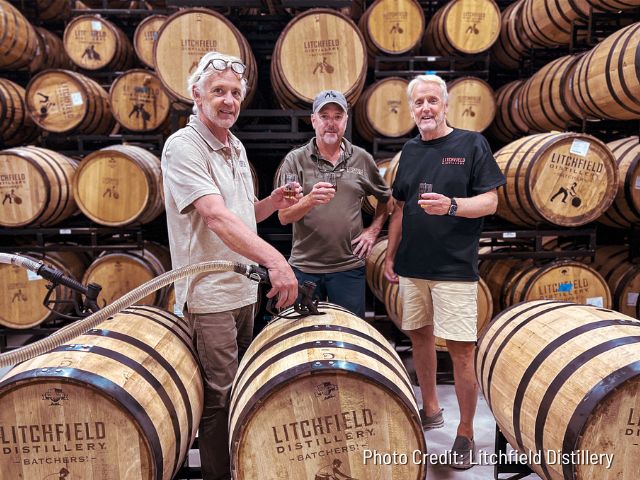
I didn't have a lot of cushion here before getting to my next destination. And plans were to interview Peter Baker, one of the founders of the distillery. I got a little hung up on us 2 0 2 when I got to New Milford because school was letting out. And so there's a bit of traffic. It's two lane road to get up to Litchfield, beautiful area, and just loved driving through the hills and perfect time for the leaves to be at peak. I was told that actually they're a little late this year, which is perfect for me because the hotels are fairly priced and not a lot of traffic on the road. Just really a beautiful scene out here. So I get to the distillery, Peter and I arrived at the same time, and I got inside. We took a tour of the distillery. I have to say it is one of the most sterile distillery operations that I've seen, at least since tele Moore do in Ireland.
(03:54):
It looks like you can eat dinner off the floor in that place. Well organized and lots of floor space in the middle. And then Peter asked me what I wanted to taste. Well, I got to head to Rhode Island after this, so I thought I'll just have a couple of things bring out what you're really proud of and that you would like me to taste. So let's jump into our conversation with Peter Baker of Litchfield Distillery. Litchfield is a name that's come across on my bracketology. You guys have been in, I have a friend of mine that lives in Florida. He's from Connecticut. He's like, Litchfield Litchfield, you got to get up there.
Peter (04:30):
Oh, no kidding.
Drew (04:32):
You've been on my curious side here for a while. So kind of go a little bit into the background of the distillery. How did this all get started?
Peter (04:43):
So that's a good question. My brothers and I have two brothers, David and Jack. So somewhere around 2011, 2012, we had been in a family business for three generations in a bottled water business. We were looking to do something to diversify a bit and to have the three of us work together and create something different than the water business. We looked around at different industries and one thing led to another, and we liked the bourbon space. We primarily started to make, the reason we got into this was to make bourbon. Obviously we make other products now. So one thing led to another and we worked with some consultants and my brothers did a lot of investigative work and research and all that, and we said, yeah, this is something we think we want to get into. And a lot of people say, oh, you got a nice hobby going there, but we didn't do this to be a hobby. We did this to build a brand and to make the best craft spirits that we could possibly make. So it wasn't a little thing we did with my brothers. We went full into this thing to make a real brand and a real product, which I think we did.
Drew (05:50):
So the water business that you've been in, was that based here in
Peter (05:55):
The field? It was all through New England and New York State. It was a pretty big operation, but my brothers and I grew up on the ground floor. We did everything by hand. And so the logistics, the manufacturing had to do different things. That was kind of second nature to us when we got into the bourbon business was some of the science is different, but a lot of the things we do here we did in our water business previous.
Drew (06:20):
So what time period was this that you got this up and running?
Peter (06:23):
So I would say we started probably really in the beginning, 2011, 2012. And we started actually making our first barrels in December of 2014. So we just hit our 10 year milestone back in last December.
Drew (06:39):
So were there other distilleries in Connecticut at that point, or were you guys early on?
Peter (06:45):
Yeah, I mean, there was a lot of licenses that were out. Some people had looked into it, got a license and maybe started and didn't go through with it all. Some continue to, a lot of 'em made clear spirits. A few make bourbons now, or aged spirits. But yeah, there's probably seven or eight going concerned businesses here in Connecticut
Drew (07:09):
In terms of Litchfield. And driving up here is a beautiful drive to this area. Of course, this is being recorded in mid-October, and the trees are at peak, obviously at this point because it's
Peter (07:20):
Gorgeous. It's very beautiful here. Yeah.
Drew (07:22):
What is Lichfield known for? I keep seeing the sign 1719. So it's been here for a while.
Peter (07:28):
Well, obviously it was early colony days. Litchfield is the county seat here in Connecticut. Litchfield is known for what you just saw when you drove up here. Beautiful. Rolling hills, lakes, rivers, vacations. A lot of New Yorkers have second homes up here. A lot of summer camps, A lot of vibrant businesses are up here, a lot of tourism. We happen to be on the Connecticut Wine Trail here, which is a big thing here in Connecticut. There are a lot of wineries here in Connecticut, and we partner with them. A lot of the wineries and breweries for that matter, buy our used barrels and they age their products in our, so there's kind of a co-op between the three different spears, the beers, and the wines and the distillery. So it's kind of a nice mix there.
Drew (08:14):
Were you thinking when you were starting this up that you were probably going to be kind of more for the tourists coming through? Were you thinking or were you thinking bigger? Let's get this out?
Peter (08:26):
No, like I said, we didn't do this to make a hobby. And when we did first buy this building, even though it has great exposure on the main thoroughfare here, we weren't allowed to have tastings. We could do tours. We weren't allowed to have people come in and do a tasting. We weren't allowed to sell some of our products out of here, so we didn't really think about it as a tourist destination because it'd be nice to go see a tour of a distill, but if you can't taste the products or buy something to take home, then why would you come here? But the building suited us. It was kind of central to where my brothers and I lived, so that worked out. And then my brother Jack worked hard all along with other distilleries in Hartford to get some laws changed to become more like the breweries and wineries where people could come and taste and buy a sample to bring home and then hopefully buy whatever they like from their local liquor stores or ask for at their local restaurants when they got back to their own communities.
Drew (09:21):
Yeah. What was the first whiskey you wanted to make? Traditionally people are going to go bourbon. We know bourbon cells. Was that?
Peter (09:32):
Yeah, we were all focused on bourbon, obviously, like many facilities do. We made clear spirits early on because you can turn that around real quick and get it in the marketplace. Marketplace as opposed to bourbon where you have to have an angel. Well, we did sell six month old bourbon when we were six months old because that's what we had. And again, truth be told, we did have some other juice from another distillery early on. We've, since long ago, sold out of all that, it's been seven or eight years since we had sold bourbon here. That wasn't our own bourbon.
Drew (10:04):
Yeah. Did you try any blending experience?
Peter (10:06):
We haven't done a lot in blending, no.
Drew (10:09):
Yeah,
Peter (10:09):
Most of it's are straight, and then you'll see some of the products here as we go on with the double barrel. All the bourbons are all the same Nashville, it's all 70% corn, 25% rye, 5% Malta, barley, and all those grains are grown here in Connecticut. We do as much business with local farmers as we can. Even our flavored vodkas are flavored by fruits that are grown here. Strawberries and blueberries are grown here in Connecticut, and even our spent mash goes back to the farms for fertilizer and feed and all that. So the farm community, obviously Connecticut's got great soil, they grow great crops, which for us turns into great bourbon.
Drew (10:49):
Nice. The first thing, because we've got some things to sample here, the first thing that you brought out, we're trying to figure out the order for, and we're talking about bourbon, but you just actually have made American single malt one of your core products.
Peter (11:05):
We have. So we have had some single malt from years past. Before it was a category we were just experimenting. So some of that we've actually have bottled and sold out before this became an actual category. In the meantime, we started building up our barrel reserve of aging single malt, anticipating that the category would become a real category. So this is a hundred percent malted barley
Drew (11:32):
And the barley. Everybody always talks about everywhere I go, they're like barley. We can't grow barley around here. So this is local barley.
Peter (11:39):
It is local barley. This barley happens to come from, I don't know now, eight or 10 generation farm up in the Hartford area, our Connecticut River Valley, and they were known for growing tobacco. And Connecticut River Valley has the most famous cigar wrap tobacco that's kind of worldwide known. And so they have changed some of their fields over to other products, other crops I should say, that can feed the beer industry or in our case, the distilling industry. So they were the first, it's a all family farm. They were the first malthouse here in Connecticut. So we started doing business with them early on. And so here we are with now a real category. This is a three-year-old single malt, which I think it's pretty tasty. It's
Drew (12:27):
Got some nice fruity notes to it. What's interesting is I'm still trying to wrap my head around as being somebody who's a scotch drinker, this idea of using new charred oak barrels and how that affects, but you have much milder climate here, so it's probably not going to be overly aggressive
Peter (12:48):
With the
Drew (12:48):
Char on the barrel.
Peter (12:50):
We talked about that early on. Obviously scotch is in used barrels and it ages a long time. I liked the char myself, so to put it in the new barrels kind of made sense for us. We weren't going to have it be 18, 20, 20 2-year-old single malt. And this is the American version?
Drew (13:10):
Yeah, well, it's got a nice little caramel finish on it, which is what I'm getting from that barrel. And so it makes me think that if you are a bourbon drinker, this is if you're wanting to try the American single malt category, this is kind of going to give you the comforts of home.
Peter (13:30):
So early on when we had people come through here, a lot of Americans were scotch drinkers. They were going to try bourbon for the first time or whatever, and obviously bourbon's a lot sweeter compared to a scotch, and a lot of people did over the years convert from drinking scotch to bourbon. But there's still a lot of loyal scotch drinkers, and I think that appeals to, I'm not a PD smoky scotch person anyway, so obviously this isn't that, although a little bit from the char. But yeah, I think it crosses over pretty well.
Drew (14:08):
So you've got two bourbons here,
Peter (14:12):
So this will be a little bit of contrast. So this will be our six year double barrel. So when this was five years old, we dumped the barrels and then we proofed it down a bit, and then we put it back in the barrels for another year of aging. So this is going to have a nice smoothest to us to it. This is what I would sip on after dinner or sip by the fire on a Sunday afternoon, watching the giants loose in the fourth quarter.
Drew (14:42):
That was my question. As I was driving up here, I was going, this is New England. Do they watch the Yankees or the Red Sox?
Peter (14:50):
So there's an unofficial demarcation point of Route 84 that runs East West through southern New England. And if you're, it's a rule of thumb, it's not absolute, but if you're south of 84, you generally root for New York teams. If you're north of 84, you generally root for Boston teams.
Drew (15:07):
Okay. It's got to be tough. And if you're driving down 84, you're just confused. It's got a nice soft, approachable palette to it and nice mouthfeel.
Peter (15:22):
Yeah, we've won a lot of awards over the years. So yeah, this is, I think the six years old's been on about eight or nine months now. Prior to that, we had a five-year-old double barrel. So
Drew (15:34):
What's the process for the double barrel
Peter (15:36):
When it's five years old? We dump the barrels, add proofing water to it, let the proofing water and the bourbon mix together, put it back in the barrels again for another year of aging.
Drew (15:47):
Same barrels, the same barrel?
Peter (15:48):
Yeah. It goes back in the same barrel. So they're used barrels
Drew (15:50):
Technically,
Peter (15:52):
And then you fill the barrels back up, so it creates more surface contact area as opposed to the loss rate where you lose that contact area and now you have proofing water in the barrel, whereas a straight bourbon is going to have proofing water after it comes out of the barrel.
Speaker 3 (16:08):
Yeah.
Peter (16:09):
So the proofing water mixed with the bourbon gets to have some of that contact surface area, and it really smooths it out nicely.
Drew (16:16):
So basically you're kind of getting, you're doing your blending of or marrying a barrels together ahead of time to kind of even things out before you stick it back in the, because I'm thinking you could just stick water into the barrel. Did you try that experiment to see,
Peter (16:33):
We never did it that way. No. We've always dumped. We are a small craft distillery, so we're only going to dump three, four, or five barrels at a time and make a batch out of that. And so we've never just added the water back into the barrel. We've done it after the barrel, then back in the barrel,
Drew (16:50):
And
Peter (16:50):
After we dump the barrel then back in.
Drew (16:52):
It's always interesting to see techniques and how they come
Peter (16:54):
About. Well, that's why everything is like, I don't know if it's half and half, but it's science and art. Right,
Drew (17:00):
Exactly.
Peter (17:01):
Yeah.
Drew (17:01):
Yeah. And you're not going to know until you try.
Peter (17:04):
Exactly. The problem with trying is you got to wait a few years to see if what you tried worked out, which for us, luckily we haven't had anything we didn't really like. We haven't had anything that we had to pour down the drain by any means.
(17:20):
And again, for a small distillery like ourselves, we have a lot of different products that fit a lot of people's different taste profiles from single malt to six year double to what we're going to try next. Our oldest 8-year-old straight, we have flavored bourbons, lower proof, 86 proof flavored bourbons for people that maybe not quite ready to drink a straight bourbon, and they're going to have a maple or vanilla cinnamon or a coffee flavored bourbon that we make. And then the other clear spirits with the vodkas and the gin and the flavored vodkas or agave spirit. And then we make full strength cocktails in a bottle ready to drink cocktails. We make old fashioned a Manhattan Cosmo and espresso martini. Everything's made with real products. Our espresso martini, we cold brew our own coffee here.
Speaker 3 (18:12):
It's
Peter (18:12):
Real coffee. It's not lcu or coffee flavoring. The Cosmo, we make our own triple sac here, real cranberry juice. And so we don't cut any corners. We put any artificial flavors, colors, or sweeteners in anything we do. So we're a true craft distillery. We make it by hand. We're out there doing the mixing and all that stuff ourselves.
Drew (18:37):
You have a nice spiffy clean.
Peter (18:39):
Well, like I said, we came from the water industry, and that was a very sanitized industry, and we really follow good manufacturing practices. And listen, this is our home. People come here and they come through and we bring hundreds of people through here every week, and we want that wow factor when they walk in and everybody goes, wow, this is nice. And cleaning here. Yeah. Well, yeah. Well, you're going to end up drinking what we're selling here. So yeah, now everything's nice and clean. That's what we do.
Drew (19:06):
Yeah. My curiosity is running with the bottled water thing, because I always think of bottled water as kind of a more modern thing. In the early two thousands, late nineties, everybody had to walk around with a bottle of water. But before that, I don't really remember it. Was it prevalent at that time?
Peter (19:28):
Prevalent is relative, but my grandfather started the business in 1914, and we weren't the first ones. There was bottled water companies going back to the late 18 hundreds. So it was something where it was this part of the United States. New England had a lot of European immigrants, and they were not used to drinking tap water. They all drank bottled water in Europe years ago. They couldn't trust the tap water
(19:51):
As the industrial revolution happened and people working in the big factories with the heat in the summer and whatever, they needed to put water where the people were, but they didn't have plumbing to get water and drains and stuff where the people worked. So there was the iceman that put ice in the cooler, and we put, my grandfather put bottles on top of that, and the water ran through the ice and people got cold water in the middle of the summer, and then it became a fad in the, I dunno, eighties or nineties or whatever. But no, bottled water was a true staple product for a lot of people earlier on than people of our generation think about.
Drew (20:27):
But it would've been glass bottles in those early days.
Peter (20:29):
We delivered glass bottles when I was first delivering water, it was in glass bottles,
Drew (20:33):
And that was up till
Peter (20:35):
We probably transitioned in the early eighties, mid eighties to plastic.
Drew (20:41):
Okay. That's interesting.
Peter (20:43):
Yeah.
Drew (20:43):
Maybe it was the rise of plastic that,
Peter (20:45):
Yeah. Now we're back to glass bottles.
Drew (20:47):
Yeah. With your bourbons. Yeah,
Peter (20:49):
Absolutely. You want to try our latest?
Drew (20:51):
Yeah. Yeah. Any surprises that you've had since you got into this business? Things you didn't really, or products maybe that took off that you're like, oh, I didn't really expect that was going to do.
Peter (21:05):
It was kind of systematic what we've done, and we kind of try to stay ahead of some of the trends in the industry. I can't really look back and say I was really surprised that much. Maybe the fact that once in our case, the state of Connecticut realized that they hadn't brought the regs up for distilleries as they had for wineries and breweries and how helpful they were, and bringing us up to that level where we could have tastings and sell out of here and how we distribute and things like that, which was nice to have a government that looked at a small industry and said, Hey, we can help this industry out and create jobs and do that sort of thing. So that was a nice surprise. I don't think I have any negative surprises up to this point
Drew (21:50):
With the flavored spirits. How long did it take before you moved into those?
Peter (21:55):
That was pretty early on too. Like I said, a lot of people weren't necessarily into brown spirits at that time, so we kind of called it our entry bourbon, but also mixologists kind of gravitated towards, because if they're making different types of drink, not your traditional old fashioned or Manhattan, they're making different drinks now. We've got a base bourbon with a vanilla or maple or cinnamon flavor that they can use that in their creativity to make different cocktails that they're looking to make. So it kind of helped bring some non bourbon people into the category, and it helped out in the on-premise business with mixologists and that sort of thing.
Drew (22:34):
Yeah. Do you see them outselling your
Peter (22:37):
No. The maple and vanilla are very, very popular. Our main bourbon, which it's not out here for us to try right now, is our 5-year-old straight bourbon, which at five years old, I think it drinks great on its own, but that's what I make my old fashioned with.
Speaker 3 (22:51):
It's
Peter (22:51):
Got the straight bourbon, has a nice little bite that comes through your mix, the old fashioned mix of simple syrup and bitters and all that. Like I said, the 6-year-old, we just tried, to me, that's just, we're going to just sip on that.
Drew (23:05):
Yeah,
Peter (23:06):
I guess looking back, I'm surprised we have so many products to offer, and every time we say, okay, this is the last one, we're Notre not going to do another one. And then my brother, we're sitting here today, my brother's going, well, what are we going to do next year? And so here we go, we're going to figure something out.
Drew (23:22):
Got to keep that creativity. It keeps it interesting.
Peter (23:25):
Alright. You want to try one more?
Drew (23:26):
Yeah, let's go ahead and do that.
Peter (23:27):
Alright. So this is the oldest bourbon that we've distilled and bottled here. This is an 8-year-old, we call it our founders reserve, which I just poured some on the table
Drew (23:39):
Tables get thirsty too.
Peter (23:40):
That's right. So this is, again, same Nashville, 70% corn, 25%, 5% malted barley. It's eight years old, it's a hundred proof. So basically you could characterize this as a bottled in bond, although we didn't label it that way. A little higher proof than our other bourbons.
Drew (24:00):
Wow. The thing I always wonder about when you start getting to your first barrels that are getting to eight, nine years is how much the oak takes over. But it doesn't, I mean, this is maybe in a way that the char and stuff is bringing kind of this nice toasty flavor, but yeah, it's very rich, actually. Rich in terms of a thick flavor. I mean, there's a lot going on there.
Peter (24:30):
No, I mean, we say we've done this for, well, we did the six year was the oldest 7-year-old oldest, now eight years, our oldest and everybody like, wow, that's really good. And then next year it's like, wow,
Drew (24:44):
That's really
Peter (24:45):
Good. Again,
Drew (24:45):
Just keeps getting better. But the problem is, is that stocks keep getting smaller.
Peter (24:50):
That's true. And so we have to try to organize for that. But yeah,
Drew (24:53):
It's almost like a little black tea note to that.
Peter (24:55):
Okay.
Drew (24:56):
It's really interesting
Peter (24:58):
With all we do here, the different flavors that people call out, it is pretty wild. From coffee to bananas to,
Drew (25:07):
Yeah. I mean, I could probably see a little banana in there too. Interesting. Yeah. Now the question is where do you find the sweet spot is and that you go, what is it, five years? Do we go a little longer?
Peter (25:23):
Yeah, that's a good question. And we talk about it all the time. So I'm sure we're always going to let a couple barrels get older and older and see where that takes us. But yeah, I mean, again, going back to science versus art versus public appeal, sky's the limit. We don't really know where somebody walks in the door tomorrow and said, this is the next best thing. As old as it is, it's an evolving industry.
Drew (25:53):
So on each of your bottles, you have em, Boston, their spirit of hard work. Where did that come from?
Peter (26:00):
Well, that came from our partner in crime here. Tony, who you met initially came up with that slogan, which we fell in love with right away. I mean, it is perfect. I mean, it's what we do here. We work hard, and whether it's sweeping floors or grinding out what our next product's going to be, and our people work hard and we make good spirits. So that tagline is perfect for what we do here.
Drew (26:29):
And the guy on the bottle,
Peter (26:31):
So the guy on the bottle was our first employee, James McCoy. He came to us through a consultant and he was our first head distiller here. And he was literally rolling a barrel one day to move it. And the hat on his head, the hat he wore every day, it's not a prop. And he was moving a barrel and my brother saw him and he said, Hey, can you keep rolling it back and forth? And then, I dunno, Tony or my brother were taking pictures of it, and then Tony turned it into our logo.
Drew (27:00):
Nice.
Peter (27:01):
Yeah, so it's a good story. Actually, James' mother used to live in Litchfield here. I'm not sure if she's still here or not, but he was with us about three years. He moved on to help another startup distillery in New Hampshire. And I haven't seen him in a little while, but we owe a lot to him to have
Drew (27:20):
You see him every day. He's on your bottles. He always see him every day.
Peter (27:22):
Yes. And people ask when they come, who is that guy? Where did he come from?
Drew (27:26):
Yeah. Very nice. Well, Peter, thank you so much for walking me through the spirits and taking some time to talk about Litchfield so people get a little better idea. And they know, especially in October, it's a great little drive to come up through here and see.
Peter (27:41):
You don't want to come here in January?
Drew (27:42):
No, probably not. Probably not.
Peter (27:45):
Well, thanks. No, it is beautiful all year round here. But we appreciate you coming
Drew (27:48):
Up. Thanks so much for being on today. Absolutely.
Peter (27:49):
And good luck with everything you're doing.
Drew (27:50):
Thank you. Cheers. I hope you enjoyed this journey to Litchfield Distillery in Western Connecticut. And if I peaked your interest in visiting Litchfield, well head to whiskey lore.org/flights. Click on Litchfield Distillery there on that page, and you will get to the profile page for the distillery with all the social media links and website booking links. And if you want to go to the distillery, we'll just go ahead and add it to your handy whiskey lore wishlist, which you can get by signing up for a free account. And to find details about this and hundreds of other distilleries across the United States. Pre-order your copy of Whiskey LO's Travel Guide to Experiencing American Whiskey 2026 Edition, where you'll get all the insider tips and logistics on distillery travel and some travel advice for all 50 states plus 200 plus descriptive distillery profiles and over a thousand distilleries listed nationwide.
(28:51):
Pre-order your copy now@whiskeylore.org slash shop. And as I prepare for my next destination, if you are still on the fence about to visit to Litchfield, let me give you my three reasons why I think you should have this distillery on your whiskey lore wishlist. First, it's that beautiful drive in and then the reward of getting a complimentary tour and tasting. This will give you an opportunity to see what I mean about how spiffy this distillery is. Second, it's a great family story, a generational business that's evolving to keep the passions of the family business humming. And third, they've got a great variety of flavorful and complex spirits. Now they have an eight year bourbon. So this is the maturing of a craft distillery. I had an opportunity to take a bottle of their rye whiskey with me, and I am very impressed with the depth of flavor and complexity in that whiskey.
(29:52):
Well, I am back on the road again and not a ton of distance to go. This time I got to drive through Hartford, my hotels on the other side, and then I will be stopping in the ocean state in the town of Pawtucket, the town that used to be the home to the Boston Red Sox AAA affiliate baseball team. Unfortunately, they moved north to Worcester, Massachusetts, but no worries. Pawtucket, you are getting in trade for that. Actually, it's an unrelated incident, but the distillery I'm going to visit was once in Massachusetts and has now moved to Pawtucket. Then I'll be heading to Boston itself to taste a whiskey made from Kraft beer to join me. Get your ticket to ride along by smashing that subscribe button on your favorite podcast app. Your travel guide, drew Hanish. And until next time, cheers and Slava for transcription travel information, including maps, distillery planning information, and more, head to whiskey lore.org/flights. Whiskey lore is a production of Travel Fuels Life. LLC.
About Litchfield Distillery
Tours available.
Take a Whisky Flight to Litchfield Distillery
Map to Distillery
Note: This distillery information is provided “as is” and is intended for initial research only. Be aware, offerings change without notice and distilleries periodically shut down or suspend services. Always use the distillery’s websites to get the most detailed and up-to-date information. Your due diligence will ensure the smoothest experience possible.