
131 - LOCH LOMOND DISTILLERY: Scotland's Most Flexible Distillery
Listen to the Episode
Show Notes
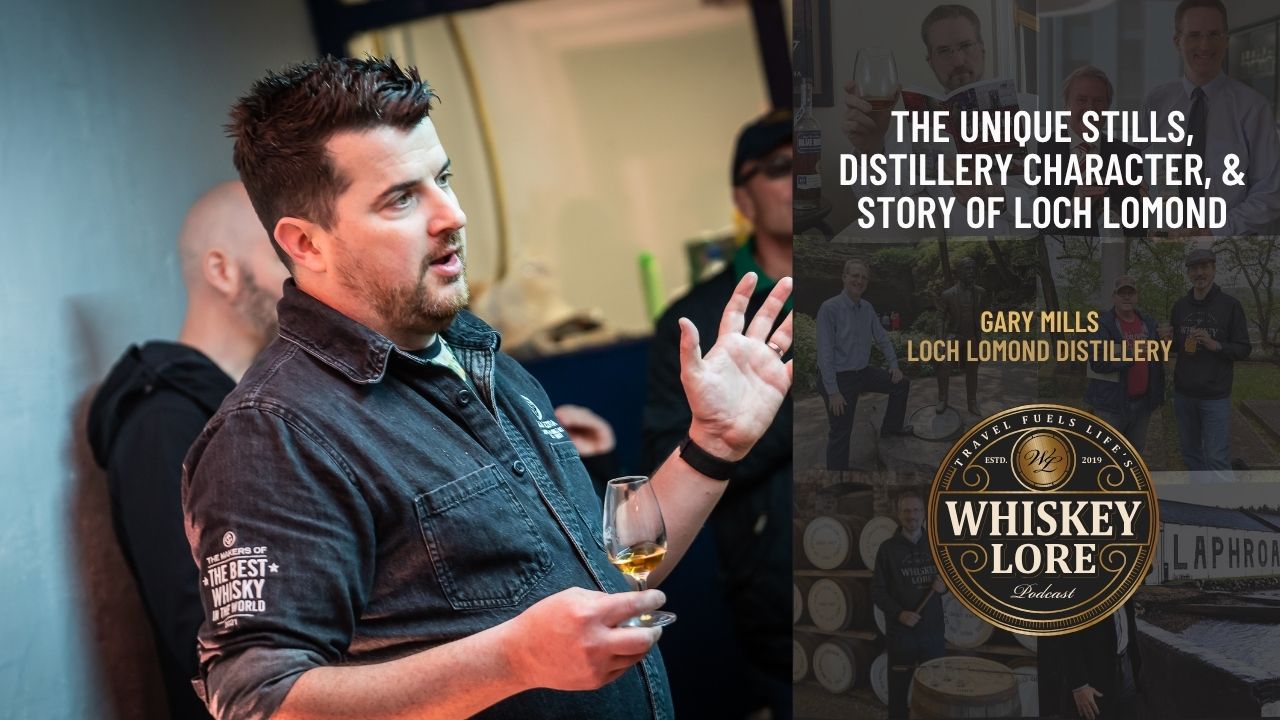
Join me as I chat with Gary Mills, the Award-winning Brand Ambassador and Visitor's Experience Manager for Loch Lomond Distillery - a whisky that is making its way across the U.S. thanks to the Foley Family's distribution. We'll dive into the unique history of the distillery, the stills that set it apart from the rest of Scotland, and I'll ask about how the Scotch Whisky Association put the breaks on how they labeled one of their whiskies. We'll also learn the origins of the Lomond still and find out what the difference is between that and the unique column still at Loch Lomond distillery.
We'll finish with a tasting of the 12 year and 18 year expressions and chat about the uniqueness of having a cooperage on site.
🌟 If you want bonus content, make sure you're a member of the Whiskey Lore Speakeasy, where this interview contains 20 more minutes that goes into the devil's cut, more details about the historic Littlemill Distillery, and the distillery's yeast focus.
Transcript
Want more insider information about Loch Lomond, enjoy an extended conversation with their Awarding winning Brand Ambassador Gary Mills as a member of the Whiskey Lore Speakeasy at patreon.com/whiskeylore
Drew H (00:00:14):
Welcome to Whiskey Lore of the Interviews. I'm your host, Drew Hannush, the bestselling author of Whiskey Lore's Travel Guide to Experiencing American Whiskey, Experiencing Kentucky Bourbon in the book that busts 24 of Whiskey's Biggest Myths Whiskey Lore Volume one. And this week, I'm very excited to be back talking Scotch whiskey again, heading overseas via our little Zoom feed and getting into a little bit of Scotch whiskey history, talking about stills and talking about whiskey, of course. And we'll be actually meeting Gary Mills, who is the global brand manager and visitor's experience manager at Loch Loman Distillery, which is a highland distillery just west of Glasgow. And I've driven near it. I have not actually been there before, but it's on the way to Oban and Campbeltown. So that means definitely a well-traveled path for me. So I'm looking forward to talking about the distillery because I've seen the bottles around.
(00:01:11):
I know about Laklaman mostly through my experience in talking with Ian McAllister at Glen Scotia because they are part of the La Gloman group as well. So we'll dive in and learn a bit here. So Gary, welcome to the podcast.
Gary M (00:01:27):
Thanks, Drew. Thanks for having me.
Drew H (00:01:28):
Yeah, it's great to dive in. Congratulations on your award, by the way. Tell everybody what you just earned here from the World Whiskey Award.
Gary M (00:01:37):
Thank you so much. Just last Wednesday there at the World Whiskey Award Global Finals, I was named the World's Best Scotch Whiskey Ambassador.
Drew H (00:01:49):
Nice. So somebody's paying attention to what you're doing.
Gary M (00:01:51):
Well, yes, thankfully. No, it's a big honor to be able to have it. Genuinely, it's a job I love doing, Drew, and just to get any sort of recognition is great, but to be recognized in a room full of amazing whiskey people was just, yeah, something else.
Drew H (00:02:12):
So how did you get into all of this?
Gary M (00:02:14):
My degree was in marketing. And when we all graduated, one of my friends was lucky enough to get a job into the drinks industry very early on and made a lot of us very, very jealous. So I made it my mission from there to get into drinks. And as you may well know, I imagine it's very similar to the other side of the pond. It's not the easiest industry to get into.
Drew H (00:02:37):
Yeah. It's
Gary M (00:02:37):
Tough not to crack. So I went round the houses of ... I've had many, many roles, whether it's milk or water and sewage funnels or beauty products. Before finally landing my absolute dream role in the Lokalman group I joined. So the Local Lomen Group was formed in 2014 and I joined in April of 2015. So as of next week, I'll be into my 12th year with the company.
Drew H (00:03:02):
Wow.
Gary M (00:03:03):
And it was just the very start. So they were refreshing the Loklomin range, refreshing the Glen Scotia range. And when I joined, I doubled the marketing team. So there was only me and one other to do everything for everyone, Drew. And it's just been a wild ride ever since.
Drew H (00:03:19):
You get to be a man of many hats. I know that experience because before I jumped in and became my own web designer for a while, I was working for a marketing department. And as they cut positions, I went from being a web designer to being a graphic designer to doing trade show graphics and things like that. I mean, you sometimes in the smaller group have to pick up as many hats as you can. No,
Gary M (00:03:44):
Absolutely. So that it's been such a dynamic business and it's changed very quickly and it's grown very quickly. But like you said, it just means you just need to get stuck in and do whatever needs done. And I love that. It's one of the things I love about marketing in general and then throwing spirits and whiskey into the mix. And it's just been an absolute dream.
Drew H (00:04:03):
So what was Locke Loman's direction as you guys are taking this over now and you're starting to push more into a marketing area, was it used for blends and things like that or was it a brand on the shelf?
Gary M (00:04:17):
Yeah. So the history pre-Locklemon Group was very much blend focused. The two kind of arms of the business were bottled blended scotch, but also bulk whiskey. So they were selling a lot of volume whiskey going into out of the tanker loads for other people to bottle and do with as they wish. So produce a good quality young whiskey sent off to volume.
Drew H (00:04:42):
In coming in and trying to get a direction going for that, I mean, where do you even start? And did you start with either Glen Scotia and then move to Lakoman or were you doing both simultaneously?
Gary M (00:04:56):
That would be far too simple, Drew. We decided we were doing everything at one time. So Glen Scotia was probably the easier of the two. Campbelltown has a very defined style, and that was the kind of easy bit was the two driving factors behind the Glen Scotia range where one, the liquid had to be of Campbelltown style and available year round. And within those parameters, it was really easy to then find the bits that all fit. Finding the Loc Lomand grove took a wee bit more. That evolved several times. Previous owners weren't focused on single malt. There was a small amount of single malt. So we first off lent into those historical elements, but then as that grew arms and legs, it kind of morphed into something else. We had to take that step back, do a bit of a reset and really more clearly define what Loch Lomand distillery is all about.
Drew H (00:05:49):
As I saw when I was traveling through, I was like, "Boy, I'd love to go visit there." But it doesn't look like Laklaman actually has just like a general tourist kind of visitor's experience versus Glen Scotia. Is that ...
Gary M (00:06:02):
That's correct. We're not open to the public. And if I'm being honest, we're not realistically likely to be in the near future. It's a beast of a distillery and it's not the most accessible distillery, if that's probably the best way of putting it in terms of getting around the distillery, because it's shoehorned into a preexisting building, very much like the instant, similar way. It was into an existing preexisting building that had access to water that gives you a head start at the beginning of your journey, but you fast forward to 15, well, now 60 years down the line, starting to pose as a few challenges, Drew.
Drew H (00:06:40):
Okay. And then you've got Glen Scotia, which does have a visitor's experience. Were you playing any part in trying to put that together as part of your whole marketing package?
Gary M (00:06:52):
Well, so thankfully, when I came in, when I joined, the visitor center had literally just opened a matter of weeks. So it's really been evolving from there. And that's a journey that still goes on to this day, to the point where when we opened the current visitor center, you've been in Glen Scotia before, haven't
Drew H (00:07:10):
You? I have, yeah.
Gary M (00:07:11):
So it's quite a small shop. We're kind of set up, we could probably do it in the shop by tasting for maybe six or eight people at a push. And at the time, remembering we had nothing before that. It was just Ian's old office. The viewpoint was if we're regularly hosting six to eight people for groups on a weekly basis, that'd be a wonderful place for us to be. But you fast forward 14 years and we're now, there are busloads of people turning up. The boom of Campbelltown has exploded again. So we're now at the point of we're looking to expand, we're looking to redevelop the visitor center and make it a bit more fit for purpose and a bit more future proof.
Drew H (00:07:49):
What was fun about my experience at Glen Scotia was that I went in there and small teams, so everybody's kind of buddying up on what they need to do. And so our tour guide had actually leave to go help bring some supplies in or something. So he left us with Ian, and that's where I meet Ian McAllister at that point. And what's really fun about having him do it is that you can tell he's really proud of the stuff that he made. So he's like, "Ooh, wait, I got a bottle of such and such." And he goes back and grabs it and you're like, "It feels like you're at his office while you're there because of the size of it and because if you interact with him, he was such a friendly person that just wanted to share whatever he was doing with you. " And so that's a great experience too.
Gary M (00:08:41):
Yes. It's just too sad to the coin of Campbelltown because you've got Sprint Bank who, because of the nature of what they do, they do everything on site from malting the barley to bottling and labeling. So they've got massive stuff. And the analogy, or the point I always make is they literally have more people on site to do just tours
Drew H (00:09:03):
Than
Gary M (00:09:03):
We have total staff.
Drew H (00:09:06):
Wow. Well, and then what's interesting about this is that as I was looking at the distilleries that you have under your care for the Laklaman Group, one of the names that sticks out to me is Little Mills. Now I'm assuming now, me being a history guy, there's always this talk about, what's the oldest distillery? And Little Mill was around, I guess I don't know that any of it exists anymore at this point. Is that true or is there anything on that site? The
Gary M (00:09:37):
Last bit that you can see on it is the distillery manager's house.
Drew H (00:09:40):
That
Gary M (00:09:40):
Still stands. Little Mill was on two sides of a road. The side nearest the Clyde is now flats. And the reason why they didn't develop the other side is because the water ... Well, there's a water source. There's a stream that runs underneath that side. And because we're so near the river, effectively, there's not enough concrete in the whole of Scotland, I think, to fill that gap to allow you to build on it. So that's why the distillery manager's house still ... Or what's left of it still stands.
Drew H (00:10:08):
When did that distillery go down as I understand it? So
Gary M (00:10:12):
Late 1990s, finished production. The last production was 1994, burned down in 1997.
Drew H (00:10:18):
So how do you market a whiskey that doesn't have a distillery anymore?
Gary M (00:10:24):
We're very lucky in a way, Drew, and that we're now one of the only silent distillery with spirit left that is not reopening.
Drew H (00:10:34):
Okay.
Gary M (00:10:35):
Also, we're in a very fortunate position where you know there are so many of these kind of fortunate accidents where things just happen and it turns out 20, 30 years, it makes this wonderful thing. Because the previous owners sold off all the first fill bar bink asks to liquidate cash quicker. The stock that we were left with was primarily refill urbans, which through its first 10, 20 years wasn't wonderful for, but honest, very average, which much blending whiskey was back then, but as it hit 25, now 30, almost some of it pushing 50, Drew, it is ... I kid you not some of the best liquid I've ever tasted from a whiskey perspective. And that's ... I've been very fortunate to have tried a real wide variety, but it's such a vibrant, youthful, fruity character to it that you just don't expect for a whiskey of its age.
(00:11:32):
And the key thing for us is to be able to put liquid on lips. And as much as it's a ... You would think we would want to block and sell all of it, but it's a whiskey that I want people to experience because it is so magnificent. And we're at a stage now that old whiskey ... I mean, you rewind 10, 12 years ago, and if you had a 50-year-old whiskey, people bought it because it was a 50-year-old whiskey, because there weren't that many of them about. But it now feels like there are so many more distilleries that have that. Nevermind Gordon McPhail putting out 60, 70, 80-year-old whiskeys as well. The age is not enough. So it's got to have something else to it and it's got to be good liquid. You need to be able to let people try it and let them hopefully blow their socks off with it.
Drew H (00:12:20):
I talk about the fact that people didn't really necessarily do tasting notes at large scale until the 21st century. Now all of a sudden we're all versed on tasting notes, but it brings up that question of a distilleries personality. And since you have the last barrels from Little Mill, how would you describe the personality of that distillery? Is there a character that really stands out? You said fruity. Yes.
Gary M (00:12:49):
Yeah. So that's ... And again, it is one of the things I love about the Loch Lomin group is that there are these three distilleries within the group, but they're all linked in such a wonderful way, to the point where essentially the liquid we are now making at Loch Lomend is the modern little mill liquid, if you like, because of that same style of still that's been brought through and put into lock lomen. So it's that the real kind of defining characteristic, fruity, yes, for sure. That light, lowland, triple distilled style, but it was to do with the variety. Little mill was the thing that really set them apart. I think they were one of the first scotch distilleries to be able to release ... Or they released whiskeys under different names because the characteristics of them were so distinctly different. So the three spirits coming out of Littmal were Little Mill, Dunglass, and Dunbuk, and they were released under those names because they were so distinctly different.
Drew H (00:13:50):
And when you're saying different, were they peeding whiskey at all or did they ...
Gary M (00:13:55):
Yeah. So the little mill would be unpeated, the dumbbuck and dunglass were the two peated, lightly peated and then medium peated with the two, but it wasn't necessarily just the same spirit pate It's to do with the style of still allowed for that real complexity of flavor to come through.
Drew H (00:14:12):
So it's really interesting because you're not far from the lullin line where you're at. And I think about how when I talk to people hear about scotch whiskey, they'll go, "Oh, the regions, and the regions all have their own personalities." But it never ceases to shock me when somebody says low limb whiskey, but now we're introducing the idea of Pete into a lullin whiskey, because that's not the first thing you think of when you think of lullin whiskey.
Gary M (00:14:41):
No, not at all. Yeah, we're very ... I mean, obviously Glen Goin talk about maturing in one region and distilling in the other, but we're on one side of the river leaving at Loch Lomand and the Loch Lemon Brewery have just opened Leaving Bank on the opposite side of the river leaving, literally the opposite side, and they're a Lolland whiskey and we're a highland whiskey. So the River Leving is one of those defining lines. I think with the exception of Campbelltown and Isla, I don't think the regions are as applicable from a flavor point of view anymore. They're no longer the same shorthand they were for the blenders back in the day for those flavor profiles. To your point, do you know what I mean? It's not the fact that Pete coming into the Lowlands, you've got brick and unpeated Isla. These kind of things, it's even the fact that there are 51 spayside distilleries in that small area.
(00:15:34):
There's no way you could throw a blanket over all of them and say, "That's what Spaceide is.
Drew H (00:15:39):
" Yeah, absolutely. One last thing about Little Mill, nobody really gets to tell that story anymore. So maybe here's a chance for you to kind of pop in here with oldest distillery commentary because I've been to Glen Turret, I've been to Strath Island. Both of them claim to be fighting for that title of oldest distillery in Scotland. So what is the background of it?
Gary M (00:16:07):
Yes. So part of my tenure through the Lokaloman Group was I was brand manager for both Glen Scotia and Little Mill. And at the very start, we knew very, very little about Little Mill other than when it stopped production, the fact that it burned down and that we had the last of the casks and that story only goes so far. Once you put out one release with those three bullet points, you've kind of exhausted that. So one of the first things I did was kind of set off, get some research done. So just see what we could on earth. One of the things we did always have though was there's a picture of the distillery building that it dates stone on at 1772, but you can't really build any sort of claim just off a photograph, off photograph of a building that doesn't even exist anymore, nevermind the
Drew H (00:16:59):
Datastone.
Gary M (00:17:01):
And we're very fortunate in that our researchers uncovered a license. It was a license to sell and distribute ails and other excisable liquors,
(00:17:14):
And that was dated 1773, which effectively with a lot of other information that we found allows us to really kind of pinpoint that 1770 to really legitimize it to the point that you're obviously, if you're applying for a license to be able to sell these liquids, it makes a lot of sense that you've been making them already and that you therefore have those liquids to sell. So it really kind of backed up that 1772 for us. And it's to the point where we don't claim ourselves to be Scotland's oldest distillery, because we know there are obviously distilleries that go back way, way, way back.
(00:17:58):
We're calling ourselves Scotland's oldest license distillery and a big part of that comes from the fact that the family history through Little Mill at that time was the Buchanans, so the Buchanans of Buchanan Street and Glasgow, big philanthropists, as many people were back then, and a lot of their history was through malt. There were mobsters that were part of these kind of conglomerations of the orders of the malt men, fine upstanding citizens as well. There were judges, there were doctors, these kind of things. And it's the kind of thing where, again, looking at that history and allowing some license to piece these bits together, if you are this upstanding family, members of the pillars of the community, it would go hand in hand for me that if that kind of family then has a distillery and the ability to have a license is there, then they're going to do it and they're going to do it properly.
(00:18:53):
So if we're going to have a distillery, we're going to have it licensed, we're going to pay taxes and we'll do it the right way. So they went out and they got the license and it went
Drew H (00:19:02):
From there. It'd be so fun to know what they were making back then. I have a theory that the Irish claim, the malted and unmalted barley, but then I did a whole whiskey law episode around the malt riots in Glasgow in 1725, which were about they're charging us too much tax on our malt and what are we going to do? And then found that Adam Smith actually in his wealth of nations wrote a recipe for what was commonly made in Scotland at the time, and they were giving malted and unmalted barley. So it'd be interesting-
Gary M (00:19:38):
No, absolutely. It was very much, for such a long time, it was what you could get around you. The transport was such that you didn't go too far or you didn't want to go too far. It would just make everything so much more complicated. So yeah, whether you could get malty barley and you would throw in whatever you could get from the fields around you. And again, nothing was really been matured at that point in time either. It was just about creating alcohol to get drunk effectively.
Drew H (00:20:08):
So let's get to the star of the show, which is the Lakoman distillery. Let's talk about the history of that distillery, because as I mentioned at the beginning, we hear of these 200 year old distilleries and beyond we're going for those longer records. These younger distilleries, they're not built into a farmer distillers record, that's not really where they kind of came from. So talk about the origins of Lokloman then and how it got into this blending world.
Gary M (00:20:39):
So taking a slight step back, there was a lock loaming distillery back in the early 1800s. It was up there north end of Lock Lomend up near Tarbet, but burned down a long, long time ago and we know very, very little about it. And realistically, the liquid that they would produce there would be wildly different from what we produced now. So we have been on the current site since 1964, the first spirit running in 1966, and it was actually opened as a Sister Distillery to Little Mill.
(00:21:12):
Like I said, they're all intrinsically linked together. So the owner at the time was a man called Duncan Thomas. It was him, a partnership between himself and Burton Brands. They established Locklemont on the site in Alexandria. Used to be an old dye works, massive diewarks called red, Turkey Reduction a very specific color, but it's huge, essentially a small village where everybody all stayed. And what it did for the little mill distillery company, they moved only about eight miles down the road as the crow flies, but like I said, it gives you two distilleries, one a land, one island. The little mill site was quite small, quite restricted in space, and the locklement is huge given that ability to expand. We currently have 28 warehouses on site.
Drew H (00:22:02):
Wow.
Gary M (00:22:04):
Combined with our offsite warehouses as well, we've got capacity told half a million casks. So it's a fair old site. So it allowed two different styles of whiskey, room for expansion and growth. Remember in '60s was when distillers started to think about single mold. It wasn't quite into the consumer mindset yet. So it was really kind of starting to build that momentum for them and that opportunity to grow. But the move into the blending side of things is really what shaped Local Mind into what it is now. And that was under the previous ownership. So a man called Sandy Bullock, Scottish businessman owned quite a few businesses across the country. And he effectively started off with the rights to sell a blinded scotch called High Commissioner. So he was buying the bottled product and selling that across the UK, but Sandy decided he wanted to make a bit more money from it, so he built a bottling hole.
(00:23:02):
So we have our own bottling hole down inertia. So he was buying the bulk liquid, bottling it and selling it, making a bit more money. He then decided realistically he wanted to make all of the money from it. So he bought a distillery.
Drew H (00:23:15):
Nice.
Gary M (00:23:15):
He bought distillery to be able to create the liquid bottle to sell it. So obviously for blended scotch, as your list as well be aware, you need both grain and malt whiskey. With the grain essentially being the vehicle and the malt whiskey is bringing all the different flavors to create that complexity of the blend. And unless you are Pernod Diageo, one of the big boys, you need to buy green whiskey from somebody else, different styles of malt from different distilleries to layer in that flavor. Sandy Bullock didn't want to do that either. So he evolved this distillery to be able to do everything, to become this self-sufficient, blended scotch factory. So we've got the green distillery and the malt. So we're the only distillery in Scotland that can produce both under one roof. So we're the only distillery in Scotland to be able to produce a distillery named blend.
(00:24:09):
And then where most distilleries will produce three styles of spirit with their swan neck pot stills, we've got the ability to make 11 distinct new make spirits from one side.
Drew H (00:24:20):
Wow. It's a bit of a shock to me. I not really thought about the fact that there were ... Because in the United States, we've got plenty of distilleries that have multiple potstell styles or a pot still in a column still in the same facility. Was this something that was ... I mean, the Scotch Whiskey Association could be very touchy about particular things. Was there an issue with that or ...
Gary M (00:24:45):
We did have it with one and it wasn't necessarily an issue. So we have standard swan neck stills that you'll see in every distillate across Scotland and across the world.
(00:24:56):
We then have our super unique straightneck pot stills. So it's a pot steel base with a kind of rectifying column on top effectively. But the one that probably caused us the biggest issue is our coffee style still. So we have a column steel with three distinct differences from most column steel. So our column steel has been of 100% copper rather than stainless steel with some sacrificial copper. And we are feeding that with 100% malted barley, so it's not used for grain. And we are taking that off. So most column stills will distill the liquid document off at 94%. So you've distilled a lot of the flavor out. We are taking off between 80 and 85.
(00:25:38):
Again, this was installed under Sandy Bullock's ownership and his idea was to be able to create big volume good quality single malt because at the time of installing it, the SWA regulations were from a steel, obviously distilled matured and bottled in Scotland three years at a cask, but from a steel point of view, it was just distilled on a copper still. That was really the main criteria. So we ticked that box. So we were producing ... We got to the stage where we had produced two and a half years worth of spirit drew. We were this close
Drew H (00:26:10):
To being
Gary M (00:26:11):
Single. And Sandy Bullock's plan was to sell it on as tanker loads of good quality young single malt to other people, but also use it as blends. But yeah, after two and a half years, the SWA amended regulations so that now to be single malt, you must be batch distilled in a copper pot still, where we are continuously distilled in a copper column still. So it means we must call the product from that still a single grain,
Drew H (00:26:38):
Unfortunately. Okay. So I mean, that comes out of there, are you selling that on its own or are you selling it for blends?
Gary M (00:26:50):
Yeah, both. Both. Yeah. No, it goes into silver blends, but we sell it as single grain and it is ... Could you not, one of my favorite liquids that we produce, Drew, it is light, fruity, wonderful kind of ... It's matured in first filling refill webins. We've got a wonderful, sweet vanilla character, but the new Mexico real kind of black current vibe to it, and it's just amazingly intense. It gives us some flexibility as well. We've done some mixed mash bell trials in there too. So we've done 70% malted barley, 30% oats, which just gives it super creamy, tech mouth feel. And then we've done a 70% malted barley, 30% rye, just nice respice character into it as well.
Drew H (00:27:36):
Wow. Okay. So this is interesting because I mean, it would be fascinating to know, and I know you've probably done these experiments of side by side of taking the exact same yeast and barley and running it through a batch versus running it through the column. Because to me, the concept with the column has always been, well, yeah, it will create a lighter spirit, but it's also probably you're not getting to take cuts quite the same way that you do with a pot still, or do you get to take cuts with this particular still?
Gary M (00:28:15):
Yes, you absolutely can. And it's to the point where we can actually even dial it in. So like I said, I'm coming into my 12th year at Locklemont Drew and I still learn things going around
Drew H (00:28:28):
Us
Gary M (00:28:29):
Still. Anytime Michael Henry, our master distiller does a tour, I'll follow because I'll always pick up something. The last time we went round, I discovered that we're currently taking ... So there's around 80 plates between the two columns, and we're taking from the top eight, and we'll alter the cup to be able to take from whichever plate we take, and that'll basically help us hone in on specific flavor profiles, whether it's oily or sweeter or fruitier. And it's just the science of it still baffles me, but it's one of the things I love about Scotch. There's just so much.
Drew H (00:29:06):
Yeah. You're probably like me in that ... Well, I was not really big into science until I got into the whiskey industry. Then it became very interesting, but because I didn't have the background in it, a lot of it's really hard to get it to absorb into your brain and having gone to as many different types of distilleries as I have on both sides of the Atlantic, first I have to relearn everything when I come to Scotland because it's like, oh, I've gotten so used to the American way of making whiskey, now I got to get into the Scottish way of making whiskey. But one of the things that I talk to distillers over here about all the time is that concept of, if you're finding a particular plate that you're pulling it off of on that still, aren't we talking about taking a very precise heart cut rather than taking what you would off of a batch to No, which is going to be a range of hearts.
Gary M (00:30:03):
Yeah, no, absolutely. And your still design will do a lot of that, Drew. And that I suppose probably segues us very nicely into our super unique straight neck pot stills. They were designed by Duncan Thomas who owned Little Mill from 1930 through till it passed away in 1969. An American chemist by trade, by all accounts, bit of a mad scientist, he implemented a lot of innovation at Little Mill, salad and boxes and the liking. But obviously the biggest one thing for us was the street neck pot still. So we take a step back. Swan neck distillations are how a swan neck pot works essentially because the characteristics of a swan neck still you can change that will alter your spirit will be the size and shape of the port still base.
(00:30:52):
The width height and the shape of the neck, so whether it's an onion bulb, whether it's nice and tall and stretched or whether it's squat and low like Campbelltown. And then the angle of your liner, again, whether you're an incline decline or horizontal. But fundamentally, once your still is installed and it's commissioned into your distillery, all of those characteristics are set with the few exceptions of the smart folk that've introduced a bit of innovation in there. The vast majority of that's all set. So it means that with swan neck stills, you can really only create three types of spit, heavily pated, medium, pate, and unpated. And it's why most distilleries, because they have swan neck stills, put so much focus on wood. And they'll say anything between 60 and for up to 80% of the flavor comes from the wood. And it's because they only have these three spirits.
(00:31:44):
They are more reliant on wood to introduce variety, to introduce new flavors and create a range of whiskeys, which makes sense. Because
Drew H (00:31:53):
If
Gary M (00:31:53):
They didn't do it, there would only be three whiskeys from every distillery. It'd be a very boring category for all of us.
(00:32:00):
What Duncan Thomas managed to do was design these stills to create more variety ultimately. So it's a pot still base, which is why we stick within the SW regulations of single malt. But then the rectifying heads on the top of the pot rall and the standard spawn necks, it's a straight column, perforated copper plates inside. So one plate in the wash still, 17 in the spirit still. It's all about increasing the copper contact, increasing the reflux, and making it harder for those heavier spirits to travel up the still. Cooling ring around the top, which then allows us to be able to, whether that's on or off. And coming back to your point of cuts, what Duncan Thomas managed to engineer. So by changing the cut that we take from this still fundamentally changes the style of the spirit. So we do two cups from that still.
(00:32:56):
So one runs from, starts at 90% ABV and goes down to 78% ABV. So that average is about 85. And effectively, that's the spirit that that still was designed to make. What he was trying to do was be able to create a triple distilled style, that light floral spirit using only double distillation. So that's 85%. And then the second cup we take starts at 90% up ABV, but comes all the way down to 55. So that average is more about 65% in the receiver, which is more akin to the kind of swan neck. It's got a bit lighter, it's a bit more fruit character, but capture more of those ops.
Drew H (00:33:37):
I was going to say, it's really interesting because as I have tasted through, when I think about, for example, if you go to Old Paltney, they have a short stubby still. And so it creates a very heavy whiskey. But if you go to Glen Morangi, you get the big tall swan necks and you get a very light character out of that. And I sort of assume that you're not necessarily going to get that much of a mouthfeel out of a whiskey that has really tall stills, but you guys seem to buck that trend with this. Is it because of how wide? Because this is the thing that people, I guess, need to visualize is that if you're at Glen Moring, it's a very thin swan neck versus yours, which is a column. So it's the same whipple. There's
Gary M (00:34:27):
Probably not a massive difference to it. I think that the biggest difference would be ... So like I said, you get three spirits out of Swanneck still. The combination of the two cuts using PT and PT Barley basically means that we can get five distinct new makes from the straight neck still. So we can get eight single malt new make spirits from one still room floor. And most of our releases, so both the 12 and the 18 are a combination of four spirits. So it's not just from that straight neck still. So when the distillery opened, it just had the straight neck stilts, but again, it was ... So the ability to make those five spirits, but Sandy Bullock added the swan neck to bring in the other three, and then he added the column still to bring in another two.
Drew H (00:35:17):
So
Gary M (00:35:17):
Essentially what he's done is create this crazy ... We call ourselves Scotland's most capable and adept distillery. We've got the ability to recreate essentially any regional style of scotch from our one still room floor. The only one we can't make is Campbellton, because we're not in Campbelltown for a start. But obviously, as we said earlier, Campbelltown have small squat, short stills, hence that big bold oily spirit. But that's fundamentally why Sandy Bullock bought Glen Scotia. That's why Glen Scotia is part of the group. So he was making all the other malt styles at Locklow and making the Campbelltown down in Glen Scotia, built a green distillery. Bob's your uncle, you've got everything on your doorstep to be able to make any blend that you want.
Drew H (00:36:05):
It's really interesting. So it's kind of the same philosophy of having Little Mill and then having Laklaman, you got some flexibility there.
Gary M (00:36:15):
Exactly. But he had a blended Scotch out and he effectively did not want the hassle of single malt. He was very much focused on blended scotch for the UK market and did do a little bit of single malt, but we'll come back to that later. That's some funny stuff for sure.
Drew H (00:36:34):
Well, and then does this mean that when you're creating blends up at Laklamon, that you're bringing up some of the Glen Scotia for those blends?
Gary M (00:36:44):
Yeah, absolutely. We're at the position where, and we still do, whilst we're becoming more well known for our single malts, we're still doing blend. We still do high commissioner. We still produce a range of blends and malts for other people. We still do some third party, some contract bottling. And Michael Henry, his sample room is littered with other brands because people will come to us with a blended scotch that's possibly made somewhere else and they'll say, "Can you match that flavor?" Realistically, the answer is yes. We can pretty much make anything. Whether they like the price that we're going to charge them for it, that's an entirely different thing. But from a flavor point of view, there's very, very little we can't do out of that distillery.
Drew H (00:37:28):
So I get this vision when I'm driving down to Campbelltown, I'm always white knuckling it because here in the US we have really wide roads, but then all of a sudden you start coming up on brick walls and buses passing you by on narrow roads. And I'm trying to think, how are you bringing this whiskey up?
Gary M (00:37:47):
Carefully is. So there's a transport company, ETM, they're based in Campbelltown and that's all they do is shuttle up and down from Campbelltown to Glasgow every day, twice a day. If you're not in a hurry, Drew, it's one of the best drives. I mean, it's what the song, The Long and Winding Road is about that drive. It's about that road.
Drew H (00:38:11):
I talk about that drive the first time I drove down through there, I had just come back from Hawaii and it was really interesting because I said, I look on one side and I feel like I'm in Scotland, but I look on the other side towards the water and I almost feel like I'm in Hawaii because there's black rocks and it just has that amazing feel to it. So it's definitely part of the reason why I like driving down there, but just a great town to be in. So you guys are somewhat isolated. You're not far off the main highway though, are you? I mean, you are on the road too.
Gary M (00:38:48):
Yeah, very much so. Yeah. So we are about a mile off the south coast of Loch Loman itself. We're a small town called Alexander, not the most prettiest bit as well. So we're based on industrialistic, which is not the image that everybody conjures up when you think of Locklemont.
Drew H (00:39:06):
Yeah.
Gary M (00:39:07):
But yeah, it's what is wonderful to be able to be because we're 25, 35 minutes outside of Glasgow. We're in
Drew H (00:39:13):
The
Gary M (00:39:14):
Biggest national park in Scotland. It's a wonderful place to bedroom.
Drew H (00:39:19):
When you say industrial, it's funny because I think of Timotan because Tomatan was at one time the largest distillery in Scotland and in being that now it's not anywhere close to that size, but it's still the same building. So there's a lot of holes in the area where there used to be pot stills. So I think you could make it work. I'm just-
Gary M (00:39:43):
Listen, I absolutely see beauty in it. I absolutely, not everyone will.
Drew H (00:39:48):
Yeah.
Gary M (00:39:49):
There's very good reason why you don't see very many pictures of the outside of Locklem and Drew of the distillery fitted into a preexisting building. But what I love about it, and it's the same as Denson, it means when you're looking at that building, because it's not all beautified and all of that kind of thing, you know that the investment in that site has gone where it matters inside and spirit quality, spirit production is where all the
Drew H (00:40:14):
Cash
Gary M (00:40:14):
Has gone. And we're reaping the benefits of that now.
Drew H (00:40:17):
From what I see, because you're a visitor center manager, so there's something going on there, what kind of people usually end up visiting?
Gary M (00:40:25):
A real mixed bag, Drew, whether it's kind of partners from across the world, customers, importers. We will take the odd whiskey club around. We've even been known to have the odd podcaster over as well, Drew. So next time you're in town, please let me know and I would be more delighted
Drew H (00:40:45):
To show you around.
Gary M (00:40:46):
Okay. But it's a great thing. Lockholeman does a big, complicated distillery and one of the best things we can do is bring people around, give them the full tour, show them this mad magnificent distillery. And then our cooperage, one of only four distilleries to have a full onsite cooperage. And then the way I tend to finish, where possible to finish the tour off is with a new make tasting. I think I'm one of the only distillery tours that have a new make tasting that will go through a tasting of the five unpeated new makes through the grain and four of the multi-barley new mix. And it's not necessarily about picking up distinct notes, it's about accepting or appreciating that you've got five new makes in front of you and they're all distinctly different. And what that just kind of wraps everything up in a nice we bought, it explains from a pallet point of view, why we do all the mad things in the distillery and it kind
Drew H (00:41:46):
Of
Gary M (00:41:47):
Brings it all together and then go on to finish product as well from it.
Drew H (00:41:51):
Ian must have picked up on that because the only other place I have tasted a new make in Scotland is at Glen Scotia and I tell people when I tasted that, because there are some people here in the US that will say, "Oh, barley, it doesn't have that much flavor because they're running it through a column still and they're over distilling it basically and not taking the cuts that you're taking." And I said, "Wait a second, because I tasted the stuff off the still at Glen Scotia and my opinion was, I don't know that you want to put this in a barrel because it's so fruity as it is right now." I feel like I don't want to have it knock that flavor down too much with the barrel.
Gary M (00:42:33):
It's one of my favorite things to do and it tends to, to be fair, it does tend to stick with ... I'll try and do as many distillery tours around Scotland as I can. And I don't go in brandy gear. I don't like to declare myself because then they think you're ... Not that you're spying or that you're going to ask awkward questions, but I tend to out myself fairly quickly when I tend to ask if I can try the new make. Who do you work for? You work for Installer. And I agree, there are some super, super tasty new mix, especially when you think of a lot of the new distilleries, they've put so much work before they've even broken ground into what their new mix is going to taste like working with other distilleries, selecting the right barley and getting all their cup points sorted so that you know, because so many of them are releasing their first whiskeys at three, four, five years old.
(00:43:24):
So it's got to be good new make to start with.
Drew H (00:43:27):
Yeah.
Gary M (00:43:28):
But the caveat I would always put, and I've had a couple of people comround the distillery, I've tried one or two of the new mix and went, "Wow, that's amazing. You should bottle that. " My comeback has always been, at no point in my life have I ever come home from work good day or bad day and said, "Oh, do you know what? I could really go a glass of new make spirit." Never. Never has that crossed my mind, right?
Drew H (00:43:54):
Yeah. Well, you're going to have to come over here for ... We have lots of places to sell moonshine.
Gary M (00:43:59):
That's very true. Yeah, yeah, yeah.That's a different way of life, for sure.
Drew H (00:44:04):
It is. Absolutely. One of the things that caught my attention when I was doing some reading up on you guys is that you promote a carefully selected yeast strain or carefully selected yeast strains. And the reason that grabs my attention is because when you go to Kentucky, you're going to hear all sorts of romantic stories about yeast and how important it is to the flavor of the whiskey. And then I'm going through Scottish distilleries and I mentioned yeast and they're like, "Well, we just used the regular distillery yeast." So I don't hear distilleries bragging about their yeast or talking about their yeast very much. So talk about kind of Lakoman's philosophy on yeast.
Gary M (00:44:50):
Yeah. So I think it's something you're probably seeing more of now. And again, it's that kind of set yourself apart a bit. And I think part of it, there are so many variables in Scotch. Even covering the style of your still or the shape we are still, and the different yeasts are a part of that. I think the, again, analogy I always use is if you wind your mind back to when we're all under various lockdowns during various COVID times, and so many people started making their own breads and using different yeasts to make bread will have a massive impact on the final flavor, the final kind of texture of that bread. And it is the same for whiskey. But the reason why most people stick to standard distillery is it's known variables. You know exactly what yield you're going to get, you know exactly how hot it's going to get, the CO2 that's going to come out and how long it's going to take.
(00:45:44):
So standard fermentation takes between 48 and 60 hours. The one that we use most commonly is chardonnay wine yeast and that takes approximately 14 days. That's not time that everyone has. You want those stills running all the time,
(00:46:03):
But we've got a massive washback capacity. We've got 21 washbacks in total. 10 of those hold 25,000 liters and 11 of them hold 50,000 liters.
Drew H (00:46:14):
Wow.
Gary M (00:46:15):
And that's because our minimum fermentation time is 92 hours. Average just 110 and a big part of that, not necessarily about different yeasts. It's more about a secondary fermentation. You got a bacterial fermentation at the tail end. It doesn't create any more alcohol, but it changes the alcohols that are there. It's a malactic fermentation that builds up the esters and congeners, builds a lot of flavor. And importantly for us, it's fruity flavor. So when we boil down what lock loamed whiskeys are from a flavor characteristics, it's fruit, honey sweetness, and soft smoke. And that's if the long fermentation is where the fruit starts and it's why it's a common thread through everything we produce because everything gets that minimum 92
Drew H (00:47:01):
Hours. I love hearing about longer fermentation. Sometimes there's an argument that's made over leaving something that long in a smaller distillery is very hard to do, as you say. And there's arguments for why you shouldn't do it that long. But for me, the more of those fruit notes that you're pulling out over that long period of time, to me, it's just a plus to make. Get as much flavor out of it as you can.
Gary M (00:47:26):
Absolutely. And so it's all stainless steel washbacks. And again, part of that sandy bullet philosophy, it was a repeatable piece. We wanted to be able to do it at volume and make it repeatable and be able to produce that same consistent quality time and time again so that stainless steel allows for that and just pull those flavors through. Exactly.
Drew H (00:47:47):
So I have the 12 year here and this is really interesting. It's funny, I'll get a bottle of whiskey and usually I'll have a mindless session with it. The first glass, I'll just sit in front of the TV or something and I'll be sipping on it and I'll see if it catches my attention. And this one, just as you say, the fruity notes in this, and I want to say there was a berry note that I was getting on the finish with this whiskey when I was first tasting it. That's what was kind of sticking with me for some reason. I didn't necessarily get it today as I started nosing and taking a sip of it. Today it's more kind of that little smoky note that's coming through. And so talk about that because when we talk about the consumer, you will hear people say, "Oh, I don't like scotch because it's too smoky." Well, how do you get people to try something that they've already made their opinion up before they've even stuck their nose in a glass?
Gary M (00:48:53):
No, it's always a massive challenge with consumers across the world, Drew. And I think that historically, so many people have had that experience where, whether it's a father or an uncle or a grandfather, or sometimes your friends quote unquote, will do it to you as well, where if you're new into scotch and you'll say, "Get me a scotch. Let me try something." And they think it's hilarious to go and get the biggest, dirtiest, smokiest thing they can get from behind the butter, just purely to watch your face when you drink it. So that has been so many people's first ... And in your mind, you just immediately go, "Well, if that's scotch, that's not for me. " Or the other side of the coin is people with that scotch, that's everything I want.
Drew H (00:49:38):
There's
Gary M (00:49:38):
So, so much more to it. The way we use, or the way our Michael N, our master blender uses our ... So we produce petered spirits for around six weeks a year. It'll always be just before a shutdown, because then you're going to be cleaning and going through the stills anyway, so that makes a lot of sense. But the way Michael Henry uses our peated spirits is the same way that a chef, or you and I, when we're making food, or cooking food, we'll use salt and pepper. We use it very much in that way. So if you think about it, when you're cooking, you're adding salt and pepper. You don't want salt and pepper to be the dominant flavors. What you want them to do is help bring the rest of the flavors together and elevate the flavors that are already there. So that's why everything will have that soft smoke sprinkled to it.
(00:50:21):
And hopefully, when you try the whiskey, you're getting that smoke. It is very much a gentle smoke, just at the very tail end of the drum, right on the finish. And it's where I would always say that the localed whiskeys with a couple of exceptions have peat in them, but I wouldn't necessarily call them pated whiskeys. It's all about striking the balance.
Drew H (00:50:43):
It's much more ... I hear people use the term campfire. It has kind of that. It's not an ashy kind of smoke like a nard big, and it's not a medicinal kind of whiskey like a LaFrog. It does remind me more of the spaceide style or maybe a little more heathery smoke, but-
Gary M (00:51:03):
Approachability to it is probably the best, whether that's even a word that I've just made up, I think.
Drew H (00:51:09):
It's a good one. It's a good one.
Gary M (00:51:11):
The main thing is it's not overpowering your palette.
(00:51:15):
It's undeniably there, but it's there and then it lifts again and you get more of those, whether it's that honey sweet character or some wonderful white flesh fruits coming through from the spirits as well. So the local and 12, it's a combination of four distinct spirits. So everything we distill at Log Lomin, everything goes into expert. So it's matured in Xburbon because we're about putting flavor through distillation. It's flavor first installation. And by maturing in that exburbed American oak, it allows those flavors to blossom without a massive detour of a wine or a portfolio cask. The one consistent flavor profile that American Oak does layer in is that honeysweet character. And that's where that middle pillar of the fruit honey sweetness soft smoke comes in because it's all matured and expert in American oak, that's where layers that wonderful honey sweet character through.
Drew H (00:52:16):
It's like a nutty honey on the finish. But the other thing that I really find dramatic in this whiskey, not overbearing, but it's just this really nice warm peppery finish that you get on this whiskey that you don't necessarily ... I always think peppery, I think of like a rye whiskey giving you that peppery note. And again, it's like these things like the smoke and the peppery note are just kind of accents on this apple pear. I read peach and then I tasted peach. It's definitely there. It's not the first thing my brain goes to, but then I'm like, yeah, it is there, isn't it?
Gary M (00:53:00):
For me, it's just such a well balanced whiskey root. One of the best descriptors or the best way of describing the local 12 was a really good table whiskey. And by that person meant it's a bottle you can put down when you've got friends over, put that bottle down in the middle of the table and everybody around that table will find something they like about it. Might not all be the same thing,
Drew H (00:53:23):
But
Gary M (00:53:23):
Everyone will find something they like about that whiskey. There will be very few people that dislike that whiskey for me. It's just such a good ... As much as I said, Highland's geographically the broadest of the regions covers such a big bread, but that for me is a great example of a highland scotch with just that little bit of fruit and a little bit of smoke in it as well. It's just a great, great drinking single malt.
Drew H (00:53:48):
What about this idea of non-shill filtering? When did that sort of enter the picture for you guys? Because I know initially that was not something people were promoting, and then all of a sudden whiskey fans are piling on now going, "Is it? Is it not? " And it starts to become controversial.
Gary M (00:54:07):
Real kind of easy rule of thumb for a lot of people, if your whiskey is below 43% ABV, so below 86 proof, the chances are it will be chill filtered. And it's purely cosmetic is the reason why we do it. When whiskeys are at that lower ABV, if there's a change in temperature, whether that's just ambient temperature, if it's been stored in cold or you're adding ice or you're adding cold water, there's a chance at that liquid all cloudy. It affects the taste in no shape or form, but it's just from a consumer point of view, people immediately think something's wrong with that. Something's got whiskey's gone off or something's happened to it. So to stop that from happening, like I said, the lower ABVs, we chill filter the whiskey. So it's literally passed through a filter at close to freezing, strips out some of the alcohol, but unfortunately remove some of the esters, which hold some of those oils and some of the flavor profiles.
(00:55:13):
So you tend to find those 80 proof, those kind of 86 proof don't tend to have as strong a mouthfeel to it and they tend to be not weaker, but that's why ... And it's that recent boom, that recent boomer scotch where people have really driven on cask strength, barrel picks, and that's because they're not chill filtered or nonchal filtered, as we would call it, as it was from the cask as nature intended, as we like to see.
Drew H (00:55:42):
Actually, what would be an interesting question, because I know you've probably seen the progression of the individual knowledge about whiskey and the deeper questions that they're starting to ask. What's kind of the question difference between when you're out talking to a group of people who are in a bar versus the people who are coming in, who are industry people? Non-chill filtering would be a good example of something that now you have the regular consumers asking. Do you see a different level of questions coming from both sides and are the concerns the same?
Gary M (00:56:21):
The thing I love about it, Drew, is that you'll never be able to tell. You would think there would be the kind of standard assumptions of trade people will ask you more of this, standard consumers will ask you more of this. It's such a mixed bag and it's probably the thing I love the most about this job, is that you're walking into a room, you'll have a good idea of what you're coming into, but it could be anything and the night can go in 95 different directions,
(00:56:51):
Whether it's somebody asking you about cut points, fermentation time, how tall the still is, the real specific stuff. Or you can come into a room where you think you're walking into the most knowledgeable room and somebody says, "What do you mean malted, Barley? What does malting mean?" And you can step back into that and I love it. I love it. It just to be able to take everybody on that journey and if you can ... It's not always about hitting home your brand piece. I think I've just got a passion for scotch in general, and I think that's probably what drives me. Same with the history stuff, you just want to know more. It interests me. But the great thing about it is that it helps me do my job more. It just
Drew H (00:57:36):
Helps
Gary M (00:57:36):
Me ... Again, to your point earlier, like you said, when you come round and you're relearning these bits, for me, it's about finding those fun ways to put things into context. Because I'm not, as a scientific person, to be able to take these real kind of geeky facts and for somebody to go, "Oh, but it's like that. " It's more simple analogy. I go, "Right, I can use that. That makes sense to me. " And you pass that down a
Drew H (00:58:00):
Line. Yeah. I think I just, by my very nature, go to many different distilleries, but for people who are working in a distillery, I mean, you're kind of pointing out how important it is for them to not stay in their silo, but go and visit other distilleries to learn.
Gary M (00:58:21):
Absolutely. And that's one of the other groups, I didn't even mention that, like other distilleries coming around, I think people ... There are quite a few people, it's probably more outside the industry that would think because there are so many distilleries, whether it is in America or in Scotland, that there are so many that we must be super competitive at each other's throats, telling each other nothing, but it's the exact opposite. It's a wonderful industry to be in. I'll tell anybody how we make this stuff. It's absolutely fine because realistically, nobody's going to want to me too a whiskey, do you know what I mean? They're not going to want to go, "Oh, I just make their style." You're going to want to do your own thing and it just deepens your understanding of finding out how other people do it. Like I said, I will try and go and visit as many distilleries as I can.
(00:59:08):
And that's one of the reasons I love to do it is to see how other people put that spin on things, how other people are explaining these things to people and learning what I can from it. And like I said, I'll always pick up new things every time.
Drew H (00:59:23):
I dare anybody to try to mimic what your stills are doing.
Gary M (00:59:29):
And it's one of the questions I have been asked a few times is why aren't ... Because now we're over 50 years that there wouldn't be a patent on them anymore and people say, "Well, why aren't more people doing this? " And their dance is dead. Again, it comes down to variables. There are too many variables to it and you already need to wait three years to know what your standard whiskey's going to be never mind changing this, this, this, this, this, and that. What's that? Then what if we change that? What if we change this? So you just, yeah, You go for what you know and you control what you can control. But we're in a very fortunate position, like I said, that our distillery was opened with these mad stills. So it's all we've really known. So bringing
Drew H (01:00:13):
In a
Gary M (01:00:13):
Swan deck pot still in the late 1990s was child's play for the guys in the distillery. I just turn it on and it goes. Kind of way.
Drew H (01:00:22):
Right. Yeah. Don't have to figure it out. It's fairly standard. So one last question on the stills, I didn't ask this earlier. I was over in Ireland and somebody was describing their Loman still and I said, "Oh, Loman Still. So is that the name of the still? Did that name come from Loch Lowman?" And then I was told, "No, it didn't." What is the story behind the name?
Gary M (01:00:51):
It kind of did. So it came from Loch Loman, but not Loch Loman Distillery, if that makes sense.
Drew H (01:00:58):
Okay.
Gary M (01:00:59):
The Loman still was developed by Herm Walker and they developed it about 10 years before the Loklomin distillery existed on its current site. So they were in Dunbarton, so about five miles down the road from us. And effectively named after the Locke as you would gave it that kind of landmark name. So there's a lot of confusion that then lead people to think that our styles are Loman styles, but there are a few very distinct differences. So Loman still tends to have quite a squat, flat base, which is also why we can't use them for single malt anymore. So ugly vetty over an island is used for gin.
Drew H (01:01:41):
Okay.
Gary M (01:01:43):
They tend to have quite short wide necks. So ours is quite tall and thin glympharic-esque. And then they tend to have about maximum three to four plates that can normally be opened and closed or removed totally. Where we have 17 plates, 18 plates in total, but they're fixed in place. They're welded in place.
Drew H (01:02:05):
Okay.
Gary M (01:02:06):
So that's the kind of distinct differences.
Drew H (01:02:08):
And your stills won't get upset if you call them lumen stills by mistake.
Gary M (01:02:12):
No. They're okay.
Drew H (01:02:16):
Very nice. The other thing that you have, it's funny because I think of like Spring Bank and I think how they say, "Go down there." And it is a great distillery to visit and they have so many different aspects of what they do down there. You can see almost the whole scotch whiskey making process, except no cooperage down there, I don't think. Whereas you do have a cooperage. I guess because of the size of your distillery, it really became a necessity to have a cooperage on site?
Gary M (01:02:46):
I think it would have been Drew. Again, when you look at where we are now with close to 500,000 casks, but I think realistically it would have been coming back to Sandy Bullock's drive for self-sufficiency to be at the beginning of no one else. We don't want to have to wait for three months, six months to wait for tasks from the various cooperages. They've got them for ourselves. You see, we're one of only four distilleries that have got full in- house, full service cooperage. And when I say full service, what I mean by that is effectively the only thing we don't do is build new casks. We can. I mean, we'll make hogs heads, et cetera, but we could make fresh casks. It's not best use of our time. It's not the efficient use of the guy's time. So our team of eight full-time coopers, one apprentice, we'll be repairing and maintaining an region of around 20 to 25,000 casks every year.
(01:03:42):
And then we'll also be rejuvenating around the same number around 20 to 25,000 casks. So by rejuvenate, we're essentially doing a similar process to STR and that we're stripping off some of the charcoal. So we're de- charring and then we're burning it again, we're recharing it. So it effectively means that where most distilleries can use a cask three times, localmen can use a cask anything up to nine times.
Drew H (01:04:06):
Wow. Okay. Which
Gary M (01:04:08):
Gives us the longevity of the cask. But I mean, Michael Henry puts a lot of importance and the impact that had in the spirit quality can't be overestimated. Just control over another variable, Drew. It just means we're in control of many things as we physically can be.
Drew H (01:04:23):
It's really interesting that I had a conversation with a Frenchman who is in the cooperage industry in France and he was talking about, because we got the whole discussion of how they used to prepare or and how they now produce barrels for cognac. And over here, we get into the whole tale about who was the first to char a barrel and this becomes a whole legend and everybody assumes that charring a barrel was the main thing. And so it gets all these questions rolling in my head. Now he said that in the cognac industry, they just toasted barrels. They didn't necessarily char barrels. And I found that interesting. And it makes me question because I've not been to a cooperage in Scotland to see exactly how they are preparing those barrels. So do you mostly, let's say you get a hogs head in that had sherry in it, or do you do anything to that barrel other than put a liquid in it, or do you retoast those barrels or do any kind of ... Or is it just whatever the need is at the moment?
Gary M (01:05:42):
Yeah, probably that latter point to it. It's more what's required. So the kind of difference between the two and the way I kind of give the difference between charring. Charring and toasting is essentially, if you think about, if you're making toast, it's whether you make your toast in a toaster and you've got that gentle, very kind of slow, steady heat, that's a char. You have a nice slight brown color to it versus taking a bit of bread and putting it over an open flame,
(01:06:13):
Very quickly going to build up a bit of charcoal and it's quite an aggressive heat to it. That's how we chark. We only do charring at local and using a propane lance that goes into the cask and we stick a flamethrower inside it. But the kind of charring of a cask or even the toasting of a cask, you're doing a couple of things. But the main thing you're doing is you're kind of breaking down the sugars and the wood that helps bring some sweetness kind of coming through. Also stops so much of that spirit just being lost and absorbed into the cask
(01:06:50):
Where then that step up into the charring from a burping point of view, because of the difference in climate and that young, slightly more aggressive maturation, it's helping doing the filtering as well. It's cleaning some of that spur up. But for us, when we rechar a cask, so the main reason we would rechar it, so a cast will normally come into us. Every single cast will be checked by our coopers. So they're looking for defects within staves that can be replaced and they'll replace staves in about 20, 25 minutes, have a cask ready to go. A cast will normally be used three times for single malt.
(01:07:28):
It'll come into the cooperage. It'll be checked again for defects. That's then when it'll be kind of recharged. So effectively, and why most distilleries will just stop using a cask after three times, the individual staves becomes saturated with wood effectively. It becomes like a sponge full of water. It can't take any more liquid in, but more importantly, it won't let the oxygen through the wood into that spirit to mature it in the same way, hence why most distilleries will get rid of it. But the recharring process by lightening the flame inside the cask burns all that spirit out, takes all the spirit all the way out, and you effectively reset a gask. So it means you don't get any bourbon influence, you don't get any scotch influence. You're just getting the wood influence from it. So again, that honey sweet character comes back to where we use a real mixture of recharge casks at localman.
(01:08:22):
So three times for a malt, it'll come in and be decharged by recharge, three times for grain whiskey, and then it'll come back into the distillery again, recharge, recharge for the three times for green whiskey. So that gives us a nine seasonal cask over its life.
Drew H (01:08:37):
Very nice. Are the little mills still in their original casks or do you shift sometimes?
Gary M (01:08:43):
Some of them are. Some of them are, but a lot of them, when the lockdown group took over, that was one of the first things we did was kind of obviously check the inventory. Some of them weren't in the best condition, because like I said, they sold all the best casks off very early on, but they were all essentially put back into the same style of cask. So most of them all went back into refill bourbons or some went into refill sheds as well.
Drew H (01:09:08):
Okay. I guess you can't scrape those down and rechar them too often or too many times, otherwise they become unstable.
Gary M (01:09:17):
Correct. Yes. So our DCR machine uses a stainless steel brush rather than where the STR process is shaving, so you're taking big chunks. We only take
Drew H (01:09:26):
A
Gary M (01:09:26):
Couple millimeters off each time we do HR exactly to that point to maintain the integrity of the individual staves.
Drew H (01:09:33):
So you're on the other end of this question that I have because I've been talking here about the myths of whiskey and one of the things that we talk about on distillery tours, they'll pull up a wood stave and they'll show that it sinks this deep into the wood, but they're showing the side of the stave, which is where the seam is, which means that liquid can get further into that seam versus into the actual surface of the wood. And my feeling on that is that actually, and I've had some people testing this here lately, that it's really not getting past the toast very much, if at all, when it's absorbing into the wood. The reason you're seeing it so deep is because you're looking at the side rather than looking at the wood there. So when you're talking about scraping off this char, you're not having to go that deep into the wood.
(01:10:26):
No,
Gary M (01:10:26):
No. The level of charcoal doesn't go that deep. Unless you go for even an alligator at level five,
Drew H (01:10:35):
You're
Gary M (01:10:35):
Probably still going to go in 50 mil. It's not even going to be that much. But the spirit will go all the way through the spirit over time. Again, I think over your side of the pond, you're not mature, again, because of that aggressive maturation.
Drew H (01:10:50):
You're
Gary M (01:10:50):
Not maturing for as long. Our stuff does, it gets that chance to ... I've seen casks come out where the spirit line is literally touching the outside edge and you can actually see where it's starting to bleed and seep out of the cask itself.
Drew H (01:11:04):
Oh, wow. Not just on the seam, but actually inside ... If you sliced a stave in half and looked at it ...
Gary M (01:11:12):
Absolutely.
Drew H (01:11:12):
Wow.
Gary M (01:11:12):
Yeah, absolutely.
Drew H (01:11:13):
Okay. All right. See-
Gary M (01:11:15):
And again, I suppose that's the point where I'm in a fortune position that I'm walking through a cooperage twice weekly.
Drew H (01:11:22):
So
Gary M (01:11:23):
I'm seeing a lot of these casks as they're being broken down.
Drew H (01:11:26):
That's really interesting. Okay. And this is what we talked about with the idea that you learn something new every day. And these types of questions, I know there's a lot of debate about it. Once I bring it up, people go, "Oh, wait, now is that true or is that not true?" And you don't know until you start testing it, but not just testing it on this side of the Atlantic, it's because we're not keeping it in the barrel quite as long as you guys. So yeah, you're right. That's interesting. So I have the 18 here. Kind of describe the process since we've been talking about Cooperages, it's fitting to jump into your older age whiskey, which is probably going to have a little bit more of that wood character.
Gary M (01:12:17):
Yes and no. So the kind of spirit makeup is very similar to the 12th and it's four spirits where in the 12 we're using a medium peat and the 18 we're using a heavy peat
Drew H (01:12:31):
Because
Gary M (01:12:32):
It doesn't mean it's going to be ... There is a significant amount more peak, but it's still not a heavily peated drum. Pete dissipates over time, so we have to, because we know it's going to be in that cast for six years longer. And similarly, again, all ex- bourbon American oak, but we're using a heavier proportion of refill bourbons. So first fill tends to have its butter zone 12 to 14 years for me for scotch is where you get that nice ... The balance between the wood character and the distillery, the distillate character. 15, 16 years beyond, it starts to get a lot more okay. So using more refills for something 18, 20 beyond there makes a lot more sense. So underlie you do it with that being said, you do get more of the wood upfront, but very quickly you move back into that familiarity of the 12s.
(01:13:31):
There's fruit, there's honey, and there's smoke, but distinctly different. For me, it's a real kind of stewed apple kind of character.
Drew H (01:13:41):
I get a little citrus on it too.
Gary M (01:13:43):
Yes. Yeah. So that's one, and I'll always ... I love talking ... You mentioned it right at the very start. Tasting notes have only been a thing for 20 years.
(01:13:56):
And the importance on them seems to, again, have grown a lot, but one need to keep reminding people is that most tasting notes are written by master blenders, master distillers. People that are doing this stuff for a living, like they're drinking and nosing and tasting whiskey for a living and have real refined palettes. I always tell people to view them as a guide. It's going to tell you what they get. If you don't get that, it doesn't mean you're wrong. Everybody's palette is different. And one of the things that I will openly admit to people is that Michael Henry calls out a lot of the citrus notes and a lot of the local whiskeys, and it's an absolute blind spot in my palate. It's just not that I pick up. I'm not saying that it's not there because I've done enough tastings where a lot of people do get it,
Drew H (01:14:40):
But
Gary M (01:14:40):
It's just not something that's there that my palate is processing through.
Drew H (01:14:45):
Yeah. No, I get that. I completely get that. And it's interesting that you note, because this is my feeling about peated whiskeys, is that I've had Laprog 10, love it. I have Lefrog 15 and I'm like, "What's the point?" Because all the peat that I love is disappearing into the wood so that you pump up the amount of peat for your older whiskeys really didn't think about that before, but yeah, you can kind of fight the system by just juicing it up a bit.
Gary M (01:15:19):
And again, it's one of these things, they weren't thinking about that 30, 40 years ago because they weren't aging things beyond ... Age didn't really matter. It was all going to be blended. So they wanted it good quality, young, distinct flavor profit. But that mindset has changed so much now. And we're learning these things from the accidents of the past and making them into purposeful decisions now.
Drew H (01:15:44):
Yeah. When you talk about a blind spot, honey is one of my blind spots, but if you mention it to me, I will pick it up. It's like my brain doesn't necessarily go there. What's interesting is that the other thing that is lightened up on this still gives you a little bit of heat, but it's not as peppery to me as the ... Which you would sense would be the thing that would happen, but I'm getting more of a cinnamon note on this now, actually.
Gary M (01:16:11):
Yes.
Drew H (01:16:12):
Yeah.
Gary M (01:16:12):
It's a distinct change in the spice. Like I said, it's almost a truly spiced stewed apple character. And I think my favorite thing about the 18 for me is that the length, the depth and the complexity of it. It's a clear step up from the 12th, undeniably, and it just lingers on the palette in the best way possible. Yeah.
Drew H (01:16:34):
This is a whiskey you want to sit with for a little while and discover what's in it. I know I was picking up other things the other day that I did not put down in my notes and I'm going, "I know there's other stuff in here," but it's like sometimes you just need to enjoy the whiskey and stop trying to analyze it.
Gary M (01:16:56):
Exactly, Drew. And that's the thing, my question number one to people normally is, do you enjoy it?
Drew H (01:17:03):
Yeah.
Gary M (01:17:04):
And if you say yes, I'm a happy man. Whether you get all the notes that are in the back of the pack or not, if you like it and you want to drink more of it, brilliant.
Drew H (01:17:14):
Yeah. Yeah, absolutely. So Lokelma is a whiskey that I have seen first on a bottom shelf, I think around here, probably one of the first bottles that I saw. So I don't know what it was that I was seeing there, but it was very rare that I saw any of it, and now I'm starting to see more of it. So talk about your relationship with the Foley family and how that's kind of opening you up to the US market.
Gary M (01:17:42):
Yes. So I think similar to the way that the Loklomin range of whiskeys has changed and evolved over time, so is our relationship with many different markets, Drew, it's trying to find ... We've had to find our place as a distillery, as a brand, what do we represent? And then finding the right partners to take us into the right markets and the right places in those markets. And I think in fully family wines and spirits, we've found the right partner for us in the US. We came on board with them as they grew from just a wine distributor into wines and spirits, giving us that access to more states. They had a dedicated spirits team. I mean, you obviously are acutely aware of the fact that you're living in a country of 50 countries with different- 50 different rules. And the complexities are huge. And the scope that Foley are able to give us, they're such a good team.
(01:18:49):
They're so enthusiastic about the spirits and we're making real good progress with it. And I'm really excited to see what the next couple of years bring with us and the opportunities that Local Men and Glen Scotia will both have across the point.
Drew H (01:19:05):
Yeah. How many states do you know how many states you're in at this point? No. Okay. Are you basically- Yeah, I was going to say, if you're basically following some of that, Minden Mill is one of their brands. So I imagine you're probably showing up in a lot of states they're in.
Gary M (01:19:23):
Exactly that. Exactly. Yeah.
Drew H (01:19:24):
Yeah. Have they invited you over for a Golden Knights hockey game yet because they own the hockey team there too?
Gary M (01:19:30):
Yeah. Not yet, Drew, Henry, Nudge, Nudge. But yeah, we've got ... Michael Henry, our master blender, I believe is going to be over in the next coming months, if not weeks. So he's going to be going over and doing a few events, hosting a few tastings and things, which is going to be great. For the brand, again, to be able to bring the master blender over, it's just one of the best things to be able to do. Hopefully then brand ambassador next. But again, we've got a great team out there. We've got a great team out there doing their bit and spreading the good work.
Drew H (01:20:02):
Fantastic. Gary, great chatting with you today. Thank you for filling us in. Even diving down into Little Mill, which is great because my history mind wants to know more and kind of get a feel for things. And unfortunately, when a distillery disappears like that, you're kind of just at the word of mouth, oral tradition kind of ... So yeah.
Gary M (01:20:26):
Especially when that distillery burns down, it tends to take a lot of stuff with it.
Drew H (01:20:30):
Yeah. Yeah. Tough, tough. But no, absolute pleasure speaking with you. And I will be thinking next time I go through. I definitely need to stop in at Loch Loman and see what it's about. Let's
Gary M (01:20:45):
Do, please do. Let me know next time you're coming over. I would be delighted to host you.
Drew H (01:20:49):
I love big industrial distilleries. They don't bother me at all. They have their own story to tell. Excellent.
Gary M (01:20:56):
Absolutely.
Drew H (01:20:56):
Fantastic. Well, thank you so much and best of luck spreading the word about Laklaman. Cheers. I hope you enjoyed my conversation with Gary Mills of Loch Loman Distillery. And coming up later this week, I'm going to be doing a tasting of four unique American craft whiskey expressions with my friends, Todd and Jim from the Bourbon Road podcast. And prepare yourself because next week I'm going to have a new Whiskey Lore Stories episode with gunfire in the streets. It will be an interesting one. And also, Whiskey Lore has a new concept coming, History Mondays and Travel and Deep Dive Thursdays. Whether you love travel, process or history, I'm going to have something for you and we're going to give you more of it each week. Thank you again for being a Patreon member and enjoy your week. Until next time, Cheers and Slongeva. Whiskey Lord is a production of Travel Fuels Life, LLC.