
130 - GRANDADDY MIMMS: Talking Waylon, Old Recipes, and High Proof Moonshine
Listen to the Episode
Show Notes
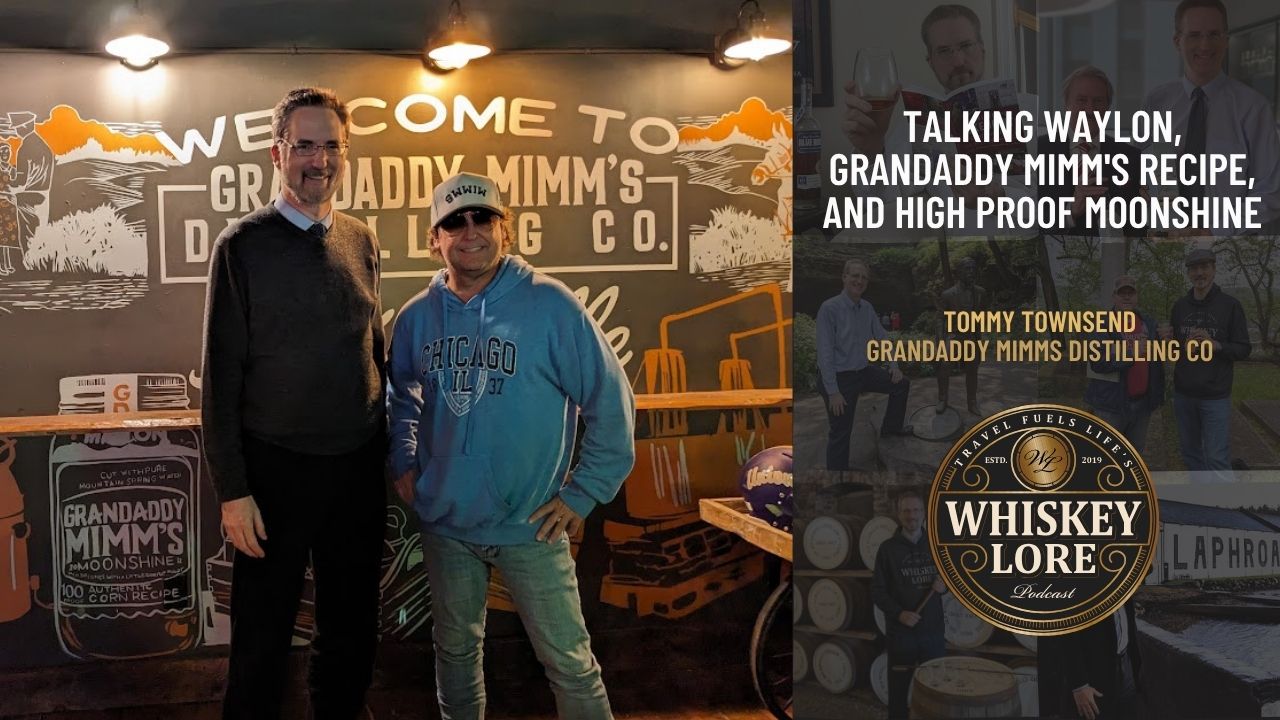
Let's mix two of my favorite subjects today - music and whiskey - as I stop by Tommy Townsend's North Georgia distillery Grandaddy Mimms. As a musician, Tommy has many ties to Waylon Jennings, we'll chat about that (and there is a bonus episode with even more conversation around music, free for Patreon subscribers at patreon.com/whiskeylore ), and we'll talk about the development of the distillery, the use of two thumpers, the problem with high proof flavored moonshine, how moonshine and city hall got together, and Tommy with tap into plenty of stories.
Enjoy this episode, that started out to be a Whiskey Flights episode, but we just had so much to talk about. Cheers! Drew
Transcript
Drew H (00:14):
Welcome to Whiskey Lore The Interviews. I'm your host, Drew Hannush, the bestselling author of Whiskey Lore's Travel Guide to Experiencing American Whiskey, experiencing Kentucky Bourbon and the book that busts 24 of Whiskey's Biggest Myths, Whiskey Lore Volume One. And this week I am looking forward to sharing an interview that I did back when I was driving home from the Jim Beam Industry Conference. I decided instead of coming straight home, I would head through North Georgia and meet with Tommy Townsend, who is the founder of Granddaddy Mims in Blairsville and Dawsonville, Georgia. And Tommy and I had had a long chat back when I was reaching out to distilleries about getting information from my experiencing American whiskey book. And what I found was I wasn't just getting a fun story about a distillery. I also found out that Tommy is a singer, songwriter and traveling musician who not only had his own music produced by the legendary Waylon Jennings.
(01:14):
Tommy also stepped in to play guitar and sing for Waylon's band after his untimely passing back in 2002. So today we're going to talk about how Tommy is making spirits in North Georgia, Blairsville's connection to sorghum, what that still is doing outside of Granddaddy Mim's location. And of course, the singer-songwriter is going to have some fun stories to share. Plus, we're going to talk music, a little bit of Waylon and have some bonus coverage. So you want to stay tuned to hear more about that towards the end of the episode. So let's jump right into our conversation with Tommy Townsend of Granddaddy Mims in Blairsville, Georgia. Thank you for the invite by. We had a great conversation on the Zoom, so I was like, yeah. When I get to North Georgia, I got to check this out. I just happened to be happy. When
Tommy T (02:10):
Was that we did that? I don't
Drew H (02:11):
Remember. Oh man, that was probably four or five months ago. Okay.
Tommy T (02:15):
Yeah.
Drew H (02:15):
Because it was prepping for the book. Yeah, exactly. Yeah, exactly. Get the details. Now I get to see it firsthand. Yeah, there you go. Yeah. So give me a little bit of background. Now, of course, the thing that makes my eyes light up when I first see is the connection to Waylon Jennings. So give a little background, first of all, how you got involved in music because you are a traveling musician.
Tommy T (02:40):
Exactly. Yeah.
Drew H (02:41):
Yeah.
Tommy T (02:41):
Yeah. The distillery was never in the plan.
Drew H (02:44):
Okay.
Tommy T (02:46):
So yeah, my wife and I and our family, we moved to Nashville in 95 and I was working some with Waylon and the band and Jerry Bridges, which was Waylon's bass player. They were co-producing an album
Drew H (03:02):
On
Tommy T (03:03):
Me and Wayland's team was managing me. And so I'd moved up there for that. And we recorded tons of songs. And then Wayland passed in 2001. All those songs just laid later around. And I got a record deal from it with Audim Records like three years ago. But anyway, but yeah, I'd go out with them. I had my own band. I've had a couple of record deals, had songs recorded and stuff on the radio and everything. And so I just grew up playing music and that's all I ever wanted to do. And that's what I got to do
Drew H (03:41):
And
Tommy T (03:42):
Still do.
(03:43):
But yeah, it wasn't until 2011, a friend of mine from Anaheim, California, which grew up in West Texas, outside of Lubbock, and we'd been friends for many years. And he called me and he said, "Tommy," he said, "My great aunt Mildred passed and said she was 90 something years old and said she loved country music and never got to go to Nashville or got to go to the Grand Ole Opry." He said, "Would you ... " He said, "I'll pay you to come out here and sing at her funeral and everything." I said, "Well, I'll come do it, but you're not going to pay
Drew H (04:15):
Me. " I said,
Tommy T (04:17):
"You and I have been friends too long." I said, "I've never met your Aunt Mildred, but I'm knowing you and that's good enough." So went up there and so he flew in from Anaheim a day early and I flew in from Nashville a day early and he was just showing me where he grew up as a kid and out in West Texas is like all the power poles and the trees are leaning one way because of the wind. And so we were just riding out some of these roads and they were, it was about this time of year, I guess, and there's crop dusters, dusting the crops and that stuff is coming through the air conditioner and everything. And so he got to talk about old moonshiners when he was a kid. And I said, "Yeah." I said, "My grandfather was a pretty famous moonshiner back in North Georgia a long time ago." And he kind of looked funny and he goes, because Jack's a financial guru and he's been on money magazine cover, everything.
(05:13):
And he looked at me real funny and he goes, "Well, can you get your hands on the recipe?" I said, "Well, I don't know. " I said, "I've heard stories about my grandfather from all my family, as long as I can remember, and I never knew him." I was like maybe two when he passed
(05:30):
Away, and maybe I have some faint memories of him or whatever, but he said, "Well, if you could find the recipe and we could find a distillery," he said, "Well, ought to bring it back." And he goes, "I'll help you get started." So he's like, "Yeah, that sounds like fun." I didn't know anything about liquor. He don't know anything about liquor and here we are. So I got back to Nashville, I was telling my wife and she said, "Oh yeah, no." I said, "We're going to try to do this. " So I called my mom because it was my mom's dad. My grandfather's name is Jack McClure,
Drew H (06:08):
But
Tommy T (06:08):
All the grandkids called him Mim or Mimi. So that's where the name comes from. So I said, "Mom," I said, "Do you know anything about Mimi's liquor?" And she said, "Well, son." She goes, "All I remember..." Because she was the youngest child. She says, "All I remember is people coming in the house all hours of the night buying liquor and they used to do the mash down at the barn and she said, I'd go with your granddaddy down there to feed the hogs and the pigs and the cows and said, I'd smell that mash." And she said, "I didn't know what it was. " And she said, "Daddy, what is that smell?" He goes, "Oh, that's just corn we got to feed the hawks and the cows and everything."
Drew H (06:56):
Forget the process that the corn just went through.
Tommy T (06:58):
Exactly, exactly. But she said, "Your grandfather never let me around the stills because I was too young." And she said, "Why?" And I told her, and she was totally against it. She said, "Son," she said, "You don't need to get in that business." So there was all kinds of trouble and-
Drew H (07:18):
Did she think you were going to become a moonshiner?
Tommy T (07:21):
I said, "Well mom, I said drinking's different now than it was back in the 1940s." And so anyway, she said, "I don't really know anything about it except stories that she's told me. " She said, "Call your uncle George." Said he helped him make some before he went into service back in the 50s. So I called my Uncle George and I asked him about it and he said, "Yeah, I remember exactly how we made it. " So there never was just a written down recipe, but he said, "I don't remember exactly what we did." And he emailed it to me, I mean, from growing the corn to sprouting the corn in the bathtub
Drew H (08:00):
Or
Tommy T (08:01):
Whatever. And so he sent that to me and I had it and I'm like, "I got it. I don't know what to do with it.
Drew H (08:09):
"
Tommy T (08:09):
So I was going down to the studio one day in Nashville and I had stopped at the convenience store to buy me a bottle of water. And so I looked down at the Tennessean and it said, "Prohibition whiskey being made legally again in Tennessee." And I never really read the paper that much. I might glance at it or something, but I thought, "I better buy this and read it. " And it was a Corsier distillery in downtown Nashville and they were making some boutique whiskeys and bourbons and stuff. So I called them and got a meeting with them because I didn't know. I thought, well, this is a start. Yeah, exactly. So they met with me and told me what they did and they said, "Well, we don't do any outside, any private label contract stuff." I said, "That's cool." I said, "I'm from Georgia.
(09:05):
I'd like be fun to have it made in Georgia." So they gave me a distilleries name in Milledgeville that had started doing some stuff. And I went down and met with them and so we did a deal with them and I gave them the recipe and then that's when everything started with United and got on board with them. But yeah, we started the LLC in the spring of 2012,
(09:31):
Got with United Distributors and they started distributing it in September of 2012.
Drew H (09:37):
So one thing about, so you started with Moonshine, so you didn't have to wait?
Tommy T (09:41):
No, no, we didn't have to wait, made it, and then we made some apple brandy too,
Drew H (09:47):
Apple
Tommy T (09:47):
Brandy. And matter of fact, I've got about a half a flask of my grandfather's apple brandy downstairs.
Drew H (09:54):
Wow.
Tommy T (09:55):
I'll show it to you when we get done. But my mom had had it, had saved it back in a cabinet,
Drew H (10:03):
Whatever.
Tommy T (10:04):
But anyway, we started the brand, Granddaddy Mims, and I don't know, we started selling, I don't know, maybe 20, 30 cases a month, just the stores here and there around North Georgia, and then it kind of got bigger and bigger. And then through the music business, I got distribution in Tennessee with it, and the Wild Horse Saloon picked it up.
Drew H (10:30):
Oh, wow. Okay.
Tommy T (10:32):
And they wanted to make moonshine margaritas. And so the Wild Horse Saloon was owned by Marriott or Hilton or one of those big hotel chains. So we had to actually pay to get in it, but they were buying like 30 cases a month. They were our biggest account. That's crazy. Just going through that. And they had the Granddaddy Mims cowboy boot glasses and they served that in them as souvenir glass that the customer got to take home. And then being in the music business and with the Wayland band, we did several promotions down
Drew H (11:09):
There
Tommy T (11:09):
With it. And it got scattered around Tennessee.
Drew H (11:14):
It's pretty amazing you got into Tennessee because Tennessee is- Oh,
Tommy T (11:18):
It's old smokey
Drew H (11:20):
Territory sold
Tommy T (11:22):
Up.
Drew H (11:22):
Exactly.
Tommy T (11:23):
And so I guess 2016, we opened up the distillery here in Blairsville because all the county officials, I knew every one of them, but here because of tourism and what's so funny was Blairsville, Union County is a dry county.
Drew H (11:40):
They
Tommy T (11:40):
Have liquor about the drink now and beer and wine and grocery stores and convenience stores, but it was a dry county. So the county commissioner at that time had to change the ordinance for us to put a distillery here and he slid that ordinance under arcing dogs and leash laws or something. And it has to run in the paper for a couple of weeks. Nobody
Drew H (12:04):
Noticed?
Tommy T (12:04):
Nobody noticed or if they did, they didn't say anything.
Drew H (12:07):
Wow.
Tommy T (12:07):
So that's how we got the distillery here. And so one thing led to another, and then we got distribution in Florida and I guess that was in probably 2018 or something like that. And then 2019, 2020, Walmart sought us out in Florida. And so that was the year of the pandemic and we were invited to Bentonville to do the presentation. We couldn't, so we did it on Zoom, but they picked up like a couple of skews and now they carry everything we do. And there's 156 Walmart stores in Florida.
Drew H (12:53):
Kind of makes you wonder how they found out about you.
Tommy T (12:56):
Yeah. And I don't, maybe it was our distributor just made a pitch to them
Drew H (13:01):
Somehow
Tommy T (13:01):
Or something. But what really drives our sales and been driving our growth is we have 140 proof corn liquor. And the reason we did that was my granddad's recipes were around a hundred proof, the best that you could tell by shaking the jar
Drew H (13:21):
Back
Tommy T (13:22):
A long time ago because I talked to my uncle and he said, "Well, it was around 100 proof, maybe 110, maybe 98, whatever." But anyway, so when we were first introducing the moonshine to the stores here in Georgia, I would come down from Nashville and ride with the distributor reps and stuff. And there's about five or six stores told me that if you would really come up with a really high proof moonshines, it would sell because people are used to that hundred proof. But like when old moonshiners did it here in the mountains, wherever they did it, Virginia, Western Virginia, it was around 100 proof. People think, oh, it was like gasoline or
Drew H (14:03):
Something, but it
Tommy T (14:04):
Really wasn't. But we just took it and didn't cut it as
Drew H (14:09):
Much
Tommy T (14:11):
And made the 140 proof. And we couldn't even keep up with it at the very beginning. And because it starts running out of the steels about 160 or 170. So you got to catch that and set it aside and cut it or whatever, but that started our sales going up and every liquor store was buying it because of the proof.
Drew H (14:33):
Yeah. So what do you do? I mean, I'm just seeing somebody with a mason jar kicking back and drinking 140 proof. I'm guessing that's not what they're doing with it.
Tommy T (14:42):
No. Well, the Wildhorse Loon in Nashville were mixing drinks, those margaritas with it, but then there's some people that were just taking shots of it, and that's way bigger than me. Yeah. A little bit too strong, but it'll cure the common cold.
Drew H (15:06):
I bet.
Tommy T (15:07):
Yeah. But we started doing that and put the distillery here in 2016 just because tourism, it kept growing and growing, growing. We got distribution in Florida. And then I had a friend of mine in Nashville, him and some partners were opening up an amphitheater in Kentucky and he had called me and says, "How can we get your liquor up here?" And I said, "Well, you have to go through a distributor."
Drew H (15:34):
And
Tommy T (15:34):
I said, "Well, you just can't sell it until you direct it. " So he knew a guy at RNDC. I called them, and of course they're a huge company. And I sent them samples and he called me back and said, Tommy, he said, "Man, y'all's product is great, but he said, we don't have room for it. " And he said, "Our portfolio is so big." So he gave me a guy that worked at RNDC that used to work at Brown Foreman and they had started like a mid-tier, it's called Heritage of Wine and Spirits.
Drew H (16:03):
He
Tommy T (16:04):
Said, "Call him." And I called him one morning and lo and behold, he's a musician too. And I said, "I've got probably going to explain what it was, my grandfather's 100-year-old recipes or whatever." We talked about music for 30 minutes before we even talked about liquor. And I was telling him, I said, "This amphitheater wants to buy it. " And I said, "It'll probably be a pretty good account because it's like a three or 4,000 seater amphitheater and they're going to have major ax coming there." And so he said, "Sure." He said, "We'll take it on. " He said, "Send me some samples." And I said, "Well, since you're taking it on, could you get it in more stores?" He said, "Well, certainly." I told him I'd come help him work at the market. But anyway, the amphitheater opened and we had just got through aging a barrel of our moonshine in a bourbon barrel and it was two years old and it came out at 109 proof.
(17:02):
And so Hank Williams Jr. Was the first act they had. And so Jeff called me up, he invited me up, says, "Why don't you come up?" I said, "Oh yeah, that's cool."
Drew H (17:13):
Because
Tommy T (17:14):
We'd done some stuff with Hanken. And so I took a few bottles of that aged moonshine, which is basically whiskey. You just can't call it whiskey because it's got sugar in the mash.
Drew H (17:24):
Right.
Tommy T (17:25):
So Hank Williams Jr. Got the first bottle
Drew H (17:28):
Of
Tommy T (17:29):
The barrel aged whiskey
Drew H (17:31):
And
Tommy T (17:32):
He liked it. But anyway, and then they had partnered with our moonshine with AL8, which is Kentucky's ...
Drew H (17:42):
I know some of my listeners don't know AL8, but if you ever go to Kentucky, you have to have it.
Tommy T (17:47):
You have to have it. It's kind of like Mellow Yellow or Mountain Dew, I guess. And so they partnered with them at the amphitheater and they were doing L8 Grande Mims slushies and drinks and everything. And so that's how we got in Kentucky.
Drew H (18:07):
Into the belly of the beast.
Tommy T (18:08):
Into the belly of the beast, yeah. And it was a moonshine company right there in the midst of all the bourbon, which I think is cool because I don't know that there's a lot of moonshine distilleries in
Drew H (18:22):
Kentucky. You got to go to Eastern Kentucky and there's a couple, but yeah. And Southern Kentucky is another one, but yeah, just a scattering of them. So that's pretty big. Did your uncle want to become a taste tester for you?
Tommy T (18:39):
Well, it's funny, he wasn't a drinker, but he did taste it a few days. Well, he grew up here in Young Harris, the next town over, but him and a lot of my family, when they graduated high school, they moved to Detroit, Michigan to work at General Motors, but my uncle George had retired. He and his wife, they had moved to Charlotte, North Carolina. And so he would come down here periodically, and he just passed in October. He was 88. But yeah, he was really involved in it with us and just come here a lot and hang out and stuff. But it's been a wild ride. But when we started everything here, I wanted to make it just like my grandfather made it. And then so we use spring water from our farm. We haul it down here in totes and we do all this stuff to it, but yeah, everything is as natural as it could be.
(19:37):
We get our corn from local farmers or at the local feed store here, some of it's sourced in North Carolina, maybe in Alabama, and Georgia too. But we use all local products except for the sugar. Well,
Drew H (19:54):
I was going to say, the sugar, I wonder, because this area is kind of known for sorghum, isn't it?
Tommy T (19:58):
It is.
Drew H (19:59):
Yeah.
Tommy T (20:00):
Yeah. And a funny story about that was during the war, World War II, when my grandfather was deep into it, they rationed sugar. And so a lot of people that had the sugar stamps here were selling their stamps to moonshiners, so they get sugar. Well, my grandfather actually knew a sorghum mill in Young Harris. Matter of fact, the son still runs that sargam mill, Hughes' sarga mill. And so my granddaddy would go over there and buy sorghum from him to sweeten the mash.
Drew H (20:43):
Okay. I wondered if he ever snuck some in there. Yeah.
Tommy T (20:46):
And so he flew under the radar
Drew H (20:49):
On
Tommy T (20:49):
All of that. And then probably three years ago, we decided to do that because we have the local sorghum festival here. And so after the sorghum festival is over, they have just plenty of unsold syrup. So we would go down there to the mill and just get it, but we actually took it a little further. We did a sargum rum with it. So that's a wash and not a mash.
Drew H (21:22):
Exactly. So
Tommy T (21:23):
Yeah, we put that out and it's so funny. It's kind of seasonal and we just ran out of it. I think they bottled some here this morning.
Drew H (21:33):
Oh, did they? Okay. Yeah, because
Tommy T (21:34):
People were coming in here for the past two, three months wanting it, and we didn't have it. So we got something bottled. But yeah, we just made sorghum rum.
Drew H (21:46):
Sorghum's interesting. I had some when I was in Nashville, Nashville Craft was making it. And I found it really interesting because I'm not a rum fan, but it's different enough. I think that I always say rum to me is like burnt sugar and it's just more of a sweetness and ... Yeah.
Tommy T (22:11):
I like let's try something we get through the interview, but yeah, we got all of this that the sarco festival here had and we had to dump it in the mash tanks by the jar, pouring it out. And so we ran out of that and we actually, my son-in-law and I, he's one of our distillers here, we actually went up above Knoxville somewhere and bought a whole drum of sargum and we used that and then we actually sourced some from Kentucky. It was around Louisville. And the last name, the guys that makes it, his last name is Townsend.
Drew H (22:54):
Ah, nice. There you go. All sorts of ties
Tommy T (22:56):
In. So yeah, we've got some from there, but yeah, we just recently got some more from the Sargent Festival here and that's what was been ran, that's what was bottled today.
Drew H (23:08):
Yeah.
Tommy T (23:08):
Yeah.
Drew H (23:09):
What did it take to get equipment in here and find somebody to do the distilling? Did you start doing some of the distilling yourself
Tommy T (23:15):
Or- No, I didn't. Our master distiller is a moonshiner that ... I mean, he's been making liquor for 40 or 50 years.
Drew H (23:26):
And
Tommy T (23:27):
Matter of fact, one of the stills in the back was one of their bootleg stills
Drew H (23:32):
That
Tommy T (23:32):
We brought in. And of course I told him, I said, "You bring it in, you can't take it out. You just got to have a serial number registered with the federal government." But it's actually like a 50 gallon steel. We use it to do tests. Matter of fact, that's what we ran it. We ran the test batches of the rum
Drew H (23:51):
On there,
Tommy T (23:54):
But that is distributed some. It's mostly sold here
Drew H (23:58):
Just because
Tommy T (23:59):
We don't have a lot of it, but we're a brewery too. And so we actually did a sargum beer. Oh,
Drew H (24:07):
That's interesting. Yeah.
Tommy T (24:09):
It was really good.
Drew H (24:10):
I mean, again, I think ultra on the sweet side rather than ... Yeah, it
Tommy T (24:17):
Was. But you could taste the sorghum.
Drew H (24:22):
When you're making a beer out of sorghum, do you try to keep the alcohol level low? Because I know usually high gravity beer start getting really sweet on their own. Yeah,
Tommy T (24:32):
That's what we did. Yeah.
Drew H (24:33):
Yeah.
Tommy T (24:33):
But yeah, we did that. I mean, that's just very seasonal. We may have it from like end of September through Christmas or something
Drew H (24:43):
Like
Tommy T (24:44):
That. I don't think we got any more left. If we do, I'll let you try some of that.
Drew H (24:48):
Okay. It was funny because we were chatting before we turned the mics on about how much alcohol has to travel in this state just to get into somebody's hands. Oh, I know. Because you were talking about some of your customers were going, "This beer's really good." Yeah. "Can we get it in other places around here?" And it's like, talk about the journey. What does it has to go through for it? Oh
Tommy T (25:14):
Yeah. Well, Georgia being a three tier state, we just can't sell it directly to a veneer bar or restaurant. So we're up here in Blairsville and North Georgia Mountains and Atlanta is two hours away, that's where our distributor is. So we have to make it and then put it in kegs. We would have to send it to Atlanta to come back to Blairsville here to a restaurant. It's
Drew H (25:42):
Nuts.
Tommy T (25:42):
We're not that big. And like I said, the reason we did beer was because everybody doesn't drink liquor and there's a whole story behind the name of the beer. It's called Border Hop Beer. And that story is my grandfather back in probably like 1940, he owned a beer joint, I guess you'd call it then, where he sold beer legally. It was right on Border Hop, it was right on the North Carolina, Georgia border on the Georgia side. But I mean, you could spit on the state line. And so I thought if you ever had a beer, I'd name it Border Hop. And that's where that came from. But he sold beer legally there. He bought his liquor out of there and then in the back he had illegal gambling and there was three slot machines that he had and one of them's sitting down here and it still works.
(26:41):
It's a nickel slot machine. And then he had a big troller record player and he had a jukebox. And in 1943, I think it was May of 1943, he got shut down for, and they called it, well, operating a dance hall without a license and illegal gambling. Gambling
Drew H (27:07):
On top of that. Yeah.
Tommy T (27:08):
And the fine was $800 and he went and paid the fine and opened the place back up. But my uncle George was telling me, he said, "I remember being in there as a little boy and said, your granddaddy and your great uncle, they would be money just piled up on the floor."
Drew H (27:26):
Wow.
Tommy T (27:27):
And he said, "I'd play in it and the money." But yeah, I've got the court documents in there of where that was shut down and opened back up. And then in 1940, well, 1943, I think it was shut down for good, but there was one time that he went and paid the fine and like I said, got the court records in there, but yeah, that's where Border Hot Beer came from. So if you ever see it out in the store one day, maybe, I don't know.
Drew H (27:57):
Yeah, there it is.
Tommy T (27:59):
There it is.
Drew H (28:00):
So it's funny because you can tell instantly as we start chatting that you're a country music songwriter because you're great at telling stories. Yeah. And the other part of it is, is that now you have a whiskey or you have moonshine and you get to name all of these things. So do you kind of weave your stories into your moonshines beyond that?
Tommy T (28:26):
Yeah. Well, and like everything that we produce, all the flavors, they have a story behind it. Well, we do one called apple brown Betty,
(28:40):
And that was my granny's pie recipe. And I remember she would make that every Christmas Eve and it was like brown sugar, stick of butter, fried apples with a fried crust on it. And so all the apple pies and everything were coming out or whatever from other brands. And I'm thinking, "Well, let's do this and put the story behind it. " And my mom had the recipe of the apple brown betty. And I remember when I was a kid, I called it apple Freddie for some reason. But anyway, it's called apple brown betty and so that name stuck. And the first few jars we did, we actually had the recipe on it. But then my grandmother, I can remember her, I mean, she cooked so good and we did a low proof peach cobbler and a cherry cobbler and a blueberry cobbler because I remember when she made all those.
(29:38):
And those are not really much in distribution, they're more here.
Drew H (29:42):
And
Tommy T (29:43):
I guess it was 2019, I had the idea is like, you see all these moonshines on liquor store shelves, but they're like 35 proof or they're 40 proof or something like that. And I'm like, there's nobody doing high proof flavor
Drew H (30:00):
Yeah.
Tommy T (30:01):
So we started doing that in may have been 2019, I guess. We did a peach because my granddaddy did peach brandy and apple brandy and all that. And we didn't use fruit. We used just the juice. And when we found this out after the fact is high-proof alcohol does not hold added sugar at the end.
Drew H (30:33):
Oh, okay. So this is the reason why a lot of them are probably staying below. Probably so.
Tommy T (30:38):
Yeah. And I don't know, it's probably somewhere between 70 proof
Drew H (30:44):
And
Tommy T (30:45):
On up. There's somewhere in there that the alcohol does not hold sugar.
Drew H (30:49):
Okay. So you have to shake it?
Tommy T (30:51):
Yeah, you have to shake it. And then the first few cases that we did, after about a week, there'd be sugar in the box. It's like,
Drew H (31:03):
What's
Tommy T (31:03):
Going on here?
Drew H (31:04):
Yeah.
Tommy T (31:05):
And so we did some research and I called some people and talked to some chemist really. And one was from the University of Georgia and they said, well, it said high proof alcohol does not hold added sugar. And you think it would be the other way around. You think it would just melt it, but it doesn't. And we even tried some liquid sugar and it turned it back into sugar.
Drew H (31:34):
Wow. Okay. This is really
Tommy T (31:35):
Interesting. Yeah. I never heard this. So we were like, okay, well, this may not work. But man, it tasted really good. It had the burn and then had the flavor on the back end of it because we did just sweeten. I mean, we didn't just sweeten it just peach, pee, peach or apples or whatever. We kind of did it like the apple brandy. It's like you tasted a hint of the fruit, but you got the burn. So we were doing some stuff and we went to Home Depot and bought brand new five gallon buckets and we were just spinning, spinning, spinning it with
Drew H (32:12):
A thing
Tommy T (32:13):
Thinking, okay, this will melt the sugar or this will do all the sugar. Well, it didn't. And I forgot who told us about it, but me and my son-in-law, Michael, what we did was we got these big old tanks, cone tanks, and we fill that cone full of liquor, of the peach. And we did a peach of blueberry, a blackberry, and an apple. So we bought four cones and those things weren't cheap. So I think they hold maybe 200 gallons or something. And so we fill that thing full and let it set and let it set and let it sit. And the sugar falls out of it down in the
Drew H (33:05):
Cone. To the bottom. Yeah. To
Tommy T (33:06):
The bottom.
Drew H (33:07):
Okay.
Tommy T (33:07):
And then the liquor is as clear as corn liquor.
Drew H (33:15):
But it keeps the sweetness. And
Tommy T (33:16):
It keeps the sweetness.
Drew H (33:18):
But it just gets rid of the solids. It gets
Tommy T (33:19):
Rid of the solids. And then when it did that, we would bottle it and we would get a pump and suck it out from the top. And then when we got down to a couple inches, three, four inches from the bottom, we'd quit
Drew H (33:37):
Because
Tommy T (33:37):
The sugar would be down there.
Drew H (33:39):
Okay.
Tommy T (33:40):
And so yeah, that's
Drew H (33:41):
How- This was something Granddaddy Mims probably didn't go through.
Tommy T (33:45):
No, no, no, no. But it was like the weirdest thing is like, what in the world? And we could put this out with sugar in the bottom of it.
Drew H (33:56):
Or make it a feature. Tell somebody it's special. You can't get this
Tommy T (34:00):
Anywhere. And we had to experiment with that, bottling it because we thought, well, the sugar's all falling out. And then we'd bottle it and it'd be cloudy.
Drew H (34:12):
Oh
Tommy T (34:12):
Yeah.
Drew H (34:13):
So
Tommy T (34:13):
We dump it back in there and we found the ... I guess the magic spot is about a month that-
Drew H (34:20):
Really? Okay. So now you are into the aging kind of that thing where you have time to have to let it sit around before you.
Tommy T (34:29):
But we did get a pump
Drew H (34:33):
With
Tommy T (34:33):
The very, was it the high microns, the filter?
Drew H (34:38):
Yeah.
Tommy T (34:38):
Now actually now if we have to turn it quick-
Drew H (34:42):
You can strain
Tommy T (34:43):
It. It'll get the sugar out of it.
Drew H (34:46):
Okay.
Tommy T (34:46):
But yeah.
Drew H (34:49):
So have you experimented? Have you made whiskeys? And I know you said you were doing some barrel aging here
Tommy T (34:55):
As well. Yeah. We got some stuff aging and we do a peach whiskey, which is a young whiskey that actually just got listed in North Carolina. And if I was a drinker, that'd be what I would drink, just that on ice. And I've tried it like peach tea and add that to it. It's really, really good. And our bartenders make several drinks out of it in the tasting bar area. But we're doing that. We did a vodka and we call that Owltown vodka. It's Granddaddy M's, but Altown is actually where the community I grew up here. And so we named that after that. And it's distributed some, but it's mostly sold here. And we did just a plain vodka and we did a citrus flavored one and a raspberry guava.
Drew H (35:47):
Okay. How did you come up with that?
Tommy T (35:50):
Well, our Florida distributor asked us about a vodka and they said, need to come up with a flavor. It said guava, raspberry guava or guava, I guess, is native to Florida and people drank that down there. So we came up with raspberry guava and it's sold really well down there. But as you well know, there's 5,000 vodka brands out in the shelf. How do you know what to pick or whatever? But I can say that all of ours, everything we do here is made with spring water from the farm. And my granddaddy Townsend actually built that spring. It's coming up out of the mountain and sources my mom and dad's house and my grandparents, they were living, it sourced their house. But it's so funny, we can go up there and we can get like two totes of it and I just back it up to my parents' water spigot and just fill them up on a trailer.
(36:58):
And it's so funny, the times that we've done two containers at a time, I went out there and checked the spring and it never goes down. Really? Yeah. It's coming up out of the side of the mountain there and just, I mean, it's just-
Drew H (37:16):
You
Tommy T (37:16):
Have to
Drew H (37:17):
Thank your North Carolina neighbors for sending you down some spring water.
Tommy T (37:20):
Yeah, exactly. Exactly right. But yeah, it's some of the best water that you ... I mean, you drink, of course, city water or whatever, it don't taste good. And you think, well, you get bottled water of the spring, but this is ... I mean, it's got a taste to it. It's real silky on your top.
Drew H (37:42):
Is it? Okay. Yeah. Yeah.
Tommy T (37:44):
And it's just pure as it can be.
Drew H (37:46):
Nice. So
Tommy T (37:48):
I think that's one of the things that makes us different because we're using the spring water. I mean, Jack Daniels, they use that artesian spring and that. And then our stills are all, they're 100% copper and so the more the liquor can touch copper, the smoother
Drew H (38:10):
It
Tommy T (38:11):
Is. And ours, the condenser doesn't have a worm. It's just column and it's a quarter inch thick so that the vapors are touching that copper all the way down and then we triple distill it at one run. Oh,
Drew H (38:30):
Interesting. Okay. Two
Tommy T (38:31):
Thumpers.
Drew H (38:31):
Are you using it? Oh, you have two thumpers. Two
Tommy T (38:33):
Thumpers.
Drew H (38:34):
Oh, that's interesting. Yeah. Okay.
Tommy T (38:35):
And our stills, our distillers made them. We didn't buy them because they said, if we're going to make it, we're going to make the stills too. So it's just, like I say, it's like they had in the woods or my granddaddy had in the woods, except it's a bigger scale. But the two we got back there has produced a lot, a lot of liquor.
Drew H (38:58):
And this is how you're getting the higher proof because you're going through the third distillation.
Tommy T (39:02):
Yeah.
Drew H (39:02):
Yeah. And
Tommy T (39:03):
What we do is, well, you fill the cookers up and then the mash tanks, we put the first thump, we put about 10 gallons of mash in there, and then the second thump, we put about five gallons in there. And then as it goes through, it flavors it and then flavors it again.
Drew H (39:25):
Oh, so you're actually adding-
Tommy T (39:27):
Mash
Drew H (39:28):
Itself. ... bits of mash back in so that it's always grain on all the way through the process. Yeah.
Tommy T (39:32):
And that's the smoothness of
Drew H (39:33):
It. Okay. Oh, that's interesting.
Tommy T (39:36):
Maybe telling too much of a secret.
Drew H (39:39):
I love these little ... I mean, it's funny because as I have traveled across both sides of the Atlantic and then in talking to distillers for putting the book together, I hear people tell me processes and I go, "For anybody that thinks this industry, you go on one tour and you're going to see exactly how it's done everywhere, not the case. There are so many nuances and ways that you can handle things."
Tommy T (40:07):
Everybody does it differently, and that's what's cool about it. And I love visiting distilleries
Drew H (40:13):
To
Tommy T (40:13):
See what they do different than we do. And that's what makes the world go around.
Drew H (40:21):
Seems like there's a story behind that piece of equipment that's sitting outside, is there?
Tommy T (40:26):
That is. That was actually made by a fabricator in Macon, Georgia, and that's 1,100 gallon pot.
Drew H (40:36):
Okay.
Tommy T (40:37):
And we never used it.
Drew H (40:40):
So it's an advertisement out. It's an
Tommy T (40:41):
Advertisement thing. We ought to probably start putting dry ice in it and letting the smoke come
Drew H (40:47):
Out the top. There you go.
Tommy T (40:48):
So draw attention or something. But yeah, we never used that
Drew H (40:53):
Pot.
Tommy T (40:54):
Yeah. But it's a good story piece.
Drew H (40:57):
Yeah, absolutely. So when did you open your second distillery and why Dawsonville? I hear Dawsonville, I think of Austinville from Dawsonville. Oh yeah. Yeah. But somebody told me that it's the moonshine capital of- Georgia. ... of the world. And then I'm thinking of ... I've been to a couple of different places that have put the claim on that. We have to have a duke
Tommy T (41:20):
Out on that. Well, I knew it was the moonshine capital of Georgia. I didn't know about the world, but that's where Thunder Road starts in Dawsonville. And Ed C, that's kind of where NASCAR got its start over there. And of course, Bill Elliot. So we opened that two years ago, two and a half years ago maybe, and we weren't even looking for a second location. My daughter, she's on the chamber in the DDA Downtown Development Authority here in Blairsville, and her and her husband, Michael, had went to a function in Hellen, Georgia. And so Dawsonville had had a distillery at one point that's kind of defunct or whatever. And so they were wanting to put another moonshine distillery in that space. And so they had mentioned it to my daughter and she's like, "Oh, we got one. I don't think we need another one." And Michael, my son-in-law was like, "Well, hang on.
(42:18):
What do you got to offer?" And so we make some over there. We got a steel in there. We don't make it as much as we do here, but we
Drew H (42:27):
Do
Tommy T (42:29):
Once a month or something over there just
Drew H (42:32):
To
Tommy T (42:32):
Do it. But yeah, and we actually share that space. It's in the city hall building.
Drew H (42:38):
Is it
Tommy T (42:39):
Really? Oh, okay. All right. So we share that space with us and there's a restaurant, a country cooking restaurant that's, man, they do good biscuits and gravy and everything. And the Georgia Racing Hall of Fame, which is Cindy Elliot, she runs that. And so now there's doors that go into the Hall of Fame and into our place and the restaurant, so people can just come in one door and see all of it. And so that's pretty cool. And Cindy's actually, my grandfather's wagon that he used to haul liquor, he used to do wagon trains and all that. And we put the wagon over there in the Georgia Racing Hall of Fame, too horsepower.
Drew H (43:22):
It's funny to me to think that moonshining is synonymous with illicit distilling. And here it is sitting in the middle of the moonshine capital of Georgia, it gets placed into the city hall.
Tommy T (43:35):
Yeah. But Cindy's kind of ... I was telling her the story about the border hop and stuff. And what's so funny was I'm not the second youngest grandchild. And then Terry Roberts, he's the oldest grandchild. He actually drove Bill's coach and Chase's. So he worked for them for a long time. And so when we set up the distillery, of course I'd known Cindy and I've known Bill since I was a little kid, but Cindy didn't know that Terry and I were even ... I mean, you wouldn't know until he called her and said, "Well, that's my grandfather." And matter of fact, Terry used to help him. And so anyway, that's pretty cool. So she's actually kind of recreating a little spot in the Georgia Racing Hall of Fame of the border hop. Okay,
Drew H (44:26):
Nice.
Tommy T (44:26):
Yeah. So we took a wagon over there and I was over there the day I took a saddle of my grandfather's that was here, this is in our conference room and I took one of his cowboy hats and she set up like a card table, poker table there and everything. And I was going to ... She wanted the slot machine down here, but it's kind of an interesting piece here that we tell on our tour, but we'll try to find another slot machine to put it over to replicate it or whatever and take the record player over there. Yeah, that's how all that got started. And so they've welcomed us over there with open arms and they'll bend over backwards to help us do
Drew H (45:09):
Whatever
Tommy T (45:09):
We need to do. So we got a kind of entertainment area out front that's fenced in and the Atlantic Cornhole League starts tonight maybe over there.
Drew H (45:21):
They
Tommy T (45:21):
Do their thing over there.
Drew H (45:23):
And
Tommy T (45:24):
So anyway, that's been real good.
Drew H (45:27):
So you got music at both locations?
Tommy T (45:29):
Yeah. Yeah. We got
Drew H (45:29):
Music
Tommy T (45:30):
And we do music bingo and trivia and all the things, entertainment. So I'll slide in here every once in a while and play, which is fun. And something that's turned out to be fun that never was in the plant.
Drew H (45:45):
Right. Yeah. So you do tours here,
Tommy T (45:49):
Do tours and tastings. And well, we do tours at both places. Dawsonville is not near as big as this. So you're kind of your tour. You can kind of see it all from the tasting room or
Drew H (46:01):
Whatever.
Tommy T (46:02):
But yeah, we do both places, we do tours
Drew H (46:05):
And
Tommy T (46:06):
Stuff. But yeah, here's where we do all the production, the bottling and all that. So yeah, we'll take mashes over there and ferment them and run through the steel. And the steel over there is actually North Georgia Steel Company made that out of Delanica, Georgia. They're doing a lot of stills for a lot of distilleries around. And that thing, and it's cool, it'll hold the proof and keep going actually probably longer than these do, because these have got more wear on them than that one does. But we were noticing the first time we ran it, I mean, the proof held up there for a long time before it fell off.
Drew H (46:52):
Yeah. That's really interesting to think now I'm starting to see the infrastructure in different states where Missouri makes sense because they've got cooperages all over the place because they got plenty of oak to work with, but to now start seeing cooperages opening up in other states and still manufacturers and the rest. It shows how big the industry has gotten.
Tommy T (47:17):
Yeah. And we got, in our barrel room here, we got, I don't know, 80 barrels in there, but some of it is the moonshine
Drew H (47:27):
That
Tommy T (47:28):
We've aged in bourbon barrels and it has all the bourbon notes and all of that. And next year we'll have, I think it would be four or eight barrels of five year aged moonshine.
Drew H (47:43):
Nice. Okay. Yeah. Yeah.
Tommy T (47:45):
All
Drew H (47:45):
Right. It can't be whiskey because it got some sugar in it.
Tommy T (47:48):
Yeah, yeah. Yeah. I don't know who come up with that idea because if you're doing whiskey, you put enzymes in the mash to
Drew H (47:54):
Convert it
Tommy T (47:55):
To sugar. So why not just put the sugar in
Drew H (47:58):
There? I
Tommy T (47:59):
Don't know who come up with that, but you know.
Drew H (48:01):
I don't know. I talked to Tom Bard at the Bard distillery and they make something called Silver Mule, which is basically, they wanted to call it whiskey. So all they do is they stick it in the barrel for a second, pull it back out, and then they can call it whiskey. But I mean, that's the way whiskey used to be made and consumed was that you didn't have to necessarily put it into a barrel. You could filter it or do whatever you need to do.
Tommy T (48:29):
And it's so funny, some people come in here and they'll argue up and down with you that, oh, that's not real moonshine because it's being made-
Drew H (48:38):
Legally? Legally.
Tommy T (48:39):
It's like, well, Jack Daniels, any brown liquor is clear coming out of the steel. So it's all moonshine in the beginning. It's our moonshine, just they didn't pay taxes on it. But yeah, it's funny, people say, "Oh no, this is not real moonshine." But what's so cool is in liquor stores and stuff, and we'll do tastings, and I do them every once in a while, but I've been in a store and these people that are moonshiners know what it ... They're like, "Oh, that's not real moonshine." I'm like, "Just taste it. See what you think. " They're like, "Oh, I didn't know you could really buy this stuff." And I was like, "Yeah, it's moonshine. It's just paying the taxes on it. "
Drew H (49:29):
Absolutely.
Tommy T (49:30):
And 140 proof, the taxes are pretty hefty.
Drew H (49:33):
I can imagine. I imagine it wakes you up when you take a sip of it too.
Tommy T (49:37):
Oh yeah, or puts you down one.
Drew H (49:41):
So is that the reason for the upside down mims on your hat?
Tommy T (49:46):
Yeah,
Drew H (49:46):
I guess
Tommy T (49:47):
It is. It looks like swim, doesn't it?
Drew H (49:49):
It does. Yeah. I'm like, wait a second, that is mims and upside down.
Tommy T (49:53):
No, my daughter came up with this to put it upside down. I've got more people that has noticed this ball cap. And I just got back from the North Carolina trade show, ABC Trade Show, and I wore it one day and people would come in and they're like,
Drew H (50:13):
"What?" So you drink enough of the 140 proof that- Yeah, it might just flip around. It'll flip over. Yeah. Yeah. Exactly. Well, Tommy, thank you so much for spending the time today and chatting. You're very welcome. Yeah, this is great. Appreciate you. I knew from our conversation on the Zoom that we'd have a fun time talking.
Tommy T (50:30):
Yeah. Yeah. I'm so glad you came by. Cheers. So cheers to you. Thank you.
Drew H (50:34):
Well, I hope you enjoyed my conversation with Tommy Townsend of Granddaddy Mims. If you're a music fan like me, make sure to head out to patreon.com/whiskeylure where you can enjoy a bonus 25 minute episode where Tommy and I will dig into his musical background, how he got acquainted with Waylon, and how his music and moonshine may soon find some synergy in terms of live events in the future. That's episode number 130B out on patreon.com/whiskeylor. And we'll be heading to Scotland soon for our next interview and two things going on with Tennessee, including an interview, and we'll talk about that first registered distillery claim at Jack Daniels. Make sure that you are subscribed to the Whiskey Lore podcast so you don't miss a minute. I'm your host, Drew Hanish. And until next time, Cheers and Sloan Jevah. For show notes and transcripts, head to whiskeylore.org/interviews. Whiskey Lore is a production of Travel Fuels Life, LLC.