
Copper Fox Distillery - Sperryville
Drew (00:00):
There's a rebirth of the use of Chestnut wood with whiskey, and if you want to hear more details about that, then check out the extended interview with Rick Wasman of Copper Fox at patreon.com/whiskey lore. Welcome to Whiskey Lord's Whiskey Flights, your weekly home for discovering great craft distillery experiences around the globe. I'm your travel guide Drew Hannush best selling author of experiencing Kentucky Bourbon, experiencing Irish whiskey, and the brand new book that bust 24 of Whiskey's, biggest myths, whiskey lore, volume one. And of course I was in Martinsburg, West Virginia last week, but we're taking a drive about an hour and a half south into Northern Virginia. Beautiful sunny day passing by Front Royal, which whenever I see Front Royal, I always think of the Blue Ridge Parkway because the northern extension of that is Skyline Drive, and it's if you really want to take a nice relaxing drive, that is a great way to kind of get a feel of the Shenandoah Valley from a more elevated position.
(01:17):
And as I make my way down through this area, I'm looking for the town of S Spearville, which is where the distillery is that we're going to visit. Now, S Spearville, I say town, it's not really a town. It's actually this little self-contained village, and within it you'll find a mercantile. You'll find the copper fox antique store, and you'll find the Copper Fox Distillery. Now, copper Fox has two different distilleries, and a friend of mine told me about the one that's in Williamsburg. They have a malting floor there. And so that got me really interested, but then I found out they actually have a malting floor also up at the Spearville location. And this is an older location, so I wanted to see what this was all about. And when I walked up to the distillery, it had this feel to it kind of like the old cider mill that I used to go to when I was a kid.
(02:15):
So already a little bit of nostalgia actually. As I'm walking into the distillery, there's a fire rolling when I walk in. And Rick Wman, who is the, a founder of the distillery and the one we're going to be talking to today was in there. His mother was in there as well. And we decided to sit down by the fire chat for a couple of minutes and then get up and walk around and tour through the distillery. And the idea was we were going to do the interview after we did the walkthrough, but the very first spot we went on the way into the malting floor. All of a sudden there was a photo there and Rick started telling me a story about this farmer, and I was like, no, let's go grab the microphones and get this one captured for the podcast. So without further ado, let's jump into our conversation with Rick Wman, the distiller and founder of Copper Fox Distillery.
Rick (03:10):
So when I had the idea to malt, really, I had this idea to use fruit wood smoke, and so went to visit all the distilleries I could, Kentucky and Canada and Virginia. There wasn't much. This was back in 1999. Finally, I went to Scotland because that was the only place that I knew that there were malting barley for
Rick (03:33):
Distilleries.
Rick (03:34):
So I went there, met this guy, Jim McEwen, came back, he had offered me an internship. So I went back that same year, spent six weeks learning how to malt in Scotland at BeMore, and came back here and tried to put together my dream. Contacted Virginia Tech for the Barley Source to see what they had. And they were thrilled because they had been working on all these malting varieties, but no one was doing anything with it. I think that they were doing that for the fuel alcohol business because there was little fits and starts for licensed distilleries. It was all fuel alcohol,
(04:11):
But the economics with that just got jerked around. So they were thrilled when I was talking about making whiskeys. Got an introduction to the seed development farm, and then through them got introduced to Billy Dawson. And Billy was just a innovative farmer that everyone knew on the northern neck of Virginia and was just a prince of a guy. And he was like, sure, how much do you need? And so he planted some and some extra, and we did well with it. There was a variety called Thoroughbred, which was a six row, but it grew well in Virginia, handled some of the moisture issues and off we went. So then Billy died, I guess. I think it's been about four or five years ago now,
Drew (04:58):
Because I always hear six row and two row.
Rick (05:01):
Yeah.
Drew (05:01):
What is the advantage of one versus the other in terms of distilling?
Rick (05:06):
The two row is a little lower in protein. So if you were doing feed, you might tend toward a six row, but really we had decent yields with it and everything was fine. Okay.
Drew (05:23):
Yeah, it's interesting working with heritage grains because I've been overseas and watched a distiller at Waterford actually trying to work with a new, or I say new, but a heritage barley grain that doesn't really get a lot of yield out of it and the stickiness and other issues that you run into. Did you find a lot of that when you first got started?
Rick (05:47):
Well, we were trying to figure out the yields, and when I came back, I had a consulting engineer from Scotland, and the conversions we were getting were not bad, but as we've gone through the years, we've gotten better. So the stickiness, I've heard complaints, but we have subsequently moved to malting everything. So we malt rye, so we make a single malt rye. Rye is much harder to malt. We've malted oats. We've malted wheat because we malt. So why not?
Drew (06:22):
This is interesting too, because if you went to BeMore, then you got the experience of malting barley there, but what is really the difference? Did you have anybody you could talk to about malting rye or was it kind of trial and error?
Rick (06:39):
Oh, it was definitely trial and error. I had a good team that was having fun with it, and for us, we didn't do such huge quantities where the yields were the overwhelming thing. We were just doing it for a little bit for the novelty and a little bit for the flavor. So what we gravitated toward was a malt of rye, single malt rye that was smoked with sassafras smoke. And that's been a mainstay and a lot of people's favorite, that one double gold in San Francisco a couple years back when we submitted it. So it's a good,
Drew (07:11):
It worked.
Rick (07:12):
It worked. It worked. So this is the malt floor steep tank, again, about 1200 pounds of malt, dump it into the wheelbarrow and then spread it out on the floor. So 1200 pounds will cover about half of this room. So the way we set it up was to do just kind of continuously malt. So put the grain on the floor and three days later, start the second half and three days in the kiln. And then just constant work.
Drew (07:44):
I mean, when you see the large malting floor that they have bour and this idea that they're over there constantly having to shovel this over. How did you work that out? How many times did you have to turn the barley while you're in here?
Rick (08:04):
Well, met my mom. So her license plate is malt mom. I moved her down, she retired, and then, so I had her raking and I raked, and we all raked, but raking takes this size. Bour had an eight ton floor, so we were doing 1200 pounds. So it takes, you have to rake every four hours, but it takes five, 10 minutes.
Drew (08:30):
Yeah.
Rick (08:31):
So it's not hard.
Drew (08:32):
Yeah, no monkey shoulder, no monkey shoulder, no monkey shoulder. I love your lock andal direction sign, by the
Rick (08:41):
Way. Thanks. Yeah, not many people get that. I kind of forgot I put that up there.
Rick (08:47):
So this is the kiln. Okay. Oh, wow.
Rick (08:52):
But we moved some chairs in here for the winter and with the little wood stove, so it's nice. But this is a small version of the bour kiln, and you look on top of the wood stove, what we would do is the heat source was the wood stove, and of course that was vented outside, but the smoke source, we'd put the applewood and the cherrywood or the peach wood, whatever we're doing right on top of the wood stove. But that would form a bed of ashes, so it would kind of insulate and look at the top of that stove. We melted it. Wow. That puppy
Rick (09:29):
Has been used.
Drew (09:30):
Wow. So using these different types of wood to do the smoking rather than using peat. What was your initial thought when you decided to smoke with wood? Was it kind of a push against that notion that everything has to have that Pete wreaked to it?
Rick (09:48):
It was real simple. I loved the aromatic qualities of burning fruit wood. It's not that I didn't like peat or whatever it was really, it started with more of a culinary Ben. I was cooking with fruit wood, and I just loved the flavor, and I was splitting wood by myself. And if you ever, I don't know if you have cherry trees, the wild cherry trees where you all live, there's a lot of 'em around here,
(10:21):
And the trees would come down, but just for firewood, splitting wood by hand, you get a perfectly seasoned bit of cherry wood, and you whack it with the ax and it splits, and the aroma that comes out of that wood is just fantastic. And it was an easy step to try and get that into my food. And I think I was at a Johnny Walker tasting, and they were talking about the peat, and I was a scotch drinker, but that's when it clicked. I said, well, wouldn't it be nice to have a whiskey that was made with fruit wood smoke? And I didn't think anything about starting a distillery. I was thinking about going to the liquor store and buying it. Nothing there and nothing. And so this was maybe whatever, like I said, 1999, 2000, it was either Pete smoke or no smoke. So that was the idea. And then I'm like, that's kind of an injustice. That's just wrong, that someone has to take a stand in this life and reach out and bring something new because it's a beautiful aroma. It's a beautiful flavor. And I thought, well, it's a hook. That's something that maybe we can survive on.
Drew (11:43):
Yeah. Well, you think a lot of the distilleries that are experimenting in American single malts are going over to Scotland and bringing already pea smoked grain into the country, and the thought being that, but why?
Rick (12:00):
That's what I say. God bless him, and I know that that's what I was saying. McCarthy's made a great American single malt, but it tasted just like scotch,
Drew (12:12):
But you won't be able to go over at that time period. You wouldn't have been able to go overseas and source a wood smoke. So you really had to create your own malting
Rick (12:22):
Floor. You had to, plus what else am I going to do with my life?
Drew (12:27):
But turn barley,
Rick (12:28):
But turn bar. So yeah, so this is the kiln. This is where we would smoke
Drew (12:32):
And Okay, talk about the concept because we'll hear something like cherry wood, peach, wood, applewood. Sometimes you can be very suggestive, and if somebody says, oh, that's cherrywood. When somebody's doing a tasting of that whiskey, they'll go, oh man, I get the cherries. Does the fruit actually infuse, or is the fruit getting its flavor through the wood? Should I taste or smell peach when I have a whiskey that's been,
Rick (13:06):
There's elements of the fruit, but in a way that when you watch a sunset and the sky, the sun lights up, the clouds, the fruit lights up the wood.
Drew (13:25):
So the
Rick (13:25):
Fruit has the influence
Drew (13:26):
On the wood.
Rick (13:28):
It's there, but it's not quite the same, but it's better.
Drew (13:34):
Yeah,
Rick (13:34):
It's better. It's better in smoke form.
Drew (13:36):
Okay.
Drew (13:43):
When you think of the character and style of Irish whiskey, what's the first word that comes to mind? Could it be smooth? Well, to the whiskey, novice, smooth is a bit of a crutch word. That usually means easy drinking. So where does Irish whiskey get this reputation of being smooth? We'll ask an Irish distiller, and they'll likely tell you that it comes down to the traditional Irish technique of triple distillation, but do all Irish distillers, triple distill and is triple distilling really the invention of the Irish explore the history behind the science of triple distillation. In my new book, whiskey Lore Volume one where I tell the story behind this and 23 other pieces of lore, grab your copy now on Amazon or get the audio book through audible Apple Books or Spotify. It's time to find out the truth behind the lore. So the original name of the distillery, or was it the original name of the brand as your last name?
Rick (14:55):
Well, the distillery was always Copper Fox Distillery, and we had done a copper Fox product. I had a contract to buy out Belmont Farms that makes the Virginia Lightning and the climax and stuff. So I was going to buy his brand and everything. That didn't work out. We had done a brand together, and then we wound up a little disagreement over the status of that when I left. So that was still in the courts when I had opened this, had whiskey ready, and so I said, well, Wiseman's is open.
Drew (15:40):
Okay,
Rick (15:41):
So the first whiskey, so it was always Copper Fox Distillery, and that was the incorporation name, and it was always meant to be Copper fox whiskey, but we did the Wman single Malt, and then whatever, 10 years later when we were looking at things, copper Fox seemed to be a stronger brand name, and we were just trying to focus marketing and brand awareness. So everything became Copper Fox at that point.
Drew (16:05):
Well, I see there's a copper fox antique. Is that where the name came from or where's the origin of that name?
Rick (16:13):
When I came here in 2000, so when I was buying out or trying to buy out Belmont Farms, he wanted everything moved off his property. I actually had a contract on that building, opened up the antique store as a way to pay for the building and named it Copper Fox Antiques. And then this building came available. We couldn't get insurance over there. It was wood frame and it was a bit of a problem. So I sold that business and they kept the name.
Drew (16:48):
Okay. This place takes me back to my youth because when I was growing up in Michigan, we used to go get donuts at the cider
Rick (16:56):
Mill at the cider mill,
Drew (16:58):
And it was like a little village. It was like a little historic village north of Detroit.
Rick (17:05):
Yeah. Well, this is an old apple cider. It's listed as the juice plant, but we own the building next door, and that's where they actually used to press the apples dump and press the apples. The antique store was the big cold storage, so that had these massive compressors with ammonia and a big freight elevator. I mean, it would've been a cool distillery, but it's all wood frame with powdered cork insulation, which burns like
Drew (17:33):
Little dangerous. Yeah,
Rick (17:35):
Just beautiful burns like a champ. And it was a huge building. It had some structural issues, but I had a contract to buy that for 250,000 back in 2001. But like I said, then this opened up and wood frame, powdered cork versus concrete block poured. This is a fricking fortress right on the river and loading dock and everything. This is where we go. And then I've got an apartment upstairs, which
Drew (18:12):
Is okay. Oh, nice.
Rick (18:14):
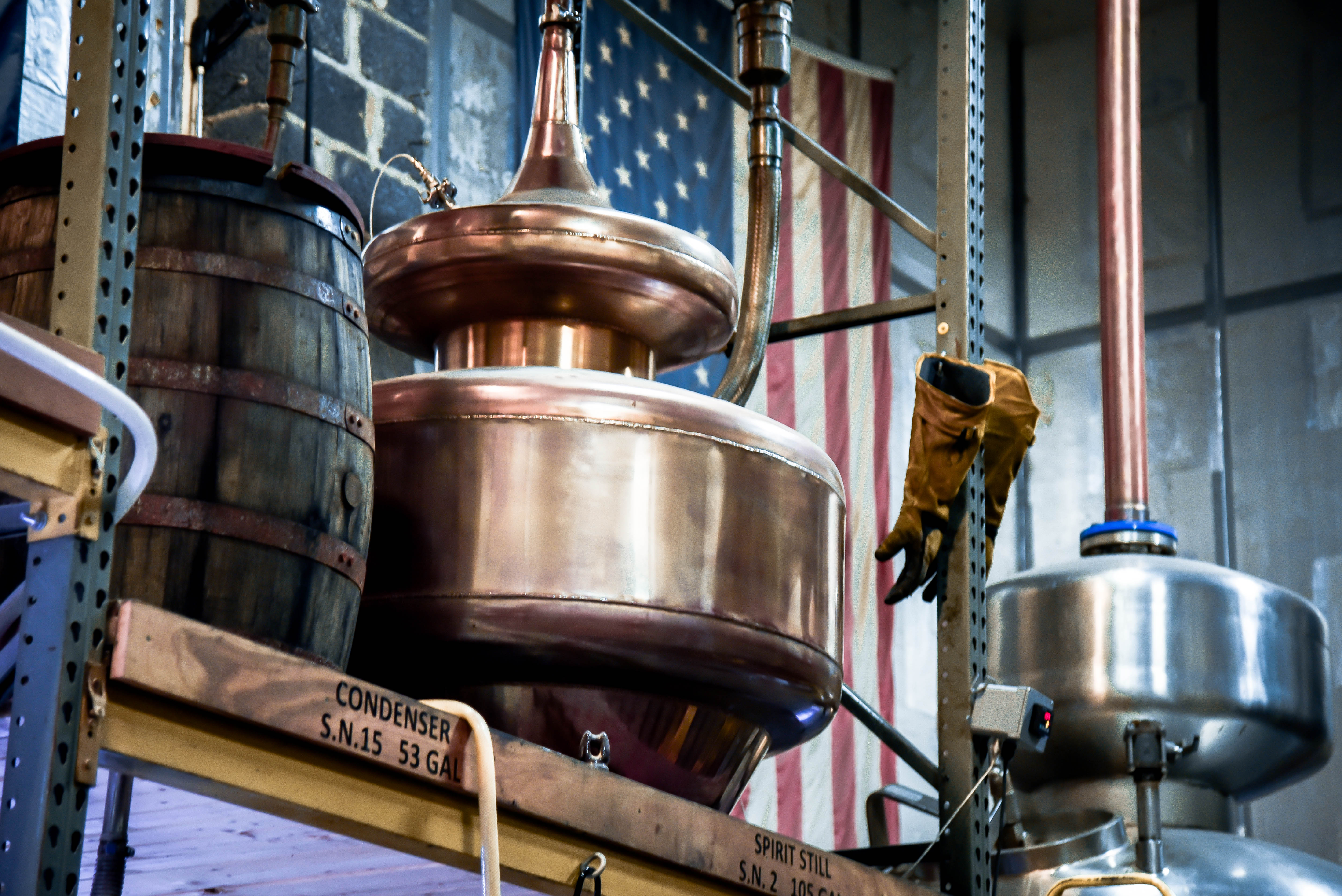
That's my secret staircase to the office. So is still, we got this used Ven still out of a used equipment yard in New Jersey, carded it down here and rigged it up. The old Portuguese still on the left used to be our
Drew (18:36):
Doubler,
Rick (18:36):
And now that's turned into our gin still. So we used to seal that up with rye paste. So that's part of the reason I had my door there is I had to check every half hour or so to make sure that the rye pace was still holding, because you could smell a leak,
Drew (18:50):
But
Rick (18:50):
You'd have to go and just jam with a putty knife. You just kind of hold it in there and it would harden up and seal up, and you had to run the steel soft and slow so you wouldn't blow the seal. And that's just the way we ran it for eight years. Finally, the things were getting pinhole leaks and everything else. We just wore them out. We were running every day or five days a week, and so we had a fabricating company down in Newport News make that the secondary still. Yeah.
Drew (19:26):
Okay. That's really interesting. From a, so are you kind of doing a worm tub kind of condensing idea here?
Rick (19:36):
It's a worm.
Drew (19:36):
Okay.
Rick (19:37):
It's a worm, yeah. And then, yeah, so it's the mash, the fermented mash always goes in the big still. And then we have a two run system. So the heads and tails from the previous two runs fill the spirit still for the first run, and then the high spirits from the first run fill the spirit still for the second run. With that, what we get is a run that comes in, it starts at about one 60, and we switch to tails for the second run around 1 18, 1 16, and that'll give us an average of 150 proof, which to me was right in between scotch and Irish. And I figured, well, how wrong can that be? But it's sustainable. We don't waste anything, and it gives us that spectrum of flavor. I've talked to some of the old time guys and they're like, oh, you should run it down to the nineties, and
Rick (20:35):
Just danger zone maybe in some ways or a little too dirty for me. It'd be a bigger flavor, but I'm okay. What we decided,
Drew (20:48):
I guess part of it too is how long you intend on aging it and the aging conditions here and the barrel char and all that.
Rick (20:55):
Right, right, right. So we're malting barley with different smokes. Okay, that's different. Great. Yeah, super. That was the original idea. But then we got into aging, the evolution of our aging thought. When I had the product down in Cu Pepper with Chuck, it was corn whiskey, so we didn't do any
Rick (21:17):
Malting,
Rick (21:18):
But we were aging with toasted applewood chips. And there we did it in a big tank. So we did big batches, a big tank, and we wanted to get the chipping done, and then the stuff into barrels, so we could count the age, but we got a lot of flavor from the chipping process. When we got here, the batches started coming out to be like a hundred gallons. So we were like, well, we could just keep on filling up a big tank or if we had small tanks. And then I'm thinking, we have small tanks, barrels, we got barrels. These are the perfect size. So what we started to do, and we've taken a lot of the stuff here because right now here is mostly the bourbon, but we cut a trap door in the barrels and we put in multiple generations of toasted applewood or peach wood and oakwood. So it's apple and oak or peach and oak or chestnut. So we've gone through different woods, but that's how we do our infusion is in the barrel.
Drew (22:27):
Okay.
Rick (22:28):
So what that led to where before and when we started in the big tank, we were just, let's do it for four months now. There's no motivation to pull the chips out early because the clock's ticking. It's in a barrel.
Drew (22:45):
Okay.
Rick (22:48):
So now we're doing two years in chips, and the whiskey's coming out fantastic.
Drew (22:54):
So it's kind of a double oak kind of idea, but you're actually not having to change to another barrel. You're putting in the wood chips to get that extra wood influence.
Rick (23:07):
And then what we end up doing though is just because the habit and we're afraid, but is we'll pull the chips and kind of consolidate a couple barrels just to be more efficient because of the loss and the angel share and the volume that the chips take up. So then we consolidate barrels and commingle and then get these really great barrels of whiskey. So yeah, so that's the old barrel room. This is our do your bottling all here. This is our bottling. And again, Williamsburg, we have an automated line that we'll do 600 bottles in an hour here. It's all changed.
Drew (23:55):
And you have a malting floor there as well?
Rick (23:57):
We do. And there it's a porcelain tile. It'll do three ton 6,000 pounds at a shot. It's a thousand gallon pot still with 2000 gallon fermenters. So what we do there is we cook once to distill twice, and here we're cooking each batch and fermenting each batch, so 500 at a time. So we're cooking four times as much there. And that's why I was saying it's just as easy from a effort labor paying guys to cook 2000 gallons as it is to cook 500. So it's just gotten to be so much cheaper there. But here we're doing the single malt sassy. We were doing a lot of bourbon here and trying to figure out, and the idea is to sell enough whiskey so we can reproduce the Williamsburg setup here, move that to a thousand gallon still, and get 2000 gallon fermenters every time we run the still. We're making, in essence, a barrels. We were making five barrels a week here for a long time there. We're making 12 barrels a week, so for a lot less effort.
Drew (25:20):
Where are you in Williamsburg? Are you down there at Colonial Williamsburg?
Rick (25:23):
We're like a half mile from Colonial Williamsburg right off the interstate, like a mile and a half off the interstate.
Drew (25:29):
Seems like a nice fit with the, and you put it into a hotel is I understand it
Rick (25:35):
Well. It was an old hotel site, which is just, it was built in the fifties. It was kind of the queen of motor lodges, but it's kind of great big pool, a pond. It's a worthy site.
Drew (25:49):
You're not using the pool as your worm tub?
Rick (25:52):
Well, I do pool the stills in the wintertime with the pool.
Drew (25:55):
Okay, nice. I love that. I think of what you saw in Scotland when you were over there. Was there anything you really wanted to kind of replicate here that you just couldn't really
Rick (26:09):
Do? No, I think my dream has come true. EDR doer was the smallest distillery then. I think there's now a couple of smaller ones, but it was so pretty, but they weren't malting their own barley, and now I know why. It's just hard. It's just hard. Yeah, absolutely.
Drew (26:33):
Where do you get the wood
Rick (26:34):
From? There's a lot of orchards around here. So we got some friends with a big orchard, the big orchards, they just have sections of grove that need to be renewed, so they'll plow out the trees, plant new ones, and so they pull 'em up right by the roots and we go, and before they burn 'em up, we'll harvest the big trunks and all the bigger pieces than let 'em season.
Drew (27:05):
It's interesting. You mentioned chestnut smoke is great. It'd be hard to make barrels out of though. Probably leaky
Rick (27:12):
Maybe. Well, you get into that, and what I didn't get into is the idea that I had was in the beginning to make cherry wood barrels, we could get cherry. And so I talked to a number of people and they were like, well, we can give it a try. But the cellular structure of oak is more of a closed cell, so it's more conducive to watertight. So I'm not sure about chestnut. I'm not sure if the cherry would've worked, but also the flavor on the cherry, I did some experiments and I didn't really like the flavor of the cherry. I love the smoke, probably cherry as much as applewood peach woods's, maybe my favorite. But as far as the maceration, immersing the wood in the spirit, the cherry was bitter.
Drew (28:08):
Probably something that might age out over a long period of time. Who knows experiments
Rick (28:17):
When you're starting a business.
Drew (28:19):
Yeah. That's
Rick (28:20):
A hard time to risk it. It's like, okay.
Rick (28:22):
Yeah,
Drew (28:23):
Exactly. Well, the other thing too is that if you're trying to make a bourbon or something and age it in there, it wouldn't fit the rules because you're not using oak,
Rick (28:32):
Right? So for a long time, we didn't make bourbon. It was just like, okay, they're making bourbon, they make good bourbon somewhere else. And what you couldn't do with the bourbon is obviously other woods, but we have a couple of bourbons. One has oats, is the third grain, no smoke, but the other has peach wood smoked malt is 20% of the mash bill. So okay. We couldn't do our wood chip experiment, although I think we could, if I think under the rules, we could do applewood finished bourbon as the primary thing. So as long as it went into new oak,
Drew (29:18):
Right, the rules, sometimes it's just a matter of dissecting it and then hoping it passes muster with the TTV when the time comes. Yeah. Do you want to try some of this stuff? Yeah, yeah, that'd be great. Well, I hope you enjoyed this visit to distillery number 14 on the whiskey lore. Whiskey flight's, great 48 tour of America's great craft distilleries. And if I piqued your interest in visiting Copper Fox Distillery in Sperry V, or even the Williamsburg location, we'll make sure to head to whiskey laura.com/virginia where you can view the profile of this distillery or the one in Williamsburg, then sign up for a free account and add this and any of the other 700 distilleries on the site into your very own personalized whiskey lore wishlist. Then when you're ready to travel, use the site's convenient planning tools along with maps, tour dates, booking links, and more.
(30:13):
To create the perfect distillery itinerary. Start your journey@whiskeylore.com slash Virginia. Before we close out this episode, a couple of suggestions of things to do in the area while visiting the distillery beyond taking a spin down Skyline. Drive first, if you're into natural wonders. Well, it's not too long of a drive from the distillery to go check out the stalagmites of LaRay Cavern, or History Fans could take a short drive over to the Civil War site, known in the South as Manassas or known to the Yankees as bull Run. And for me, since I'm heading into Maryland, I'm going to stop by one of my favorite Civil War sites, the beautiful hillside town of Harper's Ferry, West Virginia, for abolitionist John Brown. It is best to kick up the fight against slavery. And while you're there, go check out Jefferson's Rock, which is a bit of a hike up a hill, but the views of the Potomac from there are amazing, and Thomas Jefferson himself said it was worth a voyage across the Atlantic to see.
(31:21):
Does that make my way in that direction? If you're still on the fence about visiting Copper Fox Distillery, let me give you my three reasons why I think you should have this distillery on your whiskey lore wishlist. First, the malting floor is definitely a unique feature in Scotland. There are only five distilleries that have malting floors, and there are very few in the United States. Now, this one is pretty small, so you're not going to see any barley turners there with a case of monkey shoulder, but it's definitely worth a look. Second, well, this is a great chance to see the inventiveness of a craft distiller who wasn't even thinking of whiskey when he became enamored with the character of wood smoke, then decided to infuse that into spirits. You get a chance to sample these unique influences on site. And third, make sure to step out the back door of the distillery and soak in the sounds of the gentle creek running by the distillery.
(32:22):
In the old days, that stream would've been a critical part of any distilling operation. Well, I hope you enjoyed this visit The Copper Fox Distillery. It's time to head north to Maryland, and firstly, I'm going to walk through the town of Frederick and say hello to some old friends at the McClintock Distillery. Then we'll be heading about a half hour away to Hagerstown to visit a husband and wife team who are inspiring people to start heading back downtown again for their nightlife. Make sure you have your ticket to ride along by smashing that subscribe button on your favorite podcast app. I'm your travel guide Drew Hanish. And until next time, cheers and Slava for transcripts and travel information, including maps, distillery planning information and more, head to whiskey lore.com/flights and make sure to check out the 50 new distilleries that I've added to Whiskey lo.com/pennsylvania and the 72 New York distilleries that I've added to whiskey lower.com/ New York Whiskey Lords of production of Travel Fuels Life, LLL C.
About Copper Fox Distillery - Sperryville
Tours by appointment.
Take a Whisky Flight to Copper Fox Distillery - Sperryville
Map to Distillery
Note: This distillery information is provided “as is” and is intended for initial research only. Be aware, offerings change without notice and distilleries periodically shut down or suspend services. Always use the distillery’s websites to get the most detailed and up-to-date information. Your due diligence will ensure the smoothest experience possible.