
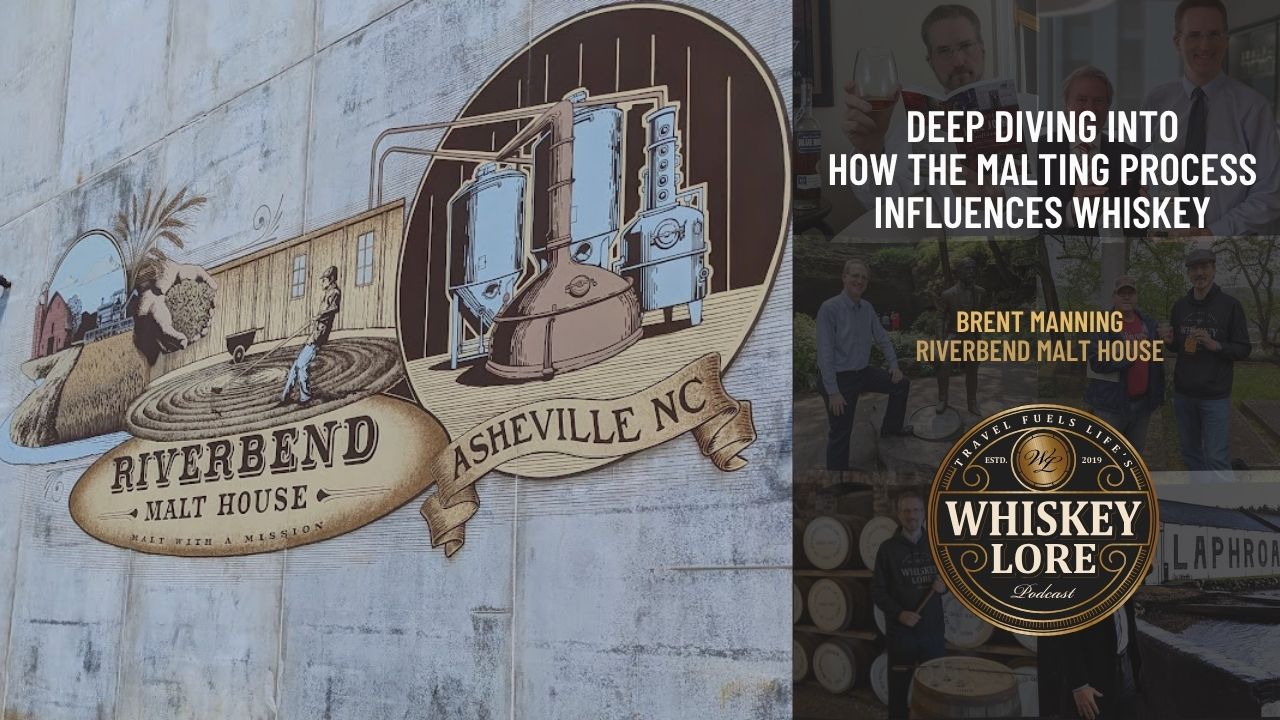
133 - RIVERBEND MALT HOUSE: Diving into the Malting Process
Listen to the Episode
Show Notes
Join me as I sit down with Brent Manning, co-founder of Riverbend Malt House, to uncover how two self-described “sustainability geeks” learned the science of malting, helped support the rise of “Beer City U.S.A.,” while starting humbly with a one-ton floor malting setup in Asheville.
We’ll dive deep into the mechanics of malting, from steeping and germination to kilning, and explore how subtle adjustments at each stage can dramatically shape flavor. Brent also breaks down the divide between brewers’ and distillers’ malts, and how Riverbend is working to close that gap by developing grains that deliver both high enzyme potential and rich, distinctive character.
Listen to the full episode with the player above or find it on Spotify, Apple or your favorite podcast app. Or listen and get bonus content as a member of the Whiskey Lore Speakeasy at patreon.com/whiskeylore. The full transcript and resources talked about in this episode are available on the tab(s) above.
For More Information:
Transcript
Drew H (00:14):
Welcome to Whiskey Lore The Interviews. I'm your host, Drew Hannush, the bestselling author of Whiskey Lore's Travel Guide to Experiencing American Whiskey: Experiencing Kentucky Bourbon, and the book that busts 24 of Whiskey's Biggest Myths, Whiskey Lore Volume One. And over the last few weeks, I've been thinking more and more about how to expand our whiskey knowledge beyond the distillers perspective and into some of the more supplemental industries that are a critical part to getting the whiskeys we love into the bottle. And one of the biggest mysteries for me has always been this concept of malting. Now, of course, I've been on a lot of distillery tours and they always tell you about converting starches to sugars so that the yeast will have something to feed on. And I've seen a few malting floors, especially over in Scotland. In the US, there's copperfox and then they do malting at Frey Ranch, but not with a malting floor.
(01:11):
But the process is usually discussed in a way that fits that particular distiller's needs. So today I headed up to my old hometown of Asheville, North Carolina and River Bend Malts, where I am meeting with company co-founder, Brent Manning. And after I got used to that wonderful smell that permeates the facility, a scent I referred to very positively as an air of grape nuts, Brent showed me around the facility and introduced me to the malting floor, the machinery that removes the issues of monkey shoulder, a painful syndrome that comes from hours and hours of turning barley. And we discussed things like the parts of the malting process that enhance flavor, what the right grains are for American single malt, and the differences between brewers and distillers malts. And as we moved up into the conference room, Brent brought some glasses and we had a sample of Oak and Grist single malt, which was distilled just about 20 minutes down the road from here.
(02:12):
And we got started in our conversation. I wanted to get kind of the groundwork set by asking Brent what it was that got he and his partner into the malting business.
Brent M (02:23):
Yeah. Myself and co-founder, Brian Simpson and I, we're sustainability geeks and we were involved in the housing market. We were environmental consultants. The housing market collapsed. We went looking for something to do. We wanted to be a part of the craft beverage industry. And we thought Asheville had enough breweries. And so we said, "Well, what about a malthouse? How would that work?" And then we began this long journey of bringing high quality barley, wheat, rye, oats, corn, et cetera, into the conversation of making beer that had a sense of place and spirits that had a sense of place. We knew whatever we did for our encore careers had to have sustainability woven through it. And so local grain seemed like a great way to do that.
Drew H (03:14):
Okay. And of course, me being from Asheville and knowing that there was really no beer around, there wasn't much of anything around here other than tourists. And then all of a sudden, a big change happened during the 1990s and into 2000s. And then I saw this beer culture start building here. So how much of that was here when you first decided to get into malting?
Brent M (03:36):
Yeah. So we had several breweries, but it was still definitely in its infancy. Our sort of legacy guys like Highland and Green Man were holding down the fort, but there was definitely a new bubbling up of new individuals. And we were seeing the overall number of breweries increase and it just started to become a social thing. I mean, we started to go out to breweries and it was a thing to go to Asheville and sample, have a flight of beers at several different places. And it really became kind of a cultural thing. And beer fits well with outdoor activities. We always called it the quintessential Asheville day was to get up, go hiking or mountain biking or whatever, and then meet everybody at the wedge down in the river arts for a beer and some peanuts and then go see a bluegrass show that night.
(04:35):
And so it was really an exciting cultural moment and it's still a big thread that's woven through our beautiful little town here.
Drew H (04:47):
You've not been malting. Now all of a sudden you're going to start malting. I actually heard that you went off to Canada to learn how to malt.
Brent M (04:55):
Yeah. So this was the fun ... Brian and I both have master's degrees in scientific fields. And so we were both pretty passionate about the fact that we weren't just going to hack at this. At the time, there were crazy videos on YouTube of people hot wiring their clothes dryer to dry out malt. And we were just like, "That's crazy. That's dangerous. We want to learn the science." And literally looked all over the world for a place to teach us and came upon the Canadian Malting Barley Technical Center and just cold called them out of the
Drew H (05:33):
Blue,
Brent M (05:33):
Said, "Hey, would you be interested in teaching us how to make malt?" And they said, "Yeah, come on. " And we spent almost a month up there, summer of 2010 in Winnipeg. And it's an amazing facility. It's a 15, 16 story building that's got some of the world's foremost small grains researchers. It had a full malthouse, full brewhouse, every piece of technical equipment you could possibly imagine to QAQC grain. And they built a beautiful curriculum for us. We brewed beer, we did test malts, we walked in the field, we went to grain elevators, we learned microbiology, we learned agronomy. I mean, it was a whirlwind tour with those guys. It was just Brian and I. It was two students and one faculty member, and we still are buddies with one of the main facilitators, a guy named Yushu Lee. He was just a wonderful human being.
(06:42):
And he would notice me starting to nod off in class. He'd be like, "All right, we'll take a break. I'm going to get Brent some coffee." And I was like, "It's kind of tough to sleep in a class of two people. " But yeah, we spent a month with them. They filled our heads with knowledge. We got back to the States and built out our little one ton kiln and just started to build the business from there.
Drew H (07:07):
Yeah. That's really interesting to think. You started floor malting.
Brent M (07:11):
Yep. Started floor malting. The folks at CMBTC, we had a great time because they thought we were completely nuts. They were just like, they were used to ... We toured a malthouse from malt Europe that was making three or 400 ton batches. And we're over here like, "Hey, we're going to do one ton floor malt batches in Asheville." And they're just like, "That's insane. I don't know what you're doing." But we thought they were crazy because they thought hoppy beer was 17 IBUs, which is basically logger level hops. And don't even get me started on their old fashioneds, but it was a great time. We learned a tremendous amount and they've continued to be a technical resource for us for the duration of our company.
Drew H (08:01):
Wow. Now, you're starting out flooring. How big did you have to have for a floor to do a ton worth of ...
Brent M (08:10):
Not big. I think the initial germination room was probably 15 by 30, something like that. The original malthouse was in a produce storage warehouse and we took over the banana room because that was the climate controlled spot in the building. And we knew most barley gets pretty ornery if it gets above 68 Fahrenheit. And so this room was our best chance at keeping it cool and happy during the warm Southeastern summers.
Drew H (08:45):
How did you go about finding ... Were the brewers around here kind of excited with the fact that there was a new place to go?
Brent M (08:52):
Yeah, there was definitely a learning curve. I mean, for all involved, I mean, we were working with Six Row Barley that wasn't exactly what they were used to working with. So they needed to make changes to their mill settings to accommodate the slightly smaller kernels. But what was really exciting at the time though was that there was this rise of mixed culture beers and there was a lot of history kind of putting wind in our sails. These mixed culture beers really were tied to a sense of place in the history books. And so when the Brewers made that connection, it just lit them up. They were like, "Oh my God, this is great. I'm learning how to make this style of beer and this guy's got the ingredients for me. " It allowed them to sort of complete that circle. And I think that was a really exciting time for us and it drove growth and we were able to ride the wave of mixed culture beer in the 2000 teens basically.
Drew H (09:56):
And
Brent M (09:57):
So that was instrumental in our growth really.
Drew H (10:00):
Did you find that you were struggling with only having so much floor space where you ...
Brent M (10:08):
Yeah, it quickly became ... We knew we needed to grow, only making one ton at a time. And Sierra Nevada, New Belgium, Oscar Blues made their announcements of their intention to open our East Coast facility a couple years after we opened. And New Belgium came calling and placed an order for our malted rye. And all of a sudden we're like, "Oh man, we're full." And then just one thing after another, all these opportunities started to cascade as the Beer City USA stuff started to rattle off. It was a constant stream of beer tourism by ... And brewers would visit from out of town, call us the next week, place an order. And it was a pretty wild time. We went from 2000 square feet where we started in 2010 to 10,000 square feet and 2014 to 70,000 square feet in 2018.
Drew H (11:09):
Wow.
Brent M (11:09):
So it was a lot, raising kids at the same time too. So it was a wild period in my life for sure.
Drew H (11:18):
Yeah. I grew up maybe four miles down the road from here. I drive by Millscap Road. I'm coming down Gerber Road and there used to be a Gerber baby food factory here and we always heard about it. I never actually got anywhere close to it, but there really wasn't much here. And then all of a sudden Gerber moved out and then we have all these apartments and stuff that are all surrounding. It's not the same road that
Brent M (11:46):
I grew up on. Yeah. We're as close to an urban malthouse as I think you can get. We can walk to a grocery store and it's pretty wild. But yeah, we're in a good spot. Brewers and distillers from town can come visit us, pick up their order, and that served us pretty well. The town's been good to us. And even though the whole beer city USA thing has kind of calmed down, there's plenty of interest in craft spirits and beer. So we're just continuing to ride that wave.
Drew H (12:18):
It's kind of that chicken and egg thing that I'm wondering about. Was part of the boom of beer the fact that they had a malthouse here that they could actually get?
Brent M (12:28):
I would love to take some credit for that, but I won't. I think a lot of what we did was just make a lot of breweries in close proximity. There was a rising tide lifts all boat kind of thing, and it became a really fun, easy, walkable thing to do in downtown. You could visit, geez, eight to 10 breweries on foot in an afternoon, and there's just not that many places in the south that offered that. But yeah, we were definitely proud to have a handle or two at every brewery in town. And we were definitely woven into that fabric, I think. So that's been something I'll always cherish.
Drew H (13:12):
When did you first start having people knock on your door about whiskey?
Brent M (13:16):
So the whiskey thing, like I said earlier, I didn't even mention spirits in our business plan just because it wasn't really a thing in North Carolina. And so it was really exciting. We were probably in Malthouse 2.0 around 2015 that we started having conversations with distillers and we had always thought, "Oh, well, we don't have distillers malt with the super high enzyme levels. We don't really have anything for you. " And they're like, "Well, we can make a multi-grain whiskey recipe. We like your malted rye, your malted wheat is intriguing. We can explore the space basically and you can be our secret sauce." And I'm like, "Okay, let's keep talking." And it turns out we could be a great neat little differentiation. It was bourbon, it was Tennessee whiskey, and the single malt thing was kind of bubbling up as we got closer to 2020.
(14:17):
We're sipping on my buddy, Will's from Oak and Grist, his single malt that's finished in a rum cask. And he came on the scene and was really just a great proponent of sourcing local and really putting those messages together of his craft and our craft. And we saw more and more people doing that. And it was really exciting to us. And now as we sit in 2026, it's 25 to 30% of our business.
(14:50):
And custom programs where we smoke different malts with different woods that are not available in the larger marketplace, we found that customers really loved that ability that we could sort of customize, but still be at a scale that was large enough to matter in their production facilities. So took a lot of effort to get there.
(15:16):
We went from one ton batches to four ton batches to multiple 10 ton batches over that period. And each one of them had their own sets of struggles and heartburn periods to figure out. But we got there and it's ... Yeah, I mean, kudos to our staff along the way that just put up with all of our cockamamie ideas and wild scheduling and all of that. But yeah, spirits has been a great thing and we're excited with the continued interest and expansion of the American single malt category. That's been going great. And then the next thing kind of on the horizon for us is a true distillers malt from the southeast.
Drew H (16:03):
Oh, okay.
Brent M (16:04):
So this has been really exciting. Just for the folks listening in, when we talk about brewer's malts, we typically talk about a diastatic power level around 110 to 130 for a base malt. When we talk about that same enzyme level of activity for distillers, it's more than double that. And so it's very different barleys that create that level of enzyme. And so we've been working with folks at Oregon State who recently kicked off a winter barley program because we grow barley from October to June in the south. Most places grow it from June to August, and we call that spring barley. But anyway, Oregon State has released a couple of G and Zero varieties that perform very well and create that enzyme level that we're looking for for the distillers. Got a couple of different ones that we're playing around with. One's called Vivar that we're pretty stoked with.
(17:09):
We're going to have commercial lots available of that by June is what we're shooting for. Really excited because this variety performs well for the farmers and for us in the malt house, and it delivers this enzyme level with a good flavor profile. And that was kind of the other give and take that we'd always sort of been aware of is just like, yeah, you got the great enzyme levels that's awesome that supports your process. We get that, but it doesn't really taste good. And we wanted something ... Most of our malts for brewers have a beautiful blend of sweet aromatics and melon character and all sorts of interesting flavor notes. And you get a distillers malt, you make a hot steep or a hot tea out of that and you get notes of like undercooked pasta and stuff like that. And that didn't really flip our switch.
(18:05):
And so when we started working with vivar, we were like, "Oh wow, we can have both now." And so that's got us really excited. We've got vivar planted in several states throughout the southeast, so we should have enough to do some really interesting trials this summer. And for us, that's the missing piece. We know we can get corn and wheat and rye from the southeast, but malting barley that met distiller specs was always the missing link. And now with vivar and some of its brothers and sisters, we're going to have the ability to sort of close that final piece of the puzzle.
Drew H (18:43):
It's really interesting to see the developments because, I mean, the thing that I was always hearing was, "Well, we have to get our barley from up north and we have to get our rye from up north." Sure. I was just down in Florida and they're talking about growing black rye down there.
Brent M (18:59):
Absolutely.
Drew H (19:01):
A rootsy rye is growing in South Carolina and different areas probably in North Carolina as well.
Brent M (19:07):
Absolutely. Yeah. Yeah. And we've malted seashore black, we've malted rinsabruzi for over a decade now and the flavor profiles are different. And that's really what excites us about this movement to sort of ... I always tell it as a kind of a one foot in the past, one foot in the future kind of thing, where we're simultaneously exploring heirloom grains while talking with researchers about what's next. And so I think when you put those two together, you've got a pretty compelling catalog to work with as a distiller to put together innovative bourbons and single malt recipes that are going to excite people. As you know, the consumer is getting more educated about their mash bills. They want to know everything. They want to know what floor of the Rick house it was sitting on. And so we feel like we offer that traceability and that really interesting flavor profile that deserves to be right there beside that piece of data about when it was distilled and which Rick house it lived in.
Drew H (20:16):
Yeah. It's really interesting. I was just down in Alabama and I was talking to Jimmy Sharp at John Emerald.
Brent M (20:23):
Yeah, good
Drew H (20:23):
People. And he said, "And just off the cuff and our grain's going up to Asheville." And I'm like, "Okay, I do have to talk to Brent at some point because now I'm fighting." So are you getting a lot of distillers that are saying, "Hey, can you work with our grain and what we're getting off of our farms to ...
Brent M (20:46):
" Absolutely. Yeah. And this is to the traceability thing, this is really part of our DNA that we work with small batches. We can tell you where every kernel came from in those batches. And when it comes to special projects with distillers, yes, we absolutely can take soft red winter wheat from the farm just down the street from the distillery, malt it to your specifications and send it right back to you. So we've done that for a host of folks throughout the Southeast. And as we know though, we have to be patient. So several of these products are still years away from being released, but we've definitely fielded phone calls on the day it went into the barrel and the people were very excited
(21:38):
Or that six month check-in where folks that are more skilled than I at gauging where is that, they can taste it at six months and tell you where it'll be in six years and they're always like, "This is going to be special." And so we've got a lot of those projects spread out across the southeast. One of the first ones came out this year. It was a collaboration with New Riff and Chattanooga Whiskey. They called it the Confluence Series where they basically did the same mash bill in each of their respective distilleries, aged it roughly the same length of time and then compared the two finished whiskeys side by side. And it was really fun. Volume one this year featured our malted Appalachian wheat and it was really fun to do that side by side to see, oh, this one's got a little bit more barrel character.
(22:34):
This one you can taste more of the wheat coming through. And so really cool to see those types of things come through. It's almost like a brewery style collaboration, but done through the eyes of a distillery that took, like I say, five, six years for it to come out.
(22:50):
And so they're going to continue that series. And then we've got just a bunch of these sort of special projects percolating up from Tennessee and Kentucky. So definitely stay tuned.
Drew H (23:04):
Yeah. Yeah. Well, interesting that you talk about the Brewer angle and the fact that both of the distillers at Chattanooga and at New Riff came from Sam Adams. So they've got that brewing background. And that's what impresses me about both of their spirits is that they pay attention to the beer. And so they're-
Brent M (23:24):
Yeah. And they're not afraid of specialty malts and all of that stuff. And I think that's a really exciting new frontier, I think, for craft distillers to explore because their systems are designed to work with it more easily and that the scale is more manageable and really cool to see the craft distilling space start to really lean into craft malt. We were talking about earlier, there's over 60 craft malthouses in the nation that are all putting their own little spin on this, different varieties, different processes, and they all come from different backgrounds. And I think everybody's putting their spin on it and you add in the additional variety development from a regional standpoint and you just have tons of different combinations that can come from this.
Drew H (24:18):
Yeah. It's hard to believe, but Whiskey Lore has been around for five years now. And over that time, I have shifted between history and travel. And recently, I decided it was time to bring a little more structure to the podcast. So you're now going to hear two episodes a week. Mondays will be focused on history, Thursdays on travel and process, but there's something else evolving here as well. From the very beginning, my goal has been to earn trust with you by showing you how I research, how I question things, and how I'm never quite satisfied even when I think I found the answer. And that has helped create the exact kind of audience that I was hoping for. The curious whiskey fan or the industry professional really wants to go deeper. The people who care about how whiskey got here and where it's going next.
(25:19):
Whiskey Lore Stories and the interviews help build that foundation. Whiskey Flights shows you the journeys you can take and soon I'm going to be introducing something new, The Legends of Whiskey Lore, where I'll spotlight the individuals from Whiskey's past who have helped shape the whiskeys that we enjoy today. And I'm also going to dig into the never before told story of the birth of bourbon. Definitely some exciting stuff coming your way. And now with all of that in place, I'm opening the door very carefully to a small number of partners who feel like a natural fit for the fans of Whiskey Lore. It's not a step I take lightly. The goal here is to not interrupt your experience, but instead enhance it by introducing products and services and resources that can add value to your whiskey journey. And for the right partner, it's an opportunity to be associated with a trusted environment.
(26:18):
And for you, it's a chance to discover something new, whether that's improving your tasting experience, planning your next trip, or for the many distillers who listen, I know you're out there to help you find some tools and services that'll help move your craft forward. So if you've got a product, service, or a brand that genuinely fits this world, something that supports whiskey enthusiasts or the industry in a meaningful way, I would love to hear from you. You can reach out to me through Instagram, through a DM, or you can email me at drew@whiskey-lore.com. Let's find out together how you might best fit into the Whiskey Lore Podcast family and connect with an audience that's always looking to learn and to grow. You walked me around the facility and well, the first place we went was into the floor malting room, which having been to Spring Bank and Bemore and to LaFreug with the windows open and everything, it's a little hard when you're going into a building that's already been prefabricated for baby food.
(27:33):
True, true. So do you have people who come to you and say, "Hey, could you do the floor malting instead of ... "
Brent M (27:41):
Oh yeah,
Drew H (27:41):
For sure.
Brent M (27:42):
Oh yeah, yeah. No, that's absolutely ... There's folks that say, "This is what we want. " And it might be an outlandish volume that would require us to do 22 batches back to back to back over two months, but we're game to do it. I mean, it's in our DNA, it's where we started. And so I still love seeing the grain on the floor. And I think it's a great teaching tool for our team as well, because when it's in a 10 ton vessel, obviously they're working with it daily, but it is a different animal. Like we were experiencing, there's way more airflow, so the smells are different, just everything's just a little different there, but the mechanics are what you can learn best from the floor. And you can notice when the grain is a little off, we always say it's a living laboratory.
(28:40):
We always use it to sort of assess that new crop year sample because A, we want to make small mistakes, but B, each year is just a little different. It might like a degree or two warmer, a degree or two cooler. It might like a little bit higher steep out moisture. All of that is best served and studied on the floor.
Drew H (29:06):
One of the things that I loved was the story that you told about the rake.
Brent M (29:11):
Yes.
Drew H (29:12):
You actually have a specially designed rake.
Brent M (29:14):
Yes, yes. So as you might imagine, there was not a rake that you could just buy at maltequipment.com. And so we found an old sketch in a textbook from the early 1900s as a best thing we could find as something of a prototype. And we walked into a metal fabricator, an artist shop here in town and we said, "Hey, I know this is kind of crazy. Can you make us one of these?" And so he's like, "Sure, yeah, whatever. I'll take a stab at it. " And it took us two or three versions to get it right because it's like bicycle geometry a little bit. The handle needs to sit at a certain ... Certain spot in your chest when you're walking backwards to get a good leverage point on it. And then also the other piece is it needs to be heavy enough so it doesn't act like a boat coming up on plane when you start to pull it through the grain.
(30:13):
And so we had to tweak a lot of those little variables over several versions to get to the final one. And it's worked well. It's probably Ray, Lord knows, millions of pounds at this point. And some of our other friends that make malt using the floor malt style have mechanized it and all of that. And bless them for figuring that out. We were always kind of like, "Well, the rake worked fine. And we've got competent staff nearby." And we just said, "Let's just keep going with what we got." But yeah, the rake has served us well over the years.
Drew H (30:54):
I was going to say, does the American medical insurance community cover monkey shoulder?
Brent M (30:59):
Right. Yeah. No. And I'm so glad no one's ever seen me slip and bust my ass raking rye. But rye has no husk on it, so it's really slick. So when it really gets germinating vigorously, there's a bit of a sheen on it. And I just remember more than a few times, just you're walking backwards and you're just muscling through the center of the batch, especially when we were doing the four ton runs. And my feet would come out from under me, just laying on my back. I'm like, "Anybody see that? " Good. Okay. But yeah, it's definitely a good workout. I will say that. When they took me off production, I gained 10 pounds. So it's real. It's definitely a workout.
Drew H (31:51):
Talk about in terms of, because I'd love to run through the process actually and get people a chance to understand that. But while you are going through, I guess we should start at the steeping, but I want to get to the idea of how you can make different types of malts on the malting floor.
Brent M (32:11):
Yeah. And we always got to jump into the deep end of the pool. I'll rewind the tape and start at the beginning. So to define malt and malting is we're basically managing the enzymatic digestion of the cell walls inside of each kernel as they're converted into a starch or simple sugar. If there are any gardeners out there that have ever started a tomato plant from a seed, that's essentially what we're doing. We're just tricking the plant into growing by creating the ideal conditions for that growth to kick off. Three main steps, steeping, germinating, and kilning doesn't matter the scale, two tons, 10 tons, 500 tons. Steeping is about two and a half days, three wet, dry cycles. We don't do one long one because the barley is actually respiring. So you can essentially drown barley. They told us day one in malt school, barley is not a fish.
(33:06):
And I've never forgotten that wine. Nice. I love that.
(33:11):
So yeah, we do two and a half days in the steep, three wet dry cycles, get the moisture content up to about 45%. If we're going onto the floor, we spread it out in about a four to six inch deep bed on the floor. The germination process begins. The first visual cue we get is called the chit. Looks like a little pimple on the end of the grain. From there, the rootlets sprout out from the chit. Heat is one of the byproducts of this enzymatic digestion. So heat plus the rootlet growth creates basically a blanket on top of the grain and that's where the raking comes in. So we pull the rake through, gently break apart that rootlet mat, get some fresh air in, cool down the bed, and the process kind of rinse, lather, repeats over the next three to five days. The product differentiation really begins here in germination.
(34:06):
We can take the same barley steeped at the same level of moisture and we make key decisions about what the final product is going to be by modulating that germination step. So if it's a light grassy pilsner or distillers ... And distillers malt is its own animal, but we'll talk beer first.
Drew H (34:27):
Yeah. So
Brent M (34:27):
If it's a light grassy Pilsner style malt, that's going to get like three and a half days at cool temps. If we want to do a British pale malt that would go into like your favorite extra special bitter, that's going to go in like a fourth day. And so what happens is that modification, that enzymatic digestive process continues on. In the pilsner stage, it's more like grassy and like fresh cut cucumbers. By the time we get to the pale ale and deeper into the Viennas and the Munich style products, you're starting to get sweeter, something like more like bread dough,
Drew H (35:04):
Pizza
Brent M (35:05):
Dough right before it goes into the oven. And so what's happening in that key stage is you're developing more soluble protein. And that higher soluble protein sets the table for more color and melanoid development in the kilning step. So like we were talking about earlier, the barley, the Munich Vienna pilsner is not indicative of a particular variety of barley. It's indicative of a style of malt being produced. And so we can take barley from all over the planet and turn it into pilsner, pale, Vienna, Munich, et cetera. So we set the table in germination. Vienna and light Munich are like five days. Paleo malt is around four pilsners at three to three and a half. We transfer into kilning. We go into a 24 hour period that has three key steps, free dry, forest dry and curing. Free dry is 16 hours, cool temps. We're just trying to gently turn off that enzymatic digestion.
Drew H (36:09):
Okay. We
Brent M (36:09):
Don't want to denature them by getting them too hot too quickly. We're looking at all of the data coming out during kilning. We're looking at temperature, pressure. Most importantly though we're looking at humidity.
Drew H (36:22):
When we
Brent M (36:23):
See the humidity start to drop precipitously, that's when we know we can go from free dry to forestry raising temperatures about 20 to 30 degrees, anywhere from 140 to 160 now in forestry. And this is where we set the table for color development.
Drew H (36:40):
So
Brent M (36:40):
We've got warmer temps, we've got soluble protein, we've still got a good bit of moisture to deal with. And so force dry is where we make the decision or continue on with our decision making process of if we're going to make pilsner, we just rock it right through there.
(36:55):
We're on the low end of the temps. We're continuing the drying gently, but efficiently. The dryer the barley gets, the higher the temperature has to be to continue that drying process. So even with a light delicate pilsner, you've still got to keep ramping up the temps to continue the drying process. So now at the end of force dry, we should be at seven or 8% moisture. We're going to go into curing. If we're doing pilsner, we're going to stay in the low 180s. If we're doing Vienna and light Munich, we're going to hit anywhere from 200 to 220, just depends. The key number is 194 Fahrenheit. The more time we spend above that point, that's when we're converting melanoidine precursors to actual melanoidance.
(37:42):
So think about it like grilling a steak in slow motion. We have all the elements there instead of 15 minutes, it's happening over hours. And so again, now to tweak that process for the distillers malt, it's a little different. We've got higher protein barley to start. We're going to do a longer, cooler germination step, really looking to maximize enzyme content during this stage. The cooler aspect of that just really keeps the barley in check and sort of chugging along more methodically rather than kind of like the modern barleys are more like a bullet train kind of think of that. And so we want a nice, cool methodical germination step, keeping things under control. We're going to push it out to five days, but it's been five cool days instead of five warm ones. So, and we're going to couple that with a very cool German kilning step where temperatures are going to be maybe finishing at 180.
Drew H (38:46):
And
Brent M (38:46):
So again, it's all about enzyme preservation. That's what we're driving towards. And so key differences are, it's a lot of levers we can throw. We always have to walk people through like there's a push pull. You can't have high color and high enzymes. You can't have ... There's just a relationship there that we have to remind people about as we start to put a custom project together or explain the differences between certain products.
Drew H (39:18):
Yeah. If we go to, when I hear of a chocolate malt, is this more of the kilning side of things?
Brent M (39:23):
Yes. So when we talk about chocolate malt, we're talking about a whole other deal.That is a very, very high temperature roasted product.
Drew H (39:32):
So
Brent M (39:33):
That malt, it is going to be germinated. It's just going to go straight into a roasting roaster, tumbling drum type of fair, whereas we do what's called static bed kilning as the name implies the barley doesn't move around. And so the goal with roasting is, or the benefits of roasting is that you can bring up the temperature of that grain uniformly and more quickly than you can in the static bed. It's only about six inches deep in the tumbling drum. It's a meter deep in the static bed kiln. And so a chocolate malt or a crystal malt will go straight well above 300 degrees. With chocolate malt, you're almost getting close to the ignition point of the grain.
Drew H (40:17):
Wow.
Brent M (40:17):
Almost, I think it's over 500 degrees
Drew H (40:20):
Is
Brent M (40:20):
Where things start to get a little weird.
Drew H (40:22):
Have you ever had that happen?
Brent M (40:24):
We had a roaster briefly and I definitely made the neighbors nervous on a couple of occasions and then that was enough for us to send it back to the manufacturer and say, "Thanks, this didn't work as advertised." So yeah, we've been slowly developing a crystal malt recipe in our static bed system that's been working really well. Darkest thing we can make right now is an 80 SRM. So that'll put you to like a really deep, deep, dark mahogany color wart. And so that would be something you would use in like a English brown ale or something like that to give it that sort of slightly oaky, slightly sweet toffee cocoa note.
Drew H (41:14):
Okay. If you wanted to dive into the world of peat, have you done any peat projects or like peach wood or- So
Brent M (41:22):
Smoking has been super fun. This has been a great creative outlet for us. We started, as we always do, we make small mistakes. So we started with a little shed from Northern Tools and a basket fabricated, doing 500 pound batches for folks, playing around with different woods. The first product we did was pecan smoke wheat and it was a home run
Drew H (41:46):
And we
Brent M (41:46):
Still make it today. Pecan smoke wheat gives it this lovely walnut oil character to it. I'm pretty sensitive to smoke and beers and spirits. And so I knew whatever we wanted to do. I wanted it to be like a note and not like a gong that rang beside your head when you sipped it. And so the pecan wheat started us down that path. And then as the distillers came into the conversation a little bit more, we started to scale up. We outfitted the shipping container out front so that we can do multi-ton runs. And yeah, we've done some peat. I blended it with some peach wood from a Georgia orchard to
Drew H (42:32):
Sort of
Brent M (42:33):
Balance it out. Again, I'm not a huge LaFroid fan, but I like the note in there and I wanted some balance. And so I felt like peach and the peat would come together nicely. And we've got a project waiting patiently in the Rick house with those two ingredients and stay tuned for more on that. But it turned out beautifully. Everybody was really excited. And for those of you listening, I still have peat available and would love to do another project.
Drew H (43:07):
Nice. Yeah. Okay.
Brent M (43:09):
Yeah. I overordered to say the least.
Drew H (43:13):
Wow. Let's talk about the grains for a moment. Sure. First of all, whenever I walk into a distillery and I'm on a tour, they will throw out two row and six row and I go, okay, that sounds interesting, but I really have no idea what the difference is between the two of them. And I'm sure there's some people in the audience that are a little confused on that too. What's the difference and what are the application differences for whiskey? Sure.
Brent M (43:39):
Yeah. So when we talk, it's all about the seed head of the plant, first and foremost. So six row denotes kind of a tightly packed spiral seed head where you've got grains that are not always uniform and shape because some of them are sort of tightly pressed together and compacted and don't grow in a uniform manner. Typically, six row was associated with a higher enzyme malt, not distillery level high malt always, but higher enzyme designed for adjunct brewing of light American macro lockers.
Drew H (44:15):
Okay.
Brent M (44:15):
So your Miller lights of the world, et cetera, would have been made with six row barley. Two row barley, as the name implies, two rows of plump uniform kernels on the seed head, not as high a yielding. So the farmers didn't exactly love it originally, but brewers loved it because it was a richer, more full flavored product typically and the uniformity allowed for easier milling and it got, it's a little bit higher extract because the kernels were plumper. And so those are kind of the basics of it. Plant breeding has, over the last 20 to 30 years, I would say has almost kind of washed out the enzyme difference. You've got multiple two row varieties now that are able to equal the enzymatic levels of the six row counterparts from decades ago. There's still a few that are circulating around, but most major malthouses in North America, I believe, are exclusively two row at this point.
(45:25):
So we still do a little bit with that classic thoroughbred six row variety that we started with, but it's a much, much smaller portion of our overall portfolio when it compared to two row.
Drew H (45:39):
So when we're talking about like the traditional brands, the big brands, they've probably gotten used to using the six row barley for the enzymes?
Brent M (45:49):
Yes, it is. Again, like a lot of big bourbon brands, we're talking about maximum of 12% of the distillers malt. And so not a huge player in the flavor portion of things. So really, again, it was their spec, I'm not going to say it had nothing to do with flavor, but really they were much more concerned about what is the DP or the diastatic power in the alpha amylase levels than they were about sort of putting it in a snifter
Drew H (46:22):
And
Brent M (46:23):
Seeing how the hot tea performed. They were looking for off flavors in the grain, like musty flavors and just general storage issue kind of things, not doing a full-blown flavor
Drew H (46:37):
Sensory
Brent M (46:37):
Thing.
Drew H (46:38):
This is one of the things that I've had this discussion offline a million times, but I've never really talked about it on the podcast before, but kind of this idea that one of the scary parts about American single malt is this concept that some of these bigger distilleries are getting in large amounts of this barley that's basically meant for enzyme conversion, but they're trying to make American single malt out of it and what the danger of that
Brent M (47:07):
Is. Yeah. And again, it's not bad malt, it's just malt that is driven, that was created for a different purpose.
(47:15):
And so when I look at what a beautiful British pale style malt can be, the color's a little bit darker and that even just given the maltster that little bit of freedom to work with a little bit higher kilning temperatures and not be so laser focused on the enzyme performance, you start to open up these just beautiful like biscuit and honeysuckle notes and fresh melon character. And that's just a lot of times you just can't get that if you're staying in the low 170s and the curing temperatures and you're germinating it so long that like there's a lot of almost vegetal material being created from that acrosphere, which is the first leaf of the plant that's growing underneath the husk because it's germinating. And so there's just some ... You can't have it both ways, basically.
(48:16):
And so I think it's attractive to have that freedom to explore the space. My favorite malt is Vienna, because I think it's at the apex of everything. You can get the biggest, boldest flavors that taste like fresh honey, but it's still got good enzymes that convert itself, it can make a dynamite single malt. And so that's really where I always kind of nudge folks into is like, because everyone always kind of wants to, "Oh, well, let me go all in on this tofe note from this really high end specialty." And I'm like, "That's great. Let's put a little bit of that in there, but that's not going to contribute a lot to the yield of your spirit." If we go back here and build it off of Vienna, we can have the best of both worlds. You can get a lot of character and not sacrifice your yield.
Drew H (49:09):
Yeah. Well, what is the toughest thing you've had to malt before?
Brent M (49:15):
The biggest challenge that we have done successfully is create a product called Honey Malt. So to make a honey malt, you're essentially throwing everything you learn out the window and letting nature take over for a little while. So we were touring the GKVs and we felt all that nice cool, fresh, humidified air going through. And so when you make a honey malt, you actually let the germinating barley kind of really get kicked off and going and three days deep and then you lock everything down and you just let it sit and it's still moist. And so you've got a lot of this native acidifying bacteria on the husk of the grain. And when it goes anoxic, that bacteria can begin to really proliferate. And so the trick is you can let it proliferate for a little while to get like this beautiful like black cherry snap to it.
(50:13):
And then you push it through a light Munich style kiln run and you get all those beautiful like syrupy sweet aromatics draped all over that black cherry note. And so you get this really, really complex finished malt, but it's really easy to mess up. If it gets too hot, it can go full blown acid and it's really tough to balance that out. If you don't go long enough, then it just tastes like Munich malt. And so it's really this dance. And so again, we've kind of trained ourselves to like, we've got all the data in the world coming at us, but go open the hatch and tell me what it smells like and tell me what it tastes like, and then we'll know if we're ready kind of thing. And so over the last ... We've had this product now for a little over a year, so we've got everybody's kind of nose and mouth tuned up to like know what to look for so that we're hitting that spec on a pretty regular basis now.
Drew H (51:13):
What this all tells me, and we could probably talk for another hour about all of this, because I mean, we talked about a lot of stuff even before we got on the microphone, is that we talk about all the different stages in making whiskey and where you can control flavor. And what you've shown me is even in the three steps of making malt and where you're getting your grain from on top of that, you have so many different areas where you can control or create flavor in the process.
Brent M (51:43):
Yeah, absolutely. I mean, we've got the modern barley varieties, a lot of folks I talk to are always like, "Let's talk about terroir." And I'm like, "Terrewa exists to me in the sense that I can tell you that variety A tastes different than variety B." I can't tell you that the farm that was grown on changes it yet. We're not at that level of differentiation.
Drew H (52:09):
We'll send you the Waterford in Ireland because they're doing all
Brent M (52:13):
That. Waterford's doing some beautiful things. But I think from their prospect, they've got a lot of different ... They've got the influence of the sea, they've got a lot of different big soils differences. If we're growing grain in the Piedmont of the Eastern US, there's not as many variables there. But no, it's really exciting. The future is really bright. I mean, we've got pipelines now of new winter varieties of barley for both brewing and distilling coming out of Virginia Tech, Oregon State. We've got numerous breeding programs around the nation that are pulling in germ plasm from all over the planet and mixing it in with what they have already begun working with. And it just keeps creating this new realm of flavor coming from all these different things that we're really excited to be a part of. We get a chance to work with varieties, just like in the world of hops where they still have a cereal number.
(53:20):
We get samples from these plant breeders that are still cereal numbers. And it's really fun to like, "Ooh, let's see what this is going to taste like. " So it's been great.
Drew H (53:31):
That's fantastic. It's great to note you're only an hour down the road from where I live and all of this crazy stuff going on up here that I really appreciate you taking the time today and rolling through and giving us a good introduction to malts and what you guys are doing here.
Brent M (53:47):
Yeah, we appreciate it.
Drew H (53:48):
All right. Cheers. Cheers. Well, I hope you learned a lot from Brent. Have a better handle on flavor development through malting. And coming up next is History Monday, which will include a return guest, my friend Jerry Daniels of Stone Fences Tours in Kentucky. Of course, he'll be done with a busy Derby week, but it is never too late to talk Kentucky Bourbon History. And Jerry surprised me a few weeks ago when he told me about some of the huge names of whiskey history that are not a part of the Kentucky Bourbon Hall of Fame. Some of them are serious shockers. We're going to come up with our own lists and countdown seven people that we think should be in the Kentucky Bourbon Hall of Fame, but that have been excluded for some crazy reason. Make sure you subscribe to the Whiskey Lore podcast so you don't miss a moment.
(54:37):
I'm your host, Drew Hannush, and until next time, Cheers and Slainte mhath. For show notes and transcripts, head to whiskeylore.org/interviews. Whiskey Lore is a production of Travel Fuels Life, LLC.