
Whiskey Thief Distilling
Drew H (00:00):
Want to hear 20 more minutes of this interview? Head to patreon.com/whiskeylore. And if you're not a member yet, sign up for a seven-day free trial of Whiskey Lore's Patreon. Welcome to Whiskey Lore's Whiskey Flights, your weekly home for discovering great craft distillery experiences around the globe. I'm your travel guy, Drew Hanish, the bestselling author of Experiencing Kentucky Bourbon: The Lost History of Tennessee Whiskey, and a brand new book that busts 24 of Whiskey's biggest myths, Whiskey Lore Volume One. And today I am headed down the road that way back in the year 2002, I drove down after coming back from Missouri wine country and doing some wine tastings. And I was amazed that I- 64 had signs that said you could take an exit and go on a distillery tour and do tastings. And after going through the whole wine experience, it was like, well, how do you do whiskey tastings?
(01:04):
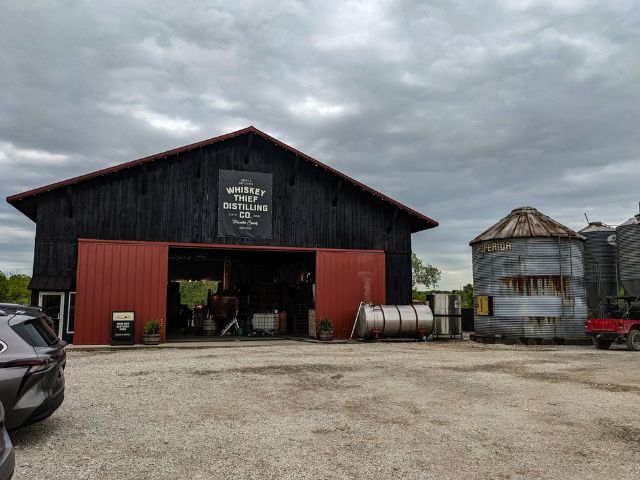
I mean, that's pretty potent stuff. Well, now 23 years later, this area is familiar as the back of my hand. And we're actually headed out to a distillery along this route just west of Frankfurt that is located at Three Boys Farm, and it's a distillery called Whiskey Thief. And the first thing to be aware of when you're coming to Whiskey Thief is that when you turn off the road to get down to the distillery, be leery of that blind hill that you'll be taking there. Make sure there's nobody coming up it as you decide to go down. And then you go across a one lane bridge and then over to the left, you'll see a sign and a dirt path that is going to take you down and around past the gift shop. And then you'll pass by another building. And if you look over to the left, you'll see down the hill, a shot of a red barn, which is where the actual distillery is at.
(02:02):
So it's beautiful drive down in there. There's a couple reasons why I wanted to have Whiskey Thief featured on the show. First is that this is really a great place to get a hands-on experience where you're handed this long copper tube where you're going to be able to draw your own whiskey out of a whiskey barrel. That contraption is known as a whiskey thief, and then you'll be able to fill your own bottle if you like the whiskey that you try and also do tours there. The second reason is that there is now a whole new experience in Louisville down on the Eastern end right past where Whiskey Row comes to an end in an area called New Lou. And so I want you guys to learn a little bit more about that as well if you're going to Louisville. And also they have a new hire.
(02:55):
A friend of the show, Lisa Wicker, who is so new that we decided the best thing to do was to have the distillery owner, Walter Zaush on to talk about the distillery and the background because Lisa is just getting up to speed on a lot of the stuff that's going on at the distillery. And then we'll talk to her in just a few minutes about what things that she'll be bringing to the whiskey thief experience. So one of my favorite people when I first started doing interviews for the Whiskey Lord podcast is the late Al Young, brand ambassador and distillery manager for Four Roses. Walter, I understand that he had a little bit of impact on your direction in this industry.
Walter Zausch (03:41):
Yeah, absolutely. So one of the early experiences I had was I got invited to go with wholesaler and retailers on a single barrel picket four roses. And it was with the famous Al Young and they had the barrels rolled in there and we were thieving out of the barrel and tasting out of the barrel. And it was just a out of this world experience. And I was kind of a guest of the people that were actually picking the barrel and making sure that they could sell it through their retail channels and all those things. And I was fairly new to the industry. So I felt like as a guest I would sort of lay low. But in the meantime, sort of in the background, I struck up this conversation with Al Lee. I spent more time probably talking to him while everybody else was focused on which barrel fill levels and proofs and this and what flavors they were getting and all that.
(04:32):
And so I was ... And then I'd run into him at various events and I think he remembered everybody. I don't think it was just exclusive to me that he had this ability to talk to people and remember them wherever he went, but it left a big impression on me in that I kind of was like, that's the single coolest experience that you can have in bourbon. First of all, to be able to talk about the spirit with somebody of that pedigree and heritage and all the things that he was, and then also just to taste straight out of the barrel and really experience the spirit the way nature intended it. And so for me, that was just like game changing and life changing probably a little bit too.
Drew H (05:13):
I mean, when I first got into traveling around Kentucky, I don't remember even people talking about going out and doing barrel picks. Today, barrel picks seemed like everybody's doing a barrel pick and where's the next one going on and the rest. But when you were doing that thieving experience, I mean, it really wasn't something that was very open to the public.
Walter Zausch (05:34):
No, and mere mortals weren't able to do that thing. You had to be with a wholesaler, maybe a retailer that was tied with that wholesaler or there was a spot that was empty and they invite somebody like me along. I don't know what I did to deserve it, but I'm sure glad they did. And then I remember the very first time that Buffalo Trace opened up some consumer barrel picks. And I remember everybody in the world was sitting at their computer at like midnight or whenever it came available for those three spots
(06:07):
And they put up three spots for whiskey and like Taylor Swift tickets were probably easier to get than that was. But strangely enough, they also had their tequila on there. And somehow I inadvertently ended up buying a barrel of tequila, which guy Bo Beckerman, who was there at the time running the program, he called me and he goes, and I didn't know him, but I kind of know who he is now. And he called and he goes, "Did you really want that tequila?" And I was like, "Yeah, no, I don't really want tequila." In hindsight now, maybe I should have taken the tequila, but at the time I was really trying to get that whiskey. So very funny how that's evolved, that whole barrel pick phenomenon.
Drew H (06:47):
So now you're running a distillery where people get to come in and actually do the thieving out of the barrel. So how did that come about? Did you first have kind of the idea that you wanted to do that and then you looked for a place to do it or did it evolve in a different way?
Walter Zausch (07:03):
So my background is a strange one, but I ended up in technology both with Apple and Microsoft and specifically even though I went to architecture school, I ended up somehow working on kind of high touch retail experiences. I had moved back to Kentucky and at some point I was with Microsoft traveling all the time and I hit that time in your career where your boss kind of says, "Hey, in order to kind of continue to grow with this, you're probably going to have to move to the company headquarters, which is in Redmond, Washington, outside of Seattle." And my wife and I thought about it for maybe 30 seconds in that we really wanted to stay in Kentucky because we're both from here, our family's here. So as I started thinking about, well, what am I going to do in Kentucky with this background and this experience, I started looking at the bourbon stuff and going, so much of this thing is an experience and I could probably translate some of that learning from honestly the best people in retail, high touch experiential retail, I could probably bring some of those things I'd learned to this industry.
(08:08):
And so started a little company and I was buying barrels and then I started to kind of help people figure out how to start brands because nobody was really starting brands. There were almost no non-distilling producers at that point, but I had sort of figured out the ins and outs of like how to navigate the TTB and colo approval and all those things. That was a way to make money as I was working on this other thing. And as I was buying barrels for this business idea, I was storing them here at Three Boys Farm. I met Ross Caldwell, who was the former owner and he was very generous and allowed me to store my barrels here and do all my kind of weird things I was doing, tests. And we became friends and had a good relationship. And I was doing that for about, I don't know, four or five years.
(08:51):
COVID came along. My business wasn't really affected, but his business was dramatically affected in that tourism was shut down. And Ross really lived off of bringing people here to the farm and letting him really experience bourbon in a very authentic way. The challenge with Ross was he didn't always love people, and I have no problem that he might one day hear this podcast and hear me say that because he would agree. He got more than about 20 guests in a day and he was ready to close the gates and go watch LSU football, but he has an engineer's mind. So he built a great distillery with some great equipment. He was making good whiskey and that was really the thing that, that was his passion. But he did rely on the tourism thing, especially until as his whiskey was aging. When that got shut down, his commercial clients like myself and others were really the thing that kept the place going.
(09:50):
So at some point, I think he kind of went through the ringer on the whole just trying to make ends meet for several years there. He had been doing it for about 10 years. He has Triplet Sons for which the three boys name came about. The original name of the company, I should add, it was called Whiskey Thief Distilling Company. So in fact, that's the original permits were issued into that name. If you went to the Secretary of State, that was our name. The Three Boys was always a kind of DBA. And so his three boys was Triplet Sons. None of them wanted to kind of continue with the company. And one day we were out here at the farm and he said, "Hey, do you got time this afternoon to drink a little bourbon?" And you always answer that question yes with Ross because A, he's an awesome guy, but also usually he was going to pull out something great because he always had like barrels stashed around that were really special and tasted great.
(10:41):
And so if he was treating you to some good whiskey, you're in for a kind of good treat. And so we started drinking suburban and the actual line was, "I think most days you like this place better than I do. " And I said, "Really?" And he goes, "Yeah." He goes, "I think I'm ready to sell and retire." He's from Louisiana originally, hence LSU fandom. And he said, "I'm ready to retire and I think you need to buy the place." And I was like, "I'm not sure. My little company's not doing ... I mean, it's doing well, but I'm not time ready to become a distillery owner necessarily." And then we drank a whole lot more whiskey. And in the process of doing that, that sort of lubricated the deal and by the time we got to the ... I don't think we finished the bottle, but let's say we did, he helped figure out how to finance some of it.
(11:28):
And I had gotten more courage for debt and that sort of thing and to figure out how to break it to my wife whose I think response was, "How about a Corvette or a boat, something responsible?" But I always jokingly say that she absolutely embraced it from the first moment because she loved it out here too. So I did fall in love with the place and there were probably most days that I liked it better than he did. And six months later we closed and one of the first things I did in that first year was rebranded it back to the original name just because I thought, because we do let people thieve out of the barrel and I thought it was a really cool name. And it goes back to that experience I had with Al Young way back in the day and hence we brought the name back Whiskey Thief, rebranded it, joined the Kentucky Bourbon Trail as Whiskey Thief.
(12:18):
Yeah. So that's how we got here.
Drew H (12:20):
It's really interesting that you mentioned about what the experience was like before because I remember when I ... I'll always do a Google search to see what the reviews are for a place before I'll head there to do it. And so this was 2019 and I was reading the reviews and I think some people probably had that kind of experience that they came out of it going, "Well, it was a really cool experience, but I don't know if it was the friendliest place in the world or whatever." I heard
Walter Zausch (12:50):
Those. I've read them all.
Drew H (12:52):
Yeah, it comes across. What did you really change about the experience? If somebody had come to Three Boys back then versus what it is now, what are the big changes that you kind of implemented when you first jumped in there?
Walter Zausch (13:05):
Well, I would keep the gates open on a Saturday. I mean, that was a easy fix. No, I mean, I took kind of what Ross was doing. And so if Ross, on those good days when you could get down, a lot of times people never really made it past the gift shop depending on what was going on, but because our gift shop is kind of all the way up at the top of the property, but on those days where Ross was sort of entertaining people in the still house or they weren't distilling or whatever it was, you would come down and he would have a series of barrels and he knew exactly which barrel tasted how and were ... Barrels go through upturns and downturns in terms of their flavor, which is something I learned from Ross that I never knew. And I thought first I was like, "This guy's kind of, I don't know, man, I'm not sure I buy this because I've done all the tours and read all the books and done this stuff and I've never seen this discussed and because they can change within sometimes three or four days depending on what's going on with the barometric pressure, humidity, temperature and all that.
(14:02):
" So he would have these barrels that are, he'd be like, "Oh, no, you don't want to taste that one." It was good about a week ago, but it's not good now. And I'd go, "That seems weird." 27 barrels or something, he knew which ones that he wanted to showcase. So he would kind of go through, thieve out of them, let you taste from them. And if you liked what you tasted, then he would fill you a bottle. And then he'd go, "Okay, I've seen enough people. " And they would close the gates and it didn't care. It didn't really matter if you were a tour company or two people driving in, you weren't getting in. So we reduced it down to five barrels. We sort of designed it. Originally, we did a lot more of designing it as a flight, so we kind of knew what the flight experience was, also figured out that just like he told me, the barrels changed.
(14:50):
So even if you design the perfect flight in two or three days, it's changed. I also kind of figured out that it didn't really matter what you liked or what I liked or what Lisa likes, it's what the customer likes. And so everybody tastes whiskey differently. Everybody has all these different preferences, high rye, high corn, or the mythology of the high corn's going to taste one way and high rice going to taste another way, even though I might go, "Oh, barrel three is not my thing today." I got three people behind me going, "This is our favorite one. Are you crazy?" So I just sort of realized that it's a very subjective thing and it's very democratic and what you like is what you like. And so we kind of made it even more that way. And now we're very careful. We never give tasting notes.
(15:37):
We want every single barrel to have its own unique expression when you're there. And yeah, we'll tell you the mat, we're as transparent about all the stats. We give you the mash bill, the age, the proof. Ross didn't do the best record keeping on char levels. So sometimes we know it's a number three char kelvin. Sometimes we don't know depending on ... And he liked to mix it up with all kinds of different barrel manufacturers, mash bills. His thing was always that historically farmers would, at the end of a season, they would have their grain and they would kind of go, "Okay, what do we got? And then let's ration them out to get as many cooks as we can. " And there wasn't this sort of science of like, "Oh, a 27% rye is going to taste distinguishhly different than a 22% rye." It was really what you had.
(16:29):
And so he liked that spirit of chance and discovery that would happen and then really let the barrel take over. So where everything we do is a single barrel. We really celebrate the barrel. We don't do a whole lot of crazy barrel stuff. We keep it 53 gallon, three, four char, sometimes a two maybe. I'm not even sure there's ever been a two, but I'm sure there is.
(16:51):
And we use Kelvin mostly, but we'll branch out and we've had Zack barrels, we've had Canton, we've had West Virginia Barrel Company barrels, we've had ISC, but we change it up. And then we let the single barrel do its thing and everybody experience different single barrels and make their own mind up. And if you like it, you can fill a bottle and take it with you. And as was said, you can't step into the same river twice. You can't really taste from the same barrel twice. If you come back a week from now and say, "Ah, I got to get three more bottles of barrel number three," I'm probably going to go, "Well, you probably want to taste it first because it may not be the same barrel three that you knew a week ago." So that's kind of what we've done. And then another big part was we've always allotted a certain amount of our capacity for walk-ins.
(17:38):
So what the other thing we learned coming out of COVID was there was so much variability in who was open and their hours and all this stuff. And you could safely distance here, which was a big advantage, as well as just people were coming to Kentucky and finding out they couldn't get into any place just because of
(17:57):
Demand. I mean, still, if you don't have your ticket for Buffalo Trace whenever they put them online, which I don't even know the trick, it's like first day of the month or something, you're probably not going. And so we just say, "No, we're going to leave a big allotment of that capacity open for walk-ins." So sometimes I think people see that and they go, "Oh, maybe that place isn't good or it's not a real distillery because they have availability and nobody else does." We do that on purpose because we want those walk-in customers, which just means we get a lot of people and they can drop in. Even people who live in Kentucky can say, "Oh, I know we can always drop into Whiskey Thief and we've added music and food and all these things." So yeah, I think those are the big components.
Drew H (18:46):
So are we building your interest in planning a trip to Whiskey Thief as part of your Kentucky Bourbon Adventure? Well, make sure to grab a copy of my newly updated and expanded addition of Whiskey Lore's Travel Guide to Experiencing Kentucky Bourbon, 100 more pages than the old guide. Again, I'll be teaching you how to plan the perfect Kentucky distillery itinerary. I'll give you profiles of 44 of the best distilleries to visit from my own personal experience. I'll tell you what I tasted, some side trips you might plan along with that distillery visit and insider things to take note of while you're at the experience. I'll also give you advice on how to handle your tastings, and I'm going to give you the real history of Kentucky Bourbon without all the lore. Make sure to grab that second edition on Amazon or use the shortcut link at whiskey-lore.com/kentuckybook and also keep your eye out for copies at your favorite distilleries in Kentucky as a few select distilleries are now going to be carrying Whiskey Lore's Travel Guide to Experiencing Kentucky Bourbon.
(19:56):
One of the things that I've noticed in my change from my first edition of my book to the second edition is that back in 2019 when I was doing distillery tours, there wasn't a lot of cast strength whiskey, but now there seems to be cast strength whiskey at least as one selection on every tour that you go on. So how have you found approaching trying to drink a cast strength whiskey for those that may be uninitiated?
Walter Zausch (20:25):
A friend of mine in Indiana who came and visited me for the first time, he got a couple of barrels in and he goes, "You know what? " And he's a whiskey drinker and he's like, "I'm loving this, but this is not for beginners." And I was like, "That's fair." So one of the things we do is we make sure that there's plenty of water for people if they want to proof down and we kind of explain all that. Lately we've started out, we had a series of wheat or wheated bourbons we did. And so we start out with that barrel. They naturally are the way we entered the barrel with them at a slightly lower proof. So I call that kind of a stretching exercise. It helps people get ready. And if they come out here in the morning, they'll burn off their toothpaste or whatever it is.
(21:07):
And a lot of times we end up, they'll go back to barrel one because I'm not sure I really tasted barrel one, but once they get through it and we kind of give them some talk about how to drink high proof whiskey, but you acclimate yourself pretty quick, I would say. So by barrel two or three, people are up to speed and they're figuring out it's not for everybody. I mean, sometimes I have to say, well, maybe it's not for everybody, but I think people really appreciate though tasting it straight out of the barrel, uncut and unfiltered and knowing like this is the real deal. And we don't touch it. We don't add water. We don't do anything. We just literally open those barrels and let people start tasting out of them. And yeah, there's oxidation going on throughout the time. The barrel's sitting there and the temperature's working on it and all those things, so it's changing, but that's the experience.
(21:57):
But I think most people leave very happy that they've had a chance to experience the foolproof.
Drew H (22:05):
Yeah. It's great to see that you have added somebody to your distillery team now who I've had the pleasure of having on the podcast before, Lisa Wicker. Lisa, since the last time I talked to you, you've gained a new title so I understand. You are now a Kentucky Colonel?
Lisa Wicker (22:23):
I am. I know. I have been for a year. Maggie Kimbrell nominated me and I'm very excited about it. I got a really nice letter from them today about my new position here.
Drew H (22:34):
Very nice. Very nice. So does anybody call you Colonel Wicker?
Lisa Wicker (22:38):
No, I'm going to ask for that though.
Drew H (22:41):
There you go. There you go. In talking about the different grain bills that were going on at the distillery in the past, are you going to kind of continue on that path or are you looking to kind of solidify some personalities to the spirits that you're making there?
Walter Zausch (22:58):
Well, let me just say real fast and then I'm going to let Lisa answer, but you went a completely different direction with the Kentucky Colonel thing because I thought you were talking about the new title meaning that she's here at Whiskey Thief, which also only happened within the last two weeks. I just wanted to say, I am so excited that she's here. I like the Kentucky Colonel thing's cool too, but that she's here is so awesome for us. And to have somebody with her experience, knowledge of the industry, the pedigree of the projects and the whiskey that she's made and worked on and won awards for. And I mean, I'm a fan first, and that she's sitting here at the same table with us now is just humbling for me. And so yeah, tell us, Lisa, are we going to stay to the mash build?
(23:47):
What are we doing?
Drew H (23:47):
You've been here for a couple of weeks. We're ready to- side
Walter Zausch (23:51):
Of the mic. I'm going to ask some questions too. Yeah.
Lisa Wicker (23:54):
I'm deconstructing everything so we could turn around and reconstruct it. Not that anything needs to be different, but things evolve, right? And I definitely want to honor the model of what's happened here already and we'll go forward. But backing up on the historic thing and what Walter was saying that you know this, Drew too, is how grain bills used to shift depending on what people had and those sorts of things. But those are definitely going to all be taken into consideration. How's that for kind of avoiding the question a little bit?
Drew H (24:25):
Very nice. Very nice. Well, there's another similarity between all the distilleries that you have worked at. I think of Starlight because I've been to each except for Widow Jane. I haven't been to Widow Jane, so I don't know what was there. But you seem to attract potstills. Is that kind of something that is of interest to you that you want to stay in the Potsdill world?
Lisa Wicker (24:48):
Oh, 100%. I mean, Pot Distilled Whiskey is what I cut my teeth on and it's near and dear to my heart. I love the flavors of pot distilled whiskey. I love distilling on columns too. I just like making whiskey. So that's kind of the bottom line. But no, there's just so many things you can finesse with the pot that you can't do on a column, and it certainly comes out in the profile of whiskey. And I love that part very much.
Drew H (25:14):
In terms of how you will be working, are you going to be on site over there or you got two different locations that you're working with? Kind of what do you see your day-to-day as being?
Lisa Wicker (25:27):
Oh, I see my day-to-day. Walter can correct me if I'm going down there like, "Hey, Lisa, we didn't talk about that. " We'll be here on the farm. I was in Nulu yesterday working with our wonderful compliance person. And then there was a whiskey dinner last night with some people that I've known now for 14 years that I met originally when I was at Limestone Branch. And so I was in Nulu for all afternoon and evening last night. So those things will happen on occasion, but mostly I'll be here on
Drew H (25:56):
The farm. So do you have a separate warehouse where you're storing ... Because as I understand, you put out maybe a thousand barrels a year. Is that figure in the neighborhood of ...
Walter Zausch (26:07):
That's our goal and sort of our maximum capacity. Whether we've ever really achieved that is probably not ... Well, I don't know if we've ever ... I don't think we've ever achieved it. And actually not in the time I've been here, because the other thing is I bought a little bit of a fix-me-up distillery after a couple of years of COVID where Ross was kind of just barely surviving. There wasn't a lot of preventative maintenance, let's say, and things going on. So we've had boiler issues ... I mean, and that's a distiller's story anyway, it's like watching Star Trek. There's always a warp core that's going out or something that's going ... Or it's like running a submarine, I guess. But we're now ready to have somebody like Lisa come in and even though we're still, there's things that need to be fixed and money that needs to be spent, we have a little bit more solid foundation to build off of.
(27:11):
So that's the goal, is that the goal is to get to that thousand barrel a year output.
Lisa Wicker (27:16):
I've never been at a distillery where it was ready to go that I didn't have a lot of things going on. I was going to try to avoid the word issues. No, issues are ... It's a commonality. I like to fix things. I like to troubleshoot. I like to problem solve. So it makes it exciting. At one point I had a couple offers from two major distilleries to come and they ... I actually even went through the interviews. They reached out to me and like, "We think we would like to talk to you. " And my son is like, he's like, "Mom, you're going to be bored out of your freaking mind." Some got to break down. They considered you for the position, but he goes, "You don't really want that. So you're so bored." I mean, I think you're going to drive all he and his sisters crazy because I was going to have too much time on my hands.
(28:03):
But yeah, so I'm excited about that. I love the fact that there's not been a distillery I've been in that hasn't ... My biggest successes have been in distilleries that have had ... Every day is a little bit different and I love that. We had some crazy stuff with Limestone Branch as we're working on client projects and our own projects. And we had the one little 150 gallon pot still, but then we had the crazy tote tank still. It was 500 gallons. And even getting ... When I started distilling for Ted Huber, the grain distillery was brand new. It was brand new. So even though the equipment was there and the facility was there, there were still things that we had to troubleshoot and work through almost on a daily basis there as well. And as the program was growing so quickly, same thing, would Jana get there and the first thing I noticed is that the boiler's installed backwards.
Drew H (28:57):
Oh, man. They're
Lisa Wicker (28:59):
Telling me all these boiler issues. And I'm like, "Well, it's backwards." I'm no boiler expert, but it's like, okay, so we were fighting that in the city, and we were in an industrial section of the city, but we're just fighting the day-to-day battles of everything from trucking to trying to figure out where we're growing our corn and those sorts of things. So I love this business very much. And so I'm really excited about everything that's happening here and will happen.
Drew H (29:25):
And in Walter's-
Walter Zausch (29:26):
Boiler being installed forward was probably a big reason you took the job. I didn't
Drew H (29:30):
Even know- And Walter's hearing all this and he's going, "Yes, this is exactly what I need. I needed somebody to handle all of it. " So let's talk and shift gears into Nulu and what's happening there. First of all, how did this idea come about and what really was your goal with Nulu?
Walter Zausch (29:49):
Yeah. So one other big part of who we are is that we're not in distribution. So part of that time I was in California with Apple and Microsoft I spent a lot of time in Napa and I found I was always drawn to those places that you couldn't find their wine. You had to go there and meet the family and do the thing and see the actual people who were making this stuff. A lot of those places either you got to be in their wine club or you buy on site. And I always thought that that was kind of a cool thing. Ross was already doing that. So I was also, I think that was another big piece of the tradition here that I really liked. So we sort of stayed true to that. So then when the state legislature a couple years ago passed whichever that was, House Bill five or whichever one it was that allowed for distilleries to have a satellite tasting room, that seemed like an interesting proposition.
(30:42):
It was something that I sort of put in the back of my mind because I understood that I could reach out to more people. And essentially it gives them another place to come and taste it, to experience it, and then to buy direct. And we could still have that great one-to-one relationship with our customers.
(31:01):
But I kept going, "Well, that's what the big distilleries do. I'm not sure I can do that. " And it's a very different experience. So we call it a tasting room and a listening room. So we're in Nulu, which is the kind of east market street part of downtown. Rabbit hole is in Nulu. Angels Envy is a short walk from where we are. So we're kind of in between those two, big guys. And there's some other things. The Heaven's Door, Bob Dylan related Heaven's Door is right across the alley from us. And they have a beautiful facility there. And so we're kind of building this little bourbon community outside of Whiskey Row on the east part of market. But we also recognize that there wasn't a lot of music. We have a lot of music at the farm all the time. So we kind of wanted to bring that component to it.
(31:53):
And it's really, the music part has taken off a life of its own. And really, I'd say we're jazz and we're jazz adjacent. It's kind of the music selection. You're going to hear jazz, bluegrass, blues, soul, piano trios, singer songwriter every now and then. So that's what we're doing. And cocktails are a big piece of that, much bigger than they are at the farm. So we've have some really great people who are making some awesome innovating in the cocktail space. Very bourbon centric. You can do flights of bottles that you can't necessarily taste at the farm. And then we have the five barrels there. We have five barrels and thieves and you can do the whole taste from the barrel and fill your own kind of experience right there. So it's a mini farm and a little couple thousand square foot building.
Drew H (32:44):
Well, Walter and Lisa, thank you so much for being on today. Great to know that Lisa has settled down in Kentucky into such a great spot and best of luck moving forward and can't wait till we chat again. Cheers. Yeah.
Lisa Wicker (32:59):
Thank you, Drew.
Walter Zausch (33:00):
Thanks, Drew. Appreciate it. Cheers.
Drew H (33:01):
Well, I hope you enjoyed this trip through Kentucky where we're celebrating the release of Whiskey Lore's Travel Guide to Experience in Kentucky Bourbon Second Edition. And if I peaked your interest in visiting Whiskey Thief in either Franklin County or Nulu, make sure to grab a copy of the book through Amazon or through your favorite online bookseller, or maybe even along the trail. Don't forget that you can discover over 1,200 distilleries worldwide by heading to whiskey-lore.com/travel. There you can sign up for our membership and then use the site's convenient planning tools, maps, tour dates, booking links, and more to create the perfect distillery itinerary. Start your journey at whiskey-lore.com/travel.
(33:47):
And as I make my way to my next distillery destination, if you're still on the fence about a visit to Whiskey Thief, let me give you my three reasons why I think you should have this distillery on your Whiskey Lore wishlist. First, if you've never had the pleasure of grabbing whiskey straight from the barrel, well, this is a great place to get the introduction. The friendly staff will make pulling the whiskey a breeze. And if you like what you taste, you can bottle it yourself. Second, well, this may be one of the most leisurely distilleries out there. Enjoy the food trucks, the music, cornhole, and even see some goats while you're out there enjoying the beautiful views of Three Boys Farm. Third, if you're in Louisville, hit Angel's Envy, Rabbit Hole, Old Forester, and then enjoy a cocktail and music and whiskey thief. There's no need to have a car.
(34:39):
It is all available on foot. I hope you enjoyed this visit of Whiskey Thief. Our next stop is a distillery that's near the edge of the Ohio River. It's taking a new approach to Kentucky's historic whiskey making tradition. Make sure you got your ticket to ride along by smashing that subscribe button on your favorite podcast app. I'm your travel guy, Drew Hanish, and until next time, Cheers and Slangeva.
(35:08):
For transcripts and travel information, including maps, distillery planning information and more, head to whiskey-lore.com/flights. Whiskey Lore is a production of Travel Fuels Life, LLC.
About Whiskey Thief Distilling
Tours available.
Take a Whisky Flight to Whiskey Thief Distilling
Map to Distillery
Note: This distillery information is provided “as is” and is intended for initial research only. Be aware, offerings change without notice and distilleries periodically shut down or suspend services. Always use the distillery’s websites to get the most detailed and up-to-date information. Your due diligence will ensure the smoothest experience possible.