
Up North Distillery
Drew H (00:00):
For some added tastings of up North's big kid cider, along with a barrel finished honey spirit and background on the inspiration for up North's north Idaho Pine Lour. Check out this episode as a member of Whiskey Lures speakeasy, where you'll get an additional 10 minutes of interview time commercial free. You'll help support this independent podcaster. Head to patreon.com/whiskey lore and first timers can use the seven day free trial. Welcome to Whiskey LO's Whiskey Flights, your weekly home for discovering great craft distillery experiences around the globe. I'm your travel guide Drew Hanish, the bestselling author of Experiencing Kentucky Bourbon second edition, the Lost History of Tennessee Whiskey, and the new book that bust 24 of Whiskey's biggest myths whiskey lore, volume one. And as this great 48 tour continues on its Western swing, I have to say that this is the shortest drive that I've had on this 4,000 mile journey between two distilleries 18 miles, which isn't too bad.
(01:12):
In fact, I decided not to get on the freeway, but instead just took a back road to get to post falls Idaho. And the distillery we're going to visit is called up North. And before heading to the distillery, I decided to stop off and grab a bite to eat at a Mexican restaurant. Well, when I got there, somebody came to the door and said, well, we have no power, so where am I going to go eat? Well, I looked around and noticed that the street lights were out too, so I figured the whole area was out, although I looked next door and there was a gas station there and their lights were on. So I stopped over and unfortunately had to kind of look through the selection of food that they had because there was really no other choice in the amount of time that I had.
(02:03):
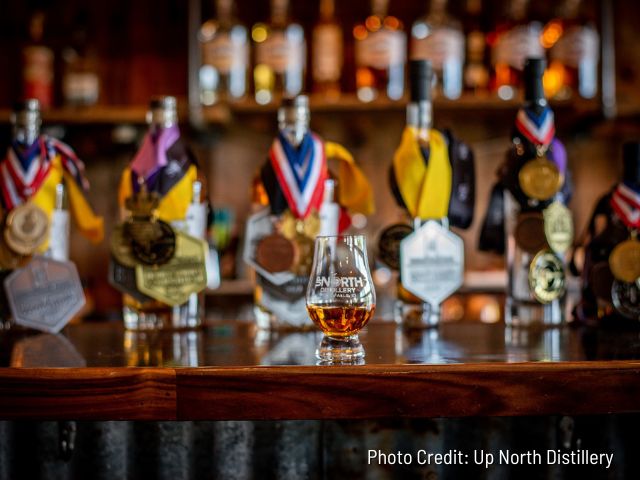
So I ended up eating a convenience store salad, which was fine. I made it through, but unfortunately, I had to go find someplace to go park and eat it. So I just pulled over on the shoulder and pulled everything out and ate the best I could, such as the life of a road warrior. As I made my way over to the distillery. Well, as I took my customary photos outside, I noticed that the distillery's open sign was off, but the door was propped open, which is a rolling garage door. It's about two thirds of the way up, but it was dark inside there too. Luckily, my microphones work off of battery powers, so no real problem there. As I walked in, I was greeted by Penny, the Golden Lab, who's protecting the place from any vagrants while the power is out. And as the owners, Hillary and Randy Mann came out to meet me, but I could see that the distillery equipment was in the back and there was a nice bar up front.
(03:06):
It was going to be a little hard to do a tour ahead of time since you couldn't really see back there too well. So we decided to sit down and jump right into the interview, and he asked about the challenges of trying to distill while there's no power, and Randy said that hopefully he was going to be able to kick the equipment back up and be able to preserve the batch of whiskey that he was making at the time. I handed over a microphone and we sat at the bar and they started lining up some spirits. And as we got into our conversation, I want to get an idea of how they got out here to Idaho. Apparently both of them are from the Midwest.
Randy M (03:48):
Yeah, I was born in Nebraska.
Hilary M (03:50):
I was born in Indiana.
Drew H (03:52):
And what brought you out to Idaho? It's not quite next door to the Midwest.
Hilary M (03:58):
My mom went back to school and she needed to do an internship, and we took a road trip from Indiana to Canada and she decided she loved it here, so we moved here.
Drew H (04:08):
Okay, so what started the journey into making spirits?
Randy M (04:12):
I started by making beer instead of just making one style of beer that I knew how to make, I would try doing other styles, and a lot of times they didn't really turn out, but I never threw them away. And then a friend of mine at work, he was in the mechanics bay with a cutting torch and welder and a beer keg and What are you doing? And he said, I'm making a whiskey still. And I said, well, tell me about this. And then he told me about it and I said, well, I have a lot of beer. We can run that through there. And it actually made pretty good moonshine,
Drew H (04:44):
So
Randy M (04:44):
I decided to build my own still and stop making beer
Drew H (04:48):
For
Randy M (04:48):
The sake of making beer.
Drew H (04:49):
Yeah, and I haven't walked back there yet. Is this your homemade or did you upgrade?
Randy M (04:55):
No, my homemade is sitting on a shelf. I kind of just keep it around to show people my first soldering job.
Drew H (05:05):
So what did you decide to make for the first thing that you produced?
Randy M (05:08):
Actually, when I first started, I was using sweet feed, grain mix and then adding corn sugar to that as well, and it made pretty nice moonshine, honestly.
Drew H (05:20):
Yeah. Then you have now evolved into, I see a shelf filled with labels that say honey on them. So talk about what it is that you're distilling here, and we're going to do some tastings on some of these in a few minutes as well.
Randy M (05:36):
We make spirits from honey. We don't sweeten with honey. The only product we do sweeten with honey is actually a Brandy lcu, but the honey products are actually made 100% from honey. They're not going to fall into the saw mill class. They're honey spirits, and that's where I believe they should stay the youngest of the group, which is the unaged honey spirits. When I first started making that product, it was essentially what didn't fit in barrels. It was leftover. I put water in it, put it in a bottle, served it at the bar. Well, there are times now I have to do full runs just to get 80 cases of that to keep pace with production. Then the next spirit in line would be our barrel finished honey spirit and don't let the barrel finished fool you. It is a mature spirit. It spends at least three years in a barrel. I mean, I have such an inventory now of all of my age products that they will get at least four and a half years in a barrel except for my 3-year-old apple brandy because it says three years on the label, and if it goes longer than three years, I'm losing money.
Drew H (06:49):
So
Randy M (06:49):
If it comes out within a couple of days after turning three years old, but then we have our barrel reserve honey spirit, which again, another mature spirit, but it's always done in a brand new barrel. So it has a lot of really good vanilla tones, great caramel tones from the caramelization of the barrel itself. And the honey itself matures just so beautifully. It doesn't have the shifts like grain does or even the apple brandy does. I mean, there are times the apple brandy especially can be picky to say the least. So there'll be times when it tastes spot on like it's apple cotton candy. Then there's the days where it tastes like, oh my gosh, it's full of tannin. I've got to give it six more months or let that mellow out. But no, the honey really does mature very nicely and it just tastes really good. My barrel reserve, although it is not grain-based at all, it does have a lot of the same qualities as bourbon, low corn bourbon rather, just because it is that brand new barrel. And that is just a beautiful, I mean, it's a beautiful chemistry project, so
Drew H (08:11):
It's got to be an interesting jump to go from distilling grain into distilling honey. First thing I'm thinking is it's very sticky.
Randy M (08:19):
It is.
Drew H (08:21):
So what form is it in when you're feeding it into the still? It's just raw
Randy M (08:24):
Honey. Just raw honey.
Drew H (08:26):
Okay.
Randy M (08:27):
Yeah. I pump it from a 55 gallon drum into a fermenter, and then after I've done that part, I pump water in there to water it down, because otherwise it would just be way too high in sugar. And the honey itself does not like other creatures, enzymes, whatever coming into its biome will try to kill them. So if it was pure honey and I put yeast in it, it would just kill the yeast.
Drew H (08:54):
Really. Okay. So how do you get the fermentation to
Randy M (09:00):
It took me a lot of trial and error. I would use too much honey and then my yeast would die at about 13% alcohol, and then I'd have residual sugar from the honey. So that's just if I have residual sugar in a mash of any type, it's wasted money to me. So I figured just got it to the point where I was maximizing my getting as much honey in there and as high alcohol as I could without having any leftover sugar. And that actually did take, I'm going to say a solid three years to actually get that ratio. Correct.
Drew H (09:36):
Wow.
Randy M (09:37):
I mean, even working with the neurologists and other people that work with honey. So we all have our issues and thank goodness we can bounce ideas off of each other.
Drew H (09:48):
Yeah, I mean, that's a challenge. If there's not a lot of people producing honey spirits across the country, it's like who do you reach out to? Are there people on YouTube who are talking about it? That kind of thing.
Randy M (10:00):
Yeah, no, I mean, if I hadn't traveled and run into people in, because I travel, we go to distilleries when we travel, just like other people go to breweries or farms or whatever. So when you find somebody that makes honey, you become allied, I guess.
Hilary M (10:19):
Yeah, the National Honey Board, they also put on a honey summit every year, and so we've been a part of that for a couple years and you get to meet other distilleries that work with honey, and so that's been a great connection too.
Drew H (10:30):
Yeah, it's crazy to think that there's so many different things that you can distill that maybe people right off top of mind don't consider. So what about honey? Is there something about this area that kind of fosters this interest in honey or,
Hilary M (10:46):
I think so. Yeah. Natural ingredients. They say it helps with allergies, all kinds of things. So Randy swears there's no hangover with the honey spirits.
Drew H (10:56):
Okay. Very nice. You can't claim it in an advertisement, I guess, but yeah. So what do people think when they first come up here and they see that? Do you have to talk them into it or are they willing to jump in?
Hilary M (11:13):
When we get visitors, they see the honey spirits in the description. They're like, I don't like sweet. I don't want to try that. And then it's like, we'll just try it. It's not sweetened with honey, it's fermented from honey. And then once they try it, they're like, oh, I do like this. So it changes their mind.
Drew H (11:29):
Okay. Something I have the barrel reserve. It's a very toasted nose on this. Is that mostly coming from the barrel
Randy M (11:38):
Influence on the barrel reserve? Yes. I use a very heavy charred barrel, whereas if you were to move on to my single malt whiskey, it's always a blend of three barrels, and that's always going to be one new barrel and two used barrels, so it kind of mellows that out. But I want big notes on my barrel reserve.
Drew H (11:58):
Yeah, you also make an apple brandy.
Hilary M (12:01):
We do.
Drew H (12:02):
And so was, I think when I think apples, you're right on the edge of Washington where we're using Washington apples or
Hilary M (12:09):
Yes.
Drew H (12:09):
Are you Okay?
Hilary M (12:11):
They press it for us and overnight it to us. So it's fresh pressed apple juice when it arrives here, and then we add yeast and create wine and then distill it.
Drew H (12:22):
Okay. So you don't end up with the same issue that you have with the honey that you can't add yeast to this. This is more going through a standard
Randy M (12:31):
Fermentation
Drew H (12:32):
Process.
Randy M (12:33):
I mean, it's apple juice, so they send it to us in concentrated form, but we do water it down. You have to. Otherwise it'd just be too acidic to do anything with. But yeah, it makes a very beautiful wine. Too bad. We just don't have that demand here. So
Drew H (12:52):
Yeah, very nice spicy notes on this. I've been talking about this on this trip because I've bumped into a couple of different distilleries that are doing brandies and I'm trying to dive into brandy for the first time. Do you find people are somewhat apprehensive on brandy, or do you feel like you have brandy drinkers around here?
Randy M (13:16):
I find a lot of times people will come in and you will tell them you have brandy, or I will tell them, I have brandy. And they will go, oh, I hate brandy. I had that when I was 17 years old. Well, that stuff we had when we were 17, 16 years old, that was fruit syrup added to vodka. This is a traditional brandy. It's nice. It's what liquor is supposed to be, whether it be whiskey, brandy, honey, spirits, tequila. The law says it must maintain character of the sugar from which it is made.
Speaker 4 (13:51):
And
Randy M (13:52):
I think this, well, I don't think the judges tell me
Drew H (13:55):
This
Randy M (13:55):
Does a good job of maintaining that character.
Drew H (13:58):
It's amazing. I mean, it actually, I feel like I just bit into an apple when the finish starts, it goes from being a spirit to suddenly being really the apple kind of in its whole, not just a hint of apple, but I mean full flavored alert. The holidays are just around the corner. And for you early bird shoppers, I've decided to offer my two distillery travel guides together in a package for one low price experience in Kentucky Bourbon is now in a brand new 2025 second edition and features over 80 Kentucky bourbon experiences along with an updated history and more prep materials for planning the ultimate bourbon adventure. And experiencing Irish whiskey is the ultimate planner for an overseas whiskey travel adventure with over 50 distillery profiles and travel advice that'll help you, whether you're traveling to the Emerald aisle or you're headed to Scotland or England, get both for a limited time at the low price of 37 99. Both will be signed, and if you're in the US, you will get free shipping. It's a spectacular offer with well over 100 distilleries to explore. So this holiday season, give the gift of travel to your favorite whiskey fan. This special offer is only@whiskeylord.org slash shop. That's whiskey lord.org/shop Kentucky and Ireland, AWAI going with Honey and Brandy. And we have another one here at the end that I think we'll save till last, but as you were saying before, it was kind of single malt was your first.
Randy M (15:54):
That's the only whiskey I make.
Drew H (15:55):
Okay.
Randy M (15:56):
So everything else is honey or apples. Whiskey must be made from grain, and I make one whiskey and it's from single malt? Well, it's from malted barley, one single malted grain.
Drew H (16:10):
And so when you decided to go in and make a single malt, what were some of the considerations you had? Did you have kind of a style in mind or kind of just go with whatever the barley brought to you?
Randy M (16:24):
I did my homework before I knew I wanted a two row distillers malt,
(16:31):
But I didn't want to get pigeonholed to just one. So I had two maltsters send me five different roasts of two row barley, and instead of going with just the plain two row like everybody else does, I went with a different one. I tend not to tell people what it is, but it came out really nice. I made little thousand milliliter mashes to make some whiskey to figure out what it would taste like. And the one I settled on comes out. It has great big, I mean, even the new make itself has huge coffee and chocolate notes, but then again, it is still ine, which is barley moonshine,
Drew H (17:15):
Which
Randy M (17:16):
In its own right is okay, but I don't think barley should be sold as a clear spirit.
Drew H (17:23):
Okay. So those notes are definitely coming from the barley rather than from the yeast or from the barrel aging? Correct.
Randy M (17:32):
Yeah. I mean, even from the start when I was using the wrong yeast, they were still there. I was just not getting the fermentation that I wanted.
Drew H (17:42):
Did you get darker malts? Did you get heavier toasted malts? Because to get these toffee and dark chocolate notes that I'm pulling out of this, yeah,
Randy M (17:52):
There's only one malt and it's kind of a medium toasted malt, but it still has the same dias static power as a power, excuse me, as a just distiller two row.
Drew H (18:03):
Yeah.
Randy M (18:03):
So if,
Drew H (18:04):
Okay, I love the smell on that. It's right. You said Tootsie roll earlier and I can't get that out of my mind. Power of suggestion.
Randy M (18:15):
So after about four and a half years in the barrel, this one, there's some kind of green apple thing in there.
Drew H (18:21):
Yeah.
Randy M (18:24):
And it was there overnight and well, overnight to me is like three months. So right at about four and a half years in the barrel, this green apple note showed up and it was just like, oh my.
Drew H (18:36):
Wow. Okay. This is nice. You sometimes wonder if it's the, as it's aging in that barrel. The thing about single malt is sometimes it's where you take those cuts and how deep you go in, and sometimes those oils at the end that are heading into the tails may taste a little funky at first, but they end up becoming the interesting flavors in single malts later around with the barrel interaction. Do you take deep cuts on it or are you
Randy M (19:08):
I do. And you were asking if I had a particular style. So I do try to distill in the style of the Scots, except I am allowed to do certain things they aren't. So I do
Drew H (19:25):
Break the rules,
Randy M (19:26):
Break the rules that are
Drew H (19:27):
Not rules for us.
Randy M (19:29):
So I rarely drink that and I forget how nice it is. Sometimes
Drew H (19:34):
You must be a chocolate and kind of cocoa.
Randy M (19:39):
She's nodding, but I can see that she's going, he's always got a milk chocolate bar with hazelnuts hidden somewhere in the house. Well, there's a little
Drew H (19:50):
Cocoa puffs in this too, I get, and I love that. It's been really interesting that I've been,
Randy M (19:56):
I can't say I've had cocoa puffs since I was probably a teenager. So
Drew H (19:59):
Yeah, when you're on a budget, sometimes you go to the store for your snacks and you're like, oh, I'll, that's a really sugary snack. I'll just get a box of Cocoa Puffs and eat those for without milk.
Randy M (20:12):
So you're cuckoo for C for cocoa
Drew H (20:14):
Puffs? Yes, exactly. Yeah. Last one is fascinating. I've never seen anything like this before. It is north Idaho pine la cour. So tell me the origins of this.
Randy M (20:33):
So this is my emulation of a lcu that they make in Bavaria. The one that they make in Bavaria is called Zer schnapps translates to stone pine lcu of the Alps. So it is made from the Bavarian stone pine.
Drew H (20:52):
Okay.
Randy M (20:53):
They steep it with corn liquor. I steep my pine cones in apple brandy. So as you can, I mean, I don't know what you're trying to imagine, but there is no such thing in this world as a pine cone orchard. So this is the funnest thing in the world to make because what happens in the late part of June, early part of July, these pine cones start coming out on the trees and they're just purple, sappy, sticky as all get out. So I have to physically climb trees to pick these pine cones.
Drew H (21:31):
Oh
Randy M (21:31):
Man. And the best ones grow at about 25 to 30 feet above ground in about the top 10 feet of the tree. So
Drew H (21:42):
No fear heights?
Randy M (21:44):
No, not really.
Drew H (21:46):
I wouldn't be there. You wouldn't catch me that doing that.
Randy M (21:48):
Well, I could tell you about the first trip we made picking those, and luckily when I fell out of the tree, I hit every branch on the way down, so it slowed me down from hitting the ground.
Drew H (21:58):
Wow.
Randy M (22:00):
But no, so this stuff is great. I mean, like I said, it's super fun to pick pine cones. You leave that day with clothes, you have no intention of keeping. At the end of the day, if you put 'em in your wife's washing machine, guess what? So yeah, the pine cones steep with the apple brandy for about four months. It's about how long it takes to get all the flavor out of them. And then after that it goes through a filtration process, which even if you can see, there's still a lot of sediment if you will. But after I filter it to where I really have either exhausted all of my filters or don't feel like I could get any more out of it, I mean this was clear when it went in the bottle, there was none of that after that. Then I add honey until I like the flavor, the loss says it has to be 3% sugar, so I start off with 3% sugar right away and then just sweeten it till I like it.
Drew H (22:59):
Okay. This is so
Randy M (23:01):
Fascinating. And it actually, because honey is so, it's thick and it doesn't dissolve right away. So it's add honey, stir, stir weight, stir, wait, stir. Then the next day add some more honey. And so it's about a three or four day process to get it sweetened to where you want it and have all the honey dissolved to where you want it
Drew H (23:26):
Between the mouth, feel the heavier mouth, feel the sweetness. But it is actually the tartness of the apple
Speaker 4 (23:36):
That
Drew H (23:36):
On top of what I would call gin notes, because we talk about juniper and piney, but I don't like an overly gin that has a lot of pine. So it's like the apple just kind of sied that down a bit.
Randy M (23:52):
Well, and it's like you can honestly taste everything that's in there right now. I think the ambient temperature really has a lot to do with that as well.
Speaker 4 (23:59):
Yeah,
Randy M (24:00):
I can taste the apple, I can taste the honey and I know exactly what the pine cones taste like so I can taste the pine cones. And that's all that's in there.
Hilary M (24:10):
It's been fun to experiment with. It makes a great hot totty. We also use it in a Manhattan, a little bit of sweet vermouth and a little bit of that kind of dries it out like a perfect Manhattan negroni. So it's been fun to experiment with.
Drew H (24:25):
Yeah. So in terms of the distillery itself, I noticed that Idaho is filled with tasting rooms. There seems to be tasting rooms all, is this your Maine or only location?
Hilary M (24:39):
So we actually have a bees knees whiskey bar in Hayden, and that has our distillery spirits as well as 400 other products. So we really like to educate people on whiskey and we think of it like an umbrella, and there's rise and Irish and scotch and local products and just a big education of flights and cocktails.
Drew H (25:03):
It's got to be miles away. It's further down into the lower part of Idaho.
Hilary M (25:08):
No, it's close. I was going to send you there next if you have time. Okay, look at that. It's 20 minutes from
Drew H (25:14):
Here. Okay. Alright. So you are truly up north. You are not going anywhere south.
Hilary M (25:19):
Yeah, but interestingly, Idaho does have some rules and regulations for distilleries, which does make it more difficult to have a tasting room in Idaho. The law is if you do not have a liquor license, you can only serve three quarter ounce samples per
Drew H (25:36):
Person,
Hilary M (25:37):
Per,
Drew H (25:39):
It's always good to know when you're traveling through and you want to go someplace why they do what they do.
Hilary M (25:44):
Right.
Drew H (25:45):
Yeah.
Hilary M (25:46):
So it was nice. We got a liquor license so people could have cocktails and get to experience that before they buy a bottle.
Drew H (25:52):
Yeah, you have to kind of use your GPS to get here. It's not like you're way off the highway or anything, but it is kind of a little bit back in. And so what do you do here? You have a nice cocktail bar
Hilary M (26:06):
Here? Yeah, we have a cocktail lounge. The operational distillery is here, and then we also have a liquor store as well. We're in a control state, so it's a state run liquor store. You'll notice we have two doors to our entrance and one is the distillery and one is the liquor store. The law is you cannot sell bottles from your bar. So people have to go out and around, get their bottle, and then take it directly to their car.
Drew H (26:27):
Ah, yeah. Fun.
Hilary M (26:30):
Yeah. But it works. Otherwise they'd have to go to the liquor store and they don't carry all of our products. So here we carry all of our products and have distillery exclusive products as well.
Drew H (26:40):
If somebody says, Ooh, I'd love to the equipment, do you guys have any kind of tour or do you? We do. You do? Okay.
Hilary M (26:47):
Yeah, Randy leads the tours and he does a personal tasting as well, so that's fun to experience as well.
Drew H (26:53):
Okay. What do they get to taste when they're here?
Hilary M (26:56):
He traditionally does one of each category, a honey spirit, a brandy, and the single malt whiskey, depending on what they like, he might throw in the big kid cider as well for dessert.
Drew H (27:07):
Very nice. Well, middle of the business day power went out, but the power's back. It's back. And you got the door open, so you get a nice little breeze. Breeze through here.
Hilary M (27:17):
Yeah.
Drew H (27:18):
I appreciate you in the middle of a business day, giving me some time and walking me through some fascinating spirits.
Hilary M (27:26):
Thank you for reaching out.
Drew H (27:27):
Yeah. People may not think Idaho initially when thinking about a spirit's journey, but that's part of what I'm trying to open up is getting people looking beyond the places that they normally would relate to spirits.
Hilary M (27:40):
And I was going to mention, you can also find our spirits on our website and we ship to 48 states.
Drew H (27:46):
Oh, nice. Oh good.
Hilary M (27:47):
Yeah.
Drew H (27:47):
Okay, fantastic. Well, so if I've teased anybody with the tasting notes I've come up with, you're going to find your own tasting notes because there's all sorts of stuff going on with these spirits. Fantastic. Well, Hillary, I appreciate time and good luck to you down the road. Thank you. And cheers.
Hilary M (28:08):
Cheers.
Drew H (28:09):
Well, I hope you enjoyed this journey, the up North distillery. And if I peaked your interest in traveling to Idaho, make sure to head to whiskey lord.org/flights where you can view the profile of up north and over 1300 other worldwide distilleries in my online whiskey, Lord Distillery travel guide. And when you find a distillery you like, log in with a free membership, bookmark your favorite distilleries to add them to your wishlist. When you're ready to travel, they're all there in one place. For you to be able to click on booking links and get your travel plans together, start your journey@whiskeylore.org slash flights.
(28:48):
And as I start my journey back east, more details on where I'm going next. But if you're still on the fence about it, visit to up north. Let me give you my three reasons why I think you should have this distillery on your whiskey lower wishlist. First, if the words Tootsie Roll and single malts are music to your ears like they are to mine, then up north has the single malt you're looking for. Second, if you want to go beyond the basics of whiskey, gin, and vodka, well, up north has some really interesting spirits, honey, spirits, brandy, and that German inspired pine Lur ready for you to explore. And third, well, Idaho is a incredibly beautiful state way up here in the panhandle, you also have quick access to places like Glacier National Park or the center of the universe. Yes, the little town of Wallace, Idaho has a sign there that you get your picture taken under that says, it is the center of the universe.
(29:48):
I always wondered where it was at. It's also the same town that they filmed Dante's Peak in, which is kind of a cool little side note. Well, thanks for joining me on today's Idaho visit. It's time to head east to a one-time mining boom town, which today is the home to a distillery that not only makes whiskey, they also make stills for other distilleries. Make sure you got your ticket to ride along with me by smashing that subscribe button on your favorite podcast app. I'm your travel guide Drew Hanish. And until next time, cheers. And for transcripts and travel information, including maps, distillery planning information and more, head to whiskey lord.org/flights. Whiskey lords of production of Travel fuels life, LLC.
About Up North Distillery
Tours available.
Tasting room also at: The Bee's Knees Whiskey Bar, 324 W Lancaster Rd Suite E, Hayden, ID 83835
Take a Whisky Flight to Up North Distillery
Map to Distillery
Note: This distillery information is provided “as is” and is intended for initial research only. Be aware, offerings change without notice and distilleries periodically shut down or suspend services. Always use the distillery’s websites to get the most detailed and up-to-date information. Your due diligence will ensure the smoothest experience possible.