
Isle of Raasay Distillery
Drew (00:00):
What the heck is the well of the pale cow? Well, if you listen to this podcast on patreon.com/whiskey lore, you're going to find out, along with hearing my tasting of Isle of Assay's flagship, you'll learn about why this is considered a highland rather than an island distillery. And we'll also talk about that bovine inspired water source. If you want no commercial interruptions and bonus coverage on these interviews, then head to patreon.com/whiskey lore. Welcome to Whiskey Lord's Whiskey Flights, your weekly home for discovering great craft distillery experiences around the globe. I'm your travel guide Drew ish, the bestselling author of experience in Kentucky Bourbon second edition in the Lost History of Tennessee Whiskey, along with the brand new book that bust 24 of Whiskey's biggest myths, whiskey lore, volume one. And for the first time in a very long time, I am back overseas on my first virtual plane flight in quite a while.
(01:08):
And after flying into Edinburgh and renting a car plan was to travel the Western Isles of Scotland. And on my first two trips to Scotland, I got really lucky and spent three weeks, both times with no problem with rain, just sunny all the time. And I was told That is a rarity. You should really feel that you are quite lucky in that. And guess what? I was because on this trip, all of a sudden everything was just stormy. So the first place I headed to was John O'Groats, which is way in the northern and northernmost point of Scotland, the proper mainland island. And I was going to take a ferry across to Orny where the S Scpa Distillery and Highland Park are at. But unfortunately, the seas were so rough that the ferries weren't running. And I thought it was because maybe they were afraid of the stormy seas, but the reality is they have a hard time docking these boats when the seas are too choppy.
(02:18):
So I had to go to eight door and look out at Orc knee while I was enjoying a Dr there instead. And I drove back down to head to the Isle of Sky, which I have been to before. In fact, been to twice one of the most beautiful places on earth. This trip. I was going to head to three distilleries. Of course, I would go to Talisker, which is the distillery that's been on that island the longest. But there are also some new distilleries. And the one I would go to first is Tove. The second one is not actually on Isle of Sky, but you have to go through Isle of Sky to get to it. It is the aisle of Rae, which is the one that I'm going to go to today. And normally I would just drive the bridge onto the aisle of Sky.
(03:08):
It's a great drive while you're on it. You actually pass by a lean dune and castle, which is where they filmed the Highlander. And then you take a bridge to get across to the aisle of Sky. But instead, I decided this trip I was going to take the car ferry from Malig to Armadale, which is on sky and do the early morning ferry. So I left at 6:00 AM just before the sun was getting ready to hit the horizon. And I have to tell you that it is absolutely gorgeous. You look back at the mountains and the lights, the few lights on the shore, as you're pulling away, the dark sky starts to brighten up beautiful blue. You see those hills fading in the distance as you're heading onto the aisle of sky. And I got so lucky. It's one of the best weather days that I've experienced in Scotland.
(04:08):
From there, I made my way up to kill some Thy at the Sky Cafe, got some coffee and a breakfast sandwich before I headed back down to the Tobe Distillery, which became the second distillery on Isla a few years ago. And it's another amazing setting for a Scottish distillery sitting on a hill above the stunning cove with views of the mainland across the water and Castle Ruins just below the distillery. And after doing a tour there, I made my way north about 45 minutes to the ferry that takes you to the aisle of Rae. And parked my car there in the available parking lot, boarded the ferry, nice sun coming down on you. And that ride across the waterway. And after about 35 to 40 minutes, I found myself on the shores of Rae once again, marveling as I looked back at the beautiful scenery behind me, the mountains, the waterway, green and brown textures.
(05:11):
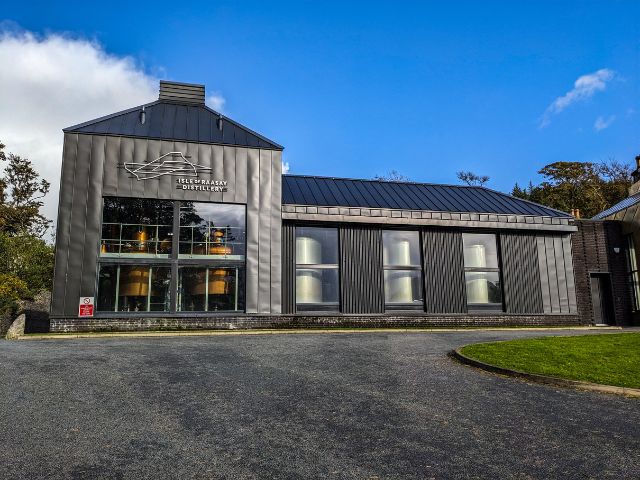
But I had a distillery I needed to get to. So I climbed the hill. It's not a far distance to walk up to the distillery from the ferry. And after touring this distillery, I have to tell you that it is not an old distillery. It's actually fairly recently built. And the first time I tasted their whiskey, it was only a four year whiskey, but it did not taste young. It actually was just bursting with flavor. And so I decided to sit down with the distilleries founder, Alistair Day, to talk about how all of this came about, how they got such a flavorful whiskey so early in the process, and also to learn a little bit about the Isle of Rae. So I asked Alistair if he could give us a little background. The island,
Alistair (05:59):
It's a very small island, 14 miles long, few miles wide, but the same size with shape as Manhattan. But in 2011 census there was 161 people lived on that.
Drew (06:11):
Wow.
Alistair (06:14):
A few more now, a few now the funeral now is nearly 200, I would think by now we employ 40 people, just over 40 people at the distillery on Raic. So yeah, it's from Edinburgh. It's about what, about five and a half hour drive to sky and then a 25 minute ferry. And from Esh you can fly into Vanessa. It's two and a half hour drive from Inverness and then the 25 minute finish.
Drew (06:39):
So talk a little bit about the history of Rae in terms of distilling. I know you are counted as the first legal distillery on her assay. What do you know of distilling that went on that island before?
Alistair (06:56):
Yeah, so you're quite right. We do refer to sales as the first legal distillery on assay. And that's because there was a tradition as there was in most parts of the highlands and islands of Scotland, of what's become known as illicit distilling. I mean, originally it wouldn't have been basically the farmers grew wheat, barley, oats for their well more oats in barley in Scotland, and that was really principally to make bread and then secondly, to feed the livestock, and then if anything was left over, it would be brewed. But then if there was more left, obviously beer was off. So you would then distill it and then you had the which would last indefinitely? Well, from a shelf life point of view, but usually got drunk quite quickly. So there's a couple of sites you can go to on Rasi. There's one down near I, which is that be being the southwest of the island. And if you follow this burn up the hill through the woods, you come to little clearing and what would've been, there's some stone shelter there that you can see where the still would've been and you could see where the water would've come from the burn. So we are very small, still small enough to pick up and hide if you had to,
(08:13):
There's some nice stories as well. So one of them is that the relations would hide out their whitewashing on sky if the excised man was coming. So if you saw the whitewashing, you knew you had to go hide. Still, there's even a story up in the north of island that still being hitting the peabo, and it was never found again, another story that someone had diverted the burn the stream through his house so he could condense the spirit. So there's lots of little stories about those days.
Drew (08:45):
I'd say the big advantage with the excise man is that if you see the boat coming across, you got a little time to hide your still.
Alistair (08:53):
Yeah, hide your still and hide your small casks. Everything can be picked up.
Drew (08:58):
How do you get around Rae? Because I mean most travelers coming across, they're going to be riding the ferry on foot. How do they usually navigate around? I think I've been to Mackinaw Island in Michigan, and it's small enough that you could just walk around it if you wanted to. But size of Manhattan, that'd be quite a walk.
Alistair (09:18):
Yeah, yeah. It is a wee bit bigger. I mean, a lot of people bring their bicycles over and cycle from the distillery point view. It's dead easy. About seven, 10 minutes walk up the hill from the ferry. The great thing is it's down the hill back to the ferry after you've had a drama. But some people bring their cars over. A lot of people come over to walk. So the ferries are pretty regular. They're pretty much every hour. Monday to Saturday, Sunday there's just three. But most days the ferry runs early. So you can come over quite easily, come over for the day, do some walking. I know some people have come over, walked up to the distillery and then they've walked down to the village and then they've taken the path up to Duncan and then come down and back along the road. So right up at the north end of the island, famous bit of road, it's called Callums Road Call. Cleod took him 10 years to build it, but build them by hand. So his daughter was going to school on Sky Course. By the time she got off, she couldn't come back. So he extended what was a car track and turned it into road. And if you drive that bit of a road, there's not too many surveyors being involved in that building and that
Drew (10:31):
It's island life. Which begs the question, how did you, because you're not from R Asay, right?
Alistair (10:37):
No, no. I grew up in Glasgow. My connection with whiskey is my great grandfather. So he was a whiskey blender in cold stream in the Scottish border. So that's the complete opposite corner of Scotland from Ramey. So it really came about, I started in whiskey by recreating my great-grandfather's blend. So this is inherited the seller book. And so this is my great grandfather's and it's all of the blends that the company produced from 18 nine to nine to 1916. So I inherited this in 2009 and then set about recreating the blends using those recipes. The blend was called the TWE deal, and I launched that in May, 2010. But after a couple of years of doing that, by 2012, it was getting much harder to buy good quality material whiskey in casks. So I thought, well, if I'm going to carry this on, I need some sort of skill, I need investment.
(11:46):
So I looked at the cost of doing that and the investment would required, and I thought do build a small distillery for that amount of money, and that's pivoted. So I wrote a plan for a borderless distillery round post even or that part of the world. Anyway, and long story short, that's how I met Bill. So Bill do's invested in me, invested in the company, and he was looking to get into whiskey. And I first met Bill in November, 2013 in here in the offices in Burgh. And I had a bottle of the TWE deal. I had the book old story and I was like, well, I would like to get into whiskey. But I was thinking of gras. The connection there is that Bill, when he was talking to his friends about getting into whiskey, his oldest friend from school, William Hector Ross, said to him, well, this youth hotel on Rati should come up and see it. So Ian's family's from Rat. I'd say it was a bit convo. And anyway, bill went up and he really thought it was great. And then he invited me up in May, 2014, and we stood outside this used hotel looking at the view, and you've seen the view looking back to this sky,
Drew (13:01):
Gorgeous.
Alistair (13:02):
And I thought, yeah, bill was right. This is the place. In fact, you see the picture behind me, that's the distillery opening back in September, 2017. That's Bill and I stood at the stills. So that's why Rati,
Drew (13:22):
Well, national Bourbon Heritage Month is coming up next month and to celebrate on Instagram and patreon.com/whiskey, I have been posting pictures from individual distilleries that I have visited in Kentucky, giving a little background information on them. And you get to see the photos, more photos out on Patreon than I'm doing on Instagram sharing about three a day on Instagram. Hopefully that is getting you inspired to start planning out a trip of your own. And if you need some help with that, then all you have to do is pick up a copy of my latest book, whiskey Lord's Travel Guide to Experience in Kentucky Bourbon. And you say, well wait a second, I already have a copy of that book. The question is, do you have the second edition? Because there are 12 more distillery profiles in there, a hundred more pages of content and it is available with great tips for you that have been updated in a new history. You can find that second edition on amazon.com or you can get a signed copy and free shipping by heading to whiskey lore.org/shop us customers only of course make this national Bourbon Heritage Month your date with a distillery adventure of a lifetime.
(14:43):
What was your expectation in terms of how long it was going to take probably for you to age this beyond the three years that is required? Did you kind of have a goal set in mind or an expectation of how long this was going to take? Because I was tasting it at four year and it was really good.
Alistair (15:03):
Yeah, well, to be perfectly honest, we knew we wanted to release whiskey 3, 4, 5 years old, but we had to take a completely different approach to designing the distill. Again, I was incredibly fortunate. So you imagine being given a blank sheet of paper and being able to design the distillery. So that was a position. So it's not like they aware the distilleries un harassing. We had to make a rasi style or any of that. We wanted it to be heine, as I said already. And that's where we started. So if you like that first line in the blank sheet of paper was Heine sga. And then we had to go, well, what is Heine Sal? And for me, if you look at the distilleries that are about the time already, Talisker, there's always a kind of element of some Pete, not the island of pea, but some Pete at some point.
(15:54):
So that's where the next line was lightly pea. That was great. And then thinking about releasing whiskey at three or five years old, it also had to be a good whiskey and excellent whiskey. So how do you make an excellent whiskey? Well, for me, it needed to have complexity, needed to have depth, and then it needed to have balance. Now the balance is the blending bit. That's where I came from, taking component parts and making something that's better than the sum of its components that's blending. So very much came with that philosophy. So that's the next alignment. That's like create complexity, collect debt. So how would you do that? Well, for lightly PT barley, we could have asked the mal to produce a multi barley at C 21 parts per million. So they would have heavily pitied and then blend it with plain un ped and get to about 20 parts, 21 parts per million.
(16:51):
And then, but what I thought would be much better to do six months of plain unpaid barley and six months of ped is then straight away you've got two separate mates and then you mature them separately and maturing them separately gives you two elements. That's you starting to create complexity and then after maturation you bring them back together. And that's how we get to lightly pt. That also means that we can do every pt, we can do an UN pt or we can do variations in between. It gives you flexibility as well. Then obviously I think about the Oak Pal. So we use three different caste types. So we use XI casks, X whiskey cast, we use chin and oak cast, and we use X bordeaux red wine cast. So very different casks. You've got clay malt in those three Cask P malt in those three cask all matured separately.
(17:46):
So you've got all these different elements that come back together. So that's creating complexity and some depth. But then the other thing that we don't talk about enough, I don't think in scotch whiskey is the mouthfeel and the kind of viscosity oiliness. So Ben thought when we're designing the process, let's have things that can be offered on, again, have complexity, so much more of a, if you like Japanese philosophy, expect, create lots of different things in the distillery and chew 'em separately and bring them back together. So things we can half off for on. We've got cooling jackets on the wash backs, so steel still wash back for cooling jackets, so it doesn't control the temperature, but it means we can stop the temperature. So we tend to use 32 degrees C as our set point. So if it's on fermentation slots at 32, if they're off, it goes high as 34, 35.
(18:40):
Now that's important because the higher fermentation, the more fusel oils, the more higher alcohols that you get and that gives you this kind of oil and meth. You then add into that that we do three and five day. So three day fermentations, you've got all the alcohol, 48, if the errors that's, you're not going to get more alcohol than that. And about 70 hours of getting towards that three days, the yeast eyes off. And when the yeast cells burst open, you get, it's a process called lysis. You get these buttery oily notes coming through. So that's that. And then the five day fermentation that says into lactic fermentation, lactic cy development. And that gives you acidity and that means you give better interaction with copper, you get better lytic reaction with the copper and also the lactic acid reaction esters that the E of very produce them.
(19:37):
You get more of those longer chain wave compounds that wean more into that kind of dark fruit anecdote that we're looking for. And then on the wash still we've got a coing jacket on the line arm, so it's on all the time, but we've got to condenses the heavier vapors early and we take 'em back down still. There's a valve that can be hand valve that open closed. So again, when it's open, we tend to get it sort of heavier and more viscous, low lines. When it's closed, we tend to get clear lighter. So yeah, we also have a little purifier just off before it gets the condenser on the spirit still. And again, that can make a light spirit, but having all these things off own combinations of things, being open, closed off own, then we can create all these different style of new. So that's your complexity and depth. But the trick really is the balance at the end. So it's after maturation when you bring it all together. So that's the bit that makes it. So that was how I designed distillery and the oak policy, and it was all with a view to four, 5-year-old whiskey.
Drew (20:40):
You really set it up for a blending house. I mean to have that many different varieties for you to be able to play with. And even I was amazed when I was hearing about the flavor differences that you're getting between the three day fermentation versus the five day fermentation. The choices of oak that you're working with, all of these things are giving you an ability to pick a little of this. It's like you've got multiple distilleries all feeding you the same spirit.
Alistair (21:10):
That's it. And that's in my view, that's what we need to create how complexity death.
Drew (21:17):
Let's talk about the oak types because this is really interesting. First of all, chin capin oak, it comes from America, it's charred and toasted. Is anybody else using chin pin? Oh, you're the first distillery I've heard
Alistair (21:32):
Using it. Yeah, I think we're certainly the first distillery that's full term maturation and has it as part of the signature al. I think that's definitely true. I think other people have, the thing about Chenin for me, so s alba is not and white oak, that's what everybody knows. And bourbon rye cast, that's what the traditional out of Chenin oak is S Bergen. So different species of oak, but it rose in pretty much all the same places as queer casaba. So if you go back, it probably was never distinguished, it probably wasn't separated. So there will be bourbon Ryan, cast scro, single mallet cast or in blend cast that I've got a combination of re berg. It was really, for me, it was kind of the nineties. So if you think about new world wine in the nineties, there was a lot of oak influence, particularly in char, a lot of oak. And I think that's really where the prevalence of berg came because it doesn't add the same flavors that Al do. And I was really conscious of that didn't want to use a fresh cask that might overpower our spirit. So it was trying to find an oak species that worked with a style of whiskey. And the great thing about ching min oil is again, it leans more into those dark fruit and the flavors.
(23:02):
We specify a high toast so that the high toast, there's two things obviously that caramelizes the natural sugars semi helis in the open, you get that those lily caramelized flavors, but the longer toasting also breaks the ligaments down into volatile phenols. So that's why we go for a high toast and a high char so that the high char as well as increasing the surface area of the cast obviously creates charcoal and the charcoal removes impurities. So particularly at that younger aged four or five years old, it is really I think important to have a high char lock charcoal that's taking some of the impurities, the spirit, it adds a lot of flavor and a lot of color, but I don't think it overpowers our spirit.
Drew (23:52):
So how much of this do you actually use in the blend?
Alistair (23:55):
We use the vast majority. So 60 plus percent is, well not chunk inventory is the XR cask. So the chin pens in the bed, 20% mark and then the X bodo are smaller for 10 15 cents.
Drew (24:14):
Rye was kind of a bold choice because most people just go right to the bourbon cask. So what was your thought in terms of what rye was going to bring?
Alistair (24:24):
So the first thing is that, so it's the same oak species as bourbon would be. However, rye whiskey has got this lovely peppery spicy element to it. That's what the rye brings. And so getting back to that complexity element of it, that's why I went for Rye Castle with bourbon because it gives us an extra flavor profile, an extra element in there, but in time it's still. So we're still going to get the vanilla and the butter SCO and all those nice flavors that you get from what people would refer to as a bourbon house. So I think the old species in the previous context are a big part of that. And it's really interesting because the plane on PD spirit works very differently with that to the P. So the P spirit ramps up this, ramps up that Pepin and being honest about it as well is all the new distilleries in the US have made Ryan cool again. Ryan kind of been unloved and is loved again. And I was kind of listening to all of that thought, well, yeah, we get an extra dimensional flavor, but actually we got to talk about cool stuff.
Drew (25:36):
What I like about what you're doing with the heated whiskey is that you're actually bringing that grain in from Inverness. So I think for people who think, oh, smoky Isla whiskey, they're going to have that very medicinal character to it. But you don't tend to have that at all in this?
Alistair (25:55):
No, no. It is Highland Pete. So it's actually coming from Glen s and Angus at the minute, but it's the highland Pete that makes the difference. So again, believe it or not, it's, it's down to lignins, it's lignans in the Sphagnum moss over hundreds and thousand views breaks down, and you get these phenolic compounds and it's just very different in Hylan period. It is to tend not to get the medicinal elements that you get from Myla. And again, it is a choice because that's leaning towards what we want to do. And we also take a narrow cup as well. So we'll come on about 72% alcohol and we'll come off at 65 in about 67 for models. So we're taking quite an narrow cut and that also means that we're not getting into those big, long, heavier, the further you go down into that, the more of those medicinal elements you're going to get.
Drew (26:56):
So you do a gin also on those stills?
Alistair (27:00):
We do, yeah.
Drew (27:01):
How do you keep the peat out of the gin?
Alistair (27:05):
That's a very good question. I think we're probably the only facility in Scotland that doesn't have a separate gin system if they make gin. So we stop production, we clean down and we use our spirit still to make, and again, it's all designed in. So as I was saying earlier, we've got the swan neck, but it's still slightly inclined line arm. And then you've got two valves before it goes to condenser. The first one of those valves diverts to the vapor basket. So spirit comes across cross, we take it through, we put the botanicals, batch botanicals in the vapor basket and goes through them to the condenser and that surgeon, and then we clean down and go back onto back onto Speedy. So the real trick is to make sure we're on plain ball before we go into gin. And with the gin, we have completely separate tank for receiving the spirit.
(28:05):
So we don't have separate tanks for plane and P, spirit and P, we just blend through. So we have this kind of intermediate spirit when we're changing over, but we fill six cas a day, so we fill three off each shift so we can narrow it right down so we know when we're changing. We identify those casses and intermediate spirit and quite interesting. We did the first bottling that for whiskey bars in Scotland and we used just intermediate cast. So it's just something different. Again, another element. And it comes back to that having different things that we can bring together that together. And the intermediate spirit gives us that as well. It's something that's a bit different again.
Drew (28:54):
So the other thing about this putting together a distillery is having visitors come up and check it out and they're coming across to an island. So what is usually a good plan of attack for that? Should people, I didn't actually stay on the island. I rode the ferry across and then I came back. But I feel like I got to see the distillery, but I didn't really get to experience much more of Rae. So in terms of getting food and lodging, what's kind of the situation there?
Alistair (29:27):
We've got six en suite luxury bedrooms in the distillery itself. So you can actually stay in the distillery. We've got a restaurant and a bar, obviously we do tours the shop and by October we'll have another five rooms. So we've got five new rooms coming on. So we'll have 11 rooms. And the new rooms are all books that the views, you can lie in bed, look at sky and have a drama. So our neighbor Rossi house, so they've got quite a lot more bedrooms and they're also an outdoor center. They have a restaurant and a barn as well. So it's somewhere else that you can go. You can rent electric bikes, you can go kayaking, they've got a ribbon, they can take you on wildlife tours and quite often see David crawl in the barn and Rossi house. He said, yeah, we just saw minky wheels today and we saw dolphins and it's like sea eagles, all this stuff.
(30:27):
So I mean, particularly this time of year, that's a great thing to do as well. And as I say that walking, so you've got Dunka, which is the highest point on Rasi, and there's a circular work that you can do. You've got the community stores in the village, the only shop on the island, it's in the village and in Verish. And then there's the old Pier, the iron ore mines. You can see the remnants of that in the south. And it's a couple, it's a really nice walk to Hal Lake. So Hal Lake's, one of the island CLS villages on the island. So it's a very tall esque. You can start walking along this track. And then there's stone building, there's a stable in there. I've got to go through the woods, down over the burn, and then up the other side. And he's got this sheep vank, which is just a grindstone wall.
(31:19):
And then up further up the hill, the houses, they've almost built into the rocks, the cliff at the top there. And it's incredibly peaceful, almost earring in this deserted village out there. So the yards in Aish, which is where car's road stops, and then just where Cal road start is Brothel castle. So it's a ruin and it's just perched in this rock. So it looks, but you don't recognize it as a castle until you get closer to it. And it's some great drawings of what it would've looked like. It was there really to as a lookout for ODing clans, other clans and vikings and all of that. And then that was the seat of the clan McLeod, oi. And then in time when all that calmed down, they moved down to Rossi house, which was a Jacobian tower originally. A few things you can do. Yeah,
Drew (32:15):
It's amazing. It's like a step back in time. If you want to get away from the hustle and bustle of Glasgow, this is the place to go.
Alistair (32:23):
Yeah, yeah, it is. Definitely quiet the class.
Drew (32:28):
Very nice. Yeah, beautiful, beautiful place. And thank you so much for spending time, Alistair. I got to get back over to Scotland sometime soon. And now this has become a distillery that I always go to Talisker now I'll have more reasons for Aisle of Sky and then coming over to Raasay as well. So I can't recommend it highly enough.
Alistair (32:56):
Thank you very much. And yeah, please let me know the next time you are I'll make sure I'm my back.
Drew (33:01):
Well, I hope you enjoyed this trip to aisle of Rae Distillery via aisle of Sky. And if I piqued your interest in visiting Aisle of Rae, make sure to head to whiskey lore.org/scotland. Find the distillery among the 76 Scottish distilleries I have listed, and sign up for a free membership. Click the bookmark icon next to aisle of Rae and make sure to add some other distilleries of interest as well to your whiskey lore wishlist. And then when you're ready to travel, use the site's convenient planning tools, maps, tour dates, booking links, and more to make your perfect distillery itinerary come alive. Start your journey@whiskeylore.org slash Scotland and as I make my way to my next distillery destination, if you are still on the fence about visiting aisle of Raaid Distillery, let me give you my three reasons why I think you should have this distillery on your whiskey lower wishlist.
(33:57):
First, the old man of store to the ferry pools, to Castle Ruins, incredible mountains and sheep laden hills. The aisle of Sky is one of the most beautiful places on earth, and within a half hour at Short Little Ferry Ride will get you an incredible view of the aisle of Sky as well as the aisle of Rae and plenty to do, including a fine Dr. A tour, a meal, maybe even a night's lodging at the Isle of Rae Distillery. Second, the tour dives deep into the process that Alistair talked about in the podcast today. And the tasting at the end will definitely turn your head. You won't have to ask how they got so much flavor into such a young spirit because you will have seen it firsthand. And third, the spirit is the taste of the island. So when you get home, all you have to do is buy a bottle and reconnect with all of those unforgettable Scottish memories. Well, I hope you enjoyed this visit to Isle of Rae. May be heading back to Scotland for more tours in the future. But next week we're going to jump into the concept of Irish whiskey, blunders and Bonders. Make sure you've got your ticket to ride along by smashing that subscribe button on your favorite podcast app. I'm your travel guy, drew Hanish. And until next time, cheers. And for transcripts and travel information, including maps, distillery planning information and more, that's whiskey lore.com/flights. Whiskey lord's production of Travel Fuels Life. LLC.
About Isle of Raasay Distillery
Located on the picturesque Isle of Raasay, the Raasay Distillery is the island's first legal distillery and a modern gem that matches the beautiful scenery that surrounds it. Accessible by ferry from the Isle of Skye, you'll enjoy a short and scenic ride followed by a lovely walk to the distillery. Upon arrival, guests can indulge in the offerings of the distillery's cafe, setting the stage for an immersive tour experience. The tour take you into the island's rich history and ecology, offering insights into the distillation process that define Raasay's spirits. After a walk around the distillery you're invited to savor three of their spirits: the Signature Single Malt, a Distillery Exclusive, and the Isle of Raasay Gin, all enjoyed in the specially designed tasting room.
Take a Whisky Flight to Isle of Raasay Distillery
Map to Distillery
Note: This distillery information is provided “as is” and is intended for initial research only. Be aware, offerings change without notice and distilleries periodically shut down or suspend services. Always use the distillery’s websites to get the most detailed and up-to-date information. Your due diligence will ensure the smoothest experience possible.