
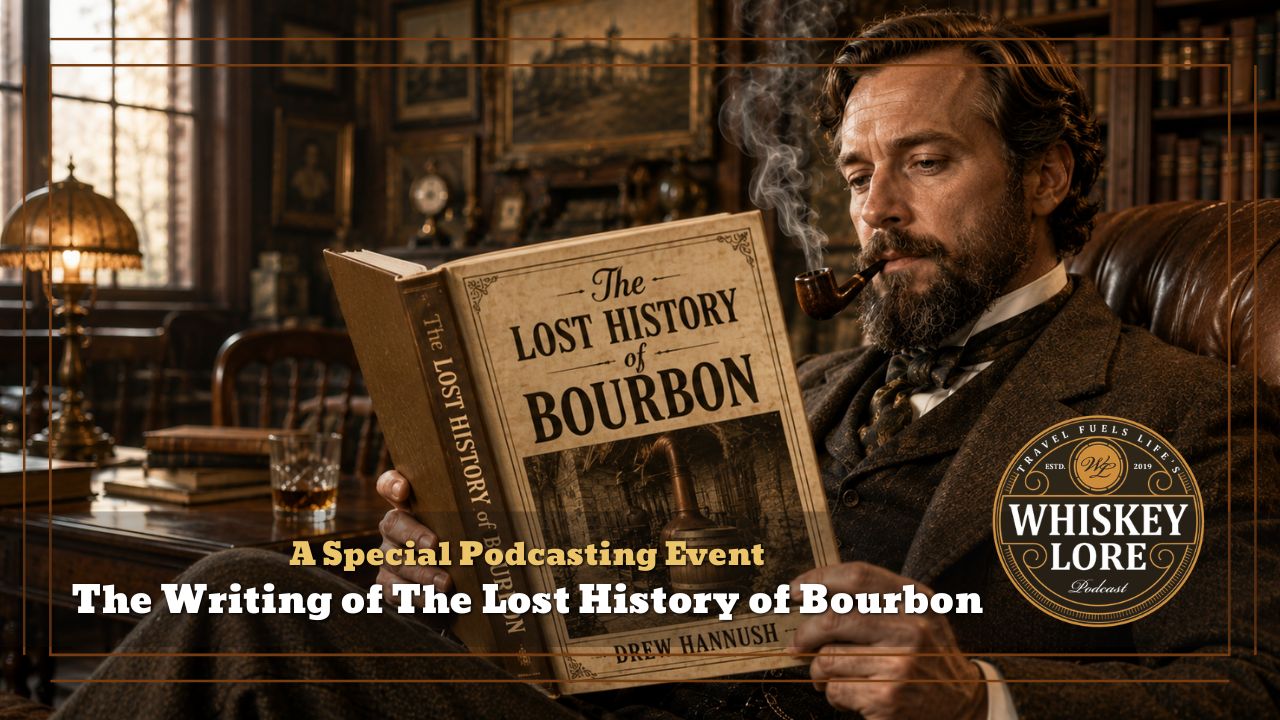
X00 - The Lost History of Bourbon: Preface
Listen to the Episode
Show Notes
Welcome to one of the most unique experiences you’ll have as a whiskey fan.
The opportunity to listen to whiskey history as it’s written and revealed.
This is a book, tentatively titled The Lost History of Bourbon has been a long time coming. I’ve had 90% of the research completed for nearly a year, but wanted to finish the Experiencing American Whiskey travel guide for the 250th anniversary of America and then I got caught up in refreshing some of my older stories here on the Whiskey Lore podcast.
But now is the time. This is a book that needs to be written. So much lore lingers on in the world of Bourbon because people are so unaware of the spirit's real origin story. I’ve gotta get this done.
And my feeling is, the best way to do this is to combine my efforts of writing a book with the creation of new episodes for Whiskey Lore.
However, this is not a new season. These episodes are considered a rough draft of my new book and will only remain up as long as I am working on the book. Once the book is complete, I’ll archive these for Club 1897 members at Patreon.com/whiskeylore
Also, the status of this book as a rough draft means things may be added or subtracted from the final edition. And know that an editor has not yet scoured this edition for grammatical errors and the improvement of prose.
I’m also leaving the door open on this until completion because this book is so important to our understanding of this spirit we call Bourbon, I want historians and authors with compelling arguments that could enhance this story to chime in during this process. It’s history we need to get right.
Understand. As of today, not a single chapter of this has been written, only an outline has been drawn up. I know where I’m going, I know the stories and details I’m going to cover. I just need to do the final chapter development and the writing of the prose. And that is what you’ll be a part of.
I can’t promise you an episode a week. I’m going to try to complete at least 2 chapters a month if not more. But I may have to take some trips back to Kentucky or stall on a story until I get further clarification.
I’m looking at this being another in my series of self-published books. Travel is expensive and support is always appreciated. If you’d like to help me continue working on great historical projects like this, consider becoming a Patreon member. It’s the best way to help me keep my focus where it needs to be, on researching and writing about the real history of the spirits we love. That’s patreon.com/whiskeylore And thank you to the 31 members who already go above and beyond by being faithful members of the patreon family. I’ll have plenty of bonus content coming up throughout this process. If you have friends who are whiskey history lovers - make sure you let them know how to find the podcast.
I hope you get as much excitement and enjoyment out of this reveal of the birth of Bourbon as I had in researching it and organizing it. It’s time to get down to the writing.
Listen using the player above. Then enjoy Chapter 1.
Transcript
PREFACE: THE MYSTERIOUS ORIGIN OF BOURBON
Imagine if as a youth, your first class in American history skipped past the settling of Jamestown, the Boston Tea Party, George Washington’s victory at Yorktown, the framing of the Constitution, and instead dropped you in the thick of the Civil War. Do you think you would have a clear understanding of America and the ideals those soldiers were fighting for?
Of course not. The story is incomplete.
Yet this is exactly how we treat the history of Bourbon. We know the style exists and we know there are those who are passionate about defending it and protecting it. But do we really know how this thing we proudly proclaim as America’s Native Spirit earned its name?
Ask a Kentuckian and they’ll tell you about Col. E.H. Taylor, Booker Noe, and Jimmy Russell. Yet, ask them a simple question—where does the name Bourbon come from—and you get mixed signals. Did it come from Bourbon County in Kentucky or did it come from Bourbon Street in New Orleans?
It seemed like a question that was foundational to me.
But to whiskey fans who love their Bourbon, it appears the mystery is part of the charm.
I caught my own dose of that charm on my very first Kentucky Bourbon Trail adventure. Walking through the stillhouses, smelling the angel’s share in rickhouses filled with barrels, the tour guides revealing the stories of legendary distillers, and with the tasting of magnificent drams—one could almost understand why poking holes in this mystique might ruin the romance.
But as a lover of history and someone new to this world of whiskey’s tall tales, there were a few stories that I felt I needed to know more about. Yes, I’m one of those people that watches movies based on true events with my laptop open doing live fact checks. Already hosting a travel podcast, I decided to go a step further and release my whiskey findings by starting a storytelling podcast called Whiskey Lore.
In the first season I told the tale of the Bottled-in-Bond Act of 1897, the see-saw history of Four Roses, and Abraham Lincoln’s famous quote about sending a barrel of Old Crow to all of his generals so they’d fight like the accused drunkard General Ulysses S. Grant. Sometimes the stories rang true but other times they appeared to be myths.
In the second season I tackled the story of the Reverend Elijah Craig, his use of a charred barrel that he rescued from a barn fire, his storing of his whiskey inside, and his marketing of the spirit as Bourbon. But when I discovered the good reverend never lived in Bourbon County, I wondered why people would believe he chose the name of a neighboring county for his spirit. One source suggested that his home in Scott County was once a part of a larger version of Bourbon County. It is true that in 1785, the original Bourbon County covered most of the eastern portion of modern Kentucky. Some 34 counties would be carved out of the original Bourbon County—but Scott County wasn’t one of them.
Feeling the Elijah Craig story was far-fetched, I decided to dig deeper into the two primary sources for the name: Bourbon Street in New Orleans and Bourbon County in Kentucky.
The Bourbon Street theory focuses on Kentucky flatboats taking whiskey down to New Orleans with the rocking of the boats on the Mississippi turning clear spirits into red likker. The French Creoles, unable to get their beloved cognac, accept the red Kentucky whiskey as a substitute for their French brandy and soon visitors to the area begin asking for the whiskey they had on Bourbon Street and then simply shortening the request to just Bourbon.
As for the Bourbon County theory, this dismisses the modern dimensions of the county as being too insignificant to have had any meaningful influence on the name. Instead, barrels were stamped with the words Old Bourbon to signify the whisky was produced somewhere within the original dimensions of the 1785 version of Bourbon County.
Knowing I was only going to get the same old stories on the internet, I set up an interview with New Orleans drinks historian Elizabeth Pearce and headed to Louisiana. My first inclination was that I was going to get a great Chamber of Commerce sales pitch on why Bourbon Street was definitely the source of the whiskey style. Instead, the response was quite the opposite. Elizabeth pointed to research by local historian Richard Campanella that showed Bourbon Street wasn’t the party place in the early 1800s that we think of today. Then she spoke of the French Creole’s distaste for anything American and she said they’d rather go without than drink American red likker. Before that interview, I thought the Bourbon Street explanation might prove persuasive. Instead, I left New Orleans feeling Bourbon County had won the argument. Little did I know, Bourbon County had a few of its own hidden secrets.
With the story settled in my mind, it was three more years before I started questioning the Old Bourbon County reasoning. What reopened the case was an invitation by Grain and Barrel Spirits to look into the history of an old brand they acquired—Chicken Cock. They were impressed with my podcast and wanted me to find a connection between the brand’s name and the story of cocktails getting their name from the stirring of the drink with a rooster’s tail. I told them I thought that would be hard to prove, but that I would take a look. What I found was a brand that claimed 1856 as its origin, but in reality, historic newspapers showed the man behind the brand had distilling exploits that went way back into the 1830s. What made the story even more fascinating was where he disitlled—Bourbon County. I wondered if there was a bigger story behind Chicken Cock’s founder. The brand gave me leeway to expand my research to complete his story.
I spent weeks tracking the brand through old newspaper articles, trying to find any details about the distillery and the whiskey. Then I traveled to Bourbon County and spent a couple of days digging through title deeds at the Bourbon County Courthouse and a day going through archived 1800s newspapers at the Bourbon County Citizen. Then I spent a day at the Paris-Bourbon County Public Library digging through family research and history books. As I pieced the Chicken Cock story together, I kept bumping into other Bourbon County distilling names that piqued my curiosity. But I had a project to complete and any ancillary research would have to wait for another time.
After I turned in my work on the Chicken Cock project, I let Bourbon County slip out of my mind and turned my focus to Tennessee. I’d nearly completed a visit to every distillery in the state and wanted to write a Tennessee whiskey travel guide, similar to my popular Experiencing Kentucky Bourbon book. Those travels also allowed me to conduct interviews diving into Tennessee’s distilling history. I covered the Jack Daniel and Nearest Green story, I talked with Andy Nelson at Nelson’s Greenbriar about the 19th century legacy of the brand, and I told the story of Tennessee temperance and the shootout in Nashville that led the state into Prohibition in 1909.
During those travels, I stopped off at Company Distilling in Thompson Station and met with its founder Heath Clark. I’d long wanted to talk to Heath about the part he played in getting Tennessee opened up to craft distilling in 2009. During the visit I let it slip that I’d been gathering information on Tennessee’s whiskey history and someday, I hoped to write a book about it. But for now, I was going to focus on the travel guide. To my surprise, he looked me dead in the eye and said, “write the history book…we need that!”
At first, I didn’t know how to react. I was comfortable with writing podcast episodes, but writing a history book felt like a daunting task and without an academic background, I wasn’t sure I’d be capable of writing a work of historical significance. Yet, I knew I already had the bones of the research, I just needed to take the Chicken Cock approach and go beyond interviews and web searches. And if I didn’t write it, who would?
When I returned home, I spent the next few months scouring 19th and 20th century newspapers, and then traveled to the courthouses and county archives across the state. Then I dug into old revenue books at the National archives. The deeper I researched, the more the myths and marketing fell away, and the more the 250 year history of Tennessee’s real distilling legacy showed its face. I realized what I had was more than just the story of the spirit, it was a journey through the state’s founding, agricultural development, and the nature of its people. I couldn’t help but wonder, how did historians miss this amazing story—the story of a spirit that predates Kentucky Bourbon?
As I began writing, I found myself becoming a cheerleader for Tennessee whiskey. And after learning about Lincoln and Robertson county Tennessee whisky and how competitive they were with Kentucky, it seemed strange hearing modern distilleries promoting Tennessee Bourbon. Lincoln County distillers in particular claimed anything out of Robertson or Bourbon county was sweet mash, which they believed was far inferior to their traditional sour mash. Without research into Robertson County whiskey, I might have taken this at face value. But I knew the Lincoln County distillers were doing a sales job. There were plenty of Robertson County distillers who were making sour mash whisky. As for Bourbon County I wasn’t quite sure because I hadn’t fully researched it, I knew I had a major blindspot. And there weren’t any modern texts I could go to provide the answers I needed on what they actually made in Bourbon County in the early and mid 1800s. I knew I couldn’t escape the inevitable. I needed to research Bourbon County.
The launch of The Lost History of Tennessee freed me up to explore Bourbon County deeper. I went on a hunt for distillers names through old newspapers and returned to Paris to dig through title deeds, genealogical records, and the county’s history. Through Rebecca Lawyer, publisher of the Bourbon County Citizen, I met historian Nancy O’Malley, whose research on Bourbon County distillers combined with her research on old mills and Kentucky’s early defensive forts known as stations, fit perfectly with my needs. We drove around the county looking for evidence of the old distilleries and walked through the Hopewell Museum, talking all the while about Bourbon County’s rich tavern history and its path along the old buffalo trace. What I discovered was, those empty fields where those distilleries once stood have plenty of stories to tell about the early days of Bourbon. And like Tennessee, it's a story that has been passed over thanks to a century of neglect.
What follows might be inconvenient to modern marketing and historical narratives. After all, Bourbon didn’t find its origin in a Scott County barn in 1789, or a commercial distillery in Louisville in 1783, nor did it find it in a log cabin on Dix Creek in the 1770s. As will be shown clearly by Part II of this book, Bourbon’s name and reputation originated from the county that bears its name. And for the first time you’re going to read that story--not by taking the well worn paths of marketing lore and books of industry. Instead, by meeting a generation of pioneers heading west for a better life, their children who took whiskey from a barter economy to commercial markets, and the grandchildren who established Bourbon’s name and fine reputation, only to see it usurped by the state and then a nation.
Welcome to the origin story of this thing we call America’s Native Spirit. Welcome to the lost history of Bourbon.
CLOSING
Whiskey Lore’s a production of Travel Fuels Life, LLC
Production, stories, and research by Drew Hannush
Are you a fan of whiskey history and Whiskey Lore’s mythbusting, and you want to support my history research and make some new friends, join the Whiskey Lore family as a member of the Whiskey Lore Speakeasy or Club 1897 where you’ll get longer interviews, whiskey tastings combined with stories, extended episodes, and a chance, with your votes, to award the best distilleries in the country with a Pagoda Award.
Just head to Patreon.com/whiskeylore.
And keep locked into the Whiskey Lore podcast as we dive into the Lost History of Bourbon in our next Monday episode.
I’ll see you there. In the meantime. Thanks for growing your whisky knowledge along with me, I’m your host Drew Hannush and until next time, cheers and slainte mhath.