
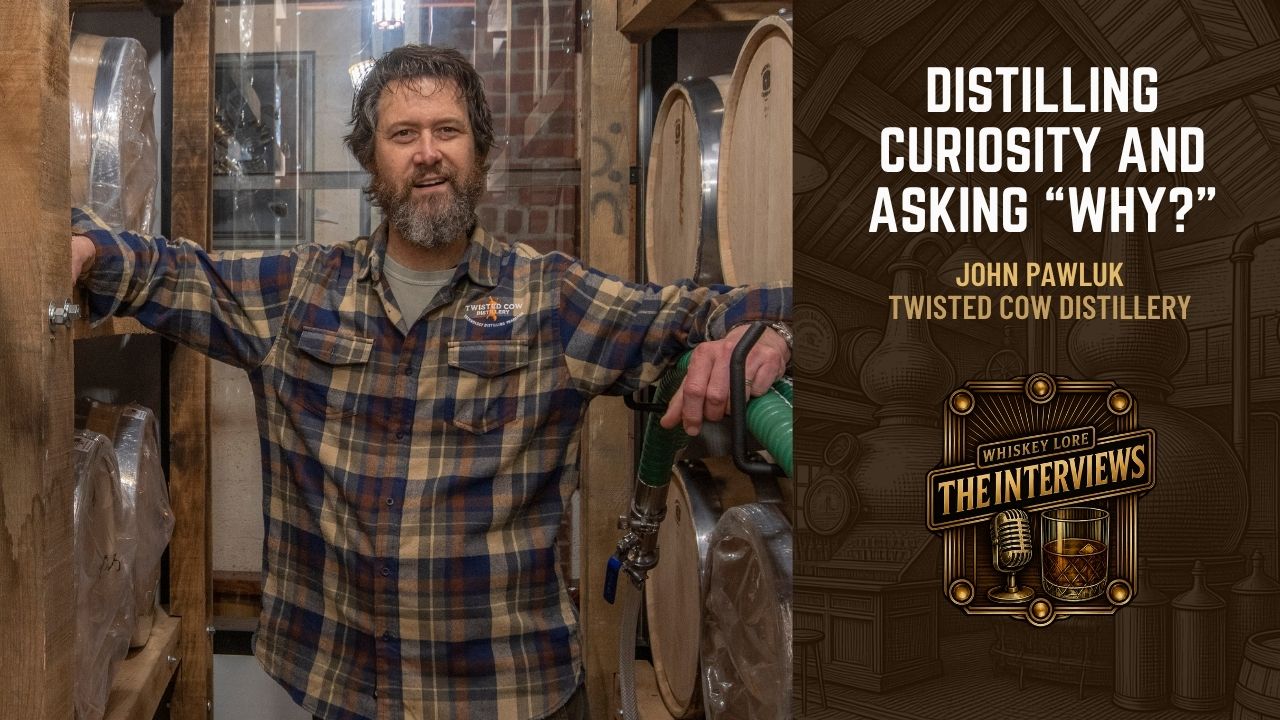
138 - TWISTED COW: Distilling Curiousity and Asking "Why?"
Show Notes
GUEST: John Pawluk (Twisted Cow Founder and Distiller)
Some distillers master tradition. Others ask why the tradition exists in the first place. In this episode, Drew Hannush sits down with Twisted Cow founder and distiller John Pawluk, whose gift of curiosity has led him to challenge long-held assumptions about fermentation, copper, grain, barrel aging, and flavor development. There is plenty of discussion around one of John's favorite tools for stretching his abilities-the iStill. Enjoy this return to long-form discussions about why and how whiskey is made. It's a fascinating look inside the mind of a whiskey maker who refuses to accept "because that's how it's always been done."
In This Episode
- Why curiosity drives better whiskey
- Building flavor before the barrel
- Rethinking copper's role
- The science of fermentation
- Why grain origin matters
- Stone mills versus hammer mills
- Barrel proof and flavor evolution
- Learning from tradition, not following it
- Experimenting with blue corn and heirloom grains
- Creating a distillery built for discovery
TWISTED COW PROFILE
JOIN THE SPEAKEASY: patreon.com/whiskeylore
Transcript
Drew H (00:00):
Have a guide to Experiencing American Whiskey, experiencing Kentucky Bourbon and the book that busts 24 of Whiskey's Biggest Myths, Whiskey Lore Volume One and today rather than doing a Whiskey Flight, welcome to Whiskey Lore The Interviews. I'm your host, Drew Hannush, the bestselling author of Whiskey Lore's Travel Guide to Experiencing American Whiskey, Experiencing Kentucky Bourbon and the book that busts 24 of Whiskey's Biggest Myths, Whiskey Lore Volume One. And today, rather than doing a whiskey flight, I decided to step back into our old school Whiskey Lore, the interviews format where we deep dive into the minds of founders and distillers. And in this episode, we're going to be heading to Long Island, New York to talk to John Pawluk, founder and distiller who started his distillery, Twisted Cow with a idea of not necessarily following tradition, learning from tradition, but then investigating how we do things and asking why they're done that way.
(00:59):
This has led him to some fascinating theories built around where flavor comes from. He questions copper's benefits and limitations to the development of flavor. We talk about grain and go beyond the idea of terroir and talking about how knowing where your grain comes from can help you in your distilling decisions. And he's got some interesting analogies in regards to milling and aging. Now, John and I met shortly after I concluded my research for my book Experiencing American Whiskey. We had a fascinating conversation on the phone. As you will hear, he has got a curious mind and I knew he'd be a great thought provoking guest for all those who want to continue seeking new ways to grow their whiskey knowledge and their own curiosity. John, welcome to the show.
John P (01:49):
Drew, thanks for having me.
Drew H (01:50):
Yeah, it's great. Well, we had a little conversation offline a few weeks ago and as we were going through and talking, I'm like, okay. First of all, my science mind is starting to cramp because I'm history first, not science first, but I have grown an appreciation for science mainly through whiskey distilleries because you can take these science philosophies and you're applying them to something that you're getting a result out of that you can taste and smell, which to me is kind of that thing that makes science real rather than just being this mythical numbers and kind of the way that people say, "I don't like history because all you keep giving me are dates and names." I guess I'm kind of that same way with science that dates and names just doesn't resonate with me as much as actually tasting a whiskey and going, "Okay, I see what you're talking about.
(02:49):
" So we'll have some fun diving into this. Sure. Yeah. So talk about your background because science wasn't really your first move into the business world.
John P (02:59):
No. So my father was a science teacher, so I always was around it as a kid. He'd come home, he did chemistry, he did some things along those lines. But I was an accountant. I did 20 something years on Wall Street as a regulatory accountant. The CFO, the FinOp, Series 24, 27, some different licenses that held me out to the regulatory bodies as the one responsible for books and records. So going past all those details, I was responsible for reading rules, interpreting them and making sure we follow procedures and put in place procedures that lived within those rules. The industry shifted. I knew my time was limited. I had an opportunity to pivot. Took me some time to figure it out, but I watched the first episode of Moonshiners. It grabbed my soul. That was the real thing that brought me forward. I watched the episode.
(03:52):
I'm like, "This is pretty cool." If these guys can do this in the woods, imagine what I'd do if I apply some technology and some discipline and some real processes around things. So I took off and did a lot of R&D, did a lot of talking, did a lot of learning and materially I'm going to say self-taught through not so much schooling, but through reading and trying to perfect a process. And when you start a business looking for the best way to put yourself in a position to be the most successful in terms of the breadth of product, the flexibility that you have in creating that product and the consistency of making that product. So that's what led me to choosing iStill as my equipment provider and pretty much doing everything that we do from the way we mill our grain to the way we manage our barrels.
(04:43):
The training I did have was by Nancy Fraley at Iron Republic. Fantastic. That was a transformational week and I live it every day. Elovage is one of the words I say more than, "Hi,
Drew H (04:57):
Honey." Yeah, it is kind of a life-changing moment when you go to IronRoot because they're doing such interesting things out there and really just bringing old world philosophies in and looking at another industry basically and saying, "What can that industry bring to our industry to make the spirit better?" And that's just a fascinating way to go about things. Some people will go around to a variety of distilleries and start doing distillery tours to learn. Some people will just go on YouTube and start looking at videos and seeing what people are talking about. How did you kind of get started? Was Iron Root the first thing you did or did you kind of scope around a bit?
John P (05:41):
I tinkered. We'll call that. Let's say I tinkered
(05:45):
And in doing so, it brought me to different locations. We camped a lot. So with the dear friends of our family, we would go, we were in Gatlinburg. So I was in Gatlinburg testing things out. And when I'd say I'm looking to start a distillery, every single distillery I do, I introduce myself. I'm looking to start at the stillery on Long Island, New York. They're like, "What?" And I just have a very genuine conversation and I'm like, "I'm looking to learn, what'd you do wrong? What would you do different? What do you like? What do you not like? " And it probably saved a couple of years of mistakes and certainly tens of thousands, if not hundreds of thousands of dollars of errors. Still made a few, but generally I'm pretty pleased with what I've done in such a short time.
Drew H (06:27):
Did you have kind of a target in terms of a product that was out there already that you said, "Okay, this is kind of a direction I'm going to go in, " or you just clean slate?
John P (06:38):
Clean slate. I take the approach of being an accountant and writing business plans, driving a goal. I wanted to say, I want to be able to make a broad range of products because I don't know what I'm going to do really well. It's not like I've done this before for someone else.
(06:54):
Like my first batch of vodka, I made 1,100 bottles and a single batch of rye vodka. No one does rye vodka because it's a pain. It's difficult. It's a hard grain to work with. It's gooey. It clumps. You need to be super precise with it. I knocked it out of the park. I absolutely love it. So you have to find your way. And I wanted to have the flexibility to find my way. And I didn't want to create a product. I wanted to create my product. Great example. Someone's like, "Is your gin going to taste like Hendrix or is it going to taste like beefeeder or is it going to more traditional or is it going to taste like something that's more forward like a Hendrix?" And I said, "No, it's going to be John's Jin. It's going to be unique. I don't want to copy.
(07:35):
I don't want to be known as someone who I may be influenced, but I don't want to mimic someone. I have my own soul to fulfill. And there's a lot of art in this. I basically say we operate at the crossroads of science and art where we pull those different aspects. You mentioned earlier, you pull the background to create flavor and our medium is through alcohol. You create the flavor and you use the creativity to say, what can we do with this? So we do things like reposado. We're the only reposado ever made in New York State. I didn't do it because it was easy.
(08:11):
Agave is very complex. The complexity of the sugars, we use a series of three different yeasts actually to bring out different aspects of that that creates some really unique flavoring in the barrel. We don't have any additives, but we're still getting caramel. We're getting vanilla. We're getting all the properties from the barrel through the distillate and the high quality barrels we use. Understanding that and not so much in a super scientific ... I can't quote you scientific names of processes. I'll never be able to do that. There's too many things that I'm thinking about, but I can get an angle on what creates flavor and what I like and what I don't like and how that translates.
Drew H (08:52):
So I'm going to put this into a music analogy because I've written music for years and years and years and people keep telling me, you should learn music theory because if you learn music theory, you'd be able to know where to go on certain things. And there's part of me that's like, I don't want to learn music theory because as soon as I learn music theory, I'm going to be locked into somebody else's thinking I want to just discover something. Is that kind of where you're at?
John P (09:18):
Agreed. So I had this conversation, we do a lot of tours. I think I did 58 individual people for tours this past weekend and they say, why'd you like distilling? Why don't you make beer? And the way I equate beer and wine making is I equate them to baking and I equate distilling to cooking. There's a lot more flexibility where you can put a sprinkle of this in. You can try some of this, you can try some of that. And it's a fearlessness that I have now found that whatever I make, I'm going to be able to do something with. I can switch things up a little. You can blend things. There's so many different ... If I don't like a certain type of flavor that's coming off a barrel, I can let it sit. I can pop it into a different bourbon barrel that's got more sweetness to it.
(10:03):
I can finish it with something. People ask me all the time, will you ever do a Cabernet finish? I'm like, That means I made a really bad bourbon. Why would I want to put my bourbon in a cabernet barrel? I don't get it. Why would I want to ever put my bourbon in a cherry barrel? I don't understand the concept. The only thing I would ever want to do, because I've always enjoyed it, is an almignache finish because I think they're something unique, but that will be a very targeted process and I would need way more experience to figure out what kind of bourbon mash bill would work in an almanyacht finish. It's just because it's, I don't know, it's something different.
(10:39):
But I don't like finishes. It's not my thing. I think there's so much capacity to create flavor with mash bill and style that it's a dimension that I have no ... And I'm even getting into different barrels, different chars on barrels. I haven't gone beyond a number three. That's fine for me. I have so many options on a number three char with barrel fill and where I have with 25 and a half feet tall in a rick room that has inside walls and a wood ceiling. You can see the wood right there above me. So I get ripping hot in the summer, not Texas hot, but I get hot and in the basement, I stay more of a Scotland. So I say we encompas the best of everything. And that's the concept of Elovage that the whole barrel room was built on. It's 25 feet.
(11:26):
We had nine barrels high and we got four barrels ride with space between them. And each one of those is a different time zone. It's a completely different environment where we have the barrels in the front and you see right behind the windows. Barrels are effectively temperature controlled because they're right next to a very low insulated wall. The tasting room is temperature controlled, therefore those barrels are, but that's a thermal barrier. The ones behind it are less temperature controlled. So those front row barrels really don't change much up and down with proof. As you go to the back of the barrel room, in six months we gain 6% or six proof and we lose six proof the first six months of a barrel's life. Crazy. That's what I expected from Elevage. The first row, I tested them after a year. I'm like, they've gone up one proof.
(12:15):
This makes no sense, but how do you find it, kind of figure it out. So every barrel room's a little different and you learn about everything all the time.
Drew H (12:23):
Yeah. I love barrel finished whiskeys and I'd like to see that experimentation, but you're right. There are so many other parts of the process where you can create flavor and that's part of what intrigued me about our conversation the other day is because you are kind of hunting and finding some different ways of creating those flavors. And let's kind of start off with your still because I've of course talked to people who are using hybrid stills that are using column stills, using pot stills. I just recently was talking to Loch Lohman. They have a very unique still that we talked about the fact that scotch whiskey has pretty strict regulations and they actually created a regulation because the Loman distillery was trying to use a still that went ... It had kind of a column-esque piece to the still that was stretching the rules a bit and they were like, "Okay, we're not sure we ... " So we have a lot more flexibility in this country to be able to do what we want to in terms of those stills.
(13:31):
And I haven't run into anybody that's using an eye still before. So kind of describe to me what is the difference between this eye still versus a continuous system versus a pot still?
John P (13:44):
Right. So I prefer a batch system, number one, because I want to make decisions along the way. When I'm making vodka, I want to be able to pull my heads, my hearts, and my tails. And I want to make that decision. I'm a control freak. So the batch system is what intrigued me, number one. Number two, there are three things the eye still has that really intrigued me. Number one, it's square. It doesn't use paddles in its agitation system. It uses cones. It is a column system that is packed. We do not have plates and boiling point based on barometric pressure within the column. So today it's raining. Boiling point of ethanol today is roughly 78.1 Celsius. We are a hundred feet above sea level is 78.3 standard. We are two tenths of a centigrade off the boiling point of ethanol. So when we're making a vodka, I want pure ethanol.
(14:46):
I want 78.3. So I found that running at 78.3 is super inefficient. It takes too long. So I run two-tenths of a centigrade over the boiling point of ethanol as measured roughly every second of that process for 20 hours. I make the same product for the last three years that's 100% identical. It is the same product because we're driven by boiling point. You can make a legal vodka at 95% or 95% or higher off the sill, but if the column temperature is say 87 Celsius, well, you're not making clean ethanol. There's another 10 degree Celsius of boiling points that you're going
Drew H (15:27):
To
John P (15:28):
Get. It's always going to be smearing and smearing is the imperfection of the world because the asiotropic relationship of ethanol where all these components stick together, but if I'm at two-tenths of a centigrade away, I'm going to be as controlled as possible. I'm going to be as clean as possible. So that for me was a way to make vodka. I actually don't enjoy vodka and didn't enjoy vodka until I made it. I love it. It's super clean. There's flavor that comes through. When I say it's super clean, it's free of things that smell like they belong in a hospital or a environmental cleanup project. Acetone heads, most vodkas, they retain it. We don't. We understand the boiling point of acetone in those heads and it's certainly below 78 degrees. Again, there's always going to be smearing, but we capture them ahead of time and then we collect them and then we capture them again and we collect them and I'll dump out four or five gallons per batch.
(16:34):
And that's why my vodka is a little more expensive, but it doesn't smell like acidone. It doesn't smell like nail polish. It's got a mouthfeel, our wheat, it's creamy, it's decadent. It's absolutely beautiful.
Drew H (16:46):
So this is what's interesting to me about vodka, because you said that you were making your vodka with rye and the first thing that goes into my head is I would use a rye grain if I was trying to achieve maybe a hint of flavor in the spirit. Is that the philosophy or are you trying to get it as neutral as possible?
John P (17:08):
I'm not trying to go as neutral as possible
(17:11):
I want to show the grain. I want people to know what they're drinking. So for me, I love the rye vodka. I'll drink it over an ice cube all day. I absolutely love it. The wheat vodka, the same in a martini, no vermouth, just shake it. Absolutely beautiful. The wheat has a mouth feel that it's creamy, it's decadent, it fills your mouth and spreads over your tongue. The rye a little less, a little sharper, but the rye gets very delicate at the end, which you would never expect. You expect rye, you have a rye. I love rye whiskey. That's my preference actually. I want a smack and I don't really get the smack with the vodka. I do get a hint of flavor, you get some spice, you get a little nut and then it gets very kind of like it tiptoes away and fades.
(18:00):
Whereas the wheat lingers, it wraps your tongue. So what we found is with that flavor profile, a cucumber vodka, which we're working on now is absolutely amazing with wheat. Jalapeno, ridiculous with wheat. It doesn't have that, those properties with corn. It doesn't have those properties with an agave base. It does because the wheat, it's like a sponge. It pulls all the flavor together and it transports it.
(18:29):
I call it the flavor train.
Drew H (18:30):
Yeah. So you basically, how are you branding your vodkas then? Do people know clearly one is wheat, one is rye?
John P (18:39):
Yeah, it's a wheat, it's a rye. We do a jalapeno. So we're developing the cucumber. It's Series 19 cucumber vodka, Series 19, jalapeno vodka.
Drew H (18:50):
Okay. One of the things that you said when we were having our initial conversation, which again kind of threw me for a loop because I go to distilleries, the first thing they're going to tell you when they show you the stills, they're going to point out that they're all copper stills and that some distilleries have even gone as far as to say we have built the line arm on this still so that it's giving even more copper contact as it comes out, sending it through a copper worm. So copper, copper, copper, copper. And then you came out and said, you're not a fan of copper. So go ahead and tell me what your philosophy is with ... Well, first of all, how much copper you're using in your still and then kind of your philosophy of stainless steel versus copper.
John P (19:44):
So the first thing is you make a bet and this is a family business. So I'm putting my family in jeopardy by starting a distillery, which is, as all the distillers out there know, that's real. It's a great way to become not a millionaire. So I therefore want to stack the cards in my favor and doing research, a lot of the sulfurous compositions of fermentation are captured by copper. What happens if you don't create them?
Drew H (20:16):
You're talking about the things that create sulfur.
John P (20:20):
Why would you need to capture them if you don't create them in the first point? So control your fermentation. Don't have it go hog wild. Give it some barriers like when you're training a dog and keep it under control. And a lot of those sulfurous components will not show up. The beauty of the ice sill is, and I'm going to kind of bump around through copper and the design, is we are a closed fermentation system. We are temperature controlled. So I cap my temperature based on the style of yeast and based on the product that I'm making. My agave products will ferment at a higher and rumprops will ferment at a higher temperature. My bourbons and rise will ferment at a slightly lower temperature based on what yeast I'm using and they're agitated every 15 minutes during fermentation. And what that does, it pushes all the carbon dioxide out, it forces it up and it gives for a healthier yeast so there's more control.
(21:17):
So the yeast isn't struggling as much. The yeast is doing its job. The way I describe it, you want your yeast to sweat, but you don't want them to run a marathon and fall apart. You want to get your yeast working a little outside of their comfort zone like we all should be. We should all be comfortable being uncomfortable. And that's what I want to do. I don't want to make them miserable. I don't want to give them a breakdown.
(21:38):
And when you push them too hard, again, what I found is that's when you create these funky flavors that you're knocking that are going to be off that create more sulfur bases.
Drew H (21:47):
Okay. So I'm assuming that you are doing a short fermentation then, maybe a three day or so
John P (21:54):
Up to five.
Drew H (21:55):
Up to five. Okay. Because the other philosophy with yeast is that some people will let it start eating itself basically after a while. Let that fermentation go as long as you can to get those fruity notes out of the spirit. But of course, if we have cannibalism going on with yeast, they can't be comfortable. They're not sitting in a lounge chair enjoying the journey.
John P (22:21):
Right. So we actually have been able, even with say in a four and a half to five and a quarter day fermentation, I'm still getting banana picking up and I'm picking that up after a year in the barrel. So I'm pretty happy with the fact that we're able to pick some of that up and I don't have a great palette. My sensory is horrific. I have a business mind and not a sensory mind. That week with Nancy Fraley was probably the most exhausted I've been in my entire life. It is absolutely exhausting for me to do sensory.
Drew H (22:57):
You have family members and teammates to help you with that stuff.
John P (23:02):
We all do. And I stress over time taste things morning, noon and night, different environments, different moods, different times of the day so you can get the mean, the average of what your opinion is works its way through. Do you like this with one cube? Do I like it with two cubes? Do I like it neat? Do I like it cold? Do I like it warm? And all these things, all these variables kind of lead me to how I can communicate with what I found about my spirit to a customer and our bartenders and barbacks are all kind of given the same information as well. But getting back to the still, if you're making your investment and you're putting your bed on black, copper, how do you clean copper? You need acids, you need bases, you need chemical, right? We use cold water. It's very simple.
(23:58):
We have a bowl that sits below the column and we have a small copper pad that sits in the vapor path. The vapor passes through the copper, but that's it. And that copper, it picks up any impurities from the fermentation and I clean that with hot water
(24:15):
Right after I pull it out of the collar. So the copper in my system is replaceable and it's not built off that. I can't imagine like when you have a mill, like for instance, we have a mill that we use a stone burn mill, very specifically a stone burn mill. I don't want to use a hammer mill. I do not want to beat the daylights out of my grain. I want a coarse grain. I want mill and I equate that to wonder bread versus a whole grain bread. So when you use a hammer mill, your temperature's going to go up, you're going to overprocess that grain and you're going to, I call it be abusive. I don't want to be abusive. I want to gently do this a little more slowly and a little more directly. That mill has parts that will wear as weak parts by design so you don't have to replace very important parts.
(25:06):
Copper is weak. Copper is not inert. So for me, I have to clean it every time I clean it. Every time I use it, I'm destroying it.
(25:16):
That's not the case with stainless. So my biggest investment is going to be around. That's for me, it just made sense. If the process is easier. And in fact, what we do here is we have a 2,000 liter still and a 5,000 liter still. We mill directly into the still, we mash in, we ferment and the still in the same unit with no transfers. So it's a simple, clean process. It's three and a half to four and a half barrels per week we can produce when we're doing a whiskey. We're about, let's say about 1,100 to 1,200 liters of vodka per batch with that and there's no transfers. So I'm only cleaning my equipment once. I don't have to clean a fermenter or masher and a still. If there's no transfers, there's less pumping, there's less hoses. Operationally, it's a much more efficient proces. And what I love about it, the square design of the sill versus round.
(26:11):
You ever agitate something in a circle? What happens? It just fins.
(26:15):
So for me, I want to optimize flavor. Like I said, we're in the flavor business. And by having a square still with conical agitators as opposed to paddles at all agitation levels, all the grain is 100% emulsified within the mash. There's no pile. I have direct heaters, 95,000 watts of heating in the big still and 36,000 watts in the little still. Every single time, every second, every molecule that touches those heaters, I'm caramelizing flavor. So the way I portray this is, have you ever had an onion in a stew? You're going to boil that onion. Have you ever had a caramelized onion on a hamburger? You tell me what you would prefer, right? Yeah. The mallud effect, the mayard, if I can never pronounce it correctly, is the browning of sugar. There's always going to be unfermented sugar in that mash. We have a great fermentation.
(27:10):
We're fully fermented, but there's always going to be something there. There's always going to be flavor to create. So for 12 hours before I distill, I'm heating up and caramelizing sugar. We're distilling for 18 to 22 hours. I'm creating flavor. I'm caramelizing flavor. So the way I describe it, and for me, it's very simple. Round, steam, jacketed stills, boil, I barbecue.
(27:39):
That's not pushing anything. That's just fact. So we're starting with more flavor. We're starting with greater mouth feel because of the equipment.
Drew H (27:50):
So what I'm thinking is that you're actually, and correct me if I'm wrong, sort of introducing some of the flavor that you might've expected to get out of the barrel later on simply by this caramelizing process that you're doing during distillation.
John P (28:09):
And we're increasing mouth feel as well. So what I've found is blue corn, we use blue corn. I love the blue hopi corn. Absolutely love it much more than I ever expected. There are a ton of corn oils in that corn. The mouthfield that we are able to extract from that it carries through. So think of a really, really rich wheated bourbon. We're getting that with 100% blue corn, crazy mouthfeel. It just coaches tongue and lingers. We're caramelizing that oil. With all those sugars, everything is getting caramelized. It's an incredible rich flavor. We're getting depth very early on. And when you ad that to a barrel and you add different barrel proofs, we're pulling different flavors from those barrels. So we're doing some barrels at 105. We're so doing some barrels at 121, 124, and you put them together, all those different flavors, that's elevage.
Drew H (29:04):
Yeah. How are you keeping all of this straight? You must be taking some notes on this.
John P (29:10):
The federal government has us tied down pretty good with reporting. So we know everything that's in every
Drew H (29:15):
Barrel.You
John P (29:17):
Know what's going on.
Drew H (29:19):
So one of the things, and kind of getting back to this sulfites discussion, because for a long time I had believed that when I started hearing this theory about copper and stripping the sulfites out, that this was what causes headaches. When I have wine, I get headaches. And when I'm drinking whiskey, I don't tend to get headaches. Although then in doing my historical research, now all of a sudden I'm hearing about fusel oils and fusel oils are what caused the headaches. And so that's why you should go to a column still instead of using a pot still because when you're doing batch distillation, you leave too many congeners in there and that's what's going to cause the headache. So you're now talking about less copper contact and then you also have this philosophy about your tails. So kind of go into that and how do we get past these, whether they're old wives tails or whatever they are about the headache causing parts of the spirit?
John P (30:22):
So two things. We use number three char. Those barrels are charcoal filters.
(30:29):
So that pulls a lot out of those conjuners. Rely on the number three char instead of a number two. When we are processing our heads, when I was taking my training on eye still, it was a great theory that in terms of the way you describe flavor, I want you to think of flavor on top of a tree and the tip of your tongue, your floral notes. The beginning of the run, low boiling point, low molecular weight, top of the tree, they're lighter. They come across earlier. Headache. So think of the end of the run, the roots of the tree, the back of your mouth, belly ache. So heavier conjuiners, heavier flavors. It's a way to paint a picture that I try to do with people. I think Odin from I still painted a great picture for me, so I try to convey that. Early on, we're able to collect the bad stuf.
(31:24):
I call it the bad set of the heads. Because we're dialed in on boiling point, we know what we want and we don't want. So we can collect them all at once. And I actually use that acetone. It's a commercial cleaner. That's what cleans my column. After the last batch, I'm cranking that column. It takes two hours to heat the column up.
(31:43):
And for the last hour in that column, all 15 feet of it, it's getting cleaned by acetone. Perfect. There's no scrubbing. There's no chemical. There's no other process. It's very, very simple. So then we discard that. That cleans up the headache material. The tails, what we do, we keep reflux on. We push that stuff. So I'm collecting at 80, 90 proof at the end. But as soon as I turn my process of reflux down, I'm left with half a percent in the boiler. There's nothing left. I've stripped everything out. So I call that ring in the rag. I'm ripping all those heavier flavors that have higher molecular weights. We're pushing them through, we're pushing them through and we go to the end. We want to get all the flavor out.
Drew H (32:34):
Okay. So how do you avoid the wet dog portion of that? I'll hear people talk about the tails and they say, "Ah, it just smells like a wet dog."
John P (32:43):
Yeah. So that's okay. It's okay to smell the wet dog because that's what the barrel's for.
Drew H (32:48):
Okay. Yeah.
John P (32:50):
So because we have so much reflux going, we're able to pull more alcohol out. We're able to pull the flavors that we're looking for and we rely on the wood to do the rest of the cleanup.
Drew H (33:03):
It's really interesting because in talking to people from distillers from different areas or talking to the Canadians and talking about their philosophy of using a column versus using a pot still the Tennessee philosophy of using charcoal instead of using a barrel because that's a Tennessee white whiskey used to be the thing. And their philosophy was they were pulling up with using that charcoal to pull all of that junk out to replace what the barrel would be doing over a period of time. So you've stumbled into these things. It's really interesting because it would be interesting to know is it all the quiet time you have alone with the still that gets your brain working these things up or have you heard things that have kind of built this philosophy for you?
John P (33:58):
It's a little bit of everything.
Drew H (33:59):
Yeah.
John P (34:00):
I really accept the United States is a melting pot, right? So I try to take that philosophy in everything we do here and listen to a lot of people that have been successful. And our motto here is technology distilling tradition. There's a lot of BS out there and because of history because of L-O-R-E, lore. Some of that's great and some of that is just that. So I want to pull, and we live by that every day. It's that and rising tide raises all ships. Those are two philosophies here.
Drew H (34:34):
Okay.
John P (34:35):
The third would be don't make a mistake to have to clean it up down the road.
Drew H (34:39):
Yeah. Well, and then thinking that the barrel is doing this kind of work, the thought process then goes to you're still three and a half years into distilling. Have you started to sense how long it takes for that number three char barrel to really start cleaning that spirit up?
John P (35:04):
We've released our first bourbon at two years, at 24 months in a day and that's a financial thing as I'm sure most of your distiller watchers can attest to, especially when you're young and you need to get something out there. I'm going to continue with two year releases. I'm super happy with them
(35:23):
And part of that is because temperature. So at 55, things start getting slow, dormancy creeps in. We've never dropped below 58 Fahrenheit in our barrel room. So because of that, we're getting interaction with woo 12 months of the year. If your barrel room, your ricks, whatever you want to call it, are exposed to elements, they're going to go dormant and you're not going to get that cleaning. We're getting that cleaning 12 months a year. So we're aging faster. Generally, we're aging a little sweeter because we're using a lower entry. Our Hickory King, I'm entering between 104 and 112 and our bloody butcher, I'm entering it 116 to 124.
(36:15):
Different corns, different flavors, different years. The bloody butcher we have this year, it is so oily. There's so much depth and body to it. We backed up the truck and I weeded it. I'm like, "All right, this is going to beats the bomb." So we weeded the bloody butcher after we did a couple of runs of 100% bloody butcher and I'm like, "You know what? Let's put some rye in here." And then we actually added a couple of malted grains. That's the other thing we do. We use different malts. We're not just using malted barley. Malted barley's boring. We're using caramel 20, caramel 40, caramel 80 and chocolate rye. So I'm basically using a stout mash bill in my bourbon and the flavor that comes off this, it just snickers, it's milky way and you can get the chocolate in the white dog. It's there and I'm using a small ... You don't need a lot.
(37:07):
Eat a lot of that chocolate rye. It is invasive.
Drew H (37:11):
What you're kind of describing to me, my thoughts go to how when you go to large scale distilleries, they have a solid mash bill that they work with. In your philosophy of doing things, do you sort of sense that maybe that's an issue and that you really should probably adjust your mash bill even season to season because you have, as you say, you may have a rough year in terms of weather and we're talking about crops where maybe this particular grain doesn't have as much flavor as last year's. And if you're locking yourself into a mash bill, you can't make adjustments to fix that.
John P (37:56):
So I rotate my mash bills annually and we always experiment and we always look to improve. So for instance, this year it was drier on Long Island and with that speak to the farm went, are you watering yet? Yes, we're watering this year. Sometimes they don't water a lot. It was dry. Well, when you don't water, what happens? You need to pull those roots are pulling more from the ground. As they're putting more water from the ground, because they're struggling, guess what? More flavor, more mineralities coming in, more depth. And that's what happened this year. This year is my favorite harvest.
Drew H (38:29):
Wow.
John P (38:30):
My favorite harvest over the last three that I've had. This was really, really cool.
Drew H (38:34):
So you're saying dryer actually can be a benefit to the flavor?
John P (38:38):
That's what my pickup on working with the grain, seeing the difference year over year, that's what I'm finding. Yeah.
Drew H (38:47):
Again,
John P (38:47):
This is theory. I don't know if it's right or wrong. It's just what I'm sensing. If I have a very strong conviction, I'll let you know this is what I feel and I'll die in that hill. This is theory. So I'm not willing to die in the hill. I don't know enough about it, but for me it makes a lot of sense.
Drew H (39:03):
This industry is nothing but theories. I mean, because somebody can convince you that this is the best way to do it. And then I will talk to somebody who is doing it completely the opposite and somehow they are creating a product that is absolutely fascinating and they go, okay.
John P (39:21):
He's a great example of that is our single malt, typically single malt barley is lauded and it is not distilled on the grain. It's not fermented on the grain. I think that's insane. I don't get that.
(39:34):
I want that grain in there. I want to caramelize as much flavor and it's like a candy. After a year and a half, it is so sweet. It is so approachable at 110 proof. It is unreal. And again, that gets back to just trying something different. The standard is this, but why is the standard that? The standard is that because of what they used to do in the tradition and don't necessarily listen to tradition, I listen to ... I just asked the question, why? And do I have to listen to those rules? No. We have the flexibility here to do what we want. So let's try this, let's try that. And I will never laud a grain. Plus it's more equipment that I have to get.
Drew H (40:19):
Right. Yeah. It's an extra step in the process. But I think in Scotland it's done because that's been tradition and they haven't necessarily ... They're not ones to usually push the envelope too much, but they've also been doing this for 200, 300 years.
John P (40:38):
And product.
Drew H (40:39):
Yeah. But
John P (40:40):
My goal is to make something similarly unique instead of an 18-year McAllen, you can probably do it in six with improved process.
Drew H (40:50):
Yeah. So this thought is that as you go across the Irish Sea into Ireland, you have a younger, yes, it's a long tradition there, but still a much younger industry going on right now. And so you're seeing this experimentation and I'm walking into a distillery that is doing on grain distillation and they're doing it saying, "We don't know what we're going to get out of this, but it's just something that we want to try." And I mean, isn't that what makes whiskey much more fascinating and keeps us from just going to buy the generic brand off the shelf?
John P (41:30):
It's evolution for me. So what we do about changing the mash bills all the time, about evolving them, trying different things out, you don't know. You don't know until you try it. And every barrel room is going to have different impact. Every barrel entry is going to have different. Every location, just because it doesn't work at a high proof at a high place in the Rick house doesn't mean it's going to work at a low proof, not going to work at a low proof at a low place in the Rickhouse. And over time you get your sense of what's going on. Like I mentioned the bloody, my first batch of bloody was too low. Now we're doing 120s and the flavor after I like ... For instance, I have a two and a half year old bloody at 105 proof. I have a one year bloody at 121.
(42:11):
I'll take the one year all day long.
Drew H (42:13):
Wow.
John P (42:14):
It's not even close and that's just barrel proof. That's entry proof. That's it. So you got to learn from your rick house, you got to learn from your grain and that's going to evolve. It's not steady. This is a living organic product that's going to change year over year. So one year we did a high rye hickory king bourbon absolutely loved it. And this year I love the wheat this year. So we're doing high wheated hickory king bourbon. So we flip the rye and the wheat mash bill and this is going to be just a little more creamier, a little sweeter, a little more mouth feel, see how it goes. And then we can let them go and compare them. We can blend them. There's a whole host of things we can do.
Drew H (42:59):
Are you sure you came out of the accounting background because this is not how accountants think.
John P (43:05):
No, it's do what you did last year, cover your butt. But it was also a risk analysis. So the creativity of Wall Street is ingrained in my soul and that creativity and trying to figure things out and asking why and how do we do things better, it's always looking to approve a process. And if that's a product, if it's a process, if it's an experience, that's basically it's inside me.
Drew H (43:30):
Yeah. Are you getting your barley local or because there's always this discussion of what grains will grow well where?
John P (43:39):
Yes. We're getting all of our grains from Long Island, single farm, foster farm on the east end of Long Island.
Drew H (43:48):
Okay. So
John P (43:49):
Plug out to the foster family. Love them.
Drew H (43:53):
Do you request things from them and say, "Hey, could you try to grow this, try to grow that?
John P (43:57):
" We're actually, I'm working on a Baiju project. We're going to make 100% sorghum baiju.
Drew H (44:05):
Okay. Baiju. Describe that for me. This is the-
John P (44:09):
Most popular spirit in the world. It's a Chinese spirit. It's made with sorghum.
Drew H (44:13):
Okay.
John P (44:14):
So funky, rummy-like flavors. So we're going to do some samples with that and we're actually going to barrel it. We're going to barrel some sorghum whiskey.
Drew H (44:25):
Okay. And is that traditional? I mean, in China, do they tend to age it or?
John P (44:31):
They do both. It's drunk about 100 to 110 proof white and you can also age it as well.
Drew H (44:37):
Okay.
John P (44:37):
But generally it's a very traditional specific occasional spirit that it's part of their society. So it's very meaningful for them.
Drew H (44:50):
Where did you first bump into it?
John P (44:52):
Actually, first time I ever had it was when I was going for my training on Icel, we were in Denver. We had some Soju and some Baiju then. And then just something happened, someone reached out to me and now we have a process that we're working on.
Drew H (45:07):
So in terms of the grains that you're bringing in, you talked about having a stone burr mill. Is that on site?
John P (45:14):
Yes.
Drew H (45:15):
Okay. Describe that mill for me because I haven't ... Is it a self-contained unit? What does it kind of require?
John P (45:23):
So it's heavy. It's loud. It's about 4,500 pounds. It's two 30 inch pieces of pink granite, one stationary, one rotates, got grooves in it. We've dressed it last year after doing about 220,000 pounds of grain. We had to dress the stones. It rotates slowly.
(45:46):
We can very easily dial it up or down and the close of those stones rub the more fine that milling's going to be. The further apart, the less fine the milling's going to be. So I have tremendous control over the milling and I can go right from corn to wheat, to barley, to malt and to chocolate rye, which chocolate rye, you don't even need to mill. You can squeeze in your finger and it turns the dust. So I can very easily do my entire mash fill continuously without having to change equipment. It's just for me, it's much more expensive than a hammer mill, but it's very much very easy. There's a temperature gauge on the stones. I know exactly what the temperature is of everything so I can dial things in. It's super effective. It's a meadow's 30 inch stoneburg mill. Has a fan of blower that blows the grain up around into a cyclone, drops it down into an auger.
(46:42):
That auger goes up. You can see right here. Sorry.
Drew H (46:45):
Ah, there you
John P (46:46):
Go. So that auger wrapped with conductive wire goes right up into ... So the mill's back there, goes right up the auger down that pipe and that connects right to the top of the still.
Drew H (47:00):
Okay. It's contained within, you're not getting dust all over the place or-
John P (47:06):
Super clean.
Drew H (47:07):
Is it? Okay.
John P (47:08):
The first couple of years, you're fighting with money. We're always fighting with money in this business, but especially now that we're putting more in than we're taking out. But you try to find the best process that you can. So originally we were bucketing in by hand, 20 pound buckets at a time, 3000 pound mash bill, nuts, six hours of misery on top of 85 Celsius water or mash flying around. That was exhausting. Now we've gotten this proces down where I was at a 14 day cycle for my first bourbon. I'm now at seven.
Drew H (47:45):
Okay.
John P (47:46):
It's a seven day process. Distill Monday, clean, empty mill mash Tuesday. Yeast gets pitched six o'clock Wednesday morning. We distill the following Monday.
Drew H (47:56):
Okay.
John P (47:56):
Simple. Just rinse and repeat.
Drew H (47:59):
Yeah. Do you have to replace those stones over how long will they ... How durable are they?
John P (48:04):
They'll go for a while. We have to dress them, so we have to just regroove them. They're about four inches thick. So for me to go through that, I'll likely be long gone before they need to be replaced.
Drew H (48:18):
So where is your favorite place to tinker and get flavor?
John P (48:22):
The barrel room.
Drew H (48:24):
Yeah.
John P (48:25):
My special place. I'll do sensory in there just because it's not necessarily neutral, but the emotional state it puts me in. The pride I have in the room, the pride in the experience that it's unique, it's different. It's my happy place. So I try to do as much of my ... It's quieter in there. So we'll have music playing on a weekend or an evening, people in here and I'll just go in there and I'll do some sensory, have it lined up and that's my quiet time. I'll have a friend come in. It's a great connection with them. I've had people that have gone through tragedies. We've had dear friends lose family members and we go in there and it insulates you from the world and we figure things out and I'm like, "Oh my God, I can't believe this. " And my first butterscotch was a very close family friend.
(49:17):
It was a tragedy. It was a loss of a child of a nephew and independently had brothers, cousins, fathers, uncles in there and it was a piece of quiet and a piece of happy and piece of discovery too that kind of ... It's cool to ... And that one in particular, we discovered the butterscotch in the reposado. And I got to tell you, today, two and a half years later, I still send text messages like butter scotch. And we both get chills and smile.
Drew H (49:51):
Wow. That's great. Well, whiskey is about making memories as well as other spirits.
John P (49:57):
We need more of that in this world.
Drew H (49:59):
Yeah, absolutely. Talk about the distillery in terms of what your plans are. Make more,
John P (50:05):
Sell more.
Drew H (50:06):
Make more, sell more. Yeah. So you've really kind of ramped up in terms of front loading this barrel warehouse.
John P (50:13):
Yeah. So you can't sell it if you don't make it and you can't get people to buy it if you only have a few. So you need sales, but you need a product to sell and you need to have some uniqueness to show people, "Hey, this is what I've done. This is what's down the pipe. This is where we're going. Do you have any interest in carrying this product? This is what I want to do. " And then I'm looking for places that want to buy a barrel, restaurants that want to have a unique barrel, that want to work on a mash bill with me. Restaurant tours are creative, especially the ones that are owned by chefs. They're like, "Oh my God, this is what we need to do. We need to have that type of spirit here that no one else can have. And we want to have our name on that.
(50:55):
We want to have a custom label. We want to show that we're involved with even this. These are the guys that make their own bread that do their own butchering. That's my soul. You're
Drew H (51:06):
Going to get to a point where you're going to want to improve those nosing and tasting capabilities to keep up with
John P (51:13):
Them. And that comes with experience. It's a muscle that ... It's like running a marathon after sitting in a chair for three days. You just got to get the muscle memory going and you got to work on it. So that's one of the skills that I've been working on. I'm going to continue to work on it. It's no different than anyone. And I look at it. Look at a hockey player that peaks when they're 30 years old as opposed to 24. It's because they worked their butt off for the last 15 years and they continually got better. That's what we're in the business of doing. Everything we do, we're building and building and building and everything's getting better as we go.
Drew H (51:49):
So in terms of the distillery experience there, you're not necessarily doing public tours, but do you have tasting room, that sort of thing?
John P (51:59):
Yep. We have a active tasting room, music, Friday, Saturday, Sunday, events, weddings. The same thing that most distilleries and breweries are doing. It's a beautiful, unique place. The most comfortable chairs imaginable. And that's what I find. You go into a bar, you go into a restaurant or you go into anywhere and you sit down and the first thing you say, "Oh, that's not really comfortable." That's the first impression you get when you sit down is my answers. That's not what I want. I want your ass to be welcomed. I want your first impression like, "Wow, it looks cool." You sit down and you say, "Ah, that's what happens. I have at least one request a week. Where'd you get the chairs? Can I get them?"
Drew H (52:44):
Yeah.
John P (52:45):
But that's what I want. I want people to be comfortable. I want them to hang out for a while. I want them to listen. I want them to talk and experience and spend 10 seconds and look around. I take a line from Top Gun. It's a target rich environment.
Drew H (52:59):
Nice. That part of Long Island, do you find that you're probably a lot of locals versus travelers coming in? Yeah.
John P (53:11):
Yeah. We're in a community. We're in a great community, super supportive and pridefully Long Island. So we're looking to get more to broaden ourselves out to start going beyond Long Island. You can't do that until you have the product and process or on the way and you have a level of confidence because you don't want to make that bad first impression. What I don't want to do is have a whiskey that's no good and be selling it and have to sell it. So that's why I wouldn't bottle. There's a business sense for it. Buy some juice cheap or not cheap and package it and sell it. I didn't want to do that with someone else's product. I wanted to do with my product because I invested in this process. I'm invested in the equipment. I'm invested in what's different in every decision that I've made and someone else's juice is not going to reflect that.
(54:02):
So for me, it was the only way forward.
Drew H (54:07):
And so your bottles, you have bottles in- house, but you're not distributing anywhere at this
John P (54:12):
Point. We're self-distributed. We're probably in 25, probably active in 15 liquor stores and something similar in terms of restaurants. So my goal is to pretty much triple that in the next six months. We're going to start bringing a sales person in. Started interviewing this past week and we're going to really start making a push to interview for some salespeople that have connections in the area. So if anyone on Long Island or New York City who are looking, reach out to me.
Drew H (54:39):
You know where to go. Yeah. So in terms of if somebody is going to get a great introduction to what you're doing, what is the whiskey you point them towards?
John P (54:55):
We're sold out of our Blue Hopi. That's our easiest drinking. Our Hickory King is our second batch, our second style. I point them to that. That's what we have available at the time. Version two is coming out in June. It's a more complex mash bill. You'll notice an evolution, both stellar and unique, both young, but depth of flavor. For a two-year whiskey to linger for 14 seconds in your mouth, that's what I'm doing. We got a 14-second flavor and there are four-year whiskeys out there that go away in six. Mash bill process.
Drew H (55:37):
Nice. All right. Twisted cow. Where does this name come from?
John P (55:42):
Twisted cow. Northport is known as the great cow harbor for two reasons. It was a shipbuilding town and port where ships would come in, they see cows grazing. Long Island, going back to the soil, Long Island was formed by two glacial deposits. So coming down from Laurentians, all the silt was scraped across a thousand miles, brought me all the way down, created the South Shore Long Island. The North Shore Long Island, just before the sound, rocky. Cliffs, we have 200 foot cliffs on shore. South Shore, sloping slow gradual off to the Atlantic. And with that, all the silt was pushed to the South Shore. So similar to how we talked about Kentucky, having the seabed, Long Island has this. We have the beauty of only having one farmer farmer for 350 years. So it's not been overfarmed. There's no poison. There's no glyphosate. There's none of that garbage involved.
(56:46):
But Northport, going back to Northport and the cow harbor. So cows would graze in the top and also weales would be born. Baby whales are called cows. So the two of those combined for the cow harbor story. So we wanted to be a non to cow harbor. We were originally tipping cow distillery. That's my legal name. You'll see on the back of the bottles, but the DBA is Twisted Cow. I got a call from a, thank God, a friendly adversary who was being protective of their trademark and got a phone call, said, "Listen, I'm all twisted up over this. Can I do a DBA and call it Twisted Cow?" Literally got put me on hold, went back to the other counterpart and said, "Just don't sell under tipping cow. Make sure your brand is twisted cow." I'm like, "Okay, done."
Drew H (57:34):
Okay.
John P (57:35):
That was that.
Drew H (57:36):
You're being kinder to cows. You're not tipping them, you're just twisting them a
John P (57:40):
Bit. No, no. The concept was to have a couple of drinks, do some stupid stuff.That's where we started. Twisted, it's an evolution. There's a lot of these businesses, a lot of people in the drinks business have gone through that, whether it have a trademark threat or infringement, and we would've won, but I would've had no money left. So you have huge battles and cream comes to the top. So I'm very happy with where we are.
Drew H (58:05):
Fantastic. Well, I'm looking forward to seeing how things develop for you and great talking with you and hearing your philosophies. And now of course everybody's listening going, okay, now it's time to taste the results of all of this philosophy that you're going through. But what's-reaching
John P (58:21):
Going, yeah.
Drew H (58:21):
Yeah. But what's interesting about it is that as we're talking about adjusting mash bills, different grains, all of this means that you're just going to keep developing and developing and so you're one to keep an eye on.
John P (58:38):
Let's hope. Your little lips of the Lord's ears.
Drew H (58:41):
Well, John, thank you so much for spending time today and chatting with me and I look forward to getting up to Long Island one of these days.
John P (58:49):
Drew, thank you for the opportunity. Had a great time. I look forward to speaking again and meeting with you.
Drew H (58:55):
Cheers.
John P (58:56):
Cheers.
Drew H (58:58):
I hope you enjoyed my conversation with John Pollock of Twisted Cow Distillery. Next Thursday, we're going to continue digging into the minds of whiskey makers as we do double duty, celebrating America's 250th anniversary while also learning about what it takes to blend 50 bourbons into the United States of Bourbon. Nora and Adam from Lost Lantern will be my guest. Can't wait to share that one with you. And if you don't want to miss it, then make sure you're subscribed to the Whiskey Lore podcast or join the Whiskey Lore family and get deeper dives into content at patreon.com/whiskeylore. I'm yours Drew Hanish and until next time Cheers and Sloanjava. For show notes and transcripts, head to whiskeylore.org/interviews. Whiskey Lore's a production of Travel Fuels Life, LLC.