
S7:8 - Rye Madness and the Salem Witch Trials
Listen to the Episode
Show Notes
In September 1692, one of the darkest moments in colonial American history came to a close as eight final victims lost their lives on the hanging rope on Gallows Hill, thanks to accusations of witchcraft.
It's a subject that has been covered historically, scientifically, and mostly as spooky entertainment. There are several theories as to why Salem descended into madness during the year 1692.
In this episode, we'll look into a study that appeared in Science Magazine fifty years ago this week, that examined the evidence and hypothesized that the madness around the village may have been due to a popular grain and a parasitic fungus called Claviceps purpurea or Ergot. It's a theory that made headlines throughout the country back in 1976. But is there any validity to the argument? It's time to dive into what some call ergot poisoning and others call rye madness.
Transcript
What was that? A breath, a precious breath? Behold another victory. A struggled rise holding back the inevitable fall. The skies, if they be skies, tilt and contract. The moon it floats on a bed of stars, blurring, then fading, then reappearing as fine pin pricks in a blanket of darkness.
Counting breaths, like rows in the furrow, waiting for some measure of life to sprout. One, two, three. I tuck the numbers into my mouth like seeds; they keep me from losing the shape of myself.
My mind tricks me back to memories of the plowshare, the slow, plain joy of a child’s hand in mine when the sowing was done. I see the ridge of the fields under frost, the barn’s low mouth, the way the oxen’s harness cut flesh.
And there, sweet Martha, once strong-willed and steadfast. I can see in my minds eye the light hitting her cheek as she bends to mend a shirt, her laugh like a key turned in a lock. I try to utter her name. But it comes so soft and labored, it struggles to pierce my ear.
I hear a child's scream in the distance. Its cadence is like that of a drumbeat, alone, desperately seeking accompaniment. Is it really there, or is it just a memory? No wait! I almost forgot...the shrieks of fear, the terror in the eyes of those I once counted as friends!
For a moment, even that memory of fear seemed a comfort to my present situation.
I try to distract my mind. I attempt to measure in my mind the small injustices of a life: a bad season’s harvest, gentle wounds left to fester and grow, and minds that narrow like the throat of a jar. These are strange bedfellows, yet they swell and consume the farmer's field, under the guise of condemnation.
Martha! I think of her again. Does she move? Is she safe? I let myself imagine her standing at the door, her mind full of a list of chores, mend the fence, tuck away the plough, fetch the feted calf. I am selfish in my mercy: I want her to be unclaimed by whatever strange, categorical thing has come to pass. I want her to have the ordinary, the stubborn continuance of a life free worry or of explanation.
The agony of the moment is nearly too much to bear. But I shall not give them the satisfaction. I tug deep into my chest, "more weight." The words surprised even me, that they were audible, and even brought a hint of defiance.
Why do they look at me so strangely? I recognize the cloth worn by the sheriff. I feel the cold dull edge of wood pushing at my mouth. His walking stick. Have I lost control of my faculties?
My mind grows weary. Thoughts stream in and out uncontrollably. Has day come or am I still in the night. A cracking noise distracts from the growing madness. A white light pierces the dark skies. The pain sharpens. The world narrows. Where am I to go? My last thought to Martha, keep the fields.
The Stubborn Farmer
When I think of the story of Giles Corey in the village of Salem during the era of the witch trials, I often wonder what was going through his mind during the endless hours he was subjected to what contemporary law referred to as peine forte et dure (or “a long hard punishment.”), which in his case, was a punishment called pressing, where a large thick wooden board was laid across his body, with large stones being added on top, with the goal of forcing him to accept a jury trial after he was accused of witchcraft. Would he think of his family? Would he retrace over and over again the paths to his current fate? Would he be clinging to the hope that the bastards who put him under those stones would never have the satisfaction of seeing him at trial? Or would he simply be overwhelmed by the crushing weight, pushing against his frail 81 year old body.
Well, the preceding narrative was my attempt to capture some of those possible thoughts of the old farmer, using an Edgar Allan Poe pastiche. One of my favorite stories by this master of the macabre, is his 1844 short story “The Premature Burial,” where he climbs inside the mind of a man facing a tortuous fate, hoping to find an answer to his current problems by considering the cases of others who had faced one of the great fears of the 19th century—the idea of being buried alive.
The one difference between Giles Corey’s situation and the protagonist in Poe’s story, is that Corey only needed to speak up and accept a jury trial to get out of his predicament. Just a few words would have brought the torture to an end. But instead, legend suggests, he instead only said 2 defiant words, “more weight.”
Why didn’t he want a jury trial? He knew it was a sham. Up to that point in the madness of the Salem Witch Trails, had anyone who claimed their innocence, avoided the long, painful suffocation of the hanging rope at Gallow’s Hill. Did he think he could escape the wood and stone? Apparently not, but historians have debated the idea that Corey may have decided that he was going to die anyway, so why not avoid the trial, which would only put the decision of who controlled his property after his death, in the hands of the court.
While not a slam dunk, in most cases, there was reason for concern in this specific case. Corey wasn’t just a simple farmer in the eyes of the law. He’d seen plenty of trouble during his time in Salem, including charges of brawling with neighbors, theft, and possibly arson. It was no secret Corey and the sheriff were at loggerheads. And in fact, after Corey’s death, the sheriff did try several times through manipulation and legal threats, to secure the Corey family’s inheritance, although they ultimately retained it.
Giles Corey eventually succumbed to the weight of the stones after what must have been two to three incredible days of endless pain.
What is fascinating to me about the Giles Corey story is the ironic effect it appeared to have on the Salem Witch Trials. The magistrate sentenced Corey to a lengthy torture with the goal of removing another witch from society, yet in his stubborn defiance, Giles Corey may have been the very martyr needed to stop the killing of Salem’s innocent victims of persecution.
Eight more would die by the hanging rope, including Giles wife Martha, three days after Giles passed on, but these were already pre-determined sentences. Giles long painful death may have been the final exclamation point on the Salem Witch Trials. The charges of witchcraft subsided and the government and community caught a whiff of sanity.
But if Giles Corey and the eight final hangings stand as a bookend on one side of the Salem story, what was it that launched this fragile community into this wave of terror that led to 19 deaths by hanging, 5 in jail, and 1 by pressing?
Well, for over two hundred years, it stood as a mystery. The trouble started when two bewitched girls, blamed their affiliations on locals who were appearing to them as spectral beings. What caused these strange fits was unknown.
But then, in 1976, a graduate student from the University of California/Santa Barbara devised a seemingly credible hypothesis that took the nation by storm. It all centered around a black fungus and a popular grain used for making bread and whiskey.
Did one of the darkest chapters in early American whiskey result from religious fervor, temporary insanity, hysteria, or was it rye madness?
Set Up the Controversy
The headline in the San Antonio Express-News was an eye-catcher: "Salem 'witches' may have eaten LSD fungus." The New Orleans Times-Picayune captioned the AP report as ‘Bad Trip’ Suspect in Salem Charges and the Fort Worth Star-Telegram titled it “Bewitched Salem-High on Drugs?”
These juicy headlines were based around an Associated Press article introducing readers to graduate student Linnda R. Caporael and her theory, which was posted in the April 2nd edition of Science Magazine of how a black fungus called ergot infected the rye grain of unsuspecting villagers, unleashing “some potent pharmacological agents” including lysergic acid amide, an alkalide related to LSD,.
Caporael is quoted as saying the “‘diabolical deeds’ and ‘the devil at work’” present in Salem might have come from convulsive ergotism.
For the unaware, Ergot is a parasitic fungus (Claviceps purpurea) that infects wild grasses and cereal grains like rye, wheat, and barley, forming hard, dark purple-black, horn-shaped growths called sclerotia. These structures contain potent, poisonous alkaloids that cause "ergotism" (St. Anthony's Fire) in humans and livestock, causing hallucinations, gangrene, and can be fatal.
It materializes in one of two forms—gangrenous and convulsive.
Gangrenous ergotism: Causes vasoconstriction, leading to burning sensations, gangrene, and the loss of limbs.
Convulsive ergotism: Symptoms include hallucinations, seizures, muscle spasms, and mania—all behaviors that could be misinterpreted as demonic possession or witchcraft.
Ergot poisoning wasn’t just a North American scourge, for most of the millenia Europeans dealt with on-again off-again waves of ergotism.
There are a number of theories surrounding the disease. Some scientists believe the interaction between alkaloids and different types of soil determine whether ergotism develops as convulsive or gangrenous. Others have tried, like with the Salem Witch Trials, to connect ergotism to historical events. Namely the Vikings domination of Europe in the early part of the millenia. The theory suggests, because the Vikings didn’t eat rye, they remained strong, while Europeans grew weak. It is interesting speculation, but it more so shows how attempts are made to solve one mystery by inserting another.
Was that the case here? Well, just one day after the stream of crafty drug puns and eye grabbing headlines marrying LSD and witches appeared, Dr. Stephen Nissenbaum, of the University of Massachusetts at Amherst, cast doubt on the Corporeal’s hypthisis.
He pointed to how the Salem story had been retold over the generations with versions that mirrored “popular attitude.” He noted British loyalists in Massachusetts during the American Revolution using the story to show early cases of dangerous “mob action.” During World War II, the trials were set out and an example of totalitarianism and thought control. And he suggested Arthur Miller’s play “The Crucible” was penned with a hint of 1950s McCarthyism in mind. That a California grad student would point to LSD-like symptoms in the dying days of the hippie culture was par for the course.
To be honest, my interest in the story comes straight from the desire to see if there is any connection to rye whiskey. It’s why I felt compelled to tease the end of the set up with the term “rye madness” which is a fringe description of the condition brought on by ergot poisoning.
Still, being the persistent researcher who never believes any expert’s opinion fully, nor who is ever satisfied when a conclusion seems certain, I decided to march on with research.
I tried watching several documentaries on the subject, but most of them were, like in the opinion of Dr. Nissenbaum, following a “popular attitude.” Ghost stories are everywhere and the entire town of Salem embraces the stories of witches. I found myself rolling my eyes at overt dramatization, fringe theories, and the devolving into embarrassing kitsch for the sake of entertainment.
One of the better documentaries I watched was produced by the Smithsonian, entitled “America’s Hidden Stories: Salem’s Secrets.” Following the work of several Salem historians, it had several moments where the research felt a little too closely tied to wanted outcomes—and nothing makes my skin crawl faster than historians trying to make the past sound ‘hip’ by using modern slang and events to help young people relate. History should be approachable, but just a few moments of watching Kirstin Dunst playing Marie Antoinette, with the cringe of modern music in the background should be enough to show how reverence for history should take precedence over trying to tease people into watching. Still, those moments were brief and I loved the recreation of the old town via computer 3D modeling and the hunt for Gallow’s Hill, which it turns out, is in someone’s backyard.
Then I watched another documentary, featuring many of the same local historians called “Witch Hunt in Salem” they quickly dismissed the ergotism claim, with author and history researcher Marilynne K. Roach cited a further article in the same journal a month later, rebutting the California claim. Well, there is nothing like someone’s claims of certainty that drive me back to research.
Well, the first thing I discovered is that, the article, written by Dr. Nicholas P. Spanos an assistant professor in the Department of Psychology at Carleton University, Ottawa, and Jack Gottlieb, a doctoral candidate at the same university, didn’t quite get the 100s of headlines its predecessor received 9 months earlier. I guess dispelling LSD and witch connections, isn’t quite as sexy to newspapers.
The article in the December 24, 1976 article started by recapping the findings of Linda Caporael, stating her belief:
The “residents of Salem Village, who in 1692 charged some of their neighbors with witchcraft did so because of delusions resulting from convulsive ergotism.”
She argued “that the general features of the Salem crisis corresponded to the features of an epidemic of convulsive ergotism.”
Now, before revealing their evidence for why ergot poisoning shouldn’t be considered the culprit, it should be noted that the first cases of physical maladies occurred in the two girls living in the home of Reverend Samuel Parris, nine-year-old Elizabeth "Betty" Parris and her 11-year-old cousin, Abigail Williams. A total of 11 girls were noted as having convulsions in the village, including 12-year old Ann Putnum, although years later in 1706, she apologized for her role in the hysteria, saying she was caught up in the devil’s work. The other eight girls came later and were over the age of 15. This information is important to know as we dive into Spanos and Gottlieb’s findings.
Their first point is that epidemics of convulsive ergotism typically occur in “locales where the inhabitants suffered from severe vitamin A deficiencies.” If adequate vitamin A is present in the individuals, the disease spreads in the gangrenous form. Salem Village was a farming community, but it wasn’t far from Salem Town, a well-known seaport. With cows and fish present, vitamin A deficiencies would be unlikely.
Second, young children under 10 are the most susceptible to convulsive ergotism. They note that only one of the girls, Bettie Pariss, was under 10 and that there wasn’t an epidemic among the young children of Salem. This point was stressed, as Caporael had suggested the fact not all children under the same roof came down with the symptoms was more due to “wide individual susceptibility to ergot poisoning.” Yet the duo also contradicted this, suggesting that according to researcher George Barger (1931 book Ergot and Ergotism), “it was common for all members of a family to develop symptoms of convulsive ergotism during epidemics.” It was such a pronounced tendency, some people thought it was infectious.
Third, were the symptoms of vomiting and diarrhea. While Cororael suggested these were in the record, the scientists could only point to 3 of the 11 gives as having shown signs of gastrointestinal disorders and none of them reporting diarrhea or vomiting. Burning sensations were another element missing in all but a couple of the girls. In one case, a rag puppet was brought in that was thought to have been used by a witch to affect people. When they burning it in front of the girl, she screamed out. They put it down to acting out a part, rather than a true symptom. This became a major theme in the article, noting that many of the children reacted in a way similar to the contemporary beliefs of what a demon possessed person experienced.
Fourth was the debunking of the claim that these accusers had any LSD-like trips. LSD creates distortions in perception, while these children were describing well formed spectral images of those they accused.
The final arguments pointed to the quick recovery of the girls, not typical with ergotism, there was also no issues with dementia or neurological damage, and none of the victims died. In fact, Betty Parriss lived into her 70s. Abigail disappeared from the record after 1692. They also suggest that most of the accused came from a specific area of the village, which pointed more to social and political factionalism.
Seems pretty cut and dried.
But there were still some holes in the argument for me. I get dismissing all of the cases that occurred after the first two girls were afflicted. After their episodes, a pattern developed. These girls, who were otherwise part of the scenery in a 17th century Puritan village, were suddenly filled with a mighty power. Whether the other girls copycatted Betty and Abigail to get attention for themselves, or whether they were willing to please their parents, by aiming their spectral evidence at people their parents had a negative attitude toward, isn’t out of the realm of possibility—especially when court records point to a pattern of demonic reactions based on common symptoms considered to be those of demonic possession.
But is it possible the first two girls might have truly come in contact with tainted grain? And their real reactions became a blueprint for the rest of the community? How did these girls dream this scheme up, if it truly was a scheme?
Well, I wasn’t the only one to not stand on the findings of Spanos & Gottlieb without asking further questions.
In August of 1982, historian, Dr. Mary K. Matossian, an associate professor at the University of Maryland, said, not so fast. In an article published in American Scientist magazine, she wrote: 'I have concluded, after examining the Salem court transcript, the ecological situation, and recent literature on ergotism,'' there was no validity to the objections. Part of her argument pointed to the years 1690-1692 as being abnormally cold. With rye bread as a staple in diets, and the damp cold environment, it was a perfect scenario for ergot development. In fact, the symptoms were present in not only humans but also in cattle, several of which died that year from their condition.
I too went back to the record and found similar findings. 1691 was an abnormally cold and damp year in Massachusetts. A poor harvest meant that grain would be rationed. The Gotlieb article asserted that these were wealthy farmers, but bad crops hit more than just the poor, especially when the markets became overpriced - which was the case in late 1691. There was also a war on. King William of Orange, after taking the throne in the Glorious Revolution, went to war against France and the battle spilled into southern parts of modern-day Maine. Shipping lanes would have been affected, and attacks by the French and their Wabanaki Confederacy allies would have created fear around the surrounding communities - including Salem, some 60 miles to the south. The lack of grain and the cold climate, made using tainted grain much more plausible. And the battles at sea, may have hindered fishing, while dying cattle might have reduced meat intake. If C and Gottlieb were up against requirements of finding reasonable doubt, they were losing credibility.
But Dr. Matossian seemed to want to debunk a good number more of their findings, which seemed a little aggressive. She was ready to reinclude many of the 11 Salem girls, which I am unwilling to. Ann Putnam and her recanting alone puts a dent in this argument, for me. Though I will say, the cattle suffering from the affliction does add to my consideration that this was more widespread than just two girls who may have been afflicted.
While Dr. Matossian achieved limited success in getting the science community to buy her theories, she was at least successful in stoking the fires of public and newspaper interest, with the Spokane Chronicle proclaiming “No witches brew, but perhaps rye bread” and the Montreal Gazette asked “Were witches flying on LSD-type drug?” in the Montreal Gazette. Thus proving, newspapers prefers an alluring headline to debunked facts.
Now, the one argument put forth by Spanos and Gottlieb suggests that when ergot poisoning occurred, it infected the whole family. They point to Betty and Abigail being in a house where they were the only ones afflicted. If they truly ate tainted bread, why did the rest of the family not contract the disease?
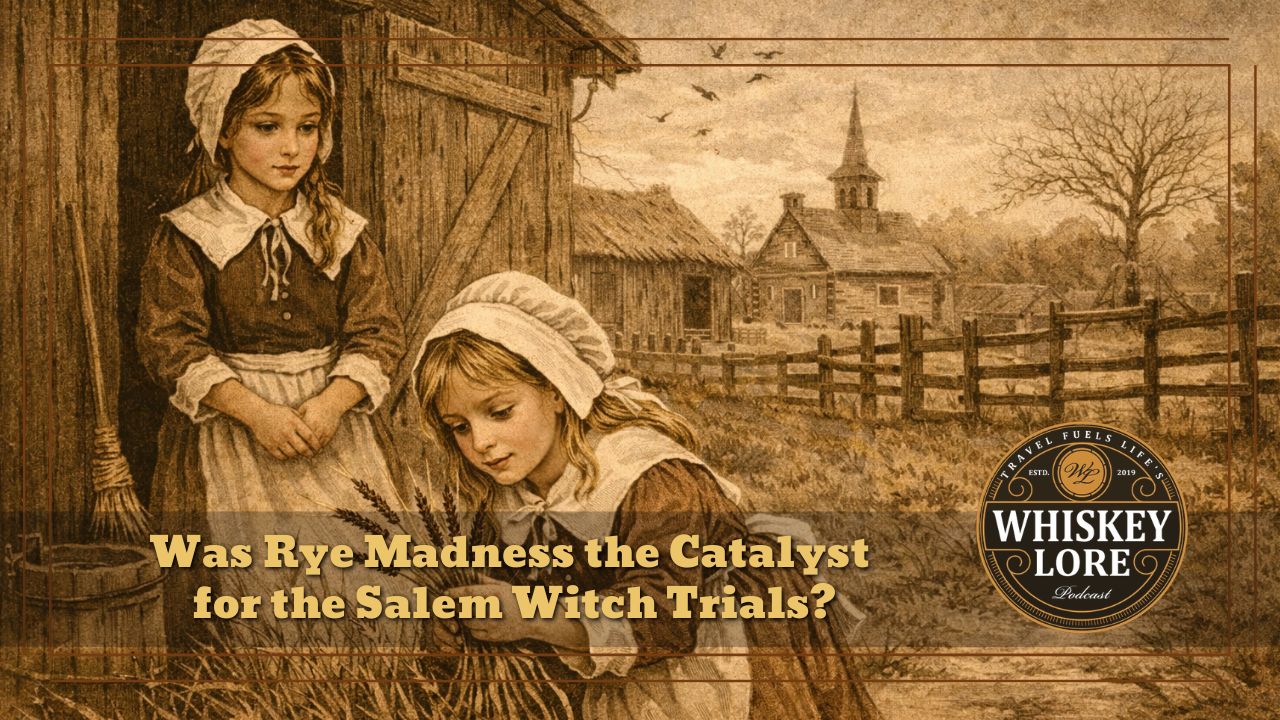
Well, let me just say, anyone who has been around children for any length of time knows, kids will put anything in their mouths. Picture Betty and Abigail, innocently playing in the barn, some wild rye contaminated with black grain spikes is growing outside the door. Abigail, not knowing any better, pulls up the grain, breaks off a piece and hands it to Betty. The two standing there, chewing on the grain and ignoring the black panicles.
When they come back in the house, Betty’s father, the Reverend, sees the two girls going into convulsions and his first thought is to demon possession, which was a “popular attitude” especially among the clergy at the time, rather than thinking they had come into contact with a poisonous fungus. After all, his grain would be protected, not out growing wild. Thus the tainted grain only affected the girls and they didn’t have the worst of the symptoms because they’d not consumed a large enough quantity. Most, if not all of the cases that followed, were simply copycats.
So, in your eyes, could ergot poisoning be conclusively removed from the realm of possibilities as a catalyst for the madness that followed in Salem?
The sad thing is, we’ll never know conclusively. There is no way to go back and ask the children what they did that day. There’s no record of what grew wild on the farm or how well the Parriss family took care of their grain. And court records can tell us a good deal of information, but not what was in people’s minds at the time—especially those lobbing accusations. Unfortunately, rye madness in 17th century Salem, is simply one of several potential explanations for one of the darkest chapters in American history.
Why Rye Madness
So, what about rye whiskey? Should you be looking with concern at the bottles of high rye Bourbons and rye whiskeys on your shelf. Well, other spirits could be included in that as well, since barley and wheat are also susceptible to the black fungus, although it isn’t as common. But, luckily, our modern agricultural monitoring is strict enough to weed out tainted grain. Unfortunately, our bovine friends are not so lucky. From time to time, animals succumb to the disease while grazing out in the fields. The last major outbreak among humans was in Pont-Saint-Esprit, France, in 1951.
If the ergot remains undetected through the milling process, it then goes into the cooking phase, where the ergot alkaloid may be altered, but isn’t necessarily fully removed.
The next phase is fermentation, which does nothing to remove the danger of the remaining alkaloid. However, distillation is another story. In this process, volatile, low-molecular compounds like ethanol, water, and small congeners make their way through the still in a vapor, but ergot alkaloids are relatively large, non-volatile molecules, so they tend to remain in the mash/stillage and do not vaporize readily during normal spirit distillation. Lab studies that purposely spiked mash with representative mycotoxins and then distilled it found none of those mycotoxins detectable in the distillate. But again, the unfortunate ones are our bovine friends as stillage is often sold off to farmers for use as a protein supplement in their cattle and pig feed. So, it’s still a best practice for producers in the food chain to remove these dangerous toxins from their sacks of grain.
So us lovers of rye whiskey can rest easy, knowing we won’t be seeing any spectral witches messing with us, next time we pour a glass 2 fingers deep with our favorite rye.
Although that might disappoint some. After all, how many people eat the worm inside a bottle of mezcal thinking they’re going to have hallucinations. Sorry to break it to you, but the worm isn’t even a worm, its typically moth larva, and it contains no psychoactive alkaloids. The reasons for your hallucinations, may be more down to tipping back too much mezcal, rather than the effects of the larva.
That said, maybe some inventive Salem based distillery will conjure up some rye whiskey, drop a fake eye into the bottle, tag it as eye of Newt, and sell it as rye madness. I mean, if you’re going to be kitsch, you might as well go all the way.
I’m Drew Hannush and this is Whiskey Lore
Whiskey Lore is a production of Travel Fuels Life LLC
Production, stories, and research by Drew Hannush
This week, I’m on the road at the Jim Beam Institute Conference and will be back next week with an all new interview as we dive into the concept of Estate distilleries, and I’ll also be recording some new whiskey flights, so look forward to those in the near future. And if you’re planning out your summer vacations, make sure to pick up a company of Whiskey Lore’s Travel Guide to Experiencing American Whiskey, you’ll find travel tips, and details of over 200 distilleries and a listing of over 1,000 across the use find it on Amazon by using the shortcut link whiskeylore.org/americanwhiskey
And once again, Thanks for growing your whisky knowledge along with me, I’m your host Drew Hannush and until next time, cheers and slainte mhath.
Find show notes, resources, and transcripts for this episode at WhiskeyLore.org/episodes
Resources
- L. R. Caporael, “Ergotism: The Satan Loosed in Salem?” Science 192, no. 4234 (April 2, 1976): 21–26, https://doi.org/10.1126/science.769159.
- N. P. Spanos and J. Gottlieb, “Ergotism and the Salem Village Witch Trials,” Science 194, no. 4272 (December 24, 1976): 1390–1394, https://doi.org/10.1126/science.795029.
- “Ergot: Six Things to Be Mindful of with Ergot in Small Grains and Grasses,” Crop Protection Network, accessed 15 March 2026, https://cropprotectionnetwork.org/publications/ergot-six-things-to-be-mindful-of-with-ergot-in-small-grains-and-grasses.
- “New Study Backs Thesis on Witches,” New York Times, August 29, 1982, https://www.nytimes.com/1982/08/29/us/new-study-backs-thesis-on-witches.html.
- N. P. Spanos and J. Gottlieb, “Ergotism and the Salem Village Witch Trials,” PDF reprint, University of Massachusetts, accessed 15 March 2026, https://people.umass.edu/dcooley/FYS_articles/Spanos%20&%20Gottlieb%20Salem%20rebuttal%20Science%2076.pdf.