
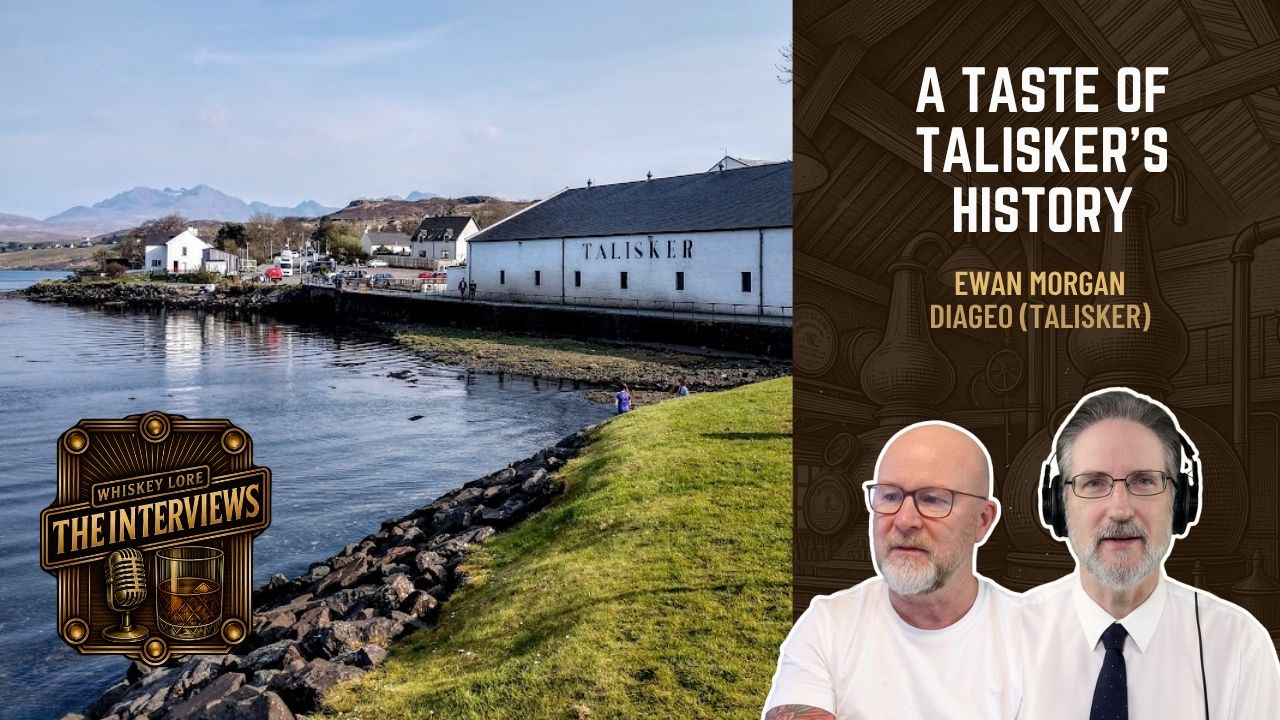
136 - TALISKER DISTILLERY: A Taste of History
Listen to the Episode
Show Notes
Talisker is a Scottish distillery filled with great contradictions: a remote distillery on the Isle of Skye making a whisky that somehow became known around the world long before most people could even reach the island itself. In this episode, I sit down with Diageo’s Head of Rare & Luxury Whisky, Ewan Morgan, for a deep dive into the history, mythology, and maturation of a whisky known for sea and smoke.
Along the way, we uncover some fascinating details about Talisker’s past, including revelations about its unique distillation setup, how the whisky was shipped from one of Scotland’s most isolated locations to places like Australia and South Africa in the 1800s, and why Talisker developed such a distinctive maritime personality.
But this conversation goes far beyond history.
Ewan also walks me through the art of tasting and collecting ultra-aged whisky, how to nose older spirits properly, why long-aged whiskies can either become masterpieces or disappointments, and what happens inside a cask over 30, 40, or even 50 years of maturation.
And then comes the tasting.
Together, we explore Talisker’s remarkable 30-year-old, 45-year-old, and 47-year-old releases, discussing how age, cask influence, oxidation, and finishing techniques shape these incredibly rare whiskies. Along the way, we also get into worm tubs, sulfur compounds, maritime maturation, and the delicate balance between oak influence and preserving distillery character.
Transcript
Drew H (00:00:14):
Welcome to Whiskey Lore the Interviews. I'm your host, Drew Hannush, the bestselling author of Whiskey Lore's Travel Guide to Experiencing American Whiskey, Experiencing Kentucky Bourbon and the book, The Bust 24 of Whiskey's Biggest Myths, Whiskey Lore Volume O. And a big shout out today to Kate at Hunter PR for reaching out to me about a potential interview with Talisker. It is a distillery I have long wanted to have on the show. I have toured it twice, love the whiskey. Port Ree is a big favorite of mine. The dependable 10 year is a staple with me, sea and smoke. And the subject of today's interview is the release of some beautiful long aged Talisker whiskeys, 30-year-old, a 45-year-old, and a 47-year-old with some fascinating backstories. And the person guiding us through the tasting of these spirits is Diageo's head of rare whiskey and luxury ambassador, Ewen Morgan.
(00:01:15):
And I mentioned to you and that I not only wanted to talk about the whiskeys, but I also wanted to talk about how you taste these long-aged whiskeys and wanted to also set the scene with some history behind the distillery as well as the Talisker name. And so I'm excited to dive into all of this with my guest, Ewan Morgan. Ewen, welcome to the show.
Ewan M (00:01:37):
Thank you very much for having me.
Drew H (00:01:39):
Well, you have quite a background. I was looking through your list of titles through the years. Let's see. National Director of Diageo's Master of Whiskey Program, certified whiskey master, keeper of the quake, maltman and lab technician, marketer, ambassador. 32 years in the business, you have seen a lot of things.
Ewan M (00:02:01):
I have. I've seen ups and downs.
Drew H (00:02:05):
Yeah.
Ewan M (00:02:06):
Innovation, new markets opening up, lots of exciting things, kind of revitalization of what scotch is and can be. And then obviously I get to deal with incredible liquids like the three that we're going to be tasting today.
Drew H (00:02:25):
Nice. Well, kind of give us a little backstory then, because you actually also have a family history in the distilling industry. How did you get started in all of this?
Ewan M (00:02:35):
Well, I grew up on a distillery in Spaceide and my father made whiskey and my grandfather made whiskey. All of my cousins and uncles all made whiskey. My grandmother was an excise woman who went around whiskey distilleries trying to ascertain if the legal amount of whiskey and taxes were being paid at each of those respective designs. That's actually how my grandmother and grandfather met. He worked at Cardu Distillery for many years and some of his, he was looking after the warehouses. He was a head warehouseman there at one point and some of his team were in one of the warehouses liberating whiskey and he was standing guard at the door of the warehouse and my grandmother Grace came along and his job was to stall her as long as possible. And in the process of stalling her, they ended up getting chatting and from there they fell in love.
Drew H (00:03:43):
Wow. And
Ewan M (00:03:45):
Then I'm here because of that. So yeah, I grew up on a distillery. At the age of 16, I started working at that distillery and I'm 52 now. So
Drew H (00:03:57):
I've
Ewan M (00:03:58):
Worked with different companies. So the precursor to Edrington Group, Highland Distillers, who we're actually going to talk a little bit about today because they were involved in Taliskar. So Roderick Kent actually his descendant sold the distillery to them.
Drew H (00:04:16):
And
Ewan M (00:04:16):
Then I worked for Santori Japanese company in Scotland. So I was looking after Bomour Distillery and Ocantasian at that point. And then now Diageo, I've been with Diageo for 15 years. It'll be 16 years in October.
Drew H (00:04:34):
Wow. And
Ewan M (00:04:34):
My son is the Johnny Walker ambassador for the Northeast of the United States. So he's fourth generation.
Drew H (00:04:40):
Wow. Okay. Nice. Yeah. So you've got ... Well, and it's funny because when I said, I'd love to talk about the history of Talisker, I thought yes, but if you're working for Diageo, you got a lot of distilleries that you have to keep up with.
Ewan M (00:04:55):
Yeah. Good job. I'm a nerd. I love history. So I read a lot. Old historical books, documents. We have an amazing archive team in Scotland who I deal with very frequently and they send me lots of stuff that they've uncovered, which is one of the things I found out earlier on today
Drew H (00:05:19):
That we can talk
Ewan M (00:05:19):
About.
Drew H (00:05:20):
I was going to say, you have a reveal of an interesting piece of history that maybe none of us have heard before, which I think that'll be- No,
Ewan M (00:05:28):
Maybe.
Drew H (00:05:29):
Maybe?
Ewan M (00:05:30):
No one.
Drew H (00:05:31):
No one has heard it before. No one. Okay. Now, how did you discover this particular bit of information? Did you ask someone and then they uncovered a piece of paper that gave it to you? I was
Ewan M (00:05:45):
Actually talking to someone at Talisco Distillery about what the technical processes would've been like in the late 1800s. And then they said they had found this document or they'd been sending this document from one of our wonderful archivists, Joanne McCarker. Hello, Joanne McCarker.
Drew H (00:06:07):
And
Ewan M (00:06:08):
Within that, there was a revelation for both me and he-
Drew H (00:06:15):
Okay. All right. There you go. We'll tease the audience and come back to that here in a moment, but a little bit more. First of all, are you a collector of whiskey?
Ewan M (00:06:29):
Yeah.
Drew H (00:06:29):
I've heard the rumor.
Ewan M (00:06:31):
I do collect whiskey. Yeah.
Drew H (00:06:33):
Yeah.
Ewan M (00:06:33):
I've collected whiskey for quite some time. So I have a few collections of whiskey here in the United States as well as in Scotland. I have a couple of bottles kicking around.
Drew H (00:06:49):
Did you set out to be a collector or did it all of a sudden you're like, "Look at all of this. I must be
Ewan M (00:06:58):
One." I think there's a fine line between collector and hoarder and I'm not sure what it is yet, but over here in the States, I have a significant amount of bottles, most of which are fairly old and collectable. And then I have quite a lot of open bottles that I like to enjoy and drink because whiskey was made to be drunk in the first place. So it would be a crime not to open some of these bottles.
Drew H (00:07:35):
Yeah. So when you buy a bottle to collect, if there's two available, do you buy a second one so that you can crack one open?
Ewan M (00:07:45):
It depends on how much they cost fruit.
Drew H (00:07:48):
You're not unlimited money over there, huh?
Ewan M (00:07:51):
I was home in Scotland recently seeing my dad, he still lives there and I bought a couple of bottles whilst I was back there, but they were quite spendy, so I didn't buy two. Plus one of them, there was only one, couldn't. I wish.
Drew H (00:08:10):
Yeah.
Ewan M (00:08:11):
Do you?
Drew H (00:08:12):
I have maybe three bottles of whiskey that I would consider collectors. They're not even collectors whiskeys. They're just really rare whiskeys. So I have three whiskeys that were made before Prohibition.
Ewan M (00:08:25):
Oh, wow.
Drew H (00:08:26):
Yeah. That I will open them if someone is really interested in whiskey and they're over at the house and has an appreciation for it. I'm one of those, I don't understand how somebody can buy a bottle of whiskey and not open it.
Ewan M (00:08:44):
Yeah. That bottle there is from 1916.
Drew H (00:08:49):
Is it? Okay. And what is it? No, I can't see it because I got-
Ewan M (00:08:51):
It's black and white. Is it
Drew H (00:08:53):
Black and white?
Ewan M (00:08:55):
Interesting. By James Buchanan.
Drew H (00:08:57):
Yeah. This is the interesting thing too. If you're collecting scotch whiskeys, you're mostly going to be collecting blends because there weren't a lot of single malts in the early 1900s. Actually,
Ewan M (00:09:12):
There were. Were
Drew H (00:09:13):
There? We
Ewan M (00:09:14):
Talk about that. Yeah.
Drew H (00:09:15):
Okay.
Ewan M (00:09:16):
Talisker being one of them. Dallaska was being exported to the Americas as well as colonies, New Zealand, Australia, South Africa. They were pretty big markets. So you could actually buy single malts back then. There's kind of this kind of popular myth that it was only blends that are available then, but no single malts definitely were available. So you could have been in Christchurch, New Zealand in the 1890s drinking Tahlesco.
Drew H (00:09:44):
Oh, wow. Okay. I mean, because I've heard Dalmore talk about that it was still selling, but they talk about it like it was an extremely rare thing. When I did my research into Glendronic, I had the same situation. Well, it wasn't that it was rare. It was that basically they got bought out by a blender. So then it just became a- Blending
Ewan M (00:10:07):
Stock.
Drew H (00:10:08):
Yeah. And so you hear of a couple of instances of that. You hear people say that there was only blended whiskey up until the 1960s, single malt started to make a comeback. And when you see a couple examples, it kind of staples it into your brain that, oh, that must be right, but every distillery is going to probably have a different story to tell once you dig into it.
Ewan M (00:10:34):
Yeah, but history's history. So don't
Drew H (00:10:38):
Let
Ewan M (00:10:38):
Marketing get in the way of a good story, I suppose.
Drew H (00:10:41):
Yeah. Yeah.
Ewan M (00:10:43):
But there were, I mean, we have records going back a long, long time and I would say around early 1800s drew certainly into the turn of the century. We were seeing a decent amount of single malts. So Mortlick
Drew H (00:11:01):
From
Ewan M (00:11:01):
Spaceside, which is actually connected to Talisker because they were designed by the same person, Charles Doig, who also designed W in distillery, as well as many others. So Mortlick was being exported into the United States, into Australia as was Johnny Walker at that point as well. So there was blended whiskey obviously being exported, but Mortlick was a huge production site back at that point and the significant amount of that single malt was actually sent to New York and it was being sold in Macy's in New York
Drew H (00:11:37):
As their
Ewan M (00:11:38):
House whiskey pre and post prohibition. So Cowey's Blue Seal being one of those whiskeys made it Mortlick, but we're not talking about Mortlick, but they are connected. And when we talk about my news, there's a wonderful correlation between the two distilleries as well.
Drew H (00:11:57):
Yeah. Those distillery records would be so interesting. We talk about when I do my research, I only really go through what was being advertised in newspapers. And so I don't get to see kind of that behind the scenes thought process or how things were being made and sometimes things are being called pure malt, single malt. We get a lot of different marketing terms even back then as to what was what.
Ewan M (00:12:26):
Well, Talasker was a victim of its own success. It got impersonated and there was a Talisker blended malt released, which had nothing to do with the distillery. It was actually legal action taken against the scamps who did that. But yeah, interestingly, we're talking about history and documentation. The only records we really have about more up until the 1920s, mid 1920s when the Walker family purchased it. We don't have anything prior to that. Everything we have is from external sources. Do you know why Drew?
Drew H (00:13:05):
Did the distillery burn?
Ewan M (00:13:07):
No, the distillery didn't burn.
Drew H (00:13:08):
Okay. The
Ewan M (00:13:09):
Guy who stole the distillery to the Walker family destroyed all of the records.
Drew H (00:13:13):
Wow. Yeah.
Ewan M (00:13:15):
His name was Dr. Alexander Cowie and we have no idea why he did it.
Drew H (00:13:22):
He didn't want to give away the secret formula maybe. I mean, it's single model.
Ewan M (00:13:26):
Well, Morelick is a very unique distillation. I know we're not talking about more. There's a very unique distillation process, 2.81 distillation,
Drew H (00:13:32):
So
Ewan M (00:13:33):
Partial double, triple, quadruple. And I guess he didn't want people to know where he got the idea from, but he also burned all of his sales records, everything. So when prohibition ended, we had to go back to Macy's and say, "Hey, really sorry about this, but what were we charging? What are we charging you guys pre-prohibition because we don't have any sales records of it because they all got destroyed." Wow. Anyway, I digress.
Drew H (00:13:58):
It's crazy. It's crazy. Well, let's touch up on some of the things about your collection. What is your most prized whiskey that you have in your collection?
Ewan M (00:14:11):
I don't know. I have a lot. I'm actually surrounded by whiskey. When I turned 50, Dr. Emma Walker, who's our master blender, created a blend for me. It's a one of one, probably that I would say.
Drew H (00:14:33):
Yeah. What is kind of the makeup of that whiskey?
Ewan M (00:14:37):
Well, I love Klein Leash. So she put Klein Leash in there and there's also Deluine because my dad was born at Deluine Distillery and then a few other space out whiskeys in there as well. Ben Renes is in there. So yeah, I've never even tasted it.
Drew H (00:14:55):
Wow.
Ewan M (00:14:57):
Yeah. I should really ask her. I talked to her quite a lot. I was like, "Could you make me a small sample of that? Because I quite like to taste it because I'm probably never going to open it.
Drew H (00:15:07):
"
Ewan M (00:15:07):
So yeah, that's probably my prized one, but I have, I don't know, a ton of whiskey,
Drew H (00:15:14):
Too
Ewan M (00:15:14):
Much.
Drew H (00:15:15):
When somebody makes up a special batch like that, I would assume that they probably hold some back for further, but if this is a one-off, would they do
Ewan M (00:15:27):
That? Yes. Let's say one bottle in the world. Yeah.
Drew H (00:15:31):
Interesting. We talked about single malts and age. What is the oldest single malt that you think you have in your collection?
Ewan M (00:15:42):
As in when it was distilled or how old?
Drew H (00:15:46):
Yeah, I guess on this side of the Atlantic, when we get into talking about bourbon that nobody wants a 50-year-old aged bourbon in Kentucky because it's just going to taste like the container it was in if there's any left in the barrel after it's all over. So I get into that mindset a little bit. It would be interesting to know if you are a collector of early 20th century whiskeys.
Ewan M (00:16:11):
Oh my goodness. I've tasted so many different whiskeys from different eras, including a bow more from the 1850s. I don't know. I have so much old, old whiskey. Most of the ones I have up here are actually blends, but in terms of single malts, I've got ones from the 30s. In terms of age, probably the oldest single malt I have here is about 70 years old. So you can age Scotch way, way, to your point, way, way longer than you can bourbon, because it's a cool climate, a maritime climate in Scotland. We don't have too much temperature fluctuation and our warehouses are temperature controlled or there's thick stone walls. So we have two types. We have old dunnage warehouses, which are the ones you see at distilleries. They're like the old traditional way of storing whiskeys where the barrels are on their sides. And then we have palletized ones.
(00:17:19):
So our largest warehouse facility just outside Sterling and Scotland and it's called Black Grange. And we have about eight million barrels on that one site. And they're all on their ends, whereas the bungs are in the top because you get more stacked on a pallet that way.
(00:17:42):
So yeah, we have a huge amount of barrels maturing in Scotland, but yeah, we don't have a huge amount of angel share, about 3% angel share-ish per year and we lose alcohol. So 0.08 ABV every year because we're losing ethanol out of the casks. So we're losing volume and alcohol every year. Whereas in the US, if you go over a hundred, then you've got steam coming off of the water that's in there and it's steam that escapes. So you're actually increasing the alcohol because you're reducing water content in the cask. So you can have proof will go up in some cases, whereas in Scotland, proof or ABV always goes down.
Drew H (00:18:31):
And this is where the danger comes in in a barrel. You not only have to worry about the barrel maybe evaporating over that long period of time, but also dropping below proof.
Ewan M (00:18:44):
Yeah, that's a very real risk and we're very good at it as our competitors. We've been doing this for a long, long time. So you will know roughly what the ABV will be, what the volume will be. And once they reach a certain threshold, then you keep a watchful eye on them and you have to make sure that that ABV doesn't go below 40 because then it's legally no longer Scotch whiskey anymore. So we have to be very mindful of that. We also have to be very mindful of the fact that it's in a vessel that's actually lending flavor and character to it and you don't want that to dominate the distillery character. So if it's in there for 30, 40, 50 years, depending how active the barrel is, we have to be extremely judicious and careful about not letting the cask go past that apex point of where the distillery character is
(00:19:47):
Because then it just doesn't taste like ... It wouldn't taste like Taska or it wouldn't taste like lagable. And I'm not saying that we've never done that before because it has happened. Legavold and 37 is probably a good example of it. Whereas they found that barrel and they didn't expect the cast to have been quite as active as it was. It was still an incredible whiskey, but it just didn't taste like lagable and much anymore. So you have to be careful of that. People love the distilleries and they love the DNA of the distilleries. So as stewards and guardians of these liquids, we have to be very careful about making sure that people can still taste the distilleries that they love.
Drew H (00:20:31):
Well, I've always been curious about if the ABV drops below, can you still use it in a blend? No. You can't. So it is no longer considered whiskey once it drops below and so you are not able to use it for anything.
Ewan M (00:20:48):
No.
Drew H (00:20:49):
Okay.
Ewan M (00:20:50):
No. Legally, no.
Drew H (00:20:53):
I'm
Ewan M (00:20:54):
Not saying it's never happened in the history of Scotch whiskey, but certainly Diageo would never do anything like that. And plus we would never let anything get to that ABV either
(00:21:06):
Because we would flag its age and we would go in and we would check what its ABV was and also check what the volume was as well. And if it gets to a point where we feel like we're going to lose it or it's going to go below 40, then we'll put it into glass and then from there we can then decide which project it goes into. Because once it goes into glass, you're also hermetically sealing it in there. There's no cask effect, there's no evaporation. So we kind of sit in kind of stasis. So that's what they'll do for these. But that's very rare that we would have to do something like that. The other thing that we can do to control maturation is to re-rack the whiskey and to re-rack just for the folks out there who don't know what it is, it's where you're taking the liquid from one barrel and putting it into another barrel and then that goes back into the warehouse.
(00:22:05):
And the barrel, if it was a very old whiskey and we felt like the casket was in was dominating it and if we went any further, we would lose the distillery character. So then we would go into a very inactive cask. So a third, maybe fourth fill cask that's going to give very, very little cask influence, but it will sit there and it will continue to mature. Because even if you're not getting cask effect, what you're getting is a creation of different things like aldehydes or esters and esther development. So inside each cask, it's like a big organic chemistry project and the oak is obviously an intrinsic part of it, but you only want the oak to play a certain part. Like I say, you don't want it to dominate
Drew H (00:22:51):
The
Ewan M (00:22:51):
Pallet. So we have to be very careful about that.
Drew H (00:22:55):
Now going back to the collecting idea and you've opened some bottles for people who are collecting whiskeys, what's your advice to make sure that it doesn't oxidize in the bottle and to preserve it? Because I mean, if you're going to spend $1,000, $5,000 on a bottle of whiskey, you're probably going to want to hold onto it for 10 years, 15 years maybe.
Ewan M (00:23:24):
There's a few things you can do. One, you can increase the volume inside the bottle itself and some people will use sterile glass balls or marbles and they'll put those in there and that will raise the liquid level up. So you've got less head space and less oxidation risk. You'll have people with decant it into smaller bottles for storage and then they'll then either seal those up or use parafilm. And if folks out there don't know what parafilm is, it's like a fancy tape that's kind of waxed and that will go around and that will create an airtight seal. Or then from the wine industry, you can take things like argon gas and then use a needle that will go in there and then it'll inject argon into that head space and the argon will stop oxidation as well. So there's different things that you can do.
(00:24:27):
The last thing you want is to have a very, very expensive bottle and then you oxidize it and I've done it. I was very kindly given a bottle of old art bag years ago and I opened it and drank shared most of the bottle and left a little bit to go back to. I forgot about it. And then when I went back to it, it went from being a spectacular life affirming liquid to being undrinkable and it smelled like carpet.
Drew H (00:25:00):
Wow.
Ewan M (00:25:01):
Not good carpet either.
Drew H (00:25:04):
That's so good. So what is your preferred method?
Ewan M (00:25:09):
I decant.
Drew H (00:25:10):
Do you?
Ewan M (00:25:10):
So I'll keep the original bottle and then I'll decant into smaller vessels as I go along to the point that sometimes you'll end up with something that small or this, which
Drew H (00:25:26):
Is,
Ewan M (00:25:26):
I'm not going to tell you what it is, but it's very, very old and I'm surrounded by them. They're all over the place. Anyway, that's what I do.
Drew H (00:25:34):
Okay. I'm sort of curious about this 1850 Bemore that you had and I have seen in the US that there was a bottle of whiskey that had been ... JP Morgan owned it and they said that it was actually the oldest whiskey in existence in the US and that it came from the 1700s. Now my thing with that is they didn't keep it in a barrel from the 1700s to 1860 when it was bottled. They had to do something else to protect it but not have it end up tasting like an oak bomb or disappear completely. What was kind of the story behind that 1850 bottle? And do you know how they cared for that to make it-
Ewan M (00:26:28):
It was discovered in an attic in Canada by descendants of the Mutter family who used to own Bomour Distillery Actually it went to auction and at that point I think it was one of the highest prices that a bottle went for, but we syringed some out just to make sure that it was actually, but more so
Drew H (00:26:51):
To
Ewan M (00:26:51):
Try a teardrop of it. I actually never told anyone this before. I nearly dropped the bottle.
Drew H (00:26:59):
No.
Ewan M (00:26:59):
I didn't nearly drop the bottle. Wind nearly dropped it. I was taking a picture of it and I had a whiteboard behind it. Someone came into the room and closed the door and the wind blew the whiteboard forward and I did a slow motion dy. Thankfully grabbed it otherwise it would have been a career defining moment, but yeah, that's probably the oldest one.
Drew H (00:27:27):
Any recollection of what that was like from a taste or nosing experience?
Ewan M (00:27:34):
It was fairly neutral. Smoke had gone. There was a little kind of element of spicy oak to it. I will say it wasn't particularly great
(00:27:45):
That's the thing though, your hit or miss when you buy these. I buy a lot of old bottles and sometimes I'll open them and sometimes they're undrinkable. Other times they're unicorns and they're just other worldly, they're just incredible. So it's a real crapshoot when you're buying these vintage bottles and some, here's a little tip for folks out there, if you are buying vintage bottles, especially ones with spring caps, so like old white horse for example, or Hague bottles. If you see like blue streaking down the inside of it, some of them used an adhesive called melmine and melanine actually came in contact with, when it came in contact with alcohol vapor over time would create these blue streaks and they're toxic. So A, don't drink
Drew H (00:28:42):
Them
Ewan M (00:28:43):
And B, if you see them, don't open your bottle because the bottle will still be worth money. It's just not a potable spirit.
Drew H (00:28:51):
It's a decoration rather than a ... Yeah. Yeah.
(00:28:55):
I guess that is the real challenge too. When I go into a shop and I see a bottle of whiskey that's going for $1,500, that's probably as much as I probably have in my budget to ever buy a bottle of whiskey, you don't know what it's going to taste like. And so if me being somebody who wants to open every bottle of whiskey that I ever have in my house, how do you go about deciding what you're going to buy and lower your risk of ending up with a bottle where you go, "Ugh, what is this? "
Ewan M (00:29:31):
How do you lower your risk?
Drew H (00:29:32):
Yeah.
Ewan M (00:29:33):
You can't.
Drew H (00:29:34):
You can't.
Ewan M (00:29:35):
No, it's potluck.
Drew H (00:29:38):
Yeah.
Ewan M (00:29:39):
I would love to tell you that there's a keen strategy to this that I've learned along the way, but I've bought some stenkers over the years and you don't know until you open them. It's one of those things. So kind of like a bit of a lucky dip to be honest or an unlucky It depending.
Drew H (00:30:01):
Yeah. Not long ago I had Stuart Walker from Fetter Karen on and before I met him I had tasted a 75 year old whiskey and that was a Irish whiskey that was at Great Northern Distillery. Apparently they had found it at Kilbegon they had found this old cask sitting in a corner somewhere. I love these stories. The cask was just sitting in the corner. Well, somebody's keeping inventory I would think, but anyway, they discovered this thing and he said that the wood was basically petrified so it was not really aging the whiskey in there. And when I tasted it was kind of that same thing that you talked about with the Bemore that it didn't necessarily have a lot of personality. It wasn't necessarily great, but it was kind of that history and being able to kind of experience something that had gone through that long time period of aging.
(00:31:03):
I mean
Ewan M (00:31:04):
They're cool to taste, but I've tasted much better whiskeys that have been far younger and far more affordable for sure.
Drew H (00:31:15):
But what was interesting about our discussion is prior to that I had tasted some whiskeys up to 29 years old but not older than that. And then I tasted one of his and basically it was a 45 year old whiskey and I was like, "This is the first time I've tasted a whiskey this old that actually has a lot of flavor and character to it. " And he said, "Well, we put it into a finishing cask." So it actually went into a newer barrel before it finished up. And so with you having that experience of having tasted a lot of long aged whiskeys, is there something to the addition of finishing waking a whiskey up and putting it into a newer cast that somebody might look for when they're buying these whiskeys?
Ewan M (00:32:06):
Yeah, 100%. You can breathe some life back into a whiskey with a finish, but you also have to be very mindful of the fact that it's a very delicate balance. So for example, if you have an old whiskey, 50 years plus, that's going to be quite delicate or it can be quite delicate. If you were to put that into a very active Pedro Himenez cask for an extended period of time, then that PX cask's going to completely swamp that liquid and all of those subtle notes and that kind of really delicate note that you may be able to pinpoint if you had a clean palate with no finish. If PX is sitting on top of it, then it's going to be very difficult to pinpoint what those are. So there be dragons. So it is a real balance. So it can completely enhance it and round it out and make it a complete experience and breathe some new life into it, but it can also completely dominate it.
(00:33:20):
And the older the liquid, the shorter the finish you will typically have to do as well. And again, you just have to be mindful. Should it go into a refill or also if you're going to do a longer finish, should you put it into a PX for a period of just a few months just to kind of give it what we call a tickle?
Drew H (00:33:41):
Yeah.
Ewan M (00:33:43):
It's really down to the people who manage the casks, the blending teams who understand the liquids, they understand what the casks will do to those different liquids because there's different interplay, but from distillery to distillery. Some distilleries lend themselves more to bourbon casks, others to more sherry casks. Others can kind of be bipartisan and will work well with both. So yeah, you really have to know your whiskey, you really have to know what your cast is going to do to it and then go back and taste it and sample it and make sure you're doing that on a regular basis. Because again, going back to what we were talking about earlier on, if you go past that apex point and the wood is won, then you've lost.
Drew H (00:34:30):
Yeah. I mean, it would seem like doing-
Ewan M (00:34:32):
Quote for the day.
Drew H (00:34:33):
There you go. It would seem like doing a virgin oak cask would be very, probably a little too aggressive maybe or I'm trying to think-
Ewan M (00:34:41):
Well, we're about to taste one.
Drew H (00:34:43):
Okay. Okay. All right. Very good.
Ewan M (00:34:45):
47
Drew H (00:34:46):
Finished
Ewan M (00:34:47):
For four months in Virgin American Oak.
Drew H (00:34:49):
Awesome. Okay. All right. So another teaser. Well, let's get into the history and I'm going to ask you this question before we dive into the history part because I heard this while I was in Scotland and I really wonder whether this is true and you're pouring out all of these long-aged whiskeys for people when they're coming in to do tastings. And so you would be the man to ask this question of the rule I heard was put it in the glass and let it rest one minute for every year it was in the cask. Have you heard that? Is that something that has any ... Is it valid at all?
Ewan M (00:35:25):
I have heard that and I don't want to say it's incorrect, but I will say this, every whiskey is different. Some need a little bit longer. Others are RTD ready to drink as soon as you pour them in there. So I would say take them all on an individual basis. Again, if you're keeping a little bit in your glass as you go along, you will see the difference. And I always say when I do taste things, A, I pre-pour everything prior. So there's a little bit of time for it to develop. If people wanted to taste it fresh out the bottle, then they have an opportunity to as well. But then I always say leave a little in your glass because we want to go back and review and see just how they've changed over the course of time we've done the tasting. So they will change significantly.
(00:36:22):
Some for the better and then others, very delicate old whiskeys, they can over oxidize quite quickly.
Drew H (00:36:32):
And
Ewan M (00:36:33):
So you have to be quite careful and go back and constantly taste it. But the kind of old analogy about seconds per year, minutes per year, it seems too convenient to me because each whiskey, it's an organic thing. So everyone is different is my diplomatic way
Drew H (00:36:56):
Of answering that. Okay. And part of the reason why I like challenging these things is because usually the first thing that happens when you get that whiskey and you bring it up to your nose, you start swirling it around. So it's like, have you just messed up everything that you were just trying to accomplish by having it sit in that glass still for 47 minutes before you drink it?
Ewan M (00:37:17):
You also don't have to swirl whiskey. To be honest, I just rotate the glass slowly and then when we actually get into the whiskeys, I'll show you how I knows and how I taste.
Drew H (00:37:29):
I
Ewan M (00:37:29):
Was trying to do it a long, long time ago by a wonderful gentleman called Keith Law, organic chemist and I've been doing it ever since.
Drew H (00:37:39):
Nice. So that's
Ewan M (00:37:39):
How we'll do it.
Drew H (00:37:41):
Okay, very good. And the other question would be about the legs in the glass. I have always heard that that is attached more to the alcohol content, but do you notice something with age that causes it, thicker legs?
Ewan M (00:37:57):
Yeah, the more viscous, the liquid. So that's pretty much all it is. It's just viscosity and not to get super nerdy about it, but once you've got that higher concentration of congeners and molecules and less water, it's going to cling to the inside of the glass more and go down slower as well
Drew H (00:38:21):
Where
Ewan M (00:38:21):
If it was younger liquid or cast strength, 50 ABV plus is probably going to run down a little bit quicker. So again, there's that kind of myth out there. It's just like the slower the legs or the tears inside the glas, the older the whiskey clap trap. I just wanted to say clap trap
Drew H (00:38:46):
And
Ewan M (00:38:47):
It's just all about viscosity. So you could have a young liquid in there that's being 100% PX or also and it's going to be more syrupy and slow as it goes down the inside of the glass. Again, everyone's different. Every single whiskey that you're going to taste all has its own idiosyncrasies, its own unique character and that can be from the nose to the palate through to what the legs are as well. So they're all different.
Drew H (00:39:17):
Okay. That's good. Like I say, I learn a little bit from everybody I talk to and the fact that you're around long-age whiskeys a lot more than most people I'm talking to. You're the man to ask. Yeah. Let's talk about Talisker and first of all, a little bit about the distillery just to kind of introduce people to it because like I say, I've been there twice and actually in the two times that I've been there, it has changed actually because I was there in 2019 and I went into the old visitor center, which was very dark and it had a lot of old world Scotland feel to it. And now they have this dynamic new visitor center. It's on the Isle of Sky in this little town of Karbost. When was the first time you actually got a chance to go there?
Ewan M (00:40:06):
I've been going to Sky for a long time. I would say I first went there when I was 25, 52 now.
Drew H (00:40:21):
Do a tour?
Ewan M (00:40:23):
Yeah, I've done tours, the tours of that distillery. I toured around the island. I've been to weddings on the island. I have some very good friends who live there. So I'm very lucky that I've had an opportunity to visit that distillery on many occasion. And you know what? Every time I go there, I find out something new about it, which is one of the great things about that distillery. It's quite an intriguing distillery. And like I said, I found something out about it today that I had no idea.
Drew H (00:40:54):
Well, the first time I went, I had an amazing trip through Scotland that I don't think ever happens to anybody. It was not cloudy one day during my two weeks in Scotland, except for the morning when I was on the lock at Carbost and it was just this kind of gloomy fog that came in and I said, "I'm finally in Scotland." It's like I've been all over this island, but all of a sudden that was it.
Ewan M (00:41:26):
That gloomy fog you refer to is what we call summer Scotland. It's actually got a name, it's called Har, H-A-A-R. And that's that fog that comes in off to see that has a really wonderful maritime note to it
Drew H (00:41:45):
As
Ewan M (00:41:45):
Well. So you can smell the kind of seaweed and the ozone and the salt. So that's what it's called. There's your word of the day.
Drew H (00:41:52):
Nice. Lock Harport, was it named after that fog?
Ewan M (00:41:59):
No.
Drew H (00:42:00):
Okay.
Ewan M (00:42:00):
That would be too convenient.
Drew H (00:42:02):
Too convenient. Yeah.
Ewan M (00:42:03):
Yeah. No, I actually don't know how we got the name Loc Harport. Talisker means sloping rock, which is an old Norse word. So that's where they came from. Obviously the Vikings loved visiting Scotland for various reasons, plundering it, being one of them setting up encampments and communities. If you go to the far north of Scotland, like Shetland Ortney, there's a lot of people up there who still have Scandinavian second names as well. So yeah, it's pretty interesting. But yeah, it's an old northward, Taliskar.
Drew H (00:42:39):
Okay. And it sort of has that in common with Isla and all of those distilleries down there that kind of have that Norse influences as well. Talk a little bit about what it would've been like in the 1830s in Carbox, because right now it's a very small little village and there's a couple of places. I stayed in Airbnbs when I was there, but there is one as far as I know, hotel and that's also the place to go eat and it's also the ... Yeah.
Ewan M (00:43:11):
Well, I'll tell you what it would've been like. It would've been extremely rural. There would've been one drover road in from the main road, which is some miles away, as you know, because you've been there. There was only a couple of houses on that site as well prior to them building the distillery in 1830. Hugh and Kenneth McCaskill who set up the distillery were actually cheap farmers
(00:43:43):
Who then diversified and took their funds to create this distillery. So yeah, there was nothing there really. A couple of houses, there is an old historical reference to what houses there were there. I think there was like five total in that area of Carbos. There was a church, obviously very religious communities, especially on the West Coast even to this day. And then obviously they built the distillery there, much to the triggering of the local reverend who was extremely opposed to the idea of bringing the devil to Carbos because he thought that it would undermine the community and bring all sorts of trouble, which it did not. But yeah, he was very, very vocal about it. And he was part of a religious community called the We Free Kirk, which is a kind of very staunch religious faction, I suppose you could say. I went to a parish vote and McCaskills won that vote narrowly from what I'm told and they were allowed to build the distillery there.
Drew H (00:45:07):
I'm just thinking you're probably not transporting that whiskey out of there to ... Well, I wonder if it even went off the island. I mean, would they basically have been producing for, or would they have ... There wasn't a port there so they would've had to take it out on small boats at least to take it to a bigger boat to be able to get it shipped off somewhere. It seems like-
Ewan M (00:45:28):
Yeah, transported by boat initially until I would say 1900s and then there was a better infrastructure on the island. But yeah, taken away by boats, that would've probably have then taken down to Glasgow. Glasgow up the river clyde and a huge whiskey port there. Many whiskeys were then exported out of not only Glasgow, but Greenick, which is further along the coastline, including Johnny Walker, which was then exported all around the world. And then subsequently when Talisco started to get very popular and we'll talk about that in a minute, it was then exported out from Glasgow as well as taken to Edinburgh by train and then from the ports of Leth, it would then get exported by ship around the world from there. But no, Drovers Roads, you could have a horse with a couple of small barrels on it, but to get any liquid of scale, then you take it by boat.
Drew H (00:46:40):
And eventually you're going to have to take it by boat anyway because it's an island and even if you get over to the Scotland side to cross over, you still-
Ewan M (00:46:50):
Ferry.
Drew H (00:46:51):
Yeah. Yeah.
Ewan M (00:46:52):
Yeah. Now there is a bridge. There's been a bridge for a number of years, but yeah.
Drew H (00:46:56):
I have to tell you, last time I went though, I had to take the ferry across and I took it first thing in the morning so the sun was just starting to come up and it was just amazing. It was a beautiful time to go out and take that ferry across.
Ewan M (00:47:11):
You keep talking about the sun in Scotland.
Drew H (00:47:14):
I know.
Ewan M (00:47:16):
I'm not sure you were ever really there, Drew.
Drew H (00:47:19):
Yeah. I'm
Ewan M (00:47:19):
Kidding.
Drew H (00:47:20):
Maybe I wasn't in Scotland.
Ewan M (00:47:22):
Once a year's day, singular.
Drew H (00:47:26):
I just got really lucky. Although that trip, I was doing a lot of fairy trips and the weather was mostly bad on that one. It waited until I wasn't just driving around. I was relying on ferries to become stormy all of a sudden. So yeah, go figure. But what's interesting is as I started kind of looking in a little bit on the history myself, I guess initially it wasn't overly successful because it seems like there was a lot of shifting and bankruptcies and stuff through the 19th century
Ewan M (00:48:02):
Yeah, that wasn't uncommon in distillation in Scotland and in Ireland for that matter where there was quite a lot of changing of hands of distilleries and that could be for various reasons. It could be people weren't particularly good marketeers or the distillery itself hadn't quite reached that kind of cult status where it was something that was seen as in demand by not only consumers, but also the blending houses who would buy single malts. But once they would find an owner who understood whiskey, understood what the consumers wanted, then that's when we started to see a lot of these legacy distilleries kicking in where you'd see multi-generational families running those distilleries, like the Cummings family at Cardu, for example, being a good example, which was two generations of ladies who actually ran that distillery so successfully that they sold it to the Walker family in 1893.
(00:49:08):
But yeah, there was a lot of transferal of distillery deeds and titles and yeah, Tasker wasn't immune to that by any means. But what they were really good at, once they kind of found their feet, I would say like the 1800s, so like 1890s onwards, then that's where they really started to establish themselves and they brought on people onto the board who were seasoned salespeople and seasoned marketeers and they were given their own markets. There's a guy called Charles Shires who looked after Australia very successfully as well as there was a guy called a strange name, his name was Mr. O'Nolin Martin and he looked after Africa again, South Africa at that point, but also Egypt and as well as the Cape Colony down in the South. And we were selling a large amount of whiskey into both of those markets, both Africa as well as into Australia and subsequently New Zealand as well.
(00:50:17):
So the weird irony is like by the turn of the century, so like 1900, Taliska is still being made in this extremely remote location, but it's being sold around the world far further than anyone who ever worked at the distillery would ever travel,
(00:50:35):
Which is pretty cool, I think.
Drew H (00:50:36):
Interesting to note too, and I don't know if this is going to spoil your secret because I want to hear your secret here in a minute, but I found that when I read the Alfred Barnard writeup on Talisker and he would've traveled there around 1886 that they had three pot stills. So they were triple distilling.
Ewan M (00:51:00):
They were. So this kind of leads me into my little revelation. They did have triple distillation from the outset, which was quite unique in Scotch whiskey, but what Taliska wanted to be, it didn't want to be pigeonholed. So they didn't want to see it as like a highland whiskey or an island whiskey. So they had this kind of merging of Irish style whiskeys, albeit in a pot still made from malted barley. So you've got this really nice juxtaposition of that triple distillation, but you've also got Pete smoke in there as well, which makes it even less common. So they were doing a triple distillation from the outset, but then what happened shortly after Barnard was there, and for the folks out there who've never read the Alfred Bernard book, he was like the whiskey yelper of the 1800s. He visited every active distillery in Scotland and it's one of the best kind of documents that we have of what distillation was like back in that era.
(00:52:11):
It can be a little bit dry as well. So he talks about how terrible roads are, how bad the food is, like a good Yelper, but he also talks about the technical details of the distilleries and for things like more like where we had no records,
(00:52:30):
There's also the James Edie book from the 1920s as well, which is kind of like the forbearer of the Barnard book. And from that we actually were able to piece together a little bit more information. So our archive team used the Barnard and James Edie books all the time as reference points. So they were very good at documenting these facts. All right. Do you want me to tell you what I found out?
Drew H (00:52:57):
Yes, drum roll.
Ewan M (00:53:01):
Bernard, obviously he was there, I think he was there in 1896 maybe. No, he wasn't. He was there in 1879. That's when he visited Talisker.
(00:53:13):
In 1896, I saw a plan earlier on today by Charles Doyg and for the folks who don't know who Charles Doyg is, very famous architect from Elgin and Spaceide near where I grew up who designed many distilleries, including WN, including Talisker. And in that plan, actually Talisker has six stills. So they moved the still house from down by the water to where it pretty much is today, which is the back of a quadrangle behind the visitor center. So a little further away from the shoreline. And there are six stills in there. So they were still doing triple distillation, but they had doubled the volume. When they stopped doing triple distillation 1928, they continued with the six stills and then there was a fire in 1960s post fire they decided to go from six stills down to five. So that's what we see today. And the first time I went around Taoski Distillery, they were like, "Oh, it's always been five stills.
(00:54:28):
We don't really know why." Anyway, there were six. There you go. So there was the two wash stills that they had went into their own unique worm tubs. Then there was the low wines and faint stills or intermediate stills and they had their own worm tubs and then the two spirit stills shared a worm tub as well. So that's what the configuration looked like. So there you
Drew H (00:54:54):
Go. Were they smaller? Do we know if they were smaller? Because I'm trying to figure out the modern configuration. Yo have two larger wash stills and three smallers. Yeah. You look
Ewan M (00:55:02):
Good down in size. Well, not always typically there's some stills where it goes the other way, lagabolin, for example, where the spirit stills are larger than the wash stills by a thousand liters because they do a very long spirit run there. And so they're looking for more of that kind of head space for reflux. They're like anomalies though. For the most part, you go down in size because every time you distill, you're losing volume
Drew H (00:55:33):
Because
Ewan M (00:55:33):
You're compressing and condensing and distilling, I guess. So you would've had your larger wash stills, your smaller intermediate stills or low wines and faint stills and then your much smaller spirit stills. So they're worth six.
(00:55:52):
And then like I say, they stopped doing triple distillation in 1928. We have no idea why it's not documented or if it is documented we haven't found it yet. And again, that's the wonderful thing about whiskey is that you discover things all the time. And I had no idea there was six stills at Talking. They were doing triple distillation from the get- go and they had doubled their capacity. So for context, if you read the Bernard book, he says that in 1886 over the course of three years, Talisco Distillery made a trifle over 40,000 gallons. So they then doubled that a few years later due to the demand of Talisker stocks around the world. So it just goes to show that with the right stewards and people in charge, then you can take a wonderful brand, a wonderful liquid, and then sell it around the world so everybody can fall in love with it.
(00:56:59):
But because of that, they had to double the size of that distillery to fix stills, not a five as previously referenced in nearly every single whiskey book you'll read.
Drew H (00:57:11):
It's just really interesting to think when they rebuilt that distillery in 1960, you have a unique linearm system there where you're going through two 90 degree bends in that line arm. It's a skinny neck as it goes up. And so I would think that you're probably trying to get lighter, maybe lighten up the whiskeys a bit. I mean, do we know what the stills looked like prior? Because one of the things I read-
Ewan M (00:57:40):
Yeah, they were exactly the same.
Drew H (00:57:42):
Exactly the same. Okay.
Ewan M (00:57:44):
Yeah.
Drew H (00:57:44):
So
Ewan M (00:57:44):
They looked the same. They went off the original plans. So that's something that we're very judicious about is keeping records of everything. So down to the millimeter are still dimensions. If there's what we call a critical failure, i.e. A fire or the steel will implode or something like that, we can then make a complete reproduction, an exact reproduction of it.
Drew H (00:58:12):
But
Ewan M (00:58:13):
You're right on the kind of strange configuration of the line arm and then also we have what's called a purifier pipe that comes off of the back of the line arm and that's something that you typically don't see at distilleries. It's part of what we call a reflux system. So rather than allowing all of the vapors to kind of pass into condensation or go through the worm tub, those purifier pipes return a portion of the heavier vapors. So more of those sulfury notes, there are things called mercaptan, so dimethyl or trimethyl disulfide and they have this kind of spent match sulfury richness to them,
(00:58:57):
Sometimes a little bit meaty if you're looking at, again, more like has this kind of meaty quality to it. But what we're looking for there is adding oil weight and texture and the oil is also controlled by a really wide cut point as well. So like lagavolin has a very wide cut point because we want an oily characteristic to it, but it adds this really incredible maritime heaviness to it that Talisker is loved for. So that's why it's there and it has this incredible balance of peppery note, spicy note, maritime note, smoky note and that's what that reflux pipe is there for is to trap those heavier flavorful congeners or phenols and then put those back into the system, into the distillation system. So what you're really doing is also driving fruit as well. So we do long fermentation atascar over 70 hours, which isn't as Along as something like open, for example, but it's still a long fermentation.
(01:00:05):
Long fermentations are going to give you a little more fruit because the longer you leave things in a fermentor, the same would go for beer, you get a buildup of lactobacilli, which has this really distinct fruity characteristic to it. To me, it tastes like strawberry sherbet,
(01:00:22):
But everyone's palate is different. But the longer you ferment, the fruitier it is. So we want to have this incredible fruity spirit that's oily, but then also has the addition of this incredible heavier sulfury notes that are going to come through from this reflux driven process. There's your nerdy moment.
Drew H (01:00:43):
Well, I have to tell you that after doing two tours of Talisker, I did not know that you were, and maybe it was mentioned during the tour and I was just glazing over looking at the beautiful pot stills, but that you have warm tubs out back. So talk about those worm tubs and what you feel like the effect is because my thing is it seems like the worm tub and Mortlock would have the same scenario of to me it creates a heavier bodied whiskey also. Is that what you kind of find?
Ewan M (01:01:19):
Yeah, 100%. Because you have to understand that copper is a purifier. So the less copper contact you have, then the heavier your spirit is going to be. And again, I was talking about your dimethyl, trimethyl disulfis. Copper strips those out very effectively. So if you want a really clean spirit, you have maximum copper contact. But with a worm tub, as opposed to a shell and tube condenser, it will go from a vapor phase back to a liquid phase very, very quickly.
(01:01:53):
And they're outside as well. So even quicker in the wintertime. And that means less copper content. That means a heavier, more flavorful, richer spirit. So if you look at the outside of a distillery and they have worm tubs and you're on a tour, you can say with all confidence to the tour guide that, "Oh, I see you're going for a more selfree, full bodied spirit, and they will hate you. " Anyway, but you'll be right.That is exactly why they do it. So if you see them at Mort Lake, you see them at the Deluin distillery, you see them in Glenelgin distillery, see them at Talisker distillery. And Taliskar also used sea water in our worm tubs. We're the first distillery in the world
Drew H (01:02:38):
To
Ewan M (01:02:38):
Do so.
Drew H (01:02:39):
Okay.
Ewan M (01:02:39):
So rather than using spring water ... So imagine that for the folks out here who've never seen it, imagine like a large wooden vat with a copper coil that starts off wide and gets narrower towards the bottom and then there's water on the outside of it. The water doesn't come in contact with the vapor or spirit. It just is there to cool it down very effectively. So we use sea water to do so.
Drew H (01:03:04):
And does the salt in the water somehow keep it a different temperature variation from non-salted water?
Ewan M (01:03:13):
Well, it depends what time of year.
Drew H (01:03:15):
Winter,
Ewan M (01:03:16):
Obviously you've got a much lower temperature, so you're going to get a heavier style of spirit. In the same way, if you visit Delanie Distillery and they will talk about winter spirit versus summer spirit. And Royal Ochnagar is the same summer spirit is a little bit lighter depending on what the summer has been like. Whereas winter spirit is definitely more robust and heavier. But yeah, we employ worm tubs there always have done. One of the few distilleries left of the 156 that are in Scotland that still have traditional worm tubs.
Drew H (01:03:55):
You didn't put peated water in there.
Ewan M (01:03:58):
No. I mean, if we did, it wouldn't make any difference because it's not coming in contact with anything. But I mean, if you're taking it off of a burn, a burn is a small river in Scotland, what we call them. If it's gone through peat, then it will be peated, but because it's not activated peat, you're not going to get a huge amount of that smoky characteristic. It's not until you apply heat to peat. Sounds like I'm spitting bars right now, but it's not until you apply heat to peat that you really activate
Drew H (01:04:30):
It and
Ewan M (01:04:30):
You get phenols come off of it. So it's very different. If you smell peat and you smell peat that's been burnt, they're two very, very different propositions. And it's just the application of heat. It's called pyrolysis.
Drew H (01:04:41):
Yeah. It's one of those things that sometimes there's this ... I've been on distillery tours where they've said, "Well, our water source has peat in it, so that adds to the flavor." And I'm thinking, are you using it for your proofing down water because I don't know how it would add a flavor pre-distillation.
Ewan M (01:05:00):
Yeah, that's absolute nonsense. It's a good story, but if you're using that as potable water, we have fairly stringent health and safety controls in Scotland, it would have to go through a reverse osmosis
Drew H (01:05:19):
Process. And then it would lose it. Yeah, lose it all anyway. Yeah.
Ewan M (01:05:25):
So as romantic as it is that someone has their distillery that has gone through peaked and maybe some stags breath being breathed onto it, that it's going to do NADA
Drew H (01:05:41):
For the
Ewan M (01:05:42):
Overall process, again, as lovely as that image is. I feel like I am myth busting right
Drew H (01:05:49):
Now,
Ewan M (01:05:50):
Except I'm taking all the romance
Drew H (01:05:54):
Out of it. That's okay. My audience is used to me poking holes and everything, so poke away. Well, we have whiskeys sitting in front of ... I don't know. Do you have all three of these sitting in front of you?
Ewan M (01:06:07):
Sure do. Yeah.
Drew H (01:06:08):
Okay. All right.
Ewan M (01:06:09):
We go through them. Let's start with a 30 year old.
Drew H (01:06:11):
Okay. Sounds good.
Ewan M (01:06:12):
All
Drew H (01:06:13):
Right. So one of my main questions is because I know Diageo trucks a lot of their whiskey down to some other areas, as you mentioned, apparently north of Inverness or around that area that you have a big barrel warehouse. Do you try to keep the age or the ones that you're going to do longer ages on? Do those usually stay at the distillery or do you find they could be anywhere?
Ewan M (01:06:38):
They can be anywhere.
Drew H (01:06:39):
Okay.
Ewan M (01:06:40):
Some are on the distilleries, some are held centrally in facilities like Black Grange, which I was talking about earlier on. But our distilleries, you have to be mindful of the fact that they were built a long, long time ago. So there wasn't that huge demand that we see today, although they were brand building at that point, but single malts or scotch whiskeys today are much, much larger brands. Johnny Walker, for example, is over 20 million cases
Drew H (01:07:13):
A
Ewan M (01:07:13):
Year. So the physical constraints of these old dunnage warehouses, you couldn't get all of those barrels in there. It's just impossible. So we have to build these large sites that we store, we saw these liquids in. But anyway, to answer your question, they're kind of scattered about the place.
Drew H (01:07:34):
Okay. I don't think it would be as romantic a place to go if you had up on the hills above Talisker, because it's down by the water and it's surrounded by hills to have big warehouses sitting up at the top of the hill. That just would kind of spoil the mood, I think.
Ewan M (01:07:53):
You're absolutely right. And we wouldn't be allowed to do it anyway. So yeah, not that we would because again, we love our distilleries and we love the way they look and we love the fact that they look pretty much the way they looked hundreds of years ago. Open, for example, 1794 barely changed all in all of those years, you look at old photographs of it and you look at new photographs of it, it's identical. So we don't want to change that with the custodians of these incredible sites. So we wouldn't want to do anything like that. So they're all for the most part stored in these large warehouse facilities,
Drew H (01:08:41):
Modern.
(01:08:42):
What's interesting about Talisker from what I've read, and correct me on anything that I'm going off the ranch on, but up until 1988, it appears that the eight year was kind of the flagship, if you want to call it that, for Talisker. After that, it went to the 10 year and doing longer age stated whiskeys is much more of a modern thing, like 21st century more than ... So how did these casks survive I think is the main question because if you're a distillery manager or warehouse manager and you know that you're always selling eight and 10 year, how did you end up with stocks that go back to 1979, 1981, which is what we'll be tasting today?
Ewan M (01:09:33):
Yeah, that's a really great question. And the answer is that we only go through a certain amount of them every year. So the ones that then start to get older, if you're making a 10-year-old whiskey, you're not going to put a 15-year-old liquid in there. So those are then set aside and those aren't allocated to a project like Talisker 10. And then they can age and age and then they will reach a certain threshold where our blending teams like we're going to put these aside for special projects to be determined. So that's how it happens. They just age out. They're the survivors, I suppose.
Drew H (01:10:17):
Well, talk about this 30-year-old because from what I've read about it, it doesn't necessarily have any kind of special finishing or anything. Is this just basically the flagship holding out for 30 years instead of 10?
Ewan M (01:10:31):
Yeah, this is refill American Oak 100%. I actually double, double checked with Greg Bruce, who's the blender for Talisker earlier on today because historically there's different cask makeups for different whiskeys as they go through. So you have to understand that a single malt is still a combination of many different casks
(01:10:56):
And they all have their own unique character and identity albeit they will have the Tasker DNA in them. So this is all refill American oak minimum of 30 years in here. So this is basically, to your point, it's like taking Tasker 10 and adding two decades of maturation, but also the creation of new flavor profiles, new compounds in there, more ester notes like fruity notes will come through. And I said I was going to show you how to nose and how to taste earlier on. So I will take you through for the folks out there. So again, we were talking about legs earlier on. Easiest way of leaving legs is tilt your glass to the side and then just rotate your glass three or four times and then upright it. And then from there you don't have to swirl it around. You will see how fast or how slow it will go down the inside of the glass.
(01:11:54):
This one is actually quite quick. Each of the tails code 30s is a unique vintage and they all have their own ABVs as well. So this one is at 49.6, so nearly a hundred proof. So you've done that, you've looked at the legs. The color, as you would expect, wonderful kind of golden amber as you will see from American oak. If this was to be sherry, it would be darker or PX, it would be much darker. And then the nosing process, imagine your glass is a clock face. I always start my nose above the 12 o'clock position
Drew H (01:12:34):
And
Ewan M (01:12:34):
Then keeping my mouth slightly open, moving my nose down to below the six. And the reason why I do that is because within the whiskey, whiskey is a solution. Within that solution, you've got different impurities called congeners. So they can be anything from your vanilla note, which is vanilla acid all the way through to, talking about clove spice notes, which is ugenol, which is a phenol, which is quite heavy. Whereas esters, we were talking about esters, they're really fruity. They're also really light and molecular weight. So fruit is always going to be here and up. So your light orchard fruits or estery notes. So your pineapple, pear, apple, et cetera, are always going to be up here. As you get further down, that's where you're going to start to bring in more of the oak effect. So a lot of those things like lignin that's going to produce this really nice, wonderful, oaky, spicy characteristic.
(01:13:38):
Then you get further down, that's where vanilla will sit. So you have vanilla acid and then your sugars and smokes are all very heavy and they fall off like an invisible waterfall. So within whiskey, you've got sugar in there. So the hemocellulose layer of oat will provide wood sugars. They're called complex polysaccharides. They fall off. So like your sticky toffee pudding notes, your muscarvado sugar notes, toffee, were those originals, all of those are all going to kind of fall off down here. But then that really incredible seaside smoke, that's where that's going to sit as well. So if you go on YouTube or whatever and you'll see people doing whiskey tastings, they'll say, "Swirl your glass wildly and then ram your nose in there and start ." Yeah.
Drew H (01:14:32):
You've been watching Richard Patterson, haven't you?
Ewan M (01:14:34):
Well, you said it, I mean, wonderful human being, big
Drew H (01:14:38):
Fan
Ewan M (01:14:39):
Hopefully I think he's a wonderful person. But yeah, for me, I don't get what I want from that and I can't think if I'm doing stuff like that either. I have to go through this process and it may work for some people where you're doing this, but I go noseblind quite quickly.
Drew H (01:14:59):
So
Ewan M (01:15:00):
You have a thing up your nose because you're olfactory bulb or your olfactory epithelium, same thing. It's like a pea size thing up your nose, hardwired straight into your cerebral cortex, extremely sensitive. And that's where a lot of your memory processes come from but are also created as well. So it's like a hardware straight into your brain, whereas your tongue and your palate has to go through different parts of the sensory process before your brain kind of decides on this tastes like rhubarb or whatever. So do be quite cautious with your nose. I always say don't be the truffle pig and don't do this. Do take your nose on this wonderful journey. I wouldn't suggest you would do this in a bar or anything like that because people think you're mental, but if you're at home and you have some time, just take your nose on that little journey.
(01:15:55):
Do you see the difference?
Drew H (01:15:56):
Yeah, it's really interesting because I never really thought about nosing it that way before. But there's also sometimes when it's that power of suggestion and then you're saying you're going to smell this down here that all of a sudden I go, "Oh, there it is as well."
Ewan M (01:16:11):
Well, this is the power of science and molecular weight.
Drew H (01:16:16):
So what's interesting is that I will usually go through a tasting multiple times on something and if I have just a small sample, of course it becomes a little bit tougher for me to do. But I discovered the other day I made the mistake of tasting the 45 than going to the 30 because the 45 is a heavier whiskey. This one felt very light when I nosed and tasted it. It was fragrant, but the body of this is much lighter. And in some ways I was thinking, what is the proof on this? Because as I was tasting it, it does not taste like something that you would expect to be almost 50% alcohol.
Ewan M (01:16:58):
Yeah. That's the thing that comes with age as well. Everything mellows with age from cheese to humans to whiskey for the most part. But what you will see with these older whiskeys is that they've just been tempered by the oak and by time and over the period of its maturation, it will change. When it first goes in, it's clear and quite angry and high strength. And then the oak and the maturation process just kind of mellows everything down. So if you have a higher ABV, it doesn't feel like you're tasting something fiery or something that's kind of like lighting your palate up and making your eyes water. It's got a lot of complexity to it and there's no initial spike in there whereas it's this wonderful kind of arc of flavor that's going on here. Let's all have a little taste.
Drew H (01:17:58):
Okay.
Ewan M (01:17:59):
Cheers.
Drew H (01:18:00):
Cheers.
Ewan M (01:18:02):
So I don't want to influence you.
Drew H (01:18:05):
I already have my notes. Yeah. So throw it at me because my notes don't match what I read that was sent to me in terms of tasting notes. Yeah.
Ewan M (01:18:14):
So I get for me and everyone's palate is different. I get this really wonderful, have you ever had candied almonds?
Drew H (01:18:23):
Yep.
Ewan M (01:18:24):
I get that. So there's really nice sweetness and then this gentle nutty note that follows it. There's a little bit of dark chocolate for me and then that sweetness kind of carries through the whole palette. The smoke is there, but it's very subset smoke. It's not like in your face medicinal smoke. There's really what I, I don't just call it, but everyone calls integration of flavors. So the smoke is really well integrated with the sweetness, which is integrated with the nuttiness, a little bit of the chocolate note in here. And then I get, for me, it's like having a terramizoo by the beach, but there's a beach bonfire a quarter of a mile away and I get that element to it. There's a little ... Again, maybe you've just had a candy dalmond. I don't know why you would do any of those things, but that's what I get.
(01:19:19):
What do you get drew?
Drew H (01:19:21):
What's interesting for me was that on the nose and on the palate, I just kept getting orange peel and I was getting that almond. On all three of these whiskeys, almond came through and actually Marzipan was the thing that I was saying on some of the other ones.This one not as much. What was interesting on this too was that I was getting kind of an herbally note on the nose, little bit more peppery on the palate, but then just this candied sweetness at the end with a little hint of that talisker sea and smoke. But this is where it gets really interesting in terms of distillery character and how far do you go before that distillery character almost kind of disappears from a whiskey. It's close on this one. It's like it is there, but it just peaks its head out a little bit on the finish, but I don't necessarily pick it up on the nosing or on the palate in the middle.
Ewan M (01:20:27):
Yeah. I think this is an extremely subtle whiskey, even though the ABV is up there, it's not like in the 60s or anything like that. But for me, that's kind of why I love it. It's this kind of tight rope between the elements of the oak and thyme and then distillery. And you can still see both, but you have to look quite closely and that's why I really like it. And like I said, Talsko 30 is a vintage. So each batch each year is different. Each ABV is different also. Each bottle is individually numbered. So I love it. I really do. I love that kind of sweet heart that runs through the whole thing. But again, that wonderful almond nutty note and that really nice sweetness, but it's not like a overt sweetness,
Drew H (01:21:21):
Like
Ewan M (01:21:21):
The smoke. It's just got this incredible balance that sits in there.
Drew H (01:21:27):
I just kept thinking while I was tasting it that this is one of those deceptive whiskeys that if you bought a bottle and you didn't know what it was, you could easily just be knocking it back in a tumbler and consume a lot of that really quickly because it drinks very easily and it brings me to that question of the word smooth and how that sits with you because if I was ever going to call a whiskey smooth, that's probably the on because it does go down so easy.
Ewan M (01:22:06):
Yeah. A lot of whiskey people hate that word. I'm not one
Drew H (01:22:13):
Of them. If
Ewan M (01:22:13):
That's a descriptor that means something to you, then it's a good descriptor because you know what you mean and you like to use that as part of the sensation of enjoying the drink. So although there's many a whiskey nerd out there probably recoiling at the mere mention of the S word, I'm not one of those people.
Drew H (01:22:44):
No. Yeah.
Ewan M (01:22:45):
You can say silky. That's one that the whiskey nerds like. They like silky. Smooth is a no-go for a lot of them.
Drew H (01:22:54):
Sometimes it's a crutch word for people and I think that's what frustrates me on it. It's not actually even the frustration. It's more of expand yourself a little bit. Tell me why you think it's smooth. When I talk about this though being an easy drinker, it's funny because it does also have that dimension of it's a whiskey that is probably better served when you are on your own and you can just pay attention to it. You can relax and kind of catch all those subtle notes because it is a very subtle whiskey. I mean, it is fragrant, but it seems like there's a lot of stuff that's probably hidden there if you allow it to come out to you.
Ewan M (01:23:35):
Yeah. And again, that goes back to what we were talking about before, where you leave it out and then revisit it and you're always going to find something different. Every time you come back there going to be something else that kind of pops in there. So whether or not ... I'm definitely getting, you were talking about Marsy Pan earlier on and I'm definitely getting more of that Marsy Pan note coming through from this now and the chocolate is kind of going away. The chocolate's gone from dark chocolate to more cocoa powder, more of that kind of dusty dryness. Whiskey is transformative. You just need a little time. Sometimes water, but I don't think this needs any water.
Drew H (01:24:21):
Sometimes I'll leave it and let it dry in the bottom of the glass and then those the glass the next morning too, which I did do with this 30 year, but didn't necessarily know. I get probably more of a grain note that I got out of it after doing that.
Ewan M (01:24:35):
Did you like it though? That's the most important thing.
Drew H (01:24:38):
Yeah. Like I say, I like a heavy bodied whiskey, so I probably gravitate more towards the ones we're heading towards than I would the 30.
Ewan M (01:24:49):
Well, that said, shall we move into Telsker, 45-year-old?
Drew H (01:24:52):
Yeah. So tell me the story, because this is called Glacial Edge, 45-year-old.
Ewan M (01:24:59):
Reason being is that we took Tasker that was in Refill American Oak and then we took the liquid out of it and then the casks, empty casks were sent to the Pemberton Ice Fields, British Columbia. We took the ends off of them and we put them on an ice field and froze them for 96 hours. Why? I hear you ask.
Drew H (01:25:27):
Yes.
Ewan M (01:25:27):
Well, what we wanted to do is freeze the inside of the cask and create what are called microfishers, basically cracks that go deeper into the oak.
(01:25:37):
So we then put the ends back on those, sent them back to Scotland, put the old tasker back into them and then finished them in those casks up to 45 years of age. And what we saw was that deeper penetration into the oak is giving us more spicy characteristics that are going to come through. So a little bit more of that clovy note, baking spice note, more complexity. Although it sounds like a marketing department's dream, it did actually influence the spirit as we're about to taste. So let's have a little look at this. Sorry, you were able to say something?
Drew H (01:26:20):
I was. I was because this is a discussion I've been having with a lot of different distilleries here in the US especially, but also had an interesting twist on it in the UK, which is this idea of when you go on a distillery tour, they will show you a wood stave and they'll say, "Well, the liquid goes into ... Look at where the line is on the barrel and this is how deep that the liquid goes into the wood." And so the discussion that I've been having lately is that, well, what you're seeing is the path of least resistance, which is the seam in the barrel. And so yes, the liquid in Kentucky is going to crawl up into that gap, but that doesn't mean that if you slice that wood in half and looked at it, that the liquid actually penetrated that far. And so this is what we've discovered is that it's not really penetrating that deep into the wood.
(01:27:17):
Although I've talked to someone in Scotland who said, yes, but after 70 years in a cask or 65 years in the cask, it does actually start to work its way in. And the reason I bring this up is because that's really kind of what you guys were doing was you were exposing wood that had not actually had liquid touch it before or could influence the whiskey as much and by cracking you're exposing basically new barrel.
Ewan M (01:27:47):
Yeah, that's exactly it.
Drew H (01:27:49):
Yeah. Fascinating.
Ewan M (01:27:51):
Now, could we have put these into a blast chiller in Scotland? Yes. Would that have been quite as a compelling sexy story? No.
Drew H (01:28:05):
You wouldn't call it glacial edge, you'd have to call it.
Ewan M (01:28:09):
No, you would call it blast freezer isn't quite as intriguing, but when we taste it, let's have a look at the legs first as opposed to the first one much slower, more syrupy on the nose, very, very different. So there's a really nice, wonderful vibrancy up at the top of this one. As I get further down, there's a little bit kind of like a papaya, gentle papaya note at the top. Then as you get further down, then that's where you get into apple strudel territory. So like baked apple, mascarva, sugar, this kind of almost like cereal pastry note in here. And then the bottom, such a delicate floral smoke that sits in here.
Drew H (01:29:10):
It's really interesting. I'm glad you said papaya because I was knocking my head against the wall going, I know that smell and I kept wanting to call it melon. I knew it was something fruity out of the ordinary and that's exactly what it was. A lot of baking spice in there and I was noticing a little bit of an iodine note, that medicinal note and I was going, "But I don't know that I've had a talisker that has a medicinal note, but it definitely does."
Ewan M (01:29:41):
Typically if you're on isol, for example, then you'll get a really profound medicinal note and that comes from chemical called cresol phenol. So people talk about phenols, they just think it's one chemical, it's actually a group of chemicals. They all have different flavor profiles and aromas. Cresulphenol has that iodine tari rope medicinal note to it. I typically don't see it in Taoska or if I do see it, it's extremely gentle. There's this wonderful kind of alderheidi note that sits in here as well. Some people talk about pear drops sometimes, or they'll talk about nail varnish remover aromatic.
Drew H (01:30:34):
It's so funny you said that. And then I get a little of it. And you would think that would age out, but it doesn't.
Ewan M (01:30:41):
Aldehydes develop in whiskey over time. So they get more complex for sure. But still at the heart of it, you've got this really wonderful uplifting, almost mentally characteristic that comes off of it and hits your sensory and almost has this kind of physical effect on it. It makes your ic flutter a little bit. It's called trigeminal senses.
Drew H (01:31:11):
Yeah. What's great about this, definitely full flavored, great body to it. But it's like a lot of those things I like about talisker, but kind of amplified in a way. The brininess, that peat smoke is coming in nicely. It's peppery. It's kind of like everything amped up, which is what I kind of wonder if that fresh barrel, basically the bits that were exposed that was basically a fresh barrel was just straight amplifying these notes.
Ewan M (01:31:44):
Yeah. But it's a gorgeous whiskey. It really is. The complexity is incredible.
Drew H (01:31:50):
Yeah.
Ewan M (01:31:51):
Again, the smoke is still there, but you really have to look for it. So maybe our beach bonfire is now a mile away as we're selling the beach, enjoying our papaya and kombu salad. Again, I don't know why you'd have that, but ...
Drew H (01:32:10):
It's also one that when you take a second taste, the pepperiness comes down a bit. The rest of the whiskey starts to reveal itself.
Ewan M (01:32:20):
Yeah. But I've never met anyone who doesn't like this whiskey.
Drew H (01:32:25):
Even
Ewan M (01:32:25):
People who don't like smokey whiskeys have all found something in this whiskey that they've loved. Whether or not it's that wonderful balance of tropical versus seaside versus smoke versus a little element of that kind of applestrudely note that's going to come through in here as well. It's just a very special whiskey.
Drew H (01:32:49):
Nice grain note that came through on it too for me at the end. It was just blending with that smoke really nicely.
Ewan M (01:32:55):
Yeah. You know what I get at the end of this? And every time I taste this whiskey, I get something else. I get a really nice almost minerality at the very, very end of it. So something you would see in a Gavi spirit, for example, like a sotall or baconora or something like that where you've got this really nice minerality that sits within it. I get that at the very end of this, which is lovely.
Drew H (01:33:22):
I love that the heat stays on your tongue too. It's not going away. It's just this nice peppery finish that stays right there. Yeah,
Ewan M (01:33:31):
It's incredible. My job doesn't suck.
Drew H (01:33:34):
No. I was going to say, how much do you get to taste along with people? I guess you're tasting along on every journey.
Ewan M (01:33:42):
No, not everyone. But today-
Drew H (01:33:46):
Good. Yeah.
Ewan M (01:33:47):
Yeah.
Drew H (01:33:48):
It's fun to share this and it's like I have a friend that's staying with me right now and so we kind of talk through them a little bit too because it's nice to hear other opinions as well and kind of get a feel for what people are attracted to and what things that maybe you love and you see somebody else go, "I don't know about that. " And then certain things that you're like, "I can't quite get what this is all about. " And then they say a magic word and you go, "Oh, it is there. Wow. Okay. I really do like that.
Ewan M (01:34:16):
" Yeah. It's always great to do it with other people around and you've got their perspectives on it. And to your point, sometimes they'll pinpoint something that you couldn't quite put your finger on and then you have this epiphany.
Drew H (01:34:35):
Plus
Ewan M (01:34:36):
It's more fun drinking with other people than on your own.
Drew H (01:34:39):
It is. All right. So we're going to go two more years this one. I'm looking for the disco note in this. This is coming from 1979. So I always got to play that in my head and think, okay, what was the distiller thinking about? Was he listening to Donna Summer while he was distilling this or what? What was going on?
Ewan M (01:34:59):
You know what? Couldn't tell you. I'm sure Disco made it this guy. I'm not sure how popular was. I don't know if they had a studio 54 in Colorado.
Drew H (01:35:11):
Never know. Beechy's song was on or who knows? Who knows? Yeah.
Ewan M (01:35:17):
But what's different about this, again, the cask finishing on this one, this was all again in Refill American Oak. We then took that liquid out of those casks and transferred them into virgin American Oak for four months. But the Virgin American Oak had actually been toasted by using volcanic rock from the aisle of sky from just outside portrait. Basalt, which is the volcanic rock that you'll find on sky, it's about between 53 and 56 million years old. They put it inside this metal, it looks like a pizza oven, kind of like a half circle thing with a flat bottom. And the middle portion of it is full of the volcanic rock and then they super heat it. So the volcanic rock is glowing and then the cask, it's inside the cask. The cask is then slowly rotated and then indirect radiation from the volcanic rock toasts the inside of those casts very evenly.
(01:36:20):
And then we put the tasker back into those casks for four months. So they got a volcanic rock toasted finish in virgin American from the Salem plateau in Missouri, which is renowned for having very slow growing oak. So very tight medullay rays. So very good cast, very hardwood, huge flavor bombs at the same time.
Drew H (01:36:47):
Okay. And this would be the one whiskey where I would go, there's that danger of overcrowding the Talisker personality by if you go too heavy-handed with a finish. Yeah.
Ewan M (01:37:01):
Yeah. Well, let's have a little
Drew H (01:37:02):
Look at it. Okay. Okay.
Ewan M (01:37:05):
Cheers.
Drew H (01:37:05):
Cheers. It's interesting because this is the one that has the minerally note that really stands out to me.
Ewan M (01:37:12):
Yeah. Way more than the 45.
Drew H (01:37:16):
Yes. Yeah. And then I get chocolate and licorice on the end.
Ewan M (01:37:23):
I wish you hadn't said licorice because I hate licorice.
Drew H (01:37:27):
And now you're going to taste it, right?
Ewan M (01:37:30):
I get more scorched toffee. There's a tiny bitterness to it, but there's a really nice kind of toffee note in there.
Drew H (01:37:41):
There's
Ewan M (01:37:42):
A really nice prickle, like almost Seichwan peppercorn and prickle, which I really do like. So there's a really lively palette on this one. Whereas the 485 is mellow, fairly subdued, has this but incredible tropical note to it. This is very different. That minerality is kind of popping off it. There's that wet slate.
Drew H (01:38:09):
Some
Ewan M (01:38:09):
People talk about that wet slate. No. So there's a really nice kind of juxtaposition of flavors going on in here. The smoke again is still there, but it's so pushed back that now our beach bonfire is a mile and a quarter
Drew H (01:38:24):
Away,
Ewan M (01:38:26):
But we're eating or scorched where there's originals and you've still got that really nice seaside note, that slaty note in there. It's gorgeous. The thing that this is like 47 years old, it's kind of nuts.
Drew H (01:38:46):
Amazing. Yeah. Well, and that was part of the reason for my disco reference because it kind of puts people into a mindset of, wait, how old is this? But it's-
Ewan M (01:38:56):
Were you a fan of the disco, Drew?
Drew H (01:38:58):
I had a couple of records, I guess I must admit, but I was young.That's my excuse. It's my excuse for any picture I have where I have bell bottoms on also. I was young. I didn't know anybody. They bought them for me. My parents bought them for me. It wasn't my choice.
Ewan M (01:39:23):
Big Bony M fan.
Drew H (01:39:24):
Yeah. But what's interesting too is we don't really mention it so much, but I mean on the nose on this, again, I go back to an orange note. It's kind of like a blood orange note that I get on this and the fruit is there. It's so interesting because I get like a matchstick smoke on the nose, but it's not dominating. But once you put it on the palate, all of that starts to work its way out. So it's an interesting ... You might nose it and go, "Oh, this isn't really going to be that smokey." And then all of a sudden when you put it on, it's not overwhelming, but that smoke definitely comes out on the palate and on the finish. It doesn't have that long peppery finish on it like the 45 does where it just lays there.
Ewan M (01:40:16):
I get this really nice marmalade, like a severe marmalade off of it, but severe marmalade maybe on a little bit of brown bread, salted Normandy butter and then again, you've got this really nice gentle smoke that sits within it. I love it.
Drew H (01:40:37):
I'm
Ewan M (01:40:38):
Kind of torn. I vacillate between which one I prefer. Today I'm in 47 land. Yesterday I was in 45. I'm a paradox.
Drew H (01:40:52):
There you go.
Ewan M (01:40:54):
I'm an enigma.
Drew H (01:40:55):
You have to enjoy it while you can because this is not going to be around forever. Talk about the availability of these whiskeys and price points on these.
Ewan M (01:41:04):
So the Tasker 30 is readily available, comes out once a year. MSRP is 1,100. The Tasker 45 is about 5,200 depending on where you are. Dwindling stocks of this, there's not much of it left. And then Tasker 47 is 5,350. And again, this is doing pretty well whilst it's out there. So these are all one and done limited releases. So if you are interested in any of these, you can go into diageo@rareandexceptional.com/us and you'll see a landing page with information about these wonderful whiskeys or talk to your friendly local liquor store.
Drew H (01:42:00):
I was going to say those are probably the ones that get claimed either early or they sit in the case for a really long time before somebody comes along and buys them.
Ewan M (01:42:10):
Yeah. The
Drew H (01:42:11):
Whiskey
Ewan M (01:42:11):
Mausoleum,
Drew H (01:42:12):
That's what
Ewan M (01:42:13):
I call them.
Drew H (01:42:14):
There you go. Well, you and I really appreciate you taking me through the journey of Talisker and your journey through and giving people kind of a sense of how to approach these whiskeys and choose these whiskeys if they want to start diving into either collecting or tasting and how to save them if they're going to open one up and not necessarily want to drink it all in the same year.
Ewan M (01:42:42):
Yeah.
Drew H (01:42:42):
Well,
Ewan M (01:42:43):
It's been an absolute pleasure. Thank you very much indeed. I've enjoyed this.
Drew H (01:42:48):
We've
Ewan M (01:42:48):
Kind of run the gamut.
Drew H (01:42:50):
Yeah, absolutely. Well-
Ewan M (01:42:52):
A lot of things. So great chat, Drew. I really appreciate it.
Drew H (01:42:56):
Yeah. People's brains will be growing.
Ewan M (01:42:59):
Yeah.
Drew H (01:42:59):
Thank you. Well, cheers to you.
Ewan M (01:43:02):
Cheers.
Drew H (01:43:03):
Well, I hope you enjoyed my conversation with you and Morgan from Diageo. Great to have a conversation where we can dive that deep into a fantastic legacy like Talisker and some amazing whiskeys as well. Don't forget, coming up later this week, we're going to be looking at the return of whiskey travel with whiskey flights returning to the lineup. And next week, another great whiskey story is on the way. Don't forget, history fans, the legends of Whiskey Lore series will be starting soon as will season eight of Whiskey Lore with a spotlight on the Birth of Bourbon. Make sure you subscribe to the Whiskey Lore podcast so you don't miss the adventure. I'm your host, Drew Hannush. Enjoy your week and until next time, Cheers and Sloan Java. For show notes and transcripts, head to whiskeylaur.org/interviews. Whiskey Law is a production of Travel Fuels Life, LLC.