
S7:13 - Four Roses Story Pt. 1: Paul Jones Era (1865-1895)
Listen to the Episode
Show Notes
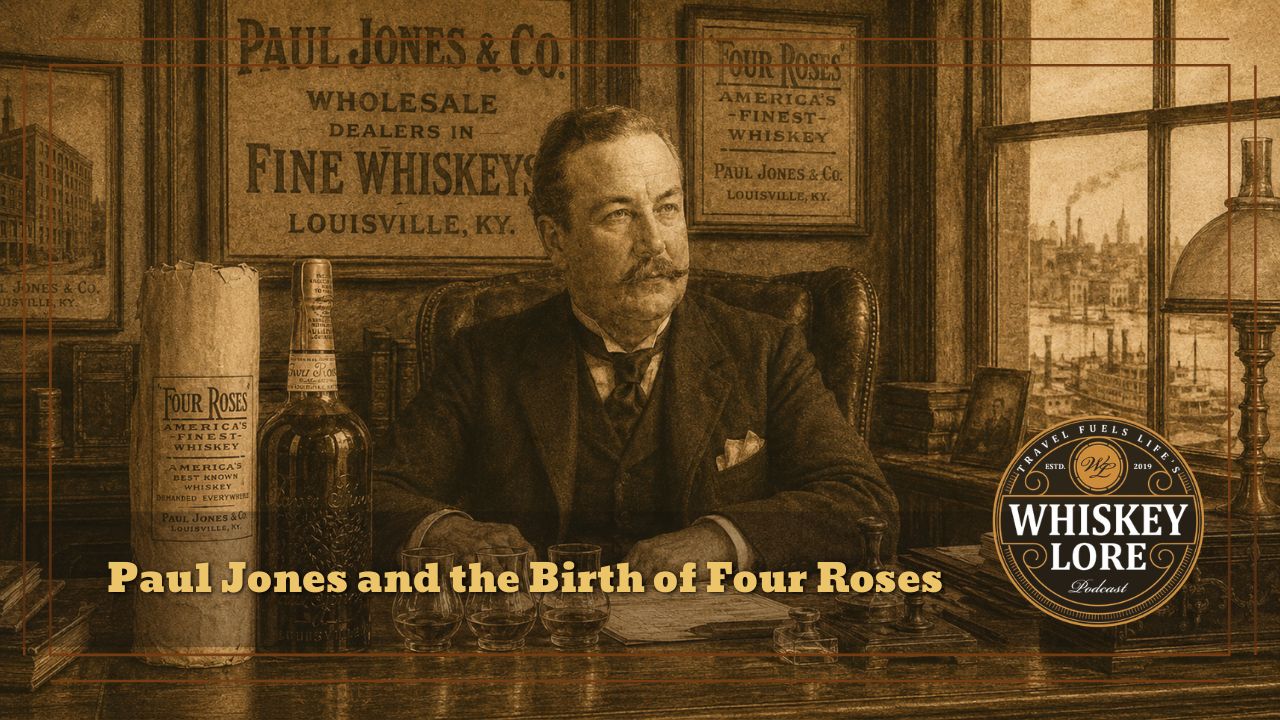
In 1864, a family of Virginians found themselves in war torn Atlanta with a decision to make - head home or plant roots. This was the birth of what would become known as Paul Jones & Company.
Over the years, there have been several stories floating around about how the flagship whiskey they later established in Louisville got its name. Was it because of a dance and proposal to a Southern Belle? Was it lifted from an Atlanta competitor's name? Or was it simply a name that came from the imagination of Paul Jones?
Today, I'll look to answer that question while taking you beyond the Season One episode to the very origins of Four Roses Bourbon.
Transcript
The summer evening settled gently over Lynchburg, Virginia.
Along Main Street, the reflections of lanterns brought a glow to the windows of brick storefronts while the last traces of sunlight slipped behind the sloping mountains of the Blue Ridge. The wooden wheels of carriages echoed against the cobblestones as families arrived at one of Lynchburg’s grand homes for an evening of conversation and dancing.
Inside, candlelight struggled to brighten dark corners in the halls, couples spoke in whispered voices in the parlor, while the main party was drawn like a moth to a flame, by the centerpiece chandeliers in the grand ballroom. Women in silk dresses assembled in clusters of quiet conversation while gentlemen in dark coats exchanged greetings near the entryway. Suddenly a pianist near the far wall struck the opening notes of a cotillion, and couples began arranging themselves into neat sets across the floor.
It was the kind of evening that defined antebellum Virginia for the well-to-do—formal, elegant, and governed as much by custom as conversation.
Enter a newcomer on the scene, nineteen-year-old Paul Jones Jr.
Born on a plantation, and raised in the traditions of old Virginia society, he knew he was expected to carry himself with the confidence expected of a young man from a respected family, though tonight confidence was harder to summon than usual.
Because across the room stood the most beautiful girl he could ever recall seeing. Graceful, poised, and impossible not to watch.
Surrounded by friends, she seemed to float from one conversation to the next, at ease with the music and pomp and circumstance of the event. Suddenly she turned and their eyes met. He fought the urge to dart his eyes away. Perhaps the cup of cherry bounce in his hand was giving him gentle encouragement.
As the musicians paused between figures and the room shifted, he crossed the floor toward her.
He bowed and spoke quietly.
Eventually he asked the question that had been on his mind since the moment he first saw her.
What answer might he expect to his proposal?
The young woman studied him for a moment, her expression stoic.
Then she smiled.
“Attend tomorrow evening,” she said. “And if my answer is yes… I shall wear a corsage of four red roses.”
That was all.
No explanation.
No promise beyond the flowers.
Just four roses would reveal the answer.
The next day passed with maddening slowness.
Paul did his best to keep his attention on the affairs of the day, but his mind drifted. Every practical matter was interrupted by the same image returning again and again.
The beautiful girl and those four red roses.
By evening he had nearly worn a path in anticipation.
When he stepped once more into the candlelit gathering, the musicians had already begun and the next cotillion was being called.
Then he saw her standing with her friends, back turned to him. He took in the whole of her figure, the bell shape of her pink dress, her white sleeve length gloves, and that beautiful long black hair adorned with a red ribbon, he felt his heart leap to his throat as she turned...
and there, pinned to her dress, four brilliantly red roses.
When it came to 19th century marketing, some distillery owners believed a good story was just as critical to a whiskey’s success as the liquid inside the bottle. And the perfect place to plant that story was in the name on the bottle. Sometimes the names were simple and connected directly to the maker, like James Crow’s Old Crow or Oscar Pepper’s Old Oscar Pepper. Sometimes a historic figure hid behind a curious name, like Old Granddad’s relationship to Basil Hayden, of the story of William Forester, a Civil War surgeon who is the potential namesake for Old Forester, or Daniel Edmund William’s initials that complete the name Tullamore D.E.W. Eventually the people behind the names fade, adding an heir of mystery to the brand.
Some brands just went right for the mystery, like Jack Daniel’s and his Old Number 7, Austin Nichol’s Wild Turkey, or James A. Miller’s Chicken Cock. But what makes Four Roses unique is how it stepped away from traditional masculine themes and into a more feminine theme of a dance, proposal, and flowers. Was the brand’s founder Paul Jones trying to find a new audience for his spirit, did Four Roses signify something in particular about the whiskey, or was he simply trying to draw on the nostalgia of the Old South?
It’s an answer I didn’t really pursue in the Season One Four Roses episode. In fact, I didn’t pursue much more beyond the conversation I had with the late great Al Young (Brand Ambassador for Four Roses) and the the book he wrote: Four Roses: The Return of a Whiskey Legend). So today, let’s start on a journey into the past, to discover the origins of this curious whiskey name, learn how the whiskey developed, and maybe find some hints to whether the legend of the corsage is true.
The Jones’ Wholesale Business
For Paul Sr, the idea of building a business in Atlanta was not a foregone conclusion. The family’s roots were in Lynchburg, Virginia, where he made a good living as a banker. But he’d seen more opportunities developing out west in Tennessee and in 1858, he packed up the family and moved to the Volunteer State. But then the war came and when his sons enlisted, Paul found himself pulled toward Atlanta.
It may not have seemed like staying in post-war Atlanta was the right move at the time, with all of the destruction wrought upon the city, but the rebuilding process was quick and what was once a small railroad town doubled in size between 1860 and 1870, partially thanks to the relocation of the state capital and the re-establishment of the railroad from Charleston to Nashville and beyond.
Looking to partner with his son Paul in a business, they rented a two story brick building at 35 Peachtree Street and established a grocery store that almost immediately morphed into a wine and liquor wholesale business.
They weren’t the only ones in this trade. A medicinal spirits salesman and representative for the Cox and Hill Distillery, Rufus Rose had established his own wholesale business two blocks down on Broad Street in the new Granite Block building.
With R.M. Rose focusing on Atlanta distilled corn liquor, Paul Jr. reached out to distillers in the north and established a relationship with the Old Baker distillery in Somerset County, Pennsylvania and had barrels of rye whiskey shipped down by rail. He also established a Paul Jones Bourbon brand. What that whiskey was made from or consisted of is not truly known. It’s possible he was sourcing local liquor or potentially he was bringing Bourbon in from Kentucky and rectifying it. The record isn’t clear.
What is clear is that he did not work for R.M. Rose, as some writers have mistakenly assumed, due to the later branding of a whiskey called Four Roses. These were competitors, not partners. And in fact, at the time Jones would have known better than to use the name Roses in his brand. In his early years as a traveling salesman, or drummer as they were known then, he made several trips down to New Orleans establishing strong trade with the wholesale house of Schmidt & Siegler on Levee Street. One of the popular brands in the city was a Cincinnati-based whiskey called Boyle’s Rose Whiskey. There had been some attempts to pass off New Orleans rum as Boyle’s Rose, so customers were asked to look out for any spurious imitations. There are just too many factors that go against Four Roses being related to his Atlanta competition.
Another thing that made the Jones wholesale house different from the early exploits of R.M. Rose and all of the other Atlanta wholesalers was how far Paul Jones Jr was traveling throughout the Southeast, spreading his whiskey. Sure he sold his whiskey in Atlanta, but also established relationships with grocers and wholesalers as far west as Tuscaloosa, south to the Florida line and over to New Orleans. By the mid-1870s, the father/son team had established the Jones brand, a thriving business, and a stellar reputation beyond the city.
But then, the firm met two major challenges. First, in March 1875 a fire ripped through the entire block of buildings on Peachtree burning up $26,000 worth of stock. Short on insurance, the firm only recovered $9,000 from their coverage. Not only had they lost inventory, their building was beyond repair. So the firm sought a new building and established themselves two blocks away at 22 Alabama Street.
At the same time Paul Sr’s health was deteriorating. Paul Jr. enlisted the help of his nephews Saunders and Lawrence to learn the ropes and pick up the slack. But by April 1877, Paul Sr’s time on earth was at an end at age 71. He died peacefully at the family home on Collins Street.
Paul Jones Old Monongahela
While the death of Paul Jones Jr’s father was a somber moment, it created an opportunity for the 37-year old to shape the business in his own image. Atlanta too was changing. Now decreed by referendum and the state’s new Constitution, Atlanta moved from temporary capital to a permanent status. But not all was joyful for residents across the Peach State. The Constitution also served to undo all of the safeguards of reconstruction and after successfully voting out the last Republican governor until the 21st century, went forward with plans for segregation and the limiting of Black voter participation through a poll tax. At the same time, Paul Jones shipments of Pennsylvania whiskey were delayed due to the national railroad strike, brought on when monopolistic practices and the recent depression led to worker pay cuts.
Rebranding the business as Paul Jones & Company, he began showing his nephews Lawrence and Saunders the art of "drumming" whiskey. He also further defined the style of whiskey he was selling. The Atlanta Constitution alerted its readers to the fact in a November 1880 article:
With all Atlanta’s boasted enterprises…there are certain merchants who push the sale of their goods beyond the furthest reach of Atlanta’s dominions.
Prominent among these stands Paul Jones, with his famous brands of liquors, led by the unrivaled “Old Monongahela Whisky,” The sale of this sterling whisky has become a feature in Atlanta’s trade. It…is considered the standard of excellence everywhere that it is known. Of late years, its reputation has outrun Atlanta and a demand has been created for it from New Orleans to the Indian Territory. An order of ten barrels of this whisky was sent to Washington last week for special use, this being the second lot ordered by the same person in that city. Wherever it is once tried a constant customer is secured.
The “Monongehela” is simply one of the choice brands with which the stock of Mr. Jones abounds. The business has grown so rapidly that of late it has become necessary to take a new building for it. There is more storage room than in any liquor house in Georgia, and the stories are connected with hydraulic elevators. The business of the firm embraces all sorts of wines and liquors, imported and domestic, and has grown to proportions surpassed by no house in the state and the “Old Monongahela,” unrivalled and unapproachable, leads the van!
Perhaps it was the stellar sales of Old Baker that finally turned Paul’s head toward rye over Bourbon—whatever the case, it clearly had become a favorite with both customers and newspapermen alike. By 1882, Jones had four men traveling from New Orleans to Virginia and down to Florida selling upwards of $400,000 of liquor annually, with his Jones Monongahela the star of the show. It didn’t take long before Paul Jones whisky found its way into saloons in Texas, Arizona, and as far away as Sierra County, California. Regionally, the Atlanta Constitution claimed he sold more of it than any other brand sold in the South.
So what was the source of this Monongahela rye? The first thought might be that this was more stock coming from Old Baker in Somerset, PA. But a new naming convention for the brand gives us a clue.
It was the mark of an ‘X.’ And not just one X, but two X’s or four. This apparently wasn’t a naming convention he pulled out of his own skull, it turns out there was a Pennsylvania distillery and brand that had been using X’s on its barrels of whiskey for some time.
Before I reveal the name, let’s talk about the meaning behind the X.
Anyone over the age of 40, who watched cartoons as a child probably remembers the old drunk with a jug with XXX marked on the side. To some kids, they thought this was poison, but the drunken actions of the character in question made the more savvy child aware that this person was drunk.
Well, if a whiskey had XXX on it, it definitely had the potential to make you drunk, but this wasn’t a warning, there was a meaning behind it. But not just one meaning.
To an 18th century distiller or modern moonshiner, one of the tricks smoothing off the rough edges of a whiskey is to distill it a second or maybe even a third time. Now, imagine your distilling operation is using barrels for cooking grains, fermenting mash, and storing the whiskey for aging purposes. That leaves a lot of barrels hanging around. What barrel will you fill up when that first run of liquor comes off the still? You’ll look for an empty one that you conveniently marked with an X with the early distiller’s friend, a piece of chalk. When you’ve collected enough first runs of whiskey in the barrel, you then run the whiskey a second time through the still to clean up more of the nasty notes of the whiskey, possibly taking heads hearts and tails cuts on the way. Now you put a second X on the barrel so your ADD doesn’t get the better of you. Now, you could let it age from there or, you could do like the Irish and distill a third time. This creates a lighter, mellower whiskey (after proofing down) and in the late 19th century, this would have been considered a sign of quality. Less headaches, easier to drink, gets the job done. If you’ve distilled it three times, you might put three X’s on the jug or bottle to let your customer know of the quality in the jug.
But that isn’t the only way X’s were used.
In medieval times, beer producing monasteries needed a way to denote weaker table beers from stronger, heartier ales. Table beers got a single X, with stronger ales getting XXX or XXXX. When English breweries began using this system in the 18th century it too was to denote quality. Eventually this system made its way to whiskey.
When distilled spirits started spreading across the country at the speed of rails, brand names began appearing on barrels and in advertisements so customers knew they were buying from a trusted source. Soon name evolved with other markings including the styles which included Bourbon, rye, or whiskey, which had no standard definition other than geographical distinctions. Then as rye found new markets in the south and west, and Bourbon imitations made from grain spirits arrived, words like pure or levels of quality denoted by X’s began to be used. John Gibson’s distillery, south of Pittsburgh on the Monongahela River became a proponent of the system in the late 1850s, Gibson’s Old Monongahela Rye as X, XX, XXX, XXXX. The more X’s, the higher the quality, just like old English ales.
We know Gibsonton Mills was the source for Paul Jones whiskey when he arrived in Louisville, thanks to an article in the Louisville Courier-Journal. But it appears that relationship started much earlier as in the 1870s and 80s, they sold their spirit as Jones’ Old Monongahela X, XX, XXX, and XXXX Rye. Could it be that Paul Jones, whose whiskey was sold mostly below the Mason-Dixon Line, actually provided that territory for the Gibson distillery?
It was definitely a whiskey of high reputation. And there weren’t a lot of people distilling rye in the South. But Jones cornered the market, with sales of Old Baker and Old Monongehela Rye boosting sales by 33% year on year.
Then, after a decade of steady growth, the state of Georgia began to quickly fall under the spell of the temperance movement. The state legislature opened up the dispensary system and local option to counties and municipalities and suddenly county after county was going dry. When the vote came to Fulton County and the state capital Atlanta, the liquor men knew if Atlanta fell, the rest of the state would follow. The fate of Jones Old Monongahela, the smooth, soft, and mellow rye whiskey—noted for its beautiful bouquet and by its nickname “the Queen of Whiskies” was in jeopardy.
When the vote came on November 25, 1885, the margin was squeaky thin, with the drys winning by just over 200 votes. The Black voters were blamed for tipping the scales as they were in every other prohibition fight, as were the churches. The whiskey men tried to get the law declared unconstitutional, but on June 30, 1886, the days of the brass rail saloons was to come to a close. Only a loophole in the law allowed whiskey wholesalers to stay in business longer, at least until their licenses ran out.
It just so happened, Paul Jones & Co had almost two months left on its license, so for a while, the Queen of Whiskies, along with Jones other stocked products like Guiness Stout and Bass Ale, would be the only game in town—a concept not lost on Paul Jones. With 400 barrels in stock on July 1st, he ordered 100 more and promised a reporter “we will sell every gallon of it.”
But what then?
Well, for some time, Paul had been building an interest in horses. Taking several trips up to Louisville, KY, he was impressed not only with the horseflesh, but also the growing liquor industry on Main Street, and impressive growth of agriculture and industry. Much of the growth was sparked by the World’s Fair-like 1883 Southern Exhibition that touted the creative energy in the city, led by inventor Thomas Edison and his incandescent light bulb.
But Atlanta was home and Jones had become not only a fixture in the business community, but he also served as police commissioner. A reporter asked him, will you step down?. “I will not,” he said defiantly. “I expect to remain a citizen of Atlanta and have sold none of my property here. I am going to the White mountains as I have done for a number of years past, and will be back here in October. I will have business interests in Louisville, but I will be here a portion of the time.”
The Birth of Four Roses
No matter his love for the city of Atlanta, there were just too many reasons to investigate the potential of Louisville. And it didn’t take long for the city to grow on him, or for Paul to grow on the city. He, Saunders and Lawrence took the leap north in either late 1887 or early 1888. They secured a location at 136 East Main Street and established Paul Jones & Company once again as a whiskey wholesale house.
Wanting to get his new community, Paul joined the Louisville Reality Association, hobnobbed with local bankers, merchants and lawyers at the Pendennis Club, joined the whisky committee on the Board of Trade, purchased a trotting horse named Billy, he even threw his hat in the ring to purchase struggling Louisville Colonels, one of the worst major league baseball teams of all times—dropping 111 out of 136 games in 1888.
With the new town also came the search for a new name for his whiskey. There were a lot of whiskey makers in the state and perhaps the use of the name Monongahela was seen as a potential sales liability in Bourbon Country. Whatever the reason, Old Monongahela XXXX Rye was replaced by Jones Four Roses and Jones Four Two and Four Star Rye. He started his rebranding by contacting his old clients in the south, with one blind tiger in Atlanta promoting Four Roses as the finest whisky in America, and R.D. Burnett in Birmingham Alabama promoting “now in stock a brand of whisky known as Four Roses, which I positively guarantee to be 1874 Rye and I can honestly say that I believe it to be the oldest and finest whisky sold in the United States.”
It’s around this time that the Louisville Courier-Journal pointed to the source of Jones whiskey, Moore & Sinnott of Pennsylvania, these were the new owners that took over after Henry Gibson retired from his father’s distillery.
Paul Jones' faith in rye whiskey would never falter. One of his shrewdest moves in Kentucky came from taking advantage of a down market. The Whiskey Trust, a giant monopoly out of Peoria, Illinois was flooding the market with cheap liquor and it has suppressing prices. Jones saw an opportunity and bought 800 barrels of rye at rock bottom prices. As soon as they were in inventory, prices shot back up. Soon, he was being offered more than $50,000 over the receipt price for that rye whisky.
The next step for Paul Jones was one that he’d never seemed to consider before. In the latter part of 1889, he began to hear through the grapevine that the J.G. Mattingly Distillery on High Street in the Portland section of Louisville might soon be up for auction. Teaming with, W.H. Thomas, a noted wholesaler and rectifier, and J.A. Cunningham and they acquired the distillery and all of its brands for $125,000. To prepare for more inventory, Paul expanded the footprint of his wholesale business by acquiring the offices next door. Soon, Four Roses was being sold by its name alone in newspapers, rather than as a Bourbon or rye. Had the formula changed? Was the product evolving into something unique?
And where the heck did that name come from? It wasn’t R.M. Rose. And it probably wasn’t the dance, proposal and corsage of red roses, seeing that Paul Jr remained a bachelor his whole life —although later accounts would pin it to Lawence instead. No, the best bet is, Four Roses, which was released at the same time as Paul Jones Four Star, was likely the Kentucky friendly replacement name for Old Monongahela, the soft whiskey said to have a beautiful bouquet (hint hint), and which was known until then as the Queen of Whiskies. The fact one of Jones old customers was now referring to 1874 distilled rye as Four Roses, makes this the best educated guess I can come up with.
Another advantage to taking on the name Four Roses instead of old Monongahela was that it freed up Paul Jones to work their whiskey up into the northeast, where it wouldn’t confuse customers of Gibson’s XXXX Rye product. Purchasing space on a building in Madison Square, New York, there he placed an incandescent light display with the words Four Roses to help promote his brands to visitors of America’s largest city. It was no cheap investment, the sign was said to cost him $1,200 a week.
While sales or a reputation for quality never seemed to be an issue for Paul Jones, his time in Louisville was met by periods of oversupply in the market and the loss of value in whiskey stocks due to the Whiskey Trust flooding the market with cheap spirits. To combat this, Jones seriously considered building an extension onto J.G. Mattingly and installing a column still to produce high wines to compete with the Illinois firm. While the still was never installed, the entanglements with the Whiskey Trust continued until a sudden turn of events changed everything.
On a Friday afternoon in 1895, Paul was struck with a seething headache. Once home, his health deteriorated so quickly, he was checked into the Norton Infirmary. For a few hours there was hope of his recovery. But then he slipped into a coma and passed away. For the man connected to modern memory by the corsage of red roses—the great irony is that Paul Jones Jr, died a bachelor. Perhaps, sadly, it only represented the story of the great love that got away.
WIth the company’s heart and soul gone, it would be left to Paul’s nephews Lawrence and Saunders, two of the three boys who once hid under their bed to avoid being captured by Union soldiers, the young men who had grown up only knowing how to sell Jones Old Monongahela whiskey, were now about to write the next chapter of the family business.
They couldn’t have asked for a better foundation. A strong wholesale business, a whiskey making distillery, a fledgling whiskey brand in Four Roses and a tried and true name in Paul Jones, and the inheritance of an estate worth nearly $1,000,000. Where would they take it?
Find out in the next episode of Whiskey Lore.
Whiskey Lore’s a production of Travel Fuels Life, LLC
Production, stories, and research by Drew Hannush
Are you a fan of whiskey history and Whiskey Lore’s mythbusting, and you want to make sure not to miss a thinng, it’s time you joined the Whiskey Lore family as a member of the Whiskey Lore Speakeasy and Club 1897 where you’ll get longer interviews, my mythbusting video series Truth or Lore, whiskey tastings with depth, extended episodes, and a chance, with your votes, to award the best distilleries in the country with a Pagoda Award.
Just head to Patreon.com/whiskeylore.
I’ll see you there. In the meantime. Thanks for growing your whisky knowledge along with me, I’m your host Drew Hannush and until next time, cheers and slainte mhath.
Find show notes, resources, and transcripts for this episode at WhiskeyLore.org/episodes