
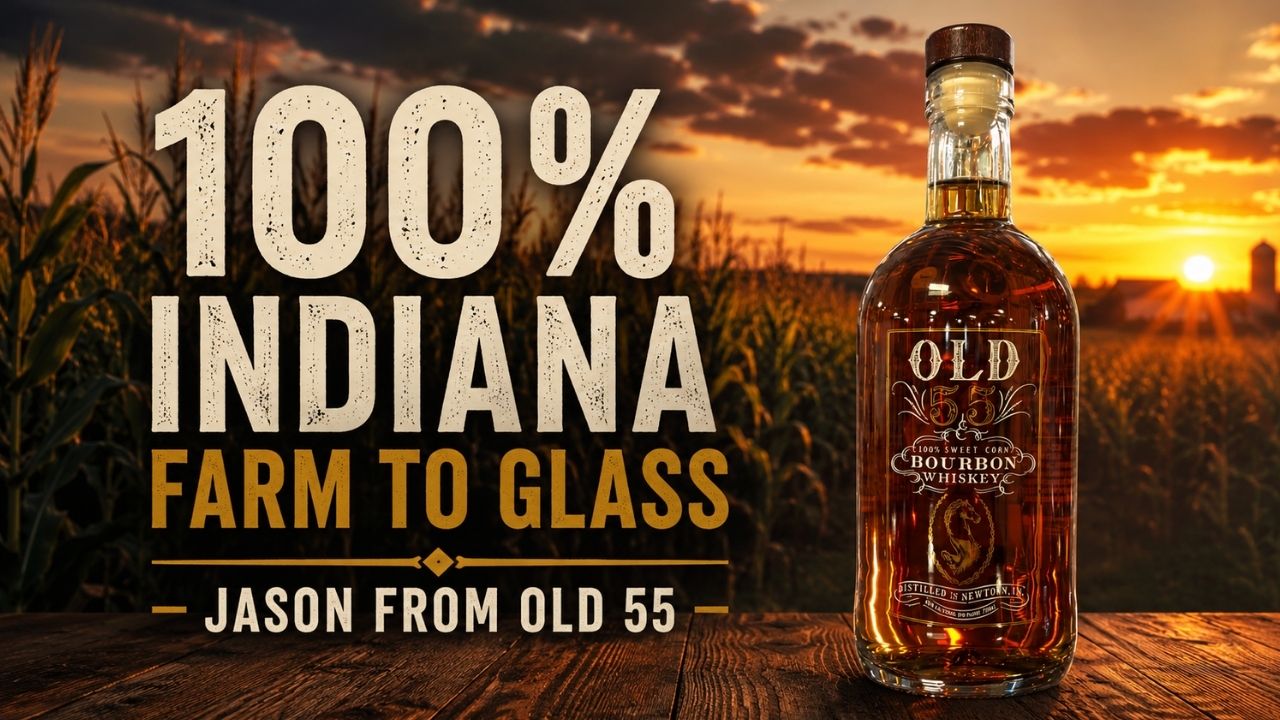
140 - OLD 55 DISTILLERY: 100% Farm to Glass in Indiana
Listen to the Episode
Show Notes
GUEST: Jason Fruits (Old 55 Distillery CEO & Co-Founder)
Some distillers inherit tradition. Others build their own path from the ground up. In this episode, Drew Hannush sits down with Old 55 Distillery co-founder and distiller Jason Fruits to explore how a family grain business became one of America's most distinctive estate distilleries. From growing the grain to questioning nearly every accepted practice in whiskey making, Jason shares why he believes there are better ways to craft exceptional bourbon—and why being in the middle of Indiana corn country may be his greatest advantage.
In This Episode
- Why "farm-to-glass" changes everything
- The business behind an estate distillery
- Choosing a hybrid still over convention
- Distilling on grain instead of beer
- Why Jason takes such a narrow hearts cut
- Can cool aging outperform Kentucky heat?
- The surprising role of enzymes
- Building a 100% sweet corn bourbon
- Why he calls his whiskey "Ferraris, not Fords"
- How family legacy shaped Old 55
JOIN THE SPEAKEASY: patreon.com/whiskeylore
OLD 55 WEBSITE: old55distillery.com
Transcript
Drew H (00:00:14):
Welcome to Whiskeylore: The Interviews. I'm your host Drew Hannish, the bestselling author of Whiskeylore's Travel Guide to Experiencing American Whiskey, Experiencing Kentucky Bourbon, and the book, The Bust 24 of Whiskey's Biggest Myths: Whiskeylore volume one. And today we are headed to rural Indiana out where the corn grows to chat with Jason Fruits, who is the distiller and co-founder of Old 55 Distillery. And Old 55 is a distillery I got interested in when I started seeing the name popping up in my Whiskeylore fan favorites distillery nominations on Instagram. And then earlier this year, Old 55's name came up again as a member of the Estate Whiskey Alliance. And so it's always fascinating to dive into true farm to glass distilling and we'll talk about that, talk about the advantages that you get from that. Also, how Jason achieves a 100% sweet corn bourbon. And I want to dive in a little bit into the distillery's unique aging environment as well.
(00:01:18):
And so Jason, welcome to the podcast.
Jason F (00:01:22):
Drew, thanks for having us, man.
Drew H (00:01:24):
I wanted to come out and visit. I wanted to see where the corn grows because as I understand it, there's not a lot around you except for corn.
Jason F (00:01:32):
You heard me chuckling earlier. Yeah. I was like, we're in corn country. So we are in the West Central Indiana, Fountain County. It's just some of the best farm ground on planet earth. And yes, it is corn, corn and more corn, man. That's all I see. We were laughing this morning. My little brother and I were doing our federal taxes together and we laughed when we left this morning when the sun hadn't come up and you could smell... It's tassel season. So everything is... I laugh. My dad is the best and his one dirty joke when we were kids, which he doesn't cus, doesn't do anything, he would be like, "Oh, smell all that sex in the air because it's tassel season for all the corn." So you can literally smell it like it is. Everything's tasseling right now. We're filling the... Yeah, there's a lot going on and just corn as far as the eye can see, that is for sure.
Drew H (00:02:27):
That's so funny because I went out and met with Colby Frey out at Frey Ranch last year. Actually, I didn't grow up on a farm. I didn't grow up around corn. I just eat it. And he was doing the whole description of how basically those tassels feed all of the... They're grabbing the pollen out of the air and they're feeding the corn and helping the corn. Just absolutely fascinating. Did you grow up with a fascination for the farm or were you kind of like, boy, as soon as I get out of here?
Jason F (00:02:59):
Yeah, exactly. Probably the exact opposite of that. So we have farm ground now quite a bit. Really what my family's business is is we're in the grain elevator business. So we have two of those. So we're like the middleman for farming.
Drew H (00:03:13):
I
Jason F (00:03:13):
Say jokingly, we do the real work. We store millions of bushels of grain and commoditize that across and it's just supply and demand. Supply is the highest during harvest and we buy it from the farmers then when the price is low and then sell it for corn chips, for sweetener and your Pepsi products, you name it all kinds of things. My grandpa started that business. It's Newtown Farm Service. The elevator is as big as the town of Newtown. Newtown is tiny. It's like 120 people and dying, I jokingly always say. Growing up, could not get out of here fast enough. So my parents are the best. You couldn't ask for better parents, but they never pushed us to get into the family business. And I laugh because my dad is an evil genius. He has weaseled me and my three siblings all back. I have an older brother, Chris.
(00:04:04):
He works for my dad. He used to be a police officer. I'm the middle unloved child. I always tell people I'm the meanest and smarter of them and they would all agree completely. And then my younger brother and sister are twins and my little sister was in DC forever and
(00:04:20):
We're all back basically Newtown adjacent somehow and have basically built these businesses and it's pretty crazy. But growing up, no, I could not. You couldn't get me out of here fast enough. I had absolutely no desire to do anything agriculturally related. And now saying this at the ripe old age of 44, I'm just basically growing into my dad, which as you grow up and you realize it's not a bad mold to mimic in any way, shape or form. But I watched the Weather Channel and the Chicago Board of Trade all day, basically. That's where we're at. So yes, yes.
Drew H (00:04:58):
Yeah. Well, what was the original dream? As I understand it, you come from a family of Purdue graduates. So what did you run off to college to learn for your future?
Jason F (00:05:10):
So originally went for engineering. I wanted to be an astronaut, but then found out I'm too tall. So I'm six two. And
(00:05:17):
To be a shuttle commander, you have to be like 5'7" to 5'11". So those dreams were crushed immediately. And so I actually was just going to go to law school was my plan. The plan was to get out of Newtown as fast as possible. So worked in the insurance finance business for a while, then got into the gaming business into casinos. I mean, every young man understands this like you get married and you have kids and your entire life changes. And my dad is a very smart guy and kind of saw the glint in my eye. And he had always encouraged me and my siblings to be entrepreneurs. And so I was always very business savvy, owned businesses since high school. We mow yards. We did all kinds of stuff. And once again, being the troublesome middle child, I was like, "We have all this corn.
(00:06:08):
We should make some whiskey. That would really upset my super conservative grandparents." And just exploring that business idea really was the start to all of this. So it was as we kind of started building numbers and seeing how the business plan looked. I mean, to segue into old 55 and how we do business today, we are completely vertically integrated and we couldn't do it if we weren't. I mean, the only way this works is us being all the way to one of the funniest things is if you would have told me 13, almost 14 years ago when we started this, that being in Newtown would be... I mean, it's like our superpower is being
Drew H (00:06:49):
Out here in
Jason F (00:06:49):
The middle of nowhere. There's easier ways to make money. And I always joke like the Fruits family, we don't ever do anything the easy way. It's always got to be the hardest way with the most power equipment until someone almost dies is like the family joke. So it constantly makes me kind of grin and chuckle that how important rural agricultural living is to me. You know what I mean? Because I fought it and fought it and fought it. I wanted nothing to do with it. Now it's my entire livelihood and life. So pretty crazy.
Drew H (00:07:20):
Well, I grew up in North Carolina in Asheville, North Carolina as a home of Thomas Wolf. And Thomas Wolf's famous saying was you can never go home again. You have proven the opposite.
Jason F (00:07:33):
Oh yeah.
Drew H (00:07:34):
What did it feel like after working in the casinos and all of a sudden being back? I mean, what was driving you? You said your father kind of inspired you to come back. What was the incentive to come back?
Jason F (00:07:46):
We had my oldest, he's 15 now. He was born in 2010. And every father knows this, you know what I mean? And every man can understand this side of it. And every woman has probably seen their husband or significant other or partner struggle in the same vein. I'm so disagreeable. I make a terrible employee. And I had learned that very since... I mean, I was always very successful. Me and all my siblings, we have all done very well for ourselves before we started and got involved in these family businesses and came back. And this is what I try to tell my 15 year old who's the start of all this is like, just do something that's bigger than yourself that means more than all the narcissistic, selfish things that you can do. And that's what it really was. That's what it turned into was like, ooh, I can build this next family business that has legacy.
(00:08:45):
I mean, that's for the first five or 10 years. It was, oh, legacy, legacy. And then I realized it's so much bigger than that. When you apply yourself to something that is well bigger than you, and then you see all those lessons and all those times you saw your dad go back to work after church on Sunday and all these things, you know what I mean? You're like, why? Why would you go? So how was to pay for you to go to college and to go, you know what I mean? It was the sacrifice and now I'm like, oh man, to be so naive and narcissistic and then grow up, kill that ego, build something of your own that you're still building to this day, you know what I mean? But be able to do it in your way and then build that respect. It's definitely something it's pretty crazy.
Drew H (00:09:32):
I'm just thinking about the pressure that there would be as I understand that your dad is not a drinker so you are diving into this business that is kind of counter to what he is doing. He is kind of hoping, I'm sure, that you have a passion for this, but you're just getting started on it. What kind of pressure is that?
Jason F (00:09:55):
Well, so I say two things. So first of all, there's a famous quote from Warren Buffet, I believe, where he says, "Find something you love and you'll never work a day in your life." And my rebuttal to that is that's what rich people say. That's not true. Anyone that actually works for a living knows that work is work. You know what I mean? There are days where I contemplate lighting this place on fire and walking away. And I don't because it's mine and I've built it and nothing is ever 100% passion. You're just unicorns and rainbows and skipping through the cornfields here. You know what I mean? There's a lot of dirty, sweaty, hard work that has to do to make all this delicious award-winning bourbon we make. And I'm absolutely fine with that. Now it took me a while to get to that, but the idea is just that...
(00:10:49):
Well, how I say this? So dad doesn't drink. He never had a sip of beer or liquor in his life, but he's the best businessman I've ever met. And he saw, I mean, we both saw the numbers and the margins with us being vertically integrated. It was just business. Does that make sense? And I always joke,
(00:11:07):
I fell in love with distillation because I am a nerd and it's the devil's in the details. It's a very detailed operation and that is absolutely why I fell in love with it because I was like, ooh. We've had a lot of the big companies interested in us since the beginning and VCs and all kinds of are always pecking around the outside. That's the cool part. We don't owe anybody money. Everything's paid for. It's just dad and I and the brothers. It's pretty awesome to be in that position. And whenever they ask dad, I always love it because they ask him, they'll be like, "Were you ever worried?" And he has never faltered once and I don't know how it blows me away. He's like, "Nope, never doubted him. Never." And I was like, "What? Good Lord." So my rebuttal to that is always because then they turn and look at me and I always say, "Listen, when you borrow millions of dollars that you didn't know you had, by the way, from the man you love and respect most on planet earth, failure's not an option." You know what I mean?
(00:12:12):
People ask me all the time, they're like, "Did you lose sleep?" I was like, "I didn't have time to lose sleep." You know what I mean? It was all on me. I like that pressure. I'm a unique personality that does thrive in that environment. In the beginning, it was too frantic to ever be worried. And now I laugh. I probably have more stress today that we're successful than I do before because I realize that people depend on me. I mean, I don't carry much anxiety. I just kind of get things done. I'm a weird personality like that. But I probably have as much as I've ever had today just because now that the business is successful, it's like, oh, then you realize all the nuts and bolts and everything that relies on you. You know what I mean?
Drew H (00:12:57):
Which
Jason F (00:12:57):
Is crazy.
Drew H (00:12:59):
Well, let's talk about those early days and how you got this all kicked up because as I understand it, you have a very unique set of stills there. So what was the thought process in choosing the stills that you were going to use?
Jason F (00:13:12):
Well, so Koda is a very expensive setup. So I wanted to make bourbon, but nobody had ever made bourbon in West Central Indiana. And at this time, so you're talking 2010. The bourbon craze hasn't even kicked off. So it was a double-edged sword in that the fight to get information was a million times harder because it wasn't out there like it is today. But
Drew H (00:13:35):
It also
Jason F (00:13:36):
Meant that I got all the information. Does that make sense? So people were like, "How do you know all this stuff?" And I'm like, "I know stuff about glass production that I should never know about, but there was nobody you had to call to get bottles." I mean, it wasn't like a 10 million Chinese distributors like there are now that you just call and it's a race to the bottom. I mean, it was glass quality, like corks, enclosure quality, all this. I mean, I had to figure out all this. Once I find something to dedicate myself to, as far as I'm that nerdy end, I would just deep dive and find all the information out and make all the phone calls. I'm a bull in a china shop that way.
(00:14:14):
We were in talks with Vendome in the beginning with our consultants. We were this very American farm to bottle. I mean, you mentioned the Estate Whiskey Alliance. As far as I know, don't take this for gospel, but we are the only 100% certified Estate Whiskey Alliance producer on the planet currently. So it looks like that's going to stand for a while. But it's super easy for us because we're literally vertically integrated. We do it all. So it's kind of crazy. So I knew I needed flexibility as far as production because I wanted to make bourbon, but man, if that fell through, I needed to be able to do other things. So Coda had some automation that was on it that none of the other distill producers really had at the time. And of course it was the most expensive equipment you could buy, which is like a family joke.This is how it always works.
(00:15:03):
So especially when it comes to me, that's how it always works. So we had that. And then really it was just figuring out mash bills, which are not... My mash bills are not complicated.
(00:15:17):
It's just very... Yeah. It all almost manifests destiny as we're just getting over this 250th anniversary. I mean, it's so funny. I always grow up hated everything happens for a reason, but it's very interesting. When you chase a certain path, certain things do happen for a reason. One of my favorite stories from the very beginning, I want to say a couple years ago, we were going to get pizza. Have you ever had Pizza King Pizza, by the way? It's like an Indiana thing. When you come out this way, I'm going to get you some Pizza King Pizza. It's very different. It's hub style. You kind of have to explain it, but my grandparents had a couple of those in the 80s and it's a very Indiana thing. It's my grandma's 92nd birthday. We were heading back over to the tasting room here at the distillery because we were just celebrating it here because it was the easiest place to get everybody parked and bring everybody in.
(00:16:15):
And dad and I were riding over to get pizza and he's like, "Hey, do you remember when we had the consultants in the beginning and they just told you how much we needed a story?" And I was like, "Yeah." And I was like, "Dad, they weren't wrong." I was like, "Do you realize how narcissistic and egomaniacal I was? " I would tell these guys, I'd be like, "No, I think I'll just make good bourbon." And they would just look at me like, "Oh, this idiot's going to be out of business." They were 100% statistically right. In hindsight, I understand where they're at because to actually make a novel, good product we're riding over there and dad's like, "You remember?" I was like, "Yeah, dad, they weren't wrong." And he's like, "But isn't it cool?" Because we would have been over a decade in.
Drew H (00:16:54):
And
Jason F (00:16:54):
He's like, "Isn't it cool how we kind of have the Nita story now?" And I'm like, "Yeah, we have the story because of you. You should have never trusted me to do this. It's absolutely ludicrous. But we built the story because we chased." And I always said this, this is a very early truism that I said to dad is just marketing 101. You never want to be in high volume, low cost. You want to be in low volume, high cost. You know what I mean? That's the marketing piece of the pie that you wanted to be in. And I said, "Pops." I told him very, I said, "We don't want to make Fords and Chevys and there's nothing wrong with them. I drive one." You what I mean? But that's what Kentucky does and they do an amazing job. I love Kentucky Bourbon. I was like, "I needed to make Ferraris in West Central,
(00:17:43):
Newtown, Indiana." And he was like, "Yeah." And it's insane. Even to still see his face when he was like, "Yeah." And he held to that the whole time. So when I was like, "Hey, we need to invest in this. " And a lot of people would be, you always get those naysayers. They'll be like, "Oh man, I wish my dad was rich and just gave me. " I'm like, "If you had anything, we are the poorest people you've ever met." My grandparents and my mom and dad are the most humble. We come from zero money. You know what I mean? This is all built on the backs of family members of mine that have worked so incredibly hard and all I have to do is not screw it up. That's my motivation. You asked me earlier, that's my motivation every day. Do not screw up two generations before you lived through the depression.
(00:18:33):
Always love telling the story. My dad's dad, so my grandpa Russell, who's just an amazing dude, started the elevators. And we had just gotten a bunch of press. We had won World's Best Single Malt at the International Whiskey Competition. I really wanted to get this picture because Forbes gave us a nice little article and we were in the print magazine. And I was like, "I really wanted to get a picture of grandpa with dad and the boys." You know what I mean? The kinsman. And my grandpa's like, his health was really bad. He ended up actually passing about three or four months after this conversation.
Drew H (00:19:11):
And
Jason F (00:19:11):
He always told me the story. So he tells me the story with grandma sitting right there and my dad. And he's like, "I think it was like the summer of 1969." So maybe a year and a half or two after I bought the elevator. And he's like, "Your dad and I got done." And he's like, "I knew it was in the middle of the summer because we got home at like 10 and the sun was still up and we had chores to do. " So he's like, "I walked in the house with your grandma." I always just saw my grandparents, this is their house, their little homestead. They rented it until like the 80s. I always just thought that they did that. You know what I mean? They finally got the guy to buy. I was like, "Oh, can't see the forest through the trees and you just assumed all these things." And it's like we're sitting there in this house that my dad grew up in and I grew up in, running around in.
(00:20:00):
And grandpa was like, "Hey, we came home and your grandma, Shirley." I was like, "Shirley, what's for dinner?" And she's like, "Well, so my dad's the oldest. He has four younger sisters." And he's like, "Well, I've had the girls go through all their sock drawers. We've looked everywhere in the house. We don't have a penny to our name. And you guys, we ate the chickens on Sunday and I gave you the last lunch meat we had for lunch today. We are broke and we have no money."
Drew H (00:20:29):
I
Jason F (00:20:30):
Get a little emotional every time I tell this story because it's just these are the sacrifices that were made. And he's like, "I called my in - laws." And he's like, "Any ma can equate to the story because when you have to call the in - laws to feed you, you know what I mean? They brought lunch meat over and fed the kids and us. And he's like, don't ever think you do it by yourself because those that know will always know. " And he was always very sagely and very wise and it's right. As much as Old 55 seems to be a one man show, there's incredibly blessed generational. It's insane and that's the motivation across the board.
Drew H (00:21:22):
Yeah. Well, I guess that humbleness just carries through and that's why you just didn't get a sense of it because if you've been in that world long enough, you kind of live that life even once you become successful.
Jason F (00:21:37):
Well, if you knew me in my 20s, humble was never the adjective you would use to describe me.
(00:21:46):
But this business has humbled me in the best way possible. Does that make sense? It puts everything in perspective. I love it for how painful it is in some days because nothing is free. You know what I mean? Everything is earned out here on this production floor. And the lessons I get to teach my boys and my kids where... Well, here's the crazy part. I have a barrel that my oldest Owen signed on the top because we were filling it because he wanted to go home. And I was like, "Dude, we got these last two barrels. Let's fill these barrels." And he's like, "Can't we just go? " And I said, "Well, here's the problem, dude. We can. I can do it tomorrow, but I'm not hurting myself today. I'm hurting myself five years from now because we didn't do the job tonight." You know what I mean?
(00:22:34):
And he was like, "Oh." And we called his mom and he was all, he's like, "Mom, we're just filling these barrels and when we get these done, we'll be home." And she's like, "Oh yeah." And I was like, "Hey, tell your mom what I told you. " And he's like, "Mom, when these barrels come out of the basement, I'll have my driver's license." And she was like, "Oh, mom." She's like, "Oh my gosh, stop it. Don't talk about that. " And he will have his driver's license in December. It's crazy. Tharrel will be out of the basement in the next six months to seven months. And he just asked me about it yesterday. We just did some bottling and he was in here helping me. And he was like, "Dad, you remember that? " I was like, "Yeah, it should be coming up here soon." And he doesn't know it, but I actually have, I'm staring at him on my desk right now.
(00:23:20):
I have a couple bottles of the first batch he ever signed. So they're 60.9. So they're what, 121.8 proof single barrel bourbon that he signed his name on. It's the first time I ever let him sign bottles. And I just snagged two of them and put them on his wedding and maybe 21 or whatever. We'll see. So yeah,
Drew H (00:23:41):
Pretty
Jason F (00:23:42):
Crazy.
Drew H (00:23:43):
That's fun. So you mentioned actually that you won an award for an American single malt, which throws me because when I think about you guys, I think about the corn side of what you were doing. Absolutely. Yeah. But again, let's talk about the decision that you made on that still. Describe the still for me. Is it a pot still? Is it a column still? Is it a combination?
Jason F (00:24:05):
It is both. It's a hybrid reflux still is technically what it is, the scientific term for it. So it is a pot still. It's a very large pot still with a three tower 19 bubble plate system attached to it. So I can run just simple pot distillations or we can run through the tower system. It has three deflegmators on it. I have automation so I can control how fast it passes through the towers. So it's kind of like the Starship Enterprise. It is a very cool piece of equipment that lets me do a lot of basically anything I want, which is really cool. So once again, going back to that Ferrari comment, one of the biggest things that we're able to do because we're vertically integrated because I'm not... Well, we just own it from top to bottom is like our heart cut. So I'm keeping about 23% of a cut of what any other distiller probably of a traditional...
(00:25:00):
When you think of like a traditional bourbon cut, it is a true 100% hearts. I don't even distill tails when we get to it because if I distill it, I have to pay federal excise taxes or do
Drew H (00:25:10):
Paperwork
Jason F (00:25:11):
On it. And so we just turn it off. For over a decade, I've had other distillers or people be like, "Well, why don't you make Fireball or do something else?" I'm like, "Because then that's more stuff I don't want to make. Cinnamon spirits for 20 year old girls. I'm good." You know what I mean? So we'll concentrate on the bourbon. So that heart cut is really where it's at. And mash bills were really pushed only because of what grains we had available at the time. So we had corn and wheat. And there's only two clear whiskeys through the beverage alcohol manual. So the band manual that we're forced to... I mean, we're federally regulated obviously and all recipes go through the band manual and there's only two white. There's a white whiskey or a corn whiskey. And I went to a large Kentucky distiller on a trip and they were...
(00:26:06):
I was like, "Wait, how do you make your... " I won't even say the product because I'll give it away. "How do you make your distillate that you sell in the tasting room? How's that labeled? "And they're like, " Oh, well, it's a white whiskey. "I was like, " Well, wait. "So in a corn whiskey versus a white whiskey, the two differences, corn says and if touches white oak, which means it never has to,
(00:26:29):
But it has to be 80% corn. And white whiskey says must touch white oak. Well, so they would take popsicle sticks and dip it in a white oak popsicle stick. And I was still a purist and romantical as could be at 28 years old when this all went down. It was almost sacrilege to me. I was like, what? So
(00:26:50):
I had corn and wheat. So our original mash bill was 80% corn and still probably what we make 95% of is that 80% corn, 20% soft red under wheat. So that's our single barrels. That is our wheated bourbon that we make most of. We single barrel everything, which is a weirdo. The sweet corn, the mash barrel's pretty easy guys. It's 100% corn on the cob, sweet corn. And that conversation went when we grew the first seven acres, dad was like, "So are you going to put some of this in here?" I was like, "Well, I think we miss the novelty if we don't do 100%." I mean, that's what nobody's... And there are other distillers that put sweet corn and stuff I don't want to take away. We are just the only ones that... Well, we're the only ones dumb enough to do a hundred percent corn cob sweet corn bourbon.
(00:27:33):
I mean, there's just no efficiency in it. Does that make sense? It's a loss
Drew H (00:27:36):
Either
Jason F (00:27:37):
For us, but it's a very cool, unique, super cool whiskey. And then the single malt was a perfect example. We were working on some barley product for more traditional bourbon mash bills and Caleb Machalki at Sugar Creek Malting Company in Lebanon, Indiana. Awesome family, awesome dude, incredible company. He helped me through this whole thing and we built this. I told him, I was like, "I not only want to make it with all Indiana stuff. I want to actually find everything we smoke it with in Indiana as well." So it's made with Indiana peat from Fort Wayne, Indiana Lavender from Bloomington and Indiana Maple there from Caleb's property. So it's a super cool product. All the mashvilles are pretty elementary in my opinion. There's nothing too crazy.
Drew H (00:28:26):
Yeah. And where did you say you got the barley from?
Jason F (00:28:29):
Caleb helped us get that. So yeah.
Drew H (00:28:31):
Okay. Two
Jason F (00:28:32):
Row con lawn. Yeah, pretty
Drew H (00:28:33):
Crazy. Well, the other thing that is kind of out of... I mean, if you'd have traveled around to a bunch of Kentucky distilleries when you were making the decision on your equipment, you would not have seen pot stills. You would've seen only column stills. Continuous
Jason F (00:28:48):
Stills, right? The problem with all that, you pigeonhole yourself. Vendome is a great company and they're awesome, but I mean almost all of those large Vendomes are kind of made to make one thing. I needed that flexibility to the conversation earlier. I needed to be able to make about anything. And so that was a huge decision how we started. So I always try to explain this. We have an enormous still, but I'm not as efficient as a continuous still if I was just pumping out. Does that make sense? But what I am, what this does is it's enormous small batch is probably the best way to explain it. Does that make sense? So all individual distillations, I have to clean the pot still out before I put the next one in so it's not continuous where we'll have people in that just don't understand and everything basically runs on a 3000 liter system.
(00:29:42):
So they'll be like, "Well, why aren't your fermentors?" And I'm like, "Well, my still is actually bigger than that guy's still." You know what I mean? Because I have a single pot. It's just he has a 50,000 liter fermentor that runs it for two days straight. You know what I mean? And they pay a guy 15 bucks an hour to Make sure the place doesn't catch on fire. You know what I mean? You know what I'm saying? Because the settings are set and as long as
(00:30:06):
Nothing plugs up or there's not a catastrophic and that's a way more efficient way to make whiskey. Does that make sense? We are
Drew H (00:30:14):
Just
Jason F (00:30:14):
Going to do... My way is more consistent. And once again, I'm chasing Ferraris, not Fords and Chevys, which there's nothing wrong with that. So to that, there is some logistical concerns and we're probably, I don't know, a hundredth of production. I still only produce one fermentation Monday through Friday. So five
Drew H (00:30:37):
Distillations
Jason F (00:30:37):
A week.That's all we're doing. I could go to, we have a quarter million dollar glycol machine we put in in 2020. That's a lot of the reasons pre 2020 to 22 we were crushing, but we blew up my mash tank and I waited a year to basically get things up. So we were just getting over that year hump. So a lot of people were like, "Man, you were everywhere." And I was like, "Yeah, we were everywhere." And then I could have compromised and sold you younger product or just source something to fill in the cracks. And luckily, once again, I don't have to chase money for money's sake. So we can basically, we just waited it until we had four plus five year old product. So to that, I know you wanted to ask about this, but we use a 30 gallon barrel aged in a basement underneath a gymnasium.
(00:31:28):
You know us Husiers in our basketball. So both my grandpas played high school basketball against each other in there. So underneath that gymnasium, we have an enormous basement. So the single malt was actually kind of because of this because I was trying to, as opposed to an above ground rick house like in Kentucky where you have 120 degree temperature variation, which is great, makes the barrels expand and contract, speeds up aging, huge sign curve, right? So from hot to cold, 16 degrees is all as it changes in that basement. Whether it's 100 degrees out like, well, it's 96 out today. So like whether it's that or it's 20 below zero, 16 degrees. So about 50 to 66 degrees is the temperature in that basement, which is very similar to like a Scottish dunnage house.
(00:32:18):
So that was actually kind of the basis for the single mall is because in this research of the basement and what it was going to do. The real reason for this is, so instead of all this disparity in product from like the fifth, sixth floor of the Rick house versus like I have super consistent product. So people are always like, "Oh, you single barrel everything. How do you do that? " I'm like, "I cheat. The basement lets me cheat, but it slows down my aging." Does that make sense? So that was the idea of using the 30 gallon barrel. It's just physics. So smaller barrels do not age product faster. If I have to hear somebody else or a barrel salesman say that, it's just physics. It's surface area. Does that make sense? They impart flavor faster. And when most people hear this, they immediately understand it.
(00:32:59):
That's why most craft product is not very good because it's too young. It's not old enough and it has been in too small of a barrel so it's over oaked. Does that make sense? So it's bad on top of bad. Here's another ode to my grandpa. I called it a swag. So that's a scientific wild ass guess. So we were working with the barrel mill at the time. This is like 2011, 2012. We were trying to source barrels because you could not find barrels anywhere because production had not spun up yet at the big guys in Kentucky and everything was sold out. And I was like, "Ooh man, I have this basement where I can mellow it. But I can't put 53s down there because I'll have like the world's only 14 year old single barrel that's actually not super over-oaked and awesome. But my dad will have already smothered me with a pillow and I'll be dead seven years in because I spent all the family." You know what I mean?
(00:33:54):
So the idea was this 30. And I mean, we get asked all the time, it would be much cheaper for us to go to 53s because I can...
(00:34:07):
Independent Stave's best barrel costs me about two thirds of what one of my 30s cost. You know what I mean?
Drew H (00:34:14):
Yeah. And
Jason F (00:34:14):
So we could save a bunch of money doing that. The problem is it would change what we've done. I mean, I think my pedigree and awards and just the whiskey speaks for itself. I think I'm open to doing other things in the future. We did a Double Oak project that won a ton of awards, won a bunch of Whiskey of the Year awards. So that was a nine and a half year old double oak that I did two years in a... It was two 30 gallon barrels for two years, a little over two years and then seven and a half years in a 53. And people went goggle. This is how crazy it is. I have not put any more in, even though I know it works. I have not put any more two year olds in a 53 and I have 53s out here.
(00:35:02):
I'm just running like a... Yeah, just like my tail's on fire.
Drew H (00:35:08):
You're in such an interesting aging environment and we talk about, I've been over to Scotland. I've seen how they're aging over there. They have a lot of moisture in the air there. Absolutely. Yep. So that's going to have something to do with it. I traveled through the south. I was determined to figure out how the heck aging happened. And when you're in the south, deep south especially, we're talking about extreme temperatures and this dealing that - Crazy. Yep. Yep. Yeah. And we got into discussions about how if you are in that kind of an environment and how Kentucky brags about the temperature changes and that it's aging, it's expanding, it's contracting in the wood and all of that. When you're in an environment where the temperature is not changing that much and you're not really necessarily getting swings that far above 60 degrees, 60 degrees was kind of the temperature that we talked about in the deep south where whiskey starts to go dormant in a barrel.
(00:36:12):
Would you agree with that or do you think the temperature is lower? What are you seeing in that cooler environment? That's
Jason F (00:36:19):
Just such an awesome question. So here's the thing. So we know a water molecule is smaller than an alcohol molecule. So we'll lose water in those barrels. And this is 12 years of data plus now. I never thought that we would overproof anything in that basement. Does that make sense? I was like
Drew H (00:36:42):
We're
Jason F (00:36:42):
Like the antithesis of overproofing. Two to three and a half years, almost every barrel in that basement is overproofed.
Drew H (00:36:52):
Okay.
Jason F (00:36:53):
Not huge. We're not talking 10 point swings. I'm talking a point or two. Does that make sense?
Drew H (00:36:57):
Yeah. Is it damp down there?
Jason F (00:37:00):
Exactly. So
Drew H (00:37:01):
This
Jason F (00:37:01):
Is what it is. So it is a very damp like it's a basement environment. There's actually, we've had a ton of rain this spring so far and I haven't had water standing in the basement in this corner for like two or three years and I do now. Actually, I just went down there yesterday and I was like, oh, I have a little bit. The basement was built in 1942. It's just an old building. So it's going to leak a little bit. This is what happens. But yes, it is due to that dampness that we see that. So very similar to, like I said, that scotch aging environment as opposed to Detling in Mississippi or these guys that are like, he's got that crazy. He's open-sided and underneath that metal roof I'm like, "Dude, it's like 140." You know what I mean? So yeah, it's hilarious.
(00:37:59):
Absolutely. And the boys in Texas spoke with them because they did some stuff with the barrel mill as well down at Garrison Brothers. They had issues with barrels exploding. You know what I mean?
Drew H (00:38:11):
So what do you do for your entry proof? Did you adjust that and whereabouts are you putting it in?
Jason F (00:38:17):
Originally, the first probably five years, most of my entry proof was at 56.25, so right under 113. And now my entry proof is all over the place because the answer is... Well, because they're all good. You know what I mean? We actually just sold a bottled in bond that was actually a cast drink. So I put it in at 102
Drew H (00:38:47):
And
Jason F (00:38:48):
It just perfectly, it was within my government specs of being within my thing. It was right at a hundred proof. And I was like, "This is like a cast drink bottled in bond." And they sold it in like two hours. It was gone. You know what I mean? People love it. Anybody that tasted it loved it. And I was like now of course that retailer and a bunch of others are like, "Can you do that again?" I was like, "I don't think I can do that repeatedly. There's no way for me to do it. " But traditionally, lower entry-proof, sweeter whiskey on the end. My whiskeys are already very high corn. You know what I mean? That wheeded bourbon mash bill, I call it like a wheater's wheater. It's a caramel vanilla bomb. We've
Drew H (00:39:23):
Ran
Jason F (00:39:24):
Lower entry proofs on the sweet corn, which is very sweet. I usually don't go under 110 unless I'm just goofing around and like a couple barrels. But most barrel entries are like 112 to 125. You know what I mean? And they're all delicious. They're all good. So we single barrel everything. So when we pull those out, I can give people in a month, I'm like, "Well, this went in here and you can taste them all. " And they're like, "These are all delicious." I'm like, "They are. Which one hit you today? We could come back next week, you'll pick a different one." You know what I mean? That's just how it works.
Drew H (00:40:00):
It's interesting to think about you taking that tight cut that you're doing because first of all, when I think about corn whiskey, I think about the fact that what's in the tails is probably going to be very oily and it's also going to require you to age that longer to age out some of the stuff that's in it.
Jason F (00:40:22):
To soften it. Exactly. Yeah.
Drew H (00:40:24):
Yeah.
Jason F (00:40:25):
Yep. And that is, it's not possibly oily. Those codgner heavy toners, the fuel oils at the end. I mean, to me, it was a quality thing and we can get into it. As a distiller, I hate the term smooth, but we make a smoother whiskey. Does that make sense? People will always tell us. And from a consumer side, I tell consumers all the time, I'm like, "I have no issue with you telling me my whiskey is smooth. Thank you. "
Drew H (00:40:54):
But
Jason F (00:40:55):
When I hear someone in the industry start talking, it just makes me throw up in my mouth. Because I'm like, "You don't even know the chemistry of what you're talking about. " You know what I mean? It's just sales speak, gimmicky. I'm like, "Tell me why." So yeah, that's my little... Yeah.
Drew H (00:41:13):
Yeah. So talk about that. And in terms of when you're having that drinking experience, what is it about your whiskey that would make somebody go, "Oh, that's really smooth." Is it a lack of bite in the whiskey? Is it a mouth feel to the whiskey?
Jason F (00:41:35):
Absolutely. So I always say this. So if you come into my tasty room and I'm working, I'm almost always here on Fridays so we can get really nerdy conversations. Let's say you're a rye drinker or you're a peated scotch drinker. I don't make anything in that vein. Does that make sense? Even my single
Drew H (00:41:54):
Malt
Jason F (00:41:54):
Is like a very... I mean, I don't like super peaty scotches. And the best part about owning a distillery with your dad that doesn't drink is you get to make everything you like. So it is a very subtle... It's smoked, but that's not my cup of tea. And so you could come in and you could look me in the eye and be like, "None of this is in my whelhouse." And I would be like, "I agree." You know what I mean? But you can never argue that anything I make isn't expertly well made. You know what I mean? And that's to your point of what you're talking about. So we do some weird stuff. So distill basically at 159, 160, we are pushing the legal limit for whiskey. Here's the problem. If you run one of those continuous stills and you push it that high and you're only distilling beer, your whiskey sucks.
(00:42:40):
You know what I mean? It doesn't have any flavor. You know what I mean?
Drew H (00:42:43):
Yeah.
Jason F (00:42:43):
So I always laugh and we have representatives from the big guys. They're like, "How are you? We're sweet mashing and then I distill on grain." I don't know very many guys that aren't amateurs that distill on grain like I do. But I raised that corn and we, you know what I mean? I'm
Drew H (00:43:04):
Going to
Jason F (00:43:04):
Distill on it. So I pump the entire mash tank that is full of that entire fermentation tank. I'm not just distilling. Distilling the beer is much more efficient. Does that make sense? I can make a lot
Drew H (00:43:16):
More
Jason F (00:43:17):
Booze faster if I just do, but it also makes crappy whiskey. You know what I mean? So we always have these great mouth pills, very viscousy, especially for the heart cut. Because to your point, and I would agree, without us taking more into those tailsy cuts and letting it mellow, you are kind of taking some of the traditional character that is... I mean, I do a lot of very proprietary weird things because I don't answer to anybody and I could kind of just chase the best possible thing. So taking that harp cut, it's spending five years in a 30 gallon barrel, it does not taste like five years. It tastes well older than that. I always say the easiest way to say this is like I make better bourbon faster than anybody else on planet Earth in. That's what we do. You know what I mean?
(00:44:05):
And there's so much semantics in that. There's so much detail.You can't really copy when we have the big guys and they've been interested in us forever. And I'm like, "You can't afford to repeat what I'm doing anyway. I'm the only one that can do it because we're vertically integrated." So yeah.
Drew H (00:44:24):
Yeah. Well, part of me thinks, from what I'm hearing about distilling on grain, getting a pot still and doing distilling through a pot still, knowing where to take your cuts, it feels like you were mentored by a scotch whiskey distiller instead of... So where did you get this inspiration for this? Did you have somebody you leaned on a bit in the early days?
Jason F (00:44:52):
Yes. So we bought the still from Coda. I'm going to butcher, my German is not good. Coda distillerchink. So that's in Eisengen, Germany. So at the time, the gentleman that was probably my biggest influence, it's not probably, my biggest influence in distilling is Robert Bernecker. So he's at a cobalt distillery in Chicago. His grandfather owned Coda at the time. And I mean, he literally has a PhD. He's a doctor of distillation from the only university in Belgium you can get a doctorate in distillation from. And we kind of hit it off. He's just a super good dude. And what's actually funny is a lot of that inspiration early, he was just like, "You got all the toys, just go to town.Figure out what you want to do. " And we were running because of this still was specially made for us, you know what I mean?
(00:45:47):
So there was just a lot of proprietariness across the board. And that is what's so beautiful about distillation in general is there's so many uncontrollable variables. We could buy another still just like this and put it across the road and I have to drill a new well. I mean, a million things change. It's different
Drew H (00:46:08):
Copper.
Jason F (00:46:08):
It's all these... I mean, I think that's the beauty of, once again, the devil's in the details, but also it's just become kind of a complete... It's very... But to that, when we were... I'm talking to dad and we have this gymnasium with a basement underneath it. My dad that doesn't drink by the way, but has been to every craft distillery with me. I mean, very smart guy, has drank in all the knowledge. And he's like, "So are you going to put the barrels upstairs so that we get this temperature exchange and we'll just use the basement as a warehouse?" And I was like, "No, I think I'm going to do the opposite." And he's like, "What?" And I was like, "Yeah, I think I want the consistency of the basement." And I did. You're actually not far off. I went to individuals that worked in Big Scotch basically and was like, "Hey, this is what I'm doing." And kudos, I will give mad credit to where credit is due to my buddies that are master distillers and work in the business and all the businesses, whether it's in Scotland or it's in Kentucky.
(00:47:17):
All of these guys, once you've got past their BS meter, are so open with their knowledge. And then they were like, "Well, Jason, you don't answer to the board at Brown-Foreman. You should definitely do that. " And I would call them and I would be like, that's their favorite stories about me is they would be like, because I would call them, I'm like, "Why are you doing this? Why are you putting 5% malted barley in when you're just enzyming just like I am?" And they're like, "Because that's how we've done it for 200 years. And if I went to the board and said, I'm going to change this,
(00:47:48):
I will be on the street tomorrow." You know what I mean? We don't change anything. And I'm like, "Ugh." They're like, "But you should definitely do that. " So I don't use a lot of bourbon mash bills in this sweet corn or the wheated bourbon. There is no malted barley in there because I don't think it plays enough factor. And one, I didn't... Well, I always laugh like Caleb at sugar cream malting company, he's like, "Dude, do you have all this? " We have concrete floors like crazy here at the production. And he's like, "You should just malt your own." I was like, "Dude, I won't punch you in the face. Get out of here. I am doing enough." So 2010 to 2014, when I start distilling, I'm taking all this knowledge and I could get all kinds of information on barrel aging. I got no information.
(00:48:30):
All the tight lip stuff was on distillation. Does that make sense? Distillation at scale, especially. And so I was like, "This is all going to be novel. I'm going to have to figure this out. I'm already recreating the wheel here. Let's not mess with the barrel." That was my idea. Does that make sense? Let's not mess with...
(00:48:46):
I need consistency in the barrel. I know what a char level three white oak barrel is going to do to a spirit and I can get in there and taste it. That's pretty easy to control. That's just time. I'm sweet mashing before that was sexy. And how many projects have I consulted on where they're sweet mashing and they have it all over their labels now? Which is great. I'm enzymatically doing everything that doesn't need to... You know what I mean? It's so much more efficient because I'm like, man. And that's the joke. This is where I really drive the big guys crazy, especially on their scale. I am so efficient on the front end of fermentations as far as sweet mashing and pulling as high alcohol percentages that I possibly can off that fermentation because the idea is I'm going to keep this tiny little...
(00:49:31):
You know what I mean? I need to make this tiny little cut as big as possible. And they're like, "This is the dumbest, most inefficient." I'm like, "It is. It absolutely is. I agree. But once again, I'm making Rolexes, not swatch watches. You know what I mean? It's a difference. You know what I mean? And not everything I do makes sense, but there is a reason for it and it's sensical, I should say. It doesn't necessarily make monetary sense, but
(00:50:00):
Once again, being vertically integrated top to bottom saves me a lot of... I don't really care. I always say it's like a sick, incestuous circle of money. I just pay the estate for the corn, which is my dad. And then I pay the elevator to get it from them and then I pay the distiller. We own every step of it. So pretty cool.
Drew H (00:50:20):
Yeah. Well, I call it accountant whiskey versus the way it used to be made really where you're just basically using what you have and kind of using your own smarts to produce it. So it's really interesting when you talk about enzymes and not really jumped into talking about enzymes with anybody because most will use a little bit of malted barley. But if you're making 100% corn whiskey, you got to have something. You're not going to malt all of that corn. I guess you could. But to do that, you're going to be changing the flavor profile a bit. How much does the enzyme change the flavor profile? Do you use different types of enzymes and for different purposes?
Jason F (00:51:08):
Oh yeah, absolutely. So seven proprietary enzymes, four proprietary yeast. I mean, I use a bunch of stuff that the big guys just don't see. A lot of people are like, "Why are you using that? That just kind of seems like a wasted expense." I'm like, "Why do I care about $7?" I mean, in a fermentation, I don't care anything. But to your point, accountants are making whiskey and the margins are so small because they have this volume. Every penny counts, which I get 100%, but probably like MGP's famous like 99, 1%, you know what I mean? Corn. I
Drew H (00:51:42):
Could
Jason F (00:51:42):
Be totally wrong here, but if I am a bedding man, I know there is no way they're getting full conversion on 1% malted barley. Does that
Drew H (00:51:51):
Make sense? Right. Yes.
Jason F (00:51:53):
So they are using an alka amylase just like I am, just like all of us use because they can't afford to not have full conversion. Does that make sense? That's one thing they can. And honestly, alka amylase, it's not that expensive in the bigger, it's super effective. I mean, you're going to put like 200 mils in and you're good to go. So that was always... I mean, that's probably some of the biggest flavor to your original question was all of that is we use a high temperature yeast that goes in at like over 150 degrees that dies off. It becomes a yeast food later. That's just for conversion. And all of that is probably not necessarily needed to make great whiskey, because there's a lot of people that make great whiskey and they do it a lot cheaper than I do, that's for sure. I agree with that.
(00:52:43):
But
(00:52:45):
This is just the way I do it. And once again, I want that conversion factor as high as possible because I know what I'm going to pull off on the other end. I'm going to keep a hundred liters off of a ton of grain. You know what I mean? That's like literally 16, 17% of what most people are going to make and bottle. And so all of this efficiency to be inefficient in the final cut just drives... A lot of my guys in big business and big whiskey, it just drives them crazy. You did so good until this point. They're like, "At least make it. Keep your cut. Don't change because Old 55's bourbons are amazing. Don't change that, but do something with the others." And I'm like, "Yeah, but then I have to do something I don't really want to do. I'm going to make a subpar product." It's like, "Where did all the Fireball come?" You know what I mean?
(00:53:32):
I was like, "Yeah, that's their most profitable brand because it's basically like industrial waste that's too strong and that's mean. I'm sorry, Sazarac, that's not what I mean. There's nothing wrong with Fireball, but there's a place for it. " You what I mean? But it's just like that's how they commoditize. Your accounting whiskey, you got it. And that's how it works.
Drew H (00:53:54):
So when we're talking about, because I still want to kind of understand, how do you get to seven enzymes? And is this conversion? Is this flavor? And did you kind of stack them over time or did you just start out with seven enzymes?
Jason F (00:54:09):
Well, I started out with five. So what's really cool with a lot of these companies is they all want to sell you something. So that's the first thing. You know what I mean? They want to sell you 62 enzymes, you know what I mean? And then you're like, "Well, what are you trying to do? What's your plan?" And then you talk and once again, I'm a Purdue grad. I'm a nerd at heart. I'm very scientifically driven. I always joke, like my buddy Alan Bishop, who is a traditional pot distiller, great dude. This is my nerdy analogy. He's Dr. Strange and I am Tony Stark. You what I mean? I use technology. We accomplish the same thing and save the world. He just does it with magic and voodoo and amethyst stones. And I do it with technology. So
(00:54:56):
We were at five originally and then we went to seven with some other stuff that we were doing that was just trying to accomplish different things. And I just liked the results of what they were doing and how they were converting and how quickly I was getting conversions done, et cetera. How efficient they were, if they chilled easier. All kinds of just efficiency stuff on my side. So those all get dumped at different temperatures as we get down to fermentation temps. And without getting too much into the proprietary weeds of what I'm using and giving away all the secret sauce, you know what I mean? They're helping conversions to a final product of getting all of that ready for my final yeast so it can go ham.
(00:55:41):
We use a very aggressive yeast and I always equate it. They are like fat kids at an all you can eat buffet. You know what I mean? I actually have to spend more energy slowing them down than just letting them go. You know what I mean? Because that's another part too. So then we're glycoling those tanks to make sure that they kind of efficiently eat through those entire tanks and I get as much conversion and as much alcohol as I can possibly get because once again, I'm going to keep this teeny tiny little cut. I want that cut to be, even though it's small compared to the industry standard, I still need it to be big. I got to make whiskey. You know what I mean? So
Drew H (00:56:16):
That's
Jason F (00:56:17):
What we're trying to do.
Drew H (00:56:18):
Are you doing five day fermentation?
Jason F (00:56:21):
So it's seven day.
Drew H (00:56:22):
Seven
Jason F (00:56:22):
Day. Okay. Because it's just Monday to Monday. Does that make sense? Yeah. I'm probably done in about four. I could probably, if I really wanted, but I am not chasing tanks. I'm not doing that. Fermentation tanks are cheap on the bigger scale of things. You what I mean? With fermentations and with our new glycol machine and everything, we could get in five distillations a day. So instead of doing five fermentations a week, I can go to 35 tomorrow and it would cost me nothing. You know what I mean?
Drew H (00:56:49):
Yeah.
Jason F (00:56:50):
Yeah. But I like bourbon, not people, and I don't really want to pay other people to make my bourbon. So my oldest is 15. He's showing some interest in coming into the business.
(00:57:01):
I have nieces that are incredibly awesome and smart. And one of these grandkids will be interested and come in and I'll invest fully, but I also am not in any way interested in family welfare. Does that make sense? Jobs for jobs. So if you're vested and you're interested, you get all of dad or your uncle Jason that you want because I will invest in you fully and then we can do as much as you want and we'll make anything you want. You know what I mean? We have the ability to do that. But until then I... Well, that's another part of growing up and killing your ego. 28-year-old me was like, "Ooh, let's go ham. Let's go. " And my dad was like, "I don't think you want to do that. " Now over a decade later, I'm like, "Yeah, you're still the smartest guy in the world.
(00:57:53):
Yeah, absolutely." I like bourbon, not people. I don't want to manage people. I mean, I'd much rather manage myself and bourbon.
Drew H (00:58:01):
Yeah. You brought up, because I love the history of whiskey and I've dived in so much into 1800s, 1700s distilling and trying to understand the farmer distiller and that whole progression. Back then, we didn't have age restrictions on being able to drink whiskey, but now you do. So if you had your youngster wanting to come in and learn how to distill, do they have to wait till they're 21?
Jason F (00:58:37):
I know Indiana changed. They had some rules on the books that with family businesses it's the same. I think those are still technically there. So he could work out here even at 15. I'm almost positive. But in an official capacity, other than child labor laws, you have to watch some of that. You know
Drew H (00:58:59):
What I mean?
Jason F (00:58:59):
Yeah. We had some interesting serving stuff where he didn't, because I owned the business and already ate the liability, he didn't need a liquor server license because he was directly... And then they hedged that up. The Indiana changed the ATC rules where they're like, oh, they saw this hole and they're like, "Oh, we can't have 13 year olds shaking cocktails at his craft whiskey bar." Which I'm fine with, of course. Yeah. I mean, as far as I know, like 18, yeah, he's ready to rock and roll if he wanted to. So
Drew H (00:59:39):
Pretty cool. Keep the family business rolling.
Jason F (00:59:43):
Well, we'll see. Like I said, not interested. He has to come to that on his own. He's a pretty special kid. So smarty pants, he gets it pretty honest from his mom and dad and awesome soccer player. And the world has kind of hit His oyster right now and I'm like, if I've learned anything is you have to come to it yourself wanting to do it, it can't be handed to you or served to you on a silver platter. So if he decides this is what he wants to do, I'm all in. Of course, what? Father doesn't want to hear that. I mean, that would be awesome. But if he wants to do something else, I get it. I get it.
Drew H (01:00:24):
So talk about the experience there. So you're out in the middle of nowhere. I'm sure you're not probably staffing up for doing tours and that sort of thing every day. Nope, nope. What is kind of the way for people to be able to plan to come out and see the distillery?
Jason F (01:00:45):
Absolutely. So we're open right now. We used to be open Friday, Saturday, Sunday. Right now it's just Friday and Saturday. Noon to eight. Sundays we, as an experiment at the beginning of the year, we had a girl Caitlin that was working for us. She was fantastic, but she got married and I lost my bartender basically. And so it was just me and the brothers. And I was like, "Man, we're dropping Sundays." And we have not lost any business. Everybody just comes on Friday and Saturday. So noon to eight, we do tours, tastings, cocktails. We have bottles for sale. I would tell you, if you're close, run by, come by and see us because we always try to have everything in stock that we can possibly have in stock here. So you'll usually find some hidden treasures here if you pop by that I don't necessarily advertise.
(01:01:35):
And yeah, no that's basically how it is because it's really... I mean, so basically the siblings and I and that's it, the four of us. So that's how we run things.
Drew H (01:01:48):
I was thinking you guys would pair up really nicely with Silvertree across the border. I talked to Dallas over there not too long ago and what they have going on because they're doing an estate distillery as well. So it's kind of a chance to see it on both sides of the border.
Jason F (01:02:02):
Absolutely.
Drew H (01:02:03):
And where are they
Jason F (01:02:03):
At? Because I don't know if I've heard of them yet.
Drew H (01:02:06):
Probably an hour west of you maybe. I'm trying to think what town they're in. Yeah, in Illinois. Oh, very cool. So might be one of those where you get a little mini trail going up and get people to - Absolutely. Have a reason to come out in that direction.
Jason F (01:02:20):
Speaking of EWA, like a state whiskey alliance like that, it's very cool in that me and the couple other guys that were doing this Adam Stump out at Stumpy's and now it's Old Monroe was just in Missouri with them Saturday. Fantastic people. He and I had talked about this. I always kind of wanted to push this estate thing and it's really cool to se the state of Kentucky and the University of Kentucky administering it to vet these people and make sure it's all good. And like I said, pretty cool. I mean, even with all that, there's estate products. And as far as I know right now we are the only 100% estate certified through the EWA distillery. So pretty cool.
Drew H (01:03:07):
Very nice. Well, and it helps because the first thing I was thinking of whenever I hear somebody say that we do everything from farm to glass, I go, "Yeah, but the one thing you usually don't do is malting, but you don't malt, so you don't have to do that. "
Jason F (01:03:24):
Exactly.
Drew H (01:03:25):
You took that little piece out of there. So
Jason F (01:03:27):
Very nice. And I should say this more accurately. I don't malt and I don't want to malt. It's like people ask me when we're going to start our own cooperage and I'm like, "What do you think? We already do everything in the world. No, we're not. I'm not making..." Hey, maybe my nephew, maybe one of these crazy kiddos will be like, "That's what I want to do. Guess what? We have all the white oak we can get at. So go to town, boys." But that's a job right there. Oh yes.
Drew H (01:03:59):
Well, Jason, thank you so much for taking the time today.Fascinating conversation and lots of... I just love hearing, especially from people who are doing this work from a farm who choose some unique ways to come at making whiskey and don't just look at, "Oh, well, Kentucky's using column stills. Let's just go ahead and use column stills. Or let's go ahead and build a rick house. Why don't we use this area that is going to be a completely different climate and see what the heck happens?" Because I mean, that's what makes whiskey fascinating and it kind of gets us to learn how all of these different elements have effects over what we finally end up getting in our glass. Amen. Amen
Jason F (01:04:44):
To that. Yep.
Drew H (01:04:46):
I appreciate you talking about all of that and I look forward to a visit one of these days.
Jason F (01:04:50):
Heck yeah, Drew. Anytime.
Drew H (01:04:53):
Well, I hope you enjoyed my conversation with Jason from Old 55 Distillery in Indiana. And I hope you had a chance to catch my opening episode of the special presentation of my upcoming book, The Lost History of Bourbon. If all goes well on Monday, you're going to hear chapter one as we trace the forgotten origins of America's native spirit. And coming up in the following week, we're going to have a little dive into Irish whiskey. Make sure you're subscribed to the Whiskeylore podcast. Make sure you're subscribed to the Whiskeylore podcast so you don't miss a moment. Have yourself a great weekend. I'm your host Drew Hannish. And until next time, cheers and Slan Java. For show notes and transcripts, head to whiskeylore.org/interviews. Whiskeylore is a production of Travel Fuels Life, LLC.