
Hall of Legends: Franklin C. Hoyt
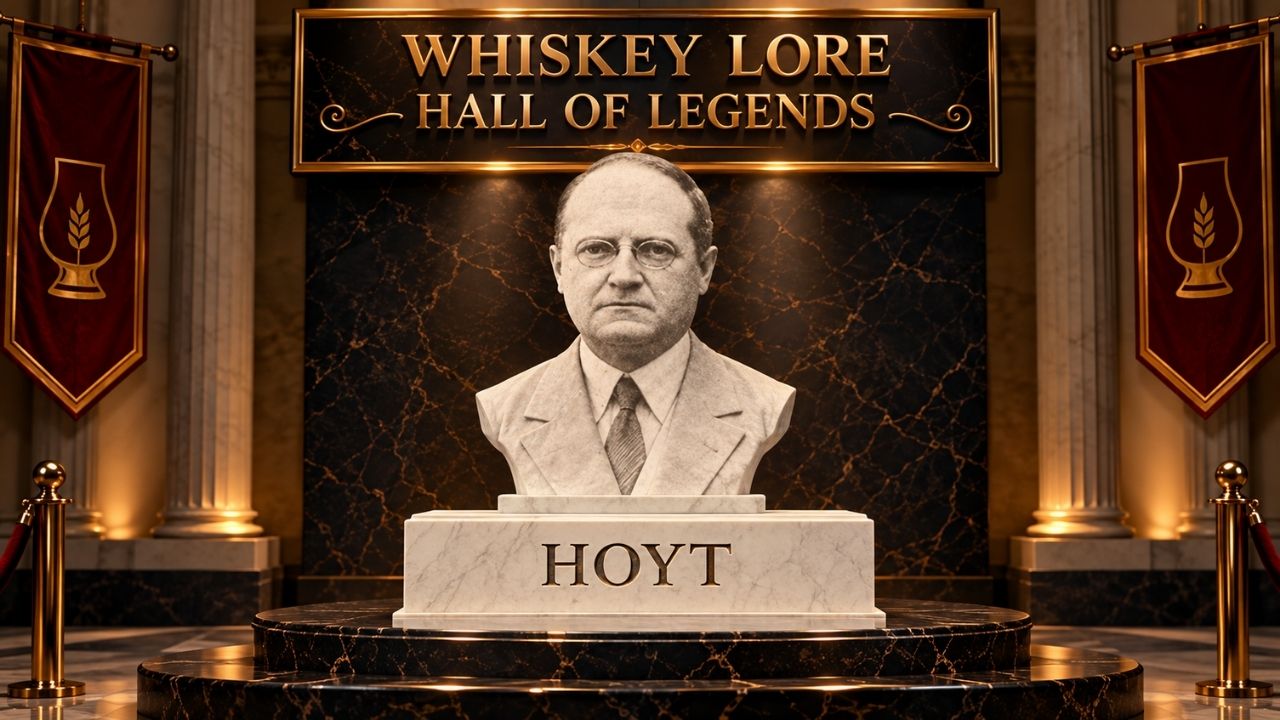
Listen to the Episode
Show Notes
FRANKLIN CHASE HOYT (1876-1937)
American jurist
- His agency established the modern rules for straight whiskey
- He established the 51% rule for Bourbon, rye, etc.
- He won $25,000 for his 1929 essay on rescuing the reputation of Prohibition and the Volstead Act
Transcript
Franklin Chase Hoyt
Welcome to the Whiskey Lore Hall of Legends
It’s time to meet our latest inductee:
Hello there. Hope you’re doing well. Forgive me. It’s been nearly a century since my spirit had a voice attached to it. It might take me a moment to get my bearings.
You’ll also have to excuse me. I’m still trying to get over the shock of being included as some kind of whiskey hero. It was never my intention to become one. In fact, as the longtime presiding justice of New York City’s Children’s Court, whiskey was about the furthest thing from my mind.
But this fellow channeling my story insisted I be included.
Frankly, I would have expected my grandfather to get the call before me. After all, when he served as Treasury Secretary under President Lincoln, he helped shape the excise law that helped bring organization and revenue from the industry.
As for me, before 1935, the biggest thing I was known for was my award winning 1929 essay on ways the government could re-establish respect for the 18th Amendment and Volstead Act. Back then, it seemed an impossibility that Prohibition would ever be repealed. But I wanted to plant a seed in the minds of those trying to legislate morality. After years in juvenile court, I’d seen how punishment alone rarely brought about the desired goal. I felt real change came through looking at the issue dispassionately.
As a pragmatist, I knew any solution would have to come within the current framework. In 1929, getting 36 states to agree to repeal seemed a pipe dream. Instead, I sought to redefine the key language in the amendment. As the law stood, it was illegal to manufacture, sell, or transport intoxicating liquors meant for beverage purposes. But what did the words “intoxicating liquors” really mean?
The dictionary back then defined “liquor” as “an especial product of distillation and as one of a spirituous character, as distinguished from beer, wine, etc.” My solution was to repeal the Volstead Act, redefine intoxicating liquor as “all alcoholic products of distillation,” and return control of malt, brewed, and fermented beverages to the states.
William Randolph Hurst put $25,000 in my pocket for writing that essay. I dare to say, those who wanted to return the world of distilling to America’s fruited plain were probably not quite as enthused about it.
Yet, the unthinkable happened. Four years after the essay was published, Utah became the 36th state to vote for repeal. And while my friend Franklin, as president of the United States was openly supportive of repeal, he and Congress weren’t quite prepared for the event.
What federal agency would rule over liquor? How would legislators stop the return of the brass rail saloon and all of its abuses. And how would the networks of bootleggers and moonshiners be shut down?
Without Congress out on December recess, President Roosevelt was forced to take action. One day before repeal, he used a loophole in the National Industrial Recovery Act, to issue Executive Order 6474, which established the Federal Alcohol Control Administration, a five man group who would shape the law. They were led by chairman and director Joseph H. Choate Jr.
This small team established the Codes of Fair Competition for separate branches of the alcohol business, which established the separation of the producer/wholesaler/retailer into a three-tier system meant to prevent the return to the days of liquor and beer interests running saloons and to stem the tide of bootlegging. FACA also promulgated regulations concerning false advertising, misbranding, labeling, and standards of identity for distilled spirits.
They classified whiskey as spirit distilled from grain and created four classes, including straight, blended, imitation, and spirit whisky. To be called straight, a whisky had to be distilled at 160 proof or lower, distilled in the same season at a single distillery with its age stated somewhere on the bottle. But there was no minimum age.
What I saw from that five man commission was incredible focus and dedication—nothing short of a miracle under extreme pressure as the government, industry, and country came to grips with the return of legal alcohol.
But it didn’t last. The Supreme Court struck down the law that gave Franklin the authority to create the FACA, leaving the agency dead in the water. Again, Congress was unprepared and chaos reined throughout the summer until in late August, the Federal Alcohol Administration Act was passed.
And this is where I come into the story. It seems my old friend Franklin saw me as the ideal candidate to help bring a non-moralistic, pragmatic approach to creating standards. I hedged at first. I felt the five-man commission had brought efficiency and focus to the liquor industry, but the new Federal Alcohol Administration was to be a department under my grandfather’s old agency, the Treasury Department. To me, I feared that bureaucracy would only bring gridlock and indecision.
Yet, despite my reservations, in September, I accepted the post, with the agreement that I was only there as a temporary measure to help get the agency on the proper path.
To help me understand all that had taken place within the FACA, I brought in the former assistant director Harris E. Willingham in as my right hand man. We covered all six branches of the industry: distilling, rectifying, importing, wholesaling, brewing, and vintners.
We reviewed and kept parts of the FACA that were showing effectiveness, such as the three tier system. But I felt the standards of identity for spirits needed some work. My team conducted hearings to determine the best path forward. Our goal was to get standards established for all six branches by December 5th—a heady task.
Not everyone was happy with our conclusions, but most of the objections came, not to our updated definition of straight whiskey, but instead, to how quickly the industry would be required to implement it. What we corrected from the FACA’s straight definition was the length and nature of aging. Our new standard required straight whiskey to spend at least two years aging in new charred oak. Yet, this is where we had our largest pushback. Few distilleries had stocks of whisky that met the new requirement and we didn’t want to kill off an industry just getting its sea legs. So, as was my nature, we looked at it pragmatically, and determined the age could be set to a shorter term initially, maybe six months and then be increased over time until the industry had enough 2 year old whiskey.
Somehow, within the agency structure, we made remarkable progress. During my tenure, we were able to establish the rules for wine and beer. However, spirits would have to wait. A persistent sore throat was concerning me and I decided it was better to safeguard my health, rather than continue pushing for regulations.
The work was basically done. All that remained were the signatures. I sent my resignation letter to the president, effective January 1st.
This is where the story gets a little twisted.
This Whiskey Lore fellow, the one I’m talking through, the one who discovered the story behind who set the standards for straight whiskey, and codified the modern rules for Bourbon, rye, and all other intoxicating liquors, apparently got a little overly excited when he discovered whose signature was on the rules. That signature wasn't mine.
After my resignation, Harris Willingham stepped in until Franklin appointed Assistant Secretary of the Treasury Josephine Roche to the temporary post.
By all accounts, Miss Josephine Roche is a remarkable woman. Her work with unions, children’s rights, and social security has long been undervalued. And while her signature graced the standards for American spirits, she had only been acting head of the FAA for seven days—most of those were spent in Detroit and Omaha promoting her other priorities. Having the Whiskey Lore guy give away my team’s hard work of consulting, collating, and defining the standards for American whiskey was a little too much to take.
The Whiskey Lore guy apologized and I appreciate him reconsidering my position in this story, even though I still don’t see myself as a whiskey hero.
My grandfather, Salmon P. Chase, Treasury Secretary under Lincoln and a guiding force behind the excise law, still seems like a much more interesting whiskey character than me. But when I consider how loose the rules for Bourbon, Rye, and other American spirits were before my team established their definitions, well...
It seems that, without me, American whiskey might be very different.
Do you know who I am?
WITHOUT ME
My name is Franklin Chase Hoyt, longtime presiding justice of New York City's Children's Court, short-term head of the Federal Alcohol Administration, and the latest member of the Whiskey Lore Hall of Legends.
Are you enjoying the reveal of whiskey’s greatest known and unknown legends? Well, later this week, you’ll get a chance to nominate your own entrant into the Whiskey Lore Hall of Legends. Make sure to join Patreon.com/whiskeylore or follow me at Instagram.com/whiskeylore for your chance to nominate the next legend.
More entrants in the Whiskey Lore Hall of Legends to come. Make sure you’re subscribed. And join us at patreon.com/whiskeylore for a chance to nominate future members of the hall.
Whiskey Lore Is a Production of Travel Fuels Life, LLC
Legendary scripts written, performed, and produced by Drew Hannush
Find transcripts and further details for today’s show at whiskeylore.org/episodes