
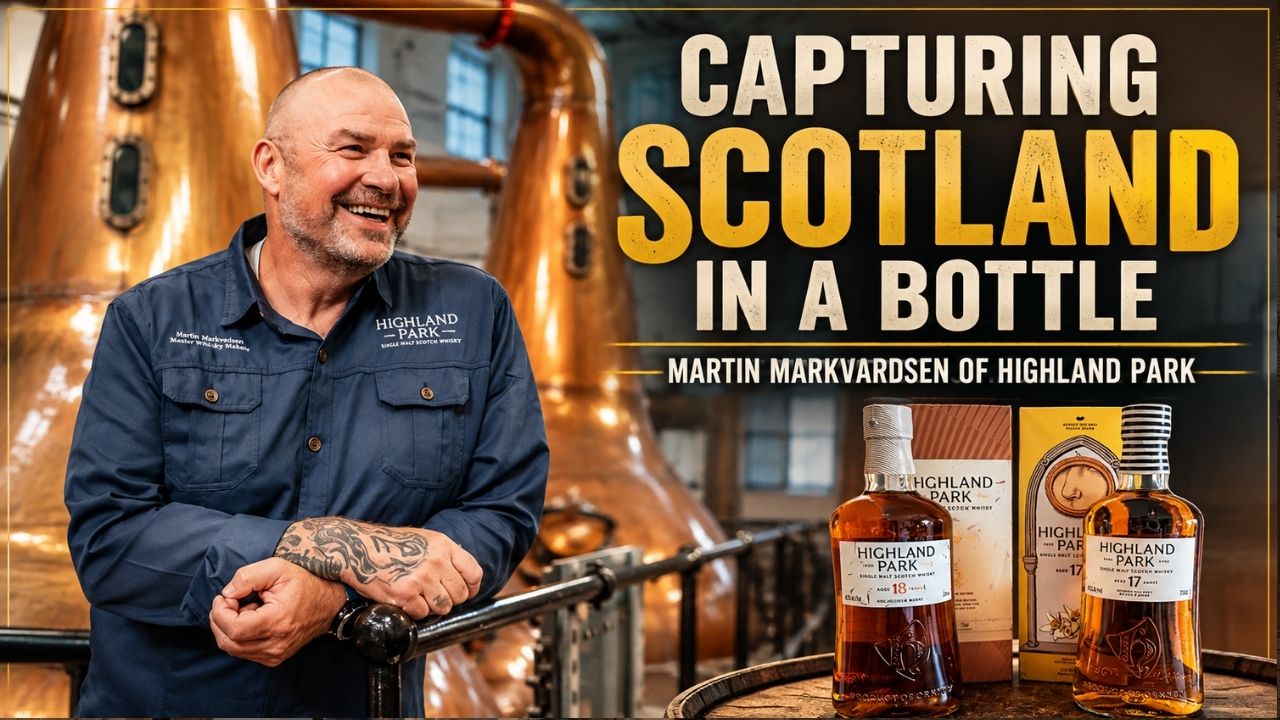
143 - HIGHLAND PARK DISTILLERY: Scotland in a Bottle
Listen to the Episode
Show Notes
GUEST: Martin Markvardsen (Senior Global Brand Ambassador, Highland Park)
What does it take to capture the flavors of Scotland in a bottle? In this episode, Drew Hannush sits down with Highland Park's Martin Markvardsen, who is celebrating 20 years with the Orkney distillery, to explore the history, people, place, and process behind one of Scotland's most complex single malts. From heather-rich Orkney peat and island maturation to the stories of illicit distillers and Martin's own unlikely journey into whisky, discover what makes Highland Park taste unmistakably like Highland Park.
In This Episode
- Why Orkney peat tastes different
- Peaty versus smoky: is there a difference?
- Why PPM doesn't tell the whole story
- Does sea air really affect aging whisky?
- How Orkney dramatically reduces the angel's share
- The illicit distiller behind Highland Park
- Why Highland Park still floor malts
- Can stainless steel replace wooden washbacks?
- Tasting whisky through memories, not flavor notes
- The best time to visit Orkney
SHOW NOTES: whiskeylore.org/interviews
JOIN THE SPEAKEASY: patreon.com/whiskeylore
Transcript
Drew H (00:00:14):
Welcome to Whiskeylore: The Interviews. I'm your host, Drew Hanish, the bestselling author of Whiskeylore's Travel Guide to Experiencing Kentucky Bourbon: Experiencing American Whiskey, and the book that busts 24 of Whiskey's Biggest Myths, Whiskeylore Volume One. And today, I'm going to be back talking about the islands of Scotland and a whiskey that I like to say encompasses elements of flavor from all over Scotland, coming out of one of the northernmost distilleries in the country, a distillery that I hope to visit on my last trip to Scotland. Unfortunately, the ferry didn't run, so I didn't get a chance to go today. I'm going to live vicariously through my guest, Martin Markvitson. He is the senior global brand ambassador for Highland Park, and he is celebrating 20 years with Highland Park. Congratulations, Martin.
Martin M (00:01:04):
Thank you. Thank you, and thank you for having me.
Drew H (00:01:06):
Yeah, we were talking before we got started about where you were headed because you're in Eastern time, so we're syncing up nicely here in terms of timing, but where did you come from and where are you headed to? Just to kind of blow people's minds a little bit.
Martin M (00:01:23):
Last week I was in LA and San Francisco. I went up to Cash Creek and did a whiskey fair there as well, came here. And then next week I will be in Texas, San Antonio and Austin. Then I'm going to London for the London Whiskey Show up to Glasgow to do a few meetings and then back home for a few days before I'm heading off six week to Asia to do exactly the same as I did here.
Drew H (00:01:51):
Wow. And you guys don't get frequent flyer miles over in Scotland, do you?
Martin M (00:01:58):
Well, we do, but the last thing I want to do when I'm off is definitely to fly. So I have quite a few of them which will never be used. They always run out. So I travel 200 days a year. So when I'm not traveling, I'm home and relaxing a bit.
Drew H (00:02:14):
Well, they say if you keep busy on stuff, time flies. So how long does this 20 years that you've been with Highland Park feel like it's been?
Martin M (00:02:24):
It doesn't feel like 20. And honestly, working with Highland Park and working with my hobby and Highland Park was my favorite brand before I started at Highland Park. I don't feel I have many days that feels like work. It's always just, it's my passion, it's my hobby still. It's something I like to do. And being around colleagues is close to being my family because I travel so much. And especially when I'm back in Auckland at the distillery together with the guys there, it's not work, it's just being home. I don't really think about it. It was more looking at the calendar. I said, "Oh my God, I've been here for 20 years." And found out that it was, if not the longest serving ambassador in the world for the same brand, but one of the longest serving ambassador in the world for the same brand.
Drew H (00:03:14):
Wow. And you were in the industry for a while before you -
Martin M (00:03:17):
Yeah, I did my first whiskey tasting in 1989. So a different time than today. We had five whiskey producing countries and you could basically count all the distilleries. Today, it's different. It's easier to mention the markets around the world that are not making whiskey. And we had 92 distilleries in Scotland when I began. Now there's 159. No distillers in England, they have 72, I think it is. So the whiskey world have changed a lot over the years and it's always good with competition, but it's also a lot happening on the market that we need to look over our shoulder and see what's going on.
Drew H (00:04:00):
How have you seen the experience change for people? I'm guessing in 1989, if you're doing a tasting, people are probably a blank slate at that point. There's so much information with the internet nowadays and there's so many experiences going on. Have you seen kind of a shift in people?
Martin M (00:04:19):
Yeah, I would say in general, the knowledge from consumers and from people are bigger than it ever been before. And as you say, it's easy to sit on a tasting and then look up on your phone what will the next question be because I know the answer for it. And you see that, but it's good. And with 20 years for Highland Park, it's always a challenge as well to come out and the question that are coming. And that's kind of what still makes it fun to see that people are much more interested. It's not just today a drink that they have to enjoy. It's so much more than that. They need the history, they need the production. What makes that whiskey different from another? Is it the yeast? All these kind of things. So everyone is their own little expert in whiskey. And I think that's down to consumers that just started, but have heard about whiskey from Scotland now, member of a Facebook group or whatever it can be.
(00:05:20):
So it's much bigger than when I began.
Drew H (00:05:24):
Have you found that you occasionally still get a question that you go, "I have no idea how to answer." Because when you get started in this business, it's like you do that a lot. There's so much to learn that you have to keep going back and asking questions.
Martin M (00:05:40):
Now and again, there comes a question where you have to dig deep, but also I got a question not so long ago. I was doing a tasting in Sweden and there was a guy asking us, first of all, he was writing everything down I said. And now again, he stopped me doing this masterclass and said, "Oh, can you repeat that?" But then he asked me, "So you have wooden washbacks. How many staves is in your washbacks?" And you know what? I've never counted them. So I said, "Well, we have two types of wood in our washbacks. So Oregon pine is always 48 staves, but is 56." And then he wrote it down and I had to go over to him after I said, "I have no idea, but next time I'm back, I will count them for you. I will let you know." But it's not often I get questions that I don't know the answer to, but sometimes I have to dig deep because there might be 10 years between the question comes up.
(00:06:37):
But it's good and it keeps me going. And what I always say about my job is that no two days are ever the same. It's always different audience, it's always different consumers. When I hear people saying, "Well, we are whiskey experts." And I say, "Well, so you know everything because that's what an expert do." I say, "No, we don't know everything well. If you still learn, you're not an expert." So I always prefer that I'm a whiskey geek, but specialized in Highland Park.
Drew H (00:07:10):
This is an industry that tends to humble you after a while. Having been to 400 distilleries, I can tell you that I still, every distillery I walk into, I learn something else.
Martin M (00:07:21):
And that's the beauty. And when I'm back at the distillery and working with the guys, there's always new things. And we are talking about the new body strains that are coming out, the yeasts and these kind of things, and what does this yeast do compared to the other yeast? And there's always things to learn. And I think the day you settle down and say, "Well, I think I know everything," that's the day where you should find another business because then you're not ready for new things that are coming. But I think it's a beautiful industry, just a thing that everybody talks about, the maturation part, casks. You don't know when you fill a cask, how the whiskey will turn out. You have a pretty good idea about when you make your new make spirit, but you have no idea after 12, 15, 30 years how the whiskey will actually be in that cask.
(00:08:11):
And that's something you can't learn. So that's something where you have to just be ready when it comes out. And thank God for single cask, thank God for 12-year-old, 18-year-old that are putting together so we can taste what comes out.
Drew H (00:08:25):
Yeah. And we actually have a whiskey that is just being released that we're going to talk about today as well as doing a tasting on the 18. But I want to dive a little bit into the history of Highland Park actually. As I said, I had a chance to go there. I was so looking forward to it. Actually, the first time I wanted to go, you guys were shut down for, I think, almost a year or so doing some kind of reconstruction. What was that all about? Were you doing some improvements?
Martin M (00:08:55):
We've been closed quite a few times over the last 10 years. Of course, we had COVID where we were close, but before COVID, we had a little incident. When you come up to Alkney and you passed Highland Park Distillery, you have warehouses on one side and you have the distillery on the other side. And to connect them, we had pipes running across the road on top of the road. And one day a lorry came from Kirkwell, the capital of Olkney, on the way to St. Margaret's South, passed through the road at the distillery. And he's been doing that for 20 years. But that day he forgot to take down the crane. So that was up. I was drying with the crane up and it took all the pipes down and they were all attached to the old building. So it damaged our buildings and these kind of things.
(00:09:49):
And they were connected with water, electricity, all these kind of things. So everything stopped the moment he ran into them. Normally it would probably take a few months to make it up again back to what it should be and probably also increase the height of the pipes. But we are talking Orkney and things takes time in Orkney and it's not something you do from one day to another. And instead of a few months, it took a year where we were closed because of that. We also closed down a couple of years back here to make our distillery more up to date when we talk about sustainability and so on. So we replaced all the wooden wash back to standard steel to control the temperatures, but also doesn't have to change them every 20 to 30 years or even earlier, but just have the stainless steel.
(00:10:48):
We changed the heating process as well. So we are using peat, but after peat, we were always using Coca-Cola and we wanted to get rid of that. So we are now using the heat from the distillation process that we then recover and use that instead of Coca and Cola to dry the mold completely in our kiln. So lots of good things that the future for whiskey when it comes to sustainability, but nothing that would change our process in total.
Drew H (00:11:20):
That was one of the early questions when I was going around from distillery to distillery, especially when in Scotland, because you would have distilleries that would have wooden washbacks and then you would have the stainless steel. And when you're in a country that they're meticulous about making sure when they replace a pot still that they have all the same dents in the new one that they had in the old one, you wonder how fussy the master distiller is going to be on the idea of, oh, how is this going to change my whiskey? But that's not something that you're probably going to notice.
Martin M (00:11:55):
The thing is we are working very, very closely with Scotch Whiskey Research Institute in Edinburgh, and there's no real evidence that the wooden washback will change the flavors for the final spirit that comes out. But of course, when we installed them, the first two, three months, we were doing a lot of trial to see how the new make worked with them and so on. We changed the yeast as well just to let it work better in stainless steel. So there was a lot of things, but I think it was within two weeks we figured out how they worked with our yeast and fermentation times and so on. And we got what we call classified A spirit coming out that goes into our cask. And that's what we were looking for. The same profile came out, PTNS. So it's easier for us. Just an example, to clean a wooden wash backs would take us at least an hour with the new stainless steel.
(00:12:56):
It takes four seconds. So it's a quicker kind of turnout we can have and fill them up again and so on. So when we are back to 100% production and so on. So for the guys up there, it's much easier and we can do much more experiments with the temperatures and so on because it's close vessel and maybe also in the future do experiment with different type of yeast and so on. But now we need to get everything going.
Drew H (00:13:24):
Well, talk about the history of Highland Park. On the label, we have 1798. Licensing, as I understand it, came a little bit after. To
Martin M (00:13:35):
Take it from the beginning, we had this infamous man called Magnus Jernsen that was distilling in Orkney on the place called Hyde Park in the Roastbank area. And Magnus was quite a clever man, had three jobs. During the daytime, he was a butcher, and then at night he was a smuggler illicit distiller. And then he worked for the church every Sunday. And looking at that, back in 1798, whiskey was called many things, but one of the things it was called was also the devil stram. And making the devil's dram and working for the church was not really a good combination. But Magnus did not work for the church because he believed in the man above. No, he worked for the church because he needed a place to hide his whiskey. So when he produced his whiskey, he would take it back to the church, hid it under the pulpit, holes in the walls, and even in old coffins, and made it through the years until it got caught in 1798.
(00:14:43):
In 1798, he was sentenced to pay a license, which he paid for a few years, but then he refused to pay it. And it got caught a little bit later in 1813 where David and James Robertson together with a man called Robert Prinkle. James Robertson was a customer and excise officer and he caught Magnus again and didn't take him to court. So what we have seen in all kind of scripts and so on was that he was basically just sentenced to leave Auckland for good. And when he left, he left behind his distilling equipment, his little bothy where he produced his whiskey, and David and James Robertson together with Robert Prinkle took over. And it was under their ownership until 1826 where Robert Berwick and his family made the license that we are working with today that came out after the Wash Act or the Excise Act in 1823.
(00:15:43):
So he got the license to produce legally with all the new rules and build the distillery a little bit bigger than it was later on Sinclair togo. He rented it out to a man called McFarland that was very passionate about whiskey, but didn't really have the business skills. So later we get the man that kind of made Highland Park into what it is today, James Grand in 1888 where William Stewart and James Grant builds the distillery to what it is today. And in 1895, James Grand's takeover completely as James Stewart dies and he takes completely ownership. And it was into James Grant's hands until the takeover from Highland Distillers in 1937. And then later Highland Distillers become Edrington Group that owns it today. So it's been into a lot of hands, but license has, from 1978 and up till 1826 was there a little bit and then it went away and then it was there again and so and so.
(00:16:53):
But 1826 is where the license is given. But the first license was given to Magnus Johnson because he was caught and got caught is what we translate to established because we can't really say got caught.
(00:17:16):
We know that he was producing whiskey before that, but can we say he was not established. So in 1798 where he pays the first license, which was only a few pounds, he actually get an official license. So it was the Wash Act or the Excise Act in 1823 that set the rules for how to produce whiskey. And that's what we are working with. So looking back, you see distillery today, but when Robert Berwick took over in 1826, he bought the whole distillery with warehouses and everything as it looked like back then for a thousand pounds. Wow. So that was a barking. So a few takeovers over the years, but today owned by Edrington that also owned McAllen and Glen Rothers.
Drew H (00:18:08):
I traveled the islands a couple years ago and of course you're really dependent on whether you can get a ferry to get out to the island. I'm thinking who is his market? Who is he getting whiskey made for? Is he just servicing the island Magnus in his friends around and he's kind of the connection to get whiskey or?
Martin M (00:18:34):
Well, we know again, there's books, Alkney around a bonfire and all these old books that tells about Mansi, which was Magnus Johnson. And Magnus, of course, he delivered whiskey to most of Orkney, but he also made it into the mainland. He actually had his little boat and sailed over and there are stories about him being caught with the customer excise and they took his carsks and then he drilled through the ceiling where he knew they were living upstairs on the pop. And the bar owner told him, "Well, the Karski is in the right corner of their room." And then they drilled up through the ceiling through the carsks and had a party downstairs where the customer excise was up in the room. So there's all these fantastic story about Mansi that he made it through the years until he actually was sentenced to leave Ockney.
(00:19:28):
And he probably continued his career distilling illegally on the mainland, but we lost all traces around him at that time. It's what makes the whiskey fantastic with all the old stories as well. I think they probably get better and better the more they're told, and it's like whiskey. It's aging.
Drew H (00:19:54):
Yeah. Slackens the jaw and gets you telling stories, so it just makes sense. That's the thing I fell in love with going to distilleries was hearing the stories because it connects you to a place. And if you taste the whiskey and the whiskey and you've been to that place, you also get a connection to it there as well. And that's part of what I love about traveling to distilleries and getting that.
Martin M (00:20:16):
But honestly, that was the way I fell in love with whiskey. To begin with, it was not so much the drink itself. It was more how proud the Scottish people were of the drink and the stories they could tell from the legal time and also the first and second world war and prohibition, how they smuckled in. It's these things that makes it funny to work with as well. Of course, production is for some of us, it's funny. For others, it's called nerdy, but it's the story and the passion that people have shown over the years that keeps me going as well.
Drew H (00:21:05):
So talk about your start in all of this. What got you into working in distilleries?
Martin M (00:21:13):
I'm originally born in Denmark. I'm a Danish guy and I served my service at the Danish Navy and the military police where I was there for 14 years. In my early career in the military police, I was on an excise in Edinburgh and we were there for four weeks and I had one day off to go out and see Edinburgh and all my colleagues went pop crawling. I though, "I'm going to see Scotland." So I rented a car and when you drive around Scotland, it's pretty difficult not to drive into a distillery. So I ended up at a distillery and there was a guy walking around in the courtyard of the distillery and I said, "Can I see what you're doing here?" And he was very, very proud and said, "Yeah, let's go in." And it was the master distillery that was just walking around.
(00:22:10):
So we took a tour around and I was so fascinated about. He was talking about his whiskey and everybody we met, it was their whiskey. So I was captured by that, by the story they could tell and the passion. I tasted the whiskey and it was one of the first time I really tasted whiskey, but it was not the thing that got me going. It was the stories and the passion about it. But there was something deep inside me that said, "I need to know more about this." And back in the 1980s, there was no internet. There was no - I
Drew H (00:22:45):
Was going to say there was no distillery tours. So you were basically going up and knocking on
Martin M (00:22:50):
Doors. So the only way I could learn were to go back and forth to Scotland. In Denmark, we had one or two whiskey books and they were very easy. It was Michael Jackson's first books. But it was quite the thing that turned me on in the whiskey industry were that when I went over there and I knocked the doors and said, "Do you need help for the next couple of weeks? Because I'm willing to work here for free just to learn." And in Scotland, you do know if you offer them something for free, they take it. So when I knocked the doors and said, "Can I work here?" And they say, "Oh yeah, yeah. Do you mind rolling cars into the warehouse? Do you mind? Fine." So I learned everything the hard way. And as I got closer and closer in the industry, I knew more and more people.
(00:23:46):
I went over to work with them both in distilling, but also in blending and so on and became a master of mold later on. And then I accepted a job at the most famous hotel when it comes to whiskey in Scotland at that time called Craig Alec Hotel, and accepted that as a whiskey manager, so took care of everything behind the bar. And it was from here I got approached by Highland Park because they were there listening to one of my tastings, which I had no idea they were from Highlan Park, but I sai, "Well, Highland Park 18 is my favorite whiskey." And then they came back a few weeks later and I said the same. And then the one that was in charge of the group came up and said, "Are you really that happy for Highland Park? Yeah. Do you want to work for us then?" Yes.
(00:24:36):
Wow.
Drew H (00:24:37):
And
Martin M (00:24:37):
I felt like a soccer player being asked from Liverpool, "Can you come and play for us?" Because it was something amazing. And I think when I began working for Highland Park, that's where I realized how far I was actually going with this and that it was where I wanted to spend my years in the future to promote that. I never ever expected it to be 20 years, but still going and still enjoy each and every day of it.
Drew H (00:25:09):
When you got started, how did you learn about Highland Park? Was there already somebody there that was an ambassador that you kind of worked with or did you have to kind of figure it out yourself?
Martin M (00:25:22):
Yeah, I figured out myself. I remember I was in Edinburgh, went into a bar in Edinburgh and they had one of the old style bottles of Highland Park with the Earl McNuss on the label and had a drum of that. And I was completely blown away from, "My God, this is fantastic." And I ran to the nearest shop in Edinburgh and they didn't have that particular bottle for Highland Park because it was one that was special made. But I bought the 12-year-old that came out in 1979 and had that in my room at night and though, "My God, this is amazing." And since then I actually became Highland Park fan.
(00:26:10):
I love whiskey in general. There's no such thing as bad whiskey, kind of. But it was always Highland Park where I used as a reference to everything else. And today it's still, that said, of course there's 159 distilleries in Scotland. They're all making amazing whiskeys. There's many countries making amazing whiskeys. But for me, there's still something in Highland Park that I don't find in any other whiskey. And that's what keeps me going with Highland Park as well. But mostly when we talk about Highland Park today, after that many years, it's the people behind it that, as I said to you earlier, it's family. And without the people, I don't think I would be here, but it's still a really good whiskey.
Drew H (00:27:09):
I find Highland Park to be encompassing of the entire island of
Martin M (00:27:15):
Scotland,
Drew H (00:27:16):
That there is a complexity there and there's an interest and there's Heathery notes in it. I get smoky notes in it. I get citrusy notes in it. It feels like if you wanted to put Scotland in a bottle, Highland Park would be the bottle that I would usually recommend.
Martin M (00:27:40):
Well, I agree. And you and I are not the only one because Michael Jackson, the late whiskey writer, Michael Jackson, he wrote about Highland Park that it's the best all rounder of all whiskey. And he didn't mean that in a boring way, but basically that we had a little bit of everything. If you take the lowland, this mild kind of floral feminine side of the whiskey, Highland Park has a little bit of that. But we also, at the other end of the spectrum where you have a little bit of peat and smoke and the kind of Highland masculinity, and then we had, of course, the spaceide fruity notes and so on. So we have a little bit of everything. And it is kind of a DNA to have this beautiful sweet smoke, but not too much of it because there's other that are better than ours to make heavily pizza mold.
(00:28:40):
But we want you to know and we want you to feel this kind of sweet maritime notes, a little bit of rural notes as well. And I think we succeed with that in everything we do.
Drew H (00:28:52):
Where does this come from? If you could break it down in a way, is it the grains that you're bringing in? Is it the process? What is creating such a complex whiskey?
Martin M (00:29:07):
Well, it's not the grain. The barney we're using today is the same barney type as say 80% of the distilleries are doing. It's not the yeast, but it's the peat we are using from Auckland. That's the first kind of ingredients we add to our, can we say final flavor. So the peat in Oakney is very, very different than the rest of Scotland. We're normally talking about four areas where we cut peat. So everybody knows about Isla, where we have beautiful distilleries like LaFroix and Bermore and Colila, Arbeg and these kind of things. We have Tumintal in the Highlands. We have San Fercus in Aberdeenshire, and then we have Oakney. That's kind of the four main areas with peat mirrors, and they're all different. So peat is not just peat. And for the listeners out there, You don't know what peat is, but peat is basically decomposed organic matter for thousands of years.
(00:30:06):
So you need lots of water to create it. You need plant material to create it over thousands of years. And if you go to some of the other places in Scotland, then Oakney, you'll see that a lot of trees used to grow their trees from 4,000 years ago, different kind of bushes, grass, plants, flowers, whatever it can be.
(00:30:30):
If you go to Orkney, one of the things you will very, very rarely see in Orkney is trees. So trees can't survive in Oakney due to the wind. The wind in Orkney is heavy. 80 hours a year is up to 110 miles per hour. So heavy, heavy wind. And that means the trees you find it very difficult to survive. But what we do have a lot of, and especially at Hbs de Muir where we cut our peat, is a little flour called heather. You won't see it too much in America, but it's a little purple flower that gives us a lot of kind of honey floral flavor. But that also means that when we burn our peat, it burns in a different way. It give different flavors than if you go to isla. So in all honesty, if we use the same amount of peat as we'll do at one of the islet distilleries, the same peating hours, we might get the same PPM level, parts per million level, but our flavors in the end product will be completely different because our peat do not allow it.
(00:31:34):
So the first kind of ingredients we can say that change our whiskey and makes it sweet, floral and like the pizza is the peat we're using from Oakney. If the peat in Highland Park is wrong, our whiskey will be wrong. And that's just how it is.
Drew H (00:31:48):
Okay. When you're doing the kilning, is the peat still wet or is it
Martin M (00:31:53):
Dried?
(00:31:54):
You need to have some moist inside the peat because otherwise you can't make smoke, then it will just burn. So it needs to be a little bit moisty. But we are the only distillery in the world using oakney peat. So this is where we really stand apart. We are using the same place that we've been using since 1798 to cut peat, which is Harvester Muir. And we use about 80 to 110 ton per year for our production. And so we cut it in May, June and we leave it there to air dry. And you think air drying in Scotland where it rains a lot? But it actually works. When you cut peat, it gets kind of an oily skin very quickly so water will run off. But even after a few months, you can break it into two and you'll still feel the moist inside and we need that for our production.
(00:32:46):
So it's not an endless source because we cut down three, four meters where we use the peat and our peat only grows with a millimeter per year. So of course when we cut down to three, four meters, it will take 3000 years to be the same. But we are leading a program in Scotland to see how good we can regenerate peat. Not quicker because that's the nature law, but definitely make it grow again. And with all the changes in climate and so on, that's one of the things that we definitely need. But we do have enough peat for the next, I would say two, 300 years at Hobster using the amount we're using today. But we also own the rights at another peat mure, but we can't cut peat there now because we own it in corporation with RSPC, which is the protection of birds.
(00:33:45):
So until we run dry at Hobister, we are not allowed to cut peat in there. But when we run dry in two, 300 years, we will politely ask the birds to move next door and then we take over their land the next couple of hundred years. So I'm not too worried about the peat situation. We have really, really good peat source and it's where we need the flavors from. And then of course after that, maturation is a big part of it. Not only are we using shelly cars, both American oak and European oak to give some of the flavors to it, but the warehousing and the climate in Auckland is a little bit different as well. We are coastal whiskey, so we are close to the sea. We'll get a little bit of maritime notes in a whiskey, but we also see that because of the climate there that it's never really, really, really cold.
(00:34:46):
It's never warm either. The difference between summer and winter is not a lot of degrees. So our whiskey matures in a different way. And we can see the difference between whiskey matured in Auckland and whiskey matured in Glasgow Highland Park because we do have the cask line in Glasgow as well. And we can see the difference in flavors and alcohol strengths between those as well. So there's more to it than just making whiskey. There's all the ingredients we put in like peat and casks and these kind of things as well. So all together.
Drew H (00:35:21):
Interesting having them aging in two different places because there's this idea that if you're aging a whiskey in a coastal environment, yes, it's in a cask, but it is actually picking up some of the elements of the sea air in it versus the ones that you would be aging in Glasgow. Do you find that? I mean, is it significant enough that you would be able to tell that?
Martin M (00:35:45):
No. I would say you have to leave it for a lot of years before the kind of coastal air can penetrate the cask and really get that effect in there. But what we can see with the coastal is that the humidity is a little bit different together with the temperatures. So when we're talking about the angel share in Scotland, it's normally that we are accepted to lose two to two and a half percent from a clask a year. And that's what we're losing when we mature our whiskey in Glasgow. But in Auskney we lose 0.5 to 1%. Wow. So it's a different climate with a slower maturation and not a big share to the angels. So that's where we can really see it. But there is a slight difference in the flavors of the whiskey. And one thing we can see is that whiskey matured in Glasgow will normally have a higher strength after 12 years where we will have more in the cask in Auckney, but a little bit lower strength.
(00:36:46):
And that's the combination between humidity and temperatures that can change that as well.
Drew H (00:36:55):
That's really interesting. The whole concept of aging a whiskey in a environment that goes slower, does that keep you from wanting to put out whiskeys below 12 years? Or what do you find of the younger whiskeys?
Martin M (00:37:17):
No, we used to have a 10 year old. We have had a few non-age statement that have been around eight years as well, which has been all good. When we say 10 years old doesn't mean that we don't use some older cask, and we have some really good whiskeys, but I would say most of those would probably have been made with cask from Glasgow and not from Orkney. But it's not like in a blind tasting you would say, oh, especially not when it's taken down to 43, you say, oh, this must have been matured in Glasgow and Edinburgh. So it's not a huge difference in flavors. Our master whiskey maker, Mark Watson, will probably be able to tell you a little bit about when he knows it and tastes it that, oh, this is probably from Orkney compared to this one here. But I think it will be more about the strength of the whiskey.
(00:38:10):
He can tell you that exactly than that. I always find, but I think that's my imagination. I always find that when I taste whiskey from a warehouse in Oakney, straight from the casks, that I find a little bit more kind of spiciness, saltiness. But I think it might be my imagination because I want it to be but it's one of these things that the good thing is that no two cars are the same. But even in Orkney, we can see our warehouses lying on a hill going up a little bit and there's a big difference in how the cars closest to the sea mature compared to in the warehouses further away. And all these kind of things have an effect, of course, at the final flavors.
Drew H (00:38:59):
You're doing onsite floor maltings, as I
Martin M (00:39:02):
Understand.
Drew H (00:39:03):
If you're doing your own peat, that's the most convenient way for you to handle that. I'm wondering about the process. First of all, you're not doing any whiskeys that have no peat influence on them. No. So when you're doing this and you're kilning and you're then doing your floor malting, kilning, and then you are doing distilling, you're not doing like a bunahobin and you're doing your peated whiskey at one point and then doing a non-peated and then blending them together to try to marry a flavor. But instead you're having to get that flavor, the right amount of peat into your wart. What is the process for that? Because it seems a little different than others.
Martin M (00:39:50):
Yeah. So basically we don't make anything unpeated. Everything that's unpeated would come from a commercial malting. So everything we produce at Highland Park will be peated. But in a 12, 15, 18, the core range and a few others, the ratio will be 20% peated mold and 80% unpeated. That means that we mix our peated mold with unpeated mold before the mashing. So we take the malted barley in from a commercial mold. We take 75 to 80% of that and we take 20 to 25% of the peated mold and that's the mash bill. And then we produce on that. But because we are doing everything that is peated on site, now and again, we keep some of it back and don't put it in with the 80, mix it with the 80%. And that's where we make something like heather that came out last year, which is a heavily peated Highland Park because then we peat it up to about 38 to 45 PPM.
(00:41:00):
And that's where we can make some of these special additions with a little bit more peat and so on. And that's simply because we just add a little bit more of the heavily peated whiskey in there. So we produce heavily peated malt for a couple of weeks every year, but the normal ratio will be 2080, so 20% peated, 80% unpeated.
Drew H (00:41:21):
What's fascinating me about this is the idea of this complexity of flavor coming from the peat because we get it in our minds that peat is about adding kind of a smoky note to it. And if you're in Iola, you're going to get the medicinal note because the iodine in the water and the area and all of that and kind of the seaweedy thing you get with LeFroid because they're doing really damp peat smoking when they're doing that. So this idea that your peat actually has this complexity of flavor, what is happening when you're doing a higher volume of your peat in those whiskeys? What flavors are you noticing popping out?
Martin M (00:42:06):
Yeah. Well, first of all, there's a slight difference between being pizza and smoky. You can basically have a smoky whiskey without being pizza and you can have pizza whiskey without being too smoky. So it's two different flavor profiles, but normally they will follow together. What we see when we have, like the whiskey we make called Heather, which is a heavily pieted mold cask strain, we get much more sweetness and kind of floral notes and is a little bit more kind of earthy than it's smoky. So that peatiness is not going to go into a smoky kind of flavor that you will see mostly from Ila, but more kind of an earthy note, of course, with a touch of smoke because that's what we actually creating, but it's a different kind of flavor. And that's the thing where if we are using the same amount, as I said before, like Isla distilleries, we can't even get up there.
(00:43:10):
So we have whiskeys like 45 PPM. We even have some samples, some cask lying around with 90 PPM and a little bit over, but it's not even close to an Isla whiskey because a peat can't deliver that even though technically speaking, it's up there. And what I always say to people when we do these masterclass and so on, don't let that PPM fool you because you can have the same PPM around 90, but two very, very different whiskeys also when it comes to smokiness or peakiness. But the phenol might be the same. And it's a funny thing. It's one of these things that I'm working with quite a lot, especially when I'm down at Scotts Whiskey Research Institute to see how does all these kind of different peat levels affect whiskeys? Does it really have to be two, 300 PPM or can we actually make something happen and something funny and tasty around 20 or 30 or 40 PPM?
(00:44:14):
And that's good fun because it also depends on how do you burn your peat? Is it a slope? Is it a cold fire you have? And is it temperature low? Are you just firing up? There's a lot of these kind of things. And to give you an example, when I began working for Highland Park, we were using 300 ton per year. We were using two to three ton per seven and a half ton malt to dry it today. And we're getting the same results. Today we're using 80 to 110 ton per year and we are only using one to 1.5 ton for seven and a half ton malt. But we are getting the same PPM level just to keep an eye on it much better. And it's one of these things where you can play around with temperatures, you can play around with hours of course, and get different kind of phenol levels and definitely also different kind of flavors.
Drew H (00:45:12):
Yeah. PPM sort of becomes like a scorecard bragging right or that sort of thing. Ours is more peaty or not, but it doesn't take into account things like where you make your cuts when you're doing your heads, hearts and tails. And if you're cutting in a particular place, you may be cutting some of that potency of that smoke.
Martin M (00:45:33):
Yeah. And to be honest, what we always do internally when we talk about the PPM internally, we always talk about the PPM in the spirit because that's much more accurate because you can change it during distillation, you can change it to fermentation. There's quite a few things where you can change the PPM level, but when it's coming out as new make, that's it. And that's kind of the accurate PPM we were talking about.
Drew H (00:46:08):
So is this creating different styles and really expanding the portfolio, when did that sort of start? Since you've been doing this for quite a while, when did you see that trend start with you guys?
Martin M (00:46:20):
Yeah. Well, for Highland Park compared to many others, it's been a slow process. When we launched the first 12-year-old in 1979, we only had a 12-year-old in the market for 18 years. And then the 18 came out in the late 90s, 1990s and 25. And then you can say the evolution of a whiskey and most distilleries started. But where we kind of saw a change for Highland Park were at the time where. When we talk whiskey history and we talk whiskey production, you always have to go back in time because the past will tell the future. And the whiskey industry in Scotland between 1983 and 1993 was not really good. A lot of distillery closed and a lot of distilleries went down in production. Highland Park was one of the distilleries that went down in production and didn't really produce a lot. So when we came up to the say beginning of the 20s, 2010 and so on, when we had to produce the 18-year-old, we didn't have that amount of cask because we didn't produce that much back in those days.
(00:47:40):
And that's where the non-aged statement kind of came in and we produced a lot of special editions and probably also some editions that even though they were good, but wasn't necessary, but it was to take away a little bit of the pressure for the 18 and then come in with some others. And it worked for us. We had some amazing whiskeys and also non-aged. But then when we could see now, well, now our stock is actually where it's good and we can keep a steady production of 12, 15, 18 over the years, we kind of stopped doing a lot of special editions, but we still have a few coming out every year, like a cask string version between you and I that you have in front of you as well. And we think that's important to continue some of these special editions to show people what we also can do because it's not just about core range.
(00:48:42):
Core range is what we like people to buy and sit home and enjoy, but we also need people to see, well, okay, they can make a pitia version or the smokier version depending on how you look at flavors, but they can also make something that's completely different where they're playing around with casks. So we have had port wine casks influenced. We had riyaka casks and these kind of things. So I think it's important to keep the distillery alive by doing special editions. But what we always need to see, and this is of course Gordon Motion, the previous master blender, but also Mark Watson today, what they always need to see is that the true DNA needs to be there. So when you taste it, it should still be unmistakably Highland Park. So there's always some of these notes that we need to go for so we are not going completely out of our comfort zone when it comes to Highland Park.
Drew H (00:49:42):
This is what I love about hearing and going through this discussion about where the flavor is coming from, because how do you let people on a box know that I'm putting out a high peat whiskey here and here's why this high peat whiskey is going to be very different from what you would experience in getting a high peat whiskey from Isla or even the Highlands or anywhere else because it's so much of your
Martin M (00:50:14):
DNA.
(00:50:15):
We tend to be quite transparent on our box, but also with the message we send out, why our peat is different, especially when you come up to our, I would say a little bit old ages like 21, 25, 30, which they're all releases by vintage. So 21 or 22 release or 23 release. And they're all different when you look at the cast makeup. So when you buy a 2019 21, it's not the same as a 2023, but we tell you exactly the amount of cask we've used. We tell you exactly the type of cask we used and what those flavors will bring. And I think that's one of the things that the whiskey industry need today is it's funny to have some secrets and it's funny for people to get, but at the same time, it's also good for people to have that transparency where you can really see why is it tasting like this?
(00:51:13):
That was not the same as last time. So I think in the future you'll see us being much more transparent with information about our whiskeys and what we are actually looking for and the reason we did so and so. And I think that's what the specialty connoisseurs and so on like us to do. But also for the new people that are coming into the industry, it's a learning process for them and this gives them a little bit more background as well on what we can do with whiskey.
Drew H (00:51:45):
The knowledge that I have now is going to make me approach nosing and tasting a Highland Park whiskey differently than I did in the past. And sometimes there's a danger in that, I guess, because as we say, when you're doing a tasting and you tell somebody the flavors that they might experience with that, they're going to experience those flavors because you put it and planted that seed in their head. And so I sort of will be interesting to see how my experience with tasting Highland Park whiskey changes now that I kind of have more of a knowledge of that process.
Martin M (00:52:20):
Yeah. And it's funny you say that because neither Mark Watson, our new master blender and myself, we are not talking too much about tasting notes because it's very, very individual. And I can tell you one thing, when we launched our 15-year-old, the new version of it, one of our tasting notes was pineapple. We found some tropical fruits and it was pineapple. And I was doing a tasting in Singapore and I said, "So do you all find pineapple?" And there was a lady there saying, "Have you ever tried pineapple?" I have. Well, not from Singapore then because this is not how pineapple tastes. And then I tasted pineapple in Singapore and she was absolutely right, completely different, much more sweetness and so on coming out. So it all depends on where did you grow up? What kind of food did you grow up with and these kind of things.
(00:53:19):
And so tasting notes is very bit individual, but what I always say when I do my masterclass and tastings, if you can find sweetness, I basically don't care if you call it honey or you call it chocolate or caramel. The same spiciness, I don't need to know, if you put names on it, fine, but it could be peppery, it could be paprik carry and all these kind of things and so on. And the same with peat and smoke.
(00:53:54):
It's not necessary to know the difference for me and for you that work with whiskey as well. It's fun, but for most people when they say, "Oh, I think it's too peated," fine. I will not change their mindset, "I think it's too smoky." Because everyone is right. There's no right or wrong. And that's the beauty about whiskey. How you enjoy it is up to you and what you find in your whiskey is definitely up to you. So I'm not going to mention 20 different tasting notes. Some years ago I was doing a tasting in Italy and they took me out afterwards to a restaurant and there was a sommelier that was absolutely amazing. But when he described the wine for us, he mentioned 40 different berries and I couldn't help it. So afterwards said, "Well, at least you must have something right then because when you mentioned that many, there's a big chance you hit the right ones." And that's what I always feel.
(00:54:59):
Don't complicate whiskey too much, make it easy. But when you sit at home and you enjoy a good glass of whiskey at night, that's where you can analyze it a little bit more and go into depth and then work with that. But in all honesty, whiskey is made to be enjoyed, don't make it too complicated.
Drew H (00:55:22):
Yeah. Yeah. Sometimes if I get too into analysis, I just find myself frustrated while I'm tasting the whiskey rather than just sitting back and relaxing. And what's amazing is when you sip something and you're talking to somebody or your mind's on something else and the flavor just hits you, it's like I could have tasted this and tried to focus on it for hours and I wouldn't have pulled that flavor out. But for some reason, something sparks in your mind or you've relaxed and you've allowed the flavors to come to you
Martin M (00:56:00):
Instead of - Andrew, my girlfriend doesn't drink whiskey at all, but now and again, when I sit at home and I'll say, "Don't analyze it," but I have to do it now and again, especially when we send out new products and I'll definitely take my time to analyze it. Now and again, she comes in and I say, "Well, try and nose this whiskey and what do we find?" And the minute she puts it up on her nose and she just say, "Well, cinnamon." That was the word I was looking for. Thank you very much. So it's one of these things that it's always interesting when you have a passion for whiskey to go deep into whiskey, but it's not necessary.
Drew H (00:56:44):
Well, and all of this because I'm looking at the box for Behind You and I, and it says something to the effect of, "There's no tasting notes here. We want you to experience it." So is this kind of a change in direction for Highland Park or is this something you wanted to really just kind of say on this particular series?
Martin M (00:57:05):
Yeah. So the series we call Between You and I is actually meant to be more kind of a conversational thing. And it actually came out of this beautiful box here. Yeah. This is the second release of Between You and I, but it came out of the first one where we used a Swedish chef and we though, well, he would be good to describe flavors and so on. And we were looking at our tasting notes and then he tried the whiskey. We were using Swedish oak in this whiskey, but he didn't do that. He came up with a lot of things like, or that nose or that flavor reminds me of Led Zeppelin playing this and this tune. Or when I walked through a forest in south part of France and the autumn leaves fell down or one of the very, very first things he said when he tried it was orange.
(00:58:12):
And I was thinking about orange peel, but no, no, it's the color. It's the color. And I said, how can you describe a flavor with a color? Well, it's the first. So it was all these kind of things and his emotions and memories. And when he put the glass to his mouth or to his nose, he said, "Oh, walking through my grandma's kitchen while she was making Marzipan out of almonds."
(00:58:37):
Oh yeah. Okay. So all these kind of things. And when we made this one here with Lila Gore, a girl here from New York that is a fantastic chef and architect, it was the same. The way she described the whiskey that Mark Watson had made of the flavors and flavor profile that she really wanted from her background from Egypt and so on, it was simply amazing the nose of leather going through the museum of Egypt and all these kind of things. So it's between you and I is the conversation about the whiskey, what do you feel? And I think it's a fantastic way to describe whiskey because that's what we say. No two people will ever have the same palette or the same nose. So describing it with feelings, emotions and these kind of things is much better than caramel citrus.
Drew H (00:59:39):
Well, I think it helps make it real.This is what always got me about tasting whiskey and nosing whiskey is I'm looking and there's this liquid in my glass and I get frustrated when I'm sitting there and I'm trying to pull out a smell and I'm like, I know that scent. I'm very visual. If I see something, then I can relate to it a lot easier than if somebody tells me something. And it's the same looking at a glass of whiskey. I'm looking at it going, there's a smell, but there's a disconnect because I can't see the element that I'm smelling right now. So how can I pull that out? Which is, to me, the biggest challenge of doing nosing. But you're right. I think everybody needs to find their own way of connecting to what that smell is because I do know somebody who uses breakfast cereals as a way to tell you what his bourbon tastes like.
(01:00:43):
Because if that's what helps you connect and then just deconstruct what is it about that cereal that are the flavors or scents that you would be experiencing to kind of break that down.
Martin M (01:00:58):
I completely agree with you. And I think even though working whiskey for that many years, I can still sit at home and think there's something here, but I can't describe it. But looking back and especially over the last couple of years, if I then think differently and say, "What does this remind you of? Is there anything else?" Say, "Yeah, but I remember that smell from the time I went to and I walked past and then could be licorice, it could be all these kind of things." So I think what we need to do with whiskey as well, and especially it's got single malt, don't be too serious, but have fun with the whiskey and having fun. I don't mean drink a lot. No, have fun describing it. And I would love to read a book where there was no tasting notes, but there was a full page about feelings and emotions about what it
Drew H (01:02:09):
Tasted. What it brought back to you. Well, I will tell you that there are some fruits that are so vivid in my mind that I can't really put it to a memory of something else. So I get apricot in this on the nose and it's very strong. And that's one of those fruit smells that's very. I don't have an association with it. I can't think of. I've had apricot before, but it's usually been in a fruit salad or something like that where it's not really been out on its own. So I don't necessarily have a memory of it on its own. So that one stands out.
Martin M (01:02:48):
But between you and I here, first of all, there's a big difference if you drink it as it is or you add water, it's 47.5. So there's a little bit of spark to it. But what we used here, the first 11 years has been in American oak refill cask, but the last six years is in completely new American oak. So the new American oak will give you a lot of notes that you will normally not find in whiskey because it's very rare we're using new American oak, but there's definitely some similarities to some of the bourbon notes you will always find the sweetness and there's a little bit of corn coming out and these kind of things, even though it's not there, but it's kind of the bourbon thing. I think it's important to make whiskeys like these where we move a little bit away from what we normally do and not just saying it's all about sherry, it's all about all these notes when we talk about casks.
(01:03:54):
When we talk about casks, the kind of normal conception about cask is that they give at least 60%, some will say 80% of the flavors to a whiskey.
(01:04:07):
I agree to a certain point, but I think it's much more important to say that the cask, if the spirit is right, you need 100% cooperation between the spirit and the casks. Then it might be that the cars only give 30, but is that the 30 that is enough to change the whiskey like we want to and these kind of things. Again, don't go too much into the percentage of how much kask gives because it also depends on the spirit. If it's a heavily piece of spirit, you can't really say 60% of the flavor comes because it went straight through with the peakiness from the spirit as well. But I think here the carske really gives an impact, especially the brand new virgin oak, as we call it new oak, but it's what everybody else called virgin oak. I think it's amazing.
Drew H (01:05:02):
Yeah. One of the things that attracts me to any Highland Park that I've had really is a really nice mouthfeel to the whiskey, which just adds to the whole tasting experience. As we were sitting here, I was going, "Okay, what experience can I think of that I connect with this particular whiskey?" For some reason, I just could not get out of sitting down and enjoying some coffee cake for breakfast on the finish was just sitting in it. I'm getting butterscotch notes and the caramel notes, but the kind of a citrusy note in there as well that holds through. The smokiness is there or that peat note, but to me it's not necessarily that element that is standing out to me. To me, it is that cask is adding some really interesting surrounding notes to it.
Martin M (01:06:02):
100% agree with you. Toffee caramel notes is there, butterscotch is there. I think especially the caramel notes, we can see that will be from the new oak because it will not be there in the American oak refill cask that we normally have. We'll get a little bit more coconut from them, but the kind of tofi caramel note is definitely from the new oak. I think it's interesting to see the combination of these two casts together, how it work. Six years is a long time in new oak, but it was already matured spirit that came into it. It's not a finish, it's just a re-casking a new oak that gives us a really good complexity and some nice balance to it.
Drew H (01:06:47):
Yeah.You're re-charring the barrels or you're charring
Martin M (01:06:52):
The
Drew H (01:06:52):
Barrels?
Martin M (01:06:53):
Yes. The new oak will be charred and otherwise I think it will be too harsh. We need to take a bit of the flavors away by charring it, but also to open it up a little bit more because it's American oak. And that's where we get a little bit of the caramelization as well from the charring of the cars.
Drew H (01:07:16):
That's the tough part is putting it into a charred barrel and not letting that char just turn it into an equivalent to a bourbon that is pulling all that in. Again, your climate is probably a big help in that.
Martin M (01:07:31):
Yeah. And then of course we are looking at the degree of charring as well that it can't be croggled outskin, but a lighter charring as well. Yeah.
Drew H (01:07:45):
Let's introduce people if they haven't had it before to the 18. I have that here as well. This is interesting because when I started,
(01:07:57):
It's taken me a while to get used to drinking older whiskeys. I know a lot of people will automatically gravitate towards trying to get as old a bottle of whiskey as they can get or an oldest age statement that they can find. I'm one of those people that leans more into the early days when you're getting a lot more of the distillation, the new make experience. I want to see what the flavors are before they sit in the cask and mellow out to a point where you really have to kind of struggle. For me, it's kind of a struggle sometimes to go in and find. In heavily peated whiskeys, sometimes that age also starts to pull away some of the things that I really like about that peated whiskey. There's that challenge of that. I have to say the first time I tried 18, I was already a huge fan of 12 and I felt like it was kind of pulling back a little bit on the things that I really liked about the complexity of 12, but it actually has its own complexity that comes in that is very different from 12, I think bringing some of those older elements in.
Martin M (01:09:10):
The one that really got me started and liked Highland Park, but when I tasted the 18 in the late '90s and so on, I though, "My God, can whiskey really be that good?" But what I always found about it were that normally you will see that when you come to 15, 18, the cast becomes to take more over, but I still think we have the distillery character. I completely agree with you, one of my favorite whiskeys from Highland Park as well is the 10-year-old because you can taste a new make and I like that. But I still think we can do that here. We are using European oak yardi casks. We're using about 40% first fill and 60% refill. It's the refill that really give the balance and kind of lifts the new make spirit there. Then you get the complexity from the 40% first fill.
(01:10:05):
I still think you can find the new make here. But what Highland Park 18 has always been known for is of course the balance and the balance is definitely there. But of course this is our most award-winning whiskey and it's the one that really put Highland Park on the map. But it's a whiskey that still today, when I taste it, I keep on finding new notes in it. There's always something new coming out, but not to go back to tasting notes, but some of the things that I always find here is orange peel and marzipan and almonds is there.
Drew H (01:10:41):
Yeah. Well, and I've gotten dark chocolate out of it. I've gotten pepper out of it. I've gotten clove out of it. What I love is on the pallet, I get what I call orange creamsickle, so kind of a vanilla orange note that comes in that is really nice. And that's the thing that keeps sending me back into the glass because that is one of those flavor notes that draws me in.
Martin M (01:11:11):
I'm still blown away by it. Working with a whiskey like that for 20 years
Drew H (01:11:19):
Is still amazing. So it's interesting, Ederinton, your parent company, they're associated with Macallan. When I went to Glen Turret, they used to be part of that, and that used to be the famous Grause distillery. It's interesting that you guys are doing. That I've noticed now in the States, we're seeing famous grouse a lot more on the shelves with the Smokey version. Are they leaning on you guys for some of that peak character that's in that smoky whiskey?
Martin M (01:11:53):
No. When we owned Grouse, we sold it a couple of years back to brand. When we made the Smokey Black that was called Black Brouse to begin with and then later Smokey Black, the peated whiskey was actually made at Blentoret. We made a peated whiskey at Glentort just for grouse. We were a big part of the normal famous grouse, and of course we were also in the pizza grouse, but it was not the peated component that came from us. That was from Glen Torret.
Drew H (01:12:32):
Okay. That's interesting. It's fun seeing how these blends all come together and where the whiskey is coming from. It was one of the questions I sort of had on the historical side of Highland Park. Was it ever a component for a major blend? Because in its early years, single malt kind of faded into the 20th century and then came back at the very end of the 20th century. So it was all about blends for a while there. Were there any associations with Highland Park in particular?
Martin M (01:13:08):
Yeah, for Famous Grouse, we were always big. We were a big part of Codisak as well.
(01:13:17):
So they were the two major components, blends we delivered whiskey to. Today, not so much. Of course, when William Graham took over Famous Grouse, there was a contract about delivering whiskey from our distilleries to that for a while until they could do their own. But today Highland Park is focusing basically on single malt and creating whiskey for that. We are still delivering to a few blended whiskey from other companies. We are working very tight with companies like Panerica, Diageo, and so on, swapping cars that we need to work for our brands and so on as well. So this is still happening, but the percentage of single malt is going up every year of what we put aside for that instead of blended. I think that's the direction we want to go over the next many years.
Drew H (01:14:21):
Now, the big question, how do you plan a trip to Highland Park? Because it's funny, the first two times I went to Scotland, no one would believe me when I said that I had two different trips that were three weeks and I didn't have but a few drops of rain the entire time I was there. The time I decide to go island hopping and I'm just going to the Western Isles, it's flooding and all sorts of the worst weather that Scotland has had in the longest time. So I drove all the way up to John O'Groats, was ready to go, and then they canceled the ferry across. So what is the best foolproof way for you? Nothing is going to be 100% foolproof with Scottish weather.
Martin M (01:15:10):
I would always recommend people that will go to Auckney if they are comfortable riding on the wrong side of the road to rent a car and then drive up and take the time because you see how the scenery are changing. Then there's two ferries from north part of Scotland, there's from John Oak Roads, and there's from Scrapster going into Auckney. Then you have your own car to experience Oakney as well, which is amazing. The ferries is definitely one thing. One thing when you decide to come up, I would never do it in the summertime. I would never go to Auckney from end of May till I would say probably mid-September, and that's due to the cruise ship. We are the second biggest cruise ship harbor in Great Britain. So this year we had around 280 different cruise ships in up to three, four, 5,000 people on board.
(01:16:09):
When they stop in Auckland and you have. If you take Kirkwell, our capital up there, there's 7,000 people. And if there's two cruise ships in same day with three and a half thousand people, it's double capacity.
(01:16:21):
And if you come up and you want to see Highland Park, if you want to see some of the really historical places up there like Scarabre or Ringer Broadca and these kind of things, it's almost impossible to get in because of the cruise ships. So I will always choose before May, between February and May, and then again between September and probably November before the weather we did gets bad. But it's an amazing place and it's a thing. It's a place you need to go and see, not only for Highland Park, but just to see the amazing islands. If you like to do island hopping as you did with whiskey, here you have 70 islands to visit, 21 of them have people living on them. And then the historical side up there is simply amazing. It's a place where we have more history than the rest of Scotland together up in Auckland because of the different ownerships of the islands going all the way back to the Vikings and before them as well, but to go Oakney and lived there for many, many years until 1472, and then it was taken over by Scotland.
(01:17:42):
All these things are left behind. There's a lot of people from Auckland that still consider themselves to be more Nordic than Scottish due to the previous ownership. But it's a place where they're so proud of their history, they're so proud of their places up there, and they're proud of both Highland Park and the other distillery called Scarborough there.
Drew H (01:18:04):
Well, it's a place that I need to probably plan more than a day or two to go see, and that trip was kind of a whirlwind, so that's what locked me out of not being able to enjoy it. And so maybe that's a little message to me that I need to take some time, relax, and actually not make it a breakneck.
Martin M (01:18:27):
No, and I would say if you come to Auckland again, which I hope you do, Drew, but it's not a place where you want to hurry. It's not built for that. It's built to take your time. It's a place where you find people are extremely welcoming. The hospitality there is amazing, but it's also a place where people, they want to know about you. They want to know your story. The hotels up there are amazing. The bread and breakfast are unbelievable.
Drew H (01:19:05):
I will definitely have it on my radar again for a trip down the road. Well, Martin, thank you so much for spending time today and talking through the whiskeys. Tell us where is this 17 going to be a worldwide release? Is it limited? Where
Martin M (01:19:21):
Can people find it? It is worldwide. It will be released this Thursday, the 24th here in New York. That's the global release, 24th of September. We are releasing it at Lila Gore, that is in corporation here at the chef's apartment together with the World Press and so on. Then it will, after that, be shipped out to the entire world. There's one for travel retail as well, which is a little bit different where instead of using American oak, we used European Oak, fresh European oak as well. It's a worldwide whiskey, but it's a limited time out there, so just like the first one. And then let's see what's come up after that.
Drew H (01:20:06):
Fantastic. Well, thank you for sharing so much information about Highland Park and the processes and the history. Love diving into it, and it definitely makes me feel and gives me some new appreciations for Highland Park when I open up a bottle.
Martin M (01:20:22):
Happy to hear that, and it was my pleasure as well, Drew.
Drew H (01:20:25):
Slange.
Martin M (01:20:26):
Slange here, yeah.
Drew H (01:20:28):
I hope you enjoyed my conversation with Martin from Highland Park Distillery, and coming up next Monday, we're going to have our third entrant into the Whiskeylore Hall of Legends. Plus, later in the week, we're going to have a visit to Redwood Empire in California, and then the following week, we'll be back to our next chapter of the Lost History of Bourbon, as you're finally going to get a chance to hear how the connection between Monagahala and bourbon comes together. It's the origin story of bourbon like you've never heard it before. To catch the reveal of the entire book, make sure you subscribe to the Whiskeylore podcast. Have yourself a great week. I'm your host, Drew Hanish, and until next time, cheers and Slangeavah. For show notes and transcripts, head to whiskeylore.org/interviews. Whiskeylore is a production of Travel Fuels Life, LLC.