
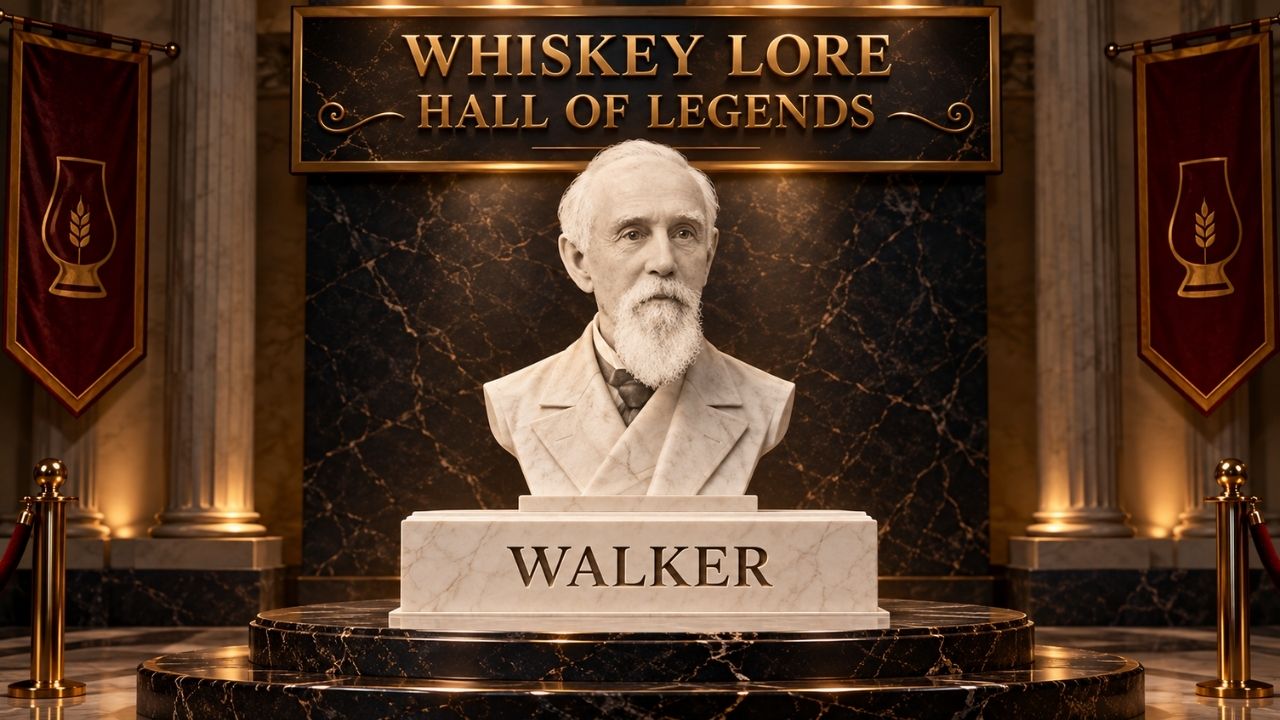
Hall of Legends Inductee #2: Hiram Walker
Listen to the Episode
Show Notes
Hiram Walker (1818-1899)
Distiller and International Gilded Age Industrialist
- Built a town in West Canada
- Brought Canadian whisky to a worldwide audience
- The American whose Canadian whisky changed American whisky for the better
Listen to the episode with the player above to hear his story or read it using the transcript tab above.
Transcript
Welcome to the Whiskey Lore Hall of Legends
It’s time to meet our latest inductee:
Hey there, you may not know my name, but I’m sure you know my whisky. It’s the crowning achievement that cemented my legacy after a forgotten history of quiet successes and failures.
Things started out pretty simple for me. Not knowing which line of industry I wanted to get into, I got into the grocery business, learned the trade, and then headed west to make my fortune.
But fortune was extremely slow in coming. After working for others, I started my own store, but found little success. Then I partnered in a tannery, but when the business burned down, I was back to the grocery business, setting it up in what you might think is the oddest of places, about the post office.
It struggled along, but I finally made enough money to expand the business down to a new location near the riverfront at the corner of Woodward and Atwater. There I sold imported brands of wines, distilled some whisky and became known for my pickling and table vinegars, which were in high demand before the war.
While whisky making was quickly winning me over, the same couldn’t be said for my home state. When the state constitution was written, seeds were planted to stop the flow of liquor in the state. Then days after opening my new store, the state legislature set a date for a public vote on prohibition. Our version of the Maine Law passed by a nearly 2-1 vote. The brakes were put on before it went into effect, as the State Supreme Court declared it unconstitutional. The issue was the legislature giving away its law making power to the citizenry. A year later, they rectified the situation by taking Michigan into full prohibition in 1855. It was the beginning of a 20 plus year dry spell, although if you visited Grand Rapids, you wouldn’t know. Liquor flowed like water.
That law might have broken my whiskey ambitions, but right across the river the British Province of Canada held great promise—land was cheap and liquor was legal. I sold off the store and vinegar brand, bought land in East Sandwich just across the Detroit River and began the construction of a flour mill and distillery.
The timing couldn’t have been better. As Michigan was shutting down liquor, the Reciprocity Treaty of 1854 opened the border to free trade of agricultural products and livestock. Michigan farmers weren't pleased by the agreement, but for me, it opened the door to buying and selling grain, developing a flour business, getting into tobacco, and raising hogs and cattle. My wife Mary and I uprooted the family, purchasing a cottage, where we spent the next dozen years while I worked to establish the cooperage, farm, and milling operations.
Eventually things got too hot in U.S./Canadian relations for me, an American citizen, to stay in Canada. The war between the states created high tension as the Union got into a squabble with the British over their support of the Confederacy. We built a new house at Shelby and Fort street in Detroit, where I also built a dock and established commercial real estate along Atwater Street, and a cigar and tobacco business. The area thrived and my boys and I might have been credited for growing the city, if not for a certain young inventor who overshadowed us with his horseless carriage.
Across the river, the Windsor Flouring Mill and Distillery was running a brisk business, gaining a reputation for its rye whisky. We also became a center for wet and dry cooperage, and thanks to my partners Heath & Winslow, we succeeded in the cattle market in New York. I also developed real estate on the Canadian side of the river in our little budding community. Townhomes were rented to workers and outfitted with utilities provided by us, as well as a hotel, a store, a church, police force, fire department, and we even got our own Canadian government sanctioned post office. One of our greatest strengths was our position on the Great Western Railway, which connected us to markets in Canada, the east coast and west to Chicago.
After years of everything going wrong, it finally felt like everything was going right, until Mary passed away in ‘72. I named our little church St. Mary’s in her honor. It wasn’t long after this my boys Edward, Franklin, and James entered the business. Each brought a different focus and skill, which helped me expand our empire even further.
While the distillery business continued to grow slow but steady, things changed drastically in 1885 when we got a nice little gift from the Canadian parliament. In an effort to knock down the illicit whisky trade, they introduced a 2 year age minimum for any whiskey made in Canada. No other country that I know of, at the time, had such a law. Add to that, we could now bottle whisky in bond at the distillery. Up to this point, our Old Rye wasn't having the success I would have liked in the US. But with these new laws, we started seeing an uptick in interest, as the states were being flooded with rectified whiskies made out of alcohol provided by the Whiskey Trust in Illinois.
No longer did we have to tell people our whiskey was "as pure as the water from a spring." A government worker was verifying it with an excise certificate stamp sealing the cork. It was around this time, in the early to mid-1880s that we solidified our brands, focusing on vintages of rye whiskey, the Imperial brand, and Club whisky.
That last one was the brand that changed our fortunes permanently. Because of the influence of Canadian whisky’s bottled-in-bond act on the consumer we added the word Canadian to the Club whisky we shipped internationally and heavily promoted that we bottled at the distillery. Soon bottles were found in London, Hawaii, Australia, and yes, finally Michigan.
Then we got another boost as the Canadian government seemed to be clearing a path for us. As word came across the border of an American protective tariff, Canada retaliated by enforcing Canada’s barrel size standards on U.S. Bourbon and Rye makers. Soon, my whiskey was going out in bottles and very few barrels were coming to Canada to provide competition - not that they would have had much of a market. Once Canadian whiskey makers took advantage of the bottling law, few Canadian retailers wanted to take the leap of faith on what was inside a barrel of American spirits.
All of this led to a very successful end of my career. The grocer who could barely keep a business running was now selling the most trusted whisky in the world - bottled Canadian whisky. Some upstarts in Chicago tried to make counterfeits of our whisky- putting it under labels like Montreal Club produced by the Montreal Distilling Co, which didn't exist in Canada. But our lawyers took care of them. We had free reign until 1895, when the head of the Internal Revenue finally got fed up with us flooding the export market with our whiskey. They got a former head of the revenue and recently elected Kentucky Rep, Walter Evans to write a bottling act that would help American spirits compete against Canadian Club. It was one of my proudest moments in an otherwise slow developing career.
In the end, I did pretty darn well for both the City of Detroit and the reputation of Canadian whisky, and thanks to the angry whispers in the halls of congress and down to Kentucky about that darned “Canadian Club” whisky dominating the export market.
And it seems that, without me, the resulting American Bottled-in-Bond Act of 1897 might not have had the villain it needed to cross the finish line.
WITHOUT ME
Do you know who I am?
My name is Hiram Walker, founder of Walkerville, the creator of Canadian Club, a forgotten Detroit legend, and the second member of the Whiskey Lore Hall of Legends.
Want to dive deeper into the story of whiskey legend Aeneas Coffey, check out Chapter 7 of the book Whiskey Lore: Volume One available on Audible, Spotify, and Apple, or in paperback through your favorite online store.
More entrants in the Whiskey Lore Hall of Legends to come. Make sure you’re subscribed. And join us at patreon.com/whiskeylore for a chance to nominate future members of the hall.
Whiskey Lore Is a Production of Travel Fuels Life, LLC
Legendary scripts written, performed, and produced by Drew Hannush
Find transcripts and further details for today’s show at whiskeylore.org/episodes