
BOURBON 3b: Did Bourbon Get Its Name from Barrels Marked “Old Bourbon”?
Listen to the Episode
Show Notes
Did Bourbon get its name from barrels stamped “Old Bourbon”? Was charred oak the secret that transformed ordinary frontier whiskey into something new? And did Kentucky's earliest distillers really have a thriving market waiting for them in New Orleans?
As we conclude Chapter 3, we'll examine the barrels at the center of several familiar Bourbon origin stories. From eighteenth-century distilling practices to Virginia's surprisingly specific barrel inspection laws, we'll discover how differently early Americans thought about whiskey. And a journey into Spanish-controlled Louisiana raises new questions about the supposed inventor of Bourbon and the markets available to him.
This is Chapter 3b of The Lost History of Bourbon, presented as a reading from an early manuscript draft. Unlike regular Whiskey Lore Stories episodes, these chapters are presented without music or sound effects. The manuscript is a work in progress, and some details may change.
Transcript
Barrels of Old Bourbon
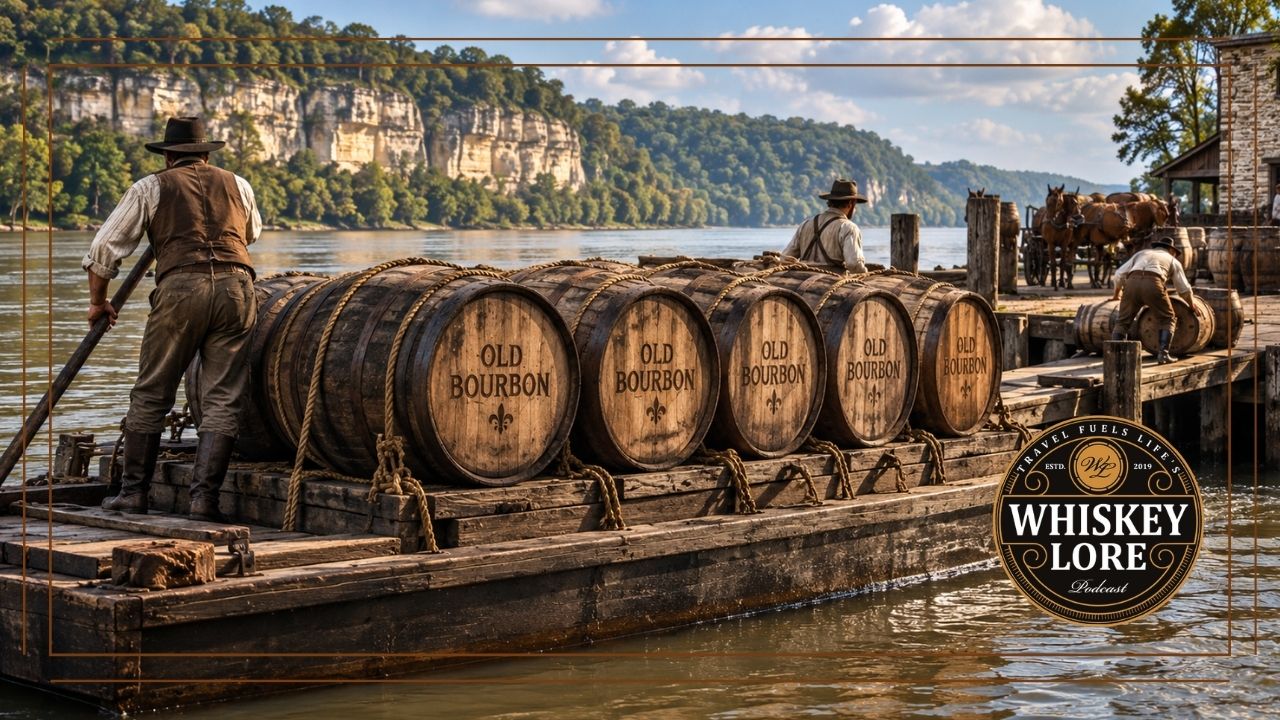
When it comes to Bourbon whiskey origin stories, no one item seems to have captured the imagination more than the container whiskey is stored in. The Reverend Elijah Craig story assumes nothing could have been called Bourbon until the whiskey was aged in a charred oak barrel. The Bourbon Street origin story requires the sloshing of whiskey in barrels traveling down the Mississippi on flatboats to create the flavor and color said to be desired on the famous New Orleans thoroughfare. And another theory suggests that stamping “Old Bourbon” on the barrel heads of Kentucky whiskey at Limestone Landing is how Bourbon got its name and famous reputation. Add to that, Rep. Chapman’s assertion that it was Jacob Spears' charring of barrels in 1790, that aided his ability to claim himself as the man who created Bourbon.
Inspecting the current whiskey scene, perhaps it should come as no surprise that the barrel gets such an elevated status in the creation myths around Bourbon. Head to a Kentucky distillery and your tour guide will extol the virtues of barrel aging. Barrels used for storing Bourbon and rye are charred and sometimes toasted, to pull out the sweet vanilla, caramel, and wood spice notes that enhance the tasting experience. It also provides Bourbon’s dark amber color. And depending on what distillery you visit, you’ll hear that Kentucky credits charred oak barrels for anywhere from 60 to 90% of the whiskey’s flavor and color. That’s a lot of impact for what the novice might only consider a storage container.
Yet, if we pull out of our modern mindset, again we will find the world Jacob Spears lived in was quite different. To the 18th century distiller the barrel was used for storage, transportation, and the removal of perceived poisons from the spirit.
There is no evidence showing 18th century distillers discussing the charring of barrels for flavor. One of the only mentions available comes from 1818, in Harrison Hall’s landmark distilling guide The Distiller. He advises burning straw inside of a hogshead barrel to prepare the vessel for the summer mashing and fermenting season. It is a step meant to clean a barrel used in steps before distilling, not for aging and flavor extraction later on.
We’re told that time in a charred oak barrel not only adds flavor but also mellows the whiskey. Without it, you might think the whiskey would be harsh and untamed. In many cases it probably was, but those pioneer distillers had other tricks up their sleeve to tame a spirit. These tricks fall under the term rectifying. In the late 18th century, rectification was a catch-all term for cleaning up a spirit. The second distillation we take for granted today, back then was considered rectification. The additional step of cutting out the harsh heads and congener heavy tails was another part of that rectification process. Another way was to run the distillate through maple or chestnut charcoal as another way to remove harsh fusel oils and congeners that created unpleasant scents and flavors. Aging in barrels was another technique, but without charring inside, the flavors extracted from a barrel would have been very different. They also tended to reuse barrels that previously held beer, cider, hogsheads of wine or sherry, or previous runs of whiskey.
But still, flavor doesn’t appear to be the prime concern of early distillers. When Harrison Hall writes of his favorite style of rectification, he suggests running it through charcoal is the best way of “freeing a spirit from a disagreeable flavor,...leaving the spirit perfectly pure, and entirely divested of the aroma or essential oil.” The next section of his book goes on to provide methods for imitating gin, brandy, and Jamaica rum, or for the preparation of cordials and bitters. What he was looking for was the illusive animal known as pure alcohol. In the days before column stills, taking a whiskey closer to its pure state took several distillations. Perhaps, because it was so hard to obtain, it was more desirable then. We assume people have always praised whiskey for its flavor, but for some drinkers, it was more about the purity of the alcohol than the flavor. They didn’t want anything tainting their cherry bounce. With this in mind, it helps us understand why there might not have been a desire to char a barrel in the pioneer days.
This begs the question, if people weren’t charring a barrel and a purer alcohol was desired over flavor, what would compel Jacob Spears or anyone to brand their spirit as Bourbon? Was he the one stamping Old Bourbon on barrels? And had he really developed a market in New Orleans?
If he had to overcome some pretty big obstacles to get it there. First was the ever present issue of danger on the frontier. In 1790, a single distiller, moving barrels by wagon down the buffalo trace to Limestone was not only time consuming, it meant risking your life, your horses, or your valuable cargo. Once reaching Limestone Landing, a flatboat was necessary to travel the Ohio to the Mississippi. Perhaps you could purchase one from a traveler coming from Pennsylvania looking to reach the buffalo trace, but that was an added expense. Then you had to travel down the Ohio, which was still a war zone, all in hopes of getting whiskey past the Falls of the Ohio to the Mississippi. With all of this in consideration, it was a pretty expensive trip and would have required a good amount of alcohol to ship to make it profitable. And then there was the issue with the Mississippi. Its passage was unpredictable. Not because of turbulent waters there was also unpredictable access for Americans.
For decades the Spanish government used Louisiana as a land buffer between the English Colonies and the Spanish held silver mines in Mexico. That buffer started to look shaky as the War of Independence drew to a close. The Spanish were spooked by the large influx of Americans flooding into lands that now encompass Kentucky and Tennessee. Their answer was to block access to the Mississippi River, to dissuade the Americans from building up towns along its eastern banks. When the Spanish Governor of Louisiana, Esteban Miró realized settlement was going to happen with or without his blockade, he began secretly encouraging leaders in Southwest Territory (Tennessee) and the Judicial District of Kentucky to become independent nations allied with the Spanish king. With that, he would offer free trade.
A Revolutionary War hero, and crafty Lexington merchant General James Wilkinson found a way around the blockade. He secretly negotiated a trade agreement with Governor Miró and began sending his own shipments from Louisville to New Orleans duty-free in 1787. Yet this wasn’t open to everyone. He held the exclusive right of shipping until 1789. Then when Americans became agitated, the deal was stripped away, traffic opened to all Americans, but under a 15–21% duty. Still, flatboat fever struck from Louisville to points inland along the Kentucky and Salt Rivers. It didn’t last long though, as traffic was again shut down after Governor Miró’s departure from office two years later.
So even if Jacob Spears had expanded his whiskey production around 1790, New Orleans offered anything but a dependable market. But let’s say he did get some barrels through, would they have been stamped “Old Bourbon,” as some very credible historians have claimed?
Looking at the historical record there was branding of barrels, mandated at Virginia ports, thanks to an old colonial statute that was re-upped by the Virginia General Assembly in October 1776. It required that every cooper assembling tight-dry cooperage for certain exportable products, burn their name (or for the enslaved, the name of their enslaver), directly onto the head of every barrel produced.
The term tight-dry cooperage might be confusing to the modern reader, but before automated bottle-making and modern transportation, barrels were used to ship nearly everything. Dry goods of sufficient size, traveled in slack or dry cooperage, which allowed some airflow. Liquids such as whiskey, tar, and turpentine required tight-wet cooperage. Between the two was tight-dry cooperage, used for products such as flour, dried fish, and pork that needed protection from outside moisture and air. This last point is important because there is a myth that charring of barrels started as a way to get the smell of fish out of them. This myth falls apart when you realize dried fish shipped in tight-dry cooperage which wasn’t water tight.
Something that might have stood out to you in those requirements for burning a name into the barrel was, it wasn’t a distiller’s name, but instead the cooper’s name. It turns out, it wasn’t the manufacturer of the product in the barrel that the state was worried about. In the days before the U.S. Constitution, when the government ran under the old Articles of Confederation, the United States was anything but united. States were in open competition for export customers and Virginia wasn’t willing to lose its powerful position in the trade market over poorly made barrels. According to the state, all tight cooperage had to be made of white oak, free from sap. If a barrel leaked, warped, or didn’t fit the state’s required 29 to 31.5 gallon capacity standard, the cooper was heavily penalized, and risked a loss of reputation.
If a Virginia cooper made a cask covered by the law, a branding iron was issued with a no smaller than a three-quarter of an inch tall stamp with the owner’s surname and first initial. Neglect using it and you could be heavily fined per cask. Try to cheat the system by putting a neighbor’s brand on your barrel and the fine was split between the government and the informant.
Once barrels that met the criteria for branding reached an official Virginia port, it faced public inspection. An official, appointed by the state, used a gauging rod to calculate the volume of the barrel and inspect it. The resultant number would be cut or branded onto one of the staves or head of the barrel. Then the name of the port was branded onto the barrel head. In the east, this included Alexandria, Norfolk, Richmond, and several others.
Limestone Landing, however, was not one of Virginia's official ports. What it received in October 1787 was an inspection station specifically for tobacco. Tobacco was stored in slack-dry cooperage, which didn’t have the branding requirement. As for whiskey arriving at the time, according to Henry Crowgey’s landmark book Kentucky Bourbon: The Early Years of Whiskeymaking (1972), barrels leaving Limestone Landing were stamped with the words Old Bourbon to denote whiskey that came from the old confines of Bourbon County before it was split into Bourbon and Mason counties. But even if whiskey had been covered by this inspection system, the geographic mark prescribed by the law identified the inspection port, not the county where the contents originated. There is an even bigger reason this branding of old Bourbon into a barrel idea doesn’t hold water.
In October 1787, the Virginia General Assembly extended the 1776 act beyond the initial ports in what they called: “An act to amend the act, intituled, An act for regulating the inspection of pork, beef, flour, tar, pitch, and turpentine.” By 1798, flour inspection was operating at Maysville, and surviving correspondence shows exactly what happened when barrels subject to inspection failed to meet the law. An inspector seized a shipment because the barrels and flour were deficient. Among the requirements cited was that the barrels be properly made and “branded with the maker’s name. Notice what product is missing from the list of product. Whiskey was not one of the commodities covered by this inspection act. And this lack of inspection for whiskey continues into the 19th century. In a 1907 deposition for an Old Crow trademark dispute, George Edwards, a Woodford County distiller active from 1828 through the Civil War era, recalled that whiskey barrels carried only a chalk or keel mark showing the number of gallons until federal excise regulations required otherwise. “There was no private brand put on the whiskey.”
So where does this leave the Jacob Spears story? It appears Rep. Chapman’s version of the story is full of holes and the chances he built the first standalone distillery west of the Alleghenies is on thin ice.
But it’s not time to give up on the story of Jacob Spears. While it doesn’t appear New Orleans was a reliable market for his early distilling, that doesn’t mean there wasn’t a market available. A lot of time has been spent by historians looking south—were they looking in the wrong direction? And what if all of the myths and first claims have actually been a distraction from Spears’ real impact on the history of Bourbon?
It’s time to put all of these bits of oral tradition, speculation, and first claims in our back pocket, and step into the world of Jacob Spears to discover his real legacy.