
BOURBON 1a: Did Kentucky's First Settlers Really Make Whiskey?
Listen to the Episode
Show Notes
We often imagine Kentucky's earliest settlers arriving with corn seed, copper stills, and plans to make whiskey. But what was life really like on the frontier during the American Revolution? Follow the Miller brothers as they lead their families toward the fertile lands of Kentucky Country, where the promise of a new beginning comes with dangers they can scarcely anticipate. Along the way, we'll examine the familiar claims about Kentucky's first distillers, including Daniel Boone's contemporaries and the beginnings of Louisville. And we'll discover why one overlooked frontier settlement may deserve a closer look in the search for Bourbon's earliest history.
This is Chapter 1a of The Lost History of Bourbon, presented as a reading from an early manuscript draft. Unlike regular Whiskey Lore Stories episodes, these chapters are presented without music or sound effects. The manuscript is a work in progress, and some details may change.
Transcript
Chapter I: The Wilds of Kentucke Country
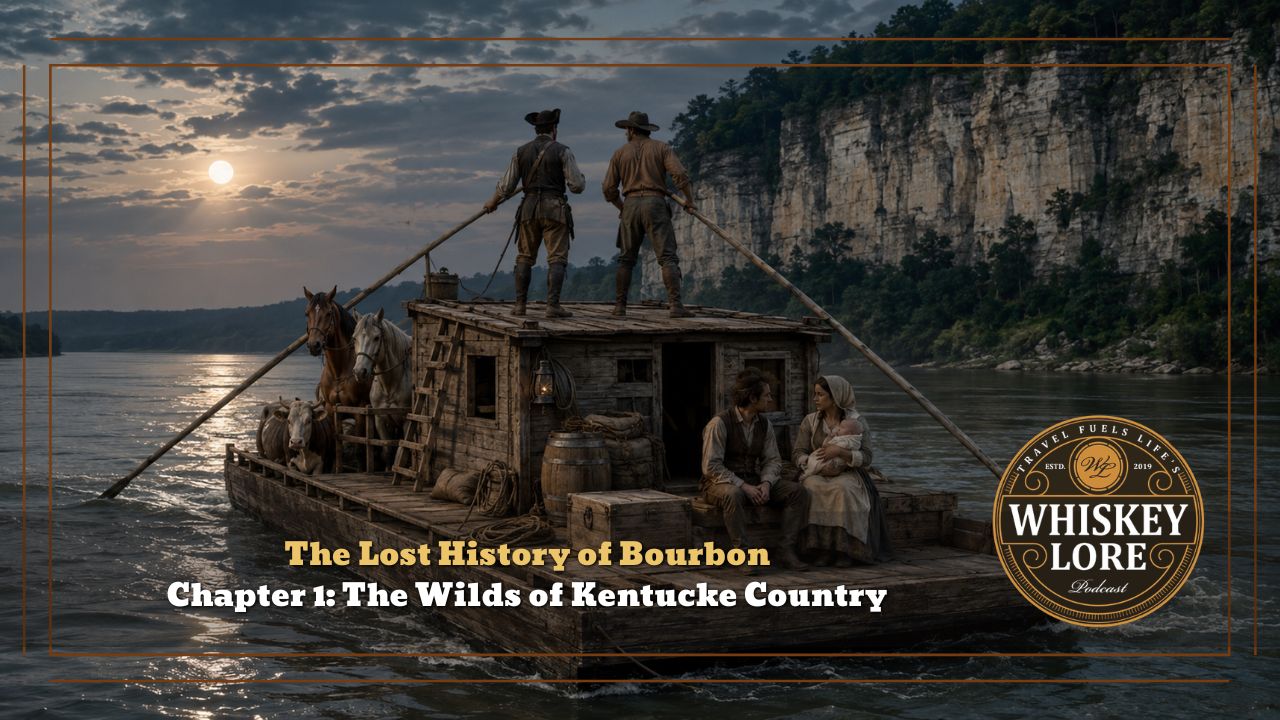
On a dark and moonlit night, two brothers stood atop a platform on an overloaded flatboat, squinting as they navigated the winding curves of the Ohio River. Their vessel held the lead position in a flotilla of boats carrying dozens of settlers into the untamed wilderness of Western Virginia known as Kentucke Country. For twenty-eight year old John Miller and his younger brother Robert, just twenty-three, there was a great tension in being responsible for so many lives.
Using large paddle sweepers tethered on either side of the boat, their job was to keep the vessel in the middle of the river, avoiding sawyers, shallow beachheads, and most of all, the dangers that lurked among the trees. They had been warned on previous trips not to trust anyone waving them to the shore. It was a common ruse meant to lead an unknowing boatman into an ambush. A stray bullet or arrow would be followed by native warriors swimming out to their boat, relieving them of their horses, slaughtering their cattle, scalping passengers, and abducting screaming children.
On their past journeys, smaller companies of twelve to fifteen men sailed with little in the way of supplies. But this time they held precious cargo, including John’s new bride Ann, their brother William, his wife Jane, and the couple’s two daughters plus all of the necessities required for permanent settlement on the frontier—horses, a cow, hens, roosters, crockery, guns, ammunition, a few farm implements, and a disassembled wagon to carry much of it to their new homestead. Behind them, several other families with similar cargo, led by men who had joined them on their previous adventures into the wilderness.
Even though they’d only spent three weeks on the water, the home they left behind in Pennsylvania's Cumberland County already seemed a lifetime away. And their new home seemed no closer, as it required tricky and uncertain navigation to reach. First, they had to spot the limestone bluffs where their friend Simon Kenton greeted settlers. Then after assembling the wagons another 40 mile trek down the buffalo trace awaited them, before they reached their homesteads at Hinkston’s creek. It was this stretch that the men dreaded most. The Ohio was wide enough to keep a safe distance from danger. But the slow pace of the wagons as they passed through the hunting grounds of the Shawnee left the caravan dangerously exposed.
As dawn approached, the first rays of light added weight to John’s eyelids. There were few places to dock after Fort Henry so John, William, and Robert Jr took turns taking naps. This shift had been particularly long. To keep his mind occupied, John tried to retrace in his mind the steps that had pushed the Miller clan into this risky adventure.
He first took his thoughts back to the stories of his dearly departed father. Some 30 years past, Robert Miller, Sr, convinced his wife and their mother Jean to leave the peaceful fields of Ayrshire for an uncertain future in America. George II’s rack-rents and religious persecution made life as a tenant farmer in Scotland unbearable. They packed up their two daughters Jean and Agnes, found passage on a ship heading out of Glasgow, and prayed for safe passage to America across uncertain seas.
After weeks on the Icy North Atlantic, they were thankful to touch firm ground in Philadelphia. Yet life in the port town didn’t feel much different than life in Scotland. Robert spent the first few months working as an indentured servant to pay off the family’s passage. But as soon as he was free of his obligations, he took the family inland. With Jean expecting another child they needed to quickly find a friendly community. They found one on the banks of the Susquehanna River. Within weeks, the couple’s third child Martha, the youngest of John’s oldest sisters was born.
A few years later, in 1750, the family was on the move again, hearing of a new town being laid out by Colonel John Armstrong for the Penns. Located in the Cumberland Valley, the frontier town of Carlisle would become the first stable home for the Millers on the American side of the Atlantic—and the only home the Miller boys could ever remember.
To newcomers, it was a town surrounded by violence. But to John danger was a way of life in the Cumberland Valley. The French and Indian War began in the area when he was only five years old. His father told him stories of Braddock’s campaign, the defence of Fort Pitt, and Colonel Armstrong's personal war against local tribes. That terror continued after the war as a vigilante group called the Paxton Boys took revenge on Indian villages, including the brutal massacre of the peaceful Conestoga tribe. One of their most famous exploits was their surprise jailbreak that freed the infamous Indian-killers Frederick Stump and John Ironcutter from the Carlisle jail.
John remembered his father’s concern over the Paxton’s violence. After years of unrest with the western tribes, a great peace treaty was in the works in New York between the Iroquois nation and the Crown. New lines were being drawn, pushing available lands for settlement out beyond the Alleghenys into the hunting lands of the Shawnee and Cherokee. If the Paxton’s didn’t spoil it, the signing of treaties in New York and Western Carolina promised a new round of settlement fever.
When news arrived that the New York Treaty of Fort Stanwix was signed, John and William drove their father crazy with talk of exploring the west. But the older man’s thirst for adventure had become a relic of the past. The dangers of the frontier had taken their toll and in 1774, Robert Sr. took his last breath.
The passing of the family patriarch untethered the Miller boys from their commitment to Carlisle. John and William began in earnest to seek out opportunities to travel west. As if on cue, neighbors William McClintock and William Steele approached them about the possibility of joining a great western expedition being formed by a Westmoreland man named Joseph Houston. The Houston Company was set to travel to Kentucke Country in the spring of ‘75. It was an opportunity to great for John and William to pass up. When their brother Robert Jr., heard of the plan, his eagerness to join had to be quashed. As a teenager, William thought Robert too young and besides, a man was needed at the homestead to look after their grieving mother and sisters.
With plans solidified, the Cumberland County men joined up with the Houston’s Company on the Monongahela in April 1775. After weeks of sailing on the Ohio, they reached the Licking River and traveled deep into the interior. To get their bearings, their first stop was the camp of another Westmoreland man, John Hinkston, whose company set out a month earlier. The members of the Houston Company didn’t expect to see much, but the Millers were impressed with how quickly Hinkston’s company had assembled their cabins and staked their claims. John Cooper and John Townsend had already finished tilling the soil and were busy planting corn. Houston’s crew spread out with the Millers, McClintock, and Steele making their way down Hinkston’s creek to a wide open area that had been cleared by a herds bison. They wanted to grab the land before someone else could claim it, but Houston’s group ill prepared for planting and headed back east through the wilderness by June,
John recalled being antsy that whole winter knowing the wonderful patch of fertile grounds they’d discovered. But the following spring, they realized if they wanted to head west, they would have to do it themselves. With the colonists rising up against the Crown in the east, McClintock and Houston joined the cause of liberty. It turns out, planning in the middle of a war wasn’t going to be easy, but by June of ‘76 John and William headed a 14 man group including their younger sister Martha’s husband William McClelland, William Steele, and Joseph Houston’s son William.
When they reached Fort Pitt, they purchased canoes and made their way along the Ohio and back up the Licking River. Taking a moment to announce their arrival at Hinkston Station, they followed Hinkston’s creek to John Cooper's settlement. This time they had farming implements and Cooper had become the area’s source for dried corn seed. When they reached the land they’d coveted a year earlier, the group became acutely aware of the dangers lurking in the trees. As much as John and William prized this land, so did the Shawnee. The area has incredibly rich soil for planting. And it was also an area teeming with wild game, especially the majestic bison whose main path from the Ohio River to the interior passed right by them.
A fortified cabin was a necessity. They worked tirelessly on John’s cabin first, making sure not to include any windows, but instead leaving portholes for their rifles to shoot through. The men knew they’d made the right move when word came down the creek in July of the killing of John Cooper by the natives and destruction of his cabin and fields. The Miller Company remained on the Hinkston throughout the summer with at least five men able to harvest their grain. Then once again they made their way through the wilderness back to Pennsylvania.
Then as winter turned to spring, attention in the Cumberland Valley turned from settling the west to war in the east. Several members of the group hedged on returning to Kentucke, with several more joining the American cause. It wasn't until 1778 that the Miller Company reorganized. But this time, the Ohio was a war zone way too dangerous to traverse. Instead they retraced their steps through the wilderness, crossing at the limestone bluffs of Simon Kenton, a man they’d met at Hinkston’s fort. Then came the 40 mile walk down the buffalo trace. This time Robert Jr, was along for his first excursion. He couldn’t help but feel uneasy sensing spying eyes on the trees. All three men agreed, if they brought a wagon down this trail, they would be sitting ducks—especially with women, children, and supplies.
As they reached their homestead, they realized many of the settlers were gone. John Hinkston and his company abandoned their station late in ‘76 and only a few others remained. The Shawnee were not happy with the permanence these fields of maize provided and did their best to take them out. But the Millers and their friends were determined to continue building. William Miller and William Steele’s cabins were the next to be built. Steele was proud of his cabin and the corn that grew with ease. But one day while working his crops, he took a bullet to the body, when a Shawnee warrior took exception to his work. Steele survived the attack, but carried that bullet in his body for the rest of his life. But for all of them, the risk was worth it. When the Millers heard surveyor Cave Johnson was in the area, they sought to solidify their claims by having him map out the boundaries of each of their properties.
By the time of harvest, each man agreed the land at last was ready for families, although John still had his concerns about the Shawnee. But two things propelled him forward. The first was the success Lt. Col. George Rogers Clark had in his Illinois campaign against the British and their Indian allies. The second was the announcement in May that the State of Virginia was providing up to 400 acres of land to anyone who had made improvements in the western lands before 1778. Not only that, but they could also claim an additional 1000 acres.
But a return trip again met with delays, In the heat of the summer, John was courting William McClintock's sister Ann. And the idea of having a new bride created new considerations. He started thinking more like his brother William who was concerned about risking the lives of his wife Jane and their two young daughters into Shawnee country. But both men knew that land was worth the risk and in August, John and Ann were wed at the Centre Presbyterian Church in the Sherman Valley. And within days, they loaded up wagons and pack horses and traveled with a caravan of families past the familiar hillsides of the Forbes Road to Fort Pitt.
Now, the flotilla was nearing its end point. John began tracing the next few steps in his mind. Once they reached the limestone bluffs, the boats were tethered and they'd either try to sell them to travelers with destinations further down the river or sell them to someone nearby who wanted to deconstruct them, using the lumber for building their homes nearby. Then they would take the dreaded 40 mile march down the buffalo trace.
With John’s attention back on that task at hand, he noticed Robert watching something intently off the shoreline. He thought perhaps his brother had a hint of the limestone cliffs as his sweep began to shift the boat toward the shore. Then out of the corner of his eye, he thought he saw a figure behind a tree. He looked back at his brother just as the sound of a reverberating crack reached his ear. Robert let out a grunt and the young man's body doubled over falling forward off the platform.
Frozen in a surreal moment, John gathered his senses and yelled out “Robert’s in the water!” He heard a rustling of activity beneath him. William’s head poked out from under the platform, looking with panic at John. The current swiftly carried the Millers away from their stricken brother. John looked back at McClelland's boat, praying they’d see him, but they were still in the center of the river and Robert’s body was too far out of reach. Then, a chill went down John's spine as William climbed up beside him. They watched in horror as their brother's body was retrieved from the water by a Shawnee warrior.
FINDING DISTILLERS ON THE FRONTIER
The tragedy surrounding the loss of Robert Miller, Jr was not uncommon for the early settlers who dared to travel beyond the Alleghenys. In 1773, Daniel Boone lost his oldest son James in an ambush of Shawnee and Cherokee in the Powell Valley. Later at Boonsboro his daughters would be abducted while wandering in a nearby corn field. He lost another son Israel at the Battle of Blue Licks nine years later. Yet most of the stories of the early pioneers like Boone focus on triumphs over tragedy.
Perhaps it is this image of frontier invincibility that leads spirits writers to assume the first thing on early settlers' minds was the distilling of corn whiskey. It’s true that farmers used distilled spirits to barter for goods once areas were free from attack. But in the wilderness, as John Cooper and William Steele discovered, corn was dangerous to grow. And without salt to preserve meat, every stalk they could harvest reduced the chance that settlers would have to resort to eating tree bark in the waning days of winter.
The Miller flotilla decided not to tempt fate. Records are sketchy, but most of the families appear to have turned back toward Pennsylvania. A few might have chanced a trek to Boonsboro. John and Ann chose the safety of Lt. Colonel George Rogers Clark’s Corn Island community.
Admitting these dangers existed on the frontier creates a difficult reality for marketers and historians looking for Kentucky’s first distiller. Opportunity was limited in these early years as was the interest and ability to document early distilling exploits. Instead of looking for the first distiller, perhaps the more interesting question is: which area provided the best opportunity for distillers?
James Harrod’s settlement at the natural spring near the Salt River seems like an ideal candidate. Arriving in the area in June 1774, Harrod was the quickest to develop a community. But it didn’t happen overnight. As soon as the men arrived, they were called off to fight in the Battle of Point Pleasant. When they returned the following March, they grew crops and invited their families to join them in early fall. But the first two years of Harrod’s Station were spent fighting off Shawnee and starvation. It wasn’t until the arrival of 23 year old George Rogers Clark that the community’s fortunes changed for the better. Clark was put in charge of the Kentucky County militia and given 500 pounds of gunpowder for its defense. The added protection allowed Harrodsburg to become the seat of government. By 1778, the need for lodging created a demand for taverns, which provided food and drink. With war disrupting trade along the Ohio River, popular colonial drinks like island rum and applejack would be hard for the tavern to source. The need for local distilling became more acute. With the Shawnee siding with the British, attacks on stations increased again making corn supplies critical to survival. The best option was to distill continental rum made from the syrup or sugarloaves sourced from sugar maple trees.
Boone’s Station is another possible source of early distilling. William Calk, a man with distilling in his family’s background, arrived by way of Daniel Boone’s Wilderness Road in 1775. Historians have gone as far as to say he was a candidate for being Kentucky’s first commercial distiller. The problem is the lack of markets. Again, the fort was under heavy threat from the Shawnee and the trail through the Cumberland Gap was a hot bed of Indian activity. Early expeditions traveled light, carrying only the items needed to survive the winter. Calk brought a kettle for cooking but there is no mention of a still. Even if he sourced one later, there were no grist mills around Boonsboro to grind any significant amount of grain, and the war made outside markets less accessible. If Calk produced any whiskey in the 1770s, the local tavern would have offered one of the few available markets.
Louisville presents an even more unlikely location for early distilling. Thanks to a land dispute, the first commercial enterprise, a dry goods store, didn’t appear until 1783. Prior to that, the first successful settlement was on Dunmore’s Island in 1778. Located at the Falls of the Ohio, it served as a military staging point for George Rogers Clark’s Illinois Campaign. The military families that lived there grew corn for survival. The corn grew with such ease, it became known as Corn Island. But it wasn’t meant to be a permanent settlement and by the next year, families were moving into forts on Beargrass Creek—including the Millers. But these provided little safety from Indian attacks and settlers who wandered too far from the stockades were frequently killed. A Welsh distiller, Evan Williams, is often credited with opening the first commercial distillery in Louisville. Williams did eventually operate a distillery, and later records even preserve complaints about the whisky he brought to town meetings. But that does not establish a commercial operation in 1783 and there is even a question as to whether Williams was even in America by that date.
Other names like Jacob Myers and Wattie Boone are interesting candidates for early distilling, but their more isolated existence meant tilling fields of corn and sending plumes of smoke into the air drew unnecessary attention. Like John Cooper, visible expansion into Shawnee hunting territory increased the likelihood of attack. The first accounts of Myers distilling don’t come from the time of his settlement in the mid-1770s on Dick’s Creek, but instead in 1781 when he offered his spirits to voters as they entered the polling place. He ultimately lost the campaign to war hero Benjamin Logan, but gave himself historical significance in the early history of Kentucky distilling.
While Harrodsburg, Boonsboro, Louisville, and some isolated locations are credible sources for early distilling, curiously, one compelling location has been almost entirely ignored in accounts of Kentucky’s earliest distilling. Its exclusion is not because it was too small to notice. On the contrary, the station was one of the largest in the region, boasting around 80 settlers. It wasn’t left out because its settlement date came too late—its origins go back to 1775. It’s not because it was devoid of potential distilling talent—several men within its stockade found future distilling success. What makes this station’s omission even more puzzling is its location—within the current dimensions of Bourbon County, the namesake for the state’s treasured spirit.
What is this mysterious place? And who were the men whose names time forgot?
Whiskey Lore’s a production of Travel Fuels Life, LLC
Production, stories, and research by Drew Hannush
Are you a fan of whiskey history and Whiskey Lore’s mythbusting it’s time you joined the Whiskey Lore family as a member of the Whiskey Lore Speakeasy and Club 1897 where you’ll get longer interviews, whiskey tastings with depth, extended episodes, and a chance, with your votes, to award the best distilleries in the country with a fan favorite Pagoda Award.
Just head to Patreon.com/whiskeylore.
Next week, future distillers experience perilous times on the banks of the Licking River. Join me for the exciting conclusion of Chapter 1 of the Lost History of Bourbon next week.
Thanks for growing your whisky knowledge along with me, I’m your host Drew Hannush and until next time, cheers and slainte mhath.
Closing Acknowledgements
Find show notes, resources, and transcripts for this episode at WhiskeyLore.org/episodes