
S7:9 - Whiskey, Power, and Blood: The Tillman and Bourbon Dispensary Crisis
Listen to the Episode
Show Notes
In the 1890s, South Carolina became the center of one of the most controversial experiments in American whiskey history—a state-controlled liquor system that promised reform but delivered conflict, corruption, and bloodshed.
In this episode, we uncover the rise of Governor Benjamin “Pitchfork Ben” Tillman, the political machine that powered him, and the dispensary system that turned whiskey into a battleground between state authority and personal liberty. From courtroom shootings to the Darlington Riot, this is a story of how quickly reform can spiral into unrest when power, profit, and principle collide.
It’s a chapter of whiskey history rarely told—but one that helped shape the alcohol control systems we live with today. Because sometimes, to understand the present, you have to uncover the stories that were left behind.
Transcript
Blood: South Carolina’s Dispensary Crisis
Blood in the Streets
"Civil War in Carolina"
The headline in the Savannah Morning News must have felt like a throwback to an earlier time of brother against brother and the news of cannon fire at ol’ Fort Sumter. But this wasn’t April 1861, it was March 1894. And it was less a battle for independence and more a fight for freedom from what some saw as an expanding and intrusive state authority.
The news coming out of Darlington, South Carolina was grim. A bloody shootout had taken place at the Cheraw & Darlington railroad depot. Two state constables and two local merchants were dead and the chief of police and several other men sustained serious injuries. The scene described, told of a contingent of constables, who had been preparing to leave town on a train, feeling for their lives, while angry townfolk, who considered them government spies, chased them into the woods with pistols in hands and lynching on their minds.
Law enforcement was split, with the mayor calling for bloodhounds to track down the spies, while the sheriff sent out a desperate plea to the governor to send out the state militia.
Meanwhile, military units across the state were defying the governor’s orders, refusing to take up arms against their fellow citizens.
What was happening in South Carolina? Why were military units in open defiance of their governor and what triggered the bloodshed that became known as the Darlington Riot?
Well, it all comes down to a liquor law. One that started as an innocent solution to the issue of prohibition, but quickly devolved into a battle between city folk, country folk, and a fight for liberty and control of the very heart and soul of the Palmetto State.
MOONSHINE AND TEMPERANCE
When it comes to South Carolina’s history, rebellion and conflict seem right at home. During the Revolutionary War, British loyalists battled patriots from Charleston, through the swamps and backcountry, up to Sumter, Camden, and Kings Mountain. It was the first state to secede from the Union, and the site of the first shots of the Civil War.
When it came to the state’s relationship with whiskey, that same sense of division was present—pitting Charleston’s wholesale merchants and saloon owners against the growing teetotaler Prohibitionist movement in the countryside.
When it came to distilling, the state was much less a player in legalized distilling and more overrun with moonshiners—the independent-minded Scots-Irish who firing up their kettles from the Dark Corner at Glassy Mountain down to the banks of Lake Hartwell and the Savannah River—trying to make what little profit they could from sparse corn harvests while dodging revenue men and local law enforcement.
This isn’t to say the state was devoid of legalized distilling. But it only kicked up around the 1880s and it took place almost entirely in the Upstate, with the town of Walhalla boasting 10 of the state’s 19 distilleries. Yet these were small, 30-gallon still setups, like that of Dr. B.S. James, who took up legal distilling, hoping to inspire others to produce value from their local grains.
Still, the growth of moonshining in the north and the expansion of saloon culture in Charleston raised concerns over “demon alcohol” and its effects on the populace. By the dawn of the 1890s, Prohibitionists saw an opportunity and pushed the general assembly to add a referendum to the ballot to gauge interest in statewide prohibition. The September 1892 vote was decisive, with nearly 39,000 voting for prohibition and only 29,000 against it. But in South Carolina, laws could not be enacted by popular vote—so lawmakers in Columbia would need to craft a bill to appease the citizenry.
BENJAMIN “PITCHFORK” TILLMAN
Enter Governor Benjamin Tillman—or “Pitchfork Ben” as he would be known during his Senatorial career—one of the most forceful and polarizing figures in South Carolina political history. Blunt and combative, he prided himself as a man of the people—plainspoken, aggressive, and openly disdainful of elites, especially those in Charleston and the old planter class. His nickname came from fiery campaign rhetoric where he promised to go to Washington and poke a pitchfork in the bowels of President Cleveland. Tillman lost his left eye in his youth, likely due to an infection following an injury, and the physical mark only seemed to reinforce his hard-edged persona. He leaned into confrontation, often framing politics as a battle between common farmers and entrenched interests, and he showed little hesitation in using inflammatory language or strong-arm tactics to achieve his ends.
Tillman rose to power through the Farmers’ Movement in the 1880s, positioning himself as a champion of agrarian reform and rural South Carolinians who felt shut out of political influence. He built an impressive base by mobilizing Farmer’s Clubs and alliances and offering patronage jobs to loyalists. His Tillmanites, as they were known, took the side of upcountry white farmers against the Bourbon Democratic elite in Charleston. The Bourbonites, as they were known, encompassed the conservative wing of the Democrats, so nicknamed not for the whiskey, but for their traditional beliefs that echoed back to the old French royal House of Bourbon.
When Tillman put his hat in the ring for governor in 1890, he was an outsider—but when the conservatives split into factions, the party delegates were given to Tillman. The Bourbons tried to upend Tillman by creating a Straightout Democratic ticket to oppose him. The Tillmanites swept into power, winning by a margin of four to one. Hardened by that mandate, Tillman didn’t waste a moment reshaping the state’s political and economic structure.
As expected, his policy focus centered on dismantling the influence of traditional elites, expanding educational opportunities for white farmers (notably through the founding of Clemson University), and asserting state control over key industries—with the whiskey men one of his main targets.
But the governor was not a Prohibitionist. His view of liquor was pragmatic. He knew the profits it could bring, especially to the state treasury. But to keep spirits flowing in the state, he needed to weaken the power of private liquor interests who he saw as both corrupt and anti-farmer.
But where was he to find a solution that would not only control the elites and stifle the whiskey men, but also appease the prohibitionists? Well, it just so happened, an answer lay right across the Savannah River in the small Georgia college town—Athens.
THE GEORGIA MODEL
When it came to Prohibition in the 19th century, there were two primary methods used to shut off the beer taps and rid barrels of their spirits—the local option (which allowed communities to decide if they were wet or dry) and statewide Prohibition (that put enforcement in the hands of the state). Georgia, who had been tinkering with thoughts of Prohibition for some time, decided to test out the local option, but with a twist. In their version, wet counties could stay wet, but dry counties could decide if they wanted alcohol available for medicinal use. If so, the municipality could opt into a local-option community dispensary—a government run liquor store that sourced its own spirits and became the only game in town for liquor sales. The town of Barnesville in Pike County became the first guinea pig for the law and area residents were amazed at how quickly the illegal drinking establishments—called blind tigers—disappeared from the area.
By the summer of 1891, Georgia’s legislators were ready to put forth a bill to expand the program. But while the potential shuttering of blind tiger traffic was seen as a side-benefit, the real goal was to expand taking the sale of alcohol out of the hands of physicians and drug stores. Wet counties would still stay wet, but dry counties could opt-into the dispensary system—to open up liquor and beer sales for medicinal, scientific, and mechanical purposes. Yes, beer was sold as medicinal—which was a point of contention for the bill's opponents. The liquor and beer would be sold at cost. Athens adopted the measure and it quickly became the talk of the South, with the South Carolina legislature keen on copycatting the law. Yet when a law was produced, only Blacksburg in York County enacted it.
But that was before the South Carolina referendum vote showed that citizens had a taste for shut down saloons and liquor stores for good. As 1892 drew to a close, a new bill appeared before the General Assembly that brought forth a radical new idea. What if, instead of having county-controlled dispensaries, the state centralized the liquor trade in one centralized control board—appointed by the state, to control every aspect of the liquor trade, from purchase to enforcement?
The bill was written and pushed forward by one of Tillman’s field generals, State Senator John Gary Evans of Aiken. Its contents may have seemed like a complete power grab to the Bourbonites, if not for a critical point of power reserved for local authorities. It required consent from property-holding citizens—known as freeholders—before a dispensary could be established in their community. A petition had to be signed by a required number—often a majority—of taxpaying landowners in the county or town. Only after that petition was filed could the state authorize a dispensary there. In this way, the system functioned as a limited form of local option, even within a state-controlled framework.
Once the dispensary was established, liquor was purchased in bulk by the state (mostly from out-of-state distilleries although homemade liquor could be sold to the dispensary). Only one dispensary was allowed per county, with Charleston as the exception, receiving ten. There would be no drinking on site, limited hours, no advertising, and all whiskey would be bottled in Columbia without branding. “Treating”—buying drinks for others—was prohibited. Bars, saloons, and private liquor stores were banned outright. And if a county was already legally dry, the law enforced prohibition strictly, with no medical loopholes and no shipments allowed in.
Where the law got prickly was in the hiring of control board enforcement agents known as constables. These agents worked directly for the control board, targeting “blind tigers,” seizing contraband alcohol, arresting violators, conducting raids without relying on local sheriffs, and stopping illegal transport across county and state lines. While they did have authority to enforce the law on private property, a warrant was required for entry. Still, many saw this as the creation of a centralized police force that bypassed local authority.
Tillman was pleased with the proposal. It promised significant revenue for the state—funding schools, expanding government, and supporting infrastructure. To him, it was the perfect blend of moral reform, economic gain, and a way to wrest power from the conservative Bourbon Democrats.
THE ORIGINAL 1892 DISPENSARY ACT
As Christmas approached, the Senate began to debate the bill and amendments were proposed by the Bourbonites looking to weaken enforcement, increase local control, and redistribute the monies raised. The bill had some ridiculous amendments as well, including one that fined or imprisoned anyone using abusive language with the constables. Senator Smythe questioned the need for making “cuss words” a crime. In the end, the bill emerged largely intact with few amendments and passed by a vote of 23-8. Pitchfork Ben seemed firmly in control of both the upper and lower houses of the legislature.
With the governor’s signature, the new law would go into effect on July 1, 1893. The delay offered state officials enough time to set up the dispensary system, appoint dispensers, organize constables, and transition from private liquor shops and saloons to state control.
It appeared the Bourbonites and Prohibitionists were both on the outside looking in at Tillman’s growing powerbase. But they did have one trigger in the new law that upset the governor’s plans. The dispensary system only worked if counties submitted their petitions—which many refused to do. The governor didn’t take it well, lashing out at those he said were aligning themselves with the whiskey men. He threatened to put an absolute prohibition on any county that didn’t submit a petition.
To further his influence across the system, he provided dispensary jobs to loyal Tillman supporters. Despite being sold as a moral reform, once enacted, the dispensary quickly became notoriously corrupt. It opened the door to kickbacks from liquor suppliers, bribery, political favoritism, embezzlement, and blackmail. It also meant, whatever Governor Tillman wanted, the system delivered.
TOO FAR OR NOT FAR ENOUGH
While early arguments centered around petitions and overreach, after dispensaries opened their doors, the debate turned to the constitutionality of the law. Bourbonite Wade Hampton III, former governor and two-term U.S. senator, insisted, “The law is unconstitutional because it removes a lawful business from private citizens and makes the state a monopoly seller.” He warned that South Carolina was being reduced to a “bar-keeper,” engaging in commerce and profiting from vice. And if the state could monopolize liquor, why not tobacco, rice, cotton, or corn? In his eyes it was a dangerous precedent—an expansion of state power into the marketplace - not to mention the damage it would do to the state’s reputation.
Tillmanites doubled down. “The State has a perfect right either to control [the liquor business], or suppress it,” one Abbeville paper argued. Liquor, they said, was not an ordinary commodity—it could be regulated or monopolized for the public good. And for those worried about liberty, they pointed to the petition system: dispensaries were not forced on communities, and local will was being respected. Besides, they insisted, "once people see the revenue, opposition will disappear."
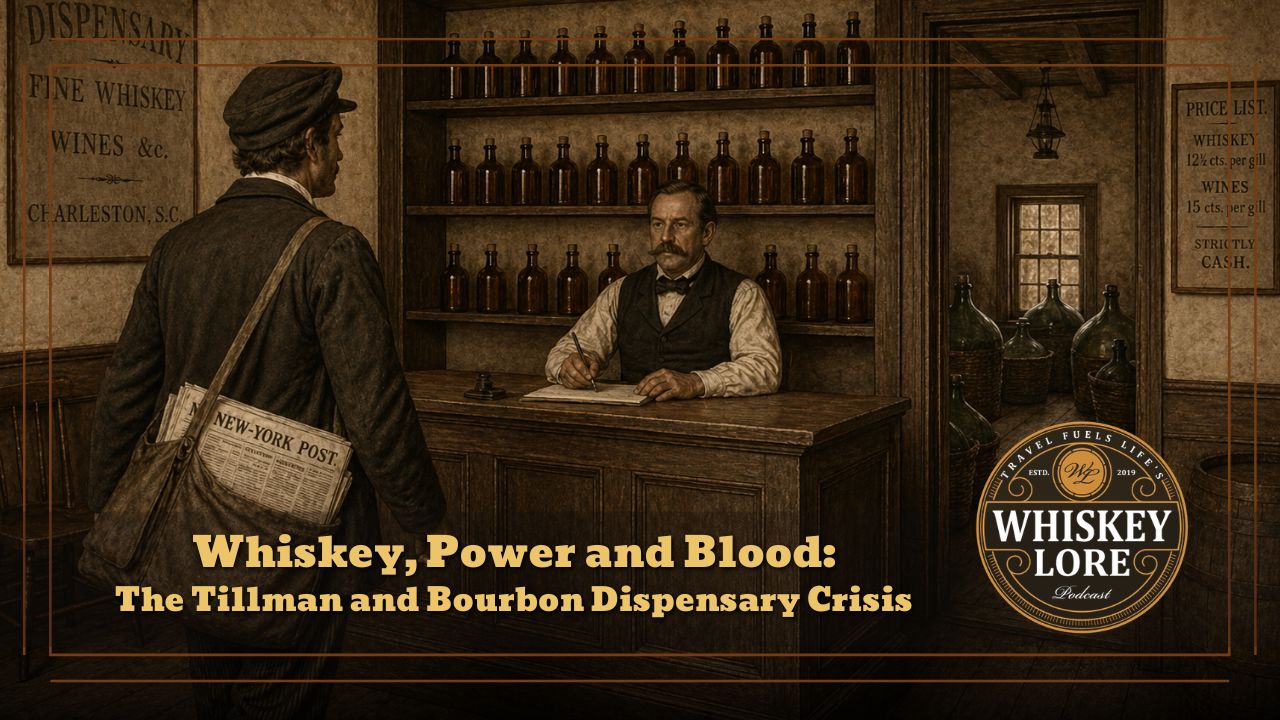
Six weeks into the new dispensary system, a New York Evening Post writer stepped into the Main Street dispensary to have a look around. It was a large store room with the dispenser sitting behind a desk with a pad for tracking purchases—the bottles perched on the shelf behind him. He asked to buy some whiskey, “corn or rye” the reply came back. “Rye” “How much” One pint 75 cents, two 90 cents. Corn whiskey was the usual request. The rye came from Kentucky and Pennsylvania, the corn from North Carolina.
The writer noted that 17 saloons had already been shuttered in Greenville under the new law, their owners holding out hope for an unconstitutional ruling. Moonshiners from the Dark Corner still hauled whiskey in the bottoms of wagons, but buyers and sellers alike risked capture by Tillman’s spies—the constables.
To observers in the North, it looked like a bold experiment in state-controlled liquor sales. To the Bourbonites, it was something else entirely—an assault on liberty, a socialistic scheme enforced by what they saw as a dogmatic and autocratic executive.
The truth was, Pitchfork Tillman didn’t think the law went far enough. Yes, the blind tigers were on the run, public drunkenness had waned, and private distilling was finally under some level of control, but those pesky warrants were taking away the element of surprise, and his constables weren’t as effective as he would like. Changes needed to be made.
THE GOVERNOR’S SECOND ACT
Dateline December 1, Columbia. The article “Patching it up” in the Orangeburg Times and Democrat had a whimsical tone. “For the last two days an administration bill amendatory to the dispensary law has been in the process of transcription in the enrolling department from the original draft. It appeared mysteriously in the department, without an apparent father, and it is not yet known just who drafted it. It was endorsed to the effect that Governor Tillman desires that it should be immediately engrossed and submitted to him. This was accomplished last evening.” The bill, written and delivered by Pitchfork’s errand boy Senator John Gary Evans was a bloated reframing of the current dispensary law, with increased deterrents for violators. Including a $500 fine and/or 6 months imprisonment for any infringement. Section 25, which punished those for knowingly bringing liquor into the state, had the word knowingly removed. It also allowed the governor to bypass judicial objections and routed penalties through trial justice courts, speeding enforcement. And while the old bill allowed some levels of patronage, the governor now had explicit power to hire or fire any dispenser he pleased, wherever and for any reason.
Meanwhile, other items were removed that the governor found personally offensive. Like the requirement of those pesky freeholder petitions. Now the governor (cough) the control board, could put a dispensary in any county without approval by the local community. And the need for warrants was removed in Section 23 giving the control board’s constables the right to seize and arrest parties and packages without a warrant—although they could obtain one after the seizure or arrest.
It appears the fatherless bill story was simply a canary in a coalmine that gave South Carolinians a heads up on what was to be the focal point of Tillman’s annual message to the legislature the very next day. He took an aggressive hardline on the bill, saying he was defending the state’s sovereignty against elite obstructionists. He acknowledged the opposition, minimized it, and framed it as elite self-interest. He assured the assembly he had the votes to get it passed.
What had started as a workaround to Prohibition was now being built into a pillar of executive power. And again, it passed through Tillman’s Senate 23-8. And with his signature, the law took immediate effect.
THE DEVIL IN THE DETAILS
Whether the average South Carolinian was paying attention to the power grab in Columbia was hard to say. It’s a good bet the Bourbonites in Charleston, Columbia, and Greenville weren’t too thrilled about the new found power of the governor. Most of the rural Tillmanites were peppered with positive articles about shuttered blind tigers and the reduction of rampant moonshining from their country newspapers.
But it wouldn’t be long before the power of this new legislation would hit home. Like, the next day, in fact. When just east of Columbia in Sumter, a Trade Street merchant got a surprise visit from the constables. They tore through the store looking for liquor believed to be held in violation of the law. When they didn’t find any, they went to the home of Ananias Cintina, one of the suspected individuals. Within the Italian immigrant’s home they found multiple cases of wine. The wife of the man was pregnant at the time and it was claimed her miscariage was a result of the shock from the incident. The case went before a federal judge who rebuked aspects of the constable’s conduct. What had been sold as reform was now arriving at people’s doorsteps—with consequences few could ignore.
Meanwhile, tensions were rising in Charleston in early January. The city’s dominance in the liquor trade—with over 280 saloons back in 1892—made it the economic and cultural center of the state’s alcohol industry. But the dispensary system struck directly at that foundation, dismantling private liquor commerce and turning Charleston into the focal point of resistance.
Merchants, shipping interests, liquor dealers, urban elites, and the city’s legal community began to ratchet up their rhetoric. They argued the law interfered with commerce and shipping, raising potential federal constitutional concerns. They warned of economic damage to Charleston’s port and pushed back against what they saw as centralized control from Columbia.
The News and Courier wrote, “We shall be surprised if the time does not speedily come when the long-suffering people of South Carolina will rise in their might and sweep him—and his spies—out of power.”
Rural papers fired back. The Abbeville Press and Banner accused Charleston of placing itself above the law, arguing that resistance only strengthened Tillman’s hand. If the city required “spies, constables, militia, and extra police to make her behave herself,” they said, then so be it.
Over the first four months, the bitterness in the country papers was matched by equal fervor in the city press. The language grew sharper. The divisions deeper.
A powder keg was forming.
The only question was—what would light the fuse?
BLOOD IN THE STREETS
In early February, the first shots were fired in the battle of the dispensaries. Outside the Columbia courthouse, a trial over the illegal sale of liquor was underway. One of the witnesses, Davis Miller, was given a hard time on the stand—painted as a spy. Tensions followed him out of the courtroom, where he was confronted by a man named Fry, who accused him of lying. As the argument escalated, another man, W.B. Meeize, stepped in—and within moments, bullets were flying. Meeize was struck several times, and Miller was gravely wounded.
Days later, another incident unfolded in Welford, near Spartanburg. State constables attempted to arrest a suspected blind tiger operator. Accounts differ, but what is known is that a constable named Massey fired a shot that killed Glassy Mountain resident Crawford Ballew. His companion, Moore, escaped into the woods. At trial, it was ruled that Ballew had been shot while resisting officers—effectively justifying the killing under enforcement authority—but the Ballew difference suggested Ballew was shot while running away.
Now the law was under a microscope. What had begun as a war of words had turned violent. The dispensary system was headed to the South Carolina Supreme Court, with a ruling on its constitutionality expected in April. But the legal challenge only intensified the rhetoric. Newspapers in both the countryside and the cities dug into their narratives.
South Carolina was on edge.
And by March 30th, that tension would erupt—drawing national attention to a law that was rapidly spiraling beyond control.
THE DARLINGTON RIOT
Some swore the blaze of gunfire and falling bodies lasted no more than a minute. Others claimed 100 bullets were fired in just five seconds before Tillman’s spies were running for the swamplands.
The odd thing was, the bloodshed didn’t begin with the dispensary system itself—or even with an enforcement action. It started with a personal disagreement between two men at the Darlington train depot. But by the time it was over, it had escalated far beyond anything anyone could have imagined. The eruption of gunfire from Winchester rifles and pistols was simply the final crescendo to tensions that had been building for days.
The tensions started when Tillman’s spies arrived on that Wednesday morning with orders to seek out illicit liquor in public places and in shops. Soon, their attention turn the home of a Black man, who apparently didn’t have any contraband spirits on the premises. When locals heard of the warrantless search, they began to gather near the home with shotguns and rifles. One of the locals handed the Black man a gun and told him he had a right to defend his property. The nervous constables decided it was better to make their way to their hotel.
They must have rang up the governor because within moments, he sent for T.S. Gaillard, the chief whiskey constable, who gathered some 28 to 30 men, each armed with a Winchester repeating rifle and two horse pistols.
When the spies arrived in town a prominent gentleman about town Mr. C.S. McCulloch, informed the constables that he had liquor in his own home and he dared them to come and take it. When the constables began walking toward McCulloch's home a mob of concerned citizens formed. Fearing for their lives, the constables reached out to the governor for aid. The Sumter Light Infantry was to be sent in on the governor's order that evening. At the same time, word went out to Florence and Sumter that a citizens meeting was being held in Darlington and that the goal would be to coordinate responses, if their freedoms were in danger. Meanwhile, locals began staking out the hotel where they were staying, awaiting their next move. They were determined no private houses would be searched in Darlington. After the Thursday night meeting, several citizens of these neighboring towns stayed to help Darlingtonites protect their homes.
By Friday afternoon, all seemed to be simmering down and the infantry was being ordered back to Sumter. A few constables were also preparing to leave.
With a large number of bodies around the Cheraw & Darlington railroad depot, confusion was inevitable.
The fuse was lit when a local hotel clerk, Paul Rogers got into a heated argument with Billy Floyd, the brother of a dispensary agent in Darlington. Floyd pulled his hand from his pocket and took a swing at Rogers, the flash of light from his brass knuckles blinding Rogers as the steel crashed into his jaw. The man quickly tumbled to the ground. Seeing the man drop, Constable McClendon, no fan of Rogers, shouted for Floyd to beat the hell out of him. Two other men stepped in to break up the fight and Rogers dashed off to gather some friends. Then Police Chief A.E. Durgan arrived on the scene and began gathering information. He pointed to Floyd and told him he had to appear before the mayor the next morning to answer for the incident. Just then Rogers returned with several other men. When Chief Durgan told Rogers to back off, he complained that Floyd had not fought him fairly and he deserved a fight on equal ground. The local merchant Frank Norment stepped in and told the two men, this area was no place for fisticuffs and to take their fists up town. Then McClendon piped up saying the fight HAD been fair from his standpoint. But no one was in the mood to hear from a spy, especially since he’d been fined $5 earlier in the week for drawing a pistol on Rogers. When Norment said McClendon was wrong, he called Norment a damn liar. Without hesitation, McClendon lifted his pistol, aimed and fired. The unarmed merchant fell to his knees and toppled over…dead. Before anyone knew why, citizens pistols and constable Winchester rifles were rattling off at a feverish pace. The citizens, greatly outmanned, took the brunt of the fire, including the police chief A.E. Durgan and K.D. Lucas. Another man Lucus Redmond used the occasion to empty out his pistol on constables R.H. Pepper and McClendon. Pepper died immediately, McClendon was seriously wounded. Then Redmond felt the sting of a bullet enter the back of his neck, everything went dark—he too lay dead. In a moment it was over, but the damage had been done.
Suddenly, the crowd thinned out and moved like a wave as constables headed for the woods with the citizens in hot pursuit.
RIGHTEOUS DEFIANCE
When word reached Columbia, Governor Tillman reacted immediately, calling for the military in Florence, Marion, Sumter, and Columbia to board a special train to take them to Darlington, to put the rascals down.
Then, something completely unexpected happened.
In Florence, citizens turned on the governor and raided the armory, leaving his soldiers with no weapons. The men were ordered back to their barracks.
And this incident was far from isolated.
The Richland Volunteer Rifle Company—a storied organization—could only muster six men willing to go to Darlington. They were dismissed.
Surely the Governor’s Guards, one of the readiest units in the state, would answer the call. But the men moved slowly—deliberately. The delay gave local citizens time to surround the armory and block its doors.
And then came the final blow.
War hero and local bishop Rev. Ellison Capers addressed the company and told them plainly—if he were in their place, he would refuse to be sent against his fellow citizens.
This open defiance of the governor was likened by some to Robert E. Lee’s refusal to lead Union forces against Virginia at the start of the Civil War.
When word spread that the Governor’s Guards would not be going to Darlington, crowds gathered at the armory erupted—cheering, hats thrown into the air.
Now the governor had to defend himself. He claimed Sheriff Scarborough had requested the troops and that it was his duty as chief executive to restore order. But not everyone in Darlington agreed. The mayor sided with the townspeople, calling for bloodhounds to hunt down the spies in the woods.
Tillman fired back, blaming the mayor for the unrest and saying he got what he deserved. Then he turned his venom on the newspapers—the Charleston News & Courier, The Greenville News, and Columbia’s State—accusing them of inciting resistance by telling citizens the constables had no right to search private homes.
“There is no such thing as a man’s castle about it,” he said. “The editors of these papers… are the murderers of those men who have been shot down over yonder.”
When the militia in Charleston also refused to take up arms against their fellow citizens, Pitchfork Ben took action—disbanding the city militias and redistributing their weapons to the country based militias.
The chaos spread quickly. Dispensaries were threatened with axes and dynamite. In Florence and Timmonsville, mobs overwhelmed the dispensaries, smashing their liquor stock to pieces.
Rumors spread just as fast. Some reports claimed the Darlington citizens had lynched the constables on the spot. But reports were sketchy and everything seemed a rumor.
When the governor was threatened with lynching, he moved quickly—ordering control of the state’s telegraph system, blocking the transmission of anything he deemed inflammatory. He also halted railroad traffic across South Carolina.
Was he exceeding his purview?
Under state law, he wasn’t. A provision in South Carolina’s statutes gave the governor sweeping emergency powers—allowing him to take control of telegraph and rail systems if he believed it necessary for the safety of the state. In effect, it placed those systems—and the people who operated them—under his command.
THE SUPREME COURT RULING
In the aftermath, newspapers returned to their corners, framing the events as they saw them. Country papers acknowledged the violence but portrayed it as the state restoring order—constables doing their duty and the law being enforced. Meanwhile, papers in Atlanta and Knoxville described something far more serious. The Atlanta Journal reported, “The Darlington riot is only the most significant of several other recent events of like character in South Carolina,” pointing to what they saw as a pattern of unrest—spies, broken homes, and heavy-handed enforcement.
For Tillman, the narrative had shifted. The law was no longer something to defend—it was settled policy. Just days before the Supreme Court’s decision, his confidence suggested he was already looking ahead, focusing not on whether the law should exist, but on how it would be enforced. Those who believed the dispensary system was on the brink of collapse underestimated the machinery behind it. Tillman had spent years consolidating power—and he knew how to use it.
Everything appeared to be falling into place. His handpicked successor, John Gary Evans, was poised to take the governorship, while Tillman prepared for his move to the Senate. The system—and the patronage that sustained it—would remain firmly within his control.
Then, the South Carolina Supreme Court came down with its ruling on April 19th stating that key elements of the dispensary law were unconstitutional, holding that while the State may regulate or prohibit liquor, it cannot engage directly in the commercial sale of liquor. The decision found that the law violated constitutional limits on the role of government, particularly by placing the State in the position of a merchant.
Tillman’s response? He just smirked.
He knew the three member court was about to turn in his favor, as one of the dissenting votes, Chief Justice Judge McIver, would be replaced in August by a Tillmanite. All he would have to do is stall the decision on appeal and then return it into the hands of a now friendly court.
What didn’t please Tillman was the news coming out of Charleston, "One hour after the news of the handing down of the dispensary law decision by the state supreme court, upward of 200 blind tigers had miraculously recovered their eyesight and were in full blast. Many of them hung out signs inviting the passersby to 'Walk in and have one with the house,' and people were by no means slow to accept the invitation." There was no shortage of alcohol, as the city stills had apparently ramped up while the constables were distracted by the Darlington Riot.
Still, like clockwork, in October, the South Carolina Supreme Court upheld the revised dispensary law, reversing its earlier position and ruling that the State could constitutionally control and monopolize the liquor trade under its police powers.
The matter was settled—for now.
WHAT HAPPENED TO THE DISPENSARY LAW?
So what happened to the dispensary law? Well, Tillman remained its champion until the end, but Governor Evans would only guide it for his one term in office. Corruption scandals grew under his watch and subsequent one term governors, all elected with the blessing of Senator Tillman, continued to bend the dispensary system to their will, until the corruption scandals, coupled with lax enforcement caused the government to reform the system in 1897. It fared no better. By 1907, the statewide dispensary was gone—replaced by a looser, county-based approach. Eventually, county by county the dispensaries disappeared, until, in 1916, the state joined the rest of the region in full Prohibition.
Fans of claiming firsts might conclude Tillman’s dispensary was the nation’s first state controlled liquor board. Yet, what then Governor Tillman and Senator Evans created was far different from the modern control boards and ABC systems.
Where the old system was a monopoly on retail sales, the new system only controls wholesale distribution and regulation. Where the old system only sold liquor out of government dispensaries, the new ABC framework allows private licensed retailers. Where the old system was built on political patronage, the modern organization is too small for widescale patronage. While the old system had a police force, there is no modern constabulary. And while the old system was highly centralized, the modern system is simply regulated.
And while some will complain that the modern system is still restrictive—too much control, not enough variety making it through Columbia’s gatekeepers—at least we don’t have people invading our homes, and we actually know what we’re drinking. We may not have access to all the brands we want, but at least those we’re buying come with names and labels—our ancestors could only guess what was in that bottle or growler.
Just goes to show. Sometimes, you can’t fully appreciate what you have today until you understand yesterday.
I’m Drew Hannush and this is Whiskey Lore
Whiskey Lore’s a production of Travel Fuels Life, LLC
Production, stories, and research by Drew Hannush
Are you a fan of whiskey history and Whiskey Lore’s mythbusting, well, make sure you’re subscribed to the podcast, because Mondays are for history and lore busting. And as we get closer to the end of Season 7, I’m looking to kick off a major podcast event in a few weeks based around the origins of Bourbon - not the stories and lore you’ve heard and read ad nauseum, but a groundbreaking look at Bourbon’s real history. In between those episodes, I’ll have historical interviews and a new podcast series that celebrates the legends of whiskey.
And for even more Whiskey Lore, make sure to become a member of the Whiskey Lore Speakeasy and Club 1897 where you’ll get longer interviews, bonus content, and a chance, with your votes, to award the best distilleries in the country with a Pagoda Award.
Just head to Patreon.com/whiskeylore.
I’ll see you there. In the meantime. Thanks for growing your whisky knowledge along with me, I’m your host Drew Hannush and until next time, cheers and slainte mhath.
Find show notes, resources, and transcripts for this episode at WhiskeyLore.org/episodes