
S7:12 - Is It Spelled Whiskey or Whisky?
Listen to the Episode
Show Notes
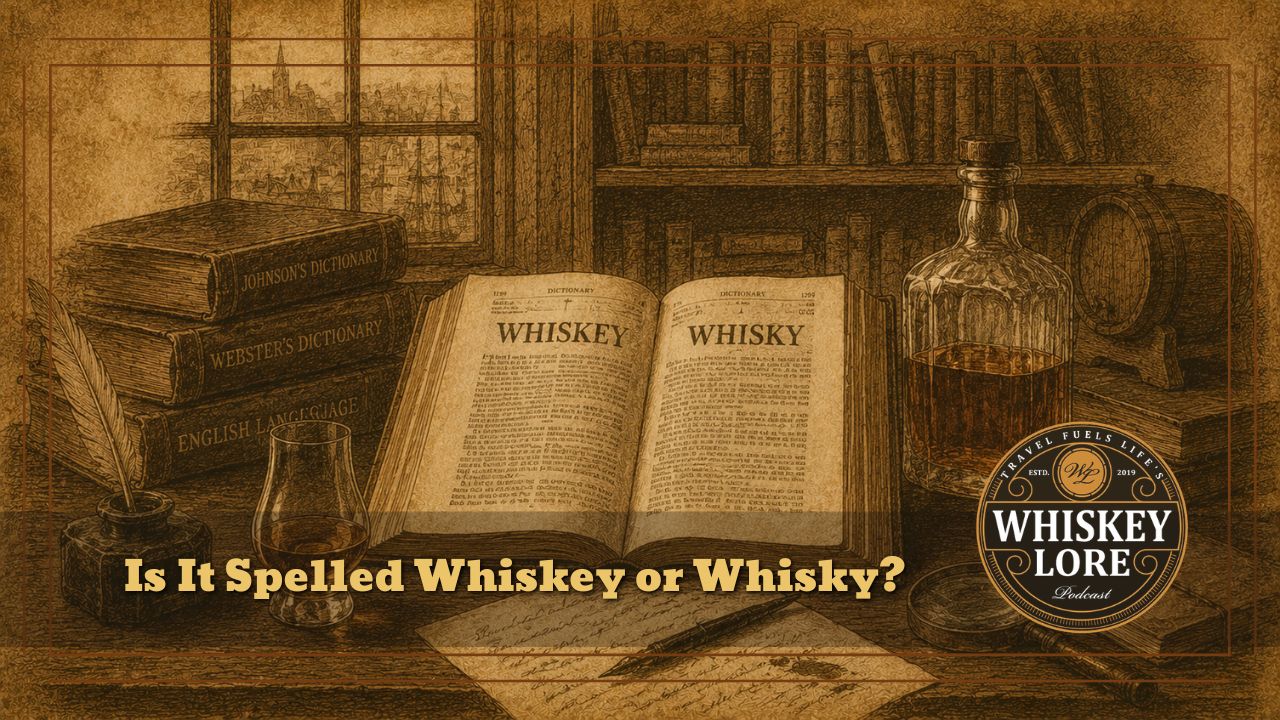
For generations, whiskey fans have repeated one simple rule: Ireland and America spell whiskey with an “e,” while Scotland, Canada, and Japan spell whisky without one. But where did that rule actually come from—and does this formula hold up historically?
Today I'll revisit one of the show’s earliest topics to dive deeper, separate fact from fiction and uncover the surprising history behind one of whiskey’s most debated letters. Along the way, we'll see what the government and the Father of American English, Noah Webster, has to say. I'll look at the cultural confusion of regional language differences, and the myths that have grown around the spelling of whiskey itself.
Was the “e” really invented by Irish distillers in the 1800s to distinguish their spirit from Scotch blends? Did Scotland always reject the spelling whiskey? And have Americans always embraced whiskey with an e?
Using newspaper archives spanning England, Scotland, Ireland, and the United States, I'll traces how the spellings evolved from the early 1700s through Prohibition and into the modern craft whiskey era. The results challenge many of the stories commonly repeated in whiskey circles today.
Transcript
(00:07):
This is Whiskey Lore. What a glorious day it must have been. The day that Noah Webster first held a copy of his landmark work, an American dictionary of the English language. After nearly 30 years of research in toil, followed by months of rallying financial support for his two volume set, December 1826 marked the moment that Webster's vision of a distinctly American English language finally reached the public. The Boston Daily advertiser hailed it as, "An extraordinary novelty in the literary world," remarking with surprise that "Any Yankees should have the hearty hood enough to propose the establishment of his own standard for the regulation of the English language." The paper predicted that British critics would lampoon the effort as they did, "Whenever a production of any merit is generated on this side of the Atlantic." It became a point of American pride and was seen as quite the intellectual feat.
(01:24):
After all, for 70 years, Samuel Johnson's a dictionary of the English language had become the last word on the subject. This comprehensive set of books had over 40,000 entries with detailed definitions. Challenging it seemed audacious, but Webster, a patriotic American, believed true independence meant developing a unique cultural identity, on identified by its own customs, history, political discourse, food, arts, and literature, all expressed through a uniquely American English. Webster built a massive list of words, eventually discarding thousands that he deemed obsolete or unhelpful. He mastered an impressive 26 languages to trace the origins of English words, scoured American and British texts for examples, and delved into science to document newer terms that Samuel Johnson hadn't included. He also took special interest in regional dialects and colloquial language and he separated letters that were once used interchangeably like I and J and U and V to solidify a new list of words.
(02:39):
One of the more controversial things Webster did was change the spelling of a large number of English words. His goal was to simplify the language by trimming the fat. Words like color and honor lost their you. He moved letters to better match phonetic sounds transforming theater and center from RE endings to ER endings. He also condensed double consonants like the double Ls in traveler and counselor and he removed the second G in wagon. He also dropped silent E's in words like acts and forego and the UE from the end of words like dialogue and catalog. Not all of his changes made the final print edition, including soup, which he wanted to spell S-O-O-P, Daughter, which he spelled D-A-W-T-E-R and Wimen, which he spelled W-I-M-M-I-N. But an overwhelming number of his changes stuck between 12 and 15,000 out of the full 70,000 word two volume set.
(03:49):
How was it received? Well, critics praised the work, but the cost of printing and the massive volume limited its sales potential. So sadly, it never became a financial success for Webster. It wouldn't be until publishers George and Charles Miriam purchased the rights and released a condensed volume in the 1840s with that book finally becoming both an influential and financial success. In this December, we will mark the 200th anniversary of this wonderful book that defined the American language and helps shape American culture and quite fitting it happens in the year and the country is celebrating its own 250th anniversary. So go ahead and raise a glass to the honor of Noah Webster, who Americanized the English language, will honor him by dropping the you in honor, but should we drop the E in Whiskey?
(04:52):
That is a great question. And if you listen to my season two episode, Whiskey or Whiskey, The Great Spelling Controversy, or read my book Whiskey Lower Volume one, then you know the answer to the question of whether he kept the E or got rid of the E. But again, this is a season where I am going back to my old episodes and listening for factual issues, which unfortunately there are some in that original season two episode. And I tried to correct some of those in my season six episode who put the E in Whiskey, but that was an Irish whiskey season so I mostly stuck to the Irish side of the equation. So today as we celebrate both America's 250th anniversary and the 200th anniversary of the canonization of American English, let's go ahead and revisit that season two episode and put in some fresh facts and research and see if we can finally find the secret behind why American whiskey brands and distillers embrace that E in whiskey.
(06:00):
It was April 2019. I had just blown in on the red eye from America into Dublin and for me it was a pretty normal traveling experience as I went through customs, exchanged some money and headed straight to the rental car office or car hire and picked up my vehicle. And as a world traveler, driving a new country has never really seemed to bother me that much, but on this particular day I was about to embark jet lagged and all on my first left side of the road driving experience. And it became a challenge right from the beginning as I tried to figure out why I couldn't find a steering wheel in the car. Took me a second to realize that the steering wheel was on the other side of the car. Then I had to figure out the rear view mirror, kept reaching for the steering column to shift because I wasn't used to the shifter being by my left thigh.
(06:56):
And then after a couple of laughable moments clicking on windshield wipers by mistake, I finally got the car moving. Now it felt like it could end up being a disaster, but for this dyslexic kid from America, I actually think I did pretty well on my first go, navigated the roundabouts, dealt with single track roads and only had one really mind numbing moment of stupidity when I relied just a wee bit too much on my instinct and found myself driving on the wrong side of the road with a car coming towards me. Luckily all survived unscathed.
(07:36):
And when it comes to visiting or living in a new area or country, there's a whole lot more to deal with than just new traffic laws. They're customs, cultures, language issues, and quirky little mannerisms that can quickly make you feel overwhelmed or out of place and things you take for granted in one location become vo-pause in another. Some are simple and easy to overcome, but in other cases it can be caused for some real social anxiety. That's something I got a face full of when I was a kid. Now, when I was growing up near the Canadian border in Michigan, we were all about the metric system. That seemed to be the future. It's what I learned in elementary school side by side with the old imperial measurements of miles, pounds, and gallons. But after my family moved from the Midwest to North Carolina, it amazed me that nobody seemed to care about the metric system.
(08:38):
In fact, the only time I ever saw it was when we got a bottle of two liter pop. Okay, be honest, put up your hand. How many people cringed when I used pop in reference to a soft drink? Well, luckily it was a term I didn't even use when I lived in Michigan. I always called it soda so I didn't get those annoying glances from the people in North Carolina whenever I would say it. But what confused the heck out of me was the fact that in North Carolina, everybody was referring to the same thing as Coke. Didn't matter if it was an RC, didn't matter if it was a Pepsi, they just ordered Coke. And to me, that's like cats sleeping with dogs. Order a Coke and get a Pepsi? Totally baffling. And of course it took me a little while to get used to Southern accents and it took Southerners a little time to get used to me saying a boat.
(09:34):
And then there were the salt shakers on the tables in the lunchroom. Amazingly, we did not have those in Michigan. In North Carolina, I was watching somebody putting salt on their entire tray, including their dessert. Shocking. And then there was the issue I was having with spelling things, having lived near the Canadian border where the Samuel Johnson version of English seemed to flow across the Detroit River like nobody's business. All it did was serve to just screw up my spelling ability. To this day, I still gravitate towards spelling dialogue and catalog with a UE and I almost always spell theater R-E. Unfortunately, that became a problem when I was in school because I'd get marked off for misspellings on words that I was sure were spelled right, but to which my teachers had not really been exposed. And that problem popped up again when I hired my first book editor.
(10:35):
She was born in England and for the most part, she did an amazing job of keeping the English Americanized, but there was one particular item that we stumbled on, the word ad, not ADD, but just AD. She kept changing it to advert. That was the moment that I realized that in her culture they say advertisement and that's why they shortened to advert, whereas we say advertisement, so we shorten it to ad. In the end, we decided to compromise. We would just spell the word out completely so as to please both cultures.
(11:17):
But what's strange is there are still a few words in the American English language that we haven't quite settled on how we want to spell them. And this came clear to me when I was growing up in Asheville, North Carolina, where I lived not too far from the Great Smoky Mountains National Park and to some might seem like a given that you spell Smokey without an E. When I worked in West Asheville, I noticed that the road Smokey Park Highway was being spelled by a good number of people with an E, so that's something I got in the habit of doing myself. But what's funny is I started to notice that there were street signs that didn't have the E, yet other ones did. And there were businesses that were alternating between having the E and not the E. So it became something I decided to dig into in the season two episode.
(12:12):
Well, what I found was that that road was named after the Smokey Park Bridge, which was built by the state back in 1950 and that bridge was named in honor of the National Park and the spelling for Great Smoky Mountains is without an E. And in fact, Noah Webster's original dictionary has no E in Smokey and the online version of that dictionary also prioritizes no E, but it does offer up the E version as a alternate spelling. So how did the county and so many local businesses and even Google Maps get this so wrong and where the heck did that E come from in Smokey? Well, unfortunately in the original version of this episode back in season two, I ended up using what I didn't realize at the time was Lore to come up with the origin of the E in Smokey. There were several online sources that pointed to the creation of Smokey Bear by the US Forest Service as the origin and the rise of the E in Smokey.
(13:19):
Now I'm not buying it as an origin because as I went back through my research, I found Smokey as a surname going all the way back as far as newspaper archives could go on the internet. However, maybe it had some influence on the inclusion of an E in Smokey in later years because we as kids see Smokey Bear's name, we see it spelled that way and we then just get in the habit of spelling it that way. What's curious is that when I released the season two episode, I had some friends in Asheville who were like, "I never really thought about Smokey Park Highway and how it's spelled both ways." Just goes to show how used to something you can get and it gets so embedded in your brain it seems like the correct way.
(14:11):
But when it comes to whiskey, well to some it's a matter of honor, especially those who spell honor with a U. Scotland's whiskey industry is notoriously persnickety when it comes to keeping the E out of scotch whiskey, but some American writers can be pretty hard nosed as well. Take Bourbon Hall of Fame historian Chuck Cowdrey, who in 2009 upon learning that New York Times columnist Eric Asmof had successfully lobbied the editorial staff to allow him to drop the E when referring to Scotch and Canadian whiskey, he posted in his blog, "My policy is that American publications should spell whiskey the American way regardless of the type of whiskey being discussed." Of course, once I got into writing whiskey books, that's the first time I had to really decide which way I was going to go. I mean, the main thing that I had to pay attention to was that the literary rule says choose a direction and then remain consistent in your writing.
(15:17):
Well, there's a lot to consider here. Do I ground myself in my native spelling like Chuck Cowdry? Is there really a quote American way of spelling whiskey? Do I dig into the history and try to determine which way I'm going to spell it by how it's historically accurate or do I lean on how the brands spell whiskey and then just fall back to my native language for generic use? And there's so many considerations and frankly, it's very easy to fall into paralysis by analysis. So as an American writer, I need to decide to E or not to E. And as I like to do, I'm going to dig into the facts from the past and use all of that information to help inform my decision.
(16:09):
To start this analysis, let's start with some popular theories as to why there are two separate spellings of this one word. Modern Irish narratives suggest that the origin of the E and whiskey came from Dublin's big four distillers, John Jamieson, William Jamieson, John Power, and George Roe. The story suggests that the Dubliners were upset at the amount of cheap blended whiskey that was traveling across the Irish Sea from Scotland after the Spirits Act of 1860 opened up the blending of grain spirits called silent spirits by the Irishmen with malt whiskey. Well, in 1879, they wrote a book called The Truths About Whiskey, laying out all the reasons Irish whiskey was superior to those upstart blended whiskeys from Scotland. In fact, the book went as far as to call into question whether those blends could even be called whiskey. It said that they added the E to whiskey to differentiate their Dublin spirits from those cheap blends that were coming from across the sea and also the cheaper whiskey coming out of the Irish countryside.
(17:16):
The Scotts? Well, they're probably not going to agree to an idea that Irish whiskey is somehow superior to Scotch, but they would basically agree with what the Irish were sort of stating, which was whiskey without an E was the standardized spelling and the Dubliners were having to add a letter to it. There are other theories as well. In Irish galic, the word whiskey evolved from Ishgabaja, which evolved from the word Aqua Bitai, which is a Latin word, meaning water of life. The first five characters in the Irish spelling are U-I-S-C-E. In Scotch Gallic, a language with a similar origin, their word is Ishkebah also meaning water of life, but the first word is spelled with a G instead of a C. The idea here is that maybe with the words being spelled differently, they just evolve differently in each country. Well, the truth is the Irish version, the Dublin four theory, it's pure lore.
(18:21):
You can go back and hear the whole story in season six, or just stay tuned because it's going to become clear in a few moments. As for the evolution of the spelling from Irish Galic and Scotch Galic roots, well, that is worth some deeper consideration. For that, let's go back to the first known instance of the use of the word whiskey in print. It comes from a broad sheet ballad titled A Dialogue Between His Grace, the Duke of Argile and the Earl of Mar, dated 1715. What's a broad sheet ballad, you say? Well, for the English working and lower middle classes in the 18th century, the broad sheet ballad was a popular form of entertainment and news. Printed on one side of a sheet of paper, these ballads delivered stories of love, politics, history, and current events all in simple rhyme and easy to memorize verses.
(19:18):
This made them accessible to both the illiterate and illiterate as they were often sung aloud in public spaces like taverns or markets. And this particular broad sheet was bringing news from the north where the Scottish Highlanders led by Bobbing John Erskine, the Earl of Mar, were attempting to restore the Stewart kings to the British throne. The battle wasn't going well for the Highlanders who were surrounded by the Duke of Argyle's forces. Some drown, others were described as running like any hair. The Lord of Mar was not about to give up. In the ballad, he warns his opponent that he's not through yet. Though this battle may be lost, he's already considering raising a new force and arming his men with plenty of tobacco and liquid courage. "We shall know how it goes, sir. Whiskey shall put our brains in a rage and snuff shall prime our nose, sir.
(20:16):
With swords and guns in our hands, we'll stoutly venture on, sir. "Well, despite Mars threats, the Jacobites would not be able to reform under his command and they lost the 15 as that conflict named after the year became known. As entertaining as this broad sheet was for the people who heard it at that time, it likely was quickly forgotten by its readers. But for fans of malts and grain spirits, it is a seminal moment where the word whiskey finally appears in print. So was it spelled with an E or without an E? Well, it did have an E, but it didn't have a Y. It was spelled W-H-I-S-K-I-E. And this shows that the Scotts had not yet grown an attitude around the use of E in whiskey. It also weakens the idea that the word evolved differently in the Irish and Scottish languages.
(21:24):
The reality is that the spelling in Ireland and Scotland in the early 18th century was utter chaos and rarely was there a standardization in spelling. Newspapers did their best, but varied from source to source and sometimes writer to writer. Well, that all started to change in 1755 with the introduction of Samuel Johnson's landmark a dictionary of the English language. With it, standardization of spelling was established, although not religiously followed throughout the kingdom, especially when it came to the word whiskey. Perhaps that was because of how Johnson approached the word in his first dictionary, not as one of his primary 40,000 words, but instead as part of the description for Ishkabah, where he noted," By corruption in Scottish, they call it whiskey.
(22:25):
"Apparently before the Scotts got their nose up in the air about how you spell whiskey, the English had their nose up in the air about this whole concept of Ishkabah and whiskey. How did he spell whiskey? The same way he spelled Smokey without an E. But apparently English newspapers didn't get the memo. In doing a newspaper search of over 700 entries using the word whiskey between 1755 and 1800, the time immediately after the release of Johnson's book, whiskey was spelled with an E counter to Johnson's advice 78% of the time. Meanwhile, out of 600 newspaper entries for Scotland, they spelled it without an E 96% of the time. As for the Irish, well, out of 800 entries, the Irish papers showed 98% favoring the spelling with an E. Being that this was 1755 through 1800, clearly the E in Ireland was not the invention of the Dublin four in 1879.
(23:32):
In fact, you just have to look at the title of their book, The Truths About Whiskey. They spelled whiskey without an E. It doesn't sound like they were lobbying for the inclusion of that letter. This does however still leave the door open to the idea of the evolution of the word since Ireland had already fallen in love with the E and Scotland had already fallen in love with no E by this early date. Now that large scale use of the E in Irish newspapers in the 18th century does lend credence to a concept about how the E got to America. During the 18th century, there were three great waves of Scott's Irish immigrants who came from Ulster to America during that time. Well, you might logically conclude that that's exactly how the E got to America, but not so fast. You're basing that on an assumption that Americans have embraced the E in whiskey from time immemoriam.
(24:33):
But as you're about to discover America's Love Affair with the E was an on again, off again affair.
(24:47):
When you head to your favorite liquor store today, look at all of those brands of American whiskey and notice what most of them have in common. Almost all of them spell whiskey with an E with a few exceptions, Maker's Mark, Old Forrester, and George Dickel, along with some upstarts. But what if I told you the E in American whiskey is more a product of the 20th century and that before that all bets were off? Well, we'll begin with the father of the American English language, Noah Webster. In his initial entry, if he was looking to be different from Samuel Johnson in the way he spelled the word, well, he just would have to add an E to whiskey, but that's not what he did. The first official spelling of whiskey in America was written without an E. But of course, as we've learned from Samuel Johnson, that doesn't necessarily mean the populous is going to get the memo.
(25:46):
So let's break out our newspaper search across the fruited plane and break it down into six main time periods, pre-revolution where we might have influence from the outside, post-revolution to Webster. In other words, before we were influenced by an American source and Webster to the end of the Civil War. Civil War through the Gilded Age into the Bottled and Bond Act, the Bottled and Bond Act to Prohibition, and then the post-prohibition era. Well, before the Revolution, not a lot of newspapers to go through and the use of the word was pretty minimal in the ones that were available with an even split between the spellings out of 30 entries. But during the era of the Farmer Distiller that took place from the Revolutionary War up to Webster, out of 74,000 newspaper entries, whiskey with an E dominated with 95% of the entries lending credence to the Irish and Scott's Irish influence on spelling.
(26:48):
But perhaps Webster's influence felt much more than Johnson's was in England because the years leading up to the Civil War, we find out of 1.5 million entries, whiskey with an E had dropped to 57% of the references. And at the same time, the English were abandoning the E as were some of the Scott's Irish in Ulster who had narrowed the margin down to two to one for the use of E. Now the gilded age, which saw the rise of Kentucky bourbon and the industrialization of the industry, well, the spelling habits changed. Whiskey without an E took a commanding lead with 65% out of the more than 5.5 million entries with the word whiskey in the country's newspapers. Was it Webster's influence growing? Possibly, but the whole world seemed to be shifting. Even the Scott's Irish and Ulster had grown to 73% that were also not using the E while the rest of Ireland remained five to one in the use of the E.
(27:58):
But after the Bottled and Bond Act of 1897 up to prohibition, when suddenly bottles were hitting the shelves, the American choice was all but a dead heat with whiskey without an E only up by 4%. So why the shift? It's hard to say. There were some newspapers talking about it except more in a comic relief form. The Philadelphia public ledger looked at the controversy by having this conversation. A new reporter said, "Some spell whiskey with an E and some spell it without, don't they? " The seasoned reporter said, "I believe so. " The new man said, "Well, how do you put it down?" "Well, my throat, of course. "The Omaha World in 1901 printed a story where a British merchant complained that in his written order for whiskey he was delivered scotch. When he confronted the seller, the merchant pointed to the order saying that it was spelled without an E, which always denoted scotch.
(29:02):
If Irish were desired, it should have been spelled with an E. In his prohibition approach, the trench and camp of Admiral Maryland wrote," Do you spell whiskey with or without an E? "Asked the barfly. "You don't spell it anymore," said around her. "You whisper it. "Well, it's obvious there was no clear guidance before prohibition, but the American government would change all of that coming out of prohibition. Just like the Scotts, they would adopt the lack of an E in their official language that defined the rules for bourbon, rye, and other styles of whiskey. Perhaps the government was honoring the wishes of Noah Webster who advised the American public over a century before, but the general public after prohibition still split. Whiskey with an E stayed in the lead in newspapers by 62%, although It must be noted that some of those references were probably referring to Scotch.
(30:06):
It's clear today that whiskey with an E is the clear preference of American brands, yet legally they can go either way as can the Canadians, Scotts, Irish, Japanese and others. There is no legally enforced statute that requires a specific spelling of the word, although a Scotch distiller might point out that in the rules there's never really a spelling with an E, but the same could be said for the United States.
(30:38):
Now, when we look at the modern landscape with Scotland, they've been the most consistent throughout the generations in their choice of spelling whiskey without an E. In Ireland though, Allstar really had dumped the E whereas the rest of Ireland seemed to embrace the E, the one exception being Bushmills, yet the Ulster spelling eventually faded because of the collapse of the Irish whiskey industry. Once we got to the mid 20th century in an effort to save the industry, all of the companies joined together into Irish Distillers Limited and this single company chose to spell whiskey with an E and so all of Irish whiskey had taken an E by default. Now this all could have changed in 1987 when John Teeling came in with his Cooley distillery, but he also stayed with the convention. And today most still follow that lead, but there are a few brands, Waterford, Blackwater.
(31:40):
They've released whiskeys without any. And that brings up another point. The industry used to be consolidated under some major companies, but both the United States and Ireland have seen an incredible rise in craft distilling because of this. All bets are off in terms of how you're going to spell whiskey. Most likely they're going to stay with the modern convention, but it is worth keeping an eye on. No longer does the shortcut that I hear on distillery tours still work in terms of saying that Ireland and the United States have ease in their spelling so their whiskey is spelled with an E and Scotland, India, Canada and Japan don't have an E in their country names so they don't put an E in the word whiskey. In fact, we can mess that up already by saying England doesn't use an E and they definitely have an E in their name.
(32:38):
So it is hard to draw a historical conclusion, especially in America where the spelling choice changed three different times. It just goes back to history is complicated and there are no simple formulas if you want to get history right. So I'm not really going to be able to use history as my basis for choosing an E or not an E and that leaves me at the mercy of trends. The current trend is the E in America, but that wasn't the case when Old Forrester came on the market and look at them. They've held onto it through all of those years. They didn't shift with the trends. Now, if I go with the trend, I'm clearly going with an E, which is exactly my reasoning for choosing the E when I created the brand Whiskey Lore, but I did make sure that if you go to whiskeylore.org, you can get to it with an E or without an E.
(33:35):
So spell it how you like without fear of repercussions. This is America after all. We're supposed to have freedom, right? So do what you feel is right. I know there's always going to be arguments and I am fine with an American standing up and defending the E in their whiskey just as I applaud a good Scott who will always question your use of an E in referring to their spirit. And I mean, let's just be honest. It's so embedded in the psyche of this Scotch whiskey drinker, I don't think a scotch would taste as good with the E. I mean, it'd be like drinking a Guinness out of a Bud Light blast. Who in their right mind would do that?
(34:22):
I'm Drew Hannush and this is Whiskey Lore. Whiskey Lore is a production of Travel Fuels Life, LLC, production stories and research by Drew Hannush. Are you a fan of Whiskey History and Whiskey Lore myth-busting? Make sure you are subscribed to the podcast because Mondays are for history and lore busting. And as we close out season seven, I'm going to be looking to kick off a major podcast event in a few weeks with the origin of bourbon on tap. Make sure you subscribe. Mondays will also feature historical interviews and a new podcast series that celebrates the legends of whiskey. And for even more Whiskey Lore, make sure you're a member of the Whiskey Lore Speakeasy or Club 1897 where you'll get longer interviews, bonus content, and a chance with your votes to award the best distilleries in the country with a Pagoda Award. Just head to patreon.com/whiskeylore.
(35:22):
And thank you for growing your whiskey knowledge along with me. I'm your host, Drew Hannush, and until next time, Cheers and Sloan Java. Find show notes, resources, and transcripts for this episode at whiskeylore.org/episodes.