
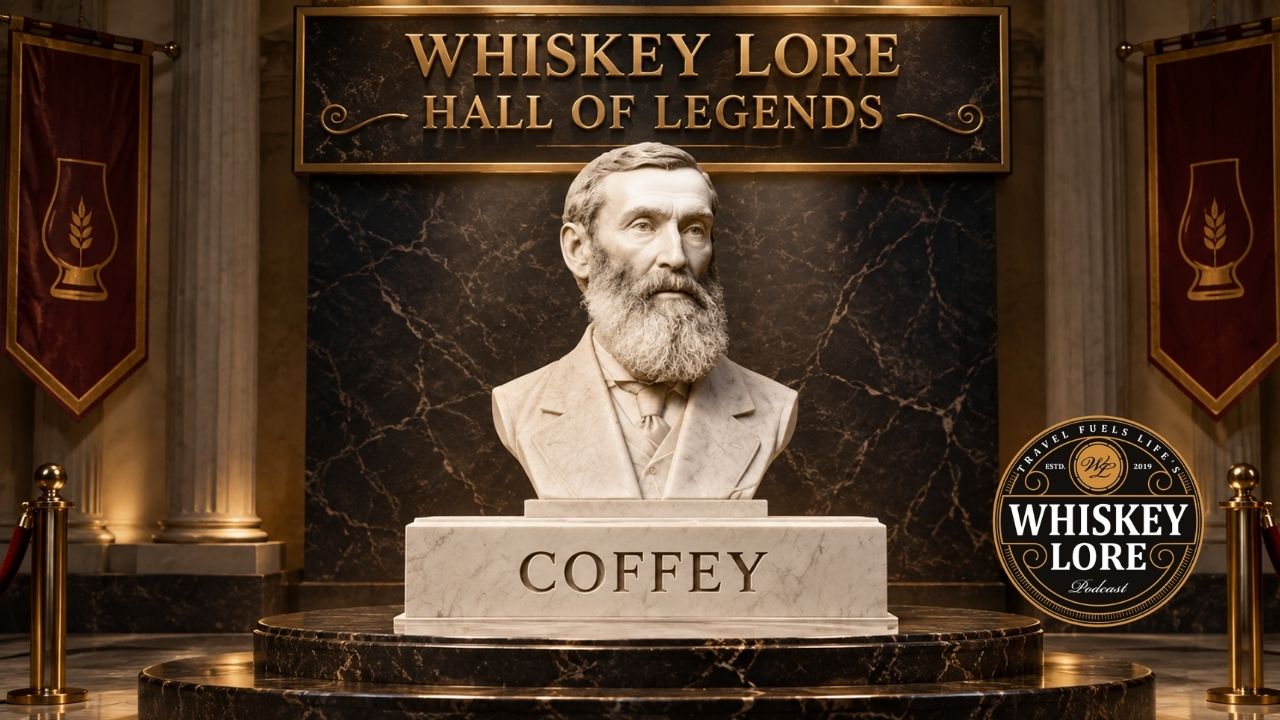
Hall of Legends Inductee #1: Aeneas Coffey
Show Notes
Aeneas Coffey (c. 1780-1852)
Inspector General of Excise for Ireland and Inventor
- Involved in the findings for the Excise Act of 1823
- Inventor of the Coffey Patent Still
- Variations of his invention continue to be used today
Listen to the episode with the player above to hear his story or read it using the transcript tab above.
Transcript
Script
Welcome to the Whiskey Lore Hall of Legends
It’s time to meet our latest inductee:
Some say I was born in France, while others say I arrived on this earth in my native Ireland. I don’t really recall, as I was a bit young then. I do remember my years at Trinity College in Dublin and my eagerness to dive into my first occupation, gauging whiskey for the Irish Excise.
It was early in that occupation that I became obsessed with the art of distillation. I consumed everything I could find about this particular form of alchemy. And I had one enormous advantage: the government paid me to visit the very people who could teach me, the distillers of Ireland. I traveled north and south, taking measurements, inspecting equipment, and collecting for the King’s coffers, all while absorbing all the knowledge I could from the craftsmen making these wonderful spirits.
It could have been the perfect life, soaking up knowledge and learning the trade, if not for the politicians who were stirring up ill feelings throughout the countryside.
Their target was the eradication of illicit distilling. Being a government employee, I knew exactly why Parliament was determined to rid the countryside of the Irish moonshine known as Poitin. Napoleon was trying to rule Europe, and Britain needed money and grain for the fight. But they were going about it the wrong way, cutting off grain supplies to legitimate distillers, while the illicit distillers had no such constraints. In the Inishowen Peninsula where I worked, the choicest grains were flooding in and Poitin was earning a solid reputation. Meanwhile, some of my colleagues in the excise were taking advantage, turning a blind eye to the trade, while taking bribes. It was scandalous and I vowed never to step into that scandalous world.
But it didn’t matter. I was a revenue man and there was a target on my back. I thought I was protecting myself when I asked four of the King’s men to accompany me on a mission to Carthage Mountain, at the northern end of the peninsula. But four soldiers were no match for the 50 or so angry locals who rode up, surrounded us, beat me, and stabbed me until I was left bloody and unconscious. To this day, I have no idea how I survived.
Yet for all the pain, Inishowen taught me something I couldn't have learned sitting behind a desk. I came to understand the plight of the rural distiller. And that knowledge would come in handy when the government got itself into even more hot water.
While I was away convalescing with my wife and children, Parliament went over the top with aggressive financial penalties. Called townland fines, the idea was to hit the landlords with severe penalties if they dared let one of their tenant farmers fire up a still. In my old territory of Inishowen, some of those distillers took matters into their own hands. They chose leaders, organized their own defense, and for two years governed themselves. They called it the Poitín Republic. In a coastal valley called Urris, blocking the main road that came through the hills, they made their stand and quite successfully for a while, at least until the war with Napoleon came to an end. Then the increased military force of the British finally put it down. I was there at the end of it. And it lit a fire in me. My experience on the ground had shown me, financial warfare and aggressive tactics weren’t going to quell the violence, bring these distillers into honest distilling, or fill the King’s coffers, which was the ultimate issue for the government.
As Inspector General of the Irish Excise, I was called on to help find a better solution. In 1823, my brother-in-law Daniel Logie and I reported on the distilling laws and practices in Ireland and Scotland. Our recommendations would help shape the landmark Excise Act of 1823. None of us knew the impact that bill would have. Thanks to us allowing the licensing of smaller stills down to 40 gallons in size and reducing the licence fee to 10 pounds, Irish distillers came out of the shadows. And so too did the Highland distillers over in Scotland. In fact, many credit that act with helping launch the modern whiskey industry.
It’s an achievement I could have hung my hat on for the rest of my life. But I’d learned so much about distilling, I wanted to see if I could make an even bigger difference outside the Excise.
For several years, distillers had been trying to figure out a way to increase production without sacrificing quality. I’d heard of all sorts of experiments where distillers tried chaining pot stills together to make a continuous distillation system. One of the more promising experiments was that of a Frenchman named Blumenthal who had stepped beyond the pot still to create a multichamber column still. Yet none had made a serious run toward production. I went to a brewery in Kilkenny and partnered in the creation of a distillery. I thought I was making progress, until the day I heard Scotsman Robert Stein had achieved the creation of a two-column system with an analyzer and rectifier. I had to double my efforts, so moved my business to Dublin, taking over the Dock Distillery on South King Street. While Stein’s machine was a major step forward, it had its flaws. He couldn't properly regulate reflux, and his plates clogged too easily. So I built my own model, added perforated plates, and got it working. I sold my first unit in Derry, near my old stomping grounds of Innishowan, at Watt’s Distillery.
I soon began outselling Stein, with stills set up from County Wexford to County Tyrone, Sligo Distillery to the Belfast Distillery. And when I set up a second office in London, my association with the gin trade and the efficiency of my system ultimately made mine the preferred machine. I hear that after my death, the Dublin distillers turned on my machine, saying it made an inferior whiskey - they mocked it by calling it silent spirit — but to many, it made the purest spirit around—the illicit distillers especially like it because they could produce fast and the spirit’s purity was said to remove the headache and poisons from the whiskey. Even the Americans embraced the concept, taking my analyzer and rectifier and combining them into a single column. For a time, nearly every legal drop of Bourbon coming out of Kentucky was made on a descendant of that machine.
It’s hard to say which was my prouder achievement, the work I did on the Excise Act of 1823 or the patent still that changed the world of whiskey paving the way for lighter blended whiskies and modern Bourbon.
It seems that, without me, the modern whiskey industry might look very different, and the whiskey in your hand might taste very different too.
Do you know who I am?
My name is Aeneas Coffey. I’m an Irish inventor, excise man, and the first member of the Whiskey Lore Hall of Legends.
Want to dive deeper into the story of whiskey legend Aeneas Coffey, check out Chapter 7 of the book Whiskey Lore: Volume One available on Audible, Spotify, and Apple, or in paperback through your favorite online store.
More entrants in the Whiskey Lore Hall of Legends to come. Make sure you’re subscribed. And join us at patreon.com/whiskeylore for a chance to nominate future members of the hall.
Whiskey Lore Is a Production of Travel Fuels Life, LLC
Legendary scripts written, performed, and produced by Drew Hannush
Find transcripts and further details for today’s show at whiskeylore.org/episodes