
129 - ESTATE WHISKEY ALLIANCE: What It Is and Its Benefits
Listen to the Episode
Show Notes
Last week, I hit the road and headed up to Lexington, KY and attended my first @beam_uky Industry Conference. It was a fantastic opportunity to shake the hands of some great people who I’ve either met through visits to their distilleries or by zoom interviews.
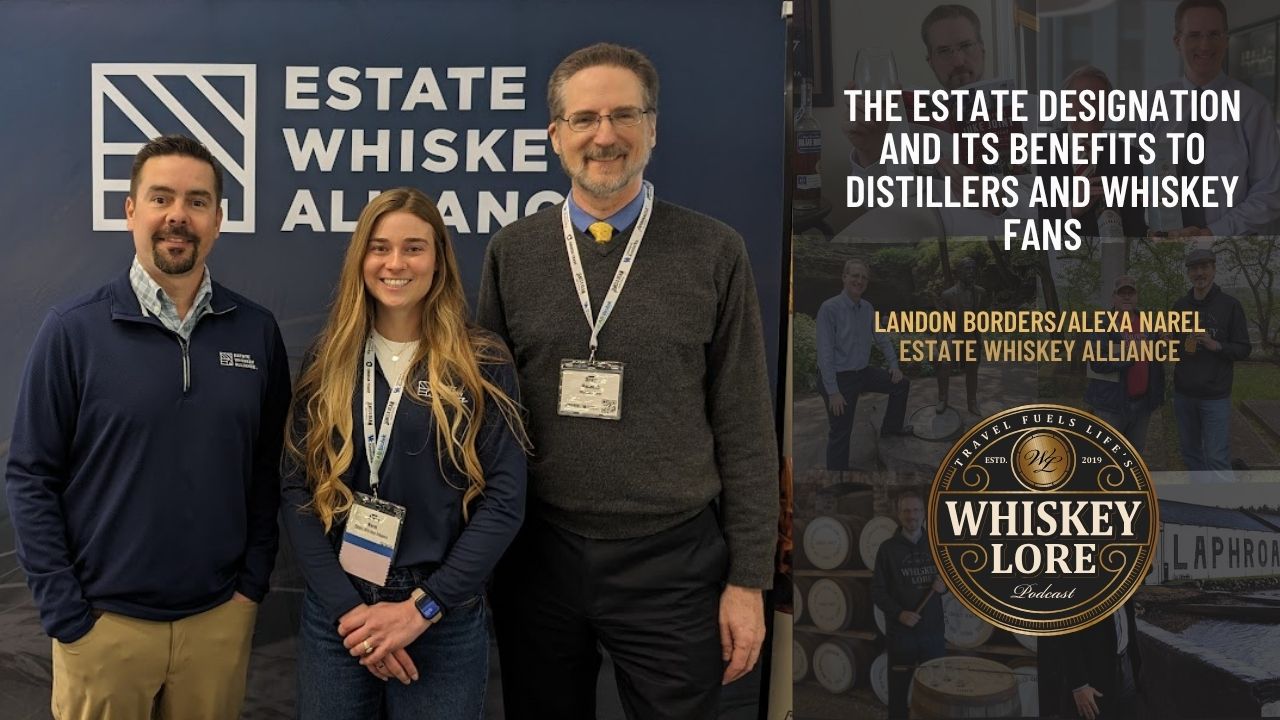
During the event, I sat down with Landon Borders and Alexa Narel of the @estatewhiskeyalliance to talk about this new certification.
On today's podcast, we'll chat about the origins of the alliance, how it builds transparency for whiskey drinkers, what it takes for distilleries or products to qualify for the Estate whiskey designation, and we'll drop some names of current members.
Learn More
Transcript
Drew H (00:14):
Welcome to Whiskey Lore The Interviews. I'm your host, Drew Hannush, the bestselling author of Whiskey Lore's Travel Guide to Experiencing American Whiskey, Experiencing Kentucky Bourbon and the book, the busts 24 of Whiskey's Biggest Myths, Whiskey Lore Volume One. And last week I had a chance to hit the road and head up to Lexington, Kentucky, where I attended my very first James B. Beam Institute Industry Conference. This one being the seventh annual gathering. It was a great opportunity to shake the hands of some of the people that I've had here on the podcast that I've actually never met in person and also some of the ones that I have met in person, people from all over the country, not just Kentucky. And I got to thank Jerry Daniels of Stonefence's tours for turning me onto this great event. Alexa Norell of the State Whiskey Alliance and Grace Sowards of the University of Kentucky for giving me a chance to cover the event as part of the media.
(01:09):
And if you are a distiller or distillery owner, which I know a lot of people who listen to my podcast are, well, I can't stress enough how valuable the keynotes and breakout sessions are. You learn everything from marketing to extremely geeky science stuff. And for me, I particularly enjoyed the events where had an open floor and attendees got to chat back and forth and trade ideas. And as always with these conferences, it's the time between breakout sessions where all the real magic happens. A lot of handshaking, getting to know one another. And you're sure to be hearing a few interviews coming along this year that will have happened because I got a chance to go to that conference and meet some really interesting people. And from the standpoint of a whiskey fan, I will have to say that this is definitely not a whiskey drinking conference.
(02:04):
It is a industry conference. So you're going to want to stick to the Kentucky Bourbon Festival, bourbon on the banks and so on. But people in the business, this is a top-notch event and I can't wait for the eighth annual event to get underway next March. And while I was there, I actually had a chance to sit down with the two drivers of the Estate Whiskey Alliance, Director Landon Borders, and Associate Director, Alexa Norel. And I wanted to dig in and learn more about the origins of this certification, how it benefits customers, what distilleries or products qualify for being in a state whiskey, find out the scope of the designation, whether it's just for farm distilleries or how much wider the definition goes, and also to maybe learn a couple of names of the distilleries that I am not aware of the fact that they are estate distilleries.
(02:59):
So let's go ahead and dive right into the conversation. And I started out by asking Landon to introduce himself, give his background and a bit of a high level view of what the Alliance is.
Landon B (03:10):
My day job at the University of Kentucky is to support research and development partnerships with the university. That includes our areas of engineering and medicine and ag and all the wonderful things that we're doing here. Our goal is to really make an impact for our partners. And when the idea of the Estate Whiskey Alliance was born, we saw a great opportunity here to partner with a lot of the distilleries and farmers that we've been working with for years to focus on defining this very important category and building a certification program for those whiskeys that meet the criteria. So that's where the Estate Whiskey Alliance was born and looking forward to sharing a lot more with you about that. Yep.
Drew H (03:53):
And you come from a different background.
Alexa N (03:55):
Yes, I do. Yeah. Very different. So I'm Alexa and I'm the associate director of the Alliance and I came from the whiskey industry. I'm a product of the Beam Institute. I think I was their third class when it first got started. And through that, I had the opportunity to be a distiller at James Pepper, which was a great experience on the Bourbon Trail in Kentucky. And then I had a little stint in wine and went to Wild Turkey. And while I was at Wild Turkey, got my MBA and pretty much as soon as I graduated, I saw this job come up. And so as soon as Landon told me about the Estate Whiskey Alliance being a part of the role, I jumped on board and knew it was what I wanted to do.
Drew H (04:35):
Well, we definitely dig into state distilling what it is and what your program is doing. But I kind of want to take a step back because I was shocked the other day. I had not really heard of ... I had heard of the Beam Institute, but I really was kind of fuzzy on it and we're here for a conference as well and I really had no idea what that was about. So since you were in one of the early programs with the Beam Institute, kind of describe that. What is that? Who does it benefit? What kind of things are people learning here?
Alexa N (05:11):
Yeah, it has come a long way, but when I went through it, it was still so helpful and beneficial. I remember my boss at Pepper was so impressed with the amount that I knew and the foundational knowledge that I came in and it was all because of the certificate program. I didn't have any other source of learning. And since then it has gotten so much better. There's more classes being offered, not to mention the facility is crazy. They have a rickhouse that I think holds over 660 barrels. They have a full size column still, four fermentation tanks, a cooker. They are full commercial scale production. And it's awesome because if you want the hands-on experience, you can get it. When I went through, we were taking classes in the basement of the ag building and it was still a great experience. I remember one of my favorite classes was making gin with Jared Gallahue.
(06:00):
I think he's at RD1 now, but we all got our own little mix of botanicals to infuse gin with. And we talked about how the different botanicals affected the gin. So we still had hands-on experience. They did a great job with it
(06:15):
And then helped place us in the industry. But now, I mean, it's come such a long way. They have a classroom building. There's all different sorts of classes. My favorite class was wine appreciation. I actually took it because I didn't like wine before that. And so I thought if I had an appreciation, maybe I would. I ended up appreciating it so much I moved to California to work in wine. Oh,
Drew H (06:37):
Wow.
Alexa N (06:37):
It worked. Yeah. Okay. But it was not an easy class. A lot of people took it thinking, oh, I'll have my wine Wednesdays. But it was like the first hour and a half would be history, and then the second hour and a half would be like the science and tasting. And then the final exam was like a combination of both the written aspect, but then also you had to do a flight of a wine tasting and identify the region that it came from and the type of grape that it was. So it really was a tough course, but it was super fun. I did sensory, I did beer production. I didn't get to do bourbon production because it was my COVID semester, so that was closed down. But I've heard now just talking to people this morning at the conference that they're offering even more classes than I was aware of, more along the lines of like tourism and being in the marketing side.
(07:28):
So they're expanding the program it seems every year.
Drew H (07:30):
It's really interesting because I think there's an assumption that University of Kentucky, they're feeding the bourbon industry in Kentucky, but maybe not looking beyond. And you can look around the conference right now and see that there are people from all over the place here. So how long does the program take for somebody to go through?
Alexa N (07:53):
So it kind of depends if you're doing it as a student or not. If you're a student and just a part of your curriculum, so I was a food science undergrad and it fit really well with the classes I was already taking. I want to say there's only four or six required courses to get the certificate. So if you're coming in from industry, certainly less than a year.
(08:13):
One semester might be pushing it if you're trying to work full-time well going through it, but I know they work with you and there's some classes that are fully online, but some, I mean, if you want the hands-on experience, you have to, have to be there. But I know the way it's set up is there's two classes you have to take and then after that you kind of get to choose which electives you want based on which direction you want to go. Or if you don't know yet, you can just take as many as you want.
Drew H (08:37):
It seems like all the people coming to this one location really just helps the industry make connections, which is part of what you're trying to do with the Estate Whiskey Alliance is get these distilleries that I've gone to visit distilleries all over between Ireland, Scotland, the United States that are doing estate distilling, the only place I could think of that they actually were fairly defined in terms of what they were doing was Nevada because they had two distilleries right next to each other. Yeah. Men
Landon B (09:12):
And mill and Frey Ranch, both members.
Drew H (09:14):
That were doing it and pushing it. I think the big question becomes the benefits of defining estate distilling and getting the consumer to understand what estate distilling is beyond that. So when you first jumped into this, what was your impression of what is estate distilling? Were you aware of it when you got into this or were you kind of in that same boat of, I hear this term, what the heck is that?
Landon B (09:45):
Yeah. Well, I mean, this wasn't our idea. In fact, so I mentioned the University of Kentucky here. We talked about the Beam Institute. It's the largest academic distillery in the world. There's a tremendous amount of bourbon currently in barrels aging across the state. Distilling and whiskey production is just inherent in our DNA, but because we've worked with so many partners, they're the ones that brought this to our attention that there's a very important category of whiskey, which is a state whiskey that's largely undefined, unregulated. There's no way to certify products to indicate that they are truly estate products. Meanwhile, there's a lot of brand confusion out there and folks making claims that may or may not be true. So they were the ones that approached us, which is great. We looked at it and said, "Well, certainly we have the infrastructure here to support a program like this.
(10:43):
" Leading consortium is something that we do often here at the University of Kentucky. We've got the know- how and the expertise, the faculty, the resources, the student pipelines. And importantly, we have the technology transfer resources. So the Estate Whiskey Alliance and State Whiskey Certified are trademarks that we own at the university and gladly license those out to alliance members, if it's the Estate Whiskey Alliance or certified products for Estate Whiskey Certified. So it just made sense for us having the rich history in the state, solving a real problem for our partners, which that translated to members of the Alliance. And it really wasn't us stepping in and creating this definition. This was truly a member engaged, member oriented approach that we took to really listen in, to do some benchmarking against the wine industry. We've hired research fellows or students here to do a lot of research for us to help inform that decision.
(11:47):
But now today, it's a well-defined definition. What is a state whiskey? It's whiskey that's made from at least two thirds of the grains that are from owned or controlled land and all production processes occur on the estate. So simple enough that consumers can understand it. We've got a lot of work to do in that category, obviously, but I think that's one of the value propositions as our members see it, is that it's much easier to do this together than alone.
Drew H (12:15):
Yeah. There's a lot of terminology floating that I can tell you after working on a book where I'm talking to distilleries across the country, I heard one person saying grain to glass on that, and then somebody else saying it. It just goes into glossy marketing
Landon B (12:31):
Rather
Drew H (12:32):
Than having a meaning behind it that somebody can go, "Yes, I know what that is. " It's kind of like the bottled and bond idea. Once you know what the rules of bottled and bond are, you know what's in the bottle and can have some confidence in that. So in coming up with a definition for it, what were the discussions like because you-
Landon B (12:57):
Yeah, for us, it was really important to have a broad perspective on this. There's large distilleries that are involved, small farm distilleries that are involved with this. The farmers, the growers, we wanted to get a perspective from them. Behind the scene, the discussion was certainly everyone rowing in the same direction. It did come down to some of the nuanced things. For example, the two thirds of all grains must be grown on a state owned or controlled land. That was an interesting conversation because we knew it was going to be important to set a high bar, but not so high that it was unachievable or it was just an elite few that could actually achieve that. So that was where we decided to set the bar for the threshold for grains, which I think has worked out wonderfully for us and for our Estate Whiskey Alliance members.
(13:52):
I think there was a discussion around the idea of control. And I know when you met with the phrase, they talked about control a lot, and that was very important to our members too, to really indicate that they truly controlled the entire process from front to back, and that's especially important on the growing side. I mean, you've seen this firsthand, how carefully folks that are practicing a state care for their crops and selection of crops and varietals and soil health and so forth. And yield often isn't a big issue for them. They really want to focus on the quality. Every little detail matters, which is something that we believe comes through in that definition and the idea of control.
Alexa N (14:40):
Yeah. I think it's an interesting question. I think more than figuring out what we wanted the word to mean, it was figuring out what it already meant in a way. So it's like we didn't invent the idea of a state. It's been around in the wine industry forever and there were so many whiskey distilleries that were already doing this. And so it was a matter of figuring out where is the common ground of what everyone is already doing and defining it. All our current members, I'm thinking real quick through them, I think all of them were already doing this before they joined and they just wanted someone to define it and protect it and then do research to support it,
Landon B (15:15):
Which
Alexa N (15:15):
Is where we come in. And so our conversations were instead of being, "What do you think a state should mean?" It's, "Why do you think you're a state? What are you doing that makes you a state?" And then us looking across the board, across different countries, organizations, whether it be research institutes or distilleries or malthouses, what do people think of when they think of state? Because we weren't trying to reinvent what it is,
Landon B (15:36):
But
Alexa N (15:37):
We just wanted to define it. And so that was kind of how we came to where it was. But to answer your initial question, I had never thought about a state and whiskey before Landon told me about this project, which is crazy having worked in the wine industry too, that it never crossed my mind. I went from wine to working out wild turkey and the idea of a state just vanished as soon as I went into whiskey. And so there's definitely a lot of work to do because if someone that was in the industry didn't know, I mean, think about people outside of the industry. And so that's where our heaviest lift is. And the biggest value is to members is in getting this across to consumers and educating them about what does it mean to be a state and why does it matter?
Drew H (16:11):
Yeah. Do you feel like, because I sort of sense this, that whiskey people kind of push against the idea of relating their terms too much to the wine industry because they kind of see that as ... Because terroir is a word that I will hear estate distillers talk about, but then you'll talk to some and they look squeamish when they say it. And I've had people on the podcast say, "Well, I know it's a term that we probably shouldn't use, but do you find a bit of that, that maybe it's not used in the whiskey industry because people feel like whiskey is somehow, I would say rougher or not as refined as that, but yet you see how refined whiskey is getting."
Alexa N (17:00):
Right.
Drew H (17:01):
Yeah.
Alexa N (17:01):
Yeah. I think it's almost a fear to say it without having the research to back it up, which is why we are so crucial about picking research that is investigating whether or not terroir exists in whiskey and to support the research that's already going on. So one of the first things we did as a research and education committee was we hired a fellow who's an undergrad at the university, actually a master's student and now a PhD, and she did a lit review about the preexisting research of terroir and whiskey and what do the numbers say? Yeah. And I feel like that has helped a lot with the hesitancy of distillers where I wasn't even hearing so much like terroir doesn't exist in whiskey, but I was hearing all that matters is the barrel.
Landon B (17:41):
Right.
Alexa N (17:42):
And so then how do you explain the studies where it's the same mash bill going into, or different mashbells going into the same barrel and it's different because of where the grain comes from?
Drew H (17:51):
Yeah.
Alexa N (17:51):
So I think it's just something that you have to prove with research and people in the whiskey industry respect research.
Landon B (17:57):
Yeah. And I would say our members too, I think they embrace the term terroir. I mean, matter of fact, we're leading a panel discussion at the James B. Beam Institute Industry Conference tomorrow called Terroir and Whiskey. So I do think they look to the wine industry, the estate practices there, they see that, they understand and they firmly believe, as do we, that the grains matter, the flavor of place is there. I was listening to your podcast with the phrase, right? And you've seen that firsthand and some of the wonderful experiments they're doing there with the single grains on their estate and you can really taste it. And that's important to our members and the folks that are certifying product. They really want the flavor of place to come through and for people to understand that extra dimension of the experience. You go to a place like Star Hill Farm Whiskey, you go to their wheat fields, that whole agricultural aspect is something that's I think different for a lot of whiskey connoisseurs, but going there, seeing it firsthand, seeing the whole big picture from planting the seeds to in the glass, in the bottle.
(19:08):
And here in front of us, we have an estate whiskey certified bottle from whiskey acres. And it's really neat to share that extra dimensional experience where you've really embraced the agricultural aspects, the grains, the varietals, the soil, the land, the climate. We believe terroir exists in whiskey and we embrace that.
Drew H (19:32):
It's really interesting to go to an estate distillery and talk to the distiller who is maybe even a farmer at the same time and hear their thought process. As I talk to them, I sometimes get this feeling like they are so invested in their own land that they're working on. They don't necessarily get the opportunity to talk to other people who are going through some of the same things that they're going through. And so how do you facilitate these members in getting them to maybe have an opportunity to share this information and maybe grow their knowledge in terms of what they're doing beyond just their own farming practices?
Alexa N (20:18):
Yeah. So we have three committees, and I think the one that's best for that purpose is probably research and education. They're totally voluntary, but everyone that is on it is people who want to do just that.
Landon B (20:30):
They
Alexa N (20:30):
Want to connect with their members, talk about what they're doing. I can't tell you the amount of times I come to this committee meeting with an agenda and then we'll end up spending the first 30 minutes just talking about why someone's grain isn't growing or how it ended up distilling and fermenting. And it's wonderful to have a platform and a network for those people who are all doing the same thing to talk, especially when there's so many people in the group that have vast knowledge. Take Jamie Walters from Whiskey Acres, he's a plant breeder at
Landon B (20:58):
Heart.
Alexa N (20:59):
And then we have people like Greg Davis, who's like a legendary distiller. And so then they get to discuss, and we have faculty from the university joining these calls too, who have this intense knowledge of plant soil sciences. And so it's just this unique group of people that like you can get all of your questions answered and then also come up with new ideas. So yeah, just to say our committee meetings usually go off the rails pretty quickly, but I think it's for the best.
Drew H (21:21):
Yeah. Well, and this points out that this is more than just something, a sticker to put on your bottle, that there is interaction going on between these as part of what they're doing. So what do they experience from year to year?
Alexa N (21:37):
So we do an annual members meeting every year as well, and I think that's been great. So we're going to have our third one this coming November, and it changes every year because as the membership grows and diversifies more like the discussions that we have change. And so it's mainly meant to be talking about what do the alliance accomplish in the last year and what do we want to do in the next year? What roadblocks are we facing? What do we want to change, if anything?That's kind of the overarching view of the day. And so to see that change has been cool. Only having two so far, and I'm excited for the third one to see how the conversations develop. I feel like in the past it's been more about like structural changes in the alliances. I mean, we're still so new trying to figure out what we're doing exactly and how we want to structure it.
(22:20):
And so now I'm excited to really dive into like, okay, like proactively, how can we move this alliance forward and grow?
Landon B (22:26):
Yeah. Yeah. And it's hugely important to us that our members are engaged and they are. And Alexa mentioned the three committees. Marketing is another huge part of what we do, trying to coordinate across our membership to have a common voice in how we talk about state whiskey, how we talk about the certification program. It's worth mentioning too that we're a nonprofit. So everything that we do, all the revenues are reinvested back into research, education, marketing, and certification programs. So we're really proud of that too. Even the research and education, that is 100% prioritized by our member. We lean in and say, "What's important to you? " Terroir, certainly one of those topics, but also on the marketing and education side, I think folks are very interested in how we can reach the right folks, understanding the demographic. There are certain people that kind of resonate towards this estate concept.
(23:25):
So who are they? How do we reach them? Where are they going to be located? We're here at the James B. Beam Institute Industry Conference today and we've got a booth here, right? So as soon as Alexa got the booth set up, it sounds like there was just immediate foot traffic and interest, which has been our experience so far. We launched in 2024 and the publications, the articles have exceeded one billion impressions so far, which far exceeded our expectations. But to us, that's a testament to the interest. Folks are curious, they're interested, they want to know more, which is exactly what we want.
Drew H (24:02):
We've talked about farm distilleries, two thirds of the product has to come from a farm or from a, can it be a partnership with a local farm that they're bringing grain in from?
Landon B (24:14):
That's absolutely right. So the importance here is control. So estate owned or controlled land, and there have been amazing long-term, long-standing partnerships with farm communities adjacent to and nearby these estates. And we realize the importance of that and that is something that we wanted to build into the definition. These relationships with the farmers, the farm communities are essential. And we did put some boundaries on that a little bit. So it is, when you read the fine print, they have to be located within a 75 mile radius of the distillery. And we thought that was, and that was also a research driven decision by us, but we thought that that was sufficient for capturing the terroir of the region, but yeah, absolutely. We want to see these farmers, these distillers work together, but with the distilleries having control of the process.
Drew H (25:16):
So with this, you also have beyond just distillers that you work with. So how do those partnerships fit into this? And what are the other industries or connected industries
Alexa N (25:31):
There? Yeah, you're right. So we do have more than just distilleries and we are so happy to have more than just distilleries because we need other voices in the alliance. And one of the recent changes we made was actually the introduction of an associate tier. So members who wouldn't have certified products or aren't distilling are able to have a lower barrier to entry and they can be as involved as they want to, but it gives you a way to join the alliances as a not distillery and a different tier. But so we do have quite a few. DISCUS is involved, Lalamond is involved. We've had a Cooperage in the past get involved. And I think the value for those members is mainly in the network and then having access to research and our annual members meeting. So being connected into this very niche group of distilleries and other organizations who all share this common goal is so unique.
(26:23):
And just to have them gathered all together and be able to participate in those meetings, I think it's a huge value to those groups, especially like a Lalamon, who's a very research driven group to be involved in the research and have a say in what gets funded and participate in it is just a unique place for them to be.
Drew H (26:42):
Okay. And you are not just in the United States?
Alexa N (26:45):
No.
Drew H (26:45):
Okay.
Alexa N (26:45):
I'm so glad you asked because we just welcomed our first member in Scotland last week.
Drew H (26:51):
Very nice.
Alexa N (26:51):
Yes, Bollandolic. So we are officially outside of North America. We have Canada, Black Fox, farm and distillery up there, US and now Scotland.
Drew H (27:01):
We have such a range of climates that we deal with. Do you find during the meetings that there's a lot of inspiration that's kind of getting passed between?
Landon B (27:15):
Yeah. I mean, as Alexa mentioned, there's certainly a lot of sharing and certainly the concept of a state cuts across all whiskey categories, which we love. We love that. And we've been to so many of our distillery partners, farms and distilleries, and everyone's doing something very uniquely different. They all have their own methods, the ways that they do things, their growing practices are different, which we love and embrace that. That to me is another expression of terroir, that everything is very uniquely different and that's what we want. That's a true differentiator for our members, that there's only one place in the world where this product can come from and it's right here, whether that's in Scotland or Canada or the United States. So our vision for the alliance is to continue growing in other countries around the world. We see this as a global initiative.
(28:14):
State whiskey is something that's done all around the world and we're excited to grow and embrace that growth and make those connections so that we have some interesting research that we're working on, education projects, our marketing strategies will continue to change and evolve, and we're very much looking forward to that.
Drew H (28:34):
How many do you think there are out there? I mean, this is what's interesting is I will hear numbers of how many distilleries there are in the United States and the numbers range wildly. I mean, how many estate distillers are probably sitting out there going, "Wow." Or don't even know that they could classify as an estate distillery.
Alexa N (28:55):
Hundreds, certainly. That was another research project we had was just looking at all of the distilleries and our filed jurisdictions where we have the marks filed. So the EU, UK, US, Canada, and Japan. And so looking there, and I mean, there were hundreds everywhere, except for Japan was more limited, which I think we knew going into it, but there are so many, there's such high potential. And it's one of those things where I learn about distilleries, like you said, that they might not even realize that they fall into this category and it's not something that they're promoting
Landon B (29:29):
Because
Alexa N (29:30):
Really the most research I can do is like go to the website, call, look at their social media accounts and see what they're doing. And sometimes you don't even know where they get their grain from. Or I'll go on a tour all the time with my fiance and I'll ask like, "Where do you get your grain from?" And they look at me like I'm an alien because they're like, "Who asked that? " I promise it matters and they won't even know sometimes like the tour guide. And so it takes a lot of research to find out who qualifies and how many there are, but I think there's really, there's high potential. Yeah.
Drew H (30:00):
I
Landon B (30:00):
Mean, we built a map actually.
Drew H (30:02):
Yeah.
Landon B (30:03):
We have a map of all of the distilleries in the US, Canada, EU, UK, and Japan that have these claims. So that's helped us to reach the right folks. We're pretty proactive in our outreach, but yeah, it's beautiful to see it. And there were actually four in Japan, Alexa. We were really surprised, certainly not by the US and how many are in the US that make these claims, but Europe as well. Europe has a lot of whiskey producers that have a claim around a state or locally grown or something along those lines that might indicate that they're aligned with our definition.
Drew H (30:46):
It's again, because we don't know how many distilleries are out there. I mean, Germany, I've heard crazy numbers of how many distilleries there are in Germany, France. You would think France would be a natural for shifting into doing terroir. They do it with their barrels, so you would think they would do it with their wine. And so you would assume that they would do it with their whiskey as well. Yeah. You got language barriers to get past. Probably not so much today as probably 20 years ago, the internet really has gotten English to become the de facto language for the globe. But what is your process of discovery? How do you find these distilleries?
Alexa N (31:31):
I think there's a lot of different avenues we take. Some are more successful than others. So I think conferences are our number one best way to meet people, especially a conference like the Beam Institute Conference. It's so well attended. It's attended globally. By all of these different groups, I want to say, don't quote me on this, but I think they have over 1,500 attendees. So there is a ton of reach here, a lot of different groups. And even if we aren't meeting groups directly that are interested, someone always knows someone. Like this morning we were sitting at the booth together and someone came up and he was like, "Can I take this piece of swag so I can go show all my friends because I know they'd be interested?" I was like, "Yeah, of course." So I think conferences are definitely our best way. A lot of the way we spend our time is just doing cold call outreach, which definitely isn't as effective.
(32:14):
Another great way is just personal connections. So the way we even even got connected to Ball and Dalic in the first place was Barb at BlackFox up in Canada,
(32:22):
Went to Ball and Dallak and was telling them about the alliance. And so then they reached out to us. So personal connections are a huge way to get involved. And then I think a lot is through our articles, like Landon mentioned, we have so many impressions on those and so people will see it. And then if you go to our website, there's just like a little contact us form, which gets sent to me. And so that has certainly been growing. And I always can tell when we've had an article get good reach because there'll be like a spike, an inbound request coming from people. And I love those discussions. Even if people don't end up joining the Alliance, I get to meet the coolest people from around the world talking about what makes them a state and how long they've been in the business. And everyone has the coolest story.
(33:02):
It's usually something with a family farm and they decided to diversify. So yeah, really all over. Yeah. Leads are coming left and right.
Drew H (33:10):
Can't just do a word search on Google or
Alexa N (33:12):
AI and-
Drew H (33:14):
Certainly not. And you probably would come up, like I was talking about, this is said so many different ways and yet in reality you look at it and you go, "Yeah, but what does that really mean in terms of grain?" What's maybe the weirdest thing you've seen in terms of somebody describing their
Alexa N (33:36):
Process? Everyone considers themselves grain to glass as a problem. So I've had on websites, I'll see grain to glass and I reach out and they're like, "Well, we use grain in glass." I'm like ...
Drew H (33:49):
Right. I got a lot of that
Alexa N (33:51):
Guys. So we're not super aligned there. That has been a pretty crazy one. What's been really cool to see though is a lot of people have reached out and they're either building a distillery right now or they're like changing their operations. And so they're like, "We want to do this in the future, but we wanted to reach out and make sure that we're going to qualify."
Landon B (34:10):
Which
Alexa N (34:10):
Is so cool to think that people are interested. I mean, what a minimum of four years. From now, I've had so many groups say like, "Okay, we're going to start growing grain. Reach out in 2032." Which is the coolest thing to see that people know it's going to stick around and that it's a growing movement.
Drew H (34:25):
Okay. And are you certifying distilleries or products? Because there are distilleries that probably bring some grain in from elsewhere to do other things, but then they have one product that would qualify as maybe an estate.
Alexa N (34:48):
Yeah. So we certify on a product basis
(34:52):
For that reason. Even brands where everything qualifies, they don't have to choose to certify at all. If it's just something they want to do to premiumize one of their products, that's totally up to them. On the backend, there are some differences, but to the consumer, they would never know. It just changes how we audit them because if a brand isn't entirely a state, we have a lot more diligence to go through and do as far as looking at segregation and making sure that something that is not estate produced would never end up with the mark. So on the backend it changes things, but there will never be an estate whiskey certified distillery. It's just the products and the distilleries are members of the alliance.
Drew H (35:29):
A lot of times with these types of things, you will end up with a certain amount of transparency that you have to have on your packaging. Do you have any requirements or anything in terms of what they have to say on their packages?
Landon B (35:44):
Yeah, certainly there's the use of the estate whiskey certified mark that is required, but also our certification mark also includes a number in the lockup. So in the top right corner, there's a percentage that indicates the percentage of estate grains that are used in that particular product. So certainly the minimum is 67%, but up to 100%. And I think that's another interesting way to convey the history of the product. Folks realize or may not realize that there's good years on the farm and there's bad years on the farm, right? Right. So that'll show up in that mark. But additionally, if you go to the website, you look up any of the certified products, you'll learn about the grain varietals that are disclosed there, the distiller, the land. There's all sorts of information, which we encourage anybody that's interested to go read up on that because transparency is huge for us and our members.
(36:46):
Authenticity is something that we talk about a lot. We are aimed to be as authentic as possible and then really want to see the flavor of place come through. So that's why we're disclosing the field locations, the distillery locations, as much of that information as possible.
Drew H (37:02):
I like the idea of the percentage on the bottle because in a way, it's going to get the ones that are designated as estate distillers to go, we should really strive to get to that 100% on some bottles because that's impressive to be able to say that.
Landon B (37:20):
It is. It is. But I think it's interesting too, I mentioned there may be a bad crop here, right? So there may be a year where they had a bad barley year and they had to source something. So you may not see the 100% that year, it may be something less than that. So is that a good thing or a bad thing? I think that's up to the consumer. So it'd be interesting to see that play out over the years as these numbers are more prolific out there and folks have an opportunity to pick up a bottle of estate certified whiskey and try it for themselves.
Alexa N (37:52):
Yeah. I almost wonder if it'll become like a collectible idea. That's what I'm thinking. Yeah. Where it's like, I got the one whiskey acres a year that wasn't 100%. That might actually be really cool. I never thought about that.
Drew H (38:01):
Yeah. It gets me thinking of Octamore, the whiskey that's the most peated in the world Brooklaw Day because people will watch each year to see what the percentage of peat is that's in each- Oh, wow. Yeah, to see. And the ones that have the highest level of peat are the ones that usually end up with the high value and collectors are going after them and trying to get them.
Landon B (38:26):
Exactly. I think it's a great analog to what we're doing here with the percentage in the lockup.
Drew H (38:32):
So let's promote a couple of the distilleries. I'm looking at whiskey acres right now. The only distillery that has a master farmer and a master distiller, which I think is a cool little claim that they're able to make. So who else is involved in the program right now?
Alexa N (38:48):
We now have 17 members, so I won't list them
Drew H (38:51):
All. Remember them all?
Alexa N (38:52):
Yeah. But so I'll start with the ones that have certified products. So Whiskey Acres and then Black Fox up in Saskatoon, Canada. They're also the world whiskey producer of the year of 2026, which was a huge honor to see that certified product get honored. And then Hillrock up in Ankrum, New York has some certified products and Maker's Mark is a member, but it's their Star Hill Farms line that is certified. Some other products that we have, Heaven Hill is involved Western Kentucky distilling. I love talking about Thousand Acres because they're one that got involved super early before they even had a still. They found out what we were doing and they were like, "Count us in and we'll figure the rest out. " So they've been a great partner. Old 55 up in Newtown, Indiana, there's nothing in the town but them, but they've been a great partner to work with.
Landon B (39:48):
Jeff the Cree down the road. They've been wonderful to work with. We already mentioned Frey Ranch and Mind and Mill and then some of the non-distillery partners and Peterson Farms is one of our founding members too. So I tell you one thing that every one of these organizations has in common, the distillers, the farmers, the suppliers, is that they're all extremely innovative, which we love that. We love the innovation spirit. We love the fact that these folks are willing to try things, to learn from them. So we love that. And as I look across all of our members, they all have that in common.
Drew H (40:26):
That's the thing that I noticed when talking to Colby, he's got control of it all. So he can say, "What would happen if
Landon B (40:33):
I used
Drew H (40:33):
This particular heirloom grain?"
Landon B (40:36):
Exactly.
Drew H (40:37):
And Jeff, the bringing bloody butcher corn, now I'm starting to see that elsewhere. So they're not just helping themselves. Absolutely. The rest of the industry sees what's going on there and then not long before the big guys come along they go. Exactly. But that's going to be the thing that I think consumers may latch onto faster than anything is that this is something that is unique and it's not mass produced. It's something that the farmer has gone out and made decisions along the way to produce a product that they would be proud of to put their name on.
Landon B (41:19):
Yeah.
Drew H (41:19):
Yeah.
Landon B (41:21):
100%.That's another characteristic that every one of these folks have in common is what makes them distinctly different is something that is about the place. It's about the land. It's about where these grains are grown and how they grow it and all the blood, sweat, and tears that goes into that. So we think that that really translates into truly unique products that can only come from that place. A
Drew H (41:47):
Distillery that is just in the building process, what value they would get from being able to hear from other people who've already done this to kind of avoid some of the pitfalls you might run into.
Alexa N (42:03):
Yeah. Being able to get the advice from other members and be connected into the network, I think has been hugely helpful, especially as we are run out of the University of Kentucky at the end of the day. And so we are great at connecting people with faculty. If they need extra guidance or expertise or if they need to figure out what toxin is growing on their barley or something that ... I mean, we can help them figure that out and connect them with the university, which I think is hugely helpful.
Landon B (42:29):
Yeah. I mean, you go to any number of these distilleries and there's some sort of UK research project going on on site, which is really cool. And it's also a great way to get students involved too. The future of this industry, we do a lot of the research with these partners, but involving students and a lot of the student fellows that come through the Estate Whiskey Alliance also go get jobs out there in the industry. So we love seeing that. We do have the research and education mission, and that's another huge advantage for a lot of these folks that are early stages is having access to the James B. Beam Institute, the faculty researchers that we have here, our extension program that we offer through the University of Kentucky, and all of those are far reaching. We do a lot of national and global research.
Drew H (43:19):
You're really taking people back to tasting whiskey the way it used to be made.
Landon B (43:24):
You nailed it.
Alexa N (43:25):
That's our goal.
Drew H (43:26):
Yeah.
Landon B (43:26):
Yeah.
Drew H (43:27):
That's fantastic. So talk about how somebody onboards into the Alliance.
Alexa N (43:35):
Yes. So it's pretty easy. You just reach out to us, which you can do a number of ways. You can go to our social media accounts, our emails, our website, there's a form, there's a phone number, any way that you want to just reach out and then we'll just kind of have a conversation about what do you want to know about the alliance? Are you interested in joining? Do you just want to learn more about it? And if you decide you want to join, you sign a membership agreement and you're a member. So it's a pretty simple process. And then if you want to have certified product, you have to submit an application to be certified. And then we review it and do a site visit, which is only required that first time, but we have to go out and just make sure everything checks out, keep trust in the mark, obviously.
(44:20):
And then we generate a report, send it back to you, say these are the ones that are deemed to be a statewise certified, send you a license agreement to put the mark on your bottle. Then every year after that, you just have to kind of submit not a full application, but a recertification,
(44:35):
Disclosing any major changes that have happened. That would, I mean, require us to go back to the site, which hasn't happened yet. But if you have a new distillery location, we're going to have to go back or like started an entirely new farming operation. We might have to go back, but typically the second time around is much lighter of a lift than the first time. But so long story short, just reach out in any way. Even if you don't think you want to become a member or you just want to talk or give us feedback about the program, I love connecting with people in this industry.
Drew H (45:05):
Nice. You need more international so you can travel more.
Alexa N (45:09):
Yes. Yeah, exactly. Yes, absolutely.
Landon B (45:12):
And I are going to have to flip a coin on the ball and dollar.
Drew H (45:17):
It's beautiful. You will enjoy it out there. I only got to walk around the distillery. I didn't get to go in it.
Alexa N (45:22):
The pictures they sent us were unbelievable. Just to think that it's five generations of their family that have been in that castle on that land is crazy to think about.
Drew H (45:33):
You'll learn quickly when you go over there. It's funny because when you talk to distillers over here and they'll talk about, we'd like to pass this on to the next generation, but they're not necessarily thinking that. They're much more in the moment in terms of what they're doing. And then I'm talking to Feather Care and Distillery in Scotland and he's talking about planting an oak tree that he said 200 years from now, that will probably be turned into barrels to make feather care and whiskey. And you're like, hmm. But to me, the estate distilleries are the ones that probably would be thinking that way because you talk about some of these families have owned their farm for 150 years, and so they've already got that history.
Landon B (46:20):
Absolutely. No, they're in it for the long play. It's a long haul for them. It is generational. I think it's something that a lot of these distilleries have in common. And you've mentioned oak. There's some interesting oak experiments and going on, certainly down at Star Hill Farm, they've planted a bunch of oak varieties down there for the same purpose. They're thinking about the long run and converting those into barrels one of these days.
Drew H (46:44):
Very good. Well, I appreciate you guys taking the time today and talking through this. I love the concept. When I heard about it first in Nevada, I was like, "Why aren't more people doing this? " And voila, more people are doing this, which is great. And building that awareness is definitely both from getting more distilleries involved, but also getting the consumer to understand what it is. It's a challenge, but I think it's a challenge that's definitely worthwhile. So how can people get in contact with you then?
Alexa N (47:21):
Probably the easiest way is just to go to our website and submit the contact form and that'll go to me or just call the number on the website. I think that also goes to me.
Landon B (47:31):
Yeah. Estatewhiskey.org. Yeah. Whichever way you prefer to spell whiskey. Yeah.
Alexa N (47:35):
Okay.
Landon B (47:36):
It'll come to us either way.
Drew H (47:37):
That's good. Smart, smart. Whiskey lore, both ways too. That's
Landon B (47:41):
Right.
Drew H (47:42):
Very good. All right. Well, thank you so much, Landon. Alexa, I appreciate you taking some time and you got a busy conference here ahead. Hope you get connect to some good people and add some more people to your designation. Well,
Landon B (47:57):
Thanks for having us. We thoroughly enjoyed the conversation.
Drew H (48:00):
Cheers.
Landon B (48:01):
Cheers. Cheers.
Drew H (48:02):
Well, I hope you enjoyed my conversation with Landon and Alexa from the Estate Whiskey Alliance. This year, I'm going to have some interviews with a handful of their members, so make sure you are subscribed so you don't miss any of those. And next week we're going to dive back into history with another Whiskey Laura story. And then the following week, we're going to meet a musician, songwriter, and distiller who stepped into the shoes of a legend after their untimely passing, and he still fronts the band today. We're going to learn about how he's making waves in the distilling world, following in the footsteps of a grandfather he never met, with whom his spirits are inspired today. It's all coming up. I'm Whiskey Lore. I'm your host, Drew Hanish. And until next time, Cheers and Sloan Jevah. For show notes and transcripts, head to whiskeylore.org/interviews. Whiskey Lore's a production of Travel Fuels Life, LLC.