
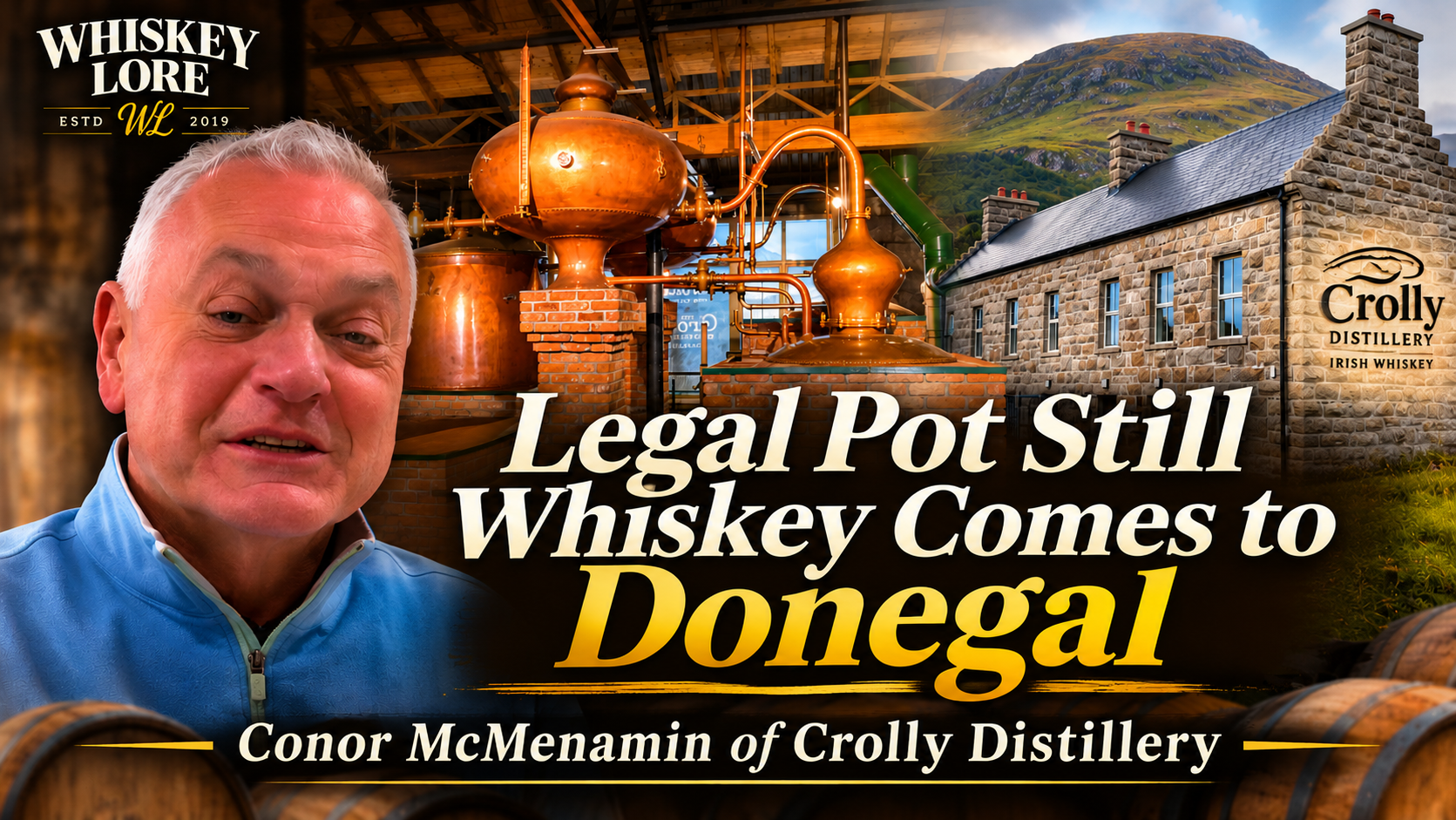
146 - Crolly Distillery: Finally! Legal Pot Still Whiskey in Donegal
Listen to the Episode
Show Notes
GUEST: Conor McMenamin (Crolly Distillery Co-Founder and Managing Director)
In the remote northwest corner of Ireland, a former carpet and doll factory has found new life as a whiskey distillery. In this episode, Drew Hannush reconnects with Crolly Distillery co-founder Conor McMenamin to explore the history of Donegal, where poverty and isolation helped fuel a thriving illicit distilling tradition. From clever schemes to outwit the authorities to the challenges of making single pot still whiskey, Conor shares how Crolly is building a future for its community while bringing some unusual approaches to Irish whiskey making.
In This Episode
- How illicit distillers turned in their own stills for rewards
- From world-famous carpets and dolls to whiskey
- Why Donegal's isolation shaped its distilling history
- What makes single pot still whiskey so difficult?
- Why Crolly changes its mash bills every year
- The secret behind Crolly's old Cognac stills
- Can a high spirit cut speed up maturation?
- When does a Cognac cask become too much?
- The surprising flavors of native Irish oak
- What makes a great distillery tour?
Transcript
Drew H (00:00:15):
Welcome to Whiskey Lore: The Interviews. I'm your host, Drew Hannush, the bestselling author of Whiskey Lore's Travel Guide to Experiencing American Whiskey, Experiencing Irish Whiskey, and a book that busts 24 of Whiskey's Biggest Myths, Whiskey Lore Volume One. And it is hard to believe, but it's actually been four and a half years since I was last in Ireland. And back then I was doing research for my book, The Experiencing Irish Whiskey Travel Guide, and got the chance to visit every distillery on the island that was in production at the time. Some of those distilleries were still kind of in the process of finalizing their visitors' experiences. And my guest today was good enough to let me stop in and step over bits of construction in their visitor center to get a sneak peek of what was to come. And today we're going to talk about the journey to getting the distillery to where it is now, some of the details about the brand new product that they have just released, which is a single pot still whiskey.
(00:01:15):
And the distillery is Crolly, it is in Dunegal, and my guest is the co-founder and managing director of the distillery, Connor McMinniman.
Conor McMenamin (00:01:25):
Thanks, Drew. It's great to see you. I always love shows and always love chatting.
Drew H (00:01:30):
Well, last time I saw the distillery, as I said, I was stepping over some... It was a little hard to navigate around the visitor center area because the bar area was still kind of laying on the floor and hadn't been all the pieces put together quite then. So I guess the question is, do you miss those days of trying to rush to get that thing ready to go for summer season?
Conor McMenamin (00:01:54):
That's an interesting question. Probably yeah, I miss them because that was probably the training that I was used to and that was my comfort space. I came from a background of engineering and construction, so I didn't find that so difficult. Now we've moved on. It's interesting whiskey journey never stops, but you start from building a distillery, so you have to use all your, what I had with skills at that stage in construction, trying to lay out the property and whatever holes and lay out your different pipe routes and electrics and all that. Lots of people wouldn't find it easy, but when you come from that's your skill base, that was easy. Then we went on to fill out the visitor center two years after that. Again, reading and layout that it would be comfortable and best you could do for a tour to get the most vibes out of it, your rim locations, your walk distances and all that.
(00:02:55):
Complicated, leads a lot of effort, but again, it was in my mailbox, so I found it okay and I quite enjoyed it really.
Drew H (00:03:03):
Well, you're going into a historic building and we'll kind of talk about the history of that building itself. Did you run into any special challenges? Because of course I know there's certain things that you can and can't do to a historic building like that.
Conor McMenamin (00:03:18):
I've just done a whiskey tasting about a week ago there and one of the guys, we generally work an open forum. So one of the guys asked me what was the hardest journey about starting and creating whiskey and creating a brand and et cetera, et cetera. I says, "Every bloody bit of it's hard." I suppose to get going, we needed a building, we needed equipment, we got all that together. Then it was a matter of locating equipment in such a way that it could function efficiently, the location of different parts of equipment relative to other parts. And then you're also in the background, you have a sort of overarching thought as how best you can locate it that a tour can go through it and safely go through it first of all and try and see it and engage with the production process in a manner that they start at the start and finish at the finish.
(00:04:15):
So the actual layout of it had to be laid out to be efficient, but also it has to be laid out because we're heavily based on tourism, that a tourist route can work and function and function safely and people can see how to make whiskey from the start to the end and preferably your tourist starts at the start and finishes at the end. So to do all that is challenging, but I think we've done it quite well.
Drew H (00:04:41):
And when I was there, as I said, the visitors area was still really heavily under construction, but the distilling area was already up, running and you'd actually been in production I think for about a year and a half by the time I got there.
Conor McMenamin (00:04:58):
The wrong way around, we probably started distilling first. So we got a distillery going, we're two years into production and I suppose it was probably between cash flow and lack of personnel that we couldn't do it all at once. So we opened the distillery, got distilling, perfected that and then we realized that we needed a visitor center to get a bit of income to try and generate cash flow. But I suppose we've done that after. And I told the rationale at the time was that we get dispirit and we can't open a visitor center at the time as we have some spurt to sell. So it sort of came naturally that we opened a visitor center roughly two years after we started distilling. And that took us about a year to get that operational and thank God that's open three and a half, four years now and it's gone from strength to strength really.
(00:05:50):
They've voted the top five best things to do, indoor things to do with TripAdvisor last year. We got a lot of people through the doors, although we are fairly remote. So it's amazing people come from all our visitor books full of people. People won't believe it, 90% of the people that come through our door are not Irish at all. They're generally whiskey tourists.
Drew H (00:06:12):
Nice. All right. Yeah. Well, and I know that was one of the early goals was a lot of people migrated out of that area, whether it was during the famine era or even in my research before that and after that, that there was a lot of people, especially the ties to America with Donegal are very strong.
Conor McMenamin (00:06:36):
Yeah. For your listeners, Donegal, we were up in the very Northwest, quite an impoverished area. And it would have been sort of the part of Ireland where the natives would have been sort of forced to move to. When British landed the plantation of Ulster and the plantation of Ireland by the British really, the native population was all pushed extremely north and extremely west, more west than north, but a lot of them would have landed right in the old hull bogs and poor agricultural areas of West Donegal, Mayo, Kerry. They would be all the traditional Irish, Irish speaking, strong Irish roots, Irish music. So traditionally there wasn't much in that area to create any wealth. So a lot of people either immigrated or what we had is we had a massive connection with Scotland. A lot of the men from the parish would have traditionally went over to Scotland for potato picking or working as farm laborers or that type of thing.
(00:07:43):
And then they would send the money home to feed their children because it was a bog really and there was very little income. So that was a sort of arrangement West Donegal and my father's time that was normal. Most people immigrated. If they could afford it, they'd immigrate to the United States. If they couldn't, they would probably go short term and be hired out to local farmers trying to get a bit of money or Scotland or London. So that was all the history of the area and our building there was quite a lot of history and so far that it was built as a help quite an English gentry were over shooting and fishing and the wife of one of the gentry, Alice Hart, was doing a tour of the area and she just got very upset with what you called agile poverty of the area.
(00:08:42):
She went back to places in London. She was a doctor and she created sort of different events where she raised some money and she gave it over to the Irish board really to fund the building of three advanced buildings. And they all were in Donegal at that time. And one was Crawley, the Crawley building that we're in. So there's a great history there of trying to help the locals out of poverty.
Drew H (00:09:10):
Talk about that building. It had many lives.
Conor McMenamin (00:09:13):
The first live was Donegal Carpets, very famous, world famous. It's in the White House. All the carpets were hand woven carpets. So there were probably a forerunner to Persian rugs hand. And the reason for that was a Welsh guy, Martin, that set up the factory. So that lasted for about 10 to 15 years in the area. And the reason for that was the local girls were all highly skilled because they used to do knitting and stuff like that. So they were very skilled at doing, as it was making carpets, was in their skill set. And also all the men were away so that it was suitable that all the ladies in the area could make carpets. So that was highly successful for about, I would say 15, maybe 20 years. And then we moved on. Then there was Irish War of Independence. The building was taken by the British soldiers as a building for barrack and soldiers.
(00:10:15):
So that went on for a few years and then some of Charles Harston who was a British soldier being shot down in the building accidentally. So we have him as a ghost. Then it laid derelict for a few years and then a lady from Mayo came up and started Crawley Dolls. After World War I, there was a shortage of dolls and crawly dolls became world famous. If you have one of the first ones either extremely valuable and they sold all over the world. So that went on for about 40 years. Then there was a transistor factory in it then for about 10 years. And when we moved in it was derelict for about 10 years. Massive history, which was good. It was one of the things that attracted her eyes to it is a great legacy of history to the building, which is good. We were trying to attach that legacy to her whiskey.
(00:11:05):
So thankfully we're on fifth occupants and we're going to try and be one of three already world famous brands and we're trying to create another one.
Drew H (00:11:17):
Very nice. Well, the question that comes to my mind is because you're isolated, it's really interesting to see that you would have a world famous product of any sort coming out of an area that's that isolated. Where would they have shipped those products out of? Would they have naturally gone up to dairy or would they have tried to get them down to Galway?
Conor McMenamin (00:11:40):
Carpets would have been, I suppose at the time was when Crawley was built about a year after it was built, the trains opened. So it was actually a train station just opposite the factory. So a lot of the stuff was exported by train now. So train is not as we know it, it went about 20 mile an hour and it went to Dunegal Town, it went to Derry. So the first thing that they had a means because before that there was not even a road out of Crawley. It was completely isolated. There was a dirt path over Arrigal Mountain, which was nearly unpassable, but it was horse and cats and that thing. So the train opened a big chance and what it also allowed was export. And so that's probably the instigator of why the factory started, how it stayed open. So when you go back to the Dunegal Carpets, Dunegal Carpets are, we have a brochure down there, quite a few brochures down there and documentation and calendars and these sorts of things where they were sold in Oxford Street, London.
(00:12:42):
They were sold in Edinburgh, and the brochures there of what type of carpet you wanted, the style of the carpet that would aluminate to suit anything. So they were world famous. I suppose they were because maybe price and cheap labor with loads of we had equipment, but they were seen as real top quality and really desirable.
Drew H (00:13:04):
So the building's got a really interesting history from that standpoint. Of course, the area is known for something else. One of the things that I find interesting about illicit distilling and that area was rich with it is that when we look at it in America, more of the story goes towards that's where people's money came from. The early pioneers when they were traveling across, we didn't necessarily have taxes until the Civil War. We had a short period after the Revolutionary War when we did. But basically in the early 1800s, there was no tax. So you could actually make your whiskey, you didn't have to call it moonshine and you didn't have to hide it and you could actually barter and trade with that product. But I've always wondered about Pachin really, was it there just for the pleasure of drink or was there a utility because Dunegal was so isolated that maybe you didn't have the authorities looking over your shoulder and you could trade?
Conor McMenamin (00:14:12):
I would say Drew, you've hit the head on all of them points. The first thing is you're talking about probably the most impoverished region in Ireland and you can imagine up on top of a hill and the only access you had was bog. To burn that, you had very little potential of growing anything. You could grow maybe a quarter acre of potatoes or something like that, but it was extremely difficult. They had fishing. They hadn't really small boats, but they could manage something and fish and get some money, but it's quite dangerous and also you needed the capital, but really had no other way. And if you look at the statistics, most people only lived till they were 30, 35. Half the people were dying of malnutrition. So it was really back to the wall stuff. So I'd say just pure survival. And the one thing they could do is they could make potching, which was probably in one way started because it would alleviate the depression of dying and starvation.
(00:15:16):
So I'd say the locals started to probably make it as an arrangement of partying for themselves or to make their life a bit better. Then it took off and then it became a way of life in terms of industry and they could cross barter food for potching and so on. So it came from pure poverty of the area really and just starvation. Our families at that time and 10 and 20 children living a quarter of an acre and pure, the daily cycle was just getting enough food to live.
Drew H (00:15:50):
And then the area actually grew quite a reputation. And I guess it was mostly out of the fact that the crown in London was doing everything they could to suppress the grain getting to the legitimate distillers. And so all the good grain was ending up going to the illicit distillers.
Conor McMenamin (00:16:09):
Yeah. There was a whole story about that. The first time it was Donegal and particularly Crawley in that West area and some parts of Cary were probably the most unlawful places in the whole of Ireland. And so far that the British never got enough control and that's half the story behind the barracks being located down there. They never really got control down there and anybody in the barracks that was well fortified and they were petrified of coming out because they were going to get shot in those petty incidents of attack. So it wasn't all that well secured by the British. That would give rise to lots of stories of people making them illegal potching. But then what would happen is their stills would wear out. So they would report the stills and the potching operation to the local RIC and they would lift the stills and they were offering a reward to the person that was in farming.
(00:17:05):
But there's quite interesting stories and we do that on our tour where when you get in behind that, the people that were reporting were the people that owned the stills. They got them lifted, got a reward and then they went out and bought new stills with the reward and started again. So there was a lot of this sort of trickery going on, but it was all coming from the same point as it was that the British weren't welcome. And that west area, they were seen as planters or people coming into our country and every local was acting against them and trying to keep living in Ireland. It was good. There's a lot of history there. And you know what's very nice is when you go down to Crowley, we have photographs there from 1930s on of different employees, first of all, in the capital factory, certainly in barracks and then more recent, better quality photos of different yearly staff photographs of whoever worked in the dolls factory.
(00:18:08):
And at the start we had maybe 50 different photographs of different years of staff parties. And at the start we didn't really know the names of the people, but after about a year, year and a half, people come in and say, "That's my granny or that's my great granny." And within about a year or maybe a year and a half, we had everybody in every photograph nearly named to such an extent there's names in the bottom of every photograph now.
Drew H (00:18:33):
Holy cow.
Conor McMenamin (00:18:34):
And then people would come in and say, "Oh, that was my great granny. She worked here. Any photographs?" And that was her cousin and that was my sister or her sister and whatever. So there's lovely stories. And I suppose you come from that poverty and poverty story, people that move up the line and become sort of are able to immigrate and make some money. They all want to come back and see their roots. And it's lovely from that. And that's quite a good reason why we get a lot of tourists, a lot of history and a lot of people connected from Canada to New Zealand to New York, a connection to Crawley.
Drew H (00:19:11):
It's amazing. It's one of those things that when you're putting together your business plan, you're not really maybe considering that that sort of thing could happen and what a benefit, especially the people of the area.
Conor McMenamin (00:19:23):
We sort of knew, people ask me again, well, why did we pick the Crawley factory and it wasn't the isolation of it and it wasn't that suitable. But the reality is when you're looking at your business plan, the one thing you don't belong figuring out when you're looking at a small whiskey production is that you can't outproduce the big guys on scale. So what you have to do is you have to look at trying to get a niche and the niche has to be connection to the area locality, making your product better, different. And then of course, trying to get extra income. So you immediately target in how can I do that? You have to get something with a good history and pedigree and a tourist facility and a tourist want to come. So if you opened a distillery in a brand new building with a brand new state finish, I just don't know if it's as good as something with a lot of history and a lot of attachment there.
(00:20:23):
If you go to Scotland and one of the things we done before we'd done the fit out of the visitor center, the three of us went to Scotland on about a three or four day tour and we took in four distillery tours a day. We've done about 12, I think in total. And from an engineering sort of head on me, what I'd done was I give every three of us and a driver and one of our consultants, Jack Millways, we give them a little summary sheet of what did you enjoy about the distillery, vote about the time, vote about the most entertained, what about good things. So maybe a list of about 15 different things that you would put a vote on as you went through the distillery. So we didn't talk about these until the whole thing was over. It was in the airport back.
(00:21:11):
We were a bit late and I think the flight was late. We started pulling out and what became very obvious without having to go through too much data was the things that take you to a whiskey tour are the quality of your tour guide, how the history behind the tour, the whiskey is emulated. We went to some that were beautifully done, new buildings, beautifully rigid. If you hadn't got a good tour guide, I can think of one particularly, it was a terrible distillery. I'm trying to think of the name of it now. I said Glasgow. It said terrible in terms of old buildings and you had to go out and in through buildings and it was raining, but the tour guide was brilliant and we're up and down steps and the whole routine, the talk of the history and the interest and the tour guide given history to that was, it was mind boggling and more interesting than anything new.
(00:22:04):
So I suppose anybody listening wants to create a distillery, try and create a heritage with it.
Drew H (00:22:12):
Well, it's funny because I know exactly which distillery you're talking about as soon as you start talking about going up and down stairs and kind of the overall feel of the place and going indoors and outdoors. I just talked -
Conor McMenamin (00:22:25):
Glen Dornock was I think maybe or something like that again. Glen Dornock maybe was the name of it. I can't remember, but I know it was a real old one, but it was lovely.
Drew H (00:22:33):
Yeah. Well, I was just talking to somebody that was talking about going, they were trying to figure out what distilleries to go visit and they said, "Well, I'm not really enthused about their whiskey." I said, "Yes, but if you want a really good tour, I had a great tour there." And it is amazing how the stories and basically the presentation of the tour guides does make a big difference. So when you're looking for people to do the tours for you, what are the things that you really emphasize with them?
Conor McMenamin (00:23:04):
When we've done that voting thing, what we had to come across and when we went further down to the, as it was analysis of it, what makes things interesting supposed to tour guide. And I remember that guy in Grand Arnock was a very comical and good crack and it was a typical scotch. Had very quick one-liners, which really everybody enjoyed. But the other thing is you can only sit, because we're on the other side of the scale was up. I remember Edinburgh was sitting in a new building, far too hot, and about talking and talking and talking nonstop about casts and new mix and cut point. And to such a point that half the people said that they got outside, it could become hot and boring. So within the realm of a visitor center and tourist activity, you need to, I suppose your time spans maybe 15 minutes in one place.
(00:23:59):
We looked and we'd figure out what was good. You need to keep people moving and then you can have a certain amount of listening, but then you have the touchy feeling, you have to have seen. You just can't have everybody sitting in a room. So the way we rooted it, we have an audio visual. Initially a break and walk up with a bit of history and knowledge, an audio visual, sit down area for about 10, 15 minutes to try and just create a starting point of how we started our brand, our ideas, our dreams. Actually, we cut that back by about two or three minutes after about three or four months because we got a feeling that it was wee bit too long and people were losing people. Then we went onto our description, hands touching the barley or what you call as our production room.
(00:24:50):
She'll explain to everybody how you make a whiskey in a very simple graphical touchy feely way. Then you move on into how you mature the whiskey, the different finishes, the bar rooms, but a sense of smells and touchy feely again. Then you move into the distillery, you walk through and then you come out and you do the tastings. So in order to get that to work well and to get devoted and to do a good tour, there's quite a bit of, it's like everything, there's quite a bit of routine planning, scripting, and I'd be a stickler because I come from an engineering type of mind where I like everything noted. So we had actually got to the point of scripting it and keeping most of the tour guides within our route. And then they could add in themselves because again, some of the tours we met in Scotland, the tour guide was too much about him rather than about.
(00:25:51):
And he got off script a lot and he became very particular or she became very particular on her own interests. But you have to keep this quite, I would say regimented in one way, but add in your own frills at the end. But to do that and to do it well, there's quite a bit of thought needed. And if you do that, and I think we've done that quite well now, people come out and even if you don't love whiskey, they love the idea of the tour because they like the history, the connection, how we went about it, even just physically looking at the piece of equipment. So like everything in life, it all takes time and energy.
Drew H (00:26:29):
I think it's finding that balance too, because I have been on tours where you have somebody who's funny, but then it becomes so much about getting people to laugh that after a while you're like, "Well, it just feels like I'm being put into a comedy show rather than actually learning about the distillery." So yeah, finding that balance and maybe being a little in tune with your audience and seeing when people might be drifting because it seems like sometimes groups have personalities in and of themselves.
Conor McMenamin (00:27:04):
Well, you're perfectly on the money because at the end of the day, this day we're four years doing tours. We started off with probably three or four tour guides. And you know what? Within about a month, you can see people. There's certain people that are just good at it. And as you say, they can follow a script and add in a bit of personality, but not overdo it. And they can pick up the room and they can pick up the sense of people's interest and change to suit the audience. There's just some people that are very good at that. I don't know, is it artistic or are they actors? And we have two, if not three tour guides from the start and we've had probably six or seven in between. And out of the six or seven that came in, one or two stayed on that were really quite good.
(00:27:54):
There's people and you know within a month or less that suits it. They need to be sort of an actor. They need to be comical. Now with a couple of tour guys, one guy's not comical at all, he's very serious. Another guy's very comical, but in a way that he's serious, it can be quite funny how serious he is, but they all enjoy it. I suppose character, they're knowledgeable and they're interested and they actually know what they're talking about. You get some that come in and you start spoofing somebody in the tour starts to catch them out of it. And you do need to know generally what you're talking about. And if you don't know, tell people you don't know and find out. So there's a skill, it's like everything, good ones are easy scene and bad ones you could train from the hell out of them, but you're fighting a dead horse really.
Drew H (00:28:49):
I hear you. I hear you. Yeah. I'm one of those guys that I don't usually tend to tell a lot of jokes. So when I actually do tell one, it becomes much more funny because nobody expects it out of me. So there's an art to that too, I guess. So one of my questions to you would be, we've talked about competing against the big guys. The question is, in your area, do you think you're out producing the illegal pachine distillers that are still in the hills?
Conor McMenamin (00:29:22):
Unfortunately now we're back in the Irish state and sometimes I think maybe the Irish state control could be worse than the British state control, but the amount of illegal drinking and making and manufacturing going on now is nearly known. It's come down to a very small level really. So you don't have to outcompete them, but outcompeting the big boys, you'll never do, but what you can do really is have a nice solid business and generate a bit of an income and create a long... Term future for the young people at Onegal. I remember when we started, Michelle, Joe and Kieran, we had a meeting to talk about this and what was overarching and I think the three of us, we were all of a business and 30 years at it. We all went through the collapse that took place in Ireland financially in 2012 and we were all well burnt in that arrangement, but we're all thankfully of an age that we get through it.
(00:30:30):
And we all had a sort of endearing interest in trying to create something for the next generation or to try and create a legacy. So it was more nearly about creating something for our future generations than for ourselves or overarching. And that came into whole remit then that we weren't as concerned about how we do it rather than we have to do it correct and do it different and do it to the best quality we can. So I suppose that's where we came from. And I suppose that came from the fact that my father was one of, I'm just taking personally, and I'm sure the other guys were the same. They were either immigrants or he was the youngest of about 12 and I think he was the only one that didn't emigrate out of the country altogether. And that was because I think first of all, they changed the bus fare and they had enough to get the bus to London to his sisters who were all working on the buses.
(00:31:27):
But then he got an opportunity to go and doing a bit of building joinery at an age of 12 or 13 and he just about got enough to keep them going and he was able to stay in Ireland. What I think about Dennis, we want to try and create some sort of lasting thing in Donegal that allows young people, they're not as badly off now, but it gives them a chance to actually, if they really want to stay in Donegal, they want to really create something, you've got to start, develop it. That was our thought at the time.
Drew H (00:32:00):
That's fantastic. I think one of the things that stood out to me actually when I looked at the release for your latest whiskey is that it says the first licensed single pot still in Donegal. So how far back do we have to go to find a licensed distiller in Donegal?
Conor McMenamin (00:32:23):
Only one ever licensed distillery in Donegal and it was out in Bohellia in Bert was licensed for about 10 years. I'm trying to think of his name now. But there was Loads and Dairy, which was across the water, which was only five million. There was probably six or seven licensed distilleries in dairy. But William Clements was a man's name down in Burt. So he was the only ever licensed distillery in Donegal, plenty of unlicensed. But then there was never a put still whiskey. And I don't know, does your listeners know the difference between a put still and an ordinary malted whiskey?
Drew H (00:33:02):
We've gone over it, but it's always good to kind of refresh people's minds as to what it is.
Conor McMenamin (00:33:09):
Potstill's uniquely Irish. And the reason it was made at all was that the British under British control, they could not control the making of potching. So what they done was they put a hammer to the nail and said, instead of licensing or trying to license the making of it, we'll license and tax barley. So they taxed malt barley and that was a way of trying to get a tax from people making potching. But the Irish discovered that if you mix green barley, which was completely untaxed, which was unmalted barley with malted barley, the enzymes in the malt can attack the hard barley or the green barley and you get actually sugar out of the green barley. So that mix of green and malted barley is known as potstill. And the Irish developed that and it was out of necessity. But they found that it actually gives you a very nice whiskey.
(00:34:09):
It's difficult to do. It's difficult to get a decent sugar conversion out of the hard barley. But if you do it, you get a lovely oily and it's a lovely, beautiful taste. So we were the first and only reducer creating potstill in Donegal because it's very difficult. On a scale of one to 10 to make malts, probably two. To make potstill, to make it well and to get good sugars and actually make it that it's consumable, it's probably a seven to eight. The technical skills of doing it, your temperature controls, your maline profiles, your whole quality control mechanism has to go up by quite a leap to do it efficiently and effectively. So that was the first potstill and actually took us about a year of mess and about to get it to work.
Drew H (00:35:03):
I noticed when I was traveling there that a lot of the distilleries that were attempting to make that actually had separate mash tons and laudering tons rather than doing all the work in one. Are you guys set up that way? I don't think we really talked about that when I was there.
Conor McMenamin (00:35:20):
There's a lot of history there. Listeners will know it's a complicated enough process. The fundamentals is easy, but it's complicated making whiskey. But in order to make a pot still anyway, what you have to really do is try and get sugars out of the green barley. So there's quite a bit of that. And fundamental what you have to do then is you have to do a step mash, which means that you have to keep changing the temperature and moving up half a degree every so often to try and wash out different sugars with different temperatures. So you need a very good control. And what we found after probably a year of doing malt, we moved on to a pot still and we figured out in a short period of time that our equipment, our heating system wasn't good enough. It wouldn't control our temperatures to the right temperature.
(00:36:13):
So we couldn't get our water consistently half a degree up regularly. It was a couple of degrees changing all the time which is fluctuations. It meant that on every mash bullet was inaccurate or not consistent, which meant that the sugars and our wash through was very poor and we were getting poor conversions out of the sugars. So it took us a good while. We had to basically put in a whole new water heating system. We had to put in actually eventually a new mash turn completely. We had to put a new mill as well because our mill wasn't milling consistently the same profile. You have to move a level of accuracy way up to do it properly. And it means very consistent methods of doing everything. So in order to do pots, it's difficult. Then you have to course, then you have to change your yeasts and you have to change your enzymes and stuff.
(00:37:12):
And it takes quite a bit of tinkering. Our master designer of thankfully is one of the best touchy feely hands on and you can really feel what's wrong in terms of mash getting a bit sticky or sludgy. You touch your way through it with different... But if you don't have somebody that really knows what they're doing and really good controls, you just won't be able to make a potstill with any consistency. And that's why I say, I don't know what the figure, but I would say there's no more than 30% of distilleries making pot still at all or maybe 40. It's just difficult to do. But the rewards if you do it well are lovely.
Drew H (00:37:56):
It gives you a whole new level of respect for those illicit distillers.
Conor McMenamin (00:38:01):
Yeah. They were probably not as refined, but if they got any sugar at all, it was a lot cheaper to green barrel. But there was a level of skill and I suppose folklore will tell you there was good and honorable and very well respected distillers. And then there was boys that were poisoning people. So there was certainly a skill in it. So if you knew what you were doing, you could make good stuff. If you didn't know what you're doing, you could blame people.
Drew H (00:38:31):
Yeah. Let's talk about the regulations for pot still because a lot of that was designed around what Middleton was doing with pot still whiskey and they had a certain recipe that they were using in terms of their mash bill. And so that's now something that's been under advisement and I don't know, has the rule actually been set yet or is that still kind of being worked out what the pot still -
Conor McMenamin (00:38:59):
It's very close. And what the bases started I suppose middleden and cork were the only ones doing pot still for years. You only got three distillers in Ireland at all back 20 years ago. Bushmills, you had Great Northern and you had Jameson down in Koch. So Koch done Potstill, Bushmills done malt. And to make the pot still they were taking malt down to blend from Bush. The two companies were all together. And then you had Great Northern Tinian who'd done both. I suppose when the technical file was created, it was probably created under Middleton's recipe, which really the main thing there only allowed for, I could be correct, I think 5% of cereals. So you could use whatever percentage of green barley, maybe it was limited to 50 and then malt, but you could only maximumly use a certain amount of cereal. But when you go back to traditional old mash bowls and stuff like that, you can imagine go back 50 to 100 years ago, they were actually using whatever they had.
(00:40:11):
So maybe sometimes they had a lot of oats, sometimes they'd order rye. They just threw it all in. And so you got these very different mash bills. Now oats particularly, you'd get a very poor yield. So it's not really widely effective to put oats into a mash bowl, but it's hard to get sugars out. But it gives you very nice, lovely, not these sort of tastings. And the beer people, people making beer would notice this a lot, but it gives you a very distinctive flavor. So that's what they're trying to get back to now is to open up the technical file to allow a better variation in your cereals. It's more or less done and it's agreed upon that I think it's good. But what they're really trying to do is not leave it open too much that it becomes far too much variation. It becomes maybe destroys the quality to a certain extent.
(00:41:03):
So there's quite a wee bit of to and from in that. My thought is you need to keep technical files reasonably technical. If you open it to every element, you can get a hell for leather and everybody's making everything and you start trying to make a vodka and call it whiskey. So I suppose there's a bit of there and trying to keep it tight, good, and not completely experimental.
Drew H (00:41:30):
So what is your formula right now? What are you using for your mash bill?
Conor McMenamin (00:41:35):
As a much small, we only do about 500 casts. We basically do a different Julio, our head distillers, originally a beer. He had his own brewery and he made his own beer. Well, it's Hertlizen beer and distilling, but we do a different batch profile every year. Even our malt this year, we're using 95% of malted barley and we used three or three and a half percent chocolate malt. And we used something like one and a half percent oats. So every year we tend to vary our mash bill for both our malt and our pot still. So our pot still only started this year about three months into it now. We were late this year with a couple of service issues. Our pot still this year is, I think it's 50 malt, 43 or four green barley with some oats. We have some chocolate malt and I think with some rye.
(00:42:42):
I don't know the percentage, but we change year to year and then every batch of every year because we're quite small, we're going to release different year to year slightly different malts and pot stills.
Drew H (00:42:57):
So you're really talking about having vintages of mash bills rather than vintages of age of the whiskey?
Conor McMenamin (00:43:06):
A bit of both because I think when you're small, the beauty is when you're small, it's not all that difficult for us to change year on year or change month to month because it's very much a hands-on process so we can do it without having big disruption. So my answer to that is why the hell not? Why wouldn't we try and maybe do it slightly different year to year? And it's not going to make massive differences, but it gives you something to play with, something different.
Drew H (00:43:37):
Well, for somebody who really loves kind of the sometimes citrusy notes and the peppery notes and the oiliness that you get from pot still, I would probably, if I tried one of your whiskeys that was higher in green barley, I would probably want to buy multiple bottles of that while it was available because it would be something that hit my palate and would make me more interested in that versus maybe getting one that was 95% of malted barley.
Conor McMenamin (00:44:10):
The other thing that's quite interesting when I do these whiskey tests and people on to me all the time and I suppose we're not, and I shouldn't say we're not because one of my partners comes from the accounting type background and Julio our head distiller annoys him a bit because he might go and buy a ton of oats and he's paying a hundred euro a ton beer than buying green barley and sort of noise and why are we doing this? But I suppose what I'm going to say is we're not as price sensitive as the bigger boys because we're not creating as much. So if we're adding 50 cents a bottle on, so be it. We're not selling millions of bottles every year. And I suppose our philosophy, go back to the starters, we want to create something unique, something different, something that people really can taste the difference of.
(00:45:03):
And my belief and I suppose our company's belief is there's enough people in the world will pay an extra five bucks or 10 bucks or whatever it is a bottle for that privilege. If you want it and you can taste it, we can give it to you. If you just want the same stuff or you want to get drunk, there's plenty other stuff to that. We'll try and serve a unique market of people that really know the difference and really want to know the difference and want to taste the difference.
Drew H (00:45:33):
Well, and it goes to your earlier point. You're kind of following tradition, which is that you basically distill the grains that you have on hand. So consistency was not the illicit distiller's way of making whiskey for sure.
Conor McMenamin (00:45:48):
Yeah, that's exactly the point. But the other thing that comes to my mind is you go to these whiskey tastings and you meet all varieties of people because I've done so many now. And if boys there that are so-called experts in whiskey and then they go to taste these things and you just realize that this boy, you could give him anything he doesn't really, or he knows some of the buzzwords, but there's no actual taste. So a lot of people drinking whiskey talk about it and talk about the kids, but I just wonder some states do actually taste it. Point of drinking or eating is to taste it and enjoy it. And some people, if you don't like spice, you say, "I don't like it. It's well made, but I don't like it." But lots of people just sort of jump on the hobby hours and they think everything's lovely and they probably volunteer taste and try and match it with price.
(00:46:42):
I don't know. But then my heart's good because I see lots of people that don't do it that actually can taste it and you don't want to see anything and you can say, "That's lovely. I don't like that." That's a skill in its own.
Drew H (00:46:54):
I think it's funny. Sometimes I will leave a distillery and I will have tasted the whiskey there and I'm like, "Man, I love this." And I take a bottle home, I get it home, I'm sitting there relaxing and I'm tasting it and I go, "Wow, something's missing here. What's missing from this? It's not quite the same as what I had at the..." And it got me thinking about the fact that when you're talking about having such a great experience on site, you're in a good mood. So you're going to be tasting something. You're going to walk away probably having a great impression of what it is that you're tasting while you're on a tour if you've had a great time. And if you haven't had a great time, maybe your tasting experience isn't quite as good.
Conor McMenamin (00:47:38):
I suppose that's true. I have a small bar in the house and the reason I got into whiskey at all is I like whiskey. I don't go mad on it like bottles per day, but what I have is probably of the order of 12 different whiskeys opened at all times. And I come in maybe this evening and I try a heavily peated whiskey and I really enjoy it and I think that's lovely. And I go in the day after and I try it again. I say, oh geez, I'm not up for that today. I want to go for something different. The reason I have them open is generally they're just... I suppose isn't that the beauty of whiskey or beauty of anything is that there's just some days that you're in the mood for certain things and sometimes you want a big heavy peanut, sometimes you just want a light one.
(00:48:23):
Sometimes you don't want any, but there's that beauty of it. But what I say to anybody that drinks whiskey, as long as it's good quality and well made and you're not getting the old sulfur and artificial and bad quality taste in your mouth, so be it. As long as they're well made, good taste and you won't do any harm. And I suppose long term is the really good, well made people. There's enough people in the world to know the difference and enough people in the world to buy them and that's why they survive.
Drew H (00:48:54):
Yeah. Yeah. Well, there's plenty of bottles that I have in my house that I've said, let me put these away over here because I'm not really into them right now, but occasionally I go back and I'll start going through those bottles again. And when I do, almost always one will start or two or three will go back into the regular population of my bottles because was I in a bad mood that day? Was I not in the mood for that particular type of whiskey? So you're right. So it's hard and that's part of the reason why whenever I do whiskey tastings, I don't tend to give ratings or try to say this is a good whiskey or that's a bad whiskey. Because as you say, there are certain elements. If it was not distilled properly or maybe you made your heads and tails cuts maybe a little too wide and you caught some stuff that needs more time in the barrel to work its way out and you're taking it out of the barrel too early, those kinds of things are going to be the things that you would say, okay, I don't know if that's ever going to get fixed.
(00:49:58):
But for a whiskey that's properly distilled, then it's down just to the consumer. Are you into that particular whiskey? Are you not? Or are you in the mood or not in the mood for that particular whiskey?
Conor McMenamin (00:50:12):
The other thing that's in my head is our stills are all ex-cognacs. They're small stills, so they're all direct fire. And again, it's heated dust for your listeners direct fire by gas underneath the still. So it's very, when we say uneconomic, you lose a lot of your energy via the heat up the chimney, but it gives you a very unique taste. This gives you what's called a mallard effect, which is a searing of your spirit. So it's very obvious when you drink your newfil, that searine taste comes off it quite strongly. And that's two reasons you get us a firing, but also on a wash still is you get a buildup of yeast on the bottom. So every month we take the top off the wash still and basically go in with a chisel and a power washer and take off a whole bacon off the bottom of it.
Drew H (00:51:09):
Wow.
Conor McMenamin (00:51:09):
That gives you quite a sugary frying at the bottom gives you a very unique taste to it. Direct fire, very few of them now. We're probably the only one in Ireland and factors maybe in Scotland do it, but apart from that, they're all heated by steam. But it's just another point of difference and it's a point of extra cost. But I think for really good tasters, you'll notice the difference from a direct fire. And then of course then we cut very high, cut at 69%, very high cut, which means we're only taking the really best spread out. Again, not economical. I know definitely some of the scotches go down to about 50, 58 cut point. Gives you much rawer spirit. So all these things, in my view, all these things make it more better. You're taking the best out of everything, but I suppose that's up to the listeners to go and try it and see.
(00:52:06):
But we get a lot of very good knowledgeable whiskey people that favor our radar stuff very highly. So I do believe it's because of these technical lack of shortfoots really.
Drew H (00:52:20):
Makes a difference.
Conor McMenamin (00:52:22):
Yeah, it does in small ways. What I say is sometimes in a whiskey and toxic, it's probably making whiskeys like me cooking and frying a sausage. I'm not a great cook, but I can make a sausage and you get a pan out and heat it up and eat it and not poison it. Whiskey's the same, but if you want to make really good whiskey, you need a proper pan, proper temperature, proper meat, you need to roll it properly. All the small things that make a very normal sausage wonderful techniques that can't all... There's a lot of them and they're small, but if you do them all right together, it really makes something special.
Drew H (00:53:04):
Well, let's talk about those pot stills because I have to say that when I first walked into the room and I saw them, my jaw dropped. They're beautiful stills. Do you see that reaction from a lot of people when they come in? Do you get a lot of oh wows when they first walk?
Conor McMenamin (00:53:21):
I suppose go back to the reason why they're oh wow, I suppose with two reasons. And the first one was probably the most obvious reason is financially. If we wanted to go to create a small distillery, you can't really buy a still of that size. But the least still you're talking about is 5,000 to 10,000 liters to begin anyway commercial. So you're on your money scale the way up through the roof and then you're looking, you're only creating what we do is about 70 to 100,000 LPAs, you're talking about using the stills once a week rather than every... So it's commercially unreasonable or unrealistic to buy a still of 1200 liters. So no, sorry, it was about 2000 liters. I think we do have about an 1800 liter full. But the reason we went for ex cognac was one, because we seen them and they were available.
(00:54:21):
Their financials or the business model of running them isn't as manageable more so than managing much bigger. So it means we can create stuff smaller. They were available and they were easily cheaper and we loved the idea of going back to heritage all the time. We were going back in our stills once 1986, I think one's about 1990. We loved the idea of different old direct fire complicated, the beauty that you can create. One of my favorite whiskeys by quite a bit in the Scottish family was Glen Fatness. Always loved Glen Factus, particularly the 14, 16 year old. It caused direct fire and you could feel the taste of it and I always liked that idea. So when the cognac stills came up, we just went and grabbed them and said, "We'll go for it and use them." They're small, lovely copper, lovely unique. And then you have a pre-warmer, which is brilliant too because it gives a lot more copper contact and then our warm tube as well full of copper.
(00:55:26):
So you get a massive amount of copper contact and as well as that you have an 1800 liter charge. And you can imagine as the charge is small, your diameter and your copper to liquid ratios is much bigger, which means you get much more reflux and much more copper contact in your distillation. I think it's extremely important when you're distilling copper contact reflux, a small batch, high cut point and our sperd run is very, very slow. We're probably at about a rate of half. We distill to our sperd run at about 83 degrees. So it takes about eight hours to do about 220 liters of charge of about, I think about 1600 liters. We have a lot of uniqueness. And the reason for that is we just feel and we want to try and make as bloody best whiskey as we can. And within reason is we just try not to worry too much about the financial consequences and hope at the end of the day that there's, as I say, enough audiences in the room that'll pay $5 or whatever it costs more per bottle.
Drew H (00:56:46):
Yeah. Well, I wonder because as I understand it, you're double distilling, you have a warm tub. Warm tub usually to me ends up adding more body to the whiskey. You already are working with a pot still whiskey, so you're dealing with the heavy oils in that. And I'm wondering if that's the reason why you're taking the really high tight cuts on the spirit because probably I would imagine in the tails, those are thick with all of that.
Conor McMenamin (00:57:22):
I suppose from a starting point why we started cutting high was when we were at our malt stage and we had a consultant at the time, an excellent guy, Dr. Rob from over in Edinburgh, a very, very knowledgeable guy and very nice. We wanted to try and get a soft spurt and a high cut gives you quite a soft spurt. And the rationale for that is we wanted to try and fast forward our maturation. So we created quite a soft spurt, which means it takes a lot of wood quite quickly. The reason for that is we wanted to try and advance releasing our whiskey quicker with good quality as it was as a point. So we created a soft spurt, which is a very high cut point. And that we continued on to our pot still with the same sort of mindset. So a lot of our malts there now with four and five year old malts and the general, what I say without too much arrogance, the general viewpoint from people that are knowledgeable and are good tasters is that our malts are much older than they actually are.
(00:58:37):
Our four year old malt could be easily disguised as a eight or 10 year old malt, particularly if you start to compare it with some of the scotches. So the reason for the high cut point was to create a soft spurt was to create a quick maturation. Now a lot of people were asking me recently, we're going to move that and cut that back. I don't think we will because it's creating something very unique and I don't know. I suppose I should do the maths to see if you take the cut point down, what do you save in terms of the economics? But I can't foresee that it's going to be life threatening if we do that. So if it's working, why the hell not what's wrong with having a four year old or five year old malt to taste like a 10 year old malt?
(00:59:23):
Why don't we continue on? I think it's fine. Low cut or high cut points are good and it's really giving you very good pot still as well. It really is. Well, it's unique. The best thing is try it and see, but I just absolutely love it.
Drew H (00:59:41):
Well, I think pot still whiskey, peated whiskey and American rye whiskey all do better for me at younger ages because those are very personality forward whiskeys to me. And the longer they sit in that barrel, the more the barrel steals from the personality of those spirits.
Conor McMenamin (01:00:04):
Yeah, agree. Interestingly, we released it at and a cognac, which is five year old, fully cognac matured five year old there. And it's wonderful stuff. But the one thing that Julio was a bit concerned was it's bordered on getting too cognac-y. And one of the concerns that I have now is we probably have a cask or two that left over. So I'll leave it on those antacums. But after Christmas, we'll probably either take that out and put it back into Xbourbon or we'll have to do something with it shortly because I don't want it to become... The problem with these fully matured in this unusual cask is it doesn't, to my view, it won't get a lot better over a long fermentation time or a maturation time. I think what happens is it gets to its peak and actually probably if anything, it probably deteriorates.
(01:01:03):
So long maturation and anything from cognac to Madeira to any of these, I think you just have to be careful. You can overdo it. As you say, the power of the original wood or the spur can take it over. So there's a lot of skill in all these things.
Drew H (01:01:25):
Would you get to a point where you would just start batching, maybe taking some of these that maybe were overdone and basically when you're creating a batch to start bottling that you would maybe match one of those to three of your regular?
Conor McMenamin (01:01:42):
Well, that was our weed policy at the start. So instead of finishing in say a cognac, we though we'll do cognac casket and then we get the 10% of the five year old cognac in with the five year old malt and maybe... But I'll review that now. We're not overly producing. We're producing 500 casts a year. So we'll only do about 10% of what we'd call specials. So we don't have a lot of that, but it may be the case now that we do less specials or else we just keep maybe a five year old fully cognac matured as our maximum or be it a PX or whatever. We just have to feel that along, but that's my feeling today. But definitely the wood policy changes when you have the option of lots of edges. And the gut feeling is funny that our five and six year old malt now has improved massively in the last two years and just had a good thing about involved in the distillery is you get this job every day or two days or every week of a good bit of tasting.
(01:02:57):
But when we tasted our six year old malt and it's improved a lot in one year.
Drew H (01:03:04):
Nice.
Conor McMenamin (01:03:04):
It's really got a lot of depth now. It's getting a lot of lovely colors and not to say that it wasn't great to start with, but it's improved a lot and you have a lot of supple they developed in one year, lots of lovely flavors starting to come on. So that's getting very close to being very drinkable and drinkable when I say that is drinkable at a very good level. So it's amazing that the ex-bourbons are slow, subtle, take time where you can push the thing a bit with the more, what do you say, vigorous cassing. You sit here today and you think you know everything and tomorrow you might know nothing. It's constant learning, making whiskey. I go back to frying the sausage, new technology, new everything, but you just have to be at it all the time and it's really a love and a passion and you play with it.
Drew H (01:03:59):
Yeah. Well, you had a really interesting experiment going on when I was there initially because you were basically working with sourced whiskey initially and you were putting them into different types of oak barrels. And what I found interesting was that not only were you using American and European oak, but you were using Irish oak as well. What do you think you really learned in doing that and that's kind of helped you in terms of managing casks going forward?
Conor McMenamin (01:04:33):
What's interesting about that? I don't know. I think half my head, the madness that we were at as three lads that knew nothing about whiskey started a distillery other than drinking it. But our first fundamental was always had the outset that we wanted to do something different. We wanted to do something that other boys couldn't do or didn't do and we probably were even sort of a, what do you call it even foolish and so we think we'll try anything if we were invincible. So our rationale to start for that series was that our town land of the Crawley distillery is kilandara, which is for a small oak forest is kilandara is really the wording. So that was our tideland. So why do we do not do homage to our town land and we'll do small oak forest? And I did see one time we were over, I can't remember was it Scottish rugby game, but I was doing tours of Scottish whiskey shops one day and I did see homage to some sort of oak finishes and they were getting quite good writtens and they were talked about and I said, "Why the hell would we do an oak series range?" So that was our starting point wanting to do something that was a homage to our area.
(01:05:47):
Then we came back then and we started researching oaks and it was a jack that came back to us to get the virgin oak cast, we had to go to a cast manufacturer who's a friend of a guy who we bought a lot of our equipment from over in Slovakia. He had relations or contacts in the cast making area in Slovakia. So we put about our heads together and see can we actually do something a wee bit differently? Can we separate out the oak casts and the species of oak out and get the cast made in the three different species? We had a few more species. We were thinking the first one was actually getting our hands on it. So the ones that were readily available is Alba, which is American oak and white oak's easy to get. Rhubar, which was easier to get a few years ago.
(01:06:43):
It's very prolific with red wine. So it's a European oak. And then we actually only found this at the native tree of Ireland is a petrea, which is the so it's Irish oak. So we decided we'd play along and we eventually came with the idea of why don't we do a three oak series? And we had our five year old malt and we finished it for six months in the three virgin casts and they're all medium char, medium toast casts. They give you very, very unique different flavors. Actually unbelievable the virgin six months, how much it influences the flavors. So actually such the rhubar, which is an European oak, gives you quite a spicy finish. It's beautiful if you like spice, maybe spice to ginger. But that one in our first call, I remember well, we only left that five months in the cast because we were doing a tasting one day between Julio and Jack at the time they said we better take that out.
(01:07:56):
It's getting over pearly ginger.
(01:08:01):
The purple, which is the rhubar is very spicy ginger, lovely aftertaste, lovely. It's really very nice. It's probably my favorite. The alba then you're talking, you're getting quite a bit of sweetness from the wood really. It's more non-technical, it's more bourbonation taste. It's quite sweet and quite mellow. And then you get to the Irish oak, which is actually probably the hardest oak when you look at it, but gives you very, very lovely fruit, lovely light fruits, pears, apples, quite unique and well worth it flavoring. It's amazing, but it's lovely. And it's by far the one that sells the best in the distillery. My experience of that is why it's probably not my favorite because I find it quite light, but it's nice summer's evening. I'm not really up for big flavor profits. It's lovely, but a lot of people like it and when you research it, the reason you like it is it's very drinkable.
(01:09:05):
There isn't big flavor. So you get a lot of, without being sexist ladies or non-whiskey drinkers that all can't drink whiskey. It's too strong. They just love it because it's light and fruity. Then you get the power of your alba, bigger, heavier, more cask of it, more vanillas and them. And then you get onto the pure spice and ginger of the ribar. Listen, try them. It's amazing. For six months in a virgin cast makes some difference. But this is the beauty of whiskey, isn't it? You play with it and you keep playing when you think you've discovered something, then you try something else and you discover something new.
Drew H (01:09:57):
So that's an experiment that's going to continue on then, it sounds like.
Conor McMenamin (01:10:02):
Yeah. We're just creating a range at the moment and we're fairly sort of set on our levels of sales. We'll probably get to three different value points on our sales tree. We'll probably get on a basic malt and a basic pot still being our entry premium level, probably retailing about 50 bucks or under and that'll have to be a volume seller and probably a bit to trade and the people, as Julio says, the mass drinkers, if you drink a bottle a month, you'll go for that. Then we'll go mid shelf, which will be mid premium or probably premium. It's known as our super premium at about 80 bucks. We'll work on probably the Virgin Oak finishes. We might add in a couple of more specials in there in terms of some age profile, some other different finishes. I'm not sure. I think that'll be evolving and probably limited in bottle numbers and this sort of thing year by year.
(01:11:08):
And then we'll go to our top premium, which is our ex-cognac at the moment. We just released and that's 15,000 bottles and we've all sold in four weeks.
Drew H (01:11:19):
Wow.
Conor McMenamin (01:11:19):
We're going to have top premium, which is only going to be probably anything up to 5,000 bottles a year, maybe 10. It depends on how well they all go and the price points all depend on what's left and what we've made, but we'll have top range, mid range and drinking range.
Drew H (01:11:40):
So where did those thousand bottles sell out of? Were you selling those just completely out of your own distillery or were those going into the European market?
Conor McMenamin (01:11:50):
This is basically the third release in the last year of our super premium range. It's got lovely gifting
Drew H (01:11:59):
Package.
Conor McMenamin (01:11:59):
We started with 700 bottles was our first 500 liter PX and that was done about a year ago maybe, and it sold out within about two months. Then we released our Ola Raso about six months ago. So with 1500 bottles in our second phase of that top premium, 1500 bottles and we're only about 200 bottles left there. But what we have is we have a Crawley club, Cargina Crawley, which is about, I'm not sure, 17,000 subscribers now, something like that. And with all that top ranges, we go out to the subscribers first. So the Cognac goes back to a thousand bottles and we probably had 500 of them sold pre-bottling altogether. We've done a pre-order for our Crawley Karja and half of them were gone before we bottled it. We're really trying to build up something unique and my view is I love supporting people that support us.
(01:13:03):
So if you're a member of our club, there has to be a reason why you're a member. The reason a member is we love you strongly and we want you to have all the chances to be first offers and all our specials. I suppose it's been what I'd say in that I remember the PX and it excited me when we done the pre-launch of that and there was a bit of fanfare and stuff, but we sold maybe 200 or something. I can't remember, maybe 300 before the launch. There was a guy in Amsterdam and he bought one and he got a package and we always put a nice little gift, no thanks. Hands thinking his name and he came back right away and he got the bottle and he says his friends were around testing and he drank the bottle and he put in an order the next day for 10 more.
Drew H (01:13:54):
Wow.
Conor McMenamin (01:13:55):
There's people in the world that... And when they're limited to a certain amount and people like them and they like the story, why the hell not? There's worse ways of spending 150 bucks.
Drew H (01:14:08):
There you go. Absolutely.
Conor McMenamin (01:14:10):
And it's unique, it's different. You can't buy it everywhere. You can't make it the way we make it. So you'll appreciate it well, Drew, because you like tastes and you like quality.
Drew H (01:14:20):
I love it. I love it. All right. Well, let's talk about the experience. First of all, how do people get there? I mean, I drove and that seems like the easiest way probably to get there, unless of course you're intimidated by driving on the left side of the road, which some people might be from this end of the globe. But I find it fine. The only thing I find with driving in Ireland is sometimes when you get on smaller back roads and you don't have the little passing places and you have a brick wall on one side
Conor McMenamin (01:14:53):
And
Drew H (01:14:53):
You have a bus coming at you from the other direction, that can be a little intimidating.
Conor McMenamin (01:14:58):
I'm just thinking it was that golfing last month staying in Rasapana and there were guys there at American coaches and they were going from Rasa Penna and they were playing the next day in La Hench and I was asking, how are you going to... We're taking a small bus journey down. For listeners, Lynch to Rasa Penna is probably six hours in a bus, but he called it a small bus journey. So Americans don't mind driving. So the easiest way, if you get to Belfast Airport, it's probably two and a half hours drive, fairly good motorway most of the way to our distillery. A lot of people come driving. And also with that Wild Atlantic way, so a lot of people go on that and that's a very scenic view of the whole Atlantic ocean all down along the West Coast. So I'd say a lot of people either come on buses or a lot of people come cars, hire a car, Belfast, even Dublin, it's three and a half hours from Dublin if you're driving.
(01:15:56):
So it's probably bad, but it's not that far. But then of course, if you're in the top echelons of wealth, you can park in the private jet in at the airport Airport. And we have a parking slot there for any guy that wants to park the jet, we'll park it in for him and he can walk to the distillery. Less than a mile walk.
Drew H (01:16:17):
And you're on the main road, so you basically... I thought when I wrote the book, I tried to figure out, could you take a bus to every distillery in Ireland? And there are some that you couldn't, you'd have to do some walking, but you could. It's just -
Conor McMenamin (01:16:36):
Yeah, the bus, the local link stops outside the gate.
Drew H (01:16:40):
Yeah. It's just very confusing because it seems like each region has their own kind of setup for their buses. So you might be going from one region to another.
Conor McMenamin (01:16:49):
The government's not that well organized and sometimes the bus doesn't land, but then the regional link has improved a lot and there's a bus from on every second hour and it passes the door. Now every second hour, it comes one direction, one hour, and then the second hour comes the other way. So it comes two different routes. One goes from the other, but every two hours it should be outside. But I would favor a car. I wouldn't be relying on public transport. Public transport is okay if you're going to do a lot of nice testing,
Drew H (01:17:26):
You might have to take it. Very nice. So do you do driver's packs for people? That's one of the things that I love about Scotland.
Conor McMenamin (01:17:32):
Yeah. We always do driver's pack. We look after... So you can pour your measures into a little bottle and you take it away and we sign it and all that. What I call them is all little personal touches. As I say, go back to we're not in the middle of Dublin, we're in West Donegal, Giltic speaking, not many generations from complete poverty. So we're looking into where the staff are really enthusiastic and a tourist is still a tourist in Donegal because we're very remote and it's not a carrier or whatever where we're inundated with tourists. So we treat people well and all the staff are really... In their heart, they just love people coming in and telling the story. And some of them do poetry, some of them have a guitar in the car, and if there's a bit of crack to behave, they join.
(01:18:23):
And what's interesting when we were talking about tour guides with a tour guide, Paul, who's a wonderful guy, he's a retired school teacher. And I wouldn't say he doesn't do the tour guiding for any financial reasons. He just does it because he loves it. In fact, last summer, his wife took him away on two or three weeks holidays. But what happened, I know something happened and he was back a week early and then he came in and asked Catherine our distillery manager, "Can I do a tour or two? Can I pull you out here?" The reality was, "Is that addicted and he loves the buzz?" He actually would do the tours for nothing because he couldn't stay away. He came in on his holidays to do them because he was sort of tour on phobia coming into him. So he comes in and does the tour.
(01:19:15):
So those are the sort of people that work with us and we keep a good community and look after them as best we can. And as people say, there's a gras to everybody. There's a love for the people coming in and their love and if you can engage with them, you won't get a better engagement back. And if you look at people who want to go onto the website or to TripAdvisor and you'll get that overarching and overwhelming feeling if you read any of the recommendations, they all say it's charming, it's loving, they really care. I'm very proud of that.
Drew H (01:19:52):
That's great. I mean, the thing is for American travelers, we're so used to branded hotels wherever we go, but I love traveling in Ireland because I can go to the B&Bs and you usually get a little local culture while you're there. And that whole stretch, going north of Belfast and just following the coast all the way around is such an amazing amount of scenery. And to me, I've heard people say this before, and I really do agree with it, that if you say you've been to Dublin, you haven't really truly been to Ireland. It's getting out and getting to these places, especially on the Western coast that you find kind of that spirit that you always sort of think is in Ireland that maybe when you're in the big city, you're not necessarily getting as much of.
Conor McMenamin (01:20:50):
Yeah. Down the West Coast and up around from Belfast right around, by the coast, you're in the poor areas really, you're out of the cities and you will get great engagement. As I say, particularly in Donegal has now become very popular even by Irish standards. A lot of people are coming from the big cities up to Donegal because you're still a tourist you look after or from a humble, probably not overpowering financial area. I golf up in Rasapena, which is a great spot, but I know I go up to the local pub and sitting on a Friday evening, there'll be a man sitting all day that never worked in his life and there'll be a man there that has a helicopter outside and there's all sorts of people life all together. And you know what? There'd be cursing and laughing and shouting and giving the wrong statement.
(01:21:54):
There's no respect for your helicopter when you're sitting and you're just an average something. It's year round, you buy it. There's something lovely about that.
Drew H (01:22:04):
Yeah. I could say two places that I stopped, one was Dulan and the other was Skiburine where I stopped into a pub and had myself a Guinness. While I was sitting there drinking it, I had a whole conversation with somebody next to me that I couldn't understand a word that they were saying, but you don't get that experience just anywhere.
Conor McMenamin (01:22:28):
No, it's lovely. I suppose that's the Irish word for you. That's why people love Ireland. It's like anything live, if you give majority of the cases is people are genuine. Most people are not there to engage to financially reward themselves. They're there to have a bit of crack.
Drew H (01:22:48):
Yeah.
Conor McMenamin (01:22:48):
So this is fun and if you get to the right Irish pub, sit in and chat or even a coffee shop or whatever, sit in and chat and get the genuine bit of fun. They're quite good fun, the crack and you can rise a better crack out of them if you can sort of... I often go into a place where it's lashing rain and for the crack and say, "Isn't that a beautiful day?" And the real ones would say, "Yeah, it's lovely to have my bikini in the car and go for a swim litter." Just a bit of fun. That's hard to beat and it's genuine and it's good fun. Irish people, I suppose the reason they've been Celtic is they have a gift to the gab. They're able to chat and they will have a better crack.
Drew H (01:23:33):
Yeah. Well, I have to get back. One of these days I will get my plane ticket and my passport's ready. I just got to get the plane ticket and some time and come visit again.
Conor McMenamin (01:23:45):
Just make sure that you land in Crawley or give me a shout. You have me email me address and what we'll do is I'll take the ladder out. We'll get up on top of some of them casts with the picket opener and we'll have a real go, as they say.
Drew H (01:23:59):
I love it. I love it. Connor, thank you so much for... It's great having you on and you had a story that I've long wanted to tell my listeners about. So it's great to have a chance to actually have you tell it and also to hear that you've got your single pot still out there now and just another reason beyond the beautiful scenery and the really great experience that you've got there and the people to come out and check out what you're doing.
Conor McMenamin (01:24:30):
Thanks very much. So thank you very much. Have a good time and long life happiness and health.
Drew H (01:24:45):
I hope you enjoyed my conversation with Connor from Crawley Distillery. It's located right along the wild Atlantic Way in Donegal. And if this conversation primed you for a trip to Ireland, make sure to pick up a copy of my book, Whiskey Lord's Travel Guide to Experiencing Irish Whiskey. You're going to find guides to nearly 50 distilleries, enough information about Irish whiskey styles and history to help you get in the mood for your travel to the Emerald Isle and plenty of logistical information for your trip planning as well. You can find a copy of it by searching amazon.com for experiencing Irish whiskey. If you really want to get a deep dive into Irish whiskey history, head to whiskeylore.org/episodes where you'll find my 17 part series filled with stories about my trip to Ireland as well as a detailed history of Irish whiskey. Have yourself a great week.
(01:25:36):
I'm your host Drew Hannish, and until next time, cheers and Slangeva. For show notes and transcripts, head to whiskeylore.org/interviews. Whiskeylore is a production of Travel Fuels Life, LLC.