
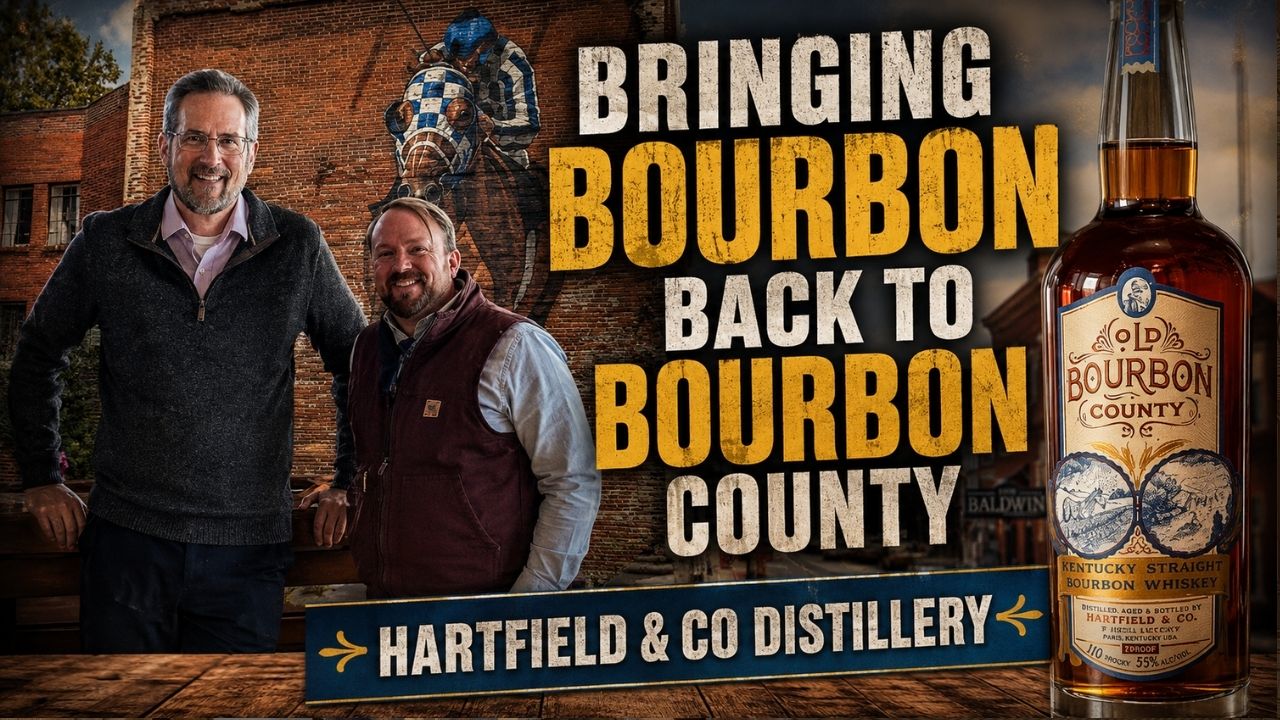
142 - HARTFIELD & CO DISTILLERY: Bringing Bourbon Back to Bourbon County
Listen to the Episode
Show Notes
GUEST: Jeremy Buchanan (Owner & Distiller, Hartfield & Co.)
What does it mean to make bourbon in Bourbon County? For Jeremy Buchanan, it means more than putting whiskey in a bottle—it means reconnecting with a forgotten distilling tradition that helped give Bourbon its name. In this episode, Drew Hannush sits down with the owner of Hartfield & Co. Distillery to explore the county's lost whiskey legacy, the philosophy behind Hartfield's pre-Prohibition approach to distilling, and why local grain may be just as important as the limestone beneath it.
In This Episode
- Bringing bourbon back to Bourbon County
- Why the county forgot its own whiskey history
- The story behind Hartfield's "pre-Prohibition" bourbon
- Does grain matter more than the barrel?
- Sourcing every grain close to home
- Why six-gallon barrels became an advantage
- Rethinking modern distilling techniques
- Gravity-fed whiskey making in a historic building
- How small distilleries preserve big ideas
- Reclaiming Bourbon County's forgotten legacy
OFFICIAL WEBSITE: hartfieldandcompany.com
JOIN THE SPEAKEASY: patreon.com/whiskeylore
Transcript
Drew H (00:14):
Welcome to Whiskey Lore: The Interviews. I'm your host, Drew Hannush, the bestselling author of Whiskeylore's Travel Guide to Experience in Kentucky Bourbon, Experiencing American Whiskey, and the book that busts 24 of Whiskey's Biggest Myths: Whiskeylore Volume One. And today I have returned from a research trip to Bourbon County, Kentucky. As you probably know by now, I am working on my next book, The Lost History of Bourbon, and I wanted to get some facts straight and dig into local archives, talk to some locals about longtime distilling families, maybe get some stories from them. And I met with Catesby Simpson, had an opportunity to sit in the room where Bourbon County first determined its tavern rates for whiskey way back in 1785. Kate Thomas invited me into the home that sits right next to where Jacob Spears farm was. It's Ewalt's Crossing, and the Ewalts had a lot of history in distilling and quite a great reputation as well.
(01:14):
She invited some friends over and we had a great chat talking about the legendary distilling families in the area. Then I spent hours at Duncan Taverns Fox Library, and Nate and Rogers pulled all sorts of information for me. I think I snapped over 1,500 pictures of pages of books so that I would have that information to be able to use. And then Suzanne over at the Paris and Bourbon County Library, a wealth of information as well. And actually, she was a huge help to me in steering me in the right direction. Apparently when I was there before, she found one of the stories I was following compelling enough that she did some digging herself and actually saved me from going down the wrong path on a story about a man who had a lot to do, I believe, with the spreading of the good name of bourbon throughout the Southeast especially, but even up into the mid-Atlantic states.
(02:14):
So I thank her for that. And because I was gone for seven days, I am still parsing some of that newly acquired information. So I haven't quite finished with the conclusion of chapter one yet, but I will hopefully have that to you next week. Unfortunately, I'm traveling again this week, but we'll see how all that works out. But one of the things that I wanted to do to close out this book is to talk about the rebirth of the legacy of bourbon in Bourbon County itself. And so Jeremy Buchanan, owner of Bourbon County's only modern distillery, Hartfield and Company, agreed to join me early last Monday morning to help me learn a little bit more about his distillery and his journey of bringing whiskey back to this historic and forgotten early center of whiskey production. So join me as we sit down, taste a couple of whiskeys and chat about Bourbon County.
(03:08):
It's Jeremy Buchanan, my guest here on the Whiskeylore Podcast. We've had conversations before. You've taken me on tours twice, actually, the second time with Jerry, which was fun being able to kind of go through all of this. Under the Yak's head.
Jeremy B (03:26):
You're the Hartfield Tavern under the Yak's head.
Drew H (03:29):
Yes, yes. Tell me the story of why we have a Yak, because it looks very Buffalo-like.
Jeremy B (03:35):
Yeah, good story. So when my older brother Andrew started looking into starting a distillery, we opened in 2014 and the name that he picked out was the Gentleman Distillery. I think he'd had a dispute with someone else in town about who was going to be the first one to bring bourbon back to Bourbon County. And so it was kind of like a tongue in cheek, like, oh, this is a gentleman's agreement. So he called the distillery The Gentleman. And just in the industry, that was a time when there were a lot of craft distilleries starting and a lot of the bigger distilleries took note and were very supportive and excited. And I think Brown-Foreman actually sponsored us to come into the KDA for the first year. Oh,
Drew H (04:18):
Nice.
Jeremy B (04:18):
However, there's one distillery, one distilling company that was as excited. So we actually got a cease and desist from Sazerac. Oh,
Drew H (04:26):
Wow.
Jeremy B (04:27):
Because they have a brand called Kentucky Gentleman. Oh
Drew H (04:31):
Man.
Jeremy B (04:32):
I think they had recently acquired at the time. And so they wanted to defend their trademark in their opinion, the name the gentleman infringed on their trademark, which it probably did. And so it was around that time that we were doing some research into our own family history and had discovered just the history of distilling in our own family line with the Hartfields. Isaac and Leopold were two brothers that started the Hartfield Distillery in 1865. And so we ended up changing to the Hartfield name, which I think is much better. But just to pay homage for our good friends at Sazerac, instead of putting up a buffalo head that could be ceased and desisted, we got a taxidermine yak head for our bar.
Drew H (05:13):
Nice.
Jeremy B (05:14):
Zak the yaks.
Drew H (05:15):
Beautiful. The yak trace or the yak trail, we'll call it.
Jeremy B (05:20):
Yeah, yeah. We decided to make up stories. A lot of people don't realize that early in the distilling days of Bourbon County, they would actually tie a barrel of bourbon to the neck of a yak and let him wander around. That's not true. But as you know - You could tell that story. A lot of things that distillers say about history is not true.
Drew H (05:41):
Yeah. It's funny because yesterday I was at Buffalo Trace. I just decided that I was going to go see what prices were and see what availability was because it's kind of like, "I got the afternoon. Why don't I just go see?" And then I though, "Well, I'll just go ahead and take the tour." If they had one available when you're traveling single, it's a little easier to - It's easier
Jeremy B (06:03):
To get on the tour.
Drew H (06:04):
Get on the tour. So I got to do the E.H. Taylor tour. I'm walking around and I'm listening to tons of lore coming in my ears and I'm like, "Oh, where do I stop biting my tongue on these?" And it came down to Old Fire Copper because that's the name that the distillery was at one time when E.H. Taylor owned it. And they were talking about on the tour how he basically brought the column still to life in the bourbon distilling industry. E.H.
Jeremy B (06:34):
Taylor's literally turning over disgrace.
Drew H (06:37):
He's got to be because he was so anti. I mean, articles that I found talking about him basically saying that whiskey was perfected in 1812 and anything they've done since then has destroyed it. The potstill is the way. Before it was the Bottled in Bond Act for him, it was all about handmade sour mash, whiskey, handstered and traditionally fermented and all of that. And now the distillery was at Ole Fire Copper. That's a name that as I'm researching Bourbon County, I'm finding that's what they were noted for here was old fire copper, meaning copper potstills with a flame underneath. Fire
Jeremy B (07:21):
From the bottom with a flame.
Drew H (07:23):
Yeah. Yeah. That's
Jeremy B (07:24):
Right.
Drew H (07:25):
How much of this did you have any inkling of what the culture was it? Because you grew up in Bourbon County.
Jeremy B (07:31):
Yeah, sure. It's really interesting. So growing up here, I'm 42, getting to 43. So I was born in 1983. I moved to Paris when I was in the first grade, so just like 89 or so. Went to Bourbon County Middle School, Bourbon County High School. Just had no idea the history of distilling in this region. And it was a dry county up until I was in middle school. So you couldn't even sell alcohol, buy alcohol or sell alcohol here in the county. You had to go to one of the surrounding counties to get a liquor. And so man, it's incredible, Drew, how much of the history of Bourbon County was just lost.
Drew H (08:07):
And
Jeremy B (08:07):
It wasn't until I got into college and started getting into bourbon and realizing that at some point you kind of become aware of where you're from. And someone said like, "Oh, Bourbon County, that was the birthplace of bourbon whiskey. And then y'all drank a lot of bourbon out there." And I was like, "Maybe we drank Jack Daniels. I don't know. What are you talking about?" But my curiosity got the better of me and started looking into it and realized that there was a rich history of distilling in Bourbon County. And basically all that went away leading up to and during prohibition and never returned.That was a big part of the impetus to start of the distillery is just bring that legacy of distilling back to Bourbon County.
Drew H (08:51):
So funny because I was in Lawrenceburg and I was talking to some people while I was in an event there. And I said, "I'm doing a book right now on Bourbon County where the name Bourbon came from." And they looked at me like, "Who are you? And what do you mean that Bourbon County. How did I live in Kentucky my whole life and not know that Bourbon County is where the name Bourbon came from?" But when I travel around here and I've talked to local people, there does seem to be this disconnect between the style name and this county.
Jeremy B (09:28):
Yeah. No, you're 100% right. I mean, it really is incredible. I don't know. We were talking a little bit about just the cultural changes. We're just four miles from Cane Ridge out towards Millerburg where the Cane Ridge Revival happened. And you had this big wave of Christianity that came through the area. And even my own family, my father's mother's side were all Methodist pastors. My father's father's side was where the Hartfields came from. They were distillers. Guess which one got talked about?
(10:00):
I have a lot of cousins named John Wesley. So that's the side of the history of the family tree that sort of gets mentioned and talked about and revered. And really it wasn't till my aunt started doing genealogical research before we found out that. I mean, there was a heartfield distillery in 1865 and this is part of the legacy of our family. Culturally, I think there was a lot of pressure. I mean, I think people still drank. They just did it privately. They just did it at home and then they went to church and pretend like they didn't. And then with prohibition hitting in the 1900s, I think there was a lot of bad feelings towards the industry. I'm sure you've talked to the Pogues about what that did to their family
Drew H (10:45):
And
Jeremy B (10:47):
Just how I think their great-grandfather just said, "We'll never distill again." Just the bad feelings that were left over after having your entire livelihood stripped away by the laws of prohibition. And so yeah, I mean, it's obviously this area of Kentucky, Central Kentucky kind of turned to tobacco. And then now it's all horse farms. I mean, that's basically the economy of Bourbon County at this point.
Drew H (11:17):
I think the shocking thing to me is that this was also a huge hemp region. And so both of those industries, it was 1919, I think, when hemp was outlawed. And then you also had Kentucky. And this shows how people might assume, oh, it's bourbon country. Kentucky probably would not have voted for prohibition. They actually did. They did. And it actually took effect about six months or so before national prohibition kicked in. And it was like there were these pockets. I guess we hear the story of Elijah Craig, Reverend Elijah Craig, Baptist minister. And we go, "Oh yeah, well, the Baptists were drinking." But there seemed to be like in the 1820s, a shift. And then you got pockets in Kentucky that were, if you were in the Catholic areas like Nelson County. That's where all the whiskey distilling was going on. And then areas like this, it was probably a mixed bag for a while.
Jeremy B (12:21):
Yeah. Yeah. It'd be really interesting to know just the history and exactly what happened. But yeah, by and large, by the time I showed up in Bourbon County, that connection was gone. No one talked about it. And it took someone just kind of mentioning it, "Oh, offhand, I bet since you're from Bourbon County, you love bourbon whiskey." I think this person from outside Kentucky was like, "Oh, you grew up Bourbon County. That's funny. Why? Well, bourbon whiskey, right? I don't know the connection." And so here we are.
Drew H (12:56):
Yeah. So you have some ties to the ministry as well for your original plans in life. That's
Jeremy B (13:03):
Right. It's very Kentucky trajectory, distinctly Kentucky. So I was a pastor for a number of years before I came here and started working with my brother in the distillery. Then eventually he stepped out. So this is my full-time gig now.
Drew H (13:19):
Yeah. First of all, what got you interested? And then how the heck did you go about learning how to make whiskey?
Jeremy B (13:27):
Yeah, this is another good question, man. So this was really my brother Andrew's kind of vision. The pre-prohibition style that we've got was really, all of it was just born from his creativity and wanting to bring back the history of bourbon production here. And then I just kind of caught the bug from him, just come down to the distillery, watching him distill. There's something incredible about taking the most common grains on the planet and mixing them up a little bit and distilling this essence of them, sticking them in a barrel. And then in some amount of time, only time, heat and pressure turns it into gold. It's like alchemy. I mean, it really is like a sort of a magical process to see just how much. We try and control for variables, this place in the rick house and this mash bill. And we distill at certain times a year and other times or whatever.
(14:22):
But at the end of the day, what happens in the barrel is going to happen. And there's a measure of uncontrollability to producing whiskey that I love. And then I just think in general, man, I'm drawn to creating an actual product. Having a physical result of my effort and energy is really satisfying to my soul.
(14:41):
And so I really just fell in love with the whole process of kind of turning these ordinary things into this brown liquid that people gather around and celebrate their life around.
Drew H (14:51):
Yeah. Well, you know when you drive into Bourbon County, you've got nature all around you. It's a beautiful drive in no matter what direction you come in from. And there's something, it's the natural process of making whiskey. Nature's not always going to be the same. You're going to have years when you got floods. There's going to be years when you have bad crops. There's going to be years you have good crops. And so you're kind of playing with those or living within those variables and what you're doing with whiskey making. Yeah,
Jeremy B (15:19):
Yeah. No doubt. And again, just like that connectivity, it's just really meaningful to me to be continuing something that my family has done in Kentucky for 200 years. I think as a, this gets beyond maybe the scope of what you want to talk about, but as a culture, I think we're suffering from just being disconnected from our past and not knowing who we are. I mean, most people just know their parents and their grandparents. And beyond that, we really haven't done a good job of passing down the stories of our families. And so you get people who are just these little islands and they know the immediate family, but they don't have that sense of clan or tribe that they used to.
Drew H (16:04):
And
Jeremy B (16:04):
So I think people have this kind of need to feel a connection to something. And I think it's one of the reasons that bourbon in particular continues to win as a category because it feels like a spirit that's rooted in the past. And if you look at all of the distilleries in Kentucky have done a really good job of, well, maybe not a true job, but a good job of kind of resurrecting the history of the spirit and tying it, anchoring it in the past. And so even just the nature of picking up a product that's 12 years old and saying, "What was I doing 12 years ago?"
Drew H (16:39):
It's
Jeremy B (16:39):
A length of time we just don't always consider when we sit around and think about our lives. And I just love how bourbon in particular kind of roots you as like an anchor in the stream of time.
Drew H (16:53):
Yeah. You make a really interesting point. I never really kind of put this all together, but I'm old enough to have grown up with the Waltons and Little House on the Prairie and those kinds of shows on TV. The younger generations are growing up connected to the world, getting more of a global view of things. However, they're not necessarily paying attention to their own family structure because they are always off in the rest of the world. And so you do wonder if there's a point where the younger generations will go, "Wait, what was all that about?" Or start really craving that kind of connection. Yeah.
Jeremy B (17:38):
I think it's a psychological need we have. Whatever you want to call that, it's a spiritual need or whatever. We're evolved to have this need for connection to the past. But yeah, I think all of us on some level, it's a human nature to just want to know, where did I come from? How did I get here? And when you are consuming a product that has this great tie to history, I think it helps people kind of understand the world they're in a little better.
Drew H (18:03):
Yeah. One of the pieces of lore as I traveled around Kentucky that is a modern piece of lore to me is this idea that if you're going to make a rye whiskey or you're going to make a single malt whiskey, you're going to have to go get your grain from somewhere else because they don't grow barley in Kentucky and they don't grow rye in Kentucky. And it's funny because the more I've traveled around, I live in the South, I see plenty of rye production going on that's growing around. And it threw me actually when you and I were walking around here on one of our previous tours around where you said that you source all your grain locally. And I said, "Oh, okay, except your barley, right?" And you went, "No, I get my barley from..." Talk about that. First of all, did you kind of also fall into that initially thinking, okay, where outside am I going to have to source this?
(19:01):
Well,
Jeremy B (19:01):
Yeah. I think when we started the distillery, you just are learning who are the big producers and where do you get your malt from or whatever. And so we were buying malt from a big company like CMG or something. It all came from out west. A lot of it was coming down from Canada. But really starting to think through like, "Hey, what does it mean to produce a local spirit that has that kind of concept of terroir?" And then our friend R.T. Case just started looking around the rise of independent beer brewers. Of course, they need a lot of barley and malt. And then the number of craft distillers that are around, he worked with the agriculture extension office at UK to find a varietal of barley that grows really well here in Kentucky.
Drew H (19:48):
And
Jeremy B (19:49):
His dad's a farmer and he still farms. And so he got several farmers around to start growing barley and is malting right up the road from here. And so really it was great for us to be able to say like, "Hey, all of our grain, even the malt is from a three county radius of the distillery."
Drew H (20:07):
Yeah. I'm just thinking if you're going to try to bring the essence of bourbon county whiskey back, one of the strengths of this area, they talk about all the distilleries talk about limestone filtered water. And sure, limestone is helpful in purifying the water, although you're going to run it through reverse osmosis most likely anyway.
Jeremy B (20:30):
I always laugh about that. Yeah.
Drew H (20:32):
Right? So you're stripping all that stuff out. Yeah. However, what they're not taking advantage of by getting their grain from out of state and you sourcing grain from this very fertile inner bluegrass region is those nutrients are actually coming up and affecting the flavors of your grain.
Jeremy B (20:49):
That's right. It changes the complexity of the grain. And I think you had pointed out that this whole area of Kentucky is an ancient seabed. And
Drew H (20:59):
So
Jeremy B (21:00):
There are nutrients here in the soil that you just can't replace. I mean, if it's thousands of years of being underwater and stuff dying on the floor of the ocean or whatever was here. And so that being the case, this is such an ideal place to grow grain. Why wouldn't we just do it here in our backyard? Yeah,
Drew H (21:18):
Absolutely. So now once you get the grain in, talk about your process of distilling. Because one of the things that, again, hit me as we were walking around and you were talking, you kind of break this trend in the bourbon industry where the barrel is all. That barrel is the thing that's going to impart 70, 80, 90% of your flavor. And you're focusing on grain. So talk about that. Yeah.
Jeremy B (21:48):
So if you go to a more modern style distillery that's got a big continuous column, big 36 inch column, they're running that through 25 plates or something. And then go into a doubler, you're really losing a lot of the natural grain flavor in the white spirit. And if you talk to the distillers at those places, it's not wrong. I mean, obviously modern bourbon is awesome. It tastes good. It's grown as a category. The growth has been exponential. And so there's nothing wrong with that production method. I will say it kind of homogenizes
Drew H (22:20):
The
Jeremy B (22:20):
Flavor profile from one bourbon to the next. And so I think one of the reasons our pre-provision style does so well is because it's so unique. But anyways, when you remove so much of that natural flavor from the grain, you really are relying on the barrel to give you a lot of the flavors that we're looking for. The vanillas, the maples, the big kind of sweet, sugary flavors that people love in modern bourbons. And kind of looking back in history and understanding what people were doing before prohibition and how things were distilled. If you're using a copper pot still fired on the bottom, a couple things have to happen. One, you have to remove the grain during fermentation.
Drew H (23:02):
If you
Jeremy B (23:03):
Don't take grain out, it's going to cake up and burn on the bottom of the still to a degree that you can't clean it. There wasn't good agitation. They didn't have good ways to seal up a still. And so you didn't have really good agitation inside those stills. And so virtually all bourbon production leading up to the coffee column was done grain out, which is how, if you make single malt whiskey, you have to take the grain out. The husk really cakes up and burns in the still and produces a weird flavor. And so all single malt whiskey is still made that way. And so we have a piece of equipment here at the distillery that does that. The liquid solid separated for the pre-prohibition style.
Drew H (23:47):
When
Jeremy B (23:48):
You pull the solids out of the ferment, you get different esters in there. You get different congeners in there. The flavors are just, they're doing a different thing. Yeah.
Drew H (23:58):
Where
Jeremy B (23:59):
You're fermenting.
Drew H (24:00):
Have you tried it both ways where you've kept the grain in? And so what do you sense the big flavor change is?
Jeremy B (24:05):
Yeah. So when you leave the grain in, you just produce a lot of harsher unwanted flavors. I think that's one of the reasons why you distill so much is you're distilling out some of those undesirable flavors. But when you pull the grain out, you just produce a sweeter mash going into the still. It already has a really nice flavor to it. And then so we do single pass distilling for our pre-prohibition style. We have a hybrid. It's not true pot still, limbic still with a big arm line
Drew H (24:40):
And
Jeremy B (24:41):
A bulb on it. It's a four plate column. But
Drew H (24:45):
Even
Jeremy B (24:45):
That simple four plate 12 inch column, it does a good job of distilling in one pass. But man, it really leaves a rich flavor in the white spirit.
Drew H (24:55):
And
Jeremy B (24:56):
So we're still retaining a lot of that flavor. When we put it into the barrel, we aged the pre-prohibition for 18 to 24 months in one of those little six gallon barrels. Oh wow.
Drew H (25:05):
Okay. And
Jeremy B (25:06):
So you're not unlocking some of those deeper sugar compounds from the barrel because it's not sitting in there for 12 years,
Drew H (25:16):
Which
Jeremy B (25:17):
Is another thing that we found kind of researching the history of bourbon. Closer to prohibition, there was kind of this whiskeys are 12, 13, 14 years old or whatever. But way back in the day, folks were putting whiskey in a barrel to transport it to a tavern. Life expectancy is 40 years old.You're
Drew H (25:37):
Not
Jeremy B (25:37):
Sticking something
Drew H (25:38):
In a barn
Jeremy B (25:38):
For 20 years to see how it tastes. Or if you did, something went wrong. You couldn't sell it or whatever. And so that 53 gallon barrel really wasn't standardized so much later in the industry. I think folks were using a variety of barrel sizes, which just impart different types of flavor. It speeds up the aging process when you use a smaller barrel. So you have more liquid surface ratios change. You got more surface area in the barrel. So you're just producing a different type
Drew H (26:06):
Of
Jeremy B (26:06):
Flavors from the barrel. So we say ours is actually reversed. That pre-prohibition style is 80% of flavor from the grain itself and
Drew H (26:14):
About
Jeremy B (26:14):
20% from the barrel.
Drew H (26:15):
I'm just thinking as you're going through that process, one of the things about having the line arm and a tall neck and the rest is that you're trying to get the heavier oils out. You want a lighter spirit. If you don't have that, are the plates doing a little bit of that work as it's going up through? And the other part is kind of wanting to clean up a spirit. The idea of going through that long line arm is that you're getting more copper contact. So you're probably cleaning the spear a little bit more before it goes into the barrel. Do you find those plates are doing that work? Yeah,
Jeremy B (26:50):
Absolutely. The column with copper plates in it, bubbler plates are doing the same type of work just with different geometry. So same science is still contact with copper the whole way, stripping out those sulfates from the spirit. And so you really are able to retain the flavors that you want and not the ones you don't want. But
Drew H (27:11):
Yeah,
Jeremy B (27:12):
Same basic concept. It's a little more efficient than if you were to run an limbic still. A lot of times you're doing a stripping run and then doing two finishing runs to get your heart of hearts cut.
Drew H (27:27):
And
Jeremy B (27:27):
So this just sort of shortens that process to a single pass. Okay.
Drew H (27:32):
Interesting with the rapid aging and then the idea of how the whiskey is going to interact with that barrel. When you're taking your cuts, what are you doing? Are you looking to get a really tight cut to make sure that you're getting not as many of those congeners through or are you feeding it longer to create interest? Yeah.
Jeremy B (27:58):
So we actually, that's a good question too. So it's a really deep cut. It's
Drew H (28:02):
Deeper than
Jeremy B (28:02):
Any other distiller I know of. So since we're doing one pass, we want to take the maximum amount of alcohol out of that run as we can. And so as the still starts running, it starts in the 160 range proof wise. And then the proof dips. You've got a drop in proof over the run of the still. There's less alcohol in the still. So you're getting more water. More of those heavier congenerates are coming out. And we actually let the distillate running off the still proof down the batch as opposed to doing a tight cut that's higher proof and then adding water to get it down to barrel entry proof.
Drew H (28:43):
And then
Jeremy B (28:45):
Barrel entry proof has changed. A lot of distilleries used to go in at a lower proof. They changed it to 125 proof because you get more bang for your barrel.
Drew H (28:55):
And
Jeremy B (28:55):
So the law was changed to allow for that higher 125 proof. But when you have a lower barrel entry proof, there's more water in the spirit. And of course that water with a limestone mix around in there actually helps strip some of the sugars out of the wood of the barrel. It
Drew H (29:17):
Contributes
Jeremy B (29:18):
To the aging process. And so for the pre-pro style, we proof the whole batch down to 117. It's our target.
Drew H (29:26):
So if the
Jeremy B (29:26):
Run has gone well, we hit 117 in the overall proof before we cut it. But at that point, we're down to like 60 proof coming off the still. I mean, that's really low. You're getting those heavy oils swirling around when it comes out of the still, drop it into that batch. And so you're really seeing a lot of those heavy flavors coming off the still towards the end of the run, which I think is what makes the product so unique.
Drew H (29:54):
You're
Jeremy B (29:54):
Not capturing that flavor. Most other distillers are going to cut that hard off at somewhere in Like a hundred proof. Then they're going to take the alcohol and the still that's left over and keep running it, collect those tails, the end of the run, and then dump that back in as back set for the next batch or
Drew H (30:14):
Something.
Jeremy B (30:14):
So you keep the alcohol, but we're not doing a stripping run and then a heart of hearts cut. We're just collecting that whole set on that single pass.
Drew H (30:24):
We
Jeremy B (30:24):
Just get as much of that alcohol as we can, but it also just pulls a lot of that flavor out.
Drew H (30:28):
How soon did you start running into the six gallon barrels and how many did you overcut it to where it was good?
Jeremy B (30:37):
Yeah. So the first building we have, we have this beautiful three story building now. It's awesome for us to distill in. It was actually an old railroad bridge that went across the Ohio River around Maysville. They took the trusses of the bridge down here and built this building around. So we have these huge spans that are just massive for the steel trusses, but allows us to age our barrels on the third floor, which is super unique.
Drew H (31:01):
Most
Jeremy B (31:01):
Rick houses are built. We have to stack barrels on barrels and that's it. The first building we're in was down on Main Street here in Paris and the stairwell was very narrow.
Drew H (31:11):
Oh no.
Jeremy B (31:13):
That was the biggest barrel we could carry up the stairs.
Drew H (31:15):
Oh wow. Okay.
Jeremy B (31:16):
And so that was kind of a happy accident. I don't know anybody else that makes a product line just out of six gallon barrels either.
Drew H (31:26):
They're
Jeremy B (31:26):
Very temperamental. They overcook very easily. There's a small window between 18 and 24 months, right around two years that is great. But there are phases where those barrels get very oaky.
Drew H (31:39):
They get
Jeremy B (31:40):
A lot of heavy oak tannin in there from the wood, which some folks like. We find that most people who drink modern bourbons don't love that very heavy oaky flavor. If you're into armagnac or cognac, maybe you love that eating an oak tree. So you have to pull the barrels at the right time of year. And if you put them down where they're seeing two summers, you have to really be careful about how tannic the spirit is inside of there. But it definitely took a lot of trial and error.
Drew H (32:08):
Yeah. So being on the third floor, I mean heat rising and the rest, how hot does it get up there in the summertime?
Jeremy B (32:16):
Hot. Yeah. I think the other day I was here, I came in late, was grabbing something, a distillery had been out on a date with my wife and we stopped by here to grab something and it was like 11 o'clock. It was still a hundred degrees up there. We've had some hot days this summer. So yeah, it eases up above a hundred. And then of course in the winter it's unconditioned. So the coldest we've ever seen it up there is about 40 degrees.
Drew H (32:41):
Yeah. Do you kind of keep an extra eye on it if you have an extra hot summer to see what those barrels
Jeremy B (32:47):
Are doing? Yeah, definitely. And part of being a craft distillery, we've only got about 600 barrels in total. And so it's easier for us to really sample through the entire number of barrels that are coming free. So we can really pay attention to them a lot more than if we had 30 rick houses and two million barrels.
Drew H (33:09):
When we were up there, your distillery cat, Rye, was up there. Very mouthy. Very mouthy cat.
Jeremy B (33:14):
They love to chat.
Drew H (33:16):
But I'm guessing rye doesn't stay on the third floor in the summertime when it's not a degree. When
Jeremy B (33:20):
It's hot like that, we'll pull them
Drew H (33:22):
Down and put them
Jeremy B (33:22):
In our office. Yeah.
Drew H (33:24):
Yeah. Well, let's do some tasting on this. So is this - Yeah,
Jeremy B (33:29):
That's the pre-pro.
Drew H (33:30):
Okay. A little darker.
Jeremy B (33:32):
Hold it up and see how dark that is
Drew H (33:33):
For 24
Jeremy B (33:35):
Months being in the barrel.
Drew H (33:36):
Very nice. I love how you pour a nice hearty glass. You
Jeremy B (33:39):
Have to. Cheers.
Drew H (33:42):
Nice, very fragrant. Here's some citrus notes on that.
Jeremy B (33:47):
It opens up. We grew tobacco growing up. I mean, one of the notes that just jumps out to me is like walking to a tobacco barn with tobacco leaves hanging.
Drew H (33:56):
It's funny again how what you grew up around.
Jeremy B (34:00):
Yeah, it influences what you note.
Drew H (34:03):
I love the body of it. And it's amazing because the way you describe your distillation process, I'm getting some of the barrel characteristics coming in, but it's like toffee caramel kind of that goes with the mouth feel, but it's not like I'm drinking an oak bomb. The char is not the first thing that I taste, which I mean, I know there's this move towards double oak. Everybody wants to see how many times they can stick something in the barrel, but there's a delicate balance there of how do you keep it from just overwhelming the spirit?
Jeremy B (34:44):
That's right.
Drew H (34:44):
Yeah. And the mash bale on this one again is -
Jeremy B (34:48):
Yeah, 62% corn, 19 rye, 19% malted barley.
Drew H (34:52):
Okay.
Jeremy B (34:52):
So we're using a ton of barley malt. And
Drew H (34:54):
Then
Jeremy B (34:54):
We were talking earlier, we use actually a two row barley, which is not really considered a distiller's
Drew H (35:01):
Malt.
Jeremy B (35:02):
Usually distillers use a six row, which just has more amalaise in it. So most modern mash bills have between five and 10% barley. And so you really want the maximum amount of amalaise in the barley malt as you can get. And so they use that six row. But what we found just looking back through history, a lot of older mash bills just had more barley. I think it was a fermentation thing. You just keep sticking more malt in there. It's going to ferment better. And then I just also wonder the influence of single malt production and that desire for that malti-flavor in spirit with a lot of those folks immigrating from Scotland and kind of bringing the knowledge of whiskey making with them.
Drew H (35:48):
When you go to Jack Daniels and you see their mash bill, I think it's 14% or 13%, Jim beam the same way. So this was their tradition coming down and talking with Chris Fletcher at Jack Daniels, he says, yes, that's how much we needed to be able to get conversion. Actual ferment. Yeah. But you make an interesting point about two row versus six row because I know a lot of distilleries, Jim Beam included, they're making their American single malt out of six row, which is more for conversion than it necessarily is for flavor. So you're kind of. The question is how much do you need? Is 19% enough of a two row barley to be able to get full conversion or do you use enzymes on top?
Jeremy B (36:33):
Yeah, we actually don't use enzymes. And so again, that was something my brother really was kind of religious about. I want to see, can we do this by hand?
Drew H (36:45):
Yeah. Yeah.
Jeremy B (36:46):
The way that it was done by our fore great grandfather. And so we don't add enzymes to that. At 19% with a two row, it actually does ferment very well. I think there's something also there. Modern distilling has gone to these massive fermentation tanks. 30,000 gallons, 10,000 gallons or whatever. Just huge amounts because they're just pumping it out and send it straight into the column still. And so when you're working with $100,000 of grain, you can't miss. You can't afford to go, "Well, we had a bad ferment, just dump it
Drew H (37:20):
Out."
Jeremy B (37:21):
And so the science around adding enzymes and just ensuring that you're creating alcohol, it also affects flavor. And we actually don't ferment up to the same amount of alcohol that a lot of modern distillers will. And again, we're okay with that because we brought bourbon back to Bourbon County. We want a spirit that represents that the way that bourbon was made here for hundreds of years. And so we're comfortable losing a little bit of money with getting a different set of flavors in the ferment and not over fermenting.
Drew H (38:01):
How big is your fermentation tank?
Jeremy B (38:04):
Yeah. So we have a 500 gallon batch still. So we use two 250 gallon tanks per ferment. And so we'll mash in two mash tons at the same time and then let those ferment side by side. And so when the two are done fermenting, it takes three to five days. Once they're done, they get dumped down in the still.
Drew H (38:28):
Okay. I just think everything in Bourbon County historically was smaller because they weren't these big, massive distilleries that there were a couple here, but more of the distilling tradition were those smaller distillers who were hand stirring the mash and everything was done on a small scale. And so I guess that gives you a little bit more ability to be able to wait things out and you don't have an accountant breathing down your neck.
Jeremy B (39:00):
So that's a pencil drawing of the Hartfield Distillery. There was one
Drew H (39:04):
Photograph
Jeremy B (39:05):
In a newspaper and it was obviously tattered and you can just kind of barely see that's the building before it burned down. But the article brags about the thousand gallon
Drew H (39:18):
Fermentor
Jeremy B (39:18):
They have.
Drew H (39:19):
They're known
Jeremy B (39:20):
To have this massive thousand gallon fermentor. But I think it does kind of go to show the scale that folks were working on in the 1800s. You're talking hundreds of gallons, not thousands.
Drew H (39:31):
Right. Yeah. Well, especially when you're out in the country. Where was that distillery? Yeah,
Jeremy B (39:36):
Green County.
Drew H (39:37):
It was
Jeremy B (39:37):
Now modern day Green County.
Drew H (39:39):
Okay. So that's south of Bardstown. It
Jeremy B (39:41):
Is. Yep.
Drew H (39:42):
And Logstill and all of that. It
Jeremy B (39:43):
Is.
Drew H (39:45):
Yeah. All right. Well, and you got to think too, did they have rail transportation out of there? Because part of me wonders whether it also stayed small scale because it was probably feeding the community more than it was. Yeah, that's
Jeremy B (40:01):
Right. Yeah. I think it was more of a local production. Yeah. There's not a railway close there. Greensburg is the closest big town
Drew H (40:11):
And
Jeremy B (40:11):
It's not very big. So no, I think that was like a lot of the taverns and mills in Bourbon County, you're producing whiskey to be consumed locally. You might ship it to the neighboring tavern or whatever, but a lot of that early bourbon production was just to feed the local community.
Drew H (40:31):
Yeah. Talk about this building. Well, people probably heard it a little bit earlier on. The rumble was barrels rolling over our head, which is great. What was this building previously that would allow you to put all those barrels? I saw those barrels when we got to the top in Rick's and I'm going, "Holy cow. How is this handling the weight?"
Jeremy B (40:55):
Yeah. So super unique building built in 1911. Like we were talking earlier, they repurposed these massive steel trusses from a bridge, which again, just goes to show like American ingenuity. Taking down a bridge, I assume, because it was too low over the Ohio River. And instead of just scrapping them, someone had the foresight to bring them down here by rail. There's a rail depot about 200 yards to the south of this building. And so they built this magnificent brick, three story building with the center of the building, these four big steel trusses. It started out as a grain and seed operation. And so kind of support the agrarian economy here in Bourbon County. In the '50s, it actually became an indoor car lot.
Drew H (41:52):
It
Jeremy B (41:52):
Was a Chevrolet dealership.
Drew H (41:53):
So
Jeremy B (41:54):
It's got a big freight elevator that supposedly can hold 5,000 pounds. We don't put that much weigh on it
Drew H (41:59):
Anymore. It's
Jeremy B (42:00):
Original. The building still in operation. It allows us to use all three floors though. And so we actually do our mashing on the third floor, use gravity to feed down to the fermentation tanks and then ferment on second floor. Again, use gravity to feed it down to the still, which is a lot more like what folks were doing back in the day about pumps.
Drew H (42:22):
Well, that's what amazes me. I mean, when you kind of intuitively do this stuff, but when I was researching, and if you go back and read the Alfred Barnard book about the distilleries of Scotland and Ireland in the 1880s, a lot of those distilleries were built downhill. The whole idea is start the process up here. Next process a little lower, next process a little lower. You got your stills down at the bottom and then your warehouse is outside. Yeah.
Jeremy B (42:51):
If you can carry grain and pressurize water to move uphill, then everything else can flow downhill. Let gravity be your friend. So it's a lot more reliable than a pump.
Drew H (43:04):
Did you say they parked cars on the third floor?
Jeremy B (43:06):
Oh yeah. Yeah. So the second floor was like a maintenance bay. The third floor, they had cars. We actually just moved an old Volvo out from the third floor a few months back.
Drew H (43:17):
There
Jeremy B (43:17):
Was still a Stingray Corvette up there too that one of the guys that owned the building before us
Drew H (43:23):
Had stored
Jeremy B (43:24):
Up there. Yeah.
Drew H (43:25):
Wow. Well, and I mean, I'm thinking in the '50s, they weren't building light cars. Those weren't aluminum cars.
Jeremy B (43:31):
Yeah. They didn't have, what's the Ford says? The military grade aluminum.
Drew H (43:36):
Yeah. No,
Jeremy B (43:37):
These things were coming out of Detroit and forged in steel and fire.
Drew H (43:42):
That is insane. Yeah. Just amazing. How did you land this building?
Jeremy B (43:47):
Yeah. So we grew up with the family of the guy that owned it. His name's Jimmy Insco, and his family had the car dealership here. So I don't
Drew H (43:57):
Know
Jeremy B (43:57):
When they acquired the building. It's probably around the time they put the dealership in. But it had been in his family for a long time. And then when we decided to expand Main Street, our operation was two 26 gallon stills and maybe 30 barrels. And so we realized pretty quick that making whiskey two and a half gallons at a time is a lot of work. And so we knew we wanted to expand and he had this space. I think these two rooms were actually a used furniture, like antique store. And it opened up. I think there was actually a alcohol rehab facility in the front part of the building. Come to
Drew H (44:39):
Bourbon after alcohol
Jeremy B (44:40):
Rehab. They elected to move, I think, after we came in. Yeah. So we took over several parts of the building back in 2016. That's when we put the 500 gallon still in.
Drew H (44:54):
We
Jeremy B (44:54):
Still use today and kind of expand the operation and have kind of grown into more and more of the building.
Drew H (45:02):
Yeah. Let's go ahead and do a tasting on your site. Now this one has a name that's close to my heart.
Jeremy B (45:07):
Here we go. Old Bourbon County is the second sample I poured. So just wanted to get a good contrast between what we call our pre-prohibition style and a more modern production style. So this is double distilled. So we're doing stripping runs, batching that together, doing a heart of heart cut. It's a more narrow cut, so you're getting less of that flavor from the grain. And then it's just being aging a 53 gallon barrel like most modern bourbons.
Drew H (45:32):
It's
Jeremy B (45:33):
A wheated mash bill. So 70 corn, 20 wheat, 10% malted barley.
Drew H (45:38):
Yeah. Was there a reason now? I mean, there's a lot of people who are moving towards wheated whiskeys these days. It's just become a trend, like hazmat is a trend. What drew you to making a whiskey with wheat?
Jeremy B (45:52):
I like wheat. I mean, I like rye whiskey. I like rye as a grain in whiskey as well. But we had made our pre-pro wheated is a 80 corn, 20% malted wheat. It's such a unique flavor. And so we wanted to start experimenting with a wheated thing. I mean, part of it was we want to kind of follow the trends of where bourbon's going to. If we're going to make a more modern style bourbon, let's try our hand at wheated. But this was actually a variant of a mash bill that someone had us contract.
Drew H (46:23):
Okay.
Jeremy B (46:24):
And so it's nice to do contract work because you get to experiment with someone else's money.
Drew H (46:28):
Yeah, exactly.
Jeremy B (46:29):
But a little distillery up in Ohio had us make some barrels of this. And man, it was coming off the still. It was really good. We changed it a little bit just to get the fermentation right, but just fell in love with the mash barrel.
Drew H (46:41):
Is this 53 gallon, you said?
Jeremy B (46:43):
53 gallon.
Drew H (46:44):
Okay. Yeah. What do you do for a char on this?
Jeremy B (46:47):
We use mostly char threes. I
Drew H (46:49):
Think there's
Jeremy B (46:50):
Some fours mixed in. Some of that, just the source of barrels was weird for a couple years.
Drew H (46:55):
I think what's interesting about Bourbon County's history that fits with this is the number of flour mills that built up around this area. So wheat was -
Jeremy B (47:07):
Wheat was
Drew H (47:07):
Very
Jeremy B (47:08):
Commonly ground.
Drew H (47:08):
Yeah. In Bourbon County. Yeah. Still has a very nice mouth feel to it. Yeah. The grain, actually it's really interesting because the grain notes are there. They're
Jeremy B (47:20):
There.
Drew H (47:20):
Yeah.
Jeremy B (47:21):
Yeah.
Drew H (47:21):
Yeah. Again, you say the cuts are a little tighter on this.
Jeremy B (47:26):
They're more narrow in your double distilling. And so you're really getting that heart of hearts cut. So you're taking a narrow profile, you're getting more influence from the barrel for
Drew H (47:36):
Sure. You're
Jeremy B (47:37):
Getting some of those more modern style flavors.
Drew H (47:40):
It's interesting that it's very herbally kind of nose to me. It
Jeremy B (47:44):
Does have kind of like a herbal tea quality
Drew H (47:46):
Too. It does. And it's interesting because I usually tend to get that out of rye whiskeys that I get the herbal note. And one of my issues with wheat, and for a long time, I just didn't really necessarily like wheated whiskey because I thought it needs the barrel too much. That's right. However, boy, if you distill it the right way, there is character in wheat that is.
Jeremy B (48:11):
Yeah. Well, I love a nice finish that sort of lingers on the palate and leaves something in there for you to taste. And most modern wheateds just kind of die off. It's really light on the palate and really light on the finish. What I love about this mash bill, I think it has that peppery spice to it on the mouth for a wheated bourbon to have that much character and flavor I think is really great.
Drew H (48:37):
Yeah. It's got a nice sweetness to it, but it's not necessarily a barrel sweetness. I wouldn't necessarily say it's a fruity sweetness either, but you get that towards the finish. And like you say, usually with a wheated, if it's older, then you'll start getting a lot of the barrel lingering at the finish. But otherwise it sometimes dissolves. But this one stays all the way through and then it's kind of an herbally experienced, dry-ish herbally experience on the end too.
Jeremy B (49:09):
I mean, it'd be interesting to see just throughout history, the complexion of mash bills and how much bourbon was being made using rye versus wheat. I know with Buffalo Traces, the whole family of sazerac spirits, a lot of them are wheeded and it's really promoted the popularity of wheated bourbons. But yeah, I'd love to see some numbers historically on what folks were using and what percentage of grain and what types of grain.
Drew H (49:41):
Well, and the thing is, probably before the Civil War, anything goes.
Jeremy B (49:45):
Anything goes. Yeah, that's
Drew H (49:46):
Right. Whatever you had was what you were distilling.
Jeremy B (49:49):
Whatever you have piled up in your barn
Drew H (49:50):
Is
Jeremy B (49:51):
Getting made into whiskey.
Drew H (49:52):
Well, and that's the thing is the big distillery here, Gigi White, was basically putting ads in the paper for local farmers to bring them. Now this was a mammoth operation and I don't know how it got ignored for all these years because when James A. Miller died, he died an extremely rich man and they were a rich family. The Millers actually go back to the founding of Millersburg. Millersburg.
Jeremy B (50:19):
Yeah.
Drew H (50:20):
And there was money there for the longest time, but they were Millers. It wasn't just their last name.
Jeremy B (50:29):
Yeah, that's actually what
Drew H (50:30):
They did. Yeah. John and William Miller both had competing mills across the creek from each other. That's
Jeremy B (50:37):
Interesting.
Drew H (50:38):
Yeah. But it does. It's going to be fun to watch this story evolve or be revealed as it goes because there are. The history of bourbon, for some reason, starts with a couple of legends at the beginning and then leapfrogs the whole foundational era of bourbon to get to once we get into industrial. And that's all post-Civil War. That's right. And nobody has asked.
Jeremy B (51:15):
Yeah. What about before then?
Drew H (51:16):
Yeah. What was going on in the 1830s, 1840s, 1850s?
Jeremy B (51:20):
Yeah. Well, I mean, I think it's characterized too by the ruins of these distilleries. I mean, some have come like Castle and Key and the Old Crow Distillery. You can go and physically see something was happening.
Drew H (51:34):
Whereas on
Jeremy B (51:35):
Our last trip - Yeah, when we've toured around Bourbon County, it's like that field right there, oh, that little spot in the creek where there's still a dam there, the little area that's been dammed up, that was a active distilling
Drew H (51:47):
Site.
Jeremy B (51:47):
Same thing with the Hartfield Distillery. It's a cattle field. And so you wouldn't be able to convince me that like, oh, there was this huge industry in Bourbon County unless you actually had some other knowledge than what you could just see with your eyes driving around the county.
Drew H (52:04):
Yeah. My hope is, is that while I'm here and I'm doing my research, I will find some images of some of the old distilleries, the buildings, because they probably exist somewhere. Dixie Hobbs did all the research in Nelson County and she found pictures of a lot of those old distilleries. Some of them looked like shacks, but that there might be some lingering photos because I think those photos will tell a whole big tale too about what the property was like that they were distilling on.
Jeremy B (52:38):
Yeah, and the scale of production. Yeah, it's pretty amazing that all that can just disappear in a hundred years or so.
Drew H (52:47):
So what are the other product lines that you've got here? Because you got a fancy bottle, I saw.
Jeremy B (52:53):
Yeah.
Drew H (52:53):
So
Jeremy B (52:54):
The pre-prohibition style and then Old Bourbon County are kind of our two flagship, but pre-probation is definitely the most unique thing we do. And then Old Bourbon County has really grown in popularity. We launched it just three years ago at KBF. And in addition to that, we have our family reserve line. And so we started releasing that at our 10-year anniversary. Not all of the stuff in the family reserve line stuff we've distilled. So definitely taking advantage of the dip in wholesale barrels that float
Drew H (53:32):
Around. Nice. Yeah.
Jeremy B (53:33):
So a lot of the really great antique whiskeys that are available. And so we're able to go out and really curate a nice collection of barrels.
Drew H (53:41):
So you toying with blending a little bit on those?
Jeremy B (53:43):
Blending. Most of them are single barrel cast strength. And then we're doing some barrel finishing with that stuff too. Just having fun with it. But family reserve line's been a lot of fun to do and put out 19, 20 year old liquid. And yeah, it's just, again, fun to just see how that liquid sits in the barrel for that amount of time, what happens to it and how does it change and modify?
Drew H (54:12):
Yeah. What is the oldest barrel you've got here? Now that's a tricky question because I'm sure the six gallon barrels are emptied out. Yeah, that's right. You're not leaving any of those barrels. We turn
Jeremy B (54:21):
Those six gallon barrels over pretty readily. Although we have been dumping a few of those that are like four years old. They're very interesting. They're all
Drew H (54:31):
Super
Jeremy B (54:31):
High proof. They've got like three gallons in them.
Drew H (54:35):
Wow. Yeah.
Jeremy B (54:36):
Yeah, you really get some interesting flavors out of those, but I think the oldest barrels we have right now are 20 years old.
Drew H (54:43):
Okay. 20 years old. Yeah. Okay. But those are sourced ones. Yeah. Correct.
Jeremy B (54:46):
I think
Drew H (54:47):
The
Jeremy B (54:47):
Oldest stuff we've distilled caps out in nine, 10 year.
Drew H (54:50):
Okay. So you still have them. Do you go and test them every once in a while just to see what's going. Are you saving them for a special purpose?
Jeremy B (54:57):
Yeah, no. I mean, it's hard to save barrels. Especially when you're a small producer. There's definitely pressure to get stuff out. And so we don't have very many. But yeah, I mean, how do you know what your own distillate tastes like at 20 years if
Drew H (55:12):
You don't
Jeremy B (55:12):
Sit a few back?
Drew H (55:13):
Yeah, exactly. What's interesting is when I first did my initial tour around Kentucky in 2018, I saw you on the map, but I didn't really. I'm like, okay, don't know. And I was not yet clued in myself to the fact that you were in Bourbon County.
Jeremy B (55:30):
Bourbon County, right.
Drew H (55:30):
And so what was the evolution? Because you are much more promotional now than I think you guys were in the past. Yeah. How do you get people to recognize that there's a distillery to come visit in Bourbon County?
Jeremy B (55:48):
We were really early on joined the Bourbon Trail, and the Kentucky Distillers Association has done a phenomenal job of promoting bourbon tourism in Kentucky. I think it's one of the things that's led to the rise of craft distilling in this region. I mean, Kentucky has, I think there's over 70 members of the KDA now, which is just wild.
Drew H (56:09):
That's
Jeremy B (56:10):
The most in the history of the organization, which goes back 200 years. And so definitely being a part of the KDA, being on the bourbon trail has been huge for us. And then beyond that, just like you said, waking people up to the reality of, "Hey, there's a rich history here in Bourbon County. We're only 20 minutes away from Lexington. Stop on in." The proliferation of other distilleries, old Pogue and Augusta. So now there's a reason to come this way
Drew H (56:40):
As
Jeremy B (56:41):
Well. And you can hit several different really historical distilleries along the way and learn some good stuff.
Drew H (56:48):
I would love to see the drive between Lexington to Maysville become something that is kind of like in Spain, the crusaders all walk the trail to. We need to have some kind of a historical walk that goes between Lexington and Maysville because that's the way the settlers would've come in by wagon and they would've taken the Buffalo Trace. And that Buffalo Trace goes right by here. That's right. And I'd love to see some taverns come back along here because that's what this area was from 1800 all the way up to Civil War.
Jeremy B (57:27):
Yeah, no doubt. No doubt. I mean, just that story of the Spears family hauling those barrels up to Maysville and putting them in the river. I mean, there's such a rich history there. Of course, with the interstate system and the way that the country's developed. I mean, there's not a reason to go there unless you want to now,
Drew H (57:46):
But you're
Jeremy B (57:47):
Totally right. It would be a lot of fun to see.
Drew H (57:50):
To have a bourbon trail trail. The trail trail. Where you get to walk the trail through all this beautiful country to get up there. Yeah, absolutely. Well, Jeremy, thank you so much for taking the time to chat and I'm sure - Yeah, man,
Jeremy B (58:05):
My pleasure. It's been a lot of fun.
Drew H (58:07):
Yeah, I'm sure we will have more conversations as more I
Jeremy B (58:10):
Dig
Drew H (58:10):
Into this
Jeremy B (58:10):
History. That's great.
Drew H (58:12):
Yeah. Cheers.
Jeremy B (58:13):
Cheers, man.
Drew H (58:14):
Well, I hope you enjoyed my conversation with Jeremy from Hartfield and Company in Bourbon County. And don't forget, coming up next Monday, if all goes well, I will have the conclusion of chapter one of the lost history of bourbon. We'll dive further into the challenges pioneers faced when it came to distilling an early Kentucky country. And we'll also get a reveal on some of the first early names in Bourbon County Distilling. It's an origin story of bourbon that you have never heard before. To catch the reveal of the entire book, make sure you're subscribed to The Whiskeylore Podcast or become a member of the Speakeasier Club 1897 at patreon.com/whiskeylore. Have yourself a great week. And until next time, cheers and Sloan Java. For show notes and transcripts, head to whiskeylore.org/interviews. Whiskeylore is a production of Travel Fuels Life, LLC.