
141 - McCONNELL'S IRISH WHISKY: New Distillery at Crumlin Road Gaol
Show Notes
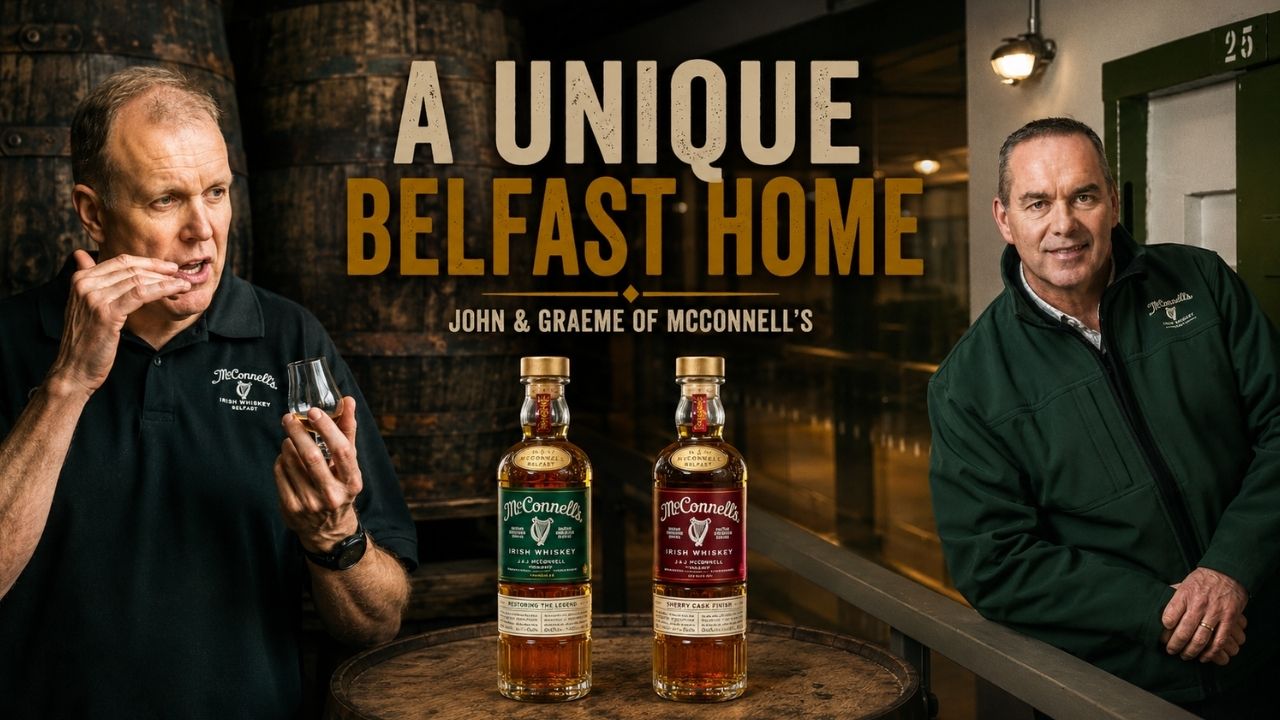
GUESTS: John Kelly (CEO) & Graeme Millar (Master Distiller), Belfast Distillery Company
Belfast was once one of the world's great whiskey capitals, but for decades its distilling heritage lay dormant. In this episode, Drew Hannush reunites with Belfast Distillery Company CEO John Kelly and Master Distiller Graeme Millar to explore the rebirth of McConnell's Irish Whisky, the remarkable transformation of Belfast's historic Crumlin Road Jail into a working distillery, and the philosophy guiding one of Northern Ireland's most ambitious whiskey projects. Along the way, they discuss McConnell's rich past, the future of Irish single malt, and why Belfast is once again becoming a destination for whiskey lovers.
In This Episode
The revival of Belfast's legendary McConnell's brand
Why Crumlin Road Jail became a distillery
Restoring a prison while preserving its history
Belfast's forgotten role in Irish whiskey
The rise and fall of McConnell's in the 1800s
Graeme Millar's vision for triple-distilled single malt
Creating a distinctive Northern Irish whiskey style
Building flavor through careful distillation and maturation
Behind the scenes of McConnell's visitor experience
Belfast's growing reputation as a whiskey destination
JOIN THE SPEAKEASY: patreon.com/whiskeylore
OFFICIAL WEBSITE: mcconnellsirishwhisky.com/tours
Transcript
COUPON CODE: WHISKEYLORE2026
OFFICIAL WEBSITE: mcconnellsirishwhisky.com/tours
Drew H (00:00:15):
Welcome to Whiskeylore: The Interviews. I'm your host, Drew Hannish, the bestselling author of Whiskeylore's Travel Guide to Experiencing Kentucky Bourbon, Experiencing Irish Whiskey, and the book that busts 24 of Whiskey's Biggest Myths: Whiskeylore volume one. And today it is time for a long overdue journey back to Northern Ireland to revisit a brand that I had on the show way back in October of 2021 where we learned about the legendary brand McConnell's in interview number 37. It wasn't too long after that interview that I get a chance to go to Northern Ireland and was doing my research for the travel guide to experiencing Irish whiskey. And just so happens that on my birthday, I ended up getting invited to the McConnell's SherryCask finished whiskey launch, which was a lot of fun. That is where I met one of today's guests, CEO John Kelly of the Belfast Distillery Company.
(00:01:10):
I got a tour around Belfast the next day from former brand ambassador Sarah Kennedy. She gave me the lay of the land there and showed me around to some of the historic areas, some associated with the distillery. And we talked a little bit about the fact that there was a new distillery being built for the company, but I wasn't quite sure where it was going to be at that time. It seemed to be a bit of a secret. Well, now we know where it is. It's in the historic Crumlin Road jail. So today we're going to talk a little bit about that, where the brand is going. And we have a new member since when I was there. He was actually distiller at Ecklandville when I met him in the past. That master blender and distiller, Graham Miller, who is now with McConnell's. So this is great.
(00:01:59):
Chance to reunite with two people I had the pleasure of meeting on that trip. So John and Graham, welcome to the podcast.
John K (00:02:07):
Thank you, Drew. Thank you. Pleasure to see you again.
Drew H (00:02:10):
Yeah, absolutely. Well, we did a deep dive in that first episode. This was really my introduction to Irish Whiskey because I really didn't know a whole lot about it until Sarah and I started getting into our conversation in that initial episode. So we did a deep dive into Irish whiskey history, Belfast's history, but I do want to jump a little bit back in and maybe do a little recap on McConnell's history. But first, let's kind of dive into how John, you first became associated with the Belfast Distillery Company.
John K (00:02:46):
Yeah. A pleasure to be chatting to you this morning for you this afternoon for us over here in Belfast. I'm from North Belfast. Actually went to high school literally over the prison wall from where we have our distillery in the Crumlin Road Jail. I often say that many of my teachers might have thought I would have ended up over the prison wall anyway, but lo and behold, I did end up here a few years after graduating from that high school. My background is Diageo. I've been in the drinks industry for more than 30 years, 22 of those years with Diageo, the drinks company in different parts of the world. I then worked in the South of Ireland in Irish whiskey. And I then was approached about this project and that was back in 2020.
(00:03:35):
Well, the project hadn't quite got off the ground at that stage, but there certainly was a real strong project plan to get moving. The brand had just launched, but the distillery in our brand home was still quite a way away. So I was approached to kind of be the CEO. And Drew, for me at that stage of my career, it was kind of like writing the best possible job that you could imagine because you get to come and run a business in your own backyard effectively and play a role not just in Irish whiskey and not just in the transformation of Belfast Irish whiskey and bringing McConnell's back, but also play a role in our community here in North Belfast in the transformation of this building and the regeneration of the community. So it was back then in 2020 and early 2021 that I got involved in the project as CEO.
(00:04:34):
And so I guess I'm just over five years old in the business.
Drew H (00:04:40):
Was it you that helped get it pushed into the American market? Because I was surprised at how easily I was able to find a bottle of McConnell's.
John K (00:04:48):
Yeah. Well, I can't take all of the credit for that. Very fortunate that my boss, who's the chairman of our business also the owner of a company called Coneca Brands over in the USA. So immediately we had a really strong relationship with our importer Coneca Brands because effectively the same group of people own both companies. And as you'll probably know from a supplier perspective, getting that importer partnership right is the first step and kind of being successful. It's from there that you can kind of roll out to the distributor network across the US. So I'll take a little bit of credit for it, but no, the foundations are the fact that we've really got a sister company in the US and that has helped us to expand relatively quickly over there.
Drew H (00:05:37):
And Graham, I met you over at Ecklinville and you guys were making some excellent whiskeys over there. I think the old Comer, is that your baby?
Graham M (00:05:45):
Got to say it was a team effort, Drew. The guys at Ecklandville know what they're doing just as well as I do. We kind of learned together, I guess, because back in 2013, 2014, that was when the new wave of distilleries were coming through. But yeah, Old Comber was one of the brands that we brought back, that the Ecklandville team brought back. And that was Popstill distilled at Ecklinville.
Drew H (00:06:07):
And it was funny because we were walking around and we got into a discussion about distilling potatoes.
Graham M (00:06:12):
That's right. Yeah. Yeah. Yeah.
Drew H (00:06:14):
You apparently were doing that over there. Are you doing that over here?
Graham M (00:06:16):
No. We're very focused. McConnell's very focused on triple distilled single malt. That's what this distillery is designed to do. And we're very focused on producing that one new make spirit to a really high degree of favor quality, consistency, very much to support the McConnell's brand as the years go by. So probably the most focused Irish distillery on the island because there's lots of Nashvilles across many of our contemporaries, which is fantastic as well. We differentiate through the maturation process more so.
Drew H (00:06:54):
And we'll dive a little deeper into that as we go on because I'm really curious about the distillery itself and the equipment that you have there and the philosophy. Let's first dive back into the history of the brand again. We talk about the brand goes back to 1776. It's interesting because I'm doing research now on the origins of bourbon and that's when the first people who would become part of the industry came into Bourbon County, but that was basically the wild frontier at that point. Talk about what you know of the early years of McConnell's. Yeah.
John K (00:07:34):
I mean, the brand was born in 1776. We're delighted to say that we celebrate our birthday with the United States of America. So we're 250 years old this year. Our early kind of notes and history really go back to a lady called Eleanor McConnell who took the brand forward with her two sons. And she was a real kind of... She just broke the ground rules back in those kind of 1800s where she was a rectifying distiller running her own business with two young sons when her husband passed away, Hugh. And she was really a trailblazer back then. So we kind of talk a lot about Eleanor and how she kind of brought the business forward to the success of the 1800s. The business was then owned not by the family, but by an independent company through the 1800s, late 1800s and early 1900s. That was at a time when Belfast really was one of the industrial capitals of Europe.
(00:08:40):
Whiskey was to the fore back then. Ship building, rope making, linen making. There was no other city on the island of Ireland that was producing so much from an industrial perspective as Belfast. And McConnell's was really one of the two big brands. There were many brands then, but certainly McConnell's was one of the really big brands that was being exported all over the world. Data that we have tells us that about 70% of all Irish whiskey was being exported through Belfast in the late 1800s and early 1900s. So it really was the Belfast was the capital of not just the Irish whiskey world, but the whiskey world because Scotch whiskey had not yet got to the heights that it started to get to later on in the 20th century. So McConnell's and Irish whiskey were very strong through the turn of that century in the early 1900s.
(00:09:38):
But we know that the coffee still played an important role in Irish whiskey and Irish rejected it. The Scotts embraced it. That allowed the Scotts to produce whiskey more cost effectively. We know that local unrest on the political stage, if you want, also created problems for Irish whiskey. We had the 1916 rising, the Civil War that followed soon after, which split families and the country apart really. That led to economic war with the Commonwealth where Irish whiskey wasn't able to be sold to Canada, India, Australia, those big markets. So that wasn't good. And then probably lastly and most significantly was prohibition. And prohibition in the 1930s really was a very difficult time for Irish whiskey on two fronts. One because Irish whiskey couldn't be sold to the US, which was bad. But even worse than that was there was a lot of bootleg product labeled Irish whiskey that was really poor per quality.
(00:10:41):
And that kind of meant that Irish whiskey went into a big decline. And with that, McConnell's actually held on longer than most. But in 1938, the McConnell's brand ceased to be produced here in Belfast
(00:10:56):
And it laid dormant for 80 years or so until our company basically looked into the history of the brand and thought, wow, this is something we want to bring back to life and we want to bring it back to life in a way which connects the brand with a wonderful brand home. And we'll talk a little later about our home here in the prison. But our ambition was to connect a brand which is 200 plus years old with an historic building, which was over a hundred years old and put those two things together in this project. So I guess that's the pocket history of the ups and downs of the McConnell's brand over the last 250 years.
Drew H (00:11:40):
Was it ever sold as a single malt? Was it a blend? The term Irish whiskey sometimes when you start looking historically, it's hard to know because today we define everything, but the definitions were a little looser in the 19th century.
Graham M (00:11:57):
Yeah. So the McConnell's business started as Sprout Grucers. So like most of the whiskey suppliers around the towns and villages of Ireland, they would've bought whiskey as a commodity from various distillers and then fatted and blended. And you'll see on the labels, liqueur whiskey, that was a common description. But liqueur whiskey, I'm not really sure what it was. I think queer whiskey, basically a blend of lots of different distilleries product. So it was a very different playing field from what it is today. As you very rightly say, Drew, the definitions are clear and very focused on whatever mash spill or whatever distillation process the liquid has gone through. So it's hard to compare the past with the present in terms of descriptions. Even harder to compare flavor profiles because we can't say that the flavor has been stable across all years. Even if we opened up a bottle from 80 years ago today, it would probably taste different from what it tasted when it was bought.
(00:13:03):
So yeah, we just focus on making the best quality that we can. That's all we can do. But no, I don't believe McConnell's was ever sold specifically as a single malt. The cure whiskey would be the common term that we can see on the old labels that we were able to get a hold of.
Drew H (00:13:20):
To your point, I received two bottles of whiskey that was distilled in the early 1900s pre-prohibition. The whiskey was actually transported across the country from Kentucky to California in barrels on a train. So plenty of agitation on the way out. Spent nine years in a canyon near Los Angeles aging in a warehouse and then was bottled. Now what's interesting is that I took two bottles with me, one of the bottles I tasted and it kind of had a musty flavor to it. It was very like cola notes. It was vanilla and cherry and those kind of flavors. And just recently I opened the second bottle, completely different profile. Same bottle. Everything was different about it. It was much fresher, cleaner. So this is the hard part. Even if you do get a bottle from that time period, I mean just the conditions that bottle goes through because if they're just using a cork, air's still getting in there.
Graham M (00:14:24):
Exactly. Yeah.
Drew H (00:14:26):
So you're never really going to... This is the sad part. We're never really going to 100% know what that old whiskey tasted like.
Graham M (00:14:33):
No,
Drew H (00:14:34):
That's true.
Graham M (00:14:34):
That's true.
Drew H (00:14:35):
And consistency being the other thing because we do kind of push towards that these days. But I think about Ireland and its relationship with bonders who were bringing whiskey in from these distilleries and basically packaging it and putting it on the market. And that question of where's quality control once it leaves the distillery and gets into the hands of a bonder?
Graham M (00:15:00):
Yeah, exactly. And we can't say how much of a value that would've been to the folks back in those days. They well have just decided to try and make the best blend they could that week. And then you turn around and you've got completely different raw materials the next week. That's quite romantic for me because that would be a really interesting arrangement. Taste on Monday, blend on Tuesday, sell it. But I have no doubt that variance was part of the feature of life in those days. We can pick up the telephone or send an email today and order a container of first filled bourbon casks and they arrive and we fill everything and we still have a little bit of variance even now. All distilleries and all whiskey makers still do with some degree of variance. But imagine having to rock down to Belfast port and just take whatever casks had been discorded from port or brandy or cherry, whatever had arrived that week.
Drew H (00:16:08):
That
Graham M (00:16:08):
Would've been a feature of how whiskey was stored back in
John K (00:16:12):
Those days. It doesn't help for portfolio planning. No.
Drew H (00:16:19):
Well, the good part is you don't have YouTubers who are coming out and saying, "Hey, why is this quality changed from one week to the next?" This whole thing of being in a world of tasting notes, that's not something that they were necessarily concerned with back then. No, definitely
Graham M (00:16:34):
Not. Very true.
Drew H (00:16:37):
There was a distillery associated with McConnell's, the old Cromac distillery. Do you know the time period that was in operation and how it was connected to McConnell's? Yes.
Graham M (00:16:49):
Well, after many successful years as whiskey bonders and blenders and sprout grocers, the decision was made to build a distillery on the banks of the Lagun River. So not far from here, probably about two miles as the crow flies, pardon the reference there.
Drew H (00:17:09):
But
Graham M (00:17:11):
We know exactly where it was. We can point out where the site was. It was built in 1899 and it was built on the Cromac Springs. So it was a very pure water supply and they actually had a couple of different businesses on the site. So there was a brewery and a soft drinks business as well. And that water supply a couple of decades prior to that had been identified as a potential source of water for Belfast as a city that was growing and big demand of water for industry and for the population. Not really sure why it didn't progress. I think maybe volume available probably affected it. They eventually moved out to Des Moines Mountains and did a big project there called Sand Valley. But yes, 1899 through to 1938 were the active years for the
Drew H (00:18:02):
Mac
Graham M (00:18:02):
Distillery. And that would've been a time whenever then the brands like Old Crow would've come along, the reference to the Crow Mac address. But based on the drawings that we see, it was a big concern. It certainly would've rivaled its peers in Belfast to have a native Collinswater Dunville's operations would've been of that scale.
Drew H (00:18:28):
Okay. It's so funny. I just palmed a forehead moment for me because I was going to ask you about there were several brands associated with McConnell's and one of them being Old Crow. And of course we have an Old Crow here in the United States which is related to a Scottish distiller who came over and started distilling in the 1820s and 30s in the United States. And so I see that name Old Crow and I'm thinking it's spelled without a W. I was wondering whether it was kind of an homage too or that somebody had found the name, but Old Cromac.
Graham M (00:19:10):
That's it.
Drew H (00:19:12):
It makes sense. So did McConnell's build that distillery or did they take over that distillery? Was that brand around before that? Based
Graham M (00:19:20):
On what I've been able to find out, I believe it was built by
John K (00:19:23):
McConnell's.
Drew H (00:19:24):
And when
John K (00:19:24):
You get a chance to visit, we have our connoisseur Cromac room for our connoisseur tour and we have lots of old memorabilia and we actually have some original old crow water fonts and old crow serving trays that date back to the 1800s or early 1900s, probably the early 1900s. So we have some of the originals here in the Cromac room.
Drew H (00:19:51):
And
John K (00:19:51):
That's helped us keep that connection with Cromac or Cromac. Obviously our 20-year-old old Cromac collection of which there'd be a number of annual iterations, that helps us keep that kind of Cromac name alive as well as we look to the future and build the portfolio. So we're trying to take that from the past and bring it forward to the future.
Drew H (00:20:17):
I guess it would be a little sticky to try to release a whiskey called Old Crow.
John K (00:20:22):
Yeah. Don't tell them, but I might have had a look at the trademark once or twice. The prices just go up.
Drew H (00:20:41):
Edit, edit, edit. Okay. And there was a fire at that distillery, did it? In 1909, did that gut the place and they had to rebuild completely or was that just kind of a minor fire?
Graham M (00:20:57):
Well, there were actually two fires. One was in a warehouse close to the distillery. It was confined to the warehouse. The more serious fire, one of the biggest fires Belfast has ever seen was 1907 in the Dunbar warehouses. And that was 30 million or something. I can't remember the number now. 30 million pounds worth of. So it was a huge fire. It was gas lighting that actually caused the problem. A gas lump filled over and caused a fire on one floor, but it quickly spread throughout the warehouse. But McConnell's in typical resilient Belfast fashion took an ad out in the paper within the next day or two and said, "We have plenty of stock. We are still distilling and this will not cause any issues for your supply of Old Crew or McConnell's whiskey."
Drew H (00:21:55):
Wow.
John K (00:21:56):
That fire actually, when you talked earlier about being at the event for our Sherry cask launch, we held that event in a bar, which is right in that Dunbar area of Belfast. So it's right beside the Duke of York, the friend at hand, the little off license there. That cobblestoned area was the Dunbar area where a lot of the whiskey distilleries had their warehousing closer to the river. So I guess you were there point number one and point number two, not all of the McConnell stock was there. So they were able to keep kind of selling even though some stock had been lost.
Drew H (00:22:34):
Oh, it's interesting because I remember seeing bush mills written up on one of the buildings. So I'm guessing they were -
John K (00:22:40):
Yeah, they had a big warehouse there as well. That's right.
Drew H (00:22:43):
Kind of getting back to the story of this jail project. I'm curious to know which came first, and maybe you know this or you don't because you came in later on. Was the original idea to build a distillery or was the original idea to find a home for McConnell's?
John K (00:23:00):
The original idea was to build a distillery in the Crummon Road Jail. So the Crumman Road Jail closed in 1996. It had just kind of ran its course if you want. You get a chance to come here, but it's single cells, which were housing two, three, maybe four prisoners at a point in time in the 1970s and '80s. No en suite facilities so it was kind of
(00:23:28):
Slopping out. So eventually in 1996 it was a time to close. This building then laid derelict for as part of 30 years. And it was a local architect whose services we retained throughout the project who actually went to the same high school as myself. And it was he coming from North Belfast and another businessman who kind of had the idea if you want, that building there could be a wonderful building for a distillery.That dates back to around 2010, 2011. So the first business plans I've read go back to then. And the idea was to build a distillery and then the brand would follow. It was really only when the current owners of the company became involved in the project around 2016, 17, that they kind of reversed the thinking and basically said, look, let's find a brand and let's get moving with liquid that we'll source and blend to our specification from a different distillery.
(00:24:34):
And then that'll create some revenue and create momentum for us to then kind of move forward with the second part of the project, which was the brand home in the geo. So the brand came first in our project, but the previous project, it was actually the distillery.
Drew H (00:24:52):
Had they done any construction in there up to that point?
John K (00:24:56):
A little bit of construction had been carried out. It's actually a complicated, beautiful building that we have here. We have a 125-year lease on a building that's owned by the Department for Infrastructure. So the government are involved. It's a grade A listed building. So the Heritage folks and architects were all involved in the project and a couple of other government departments. So there had been a little bit of work that was carried out in an earlier stage in the project, but nothing like the work that needed to be done. And it was really only when the,
(00:25:34):
I guess through the capital investment came in from the current project owners. It was only when that capital was realized in 2017 that we were really able to move forward with the plans. COVID then of course kicked in, so that kind of delayed things. I have to say when I got involved, as I said, it's a complicated set of stakeholders we have here. We've got investors from the US and North America, investment agencies, Northern Ireland government bodies in different parts of government, legal representatives for all these people ourselves as a local management team. And it really took the best part of 18 months in order to kind of get everybody. We talk about herding cats around here. I don't mean to be disingenuous to anyone, but there was a need to get everybody moving in the one direction, which we were able to do as a local management team.
(00:26:34):
And I think when people like Graham and myself got involved, it gave confidence to local government that local guys who appear to know what they're talking about and doing
Drew H (00:26:47):
Are
John K (00:26:47):
Kind of spearheading this project. And I count within that our finance director. So all of a sudden there were three of us who were kind of corralling people in the direction that the project needed to move. And brilliantly, we got construction started in August of 2022. We lowered our potstills through the roof of the building in May of 2023 and Graham got the equipment and everything turned on in April of 2024. So once we got going, there was quite a bit of momentum and we were up and running within two years.
Drew H (00:27:22):
Yeah. The challenge that you just threw on yourself by going into a historic building, I was over at Slain and he was talking about how they were lowering the potstills in and how they couldn't ding up any of the infrastructure because if they damaged something, they were basically breaking the law. Well, of course you're across the border under a different government, so I don't know how different the regulations are in terms of that. Well,
John K (00:27:51):
I mean, ultimately this all comes back to the Heritage Associations north or south. These people are rightly there to protect the beautiful buildings that we have. We had a heritage architect who was actually watching every move that our own architect was making and checking that everything was done in the right way.
(00:28:14):
We have beautiful slate walkways and the galley landings. And the challenge for us was, well, if you want to take those slate walkways out, you can take them out, but you got to replace them exactly as they are. And we just couldn't have taken that risk. So part of the reason why we had to lower the pot stills and lighter ton and fermentation tanks was because we just couldn't take the risk of removing the slate walkway. We literally have a couple of inches on either side where we were able to kind of lower the equipment through. So that was an interesting day back in May 2025. Thankfully, there wasn't a breadth of wind and the equipment lowered beautifully.
Drew H (00:28:57):
Did you video all this stuff? Yeah. Kind of document it for history?
John K (00:29:01):
Yeah. Yeah. And we'll share that with you. We've got a lovely video that we have as part of our tour. So we've got a time-lapse camera, which basically was in situ for the duration of the construction. And we'll let you have a look at that. And it really is quite dramatic.
Drew H (00:29:20):
I got a chance actually, Graham, to hear you on an interview with my friend Lori O'Dwyer from Whiskey Chats. Yeah. He got the pleasure of walking around and seeing everything. I was so jealous listening to it. I'm like, "Yeah, this would be great to hear all of this. " But what I loved about the conversation was that you went into the history of that jail and kind of talked about who was there and the cell size and all of that. Kind of give us a little review going back to 1840 up as to the background of that building and who the inmates were and its reputation.
Graham M (00:29:57):
So the building dates back to In 46, and it was built as the Belfast prison. And remembering that during the 1800s, Belfast was growing exponentially so it was quite a small 20 or 30,000 people knocking around at the start of the century and then multiply that by 10, I think, by the end of the century. And then the Victorian regime obviously was in place. The police force was quite a new thing. They needed somewhere to put all these people that were misbehaving. At the age of consent was something like eight years old. So there was children in the jails.
Drew H (00:30:35):
Wow.
Graham M (00:30:37):
The Irish famine was actually happening right at that moment as well. So there was a socially very difficult time. It was built to replace the Carrick Fergus County Jail, which is about 14 miles up the shores of the Belfast Lock. And when this building was ready, they shackled the inmates of Carick Fergus Jail and marched them 14 miles in shackles to their new home. It had four wings. This wing, the A wing was the women's bridewell as it was called at the time. So this was where the females would've been housed. And actually it wasn't always three stories high. It was two story building with the hospital at the far end. And then we think at the end of the 1800s, the new hospital was built to the rear and the extra floor put on and the wing made into one continuous building. And that's over three floors, roughly 10,000 square feet to the entire floor space.
(00:31:43):
But at 180 cells in this wing alone. And it stayed as the women's wing right through to, I think around the time of the suffragettes. So that would've been early 1900s. So we know that there were suffragettes imprisoned here and we know that they did the hunger strike. That enabled them to be released and then they would go out and cause more trouble and get rearrested within three days or four days.
(00:32:08):
But socially a very different time. That was obviously really a big issue, a key issue, that representation through voting. You had to own a house, you had to own a property. It did actually matter what religion you were as well and what change we've gone through since those days. The sales themselves were 12 feet by seven feet. And the Victorian separate system was the kind of regime that was used. So you had a Bible, you weren't allowed to talk. Your only book was a Bible and you weren't allowed to talk to anybody else and you were locked up
Drew H (00:32:49):
With
Graham M (00:32:49):
23 hours a day. So really grim, really grim. Then as time went on through the 1900s, became all male prison. Arma prism was built. As we went through two World Wars, Turment was introduced. So if you were even suspected of being troublesome with your views, you would've ended up locked away. You may have been allowed to wear your own clothes and you wouldn't have spent 23 hours a day in the cell, but that would've been a different wing. And then of course internment came back in the '50s and again in the '70s. And then if we come up to the '70s to the troubles in Northern Ireland, we had lots of famous names in the place. Ian Pisley was here for a short while. Before that, Iman De Valera made a trip north and got himself removed and ended up here for six weeks.
John K (00:33:44):
President of
Graham M (00:33:45):
Ireland.
John K (00:33:46):
Yeah.
Graham M (00:33:46):
Yeah. And then we had Martin McGinnis. We had also our, at the time when we opened, we had our minister for finance was actually an ex - inmate as well. And the TV -
Drew H (00:33:58):
Wow.
Graham M (00:33:59):
Yeah, the TV interview was... He handled it really well. I think he'd been briefed, but he handled it really well. A message that we really want to get across is the positive use of the building now. An iconic building in Belfast that's come through all these iterations as part of the fabric of the city. And now it's home to McConnell's and we're doing very positive things here. We're making beautiful whiskey and we welcome people through our doors for events, tastings, afternoon tea, whatever event that you want to have. We're here to cater for those needs.
Drew H (00:34:39):
What was it like when you started talking to people about this project? Now I know the buzz had probably been around. I found a newspaper article, I think 2014, 2015 or something about the idea of this going on. But a building that has had something that's still fresh in people's minds of kind of a negative aspect to it. Did you get a lot of surprise from people whenever you would mention it that we're building a distillery here?
John K (00:35:10):
Yeah. Yeah. I think we got a little surprise, a little maybe disbelief that that could actually happen. And I think the story that Graham tells is a great one. I mean, our finance minister at the time was asked, "Well, Connor, how are you enjoying your second visit to the
(00:35:29):
Crumb?" And we nearly passed out. We were like, "Oh my goodness, this is our laundry. This is all going to go. " But he handled it in a really great way that I think is a good kind of metaphor for what we're trying to achieve. He talked about how this was in his time, that initial time here, a dark, damp, violent place full of hatred to be perfectly honest. And now look at it. It's a bright, airy space, which is all about bringing people together. These events that Graham's talking about, reminding ourselves of the great history that Belfast has in making whiskey and the great brand that McConnell's was, but it's also a place about the future. We're distilling liquid here that Graham will lay down and it might not be in a bottle for 20, 25, 30 years. And so there's a great sense of having transformed the building from that negative space to a real positive place of looking at the future and respectful of the past, but very much kind of looking to the future and the kind of innovation and community spirit and all of those kind of powerful, positive things that we want to have in the building here.
(00:36:51):
And I think we're all, as a team, delighted with our brand home. We're very proud of our brand home. We're very proud to welcome here, welcome everyone here. And it certainly is quite a different place to come in and work. It's not your usual office environment, let's say.
Drew H (00:37:07):
Yeah. You're not leaning into ghost tours or anything like that. Are there any tales of ghosts around there?
Graham M (00:37:16):
I like to try to avoid that entirely because sometimes I'm here by myself at times too.
John K (00:37:23):
It is funny. If you're locking up on your own in a dark night and you go through the retail space, we know that there are mannequins there that have merchandise on them. And no matter what, you know they're there, but you kind of look up and you see one of those mannequins and it definitely gives you a fright no matter how often you do it. So
Graham M (00:37:47):
As you know with modern distilleries, sometimes the valves can actuate unexpectedly and you hear a little hiss of air or a click or a clunk. So
Drew H (00:37:57):
Anything
Graham M (00:37:58):
I hear, I just tell myself, that's a valve or a pump. Yeah.
Drew H (00:38:03):
Yeah. Good way to fool a guest when they come in. Exactly. Did you hear that? Oh, that's fun. So in trying to keep the past in that building but freshen it up, what is the process for doing that? I mean, you had to have a lot of discussions about how we preserve that history yet still get that positive vibe and utility out of it.
Graham M (00:38:30):
That's a question that can really be answered best by coming to see the place. And that would be our invitation to everybody. There's new parts to it, of course. We've knocked down some walls to make bigger rooms so that we don't all have to switch from one cell to another to talk to each other. It's been done in such a sympathetic way and such an innovative way. You know exactly what the building was before because there's lots of original features still here, but also you feel like you're in a modern space, a relaxing and warm space. We've actually won awards for the Fit Out. The architects have won numerous awards actually for the Fit Out at a national level. The building company who did the work have won awards as well. The structural engineer has won awards. So it's been recognized as a project that with its challenges, it's been executed in such a way that it's worth getting on the bus, get on that number 11 bus or the city site saying tour bus and get off at the stop just outside the door here and come and see it.
(00:39:43):
It's a wee bit like if you're into a certain kind of music or a certain kind of band, it's very difficult to describe what it is about that that works.
(00:39:53):
So it can only really be experienced when you're stand here.
Drew H (00:39:57):
Yeah. You have other wings to the building. Are those being utilized?
Graham M (00:40:02):
Yes. So C-Wing has been utilized since 2010 as a jail tour. So it's specifically the history of the jail. And that actually came into being by some ex inmates doing tours as a one-off now and again. But they were always sold out. So they would sell out in no time. So the DFI decided that they would make a venue. So the C Wing's been really successful as a tour venue since 2010. The other two wings are still vacant. So I have a few ideas what we could do. Recently we had a film crew with the BBC filming a new drama series in B Wing.
Drew H (00:40:49):
And
Graham M (00:40:49):
My friend Paul Shirt actually builds a set. So he invited me in to watch them doing a filming session. It's fantastic to see totally different industry divorce and how they go about doing their work.
Drew H (00:41:01):
Very nice.
John K (00:41:02):
Or a hotel, for example. I mean, we would love that. There's a number of prisons around the world. Austin, I know there's one, Amsterdam, Istanbul prisons that have been converted into boutique hotels. So we would be really in favor of someone taking on one of the other wings and having a small boutique hotel there and spending a bit of time with us at McConnell.
Drew H (00:41:26):
You're going to give them more than a cubicle with no en suite, right?
John K (00:41:30):
You probably have to maybe extend a little bit further.
Graham M (00:41:34):
Yeah, they might knock through.
Drew H (00:41:37):
It's
Graham M (00:41:37):
Good to knock through those walls. Pretty thick.
Drew H (00:41:40):
It'd be the real experience. Come on in and enjoy.
Graham M (00:41:45):
As a guest, you could bring your own pickax.
Drew H (00:41:47):
There you go. There you go. Nice. Well, let's talk a little bit about the production facility there and what you built. And was the idea always going to be single malt? I mean, there's a lot of Irish tradition out there.
Graham M (00:42:02):
Yeah. The equipment specification itself has been around since the early ideas of the project. At a time when people were starting to talk about potstill whiskey and double distillation, et cetera, et cetera. It was always clear certainly to me whenever I arrived with the team that this is the right design and construction for McConnell's because triple distilled single malt is the quintessential whiskey style outside of potstill. I think potstill, we love it here in Ireland and we all know exactly what it is. That story around the world is developing as we speak, but differentiation is really important in the island. Lots of my contemporaries and peers are making different styles. We've chosen to walk this line, walk this course and do it very, very well. So yeah, it supports the McConnell's brand vision. It supports the flavor profile. And whether it's as a component in our five-year blend or as a 20, 25, 30-year-old single malt, it will deliver on flavor.
(00:43:20):
And that's all I care about basically.
Drew H (00:43:23):
Yeah. Yeah. Well, this is the thing is that when I visited you at Ecklandville, the talk over there was we're probably not releasing any of this stuff until it's well over 10 years. Oh, that's a long time to wait for your first spirits to come out. It is. Are you going to build this as a component into what you have or are you going to create this as a separate liquid?
Graham M (00:43:48):
This will be part of the McConnell's five-year blend, which is the core of our table. So we've got our five-year blend green label with our sherry cast finish, which you were at the launch of. We also have a cognac cask finish all based around the same core liquid. So the bottle will look the same, but the single malt component will change. And that's a story that we will be developing over the next few years to prepare our McConnell spans to get ready for that change because there was a choice on day one to try and come as close to the liquid that we use at the minute or actually just allow the distillery to find its own way and make the best tasting liquid that we could from distillery, from distillers that we have. And thankfully, John, it's very tolerant of my ideas. It wasn't a very long conversation.
(00:44:50):
I don't remember it being a long discussion. Not at all. And for two reasons, one is
(00:44:58):
It should be the best liquid that can possibly come from this place and from these stills. But also we don't want really to be very similar to anybody else either because as I said, as an island, we will thrive on diversity in terms of flavor profiles, whether that's as single products or as a portfolio for blenders and bottlers to use in the future. If you look at the Scott's model, some of those products have 40 plus distilleries that are in some of the blends. So that's a long way ahead of us. But a lot of the distillers that I talk to, my peers have the same idea as what I have. We want to be different. We don't all want to create this kind of pigeonhole flavor profile. So we
Drew H (00:45:54):
Value
Graham M (00:45:54):
Diversity. I think that's really important. It's going to really ramp up the excitement and the variety and the investments available as time goes on.
Drew H (00:46:03):
This is the thing that I definitely felt while I was traveling around, even back in 2022, is that feeling like there is a desire after nearly half a century of just being one company basically defining all of Irish whiskey that Irish whiskey now is saying, look, this island has a lot of personality to it. Why is our whiskey not showing that? And so I love that because I'm seeing it here in the US also, this craft movement, this movement towards using local grains and trying to find local yeasts and trying to do that. How much of that kind of stuff are you incorporating into what you're developing in this single malt?
Graham M (00:46:54):
Well, we use only Irish grain. It comes from our malting partner that we use. I guess the differentiation really starts whenever it arrives here. If you get the chance to spend the morning with me, see the level of detail that goes into every batch that we make. We're so particular about the process control and settings, even how the mill's set up. Everything matters. And what I'm trying to achieve is to have this perfect new make. So I don't want any flavor profile in there that's not going to enhance the flavor as it goes forward. I don't want to have anything that I'm trying to mature out or to change in maturation. I only want the cask to add to the picture. So the new make that we make, it's as complex and delicate as possible. And I can tell you, you can take a taste of it straight off the still, maybe a few drops of water.
(00:48:02):
But the blueberry, black current jam, light citrus notes, they're all there. There's nothing negative. There's nothing funky. Not to disparage some of those more bold styles. It's important to be able to do that as well, but this is what we have decided to do and this is our style. I was in Glasgow last week with the Aris Whiskey Club of Glasgow who are a very animated bunch, particularly after seven jams.
(00:48:34):
We took a two-year-old spirit from cask 497 and I can stand up in a room of 40 people and present that. It's so sophisticated already and it's not even whiskey yet. We have another year to go. So it's really exciting for me to be able to go and talk about that. And it's got all those elements I talked about in the new make, but the enhancement of the cask maturation, even just for a short time, it's very clean to see and to taste.
Drew H (00:49:11):
Yeah. So how are you doing your cuts off of these three stills? Are you doing cuts off of the second intermediate still before you're going into the third? And then are you doing a really tight heart cut when you're coming off of that third still?
Graham M (00:49:27):
Yeah. So obviously we don't cut at the first distillation at all. Little wine's going straight into the intermediate still alongside the fence from the previous distillation. So yes, we cut. So we cut in the intermediate still. Everything we do, it gets driven by flavor. So we've set up the parameters based on what we think flavor-wise should be delivered as a strong fence or a double distilled liquid. Then we go in to the spirit still and we do a pretty tight cut. So the strength that we're coming off at is about 82%. Now we're highly automated, but the one element that it has to be done by nose is the final cuts on the spirit still. We do get one day to another if the ambient temperature's a wee bit different or flow rate's slightly different. It can vary a little bit. But I can tell you a sample from May tastes exactly the same as August or October.
Drew H (00:50:34):
Wow.
Graham M (00:50:35):
We've got a really fantastic consistency of flavor. And again, it's a middle sized distillery. It's half a million liters of pure alcohol capacity. So it's not one of the biggest, but it's certainly not one of the smallest. So to have that consistency at our size is something I'm very proud of.
Drew H (00:50:58):
Yeah. Well, are you barreling this up all in ex - bourbon or are you doing kind of a... What's your strategy in terms of how you're going to age this whiskey?
Graham M (00:51:08):
Well, everything starts in ex - bourbon casks. So having been, I suppose one of the benefits of getting to my age, I've been able to try some different things. And really a few years in ex - bourbon initially is a very good grounding for a whiskey. So it just gives us those building blocks of flavor that we can then work from for finishes and what have you. So yeah, ex - bourbon all the way until five years old.
Drew H (00:51:43):
He's always curious about this and not all distilleries will tell you exactly where they source their barrels from, but do you find just a generic ex - bourbon versus a bourbon barrel from a distillery, a certain distillery or certain company that you maybe have a preference for one over another or that it really makes that much of a difference in terms of your aging?
Graham M (00:52:10):
Well, I think it's really important to have a quality cask. So for two reasons, we don't want anything to leak out, number one. And second, the grade in which the cask has been curated in its first life as a bourbon cask. Very important. So the quality of the choring, the quality of the raw materials, et cetera. We have formed very strong relationship with the two Cooperages on Ireland and Mayo and this. And I trust them with that part of the job. So for
(00:52:46):
All of our standard production, we'll utilize ex - bourbon cask that have come from distilleries that have a solid cast management program in place. So that looks after the physical robustness of them, but also the quality in terms of flavor. We have done some special caskings though. I suppose the one that I would talk about first and foremost is the 250 Guild, which is our cask program. It's the first 250 casks that we filled. And we're utilizing three different styles of casks there. They're all ex - bourbon, but we have X wild turkey select casks for most of them. Wild turkey with a little bit of rye in the mash bill, I think. It's a nice choice there. And then we've used sparal cut, toasted and charred, shaved, ex - bourbon casks. Another distillery, which I can't tell you because the name's been painted out, but they're toasted and charred as well.
(00:53:52):
If anybody we're talking about, there's not that many bourbon distilleries that toast and chart. I'll leave that up there.
Drew H (00:54:00):
Okay. I have an idea.
Graham M (00:54:02):
You can Google that, but there's a dozen of those and there's two dozen spiral cuts. So they're very limited numbers. And those just get... I mean, it's quite subtle. At this point in time, it's quite subtle, but the difference is there. From one which is more fruity, tending to be more fruity, more soft wood spice notes to a different kind of wood shavings note nearly. But we can already see the differences starting to come through.
John K (00:54:31):
And I think one gentleman has bought one of each barrel from what
Graham M (00:54:36):
I know.
John K (00:54:36):
Yes, that's true. So this is our kind of barrel program where it's to celebrate the 250th anniversary of McConnell's and also the United States. And we've got these kind of special 250 barrels of the very first liquid that came from the distillery. And by being part of that, you're kind of being part of the family here at McConnell's. Y come and meet your barrel the first week of August every year we bring everybody over and they come and meet their barrel and do tasting with Graham. So that's a really special program that we have available to all of our guests.
Drew H (00:55:12):
You're doing tours there. Is there one standard tour or you have a variety of tours?
John K (00:55:17):
No, we have a variety of tours, but I think just stepping back from that very quickly, Drew, we've become one of the leading tourist attractions in not just Belfast, but Northern Ireland. If anyone does a TripAdvisor into McConnell's, we'll come up number two or three out of 300 odd tourist attractions in Northern Ireland. So we've very quickly created a name for ourselves. We've had 45,000 visitors in the first two years who have come and spent time with us here. And tours are obviously what we're about first and foremost. So we have a signature tour, which is a one hour tour of the facility and you get to sample some of the wonderful new make that Graham has talked about. Some of our five year and some of our Sherry cask as well as having a Belfast buck, which is a McConnell's and ginger ale with a slice of orange at the beginning of the tour.
(00:56:19):
So the Belfast buck is a simple long drink that we've introduced to a bit like the Moscow Mule. We're introducing the Belfast book. So that's the signature tour for the connoisseurs. We have a connoisseur tour that lasts another 30 minutes. And in that tour, you get to spend a little bit more time exploring the history of McConnell's, a bit more about where the water's coming from, the distilling process. And you get to taste some of our cask strength sherry cask finish, but also our old Cromac 20-year-old single malt, which is a wonderful single malt award-winning single malt, best exclusive cask on the island of Ireland, age 15 to 23. 20
Graham M (00:57:11):
Lumber.
John K (00:57:12):
20 Lumber. There you go. So award-winning tasting for the connoisseur. We also have a cocktail making room so you can bring a group of friends and you can learn how to make cocktails. And you touched on it earlier about the diversity of Irish whiskey. And what we're very keen to do is to really bring Irish whiskey and McConnell's to a new and diverse kind of consumer group. So bringing people in to do tours because they're whiskey lovers or to make cocktails because they normally drink white wine or beer or whatever, but learning how to mix it up and do something different. We've got a wonderful kind of cocktail room alongside that. So that's the core of the business, but we've got great event space on three different floors, can accommodate this room where we're in up to 20 people. We've had weddings here for 200 plus people.
(00:58:08):
So we can accommodate different kind of scale events. And we've got a cafe, we've got a bar, and we've got a retail space. So I often say that when we opened the business that day, we opened kind of five businesses in one, the tours, the events, the bar, the cafe and the retail space. So there's lots to do and enjoy on an afternoon here at the distillery.
Drew H (00:58:35):
I find it interesting now when I went there, there was no distillery to visit. And now you have two distilleries in Belfast to go visit. I know actually there's a little bit of history between your two distilleries in terms of the founders. The original planner of this Belfast distillery actually is now over at Titanic.
John K (00:58:58):
Well, there's actually an even further back history there in that the father of the man that built the Titanic who's famously in the film. His father was actually a director of the McConnell's business back when it was owned back in the early 1900s. So there's
Drew H (00:59:22):
A history
John K (00:59:22):
That goes back all the way to the Titanic ship and McConnell's. And look, we celebrate Belfast and shipbuilding all over the world. If you look at our bo behind you there, it's got that little badge, which we talk about as the rivets on the big iron ships that were built in the Harlem Wolf shipyard in the 1800s and 1900s. So there's a specific connection between McConnell's. We've no doubt, although we haven't found a bottle, but we've no doubt that there would've been McConnell's on the Titanic because it was the whiskey of choice in Belfast back then. So there's a real history between Titanic shipbuilding and McConnell's. And then yes, you're right. In terms of the directorship, and I referred to earlier the architect and a businessman who had the idea to build the distillery here in the jail, Peter Lavre, who was part of this business up until 2017, Peter then went and then got going with Titanic Distillers and
(01:00:27):
Peter owns Titanic Distillers. We're really close friends. We wish them well. We always compete on the shelf, but I say this about Irish whiskey distillers all over the island. We will compete for consumers on the shelf, but my goodness, as an industry, we work well together. So there's a very strong Irish Whiskey Association. We're very proud to be members of that and we'll support each other. So Graham and Damien down at Titanic will share notes and compare things. And we'd love nothing more to have someone come spend a morning at Titanic Distillers in an afternoon with us at McConnell's. So we collaborate as well as compete, I would say.
Drew H (01:01:14):
Beautiful. I'm from Detroit originally, very blue collar city. And there's something about blue collar cities when I'm traveling that I love going to. It's like you're amongst the people when you go. You mentioned Glasgow. When I'm in Scotland, that's always my jumping off point. I start in Glasgow and then I go out from there. And I got that same vibe in Belfast. Belfast to me is just kind of salt of the earth people. Growing up in the mountains of North Carolina where it's Scott's Irish, it's almost like being at home in a different country for me. So I really enjoyed my time there. It's a great town to explore and to have the whiskey distilleries there now is an absolute plus for whiskey fans bringing that history back.
John K (01:02:07):
You make a great point. And I've said this before. I think of Belfast, Glasgow, and Liverpool as big industrial cities in Ireland, Scotland and England as opposed to London, Edinburgh, and Dublin, which are maybe much more parliamentary or aristocracy. And I think there's a real, that's where we see Belfast. We're very much kind of proud of our industrial heritage. And we talk about Belfast, it's on our bottle, established in 1776. We talk about that all over the world. So we're incredibly proud to be from Belfast, which was once the epicenter of the whiskey world.
Drew H (01:02:51):
Well, I look forward to seeing how the whiskeys develop. I know they're in good hands and definitely looking forward to seeing that building at some point and seeing what you've done to it. The photos are impressive and they just kind of urge me on to make those plans as soon as I can. So looking forward to it and highly recommend people checking it out and testing a bottle of McConnell's that's on the shelf right now because it's a really nice drinker and something that I think will give people a great first impression of what you're doing.
John K (01:03:26):
Well, we hope you enjoy it. And one just last offer to all of your viewers out there with Whiskeylore. We'd love to extend an invite to McConnell's Distillery. We have our friends and family rates if you want for all of our tours here. So we'll find a way of connecting with you, Drew, and get some sort of offer out there to anyone who's coming to Belfast in Ireland that's a friend of Whiskeylore is very much a friend of ourselves at McConnell's. So we'll find a way to get an invite for all of those guys.
Drew H (01:03:58):
Beautiful. I will let them know. Thank you so much guys. I appreciate your time today and introducing me to the history and the distillery as it's going right now. And as I say, looking forward to seeing what you guys do in the future. Cheers to you.
John K (01:04:14):
Thanks Drew. Cheers.
Graham M (01:04:16):
Thank
Drew H (01:04:16):
You. Well,
(01:04:17):
I hope you enjoyed my conversation with John and Graeme from McConnell's Distillery at the historic Crumlin Road Jail in Belfast. They were nice enough to give us a discount code that Whiskeylore fans can use if they want to go visit the distillery. Good until the end of 2026. It'll get you 20% off their signature tour. Just go to Connellsirishwhisky.com/tours. That's whiskey without an E, and type in with an E, WHISKEYLORE2026 during checkout. Or if the E lends some confusion, just head to whiskeylore.org/interviews, click on interview 141 and find a discount code under the transcripts tab. And don't forget, coming up next Monday, I should have chapter one of the lost history of bourbon ready for you to listen to here. Chance to hear for the first time the real story of the birth of bourbon. Make sure you're subscribed to the Whiskeylore Podcast so you don't miss a moment.
(01:05:13):
Have yourself a great week. I'm your host, Drew Hannish. And until next time, cheers and Slan Java. For show notes and transcripts, head to whiskeylore.org/interviews. Whiskeylore is a production of Travel Fuels Life, LLC.