
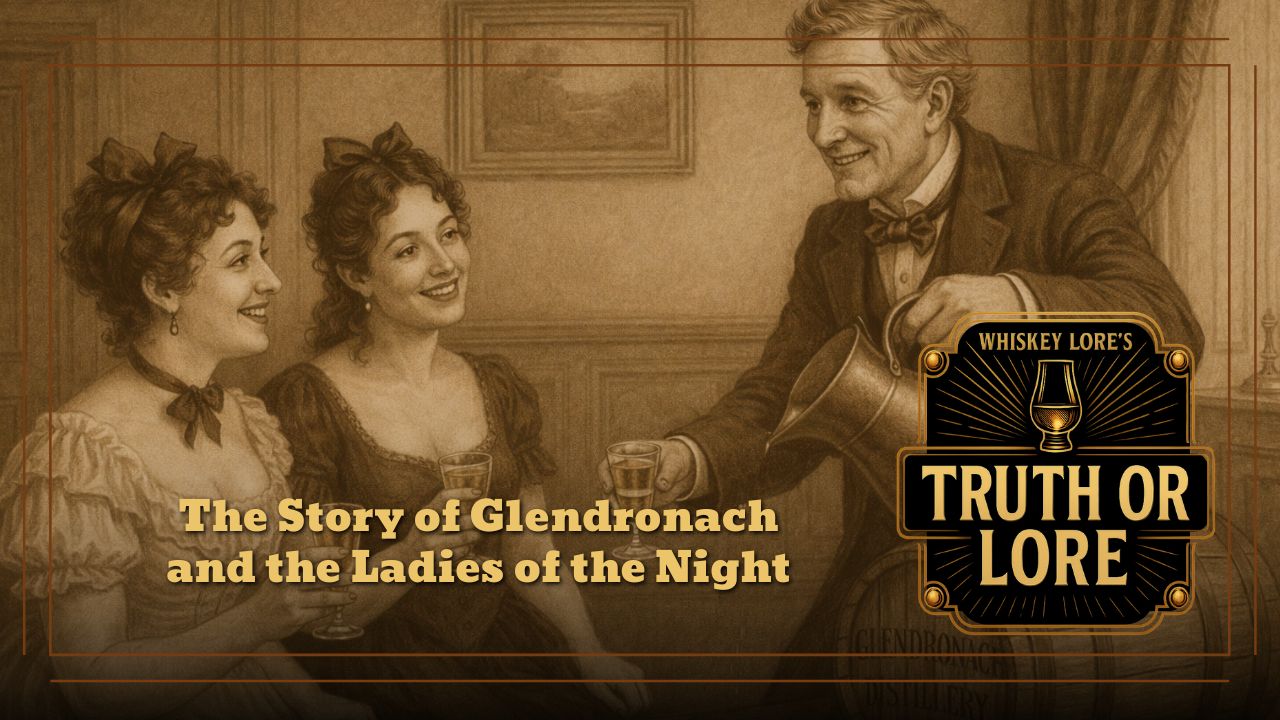
The Story of Glendronach and the Ladies of the Night
Listen to the Episode
Show Notes
Season 7 continues the return to Whiskey Lore’s storytelling roots with a re-examination of the very story that launched the podcast. In this episode, Drew Hannush revisits the life of James “Cobbie” Allardes (spelled Allardice on Glendronach bottles) and the famous Edinburgh tale that claims he used “ladies of the night” to introduce Glendronach whisky to the capital.
This time, the story is reopened like a historical cold case. Drawing on estate records, excise data, and 19th-century accounts, the episode reconstructs who Cobbie really was, how Glendronach actually came to be, and what the numbers reveal about its early success. What emerges is a far more deliberate, ambitious, and complicated figure than the folklore suggests—and a distillery story that looks very different when placed back into its real historical context.
In this episode, you’ll explore:
• Who James “Cobbie” Allardes really was before Glendronach
• The political and agricultural forces that made the distillery possible
• The full “ladies of the night” story—and what holds up under scrutiny
• Whether 1826 truly marks Glendronach’s beginning
• The level of Glendronach's success under Cobbie's leadership
• How fire, finance, and shifting Highland life reshaped Cobbie’s legacy
Use the player above to enjoy this episode or find it on the Whiskey Lore Podcast, available on your favorite podcast app.
Want to learn more about Glendronach's history and when it earned its status as the Sherry Bomb of the Highlands? Join the Whiskey Lore Speakeasy and enjoy "Behind The Lore" episodes.
Transcript
It was a typically cool damp morning in the Scottish Highlands, and James Allardes was standing in the doorway of his 50x50 stone built stillhouse marveling at the skill of his distiller, who was eying the bobbing hydrometer above the spirit safe. A couple years before, he wouldn’t have imagined owning a distillery, but recent law changes, eager local farmers, and his ownership of a property perfectly suited to the task, created this enterprise out of thin air.
He couldn’t help but think, he was living a charmed life. Few in his social class could dream of having so much good fortune and control over the direction of their life.
As a teen, he had lucked into a position as a tenant farmer and then farm manager for Sir John Gordon, a local aristocrat, who was tied to the the most prominent families in the Kingdom of the Forgue, the Gordons. He loved working with the soil and land development and eventually took over three leases—managing nearly 800 acres. Then, in 1800, when his father passed away, he inherited the modest Boynsmill Estate, with its 15 acres, along with a fine manor house and mill. His brother John offered to manage the property while James pursued his passion, working the Cobairdy Estate and living in its manor house.
Of his three leases, Sir John’s Cobairdy was his favorite. He seemed obsessed with making it one of the grandest and profitable in the area, building 12 miles of stone and lyme dykes and planting a large number of trees. When, Cobairdy passed into the hands of John Morison of Auchintoul, he was so impressed with James’ tireless effort, and the value he was bringing to the property, he promised James that he would be paid full value for every tree and dyke upon his retirement. James became so associated with the property, locals playfully referred to him as the Laird of Cobairdy even though he was still just a tenant. His friends simply shortened the nickname to "Cobbie."
But Cobairdy brought more than just work. Befriending several in the community, his greatest friendship developed with a boy who lived on the adjoining property. George, the Marquis of Huntly, who was the son of Alexander, the 4th Duke of Cordon. It was a genuine friendship he prized. It also opened doors well above his station and gave him access to the lavish parties that the Marquis held at Huntly Lodge. Always staying respectful to his host and friend, Cobbie was always one of the first to arrive.
Outside he’d find oxen, bread and beer provided to the poor, while inside, the halls were filled with the music of pipers and fiddlers. The festivities often included horse races at Huntly Castle and guests easily cleaned out hogsheads of Claret and Madeira. Cobbie’s friends the Marquis and Alexander Shand always seemed to end up in drinking competitions to see which could outdrink the other, Cobbie was sensible and kept his wits about him while mingling with the gentry. His easy going agreeable manner, spritely temperament, quick wit, and charming local accent—which he had no intention of abandoning—helped endear him to many.
And being a pragmatist didn’t hurt either, it seemed this quality is what earned him the status of Justice of the Peace, a position he still held, and manager of several turnpike projects, including the road between Banff and Huntly, and the turnpike that lead to his own Boynsmill Estate—a road that became critical in the next stage of his life.
Thinking back, the seeds of his current distilling endeavor really were planted as far back as 1807, when his friend the Marquis received a writ of summons to the House of Lords. Having a friend in Parliament allowed Cobbie to keep his finger on the pulse of legislation centered around agriculture.
Then in 1822, his conversations with the marquis and the goings on in Parliament centered around a dangerous monopoly of distillers in England and Scotland and the effects they were having on Great Britain’s farmers. Colluding to control grain prices through drastic swings in production levels, these distillers had no issue with letting English crops rot in the field, if it meant profits for them. It was giving rise to smuggling from Ireland and France which only exacerbated the problem for farmers. Cobbie found it curious that the proposed solution Parliament was bandying about was the lowering of duties, to fuel new competition for those monopolistic large-sale distillers. It’s a scheme that had found limited success in the Scottish excise law of 1816. Cobbie kept his eye out for letters from the marquis and on the Aberdeen Journal. If distillery licensing fees were reduced to create competition for the monopolies, the Highlands would be abuzz with distillers looking for a place to mill their grain—Boynesmill might finally become more than just a small farm known for prize-winning cattle-breeding.
His instinct had been spot on. When license fees and duties were reduced with the Excise Act of 1823, talk of distilling saturated the area. Cobbie and two local farmers, his cousin Robert Stuart, a grower of bere barley, and neighbor John Richardson Thain started talking about the feasibility of using the Dronac Burn as a water source for a distilling operation, Then, an article appeared in the Aberdeen Journal, outlining all the rules and regulations required to start a distillery. To Cobbie, the barrier to entry didn’t seem that high, and the government appeared to be encouraging the practice. And they didn’t see much competition. The only legal distilling around the Kingdom of the Forgue were modest distilleries like Strathisla and Glen Garioch.
Still, building a distillery remained all talk, until Cobbie’s nephew Robert Davidson, a chemist in his father’s spirits shop in Aberdeen, began to talk of the increasing demand for fresh yeast. Robert’s brother William, who was interested in getting into the business, told Cobbie, Thain, and Stuart, if they wanted to get into the business, they’d better start immediately. Before Cobbie knew it, a stone stillhouse was built at Boynsmill, equipment acquired, licenses secured, and in 1825, the Glendronach Distillery Company was born.
Wanting the distillery to be the largest in the area, Cobbie outfitted it accordingly. The operations were impressive. Day after day, grain was peat dried, run through the water mill to convert it to husks, grits, and flour, and then cooked, lautered, distilled, condensed through a worm-tub, and then placed in hogsheads and puncheons to age. Cobbie wanted to make a good first impression, so his Glendronach would spend at least eight months in a cask before taking it to market.
But the one thing Cobbie didn't count on was a thin market for whisky. Twice he'd sent a salesman out with a barrel to sell his good Glendronach and twice the salesman returned, saying everyone was already supplied. Still observing the busy nature of his distiller, he looked about the place and started to imagine hundreds of barrels of whisky stacking up, with no way to get them sold. What was he to do?
Reflections
It was seven years ago that I, as a fan of GlenDronach, decided to tell the story of James “Cobbie” Allardes as the kickoff story in the Whiskey Lore podcast.
The intention was to create a podcast around the marketing exploits of Tommy Dewar, while opening the episode with a counterpoint story about a slightly more eccentric form of marketing, conducted by Cobbie and his ladies of the night.
It’s a story I heard during my first trip to GlenDronach in 2019, and I was curious as to whether it was true or not.
When I returned home, I didn’t expect to find much evidence and just considered it some fun lore. But to my amazement, Australian David Allardice had posted, not only the story of Cobbie and the ladies, but he also provided some additional research material from notes and books written in the 19th century. Much of that content found its way into my original episode.
But the way I researched then is quite different from the way I research now, and it has been nagging at me to treat the story of James Allardes like an investigator reopening a cold case. I had no idea how much more I would find and I was shocked when deeper details started painting an altered version of the man and his Glendronach Distillery.
If you listened to Episode one: Whisky Tom, you’re already picking up on a lot of changes and deeper detail. In the original episode, the inspiration for Glendronach came from the 4th Duke of Gordon, who I said championed the Excise Act of 1823, and the three other founders, who convinced Cobbie to use Boynsmill Estate and its resources, to start a distillery.
Turns out it was the son of the 4th Duke who was in Parliament, not the father. It also turns out, the idea he was wanting to stop illicit distilling on his lands as a reason to push for the act, doesn’t appear entirely true either.
I also found that Cobbie was a much more pragmatic and forward-thinking individual than I gave him credit for in the original telling. In that episode, life seems to be happening to Cobbie, but records show Cobbie was carving out his own destiny and giving luck plenty of opportunities to find him.
Now, it’s easy to correct facts, but what is harder to do is correct wrong impressions. If you think of Hollywood biopics that you later learn played loose and free with the facts, you sometimes come away from your own research, frustrated that you got the wrong impression of the character. And this is the hardest thing for a storyteller to pull off…painting an accurate picture of a person, while keeping the story entertaining. In Hollywood, they need to make money, so this is easier to do—as a myth-buster, this stuff drives me crazy.
And it was the impression I created in the first episode that really started gnawing at me. To keep consistent, I wrote the story of Cobbie to fit the impression I was getting from him in the ladies of the night story. As you are about to hear, if this is the first time you’ve heard this story, it is much different from the impression you may have gotten from the first part of this episode.
So as an interesting exercise, and to let you get a feel for the storyteller’s dilemma, I wanted to set up the real Cobbie in the intro of this episode, share with you the ladies of the night story, and then present you with the rest of Cobbie’s story, allowing you to see him in the way you feel is most logical, while I fill in the rest of the details of his distillery, its success, and where Cobbie ended up in life.
So, sit back and relax and enjoy this story, which is paraphrased from a book called The Kingdom of Forgue, My Native Parish: With Historical Rhymes and Other Verse written under a pseudonym, The Herd Loon, thought to be Charles Horne, Forgue resident from 1834-1911.
Guid Glendronach Whisky
After a moment of quiet reflection, Cobbie decided, he’d had enough of the melancholy that was overcoming him. He called to one of the distiller's assistants and asked him to take a fair-sized barrel of eight month old whisky and put it into his riding carriage. He grabbed a flagon from which to pour out samples and set off for Aberdeen. Along the way, he stopped off at every inn, tavern, and whisky shop he could find. But sadly, they just repeated what his salesman told him, they were already supplied for the season.
But undeterred, he thought, if I can't sell my guid GlenDronach whisky here, then I'll head down to the big city of Edinburgh. He fetched a larger barrel and had it placed on a ship heading for the capital city. While his barrel floated toward its destination, Cobbie took the slow route in his gig, with a bottle of his whisky, a flagon, and a glass at the ready to pour samples at every whisky shop from Aberdeen to Edinburgh.
Arriving at his first-class hotel, the waiters informed him, his barrel was already in his room. Satisfied, he set out to scour the city, looking for anyone that would be a potential vendor for his whisky. He sold a gallon or two, but he needed to sell casks and puncheons, not gallons, if he was going to have any measure of success. Finally, he found one company willing to take all of his whisky, but their asking price was far too low. Cobbie knew his whisky wouldn't spoil, so he turned them down, banking on a better offer elsewhere.
As he strolled slowly back toward his hotel, hands clasped behind his back, he thought about heading home. As he walked through Canongate, a beautiful and treasured burgh just East of Edinburgh he had the most unlikely of encounters. Two young ladies approached him and asked him for a dram.
“A dram?” said Cobbie. “Sure. Come along with me and I’ll give you a dram of good Glendronach whisky.”
The women thought they were about to enter a public house, but as they passed pub after pub, they were confused and asked him which pub they were going to. “No, no, I have a room of my own and whisky of my own making, so just come along with me, for I’m sure you never tasted better whisky.”
The women were agreeable, but when they saw he was heading into a first-class hotel, they said "we won't be allowed in there."
“Come along,” said Cobbie “I would like to see who would keep you out. I pay well for my room, and I’ll make use of it.”
When Cobbie walked into the hotel, followed by the ladies, the waiters objected and said, “Mr. Allardes, are you aware who those two women are?”
“No,” said Cobbie “I know nothing about them, but they are two pretty girls, and I am just going to give them a dram of my own good Glendronach whisky; they won’t stay any longer than it takes to drink it.”
Confused, the waiters let him pass, but wondered if this northerner had lost his mind. They secretly followed the group up the stairs. James unlocked the door and let the ladies inside. The waiters made their way to the closed door and pressed their ears against it, hoping to catch any hint of scandal.
“Sit over there and I'll grab a bottle.”
He filled a glass and gave it to one. She downed it, and he filled it again for the other.
“Now,” he said, “isn’t that good whisky? That is whisky of my own making.”
The ladies agreed it was good.
“Well,” said Cobbie “tell your friends that you have had a dram of the first Glendronach whisky that was ever in Edinburgh.”
“You might,” said one of them, “give us some to take home so our friends can taste it.”
Cobbie thought to himself, what's the harm? He rang the bell and the waiters outside almost jumped out of their skins, fearing they'd been caught snooping. They waited a second, opened the door sheepishly and James asked them to bring him an ordinary bottle. He filled the bottle from the flagon, corked it, and gave it to the women, saying, “Take it with you, and treat your friends at home, and tell them it is good Glendronach whisky." He started to turn away, "and oh, here is another glass for you before you go.”
One of the ladies took the glass and politely only drank half of it. As she started handing it back to him, he exclaimed, “Drink it all — it’s good Glendronach.”
As Cobbie sent the ladies on their way, the two waiters informed him these weren't just ladies, they were ladies of the night and that they wouldn't be welcomed back again.
When the two ladies got back to their friends, they passed the bottle around and began mocking the northerner, saying, “Drink it up — it’s good Glendronach whisky.”
The bottle emptied quickly and the enthusiastic drinkers, still none worse for wear, suggested the ladies go back and get some more. But one of them had heard the waiters saying they weren't to be welcomed back. That's when one of the ladies said she could act all ladylike, put a thick veil over her face and maybe make it past the waiters.
When she arrived at the hotel, she asked the waiter if Mr. Allardes was staying there. The waiter nodded his head, but asked what she wanted with him. She said she was "a friend." The waiter went up to let Cobbie know there was a lady there to see him.
“Then bring her in.”
In her best a ladylike manner, upon seeing James, she held out her hand, and asked after his health, as the waiter made his way back down the stairs. James looked at her, confused. When the door closed, she said, “Oh, Mr. Allardes,” said the lady, “thank you for the bottle of whisky you gave us. Would you be kind enough to give us another bottle as we have more friends excited to try Glendronach whisky. We told them how good it is.”
“Yes, yes,” said Cobbie “but you’re not one of the girls I gave the whisky to.”
“Oh yes I am,” said the lady, “only I have put on a different dress.”
“No, no,” said Cobbie “I know the girls too well to be deceived, but since you are anxious for a taste of Glendronach, and since I am leaving tomorrow for the north, you may just take the flagon and all that is in it.”
The lady picked up the flagon, which was fairly heavy, thanked Mr. Allardes, and left the hotel.
About an hour later, there were drunk ladies of the night all over the area shouting out "Drink it up, it’s good Glendronach whisky."
Cobbie sold out every drop that night and went home happy the next day - and for years, nearly every public house throughout Edinburgh displayed placards bearing the words "Guid Glendronach Whisky."
The Reality
So who is the real James “Cobbie” Allardes? A kindly-northern simpleton who was so blinded by his need for sales that he didn’t notice the way he was being mocked by the ladies? Or was he the industrious go-getter who took the lead in everything he did?
What initially pulled me in the direction of the kindly-northerner was his status as a tenant farmer and the idea he was “reacting” to the ideas of the Duke of Gordon and his three partners.
That just doesn’t wash with the man I just researched. Yes he had a thick northern accent and loved planting trees and building dykes, but he was also a man of sophistication, who so impressed those around him that he was frequently invited to events well above his station. In fact, a Mr. McCombie remarked Cobbie always wore powder, which meant he either powdered his hair or wig for an event. This was a style that had fallen out of fashion by the 1810s, but Cobbie was characterized as being conservative in nature—which puts a kink in the ladies of the night story.
Now, I don’t want to dismiss that out of hand. Lore usually includes some elements of truth, but it seems out of character. Another hole in the story is this issue he had with being able to find a market for his whisky.
Remember how Robert Davidson, the chemist in an Aberdeen whisky shop, was selling Cobbie on the demand for fresh yeast? His father was William Davidson, the owner of the whisky shop, and Robert’s brother William, Jr, was one of the founding partners of Glendronach. While it may be true that Glen Garioch or other distilleries on the way to Aberdeen had supplied the taverns and inns throughout Aberdeenshire, Cobbie would have at least had one whisky shop in Aberdeen, excited to take in his good Glendronach.
Another interesting piece to this story is the part the marquis played. There are several mentions of Cobbie being invited to join him in London. One story mentions Cobbie reaching out to the Duke and then receiving an invitation from His Grace to dine with him. It was said, nothing but earls and lords attended. And Cobbie had them in stitches throughout the night. Even the servants behind their chairs couldn’t hold back their laughter. It seemed that Cobbie had a magic touch in all social classes and was welcomed back with open arms. Now, all of these mentions say the Duke of Gordon invited him to London, but the marquis became the 5th Duke of Gordon upon his father’s death in 1827. Does that mean Cobbie didn’t go to London until 1827 or after, that is possible. To this date, I can’t find any specifics as to when his visits occurred.
However, there is a huge piece of evidence to suggest Cobbie was doing extremely well selling Glendronach, as early as 1826.
We often hear stories of Glenlivet being the most desired name in the Highlands, but distilling records from October 1826-1827 tell a different story.
By the summer of 1826, Glendronach was producing twice as much whisky as any other distillery in the Highlands. With an annual output of 31,329 proof gallons, their nearest competitor was Barclay, McDonald & Co's Glenury in Aberdeen at 16,266. Nearby Huntly Distillery Co produced 9,717, and Glengarioch 7,890. Smaller placers included Strathisla, Mortloch, Portsoy, MacAllan, Cardow, and George Smith's Drumin distillery, that would soon absorb the name Glenlivet. At the time, they were only producing 1,304 proof gallons a year. Of course, all of these were dwarfed by the distilleries in the triangle of Glasgow, Stirling, and Edinburgh. The capital city’s William Young & Co's Grange distillery produced almost 4 times as much as Glendronach, at 112,404 proof gallons, with Archibald Dunlop nearing the same numbers, and Robert Stretchan, and Andrew Stein pulling in 75,000 gallons or more per anum. Making me wonder why Cobbie dared stumble into the belly of the beast.
That said, his Highland whisky was peat fired and distilled on smaller stills. It’s likely it was a quality over quantity story. This was still in the era before blending grain and malt whisky was allowed by law, so lowland whisky was still either pure malt, likely fired by coal, or grain spirits used for gin.
Truth is, Cobbie did get a foothold in Edinburgh, with the first mention of Glendronach in the Aberdeen Journal appeared in September 1826, when it was announced “London now has real Scotch malt whisky from Glendronach distillery, and which we know to be of very superior quality. A few days later, more retailers are mentioned in the paper, including William Davidson at 44 Broad Street in Aberdeen, Messrs White and Clark at 20 Constitution Street, in Leith (a main shipping port 3 miles from Edinburgh), and Alex Glennie’s at 26 Dowgate Hill in London - where they paper says it can be had in any quantity—mild and high flavored.
So, the more records are revealed, the more we see a picture of a highly successful business that likely began production just after the harvest in 1825, with malting in the late autumn and distilling throughout the winter and spring of 1826. With this schedule, the first 8-month old Glendronach whiskies reaching London, Aberdeen and Edinburgh by the fall of 1826. It doesn’t sound like Cobbie sat around too long, waiting to find markets.
The Story of Glendronach
So what became of Cobbie and his “good Glendronach whisky?”
Well, the initial story was a great success. Glendronach was likely the best known and apparently most desired Highland whisky for the remainder of the 1820s.
And Cobbie remained a passionate promoter of his whisky. During one of his many visits to Gordon Castle, he’d consumed a tad too much whisky. Wandering to the drawing room, the Duchess was playing piano. Cobbie complimented her on her playing and gave her other high compliments. Falling back on her breeding, the Duchess took offense to a man below her station paying her compliments. When the Duke informed him the next morning of the Duchess’ displeasure, a disheartened Cobbie leaned on his quick wit and responded, “Well, your Grace, it was just the trash of Glenlivet you gave me yesterday after dinner that did not agree wi’ me. If it had been ‘my ain gweed Glendronach’ I would not have been ony the waur.” The Duke remedied the situation by ordering a cask of Glendronach.
But the 1830s weren’t so kind, to Cobbie. On February 21st at 2 AM, a fire broke out in the stillhouse. The fire spread so fast, the workman, who lived on property, barely escaped with their lives. Everything in the 50x50 stillhouse was lost, the mash tun, stills, utensils, and stock—an estimated 10,000 pound loss. All that remained were bare stone walls. Luckily there was enough insurance money to cover half the damage and Cobbie, even at age 58, was eager to work on rebuilding - advertising for masons, carpenters and slaters within weeks. William Jr got his father to place an ad, calming nerves—saying he had plenty of Glendronach on-hand and they’d just purchased what was left in the Bonded warehouse, so they could hold out until the distillery was rebuilt.
All seemed to be back to normal, when a number of hardships arrived in a bundle. It was May 1836, and Cobbie’s long time friend the 5th Duke of Gordon passed away, leaving no heir to take his place. At the same time, Cobbie’s 44 year tenure at Cobairdy Estate came to a close—while the payment he received for his years of labor and management were happily collected, it seemed like familiar doors were closing.
Then, the following February, right in the middle of distilling season, another fire broke out in the stillhouse, raging out of control. Luckily, the previous fire had shown the need for keeping whisky apart from the stillhouse, but the roof and parts of the floor were lost, along with a quantity of malt and grain. Luckily the spirits and utensils were saved. But for Cobbie’s business partners, they’d had enough. Now all in their 60s, except for William Jr, they put a notice in the Aberdeen Journal saying they were winding up affairs and the creditors and debtors should get in immediate contact. Meanwhile, Cobbie, now 65, began hiring contractors, and poached a distillery manager, Mr. Walter Scott, from Teninnich Distillery in Rothshire. By November, Scott was running the show and put out a call for bare and barley for malting. At the same time, James Allardes, John Richardson Thain, Robert Stuart, John Allardes (Cobbie’s brother), and John Stuart (as Mandatory for William Davidson) signed the papers to dissolve the business, effective 9 November. The company would reform with Walter Scott as managing partner and James Allardes.
But the economic conditions in the Highlands were rough. Over many decades, the region saw a shift from traditional mixed agriculture to commercialized sheep farming. This move toward higher rents and profits came at the expense of the small tenant farmer. Across the region, tenant populations were cleared off estates, with some farmers moving to America or the Lowland cities, and others being placed on smaller pots of land in what were known as crofting communities. This created hardships that would only increase in 1846 with the great potato famine that most cruelly attacked the crofting communities. Cobbie had heard plenty about these troubles and as Justice of the Peace for a wide region, he’d seen many a tenant removed from their lands. Yet, the Gordon’s shielded the area around Huntly from most of this strife. The vacancy left by the Duke’s untimely demise likely popped the bubble the community had been living under. It wasn’t long before Cobbie and his brother John were struggling with their farms.
Always a forward thinker, it must have shocked Cobbie at the speed with which his stability fell away. In the early months of 1840, the creditors started calling. By the summer of 1842, Cobbie and John were in Aberdeen, fighting for their property. In the end, both men found their holdings, including Boynsmill Estate and the distillery put up for auction. Yet no buyers were to be found. For months, the drama dragged on. Meanwhile, a life of planning and investing was sucked dry thanks to his sequestered estate. Life insurance policies were liquidated and any property seized and sold off. Finally, the price was lowered and Walter Scott, and two investors George Smith and William Pittendrich gained shares in the distillery, while the estate was sold to George Thomson, at native of the area.
Cobbie’s life didn’t improve after the bankruptcy. A bachelor, he was allowed to retire at Boynsmill Estate, living out his final years mostly out of the spotlight—but not by choice. Without his connection to the Duke, the invitations were slow in coming. The older generation had died away. When he was invited somewhere, he knew he was only there to fill a quota. Still, he made an effort to be timely in his arrival. He would remark, “here I am, the last sought and the first to arrive.”
Cobbie died at Boynsmill on April 15th, 1853 at the age of 82. By every measure James Allardes was a success and long before his distilling endeavors—but it was Glendronach that would carry his name to immortality.