
Is Jack Daniel's the Oldest Registered Distillery in the United States?
Listen to the Episode
Show Notes
When was Jack Daniel's registered as a distillery? According to legend, it was 1866.
But I have questions.
When were Jack and Nearest working on the Dan Call Farm and when did Jack come over to the Cave Spring Hollow (the distillery's present location) to start distilling? None of the stories about this distillery match. Some sources say Jack Daniel took over as distiller from Nearest when he moved to the Cave Spring Hollow. But the Jack Daniel distillery supposedly started on Dan Call's farm. So was that 1866 or before, or after? And when was it the Daniel & Call Distillery.
Now I have answers. And the story is not what you've been told. What is listed as the "oldest registered distillery in the United States" according to the National Register of Historic Places wasn't the location of Jack's distillery in 1866.
So where did this story come from? Why has this myth held on so long? How did the National Register get this bit of information wrong?
Join me as I dig into what might have been a true story that was shifted over time into what is now the oldest registered distillery claim. It's a fascinating evolution and one that will lead us to answer another long asked question - where did this name Old Number 7 come from.
Enjoy a romp through the history of Jack Daniel's, using historical evidence to recreate the creation of an origin myth.
And check out Behind the Lore: Jack and Nearest on patreon.com/whiskeylore for a deeper look at the story of these two historic whiskey makers.
Cheers and slainte mhath,
Drew
Transcript
The Miracle Registration
Imagine, if you will, a teenager standing in a historic 1860s stillhouse, leaning against a fermenter—lost in thought. In his hand, a document provided by the federal government in Washington, D.C. that gives he, and he alone the right to distill whiskey legally in America.
This picture is part of a Tennessee whiskey fable we’ve long been told is fact. Why did the government seek out this particular young man for this incredible honor? Did they hear about his legendary trips down to Huntsville during the Civil War, braving federal soldiers along the way as he and his buddy Button took wagon loads of whiskey and meat to the occupied town?
Did they hear the stories of how the boy had left home at 7, befriended a local preacher, and learned the ways of distilling from an enslaved man, Nearest Green, who was known as the best whiskey maker around?
Surely this boy wonder story was the reason, Jasper Newton “Jack” Daniel was being honored with the first federal registration of a distillery. I mean, why else would these federal officers brave a still hostile Tennessee backcountry to single him out?
Now imagine the young man grabbing a paintbrush and a bucket of white paint and proudly writing on the stillhouse door—Jack Daniel’s Distillery RD#1.
Balderdash!
If you’ve ever had an opportunity to visit the Jack Daniel’s Distillery, no doubt you’ve seen the number DSP-TN-1 and if you are a long time buyer of Jack Daniel’s Old Number 7, you may remember when the label boasted of the distillery’s status as the first registered distillery in the United States—established 1866.
It’s easy to take at face value. But if you think about it, I mean, really dissect it—does does any of that opening story make any sense? Why would the federal government ignore low hanging fruit distilleries in Union friendly states like Pennsylvania, New Jersey, and New York, to reward the distinction of being the first registered distillery in America to a teenager in the hills of Tennessee? And what southern distiller in his right mind would be honored to be the first in his state to be under a Yankee devised tax registration number?
It’s one of those bits of lore that never quite sat right with me.
And as I started digging through old Internal Revenue tax assessors books and county deeds while researching for my book The Lost History of Tennessee Whiskey, the story quickly fell apart.
To start with, let's look at what should be the obvious first question. When did the federal government start issuing Registered Distillery numbers? We are to assume that was 1866? But why not in 1862 when the Internal Revenue was formed? The reality is, no one saw the need to go to the trouble of handing out registration numbers at first, because this tax was to be a temporary war measure. However, collecting the tax wasn’t as easy as the government thought. The birth of American moonshining brought about a lack of tax revenue and the government responded by raising the tax, which only sent more distillers underground. As the war came to a close, the focus of the revenue department was on recouping all of the lost revenue, so they began devising a complex tax system that required every distillery in the country to provide drawings of their distilleries, lists of their equipment, and the steps in their process, while the government worked out methods for taxing every step of production while protecting the system against fraud. To keep these distilleries all separate, they split states up into districts, assigned deputy commissioners to these districts, and to clearly show where legal distilling was taking place, each distillery was given a registered distillery or RD number that had to be painted on the stillhouse door. This new system wasn’t announced to the public until the summer of 1868, two years after the supposed registering of the Jack Daniel’s distillery.
So, what if they just got the year wrong and Jack Daniel was the first in line in 1868? I thought of that too and scoured the tax assessor's books in the National Archives and newspapers, but could find no record of a Jack Daniel’s distillery between 1868 and 1874.
But you say, wait! Jack Daniel's modern registration number is number 1. Isn't that proof enough? And what of the listing of the Jack Daniel's distillery on the National Register of Historic Places, doesn't that show that the government confirms this is the first registered distillery in the United States?
There seems to be a lot of evidence, doesn’t there? But if you listened to my previous episode, where we dove into the history of Jack and Nearest, placing the story on a more concrete timeline, based on public records, you know Jack’s distillery wasn’t registered until years after the recognized 1866 date.
How did this story get so jacked up? Stick with me here, because you’re about to get a masterclass on how someone can take a possible truth, spin it into something greater when the truth is no longer convenient, and then cement a legend by burying the real history.
THE REAL STORY OF JACK DANIEL
To start our journey, let’s recap the story of Jack Daniel using the most believable elements based around documented facts and the most feasible elements of oral tradition, then travel up through time to see how this oldest registered distillery claim developed.
Born in Lincoln County in the late-Summer of 1849, Jack was the youngest of 10 children born to Calloway and Lucinda Daniel. Jack’s early life on the family’s 185 acre estate along East Mulberry Creek was filled with tragedy. His mother died of typhoid fever when he was just 4 months old, his brother Lemuel died of a camp sickness before the battle of Missionary Ridge in Chattanooga in 1863, and his father died of pneumonia in 1864, leaving Jack’s future prospects and inheritance in doubt—as his stepmother Matilda quickly remarried after the court gifted Calloway’s estate to her in 1865.
Wanting to be anywhere, other than under the thumb of his two step-parents, somewhere around the age of 16, Jack went to the home of his father’s close friend Felix Waggoner’s place where he eventually met the Reverend Dan Call.
Call, a Lutheran preacher, along with his brother William raised money by leasing out a portion of their family farm to Hughes and Tolley who ran a distillery on-site. Their distiller was a 25-year old farmer and former enslaved man named Nathan “Nearest” Green.
Jack grew an interest in the art of distilling and wanted to work for the firm, but he needed to be freed from the clutches of his step-parents. In the tight knit Lincoln County community, one of the distillery owners, Ben Tolley, knew his father William Tolley, the legendary Lincoln County distiller, had many dealings with the Daniel’s, including being a witness for Calloway Daniel when he bought the Mulberry Creek property. Enlisting the help of Jack’s brother Wiley B. Daniel, and neighbor Felix Waggoner, the three men went down to the Lincoln County Courthouse and paid $3,000 to turn Jack’s guardianship control over to Felix Waggoner. Now, with Jack free to work for Hughes and Tolley, learned the art of distilling from Nearest and then turned to sales, taking wagonloads of whiskey, brandy, and meat down to Huntsville, Alabama, in the town occupied by Union soldiers. Thus began the whiskey career of young Jack.
So, at this point, you might ask the question: was it Hughes and Tolley that earned the first registered distillery designation in 1868 and it just became associated with Jack?
The answer is a definite no. Not because we know the number of the Hughes and Tolley distillery, we don’t. But what we do know is that the distillery that carried the #1 in Lincoln County was that of John Taylor Motlow, the cousin of Jack’s in-law through his sister Nettie, Felix “Stump” Motlow. John T. Motlow not only was the first registered in the 4th district of Tennessee, he also had the largest distillery at the time.
So, the first registered distillery claim is clearly false. And as we covered in the previous episode, after Hughes and Tolley shut down in 1869, Lincoln County all but shut down their entire distilling industry due to new federal laws that basically outlawed the distilling of traditional sour mash whiskey. When the Internal Revenue became frustrated with the loss of revenue due to defiant distillers, they changed the rules in 1873 and Ben Tolley returned to distilling on Dan Call’s farm and Jack, who was living with Stump, Finetta, and baby Lem Motlow at the time, returned to his sales job. After a fire and the abandonment of the business by Ben Tolley, Dan Call saw an opportunity to partner with Jack Daniel, who had just inherited $1,000 from his father Calloway’s contested estate, and in November 1875, the Daniel and Call Distillery, RD#7 was born on Dan Call’s farm.
Now, there are two items to take note of here, first is the date—obviously 1875 is some 9 years after the 1866 date, which is the date Jack was supposed to be going it alone. That date wouldn’t come until 1877, when Dan Call stepped out of the distillery ownership business and simply leased the stillhouse to Jack.
The other item of note is the distillery number—#7 in the 4th district. It wasn’t a number Daniel and Call held for long as the Internal Revenue was tasked by Congress to cut their budget. To do this, the commissioner began combining districts to reduce the need for deputy commissioners and offices. The 4th district, which included parts of Lincoln, Moore, Coffee, Bedford, and other regional counties was folded into a 5th district that featured Nashville and the famed Robertson County distillers. Since there was already a #7 distillery in the 5th district, Daniel and Call had to change their RD# to 16.
And here is planted, the seeds of another piece of Jack Daniel’s lore. Think about the famous “Old Number 7” Jack Daniel’s brand. Where do you think that came from?
Well, if you go down the chain of owners from Jack Daniel, to his nephew Lem Motlow, and Lem’s boys who took over after his death, you’ll hear a huge variety of stories surrounding that Old Number 7 brand’s origin.
7 was Jack's lucky number
7 was the number of Jack’s secret girlfriends
7 was a ledger entry that contained the recipe
Old Number 7 was the 7th recipe they tried and eventually went with.
And I even found a quote where Lem says it was because the whiskey was aged 7 years.
The one thing none of them claimed was that the brand was derived from first RD# associated with the Daniel & Call distillery.
Why would they do this? It’s the most logical option, if you think about it. Especially when you consider the Nashville market became a favorite of Jack Daniel and if he put all of his effort into selling his #7 4th district sour mash in the town, only to have his number changed to 16 in the 5th, he’d want to let his customers know it was still the good old number 7 juice, wouldn’t he?
Absolutely. But by the 1890s, a whole new crop of customers had grown comfortable with the name Old Number 7 and the association with the old distillery number was fading. It had become a brand. And while the story of the number’s real origin probably still entertained audiences, it was a story that was about to become inconvenient to a new story that was about to emerge.
The Origins of the Oldest Registered Distillery Claim
By the summer of 1895, what was then known as The Old Time Distillery was thriving under the leadership of 46-year old Jack Daniel and his 26 year old nephew Lem Motlow. The distillery seemed to be living a charmed life. Other area distilleries had faced a number of obstacles from government seizure to a rash of warehouse fires, likely set by temperance fanatics who saw it as their duty to rid the area of the scourge of alcohol. While Ben Tolley and Copeland’s distillery had survived in Lincoln County their time was growing short, while the famed distilleries of Tolley and Eaton were winding down in Lynchburg, with family members heading off to Chattanooga and Memphis to build anew. Meanwhile Jack’s reputation was spreading far and wide, not just as a distiller but also as the state’s premier cattleman.
The Old Time Distillery was now in its 14th year, situated by the Cave Spring Hollow where the modern distillery now sits. Jack had long since left Dan and Nearest behind, forging out on his own distilling legacy in Lynchburg proper. His new distillery number for the Cave Spring property: #514.
Yes, the distillery that is now referred to as the Oldest Registered Distillery in the United States saw its first official number under Jack ownership as a number in the 500 range. But before you start thinking there were 513 distilleries in the 5th district before his,,,
The reason for the high number is a simple reset. Perhaps the Internal Revenue wanted to start fresh at some point and get away from single and double digit numbers. Something similar happened in recent times, when the TTB started issuing numbers in the five digit range. No, Kentucky has not had 20,000 numbered distilleries and warehouses—although I’ve heard a tour guide or two claim that. I’ve also heard the TTB wanted to start fresh in the new millennia with the 20,000 numbers, but this might just be new-fangled lore. Whatever the reason, some distilleries retain their historic single and double digit numbers, but new distilleries get issued the five digit numbers.
But I digress. The reason we’ve parked ourselves in 1895 is because this is where distillery #514 planted the seeds that sprouted into the oldest distillery claim.
It started with a Tennessee newspaper ad featured in the Lawrenceburg Democrat that read:
"Jack Daniel's Old time sour mash whisky. The purist in Tennessee. The records at Washington, D.C. Show this distill has been in operation longer than any in the United States."
Now, without context, future marketers would read this and join it with the Jack Daniel’s lore about being the oldest registered distillery and arrive at the conclusion that the claim is true, especially since the Jack Daniel’s Distillery’s current registration number is #1. But confirmation bias is a real danger in the world of finding truth over lore.
And that is exactly what has happened here. We read this in a modern context and while awkward in its phrasing, it seems to justify the claim that Jack Daniel’s was the first registered distillery, because it was “in operation longer than any in the United States.”
But the reality is, this is a nuanced statement that many people in 1890s Tennessee would have picked up on quickly, while our modern minds are missing a major puzzle piece.
You see, by 1895, nearly every distillery in the country (or if this is to be believed, EVERY distillery in the country) had been shut down at one point or another due to tax stamp fraud, this miscalculating whiskey inventories, or misstorage of barrels—all, it seems, except Jack Daniel’s Old Time Distillery, which was bragging about its spotless record. This wasn’t an oldest claim, it was a validation of honest distilling. For a man like Jack Daniel, who was well respected in both the whiskey and cattle breeding world, this was the true badge of honor—not being the first to sign up for a federal tax.
So Jack played it up. And when the Nashville American newspaper came to town to write a profile of the business scene in Moore County and Lynchburg, in March 1896, one of the headlines in the Old Time Distillery section of the article read “Has Never Been Suspended.” Then it went into detail. “One remarkable fact in connection with this distillery is that it has never suspended operations. It has run continuously except at night and on Sundays and the records of the Internal Revenue Commissioner's office in Washington to-day show that Jack Daniel's distillery has been in continuous operations longer than any distillery in the United States. This is something very remarkable and a fact which adds largely to the fame of this mammoth distillery plant."
But this point of pride and Jack’s braggadocio soon became a double-edged sword. The problem is, when you start bragging in front of the federal government, they start to get nosy, especially when every other distillery has been caught and you haven’t.
And like clockwork, the Internal Revenue went to work on a secret investigation and in February 1898, the same newspaper had a not so flattering headline, “LARGE DISTILLERY SEIZED.”
It appears the Old Time Distillery had been under surveillance by Deputy Collector C.M. Joseph and on a chilly February morning in Lynchburg, he handed Jack notice of the seizure of his plant. Yet, unlike other distilleries in the area, the collector didn’t stop the stills. Instead, he took over temporary control. Why you ask? Well, most likely because the distillery generated over $100,000 in tax revenue each year—and the government didn’t want to turn off its cash cow. But Jack was arrested and his bond was set at $34,000. He quickly posted bond and was back in the office within a couple of days.
But while the event wasn’t even a bump in the road in regards to production, the boast of being “in operation the longest” had lost its lustre. Sure, he could claim it remained in operation through the seizure, but it would be a reminder he wasn’t squeaky clean.
That’s okay, all you need to do is retool the story a bit and you’ve got a story that’s even better. And to get the new story flowing, get a cousin who is setting up shop in Alabama to start spreading the new story.
It all started in 1902, when an ad appeared in the Montgomery Advertiser, the state capital’s main newspaper. A simple text ad appeared touting Jack Daniel’s Pure Hand-Made Sour Mash Lincoln County Whiskey, “this celebrated strictly old sour mash, handmade whiskey is made at the Old Time Distillery of Jack Daniel, the oldest distillery in the United States.”
Seems it only took 4 years for “in operation the longest” to turn into, not only the oldest registered distillery—but the oldest distillery, a claim that Laird Distillery in New Jersey might find a problem with—seeing as they were a favorite of George Washingtons during the Revolutionary War. Even, Nelson’s Green Briar within the state of Tennessee predates both Daniel and Call by 7 years and Jack’s Cave Spring Hollow distillery by 13.
Still it wouldn’t be long before Lem’s Alabama cousin Spoon Motlow, picked up on this new bit of marketing lore. As president of the Gadsden Distillery, Spoon had his own Coosa Corn Whiskey brand which he sold at his two saloons, the Climax and Palace. But in 1907, Alabama fell to Prohibition and Spoon had to get creative. He established a wholesale business in Chattanooga in 1908, entered a partnership to become the sole agent for Jack Daniel’s No. 7 and then began shipping his own Coosa Corn Whiskey up from Gadsden to Chattanooga, then mailing it back into Alabama by using the interstate commerce clause to justify the legality of this scheme.
https://www.findagrave.com/memorial/16382590/john-motlow
It was Spoon’s full-page ad in the Chattanooga News in December 1908, that appeared just as Tennessee was going into its own form of Prohibition, that completely rewrote the history of Lincoln County whiskey, placing Jack Daniel in the sole possession of the area’s legacy. It’s a good bet, the reason people think Tennessee distilling started with Jack Daniel is due to this information rich ad had on future marketers, magazine and newspaper writers.
It starts off by saying “Lincoln County Whiskey is synonyms the world over for purity, excellence, and honesty.” And then it goes on to spin its tale under a subheadline “The Story of Lincoln County’s Whiskies.”
Here, we could have been treated to a list of historic names like Kelso, Fanning, Alexander, Tolley, Eaton, Hughes, but instead, we got Jack Daniel’s history and a note that no whiskey is made in Lincoln County—which was true by that time as Copeland’s distillery and Tolley’s distillery faded away at the turn of the century.
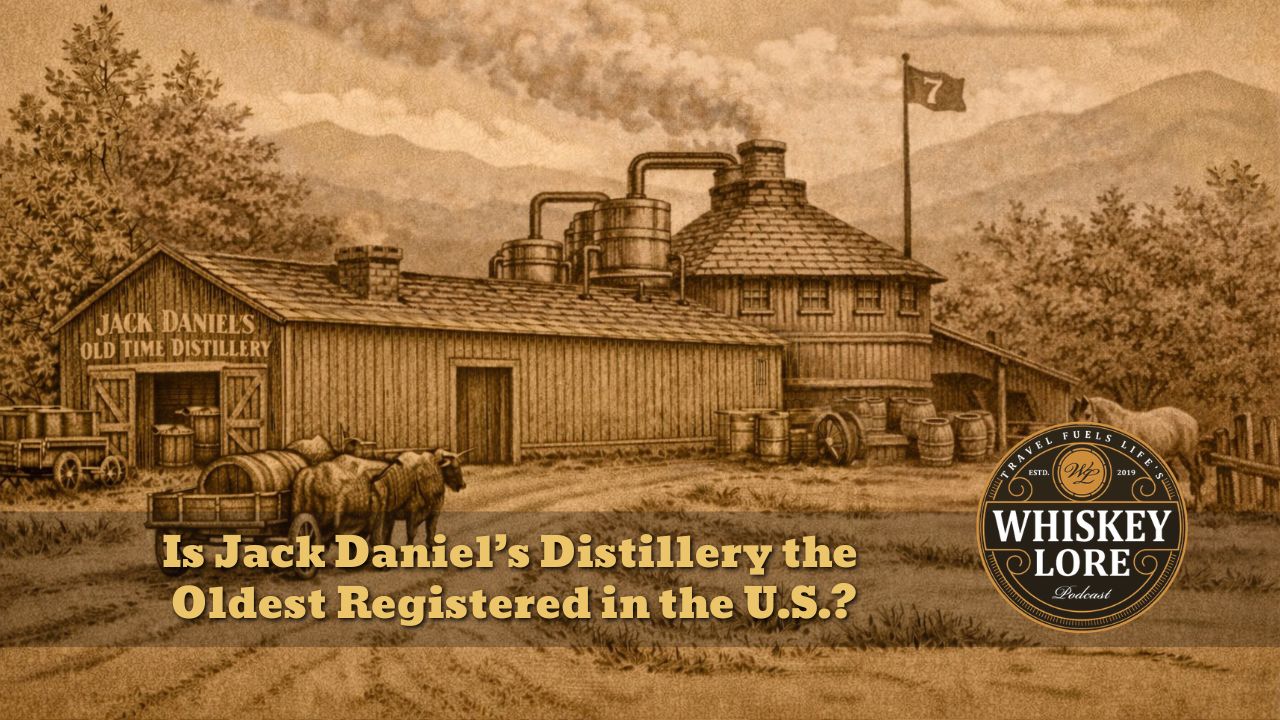
It leads with a drawing of the distillery, which was much smaller than today’s distillery, showing a picture of a pot still, not today’s modern column still. Then claiming that the Old Time Distillery is “the oldest in the United States.”
Then it goes on to say that “before the war” there were no registered stills and that the “best white people of the country made their own whiskey, and the labor was performed by slaves,” which it is interesting to note this admission, even in 1908.
It goes on to talk about the long troughs that were used for fermenting, the hand stirring which had been replaced by machines, and the use of log stills which were abandoned by Jack in 1888 due to the ease of use of copper stills. Then it states that in the 1860s, Jack Daniel established his registered distillery as The Old Time Distillery, making Old No. 7, the first whiskey to be aged 7 years, “this beginning the fact upon which its name is based.” Then it stated that except for Sundays, the distillery hadn’t lost a day since Nov. 2, 1885, making it the oldest continually operated distillery in the world. IN THE WORLD!
For this whiskey history researcher, that last line received an emphatic eyeroll. But that wasn’t the end of the fairy tales. In 1916, as the Jack Daniel’s operation moved to Missouri due to Tennessee Prohibition, the St. Louis Dispatch posted a big picture of Jack Daniel with a short article written within the ad stating “One of the first registered distilleries in the United States…established in what is now Moore County, Tennessee, by Jack Daniel in 1836. 1836? Where did they get that date? Jack was still 13 years away from being born. The only thing that could be connected to is, in December 1836, that is when Calloway, Jack’s father, left Franklin County, TN and purchased the family farm from John Eaton. And I sense this fable was told by Lem Motlow, who likely knew that as the year the Daniel’s arrived in Lincoln County. This bit of speculation is supported by some of Lem’s first Post-Prohibition ads where he claims Jack Daniel’s whiskey had been handed down through 7 generations of Daniels. It seems no piece of lore was too big for Lem Motlow. The St. Louis Dispatch concludes by stating “Jack Daniel Whiskey: Furnished from 1 Day Old to 21 Years Old.” So much for the Old Number 7 means 7 years claim.
As for the oldest registered distillery claim, well, The Old Time Distillery burned to the ground in 1930. The current distillery was built around 1938. That didn’t stop Lem from putting out an ad in the Chattanooga Daily Times in 1940, stating Jack Daniel’s Was the 1st Registered Distillery in the US. To confirm this claim the ad stated “look at the distillery register number on the next bottle of whiskey you buy. On Jack Daniel’s you will find the mark “Distillery No. 1. Est 1866.”
So how does a distillery location that was established in 1881 that had long carried the number 514, suddenly have a federally issued number 1?
Well, if you’ve heard my Season 5 Episode 9 episode about where America’s single use barrel rules comes from, you’ll remember me stating that prior to Prohibition, distilleries were issued Registered Distillery or RD numbers by the Internal Revenue Department. However, during and after Prohibition, a new agency was formed under the Treasury Department, known as the Federal Alcohol Administration or FAA. This agency introduced a new numbering system…one that wasn’t based on multiple districts within a state (such as Jack Daniel’s Old Time Distillery’s RD#514 in the 5th district), but instead a new state-by-state numbering system. The Distilled Spirits Plant number, or DSP was assigned on a graduated numbering system that included the state’s initials. So, if you pull up a bottle of Jack Daniel’s today, you’ll see DSP-TN-1. In other words, Jack Daniel’s modern distillery was the first registered in the state of Tennessee after Prohibition.
And in case you think, well maybe it was still the first after Prohibition, you would be wrong there too. Tennessee didn’t allow the manufacturing of whiskey until 1938, whereas Kentucky and Pennsylvania were actually distilling as early as 1929, when medicinal spirits began running low. Bernheim Distillery, now under the ownership of Heaven Hill, is DSP-KY-1 and a good bet to be the first to restart distilling as repeal approached—as the Louisville Courier seemed to be on top of the matter.
So you can twist and turn the fable in any direction you want to but the reality is, there is no way Jack Daniel’s was the first registered distillery in the United States.
But wait, what about the distillery’s listing on the National Register of Historic Places?
Why yes it is. And this is one of the strongest pieces of evidence that initially kept me from researching this history. After all, who, other than the government, the one that holds the records, would know better?
And then I found the 1972 document that was submitted to the register and my heart sank. Listen to this description in the official document:
"The Hollow" is the name given to the rugged ravine that runs several yards back into the hills until it meets a sheer limestone cliff. At the base of the cliff is a cave, and from it there gushes year round a stream of clear, sparkling water. This water flows at a year-round temperature of 56° and tests completely free of iron—thus the key to the product which is produced at the distillery.
Around this spring and in this hollow is located the oldest registered distillery in the United States. Here Jack Daniel began the production of his famous "sour mash" in 1866 and except for short interuptions—prohibition in Tennessee and the nation—the production of this sour mash whisky has continued under the supervision of descendants of the originator.”
This was not the oldest registered distillery, Jack didn’t start making his famous sour mash in 1866, and the distillery has not been run by descendants of Jack Daniel, who died a bachelor.
The rest of the writeup sounds like it came straight from the marketing department of Jack Daniels. And guess what, turns out, it did. Apparently the National Park Service doesn’t do its own research, instead it seeks proof and justification.
https://npgallery.nps.gov/NRHP/GetAsset/NRHP/72001248_text
The sources of evidence are listed in the document:
An article written in the July 1951 edition of Forbes Magazine called “Rare Jack Daniel’s” which was written from stories told at the distillery, a 1972 article in the Tennessee Historical Quarterly written by Jean Ridgway Bigger titled “Jack Daniel Distillery and Lynchburg: A Visit to Moore County, Tennessee” which I can only imagine was written after a lore filled tour of the distillery. And the last items used for their confirmation - “brochures from Jack Daniel Distillery.”
As my Scottish friends say: Bullocks Bullocks Bullocks.
Honestly, after all of this research and the layers of fables built upon fables, I completely understand why nothing about Jack Daniel’s story was making sense to me. The whole thing is a house of cards—and one that has somehow stayed intact for well over a century—thanks in part to Spoon Motlow’s efforts, but also the efforts of Lem Motlow and maybe even Jack Daniel, who clearly did nothing to stop these stories from growing past the point of absurdity. And since all of this lore originated with Jack and Lem, it’s easy to understand why today’s Jack Daniel’s accepted their word for it. The problem is, Lem and Jack lived in an era where telling a tall tale to sell some whiskey wasn’t that unusual. Today, we live in an information age, where there are more pathways to the truth. So it creates a situation where you have to choose a side—are you just telling old stories, or are you connecting people to your real past.
That’s what we got out of the previous episode about Jack and Nearest. By building a new framework built around a provable time line, we discovered the number of legendary distillers that worked on Dan Call’s farm—names like Tolley, Hughes, and Eaton…all of whom have ancestors, that would probably like to know they were much closer to that story than the less reliable story lets on.
In this episode, not only did we learn the real story of what has incorrectly referred to as the “oldest registered distillery,” we met the forgotten Motlow, John Thomas, who ran the biggest distillery in the area and the true distillery that owned the #1 in the 4th district. I’m sure some of their descendants might be proud to hear of such a thing. And we also have a stronger case for what Old Number 7 stands for.
But here is the inconvenient question for fans of the Lynchburg distillery—does the Cave Spring Hollow distillery truly deserve its place on the National Register of Historic Places since it isn’t the oldest registered distillery in the United States?
If you ask me, absolutely it does. Name an American distillery or American whiskey brand that is more recognizable than Jack Daniels. How many songs have been written about it? How many true stories have come from it. How many memories have been made there, not by the founders and workers, but by the millions who have been ushered around the distillery—going all the way back to Jack Daniel’s day - Yes, this is the rare distillery that was open to visitors even back before Prohibition. They’ve always made this legendary whiskey on the spot—and it’s hard to argue how big an impact the brand really had—including being the one whiskey that remained high in demand, even through the so called whiskey depression of the 1980s and 90s.
In my opinion, Jack Daniel’s and the Cave Spring Hollow have no need of lore to keep their status as America’s crown jewel of whiskey distilleries. And if Jack uses this new information and shifts their origin date from 1866 to 1877 when Jack first went solo or 1881, when he arrived at this legendary location, it only serves to prove Spoon Motlow’s 1908 boast that “Lincoln County whiskey is synonymous the world over for purity, excellence, and honesty.”
I’m Drew Hannush and this is Whiskey Lore
Whiskey Lore is a production of Travel Fuels Life LLC
Production, stories, and research by Drew Hannush
Want to dive deeper into the history of Lincoln County whiskey, tales of Davy Crockett’s distillery, and the shootout in Nashville that brought on Tennessee prohibition—grab a copy of my book The Lost History of Tennessee Whiskey, on Amazon or ask for it at your favorite bookseller. And make sure to check out my Jack & Nearest, Behind the Lore episode, exclusively available to members of the Whiskey Lore Speakeasy and Club 1897 at Patreon.com/whiskeylore. Coming up next week, we’ll head to Scotland to learn about one of the most unique stills on the island and in 2 weeks, stories will be back with the story of a tyrannical governor and his mission to control liquor sales at the point of a gun.
Until then, Thanks for growing your whisky knowledge along with me, I’m your host Drew Hannush and until next time, cheers and slainte mhath.
Find show notes, resources, and transcripts for this episode at WhiskeyLore.org/episodes