
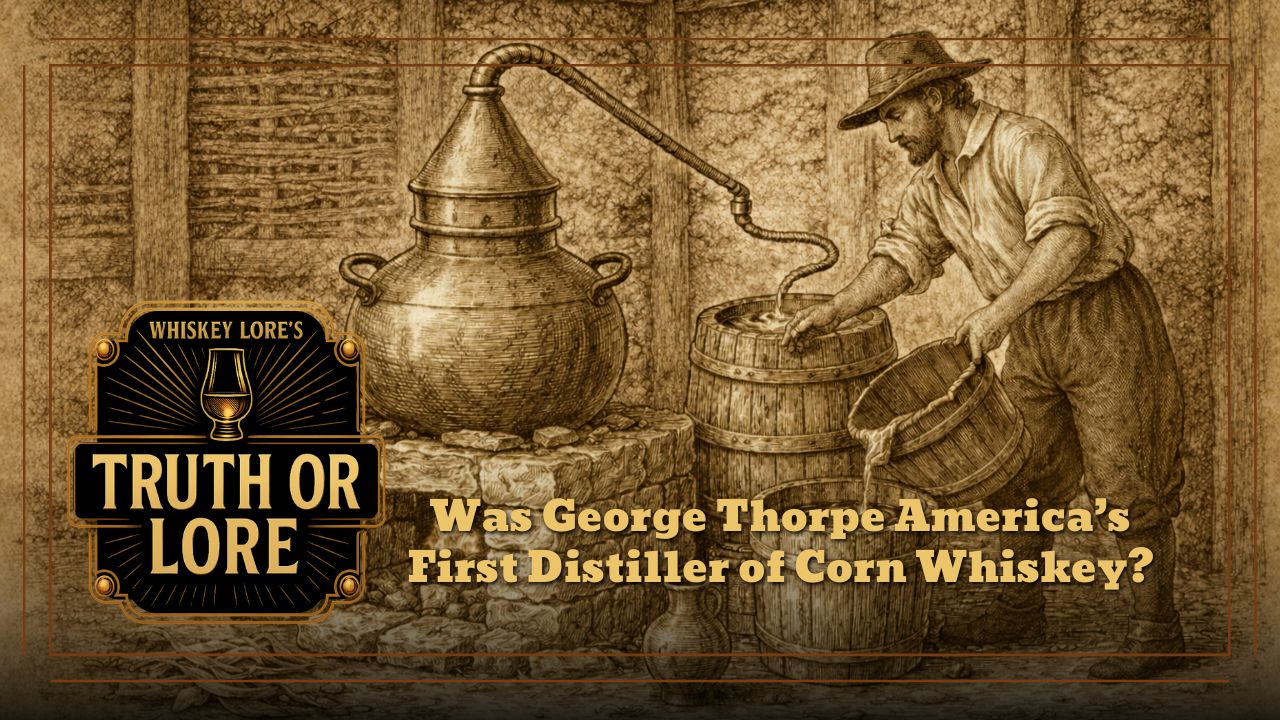
Was George Thorpe America's First Distiller of Corn Whiskey?
Listen to the Episode
Show Notes
The first time I picked up a whiskey history book, I was introduced to the story of George Thorpe, an Englishman who came to Berkeley Plantation in 1620, to make "hooch," as the book stated. He was credited with making America's first corn whiskey and starting an industry.
As I dove more and more into research on whiskey history and the evolution of distilling techniques, this American origin story seemed less and less likely. Still, I had to admit, I didn't know enough of the story to do any more than suggest, it was possibly lore.
After diving deep into the historical record, I'll take a look at three popular theories as to why George is considered America's first distiller of corn whiskey. By the end, I'll give you my thoughts, but you too will be well versed enough in the story to make your own educated guess.
Enjoy this dive into early American distilling and watch for bonus coverage in Behind the Lore at patreon.com/whiskeylore .
Transcript
THE INVENTORY
On a chilly April morning, along the banks of the James River, Captain Thomas Palmer and two gentleman he'd been recently paired with, Richard Biggs of Shirley Hundred, Samuell Sharpe of Flowerdew Hundred, made their way up-river through a thick gloomy fog on their way to the once thriving Berkeley Hudred, whose dwellings now were occupied by ghosts.
As the trusty shallop made its way toward the riverbank, Thomas could pick out those round timber posts, sharpened to a point at the top, meant to slow any breach. He knew those posts well, as they once served as his own protection. If only he could go back in time and warn his friends and the families who lived there. They had not an inkling of how useless those defensive walls would be.
As Samuell and Richard tethered the boat to the shore, Thomas recalled the days he'd go out hunting with friends, seeking white tailed deer, wild turkeys, but sometimes only scrounging up a few rabbits. On the days they'd be accompanied by a Powhatan warrior, they always seemed to have more success. The Indians knew these lands so well.
It seemed strange to him that the Powhatan should be considered anything other than friends. Berkeley's governor George Thorpe seemed to have a magic way with the Indians. He bent over backwards to assimulate them into the Berkeley culture. He'd even built a dwelling for the Powhatan's great chief Opechancanough. George was a pragmatic man. He was certain that if the English treated the natives kindly and indoctrinated them in English customs and language, it would bring peace to the area.
He remembered the few times he'd talked with George. A long time investor in the Virginia Company, the man from Gloucestershire, had inside access to the monarchy as a Gentleman Pensioner at the royal court. Thomas wasn't sure if he'd ever met with Queen Elizabeth, it didn't seem his place to ask. He was also a former member of the House of Commons from Plymouth, so he was kept abreast of how the Powhatan tried to starve the settlers out, soon after they set up their first few dwellings.
What eventually turned into a war with the Powhatan eased off after John Rolfe took the Indian maiden Pocahontas as his bride. George told him, his fascination with the Indians started thanks to that trip. A native boy, who had joined them on the journey came to live with George, his wife Margaret, and their three children. He said he was amazed at the boy's capacity to learn and he even let him draft letters for him. Eventually he even had the boy baptized in the hallowed halls of the Church of St. Martin-in-the-Fields in London. George beamed when he told that story. He was so proud.
George had arrived at Berkeley a year and a half before Thomas brought his wife Joane and daughter Pricilla over on the Tyger. He talked of a simmering tension in the air when he arrived and Thomas felt it too. Perhaps it was the sheer volume of Englishman who'd come to the shores of the James. Migration had been slow, until an imported form of tobacco, brought up from the Caribbean gave the Virginia Company its first profitable crop. Unfortunately, the greedy plant seemed to suck the life out of any field it grew in, so expanding down the river in search of more fertile lands became a necessary evil. Thomas thought it, but he wouldn't say it---Powhatan, who never seemed to settle in one place, didn't seem to appreciate our constant need for more land and our building of homes and palisades.
Thomas' train of thought broke as the men walked inside the naked fortress. Some of the buildings remarkably still stood. He could still imagine Pricilla playing with the other children by the hog pens. But the ground, once littered with cows, farmers, and stalks of corn was now a collection of tall grass and weeds. It had been two years since they'd seen a hoe.
They walked through the doorway of the largest building, the site of the old meeting hall, where they broke bread and prayed with the members of the community. It also held the room that was most central to their mission, the living quarters of George Thorpe. A shiver went down Thomas' spine as he looked to the open doorway.
There, within its confines was a perfectly preserved time capsule from two years earlier. It was a sizeable room, with space for 3-4 residents. When Thomas arrived at the Hundred, Rev. Robert Pawlett was sharing the space with George. He'd heard a co-governor, William Tracy had been appointed to that room also, but he died before Thomas arrived.
The task at hand was to inventory the room's contents. George Thorpe's estate was in question. They would need to determine which of these items belonged to George and which belonged to the Society and Virginia Company.
Just then, Richard pointed to four rumlets sitting in the corner and the men broke out in a laugh. Not a surprise that George had left some libations for the workers. This inventory might not be so bad a task after all.
Richard loosened the cork, tilted the barrel toward a pewter cup he'd found and made his best attempt to get the liquid into the vessel. Then he picked up the cup, made a fearful face, and then took a sip. "Ahh, not bad Virginia, if I do say myself. To good old George, huzzah!" Once each man had his share poured out, they went to work combing through each item, writing it down for the court.
As Thomas started working his way through George's notes, he saw a scrap of paper that was signed by Captain John Woodlief. The Captain was the first governor of Berkeley. Thomas never met him, but he was told the man was a most enterprising salesman. He'd used his sales craft, earned as a Birmingham merchant, to make trade deals with the Powhatan and other local tribes. But while he had a golden tongue, he was not an administrator. He'd arrived on the ship Margaret in 1619, with some three dozen tenant farmers, livestock, provisions, tools, and weapons, with the daunting task of setting up the palisades and constructing the meeting hall and a storehouse, while preparing to plant crops in the spring. He determined 400 acres of Berkeley's 8,000 were enough to defend and the palisade walls went up quickly. But the rest of the development slowed to a crawl.
In the spring, George arrived from England, with a mission to set up a school on a 10,000 acre plantation called Henricus, so 10 miles further up-river. It was the project he'd lobbied for. It was to be a college for the native children, where they could gain literacy, learn English customs, and be taught the Gospels. He landed at Berkeley on the London Merchant along with 50 indentured servants and a number of gentlemen. He'd also brought new instructions for Berkeley, namely they were to produce such salable staple commodities as corn, wine, oil, flax, pitch and tar, soap ashes, iron, and clapboard, and ease off of their dependence on Tobacco farming. This was to be a self-sufficient plantation.
George had hoped to get right to work on Henricus and the college, but Governor George Yeardley needed help in Jamestown and appointed him to the colony's Council of State, the governor's advisory panel. George had studied law in England and had a sharp legal mind. Yeardley leaned on him in matters of governance and colonial policy. He also enlisted George's experience as a justice of the peace in handling the Virginia Company's judicial functions, since there was no court yet established in the area. These tasks alone would have kept him busy, but he was also tasked with setting up an Ironworks and planting grape vines at Henricus. It seems George's organizational skills were a rare commodity in Virginia, and he took to each of the tasks with such vigor and efficiency, he earned praise at every corner - which only brought him more work.
By August, he was being tapped to assist in the development of Berkeley Hundred. Captain Woodlief wasn't working fast enough and winter was on the way. George was given a co-commission to govern Berkeley along with new arrival William Tracy, and the captain's authority was dissolved.
Thomas hadn't seen any of these miracles brought about by George. But he soon heard about it from the other farmers at Berkeley. He'd overcome the loss of a few farmers to what he called "a disease of the mind." And worked hard to combat the pests that were chewing into their corn crops. By the time of harvest, to everyone's surprise, the crops yielded a surplus worthy of trade.
Thomas thought back to his family's arrival and the November chill in the air. The ride from England had not been what they planned. Sailing on a ship filled with maidens meant to lift the morale of the Englishmen of Virginia, it turned from comedy to near tragedy as the ship was captured by the Turks and freed of its valuables an a good portion of its food. A rough sewn hamlet versus the luxuries of old England, Jamestown looked like a paradise on the day they landed. When they finally made their way to Berkeley Hundred, it was meant as a temporary home, but George made the newcomers feel welcome and his first gesture was to offer Thomas a sip of a strange but somehow welcomed drink made of Indian corn. It wasn't quite English beer, but it would do. But Thomas didn't realize, this was a treat. Beer was in short supply and the locals drank, of all things, water. It was quite the novelty.
As Thomas tilted the barrel and poured a little more Virginia into his cup, he thought about how a man who sometimes came across a bit pious, could be such a firm lover of a good drink. George seemed to miss a good drink, nearly as much as his family back in England. While walking him around on his first day at Berkeley, George told him ships would always be stocked with plenty of libations. Back in January of that year, the ship Supply arrived with sixty gallons of aqua vitae, eighteen tuns of beer, and sixty gallons of sack-a Spanish fortified white wine, and---George beamed---a hogshead of new cider specifically for him. He said it was likely a motivator for his current task of producing artificial wine. The investors knew his soft spot. That spring he began planting vines at Henricus while completing an Ironworks at Falling Creek. He was also putting the indentured servants to work on building the college for the native children.
But he remembered how George talked of native relations. The English always treated the tribes like inferiors. Yet, George saw something else in them. Remembering Georgius, the Indian boy who he'd adopted, he thought of how quick and intelligent the boy had become in such a short period of time. He had been desperate to see a change in his countrymen's attitude and even wrote to the Virginia Company's officials asking if he could send apparel and housewares to the Indians as a peace offering. The response was for George to do all he could to convert the Indians to Christianity. George asked if he could reach out to the Indian's principal leader Opechancanough and by October, Governor Wyatt gave him his blessing. He'd just returned from that meeting when the Tyger arrived with Thomas and his family. The word was, Opechancanough seemed genuinely curious about Christianity, saying the Christian God was much more interesting than his own.
Thomas remembers Thorpe's own manservant talking to George about how this was all a ruse and not to trust the chief. But none of us really could believe there was any ill intent on the part of the Indians.
Thomas broke the silent task of counting and recounted those handful of months he and his family spent at Berkeley. He loosened the cork on the second runlett. This one was filled with Rosasolus, a sweetened herbal liqueur, made with aqua vitae and flavored with rosemary and herbs. It poured out in a light yellow stream. Usually it was meant for medicinal cases, but today it would serve as a way to slacken jaws and make the count more entertaining.
Thomas then began to recall that dreadful day, 25 months ago.
"It was an unseasonably warm March morning. A good number of us tenants were taking advantage of the good weather and had begun tilling the fields with hoes and digging sticks. The hope was to have corn in the ground before Easter. Everyone was busy with their own personal tasks, with the women-folk milking the cows, collecting eggs, cooking up corn cakes and mending clothes. The children were off fetching firewood and carrying buckets of water for the camp, and those farmers not working the fields were working in the storehouse or repairing fences. I don't know why I thought it, but I noticed George wasn't out eating breakfast with some of the tribal members. It seemed strange. The Powhatan were there to help with some necessary repairs around the Hundred, no one was sure how long they'd stay.
I decided I should take my family to a nearby plantation so the men could focus on the job at hand. Two other families decided to join us. We took our guns, just in case we saw any deer or rabbits along the way. If the warriors lingered any longer, they'd need the surplus supplies of meat. As we made their way into the woods, I thought I heard the screeching of a hawk in the distance. But it had an odd repetitious tone. I put up my hands to shush the other travelers. That's when I realized, it wasn't a bird, it was a human shriek. Looking back toward Berkeley, I spotted an unusual amount of smoke rising. I told his wife and daughter to continue on and alert the neighboring plantation that something was terribly wrong at Berkeley. I pointed to two younger men and tapped my gun. We all doubled back in the direction of the plantation. As we got closer, I felt a horrid chill run down my spine when I heard the whooping war cries piercing the air. Yet as we got closer to the smoke the sounds of shrieks faded. That's when a group of panicked farmers, their wives and children came rushing at us with terror in their eyes. I asked what happened." "The Indians, they just rose up all at once, the menfolk had no time to grab their weapons. Lord have mercy!"
When we reached the camp, the only motion came from the smoke billowing out of two of the dwellings. Many escaped, but there by the door of the meeting hall lay nine lifeless bodies, bloodied and beaten beyond recognition. And sadly, nothing could have save them. They had no reason to anticipate such an action, proven by the fact not a single weapon was found in the vicinity.
They thought they were all leaving in peace. After all, George had gone out of his way to have a dwelling built especially for Opechancanough. The constantly broke bread together. The Powhatan had free reign to wander the grounds.
But it ends up, that was his undoing. Opechancanough was more cunning than anyone had imagined. He'd used his time at Berkeley to learn the habits of the settlers, learned what drive them, discovered their weaknesses, and then brought together a great confederacy of tribes from around the area to strike on that very day, not just Berkeley, but every plantation up and down the James."
Thomas shook his head. "It really was a marvel, what Opechancanough accomplished that day. Some 347 souls perished up and down the James because of his actions. Only Jamestown survived, thanks to a friendly native that gave them a warning just before the attack. The families that survived all dispursed to other communities that could handle them. Joane, Pricilla and I decided to make way for Jordans Journey, where we live today."
Richard asked "what happened to George?"
Thomas, drawing deep on his cup of comfort, had a look of surprise on his face. He thought everyone was aware of this particular detail. Especially someone who was cataloging many of his prized possessions.
"Well, I hadn't a clue. He wasn't outside. So I made my way into this great meeting hall, fearing that I'd find more dead bodies. " Thomas picked up a nightcap that was sitting on a pile of clothes next to him. "As I walked through the hall, I saw what looked like a human form crumpled on the floor. It was just out there." He pointed to the doorway. As I got closer, the man's features never appeared to me. He was so badly beaten, with his head caved in, that I couldn't have identified him if I tried - if not for the nightcap laying next to his body. There was one man at Berkeley who always slept with a nightcap - George Thorpe."
Firsts
When it comes to the origins of American whiskey, one of the most touted legends is that of Captain George Thorpe of Berkeley Plantation.
Born in Elizabethan England, George grew up in an age of discovery and exploration. As a member of the House of Commons and the royal court, he saw the queen encourage a cultural revolution led by the literary and theatrical works of Shakespeare, the development of the Scientific method championed by Francis Bacon, the defeat of the Spanish Armada, economic stability during the Golden Age, the circumnavigation of the globe by Sir Francis Drake, and a period of great exploration and colonial expansion.
Is it any surprise that someone surrounded by such inventiveness, scientific curiosity, and desire for discovery would be noted as the first distiller of corn whiskey.
It seems almost too perfect, doesn't it?
But, you may be asking yourself "where was the corn liquor in the story you told?"
If you're assuming it was that drink of Indian corn, you're not alone.
For three quarters of a century, at least, George Thorpe has been touted as the original maker of corn whiskey thanks in no small part to the mention of that corn-based liquid in a letter he wrote on September 19, 1620 to one of Berkeley's investors, John Smyth of Nibley.
He wrote "and wee haue found a waie to make soe good drinke of Indian corne as I [pro]test I haue diuers times refused to drinke good stronge Englishe beare and chosen to drinke that."
Not quite an admission of making liquor. He's comparing it favorably as a substitute for strong English beare. The assumption is, this was a fermented corn beverage that had beer like characteristics. That's still not some forerunner to whiskey.
But there is another piece of evidence that makes the creation of a high proof corn spirit more plausible. Within the Thorpe inventory records is listed one copper still-old.
Yet, in the absence of direct evidence, this hasn't stopped whiskey writers from making a convenient connection between two stand alone pieces of evidence.
I first came across the story of George Thorpe in Dane Huckelbridge's book "Bourbon: A history of the American Spirit." He tells the tale of two George, George Thorpe and George Washington and sets up America's early thirst for alcohol. His narrative suggests Thorpe was known for his ability to make "hooch" (a term that wouldn't find its way into our vernacular until the great Alaskan gold rush) and that was one of the catalysts that made him the perfect choice for the settlements on the James River. He goes on to say Thorpe captained "the even more crucial task of establishing a liquor industry in America." Back when I read this in 2019, I fell for it hook-line-and-sinker. I even mentioned George Thorpe in the first history I wrote about Bourbon in my 2020 first edition of Experiencing Kentucky Bourbon.
With my present skepticism, I went back to the book to check the footnote for this claim. Turns out, it points to an 1877 write-up in The Magazine of American History titled "Massacre at Falling Creek, Virginia." In it, the writer paraphrases Thorpe's words saying "that they have found a way to make a good drink from Indian corn, which he prefers to good English beer." No mention of making liquor and no mention of the still.
But Huckelbridge wasn’t the first writer to leap to the conclusion that a good drink of Indian corn had to be whiskey distilled by Thorpe.
In the February 12, 1950 edition of the Richmond Times-Dispatch, writer Charles McDowell, Jr. recalls "a gentle scholar named George Thorpe, who came to Jamestown in 1620 to try to teach the Indians...reading, writing, and arithmetic." Charles goes on to suggest that while working on Henricus college in 1621, George was fiddling with the colony's first still. What he distilled became an instant favorite with the Indians, especially Opechancanough, who sipped his drink, while playing with the key and lock on the door of the house George built for him. But then on Good Friday, 1622, the chief gave the word to "his fanatical---and doubtless drunk---warriors who rose up along 140 miles of the James River, killing every white person they could find."
McDowell's article is a perfect example of a period piece, written in the era of post-war America, where movies with cowboys and Indians, good guys and bad guys filled the screen. It completely misses the incredible spy craft and strategy Opechancanough employed in making a statement about the English usperpatition of their lands-and there is no evidence these warriors were intoxicated. They were too well coordinated, as survivors recalled. They acted so fast, the settlers had no time to grab any kind of weapon.
When I decided to dig deeper into the story of George Thorpe, I came across two other narratives that I needed to add into my scope of analysis.
The first was a 2023 Whisky Magazine article written by whiskey writer and co-founder of Starward Whiskey Chris Middleton. I've been a cautious fan of Chris' work. He comes up with some of the most fascinating bits of information surrounding the development of the whiskey and speaks with authority, but I always find myself wishing for more documentation in his articles, wondering if the information is based on oral tradition or hard evidence. In this one, titled "Mythbusters: The case against George Thorpe," he goes off in an unexpected direction. Rather than challenging the corn drink meets still theory, he uses words like "likely" and "records indicate," to speculate that someone in Jamestown was distilling corn liquor before George. He specifically mentions a physician named Laurence Bohun, who arrived in Jamestown in 1610. Modern writings suggest Bohun may have brewed wine and Chris connects Bohun's studies of local plants and distilling of cordialls in the paragraph without outright suggesting these two items turned into corn distillation. The problem is, Bohun was only in Jamestown for a year and right at the end of the starving time, so corn was a precious commodity.
If the apothocary still fragments found during archeological digs in Jamestown are any indication, distilling corn was purely for scientic purposes. There were already barrels of aqua vitae that were being shipped in from the old country for the making of cordials. And it wasn't until the arrival of George Thorpe ten years later that I've seen the first mentions of corn surpluses and those were devoted to trade.
What's interesting is that Middleton also discounts that Thorpe made drink of Indian corn. I'd be inclined to agree with him, since Thorpe used the pronoun "we" when suggesting its creator. If corn liquor was made, without direct attribution, the chances George was the person manning the still is minimized.
There was still one more piece of potential evidence as to Thorpe's production of corn liquor that made me do a double take. In chef and author Patrick Evans-Hylton's book "Virginia Distilled: Four Hundred Years of Drinking in the Old Dominion," he points to the corn beer as a predecessor of Bourbon and points to the three small barrels of liquor that were opened and drunk.
If you recall, those barrels were referred to as Virginia, not aqua vitae, beer, cider, or wine.
I had some more digging to do. And as I drove down rabbit hole after rabbit hole, trying my best to rid myself of any desired outcome so as not to tie myself to a narrative, I found myself closer to a possible answer than I believed I could get.
VIRGINIA AND ROSASOLUS
But before we start combing through my logic, theories, and evidence, let's take a step back to the story I told at the beginning of this episode. In the interest of full disclosure, that was a story embellished for entertainment purposes. In other words, I Hollywood-ized the arrival, departure, and grizzly discovery of Captain Thomas Palmer. His family did arrive on the Tyger and it is thought he and his family lived at Berkeley Hundred initially, but he wasn't there long. It just felt like he was the perfect connecting point, since he was the one man who lived at Berkeley and also took part in the inventory. Items like the described butchery of the settlers, details about George's life, and George's affinity for his nightcap were all parts of the historical record.
Let's start with those barrels and their contents. There were four, not three as Evans-Hylton suggested. They are listed officially in the inventory at "Item a small runlettof of Rosasolus and 3 runs. of Virginia, which were drunke out amonge the people that fetcht downe his goods."
It is interesting to note that these were "drunke out" which suggests none of the liquid remained when the inventory was complete. That must have been a fun inventory. We're not sure if the party included just the three men or if there were others there whose names didn't need to be affixed to the official document.
This also implies that they found the contents drinkable. The Rosasolas would have survived the 2 years it spent in the cask, due to its higher alcohol content. The Virginia was the bigger mystery. If it truly was corn liquor, then it would have easily survived two years in the heat and cold of Virginia. Our modern sensibilities also deduce that since Monongahela rye and Bourbon whiskey pulled their names from geographical areas, it makes sense that Virginia might denote a corn spirit.
First, let's let the elephant out of the room. No one at Berkeley Plantation in 1620 drank something they called whiskey. Whiskey as a term was still a century away. Instead, writings of the era refer to the Latin name for high proof grain and fruit spirits "aqua vitae." Even the term Uisece Baugh isn't found in writings, most likely because the letters we have are mostly official communications and uisce baugh was a more provincial word.
What I discovered is that generally high proof spirits were either called aqua vitae or strong waters. In the early 17th century, geographical indicators were more often used to describe wine. In fact, while brandy could stand alone as a name like aqua vitae, if it were associated with a region, the word brandy still accompanied the region. And I see little evidence of aqua vitae being appended with a geographical indicator. But with wine, you could say Canary (and people just knew it was wine from the Canary Islands), Bordeaux (from France), Rhenish (from the Rhine land), or Sack (Spanish fortified wine, which some suggest was wine from a solera). These location names without the word wine appended show up in Shakespeare, merchant records, and English household inventories.
If those barrels of Virginia were of good quality and drunk out, it is much more plausible they were wine that might survive for 2 years depending on conditions, rather than beer or cider that would spoil. We also assume that George intended to age these liquids, since they sat in barrels, remember, he had no idea he was about to be murdered, so it is possible these barrels were meant for immediate consumption.
Another reason I believe these casks held wine instead of corn spirit is due to George's instructions from the Virginia Company to grow vines at Henrius and develop artificial wines. George is written about as a man who is quite efficient and who stays on task. What need did he have to distill a corn drink?
And this is another item that is never considered. Using 17th century techniques, how much corn and effort would it take to make enough corn spirit to fill three runletts, which held approximately 18 gallons each. That's 54 gallons, one gallon more than the modern Bourbon barrel.
Let's start with the biggest unknown, the copper still. There is nothing in the inventory that states how large this still was. It wasn't shipped over with George's things, so there is no telling how old this still is or what size it was. Our imagination goes to George Washington's five 100+ gallon stills- but that was nearly 180 years into the future. What if Thorpe's still was just a simple glass and copper apothecary still like the one found in the Jamestown archaeological dig? As a 1 to 5 gallon still, it would be fine for creating herbal medicines, cordials, herbal waters, and conducting experiments, but not for any meaningful amount of alcohol. That would be like filling a bathtub with water using a teaspoon. It could have been a gentleman or estate still. These ranged from 5 to 20 gallon capacities. These were fine for domestic distilling, but George would need someone dedicated to the task. He was far too busy with judicial work in Jamestown, a college to build, and Berkeley to manage.
But let's assume he had an assistant. The first need is to malt the corn, as the settlers never could get barley to grow successfully in the Tidewater climate. This would require a kiln or malting floor and a heat source. The grain would also be prone to drawing in pests. It's true George was building an ironworks at Henricus, so he might have had access to a kiln, but so far, no evidence of one has revealed itself during archeological digs, and even if there was one, an Ironworks kiln isn't necessarily suited to malting grains.
Milling grain by hand, as no millstone or mill is mentioned at Berkeley Hundred. It would have to be pounded by hand using a mortar and pestle (possibly a tool in the inventory that is unnamed).
We assume the corn drink was fermented. The process of its creation is never revealed. We only assume it is fermented because George mentions it alongside English beer. But lets say they did ferment it, barrels or stirring paddles are not mentioned in the inventory. In addition, there is an absense of a worm coil, worm tubs, funnels, receivers, malt shovels, and other equipment that would aid in the production of corn spirits, yet, they thought well enough to document hammers and knives.
Cooking would require buckets for hauling hot water to be dumped into the barrel with the grain. Corn requires the most aggressive heat.
As for access to the corn, it was a primary crop at Berkeley. But lets think about how much corn is necessary to fill those three runletts with corn spirit.
To run a 5-gallon still, you'd need roughly 3 to 4 gallons of wash per batch. Colonial grain mashes were inefficient, but a workable estimate is about 1½ to 2 pounds of corn per gallon of wash, meaning around 5 to 8 pounds of corn might be required to run a small batch. Grain fermentation in early conditions might produce around 4–6% alcohol, creating roughly .12 to .24 gallons of pure alcohol in the wash. A single pass through the still might yield about 1 to 2 pints of rough corn spirit, averaging around 25–35% ABV.
This is not even taking into account the taking of heads, hearts, and tails cuts, the temperature instability due to flame fired stills, and whether the spirit was made on-grain or off-grain.
Now instead of just settling for a pint, let's think about what it would take to produce a single gallon of early corn spirit, a small colonial still might require roughly half to one bushel of corn (about 28–56 pounds) depending on efficiency, and multiple runs of the still to accumulate enough low wines. Even producing a single gallon would demand repeated firing, fermentation time, and labor. Is a single gallon of 30% ABV single distilled corn whiskey worth the effort? And at best, the liquid would be rough. Now multiply that by 54.
If it takes roughly 30 to 50 bushels of corn, and repeated runs of a small still to create a rough spirit averaging perhaps around thirty percent alcohol, how long would it take to fill three casks with corn spirit with a total capacity of 54 gallons? No one would see George for weeks, if not months. And this doesn’t even cover the roughly two to six acres of corn that may have been required to produce that amount under early seventeenth-century conditions.
Another reason I discount that a drink called "Virginia" was quality corn liquor is because of the wording in the inventory. It would take a sizeable group to have “Drunk out” three casks of corn liquor during an inventory. aqua vitae like you drink lower alcohol and thirst quenching items like wine, beer, or cider. And if it was a quality spirit, it would have had value to George's estate, which means they wouldn't have consumed it, but instead would have brought it back with the other items. George had debts and casks filled with a desirable aging product would have been survived the inventory.
There are just too many good reasons to discount the idea that the runletts contained corn spirits.
The amount of corn required, time to distill, and the numerous pieces of missing distilling equipment to produce 54 gallons of corn whiskey in a 17th century environment make Virginia more likely to be wine.
If any corn was distilled at all, it was likely for experimentation, not as a regular beverage alcohol. But even if it was for experimentation, George never reported any findings in his letters.
Is it possible George distilled corn liquor? There’s corn, a still, and barrels, which seems to be enough for some writers, but until some actual proof comes along that overcomes the overwhelming evidence against it, in my mind the first distiller of corn whiskey is still a mystery.
I’m Drew Hannush and this is Whiskey Lore
Whiskey Lore is a production of Travel Fuels Life LLC
Production, stories, and research by Drew Hannush
If you enjoyed this deep dive into the myths surrounding George Thorpe, join me later this week for an episode of Behind the Lore, where as a member of the Whiskey Lore Speakeasy or Club 1897, you’ll get to hear my theories on who should get credit for America’s easy distilling scene and I’ll tak about my processfor researching the episodes and some of the findings I left out of it. later this week as a member of the Whiskey Lore Speakeasy. There are a ton of surprises and reveals that rewrite the history of the brand as we know it. Just head to Patreon.com/whiskeylore and if you’re not yet a member, sign up for a 7 day free trial.
In the meantime, Thanks for growing your whisky knowledge along with me, I’m your host Drew Hannush and until next time, cheers and slainte mhath.
Resources
- Edward D. Neill, “Massacre at Falling Creek, Virginia, March 22, 1621–22,” Magazine of American History 1, no. 4 (April 1877): 223–25, PDF. https://static1.squarespace.com/static/590be125ff7c502a07752a5b/t/68a4b8ca8860684debdd5244/1755625674241/Neill%2C+Edward+Duffield%2C+Massacre+at+Falling+Creek%2C+Virginia%2C+March+22%2C+1621-22+%281877%29.pdf.
- Chris Middleton, “Mythbusters: The Case Against George Thorpe,” Whisky Magazine, October 24, 2023. https://whiskymag.com/articles/mythbusters-the-case-against-george-thorpe/.
- Jack Sullivan, “George Thorpe: Whiskey and Death in Virginia,” Those Pre-Pro Whiskey Men! (blog), October 28, 2021. https://pre-prowhiskeymen.blogspot.com/2021/10/george-thorpe-whiskey-and-death-in.html.
- “Alembic Fragments,” Historic Jamestowne, accessed February 16, 2026. https://historicjamestowne.org/collections/artifacts/alembic-fragments/.
- Martha W. McCartney, “George Thorpe’s Inventory of 1624: Virginia’s Earliest Known Appraisal,” photo essay by Beverly Straube, Ceramics in America (2016), Chipstone Foundation. https://chipstone.org/article.php/736/Ceramics-in-America-2016/George-Thorpe%27s-Inventory-of-1624:-Virginia%27s-Earliest-Known-Appraisal,-with-photo-essay-Ceramics-in-Early-Virginia.
- Council of Virginia, “Inventory of George Thorpe’s Estate (1634),” Encyclopedia Virginia, last updated December 7, 2020, accessed February 16, 2026. https://encyclopediavirginia.org/primary-documents/inventory-of-george-thorpes-estate-1634/.
- George Thorpe, “Letter from George Thorpe to John Smyth (December 19, 1620),” Encyclopedia Virginia, last updated December 7, 2020, accessed February 16, 2026. https://encyclopediavirginia.org/primary-documents/letter-from-george-thorpe-to-john-smyth-december-19-1620/.
- Charles E. Hatch Jr., The First Seventeen Years: Virginia 1607–1624 (Charlottesville: University Press of Virginia, 1957), Project Gutenberg eBook no. 30780, released December 28, 2009. https://www.gutenberg.org/files/30780/30780-h/30780-h.htm.
- Charles McDowell, “A Man of Distinction…George Thorpe of Henricus,” Richmond Times-Dispatch, February 12, 1950, 105.
- Dane Huckelbridge, Bourbon: A History of the American Spirit (New York: William Morrow, 2014): 22.