
Are We Heading Toward a 1980s-Style Whiskey Depression?
Listen to the Episode
Show Notes
Open a whiskey magazine, newspaper, or check out your social media feed and you're sure to hear plenty of doom and gloom around the current whiskey market. There seem to be demons hiding in the bushes everywhere. Scapegoats include over-supply, over-confidence, speculation, poor management, inflation, capital constraints, tariffs, changing tastes like shifts to RTDs, hemp drinks, a rise in tequila popularity, or the younger generations seeming disinterested in drinking alcohol. And these are just the most popular.
I've heard it over and over, we're heading for another whiskey depression (comparing this time to the 80s and 90s when whiskey fell out of favor). For some, it is just a matter of time, after all, history repeats, doesn't it?
Join me as we take a look back on the trials and tribulations of the 20th century post-Prohibition whiskey industry, to see if there are any clues as to where our current industry is heading.
WHISKEY STORIES ARE BACK!
Cheers and slainte mhath,Drew
Transcript
It was a moment that took a storied whiskey town by surprise. Melva Meacham, a long time employee of the Hiram Walker Distillery, in Peoria, Illinois said "When the announcement was first made I was shocked and later I was angry - angry that a company could cast someone aside like a worn-out piece of machinery." She was testifying before a Illinois legislature subcommittee, who was considering legislation that would require a one-year notice by employers who want to shut down their plants, as a way to cushion the blow for workers.
In the case of Hiram Walker & Sons, the issue wasn't only the amount of notice for its 850 full-time workers, it was also the shock of an industry that was synonymous with the town for over a century, was pulling up roots. Mary Freeman, who worked on the bottling line for 11 years said "The day we got the news, there were men crying at their desks."
At the time, they were making Hiram Walker vodka, gin, and Walker Delux Bourbon as their lead products. The closure was blamed on rising costs, an $8 million price tag to meet current state and federal coal burning standards, the high cost of unemployment insurance/workmans comp in the state, and the need for about $60 in upgrades.
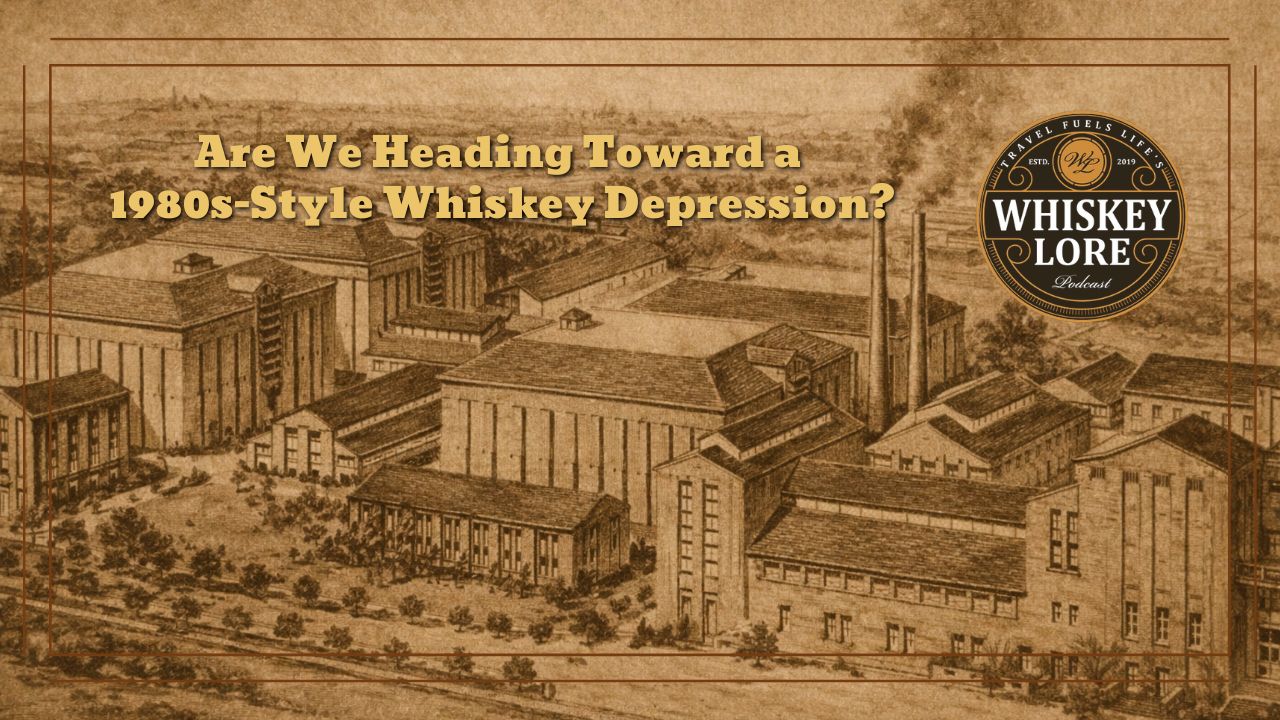
It was a much different scene on July 4, 1934, when the distillery opened to fireworks, music concerts, and a public inspection. Over 40,000 people attended. Built in the town that once held the title of Whiskey Capital of the World, thanks to the mammoth Whiskey Trust's presence there, it seemed a no-brainer for Canadian distilling giant Hiram Walker & Sons to pick the town as the spot to build what they deemed "the world's largest distillery." A full size distillery complete with column stills and a three chamber still, plus a $1 million rectifying and bottling plant was added on. The distillery had a capacity of 100,000 gallons a day.
But a distillery that opened in an era of hope and promise at the close Prohibition was now a canary in a coalmine. A harbenger of things to come for America's "Big Four" distilling corporations.
THE SETUP
Open a whiskey magazine, newspaper, or check out your social media feed and you're sure to hear plenty of doom and gloom around the current whiskey market. There seem to be demons hiding in the bushes everywhere. Scapegoats include over-supply, over-confidence, speculation, poor management, inflation, capital constraints, tariffs, changing tastes like shifts to RTDs, hemp drinks, a rise in tequila popularity, or the younger generations seeming disinterest in drinking alcohol. And these are just the most popular.
I've heard it over and over, we're heading for another whiskey depression (comparing this time to the 80s and 90s when whiskey fell out of favor). For some, it is just a matter of time, after all, history repeats, doesn't it?
Well, for all the industry and armchair prognosticators out there, one of the problems with history is that you won't really understand what is happening truly, until you can see it through a clear lens...and I'm sorry TikTok generation, clarity requires time.
One of my greatest frustrations is when I see someone with the title of "historian" on TV talking about current events like they are quoting from the history that will be written about today. Any historian worth their salt knows, we can't really judge events until we know all the facts and outcomes. Beware of those that try to convince you of outcomes even 5-10 years down the road. These are historians acting as pundants. And it should be noted that pundants don't tell history, they give opinions. And any historian too eagar to give their opinion, without first labeling it as that, should be looked at with a skeptical eye.
It's hard enough to remove bias from the events of the 19th and 20th centuries, let alone the past dozen years - especially from those who have a dog in the fight. The best a current historians can offer us is background, perspective, speculation - and maybe with that wisdom at our finger tips, we can find a way to avoid the same pitfalls that led to previous trouble.
So with that in mind, let me take you back to the post-Prohibition era, where we'll look at the players, events, and obstacles that led to America's late 20th century whiskey depression. Then I'll lend some of my own perspective as to why I think today is not the same as when the great Hiram Walker Distillery shuttered its doors.
THE ERA BIG FOUR
For over half a century, if you were drinking American whiskey, you likely were consuming the product of one of four major corporations, Schenley Industries, National Distillers, Seagrams, or Hiram Walker & Sons. Oh yes, there were smaller players, like Jim Beam, Heaven Hill, Tom Moore, Wild Turkey, Michters, Jack Daniels and Brown-Forman, but for the most part the Big Four ruled the roost.
The quickest post Prohibition success came from National Distillers, a reminant of old Whiskey Trust, after it reformed itself into several branches, including the Kentucky Distillers and Warehouse Company in 1899. During Prohibition, its president, Seton Porter, began to buy up whiskey stocks in anticipation of repeal. This gave him enough stocks of medicinal whiskey to sell both straight whiskey and blends, which became more prominant as demand drained aged whiskey stocks. National Distilleries brought with it several storied brand names including Mt. Vernon, Old Crow, OldGrandad, Old Overholt, Old McBrayer, and Old Taylor.
They also made Gilbey's Gin and Vodka, and Windsor Supremem Canadian Whiskey.
Schenley Industries was another large player, founded in 1933 by Lewis Rosenstiel, aggressive post-Pro consolidation. Cream of Kentucky, Old Quaker, Golden Wedding, Schinley Reserve and reopened the George Dickel distillery in Tennessee.
Seagrams was the distilling company whose name became synonymous with blended whiskey, featuring Seagram's VO, Seagrams 7 Crown, and Crown Royal. They also bought up a number of distilleries in Kentucky, acquiring the Four Roses name, Henry McKenna, Atherton, and had plants in Louisville, as well as Lawrenceburg, IN as well as their Waterloo and Gimli plants in Canada.
And then there was Hiram Walker & Sons - a Canadian company with American origins. It's Canadian Club so dominated American whiskey in the 1890s, the Bottled-in-Bond act was created to give American distillers a fighting chance in the export market. The continued popularity of Canadian whiskey made the introduction of the Peoria plant an easy decision and the company went all in, creating a mammoth distillery. There they produced their Ten High Straight Bourbon, Imperial blended whiskey, and Walker's DeLuxe.
What faced these companies in the 1930s was not an eviable task. Sure, they had an eagar market that covered large swaths of the country, ready to buy their first bottle of legal booze in a decade or two, but an entire industry had been dismantled and had to be rebuilt from the ground up, and deal with a government that had no clue what it was doing, not to mention a lingering depression that put pressure on sales.
The rebuild of the American whiskey industry went through several phases: The first, was the rebuild.
Warehouses had to be filled and whiskey tested, to rid it of tainted supplies.
Distilleries had to be rebuilt or repaired and new equipment procured.
As for skilled labor, some distilleries like Jack Daniels, the Stitzel Bros, and Jim Beam had legendary distillers that brought some of the old techniques to younger workers, but in states like Tennessee that went into prohibition a decade before the rest of the country, techniques were lost when the local governments refused to let distilleries reopen. For those that did open though, the industry also retooled, moving away from the remaining pot stills into the world of column distilled whiskey - led partially by a need for grain neutral spirits for blends.
Supply chains had to be reestablished within the new three tier system. New laws, a seemingly different one for every state, had to be obeyed. And there were dry counties everywhere.
The result was a lot of blended or young whiskey in the market. National and Schenley went with blends that included 65-70% grain neutral spirits. The industry allowed caramel color in the early years and some distillers used it to make their young whiskey look mature.
At the close of the 1930s, supply finally started to reach demand, but by now, people were getting used to the blends, which set them up for a future interest in Scotch and Canadian whiskies.
Meanwhile, the distilleries overshot the market's future need for whiskey. They had no idea the depression would linger so long, only to be followed by a second world war. The shift from undersupply to oversupply was dramatic. It didn't matter much that distilleries were shut down for the war effort, there wasn't need for any more alcohol. When the war came to a close, a tough post-war recession followed.
Then the bulk whiskey market collapsed when the large distilleries became vertically integrated with enough distilling capacity, the move away from independent bottlers, less need for straight whiskey, and an already existing surplus supply sitting in warehouses. Distillers that depended on bulk sales to move inventory and fianance operations found tough sledding and the Big Four began to separate from the pack.
Then, the Korean conflict brought on govermental conversations around controlling grain and distiling. Some of the larger players ramped up to beat any government controls. A market that might have been reaching a balance was again overfilling warehouses.
Meanwhile, an advertising arms race began between Seagram, Shenley, and National) drowning out the independents. Shelf space became harder to find and price wars between the larger firms put further pressure on the remaining small firms. And the industry couldn't figure out if people were heading toward blends or if straight whiskey might return to favor.
HISTORICALLY- CHANGING TASTES CREATES OVERSUPPLY
By 1958, Twenty-five years after Prohibition Ray Herrman Jr of NY, VP of National Distillers, in the midst of a recession said "business is good. We haven't felt the recession at all." The article goes on to state the industry has seen steady growth since 1949 when the first good straight whiskies since WWII were distributed. The_Times_Picayune_1958_05_09_25
Sylvia Porter of the Fort Worth Southest American reported "after 25 years of crisis piled upon crisis---ranging from the problems of reestablisheing an entire industry to major overproduction to chaotic marketing practices to the collapse of the bulk whiskey market---the U.S. distilling industry "in 1959 finally will enter a period of stability." One big item bringing financial stability was Lewis Rosenstiles push for an extending of bonding time from 8 to 20 years, so taxes didn't force sales. Noting "a great trend in the industry is toward 'lighter, smoother, softer liquor" less alcohol per drink, less intoxicating whisky." Bourbon is lowering proof to meet the mildness of scotch. Predicting a rise in consumption and Rosenstile predicting a boom.
At the time, imports were $150 million a year compared to 4 million in exports. All looked good for American whiskey going abroad on a large scale for the first time in history.
1965, two Kentucky congressmen and the Bourbon industry pushed for and passed a restriction on duty-free whiskey from a gallon to a quart.
1968 Trouble attracting young talent to the industry. Bernard Goldberg, the new president of Schenley Industries (age 44). "Perhaps it's the image---we're the only industry that had to be legalized by a constitutional amendment."
Scotland's industry was said to be booming, with the United States buying more than half of Scotland's 43 million gallons of exports. 600 million gallons were resting in casks, an estimated 10 year supply. But while the word boom was used, the article goes on to say "Profduction is slowing down now because of the vast stocks and some of the 120 distilleries in Scotland are working only part time." By 1970, sales were at record highs at 62 million gallons, up 20% with the US still the lead market.
The sixties were the era of Canadian, Scotch, and Vodka. In 1960, imports were 18% of the market, by 1970, they were 36%. Light whiskey was introduced as a category on July 1, 1972. Seagrams' solution was rethinking the popular Four Roses blend, making it 25% straight and 75% neutral grain spirits.
The Bourbon industry's perceived slowness in getting into the light spirits battle was seen as their undoing with light whiskey sales jumping in 1974 and total sales of American whiskey droping nearly 8% By 1976, Vodka was set to overtake Bourbon in sales for the first time. Martini, Manhattan, Vodka Martini, Scotch and Water, Bloody Mary, Scotch, Whiskey Sour (number 7), Vodka, Vodka & Tonic, Canadian Bar server handbook.
With prices adjusted for inflation, a fifth of Four Roses lost 18% of its value between 55 and 65, 35% between 65 and 75 and dropped significantly again by 1985. But you say, Drew, that went from 5 year old whiskey to a blend with 75% GNS. Okay, let's look at Wild Turkey 101. In 1955 a bottle adjusted for inflation would cost $106.63. in ten years it dropped to $74.55 (a 30% drop), then in 1975 it dropped to $45.16 (a 39% drop) and finally in 1985, it dropped to 36.39 - a 66% total drop in value over 30 years.
Did whiskey fall out of favor because tastes changed? Did tastes change because whiskey lost its value and maybe its perception of quality? By going after a certain demographic, did they lose their loyal following or was that going away no matter what?
1955: 5th of Four Roses 5 year old: $3.81 (Wild Turkey 101 at $8.75) $46.43 / $106.63
1965: 5th of Four Roses 65% GNS: $3.64 (Wild Turkey 101 at $7.19) $37.74 (-18%) / $74.55 (-30%)
1975: 5th of Four Roses Blended Light: $3.99 (Wild Turkey 101 at $7.44) $24.22 (-35%) / $45.16 (39%)
1985: 1.75 litre of Four Roses $10.99 a dollar less than Jim Beam White Lable. (Wild Turkey 101 at $10.99)
$33.36 - $36.39 (19%)
48% loss in perceived value and price adjusted for inflation
66%
A fifth is 757 mL, just 7 mL more than today's standard, but then that is changing too, with the introduction of the 700 mL bottle. Shrinkflation.
Whatever the reason, the shareholders in the big 4 weren't happy with the profits and things began to adjust.
In 1987, National Distillers sold its spirits division to The James B. Beam Distilling Co, in 1987, for $545 million. Beam had diversified into Spey Royal Scotch, and Kamora Coffee Liqueur among other things products to survive the Bourbon depression. The arrival of the "old's" would set them up nicely for the revival of Kentucky Bourbon in the late 1990s and early 2000s.
Schenley, was sold in 1968 to Glen Alden and by 1987 became part of Guinness under United Distillers, Guinness was a highly diversified company, with plenty of buffers to keep from being held hostage by the whiskey depression, which had reached both sides of the Atlantic. Eventually, Guinness merged and formed Diageo in 1997.
Seagrams Company held on until 2000, but when Edgar Bronfman Jr took over the business, he found the entertainment world more interesting than spirits and bought Universal Studios in 1995 and then sold the company to French media conglomerate Vivendi. Vivendi had no interest in spirits and
So the historic spirits empire was dismantled almost immediately. Spirits were split between Diageo (English) and Pernod Ricard (French), Four Roses to (Kirin) and Lawrenceburg, IN was acquired first by Lawrenceburg Distillers Indiana (LDI) in 2001 from Pernod Ricard (maker of Larry Ebersold's famous 95/5 rye), then in 2011 Midwest Grain Products, purchased LDI and the plant which played a major part in the rise of the modern craft whiskey boom.
While the Big Four didn't die completely, the dominance over the industry shifted from big New York and Canadian conglomerate ownership to a number of major players with corporate offices scattered across the globe, including Brown-Forman, Heaven Hill, Sazerac, Compari Group, Suntory Global, Diageo, Pernod Ricard, Gallo, Constillation Brands, and Bacardi. And many of these corporations have highly diverse portfolios with only a couple being whiskey heavy.
Add to that the missing link - the independents. From the early post-Prohibition days, the Big Four slowly muscled out most of their competition. They went all in on what I call "shareholder whiskey" whiskey that is beholden to the bottom line, not to craft. Ever wonder why there are so many heritage grains being discovered and why Bourbon made on pot stills is such a unique concept. Shareholders don't like low yields and outside of Scotland, where tradition is so highly prized, batch distillation on pot stills is seen as too inefficient to make any kind of fiscal sense. This is why the pot still died out in America after Prohibition, because large corporations drove the market and those old skills disappeared. Even today, Woodford Reserve doesn't make enough whiskey off their pot stills to fill their bottles. More than half, and probably more than 4 fifths of that bottle is filled with column still whiskey. It's the way of corporate America. And for the longest time, these companies have been able to market to you, giving you a sense that they're making the same whiskey the founders made back before Prohibition. As long as you believe it, you're happy, the shareholders are happy, everyone's happy. Many of the independents on the other hand, are happy to tell you what they're doing, and in fact, they are proud to show you what they're doing because, in a lot of cases, their process is inefficient, but its the results and the craft and passion that is hard to find in the big guys that sets them appart. They can't necessarily hold the industry up on their own, but they can keep it interesting, and sooner or later, the big guys will take an idea, even if it is inefficient, if there is a demand for it.
And while I think this is a major reason, from my perspective, this downturn in the whiskey industry does not lead to a foregone conclusion that we are heading toward a 20 year whiskey depression. There are two other dramatic reasons I think this time is very different.
First, cocktail culture. Beyond a few choice drinks like the Manhattan, Old Fashioned, and Whiskey Sour, cocktails were the domian of the clear spirits when I was growing up. That is no longer the case. Mixologists are crafting incredibly unique concoctions using all types of whiskey - and distilleries across the country are embracing it - even the big guys. In the 60s, you didn't stop into a distillery to grab a cocktail. Today you can.
And that is the other big piece that makes this time different - whiskey tourism. Back in the 20th century, only a handful of distilleries let you see the process. Today, there are literally thousands of distilleries around the world that welcome people in to see the stills, taste the mash, smell the angels share in the warehouse, take a cocktail making class, do a barrel pick, or even be a distiller for a day. For the first time, whiskey isn't just a bottle on a shelf with a label. There are people behind it, and those that do a great job with playing host to guests are making lifetime fans. In the past, loyalty was earned through advertising, today it is earned through experience.
ARE WE HEADING FOR A 1980s STYLE WHISKEY DEPRESSION
Yes, there are smaller independents that are shutting down. While some may be due to financial constraints, many of these distilleries are starting to reach the 10 year mark. That is when the rubber hits the road. Are you here to stay or are you burning out. I'd say half the distilleries I've seen close have stated they are just tired. That is understandable, but newspapers are doing a good job of trying to get clickbait around a failing industry. That wasn't the tone I heard when I reached out to over 200 distilleries for my Experiencing American Whiskey book. There is still a lot of optimizm in this market, especially for those that got into it for creative reasons or who have a passion for pleasing their customers.
Yes, there are some big guys who are pulling back. I laughed when some Canadians I follow were saying Jim Beam was going out of business. In reality, they shut one of 3 distilleries down - they said for renovations, although the timing is good for scaling back production, which is what a good business should do when the rickhouses are full and the market is softening. Brown-Forman's decision to close their cooperage, again is a shareholder decision, but it is also to keep them strong financially. These are smart moves - very different from the wild west days of the Big Four, post prohibition.
We had a boom and there will always be a few busts. The school of Austrian economics says that for every boom there is a bust. This is the business cycle and it is meant to clean the weak players off the board.
We've seen that. Two of the biggest examples are Garrard County Distillery and Luca Mariano Distillery. These two neighbors apparently had eyes that were too big for their stomach. I am one of the few who actually got to tour Garrard County during the month it was open. I marveled at how this one facility contained two full-scale distilleries. I kept thinking, whose going to buy all this whiskey, especially when I can name 6 other contract distilleries in Kentucky alone! Luca Mariano appears to have been overwhelmed. They didn't even have their location on their website when they started selling tours. Not a good sign. And sadly, Nearest Green Distillery seems to be heading for a similar fate, unless some 11th hour miracle occurs. Either way it goes, it will be a lesson for future distilleries to learn from.
No, I don't believe 2026 is a mirror of 1980. The industry today is much more spread out and diversified, from spirits, to tourism, to creative direction. In 1981, the Peoria distillery's only chance of rescue was to get sold for industrial uses in the production of gasohol. Archer Daniels Midland did save it for a time, but by the early 90s, the historic distillery was dismantled and demolished. Who knows what will happen to Garrard County, Nearest Green, or Luca Mariano's distilleries, or the next 20 years of the industry. But one thing is clear, today's whiskey industry is unlike any before and so should be its path forward.