
S7:15 - Four Roses Story Pt. 3: Seagram's, the Fall, and Grand Revival (1943-Present)
Listen to the Episode
Show Notes
When you talk about a roller-coaster history, Four Roses is the poster child brand. In today's episode, we'll relive the glory years of Four Roses in the post-World War II era, when Madison Avenue carved out a Four Roses lifestyle. Then, I'll dig into how Seagram's took the brand from straight Bourbon blend to "Premium Light Whiskey." Then, I'll be joined by Four Roses legendary Brand Ambassador Al Young, as we watch the grand return of the brand, with a few surprises along the way.
Enjoy this fascinating conclusion to this three-part series covering the history of Four Roses.
Transcript
Four Roses on Ice
It was a cool autumn evening in 1939, and somewhere along the scenic stretch of Connecticut’s Merritt Parkway, a Madison Avenue ad exec William Wright was driving home with his wife after a night at the theatre.
It should have been a relaxing evening, away from his troubles, but William couldn’t get his latest advertising conundrum out of his head. How to visually stop magazine readers in their tracks by getting across how cool and refreshing a Four Roses highball would be on a hot August night.
It seemed like such a simple task. The thought pulled at him mile after mile.
Then suddenly, an epiphany. He looked to the right and nudged an elbow in his wife’s side.
“Hey, what would you think of freezing four roses in a cake of ice?”
“Sounds sort of crazy,” she mumbled back, half in and out of sleep.
It took a couple of months to finally arrange a photo shoot. By mid-January, one of his firm’s photographers, Anton Bruehl, was ready to go to work.
With boxes of roses boxed and ready to go, he taxied over to the Knickerbocker Ice Company, where he helped string together groups of four roses with strings attached to drop them into the water and weights to keep the bouquets from floating to the top.
The next morning, nine 300-lb blocks of ice were delivered to the ad agency. Bruehl took one look and turned to the men saying, “these won’t do at all.” He described the roses as looking like a debutant’s corsage the morning after. The pressure of the ice freezing crushed the roses into a compressed mass. “Take them back,” he said. The delivery driver said, “we just deliver, we won’t take things back.”
With the ice melting in the office, the ad men hauled the ice to the roof. For the next three days, again and again the ice packed roses arrived, without a single block yielding something worthy of a photo.
In the middle of a January-freeze, with the roof starting to buckle under the weight of a ton of ice, management said it was time to stop the madness and find a real solution.
That’s when someone suggested freezing the roses in layers. First get the roses frozen strong enough in minimal water to survive the pressure, then submerge the smaller block in the larger block. The next obstacle was the cloudiness of the water, the liquid meant to be frozen, first had to be boiled to remove any elements that would create a hazy appearance.
It took an extraordinary amount of effort, but finally they achieved exactly what they wanted. And when it was launched, the four roses suspended in a block of ice became the brand’s most successful campaign in its history. Modifications were made to the ad over the years and a tagline appeared in 1953, “the smoothest thing on ice.”
The concept was actually simple, the execution a bit of a nightmare, but the genius of it was how that block of ice stuck in people’s minds, thinking cool on a hot summer night, with Four Roses, the perfect solution.
In an era when Madison Avenue set the trends, the “Cake of Ice” ad of Young & Rubicam provided Four Roses with an elegant springboard that propelled the brand to the top of America’s whiskey market through the 40s, 50s, and early 60s—it was confident, sophisticated, and set the tone for the upcoming car in every garage, baby boom era of post-war America.
But it was more than just the ad that propelled Four Roses to the top. After years of strong and steady growth, the Jones family, with the aid of Samuel Miller and William Veeneman, had navigated through the choppy waters of temperance and Prohibition with enough cash, whiskey, and momentum to tee things up for the age of the Ad Exec.
But now, after the last sizable independent distilling firm, Frankfort Distilling, Inc was sold for $42 million dollars to Distillers Corporation-Seagram’s Ltd of Montreal, one of the world’s big four spirits conglomerates, what would be the long term prospects for the Four Roses brand?
History tells of a great rise, followed by the decision to sell a lighter, cheaper version of Four Roses in America while reserving higher-quality whiskey for export markets. Is this really how it happened? And how did Four Roses rescue itself from the bottom shelf, to once again return as one of America’s respected brands?
Seagram’s Builds a Distilling Empire
For America’s distillers, when the War Production Board shut down distilling on October 8, 1942, it was just the latest challenge for America's whisky industry. Distillers had already endured Temperance, World War I and wartime Prohibition, and then National Prohibition itself. Repeal should have brought relief to small family distilleries, but instead the emerging Big Four—Hiram Walker, Schenley, Seagram's, and National Distillers, the successor to the old Whiskey Trust—overproduced and plunged the industry into a price war.
Frankfort Distilleries was one of the few independents to survive this margin-crushing era, which wiped out nearly one hundred post-Prohibition Kentucky distilleries and left fewer than twenty standing by the start of World War II.
With consumers hoarding whiskey ahead of expected wartime shortages, prices were climbing and many remaining independents were looking for an exit. Perhaps it was this pressure-cooker atmosphere, a looming inheritance tax bill, or the lack of an heir apparent that convinced the Jones family to sell.
For Seagram's, it was an opportunity too good to pass up.
Company president Sam Bronfman had spent two decades trying to break into the American whiskey market. Running a whisky mail-order business with his brothers, Bronfman got his first real look at the American market in 1919 when he crossed into the United States, purchasing large quantities of whiskey from distilleries desperate to liquidate stock ahead of Prohibition.
By 1923, a trip through Kentucky led him to purchase the Greenbriar Distillery in Louisville. He dismantled the plant, shipped the equipment to Montreal, and founded Distillers Corporation Ltd. He also acquired the Waterloo Distillery and the brands of Joseph E. Seagram. Recognizing the power of the Seagram name, he reorganized the company as Distillers Corporation-Seagram Ltd. The whisky he made fed Canada's medicinal needs, but he also began aggressively supplying whiskey to the United States through bootlegging channels
When Canadian authorities came under pressure from the United States to curb Bronfman's activities, the crafty entrepreneur found a workaround. He began shipping whiskey to the French islands of Saint-Pierre and Miquelon, just off Newfoundland, where rum-runners could easily pick it up and move it along the Atlantic Coast.
While much of what he was doing skirted the edge of legality, the U.S. government did not forget. After repeal, Seagram's was forced to pay a $1.5 million settlement for lost tax revenue before gaining full access to the American market.
With his bill cleared, the next challenge for Mister Sam was tariffs.
To avoid import duties, Bronfman needed distilling capacity inside the United States. He found a fantastic deal and traded stock in his Canadian corporation for the Rossville Union Distillery in Lawrenceburg, Indiana (serving today as MGP's Ross & Squibb Distillery), along with a New Jersey distillery, and $2.4 million in cash. Rossville Union alone could produce 35,000 proof gallons per day.
Then came a buying spree. Seagram's acquired the Calvert Distillery in Relay, Maryland, built the Joseph E. Seagram plant on Seventh Street Road in Louisville, added the Henry McKenna Distillery in Fairfield, and continued expanding as smaller operators struggled to survive.
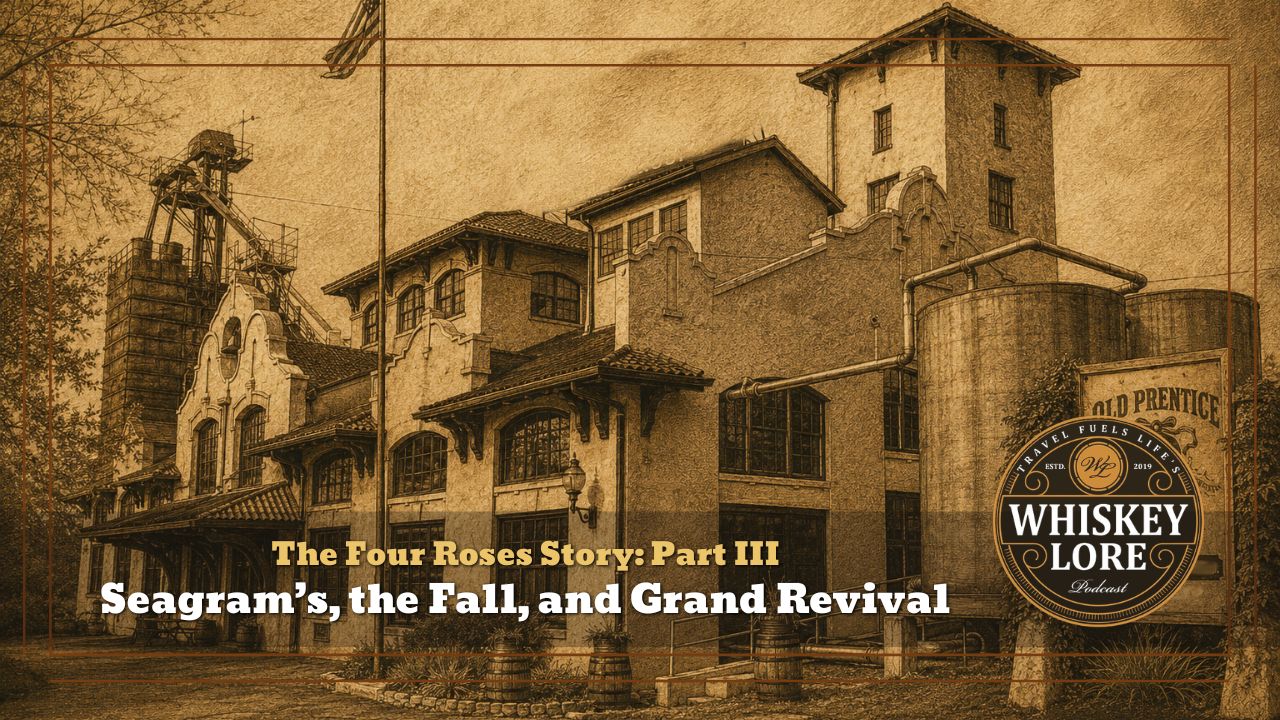
When Frankfort Distilleries came up for sale, Bronfman struck again. Seagram's gained the Shively Distillery, the A. Ph. Stitzel Distillery, and two Baltimore distilleries. He didn't stop there, acquiring Old Lewis Hunter in Cynthiana, Cummins-Collins in Athertonville, and a jewel of a distillery in Anderson County, known today as the Four Roses Distillery. Back then it was called Old Prentice. Designed by the architectural firm Joseph & Joseph in a distinctive Spanish Mission style, it remains one of the most recognizable distilleries in Kentucky.
Some of these distilleries would eventually be shuttered. Others would survive for a time. But Seagram's operations would ultimately consolidate in Lawrenceburg, Kentucky, and Lawrenceburg, Indiana.
Yet while those old distilleries vanished, their fingerprints remained—and decades later they would help shape the rebirth of Four Roses.
https://findingaids.hagley.org/repositories/3/resources/1313
The Highball Era of Four Roses
“A Truly Great Whiskey!” If you were a visitor to Times Square in New York City between 1938 and 1947, those words were hard to miss. Atop the International Casino, these words were topped by the block letters FOUR ROSES blinking on and off while a time release mechanism lit up spirals of roses from bottom to top on either side. The sign was so bright that during the war, it was shut off at night, so as to not give German U-Boats a target to aim at. It was in such a high profile location that you can hardly miss it in the famous V-J Day photograph by Alfred Eisenstaedt of a sailor dipping and kissing his girlfriend.
From the high impact sign in Times Square, to the high impact Madison Avenue ads, Four Roses appeared to be swinging for the fences in terms of promotion in the post-war years.
But the war had done a number on stocks of aged whiskey and the Big Four were scrambling for ways to extend their supplies. Under Seagram's ownership, the decision was made to shift Paul Jones and Four Roses from their long time blending of purely straight Bourbon whiskey into using flavorless, unaged grain neutral spirits as a base, and flavoring them with a percentage of straight Bourbon.
Four Roses became a blend of 40% 5 year old straight whiskey with 60% grain neutral spirits while Paul Jones was diluted with 72 ½ % grain neutral spirits.
While this seems like a downgrade to modern drinkers, the short supply of straight whiskies pushed the entire industry toward Bourbon and rye flavored grain neutral spirits. The change in Four Roses didn’t seem to hurt the brand. It remained one of the ten most popular whiskies in America. They even moved north into the hot Canadian market with a Four Roses Canadian Whisky, distilled, blended and bottled in the Great White North.
Still, a change like this was bound to draw criticism from some straight whiskey drinkers. Seagrams addressed them with a 1951 advertisement, asking a simple question: "Did you ever try to taste a word?" The ad argued that words like straight and blended described production methods, not flavor, encouraging consumers to judge the whiskey in the glass. Whether drinkers agreed or not, the media celebrated the brand. Spirits Magazine would call Four Roses "one of the best around. A great name.”
While historians point to this as the peak of Four Roses before a boardroom decision pushed the brand into the export market, leaving the cheap stuff behind—the reality is, Seagrams was supplying the taste customers in the 1950s preferred.
In the mid-20th century drinkers wanted something light and refreshing. Highballs were everywhere. A typical highball mixed whiskey with carbonated water, while the popular 7 & 7 combined Canadian whisky with lemon-lime flavored 7UP. Advertisements from the era routinely showed lighter-colored drinks crowded with ice rather than neat pours. Even Winston Churchill reportedly preferred only a splash of Johnnie Walker Red at the bottom of a glass, filling the rest with water. In 1958, the Kingston Trio had a hit singing about Scotch and Soda. Four Roses blended whiskey fit perfectly into the drinking culture of the era.
And the idea that Seagrams and Four Roses abandoned straight Bourbon drinkers in the 50s isn’t exactly true either. 1955 saw the first release of a non-GNS blend of straight Bourbons for the first time since the war. The proof was a little lower, at 86.8, but this was becoming an industry standard, with the best selling Bourbon on the market, Old Crow at 86 proof. Then in 1958, Four Roses Antique Kentucky Straight Bourbon appeared on the market, aged 6 years at 86 proof. And heavy promotion of Four Roses continued into the early sixties with stylish Madison Avenue lifestyle ads. A Four Roses Society was established, equipped with its own mascot—a bulldog named Battlin’ Bill. It was an effort to get men together to socialize over a glass of Four Roses. And the brand also entered the decanter market with a slimmed down carafe bottle design adorned with a tall gold cap. When Seagrams moved its corporate headquarters from Montreal to New York City in 1958, their devotion to promoting Four Roses Straight Bourbon and blended whiskies in the American market appeared to have no end in sight.
It was a great time to be in the Bourbon industry. Trade barriers were being lowered and countries like France, the UK, and Australia were starting to embrace Bourbon. And at home, for the first time since World War II, Bourbon held more than 50% of the American whiskey market. Sales had grown from 9.5 million gallons of Bourbon sold in the U.S. in 1948 to over 50 million gallons in 1957. Estimates suggested 1959 would see 70 million gallons sold. Even more encouraging was the 40% decline in blended whisky sales over the previous decade, with straight Bourbon picking up the slack.
The 60s seemed primed for a decade of Bourbon dominance.
Fading Roses
It was a loss of innocence.
On November 22, 1963, Americans were in shock, hearing of President John F. Kennedy's assassination in Dallas. For a generation that had endured the Great Depression, won a World War, and emerged as the world's dominant power, it was a sobering reminder that the future wasn't guaranteed.
The mood of the country seemed to shift. The carefree optimism of the 1950s gave way to something more complicated. Movies became grittier. Music went from sock hops and rockabilly to a search for an escape with the British Invasion. Fashion moved away from tailored suits and formal hats toward a younger, more rebellious look that would eventually evolve into the counterculture movement.
With so much reliance on Madison Avenue for their personality, Four Roses began to change too.
One of the first things Four Roses lost was its sense of lifestyle. By 1963, the magazine ads featuring beach parties, lodge gatherings, and aspirational living were replaced by a single glass with a penny at the bottom and the headline: "A penny can make your drink taste better." The ad wasn't selling a lifestyle anymore. It was selling process. Better grain. More distilling stages. It also focused on price, saying for a penny more per glass, you get a better spirit. The image itself was cold and stark.
The energy was gone.
And no hero was to be found. In the past, Paul Jones, Lawrence or Sam Miller were there to steer the ship…with Four Roses or Paul Jones Four Star always guaranteed at least an attempt at protection—and a reverting to quality when things were going wrong.
Under Seagrams, the hero could have been Mister Sam, but he had hundreds of products to look after under the Seagram’s banner. It left Four Roses exposed.
When Congress declared Bourbon a distinctive product of the United States in its 1964 resolution, Bourbon sales were up 4 ½ percent. Even 007 James Bond, British secret agent, was enjoying Mint Juleps and Bourbon and Branch Water in the years cinematic hit Goldfinger.
Meanwhile, Four Roses was moving in the opposite direction. The six-year-old Antique Straight Bourbon was headed toward the chopping block, while the Bourbon content of the flagship blend was reduced to just 35 percent. While the good stuff was being shipped to Asia and Europe.
What was going on at Seagrams?
It’s time for me to invite another voice into this story. A man who saw Four Roses through its darkest years and helped lead its revival from bottom-shelf dweller to a phoenix rising from the ashes.
A Premium Level of Hype
Back in 2018, when I was taking my first deep dive into Kentucky and the Bourbon scene, I prepped for my first Bourbon Trail excursion by watching a documentary called Bourbontucky. For 90 minutes I was transported across the state, where distillers and founders told rich stories about the development of Bourbon and the state of the industry.
Out of all of the stories, the one that stuck out the most was the remarkable up and down and up again history of Four Roses. When I decided to start doing the Whiskey Lore Podcast, I knew it was one of the first stories I wanted to cover, but I wasn’t quite sure where to start.
That’s when I bumped into Allison Nunis, a regional brand ambassador for the company, at a whiskey tasting event in Columbia, SC. When I told her I wanted to tell the distillery’s story, she gave me a copy of the book Four Roses: The Return of a Whiskey Legend by Al Young. Then she told me, Al was the person to talk to about the history of Four Roses. Not only was he their historian, he was also the longtime distillery manager at Lawrenceburg, KY. She got me in touch with him and we set up a meeting. I drove to Kentucky and we took our seats in the Boardroom on that beautiful Four Roses campus.
I told him I loved the book, but he seemed to be a bit modest about the part he and master distiller Jim Rutledge played in bringing the brand back. It was that era, I wanted to talk to him about.
That deep voice you’ll hear co-narrating with me will be his. He arrived as a member of the Seagrams team in 1968, just a year after Jim Rutledge joined in ‘67.
AL: ”Jim often tells the tale that he gave me my first tour in Louisville and he was lucky we got through it because he said, "I probably didn't know more than you did at that time."
In that year, 1968, some say Bourbon was on the decline, but numbers showed something very different. Blended whiskies like Four Roses only held 37% of the market share, Scotch 20%. Meanwhile, Bourbon sold over 86 million gallons and carried 43% of the market. 86 proof was clearly king, but blends were not.
Seagram’s clearly saw the trend, but instead of bringing back Antique Four Roses, they released a new label: Seagram’s Benchmark Premium Bourbon—an 86 proof Kentucky Straight Bourbon, distilled in Louisville by new head distiller Charles Lloyd Beam and aged 6 years, just like Antique.
So where was Four Roses heading?
AL: ”When I was coming in, they were making plans down the road to turn it into Four Roses premium whiskey, which would have taken the advantage of light whiskey, which is distilled above 160 proof, and is aged only for a short period of time in previously used barrels.”
Calling it premium seems odd to use today, but clearly Seagram’s chief blender Russell McLaughlan thought he had a hit in the making. He was so excited about Light Whiskey’s arrival scheduled for July 1972, that he created what he called an in-between version of Four Roses Premium brand, something the company president R.C. Wells framed as being “far out in front of the finest Scotch and Canadian whiskies in lightness and smoothness.---a new standard in whiskey.” McLaughlan noted that the in-between whiskey was a blend of 35 different aged distillates including Bourbon and rye and aged grain spirits (which made up 75% of the product). His claim is that these grain spirits are aged from 4 to 6 years, which, even at 190 proof, still retained some flavor from the grain. He called it a foretaste to Light Whiskey, and noted that “while the current package will note the 75% grain neutral spirits, the Light Whiskey won’t have to carry any such disclaimer.” Shelves were cleared of the Four Roses, to make sure customers got to taste what he considered an impressive new spirit.
While Bourbon sales were up a whopping 148% over the last 20 years, Seagram’s clearly thought they had their finger on the pulse of the future. They seemed more interested in converting vodka and gin drinkers, not whiskey fans.
When Four Roses Premium’s ads arrived in 1972 with the new bottles, the target audience was clearly female, with a woman’s hand holding up a glass with the words Underwhelm me…again,” Four Roses Premium, 86 proof, It’s Whiskey Without the Whelm. In a span of 20 years, a lifestyle brand turned into being worth a penny more, then a quality whiskey you could save pennies on, into a light underwhelming whiskey.
It's no wonder Four Roses' reputation tanked. It was trying to shift to a demographic that was clearly not interested in whiskey. And who wants to buy a product that is underwhelming?
The ultimate slap in the face for the brand came in a UPI article in 1974, where North Georgia moonshiner Hubert Howell said legal brands weren’t fit to drink. “Even Four Roses whiskey doesn’t taste as good as good moonshine whisky. Whiskey is made to sell, not to drink. A man’s a damned fool to drink it.”
It begs the question, if Mr. Howell had tasted Seagram’s Benchmark Kentucky Straight Bourbon, would he have felt the same?
Meanwhile, another fine quality Bourbon from Seagram’s hit the market in 1975. This was the 10 year old 101 Proof Eagle Rare. Initially said to be a competitor to Wild Turkey 101, it soon became associated with a save the eagles campaign at the Land Between the Lakes recreation area. While Benchmark was distilled at Louisville, Eagle Rare came out of the Old Prentice distillery in Lawrenceburg, KY. Which was about to become Al Young’s temporary home.
AL ”I was here 82, 83, and they shut Louisville down in 83. So I was out here and given the opportunity to go to Indiana and work for what was Seagrams and Sons in Lawrenceburg, Indiana, for approximately seven years. and I worked in warehousing and the distillery there.”
At the same time Charlie Beam was stepping away from the stills, leaving Ova Haney to man Old Prentice.
Was America’s love affair with Four Roses finally over? Not if Jim Rutledge had anything to do with.
AL: ”Oh my Grace. He had followed the brand and he had gone up the corporate ladder very well and ended up going into working in New York
For a long time, and then when the opportunity to come back to Kentucky presented itself, he said he wanted to do that and see what he could do to bring the quality up of the brand itself and try to reestablish it.”
So when did Jim finally get his chance to do something with the brand?
AL: ”Jim was back here in 93. He was down at Cox's Creek, 92, 93, somewhere in that area and he was working up budgets and he was becoming slowly a Kentucky area manager before he replaced Ova Haney here as a master distiller in 1994. Jim was here to begin to get his influence known in that area.”
What’s fascinating about this story is that Jim was left with the building blocks of today’s Four Roses, thanks to Mister Sam’s spending spree back in the 1940s. Remember those distillery acquisitions, the Seventh Street Road distillery in Louisville, Old Lewis Hunter, Cummins-Collins, Henry McKenna, and of course the Four Roses Old Prentice distillery. Well each of those distilleries had its own unique yeast strain. In Kentucky Bourbon, certain yeast strains are critical to the flavor stamp of a brand. In the case of Four Roses, they had five different yeast strains from five different distillery personalities.
When Jim Rutledge took over as Master Distiller in August of 1995, he had ten different recipes to work with, based on two different mashbills, each using the five yeast strains. It would create a level of flexibility unheard of in a distillery of Four Roses’ size. With each recipe aged separately, the blenders at Four Roses could create a variety of styles depending on the recipes they married together.
It was time to give Kentuckians a taste of what was to come.
AL: ”We went to the Bourbon Festival with special permission and we had to get that to bring the whiskey even into Kentucky to bring it there. I mean, we had a borrowed rug, we had a card table, I brought my champagne pot from home and we had roses in it and we were all standing around over on the other side for some of the bigger producers with their pre-made front porches and so forth and we thought, "Man, how are we ever going to compete with that? And the door opens to bring everybody in and the first people that came in were the Japanese and they saw our four roses and they kept running across the floor yelling, "Four Roses, Four Roses, Four Roses." And we haven't had to worry about looking back since.”
By September 1998, Four Roses Yellow Label was not only on the shelves in Europe and Japan, it could also be found in Kentucky and Indiana.
No more light whiskey. Rutledge incorporated the real legacy of the spirit saying “Four Roses Bourbon is a very mellow taste, relative to all other bourbons.” Kentucky as soon going to taste. Al recalled the first time he saw a bottle on the shelves.
AL: ”It was exciting because for years we had made Four Roses and couldn't buy it. I mean, it's frustrating to be able to tell people how good it is, but if you can't get to it, what are you going to do?”
Then the other problem. You’ve got to overcome that bottom shelf reputation.
AL: ”That was the bad part. We had to get rid of all that stuff and to buy up as much of it as we could. I mean, you probably might find a couple bottles out there even today, but we tried to get everything off the shelf so we could bring the whiskey back into the market.”
All seemed right with the world, with Four Roses back on its way to prominence, but as the millennium came to a close, fate thrust another major hurdle in the brand’s way. Seagrams Corporation was in disarray. New management was seeing music and entertainment as the future and in 1999, Seagrams merged with Vivendi.
Almost immediately, the Four Roses brand was up for sale and being mentioned with one huge conglomerate and then another, you must have felt like a ping pong ball?
AL: ”Well you know we didn't, I mean, Jim probably did and kept it to himself, but we didn't really look at anything. We just figured we're making whiskey every day and making it the best way we know how. Keep doing that. Everything's going to be fine. We're going to be sold. What are we going to do now? I was concerned actually as distillery manager, I had kids in college, I had kids in high school. I went over and told my wife, I said, "It doesn't look good." And she said, "Well, what's going to happen?" I said, "Well, if they could do two things, they could either sell the whole place out from under us and other people would come in and bring their people in to run it, or more importantly, they could take the brand and make it somewhere else, and that third idea is they could shut the whole thing down, buy the brand and retire it because we'd seen them do that with other brands in the 1980s. So she said, "Well, what are you going to do? " I said, "I have to ride it out. " So I had calls from people in Bardstown that said, "If things get bad, you always have a job with us," which helped a lot, but Jim tried all kinds of things to get people interested. He even told us we should all invest our retirement funds in it. Then when we looked at how much everybody had in retirement, we figured it wouldn't be near enough. Then we were fought over by Pernod Ricard and Diageo, neither of which could buy without getting to be the monopoly holder in Europe. Then Kirin, who we'd had a business relationship with since 1971, found that we were available and Jim courted them, they courted Four Roses and ended up buying the whole thing.”
And that was the thing that made the Four Roses story so compelling for me. Here was a brand, with its Fine Old Bourbon relegated to the export market in Europe and Asia, and here is a Japanese Beer company bringing it back. The question was, did you feel like they were determined to make it work in America?
AL: ”Well, that was one of the basic things they said. You remember that picture of the nurse and the sailor at the end of the war in New York City with a big time, big sign. They said they wanted to bring it back into the United States and make it as strong as it was back then. So that was a win-win right there. Beautiful, Yeah.”
So you’ve got a perceived bottom-shelf brand. How do you elevate it in people’s eyes?
AL: ”A lot of foot pounding, a lot of attraction to the press, a lot of distributor interface. We started out in Kentucky, grabbed up Indiana, Tennessee. Then we got into Illinois kind of baby steps trying to get everything back in order. So it was just a question of concerted effort. Jim was running all around the place. One of our engineers, John Ray, made up shelf talkers or knickers to put on bottles here in Kentucky. He was running around. We were going to bars, anybody that would take a bottle in, we'd give them a bottle even to let them just put it on the shelf to see how it would work. We had time on our side in a way because a lot of the people that had followed the brand closely were getting older. So consequently, we had to do more of an educational technique to get new drinkers involved with the brand. So we started doing some of that and then we increased our efforts with international sales teams, brought them over here from Japan and Europe to teach them about Bourbon and it just had a trickle down effect all over the place. As we began to teach, they began to disseminate that information out to everybody else. Are we masters at it? Heck no, we got a long way to go, but it seemed to work.”
So where did the concepts for Small Batch and Single Barrel come from?
AL: ”We thought being as unique as we are with 10 different recipes, we ought to be able to come up with something that would set us apart from everybody else. I believe I got it right. The single barrel came out in 2004 and Jim chose the OBSV recipe for that. So that was the high rye mashbill and the fruity yeast. And the barrels you chose were eight or nine years old and it was a hundred proof and the gamble paid off because the single barrel suddenly jumped to the top of the charts. It's interesting to note that it was at one time the bestselling bourbon at the Maker's Mark Lounge in Louisville on Fourth Street. Interesting. Yeah. Very interesting. So that was 2004, 2006. We came out with a small batch, which we had help from the blender from Kieran, Joda Tanaka, who came over here and decided the ratio for the K and the O yeast with both mashbills. And everybody agreed that this was just, if you liked it, we've accomplished our objective.”
Then, the hard work of restoring the brand nationwide began. Jim Rutledge started by putting his stamp on the brand with two new products - Four Roses Single Barrel released in 2004 at 100 proof and Four Roses Small Batch. The bottles the whiskey was packaged in are substantial. I asked Al if that was a conscious choice?
AL: ”Well, we had a choice. We could go cheap or we could invest in bottles that are singularly unique and readily identifiable. We went that way and we tried to get bottles that no matter what you do to them on the shelf, you can't crowd them out. Nice. So if we made the small batch to resemble a rose butt if you turn it over, the statue-esque single barrel is the way it is so that it doesn't look like a trade bottle. And then a small batch select has a bottle just like the one for a regular small batch, but it too can't be muscled out of the shelf. Nice. It has elbows.”
So what did people think about the potential for a return to glory for Four Roses? There were doubters. Arthur Shapiro, marketing consultant and former executive vice president of marketing and strategy for Seagrams said “I think they have a real uphill battle. In Europe and Japan it has a good name but to U.S. consumers who remember the name “it’s crap.” “I’m not very optimistic on it’s success.”
Jim, Al and the team at Four Roses and Kirin proved them wrong. By 2009, Four Roses had made its triumphant return to all 50 states.
Sadly, we lost Al Young just a month after my interview with him. He died peacefully, surrounded by friends and family on Christmas Day, 2019. There were so many more questions I could have asked him. I would have loved sharing this series with him.
The stories of Paul Sr and Jr starting a wholesale business from the ashes of Atlanta, leaning heavily into Old Monongahela Rye, moving on to Louisville with a new brand it tow, the inventiveness of Samuel Miller, the solid footing Lawrence Jones let the company on, the incredible lifestyle brand built under Seagrams, the loss of the products core personality, and the two men who cared enough foster a broken brand back to health. A true ashes to incredible rise, back to ashes and then rebirth story, unlike any other in whiskey.
And after a recent $55 million expansion and recent market turbulence, somehow Four Roses has found its way back into a family-owned company, Gallo—now in its fourth generation of ownership. It’s time to see what the next 160 years will bring.
I’m Drew Hannush and this is Whiskey Lore
Whiskey Lore’s a production of Travel Fuels Life, LLC
Production, stories, and research by Drew Hannush
And as we close of Season 7, I’m looking forward to kicking off two major podcast events - one based around the origins of Bourbon and the second honoring the Legends of whiskey history. Make sure you’re subscribed so you don’t miss an episode.
And for even more Whiskey Lore, make sure to become a member of the Whiskey Lore Speakeasy and Club 1897 where you’ll get longer interviews, bonus content, and a chance, with your votes, to award the best distilleries in the country with a Pagoda Award.
Just head to Patreon.com/whiskeylore.
I’ll see you there. In the meantime. Thanks for growing your whisky knowledge along with me, I’m your host Drew Hannush and until next time, cheers and slainte mhath.
Find show notes, resources, and transcripts for this episode at WhiskeyLore.org/episodes