
Hall of Legends: Colonel E. H. Taylor, Jr.
Listen to the Episode
Show Notes
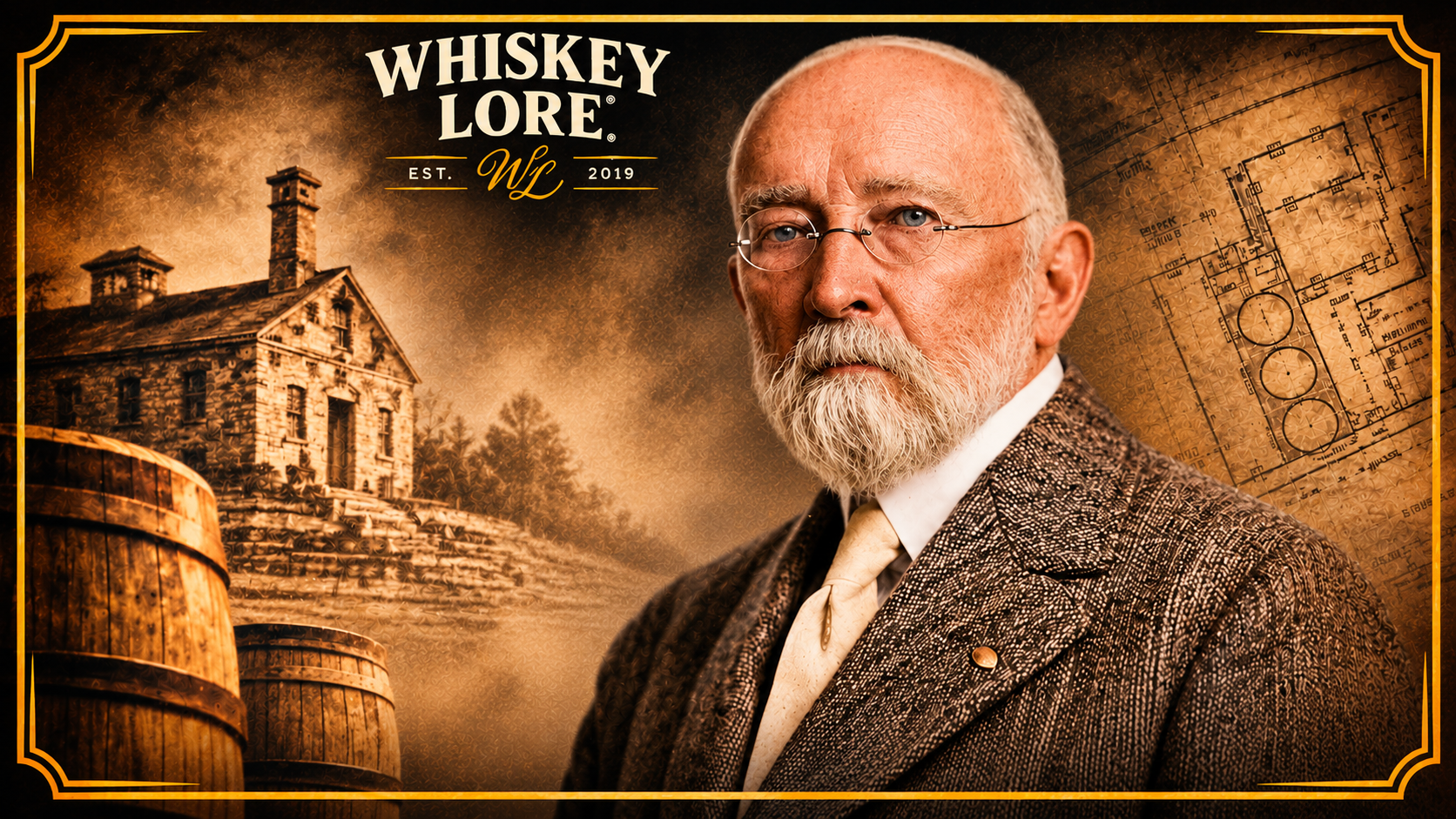
For this special Hall of Legends episode, we turn the microphone over to a figure whose name remains closely associated with Kentucky Bourbon history. But rather than recount his accomplishments, he has something else on his mind: the whiskey itself.
He lived through an era when distillers were increasingly pressured to produce more whiskey, faster and at lower cost. He watched new fermentation techniques and distillation methods replace practices he believed were responsible for Kentucky's reputation.
And he wasn't particularly quiet about it.
In his own words, he takes us through the principles he believed separated superior whiskey from the ordinary: sound grain, carefully prepared mash, natural fermentation, slow distillation, limestone water, and patient maturation.
Along the way, he offers some strong opinions about Scotch and Irish whiskey, the merits of pot stills, and the growing influence of financiers upon the American whiskey industry.
But his concerns extended beyond production. He believed consumers deserved to know where their whiskey originated and whether the product inside the bottle was genuinely what its label claimed.
That conviction would connect his name to one of the most significant pieces of legislation in American whiskey history. Yet the role he actually played may not be quite what modern accounts suggest.
And if he could walk into a modern distillery or examine the bottles bearing his name today, what would he think?
This episode draws extensively from his surviving writings, with approximately 80% of the narration taken directly from his words. Rather than telling you what this man believed, we're giving him the opportunity to tell you himself.
For more about the historical research and unexpected discoveries behind this episode, visit the Whiskey Lore Speakeasy at patreon.com/whiskeylore.
Transcript
Welcome to the Whiskey Lore Hall of Legends
It’s time to meet our latest inductee:
Good people, it is a most extraordinary circumstance to find myself once again in your company.
I understand that those who have preceded me upon this platform have seen fit to recount the particulars of their lives and the accomplishments for which they wish to be remembered. I shall spare you such an exercise. My rather uncommon upbringing, the distinguished family connections that afforded me certain advantages, my years engaged in banking and commerce, and even the considerable difficulties I encountered in my efforts to preserve the good name and ancient traditions of Kentucky sour mash whisky are matters upon which I have little desire to dwell.
There are, however, certain principles concerning the manufacture of fine whisky upon which I have never been inclined to remain silent. And I shall not do so now.
I have observed that a number of well-intentioned gentlemen, including our host on this occasion, have undertaken to explain my convictions regarding Bourbon whisky, or, more properly speaking, that superior product of Kentucky known as sour mash whisky. While I do not question the sincerity of their efforts, I believe the subject would benefit from a few observations by the gentleman whose opinions they have so freely undertaken to interpret.
Mass Production: The Enemy of Superior Whisky
Now, “it is an admitted axiom that quality recedes as cheapness advances in whiskies of the first class.”
In my day, our industry was overrun by money men who employed yeasts and other exciting agents to hasten fermentation and increase their yield. But in their pursuit of quantity, they exhausted the very elements which, if permitted to remain and develop through proper maturation, would produce those “aromas and flavors that would tempt the gods.” And all the while, while creating an inferior product, they traded upon the reputation of Kentucky Bourbon, a reputation earned through the very methods they had abandoned.
And what was the consequence? “The ancient Bourbon flavor departed and stomachs groaned under the dominion of the new ruler.”
“It was the nature of the original processes that gave the world a product with a reputation extending beyond the county and the State and the nation.”
I therefore propose to reintroduce to the modern ear the legendary processes, and the principles upon which they rested, so that you may better understand what constitutes a whisky truly worthy of the reputation of Kentucky Bourbon.
From Grain to Fermentation to the Still
First, “no finely flavored whisky can be made from unsound, defective or badly matured grain.” It must be clean and properly matured before entering the mill.
Then it must be ground into “angular fragments, adapted to starch conversion,” rather than reduced to a floury fineness, which forms lumps in the mash tub and encourages acidity.
In my beloved sour-mash process, traditionally the grain was scalded with sour spent beer from a previous distillation, but never at an excessive temperature. For “extreme high temperatures in scalds are productive of corn-oil—an injurious, fetid, disagreeable product.” Indeed, I have witnessed this offensive substance floating upon the tubs of high-wine distilleries “to a depth of a foot or more.”
The scalded meal was then “thoroughly stirred by hand in small tubs with mash rakes, vigorously used,” and left to stand “from twenty-four to forty-eight hours, according to the atmospheric temperature,” until cooled to approximately 100 degrees. During this interval, the starches began their development toward conversion into sugar, and the foundations of flavor were established.
Next, malt and rye meals were ordinarily added raw. The mash, generally one bushel to a tub, was broken up and passed through crushers into the fermenting vessels. With a little additional water, the malt and rye helped liquefy the mash. The diastase of the malt converted the starch, and the fermenter was set at a gravity of approximately eleven degrees, a measure of the dissolved sugars in the mash.
The temperature most favorable to proper fermentation was 68 degrees. Under such conditions, “the fermentation is spontaneous and unforced,” and the temperature should never exceed 81 degrees.
Now, this is a distinction of the utmost importance. The fermentation was not intended to exhaust every particle of sugar. A moderate attenuation of eight points was desirable. To force it further required an active chemical yeast, which would “secure quantity at the loss of quality.” For “an exhaustive fermentation destroys the residuum of the sugar that should be left unconverted as a base for development of superior flavors in subsequent maturation.”
We also employed strained spent beer, rather than carrying an exhausted mass of solids through successive fermentations. This preserved the desirable yeast germs while avoiding unnecessary impurities. The resulting beer was “like the first expression of juice from a grape,” and the vessels containing it were expected to possess, above all else, “cleanliness and sweetness.”
Contrast this with the sweet-mash process, in which water replaced spent beer. Such a substitution necessitated the introduction of active yeast, hastening fermentation, increasing attenuation, and, in my judgment, sacrificing those very qualities upon which superior whisky depended.
Thus, natural, slow, and deliberate fermentation formed the foundation of a fine and flavorful spirit. Yet I was not opposed to scientific advancement. Larger fermenters, properly employed, could provide greater “accuracy, and uniformity in fermentation,” without abandoning the principles that had established Kentucky's reputation.
The Importance of Water
And while the methods I have described may be employed by distillers throughout the world, “no language can exaggerate the vital importance and necessity of proper water in the manufacture of a fine grade of whisky.”
This conviction of mine was strengthened while traveling in Scotland, where I inquired of the foremost distillers why the finest whiskies appeared to originate in certain well-defined regions. I came to believe that the character of the water was among the principal explanations.
Indeed, “nowhere in the world can one find superior water for this purpose than in certain geological areas within the State of Kentucky.”
My conviction was shared by Dr. Chase Palmer, a distinguished government researcher, who observed that the waters of Kentucky's Bluegrass region were particularly suited to the manufacture of superior whisky. He further noted how the waters of Burton, Dublin, and Munich contributed to the distinctive character of their celebrated ales, porters, and beers.
As for Kentucky, I considered the waters passing through the strata of birdseye limestone, exposed along the Kentucky River cliffs near Frankfort, to be without equal. These waters acquired their peculiar properties during their passage through the mineralized earth. Along the valleys, where crystal springs emerged from the limestone, arose distilleries whose whiskies stood among the finest in the country.
Consider the experience of a distiller named Shields, who had established a reputation for superior Bourbon along Glenns Creek. Believing the rich cornfields of Illinois offered greater opportunity, he removed his establishment to that state, expecting considerable prosperity.
But, alas, “he came back disappointed. Illinois water refused to develop the fine whisky he had made in the Bluegrass.”
And now I understand that modern science has introduced a process called reverse osmosis, by which Kentucky’s beneficial minerals are stripped away. If these minerals are among the sources of our whisky's superiority, what advantage is gained by removing them, only to boast afterward of the limestone through which the water once passed?
Oh, how I wish I could hear the explanation.
So convinced was I of the importance of our regional distinction that I believed Kentucky should protect the very name Bourbon. Under the Food and Drug Act, Kentucky initially secured the exclusive right to that designation. Yet Bourbon is no longer the exclusive province of Kentucky, thanks in no small measure to the actions of politicians from our own state. Perhaps the loss of minerals makes it unnecessary.
But I must say, had I been present for that controversy, I daresay readers of the Courier-Journal would have found my opinions quite difficult to overlook.
The Ideal Still
Now, it’s time to discuss a tool critical to the production of quality Kentucky whiskies—a tool that many dismiss as a relic of the past and the enemy of profits. I admit, “from 1812 to the present day, there has been no improvement in the pot-still, considered by itself, [yet] it seems that there cannot be any better still for the purpose it fulfills.”
That purpose was the production of low wines, or singlings, at a spirit strength of 50 per cent proof, followed by their redistillation over fire to a finished product of 100 per cent proof.
It is my firm belief, “whiskies carefully run in pot-stills over slow fires to proof constitute an entire whisky—homogeneous—and a product that naturally matures under favorable climatic conditions until it is the best of beverage whiskies.”
The further a distiller departed from this method, the greater the inequality of his results. It was this deliberate manner of distillation, together with the proper preparation and fermentation of the mash, that established the reputation of high-grade, hand-made sour mash whisky.
Now, I was by no means opposed to improvements in distilling apparatus. Indeed, “I was one of the first to discard the uncleanly, elementary wooden beer still for the beer still of copper, a change which made for cleanliness and undoubtedly contributed a marked enhancement to the quality of the run.”
There were men, both in my day and before it, who understood the value of these principles. “James Crow was the first man, as I believed then, who ever distilled sour mash in Kentucky.” I have since learned that others preceded him, but Crow's reputation was deserved.
His attention to hand-stirred mash, natural fermentation, and slow distillation established a standard admired throughout Woodford, Fayette, and Franklin counties. Though I never possessed his precise formula, his principles reached my own distillery through men who had learned their trade under him.
And he was not alone. Among the distillers whose work I greatly admired were Judge W. H. McBrayer and W. F. Bond, both producers of superior Kentucky whisky.
Yet there arose a new generation of distillers who regarded speed and economy as the principal virtues of their trade. They sought stills that consumed less fuel and produced greater quantities, without sufficient regard for the character of the resulting spirit.
To the distiller who seeks excellence and the preservation of quality, I say, discard such “‘Cheap John’ methods,” including “speed in distillation as in fermentation.” For “slow distillation and low temperature in both singling and doubling processes” remain the chief requirements of superior whisky.
And let there be no misunderstanding:
“It is not the statistical or quantitative feature of this industry that has given Kentucky its world wide reputation. It is the qualitative!”
Aging Whiskey
As for aging, “Kentucky’s method for storing its fine whiskies surpassed that of Scotland or Ireland. In those regions, whiskies were entered into bond anywhere from 11 to 20 over proof, stored in damp warehouses, and allowed to reach maturity on a descending proof scale. In Kentucky, fine whiskies were entered into bond at 100 proof, placed in dry storage, and allowed to mature on an ascending proof scale.”
Our methods were worthy of attention well beyond Kentucky. In 1872, Mr. Pulitzer's New York World sent a correspondent to document the manufacture and maturation of Kentucky whisky, rather than documenting the distillers overseas.
But regardless of the methods employed in storing whisky, one principle must never be forgotten: “maturation of whiskey is nature’s province.” And yet, there were those in my day who sought to hasten this process through the application of artificial heat. Such interference, however, “can not fail to impair the delicacy of the flavor.”
Bottling Whisky
In my lifetime, amid the many efforts to sacrifice the quality of Kentucky Bourbon in pursuit of greater profits, there came one most welcome proposal. It came from Mr. Miller, the Commissioner of Internal Revenue, in his annual report for 1895. In it, he put forth a recommendation that American whisky be bottled in bond.
It was music to my ears. “If the recommendation restricted such bottling to the distillery’s bonded warehouse,” while excluding the “ordinary wholesale liquor dealer,” it would be “the only condition under which a Government stamp would carry any weight.” Only then could the stamp placed upon the cork assure the customer of the whisky's genuineness.
But note, I choose my words carefully. When speaking of genuineness, I mean assuring the consumer of the whisky's true origin, not providing a government guarantee of purity or quality—words some have mistakenly attributed to me.
What I sought to prevent was the wholesale liquor dealer blending and mixing spirits of every kind and quality, affixing his own label, and then presenting the resulting product under the endorsement of the Government.
In the process of the wholesaler, the identity of the whisky and of the distiller who manufactured it would disappear, replaced by inferior compounds springing forth from “the agile hand of the bottling expert.” In just such a case, “the government becomes, so far as genuineness is concerned, an endorser of that of which it knows nothing.”
And thus, the consumer might be falsely led to believe that the stamp upon the bottle was a guarantee of its purity. Indeed, a Canadian firm had built up an immense trade in this country by employing just such a practice, promoting its Dominion seal as a certificate of quality. “The Canadian laws are more indulgent to the liquor seller than ours in this respect.”
In a letter to the Courier-Journal, I made plain the distinction between genuineness and purity. “The latter will depend upon a dozen elements—grain, cleanliness, methods of fermentation and distillation, care, water, storage, etc—the right use of which will alone produce a whiskey unexcelled in quality and unexampled in purity. The degrees of quality and purity will vary as the intelligence of the distiller, his knowledge of and attention to the business and facilities for perfecting his methods.”
My suggestion: “restrict the manner of bottling whisky to the distillery warehouse, authorize the government stamp across the cork of the bottle to bear the distiller’s name, provide adequate penalties for copying, imitating or forging such stamps, and you have a guarantee of genuineness that must and will satisfy the trade and the consumer.”
The resulting legislation, passed by Congress in March of 1897, was perhaps the greatest gift to consumers seeking the genuine article. It was not a perfect bill, but the designation “Bottled at Distillery Warehouse No. ___, by ___, Distillery” provided much of the clarity I wanted.
I, like many others, watched the wholesalers and rectifiers fight the measure tooth and nail in Congress. Yet despite their opposition, Representative Walter Evans succeeded in shepherding the bill through Congress and all the way to the White House, where President Cleveland affixed his signature.
And while I had spent so many years extolling the virtues of fine, pot-distilled sour mash whisky, I now had another cause for satisfaction: a law that allowed the genuine article to bear the name of the distillery that made it.
In Conclusion
And with that, I believed that the combination of my fine Kentucky sour mash whisky and the new Bottled-in-Bond designation would prove to be a powerful one.
And I was not mistaken.
Just a month after the Mellwood Distillery introduced the first whiskies under this new standard, I sold some 10,000 cases of Bottled-in-Bond Kentucky sour mash whisky to a firm in Chicago. By year's end, bottles bearing my name and the new designation could be found from coast to coast.
And while my name has gone down in history in close association with the Bottled-in-Bond Act, I confess that I would rather be remembered for my devotion to the principles of producing superior Kentucky sour mash whisky.
Do not misunderstand me. I take considerable pride in that association. But I neither wrote the legislation nor lobbied for its passage, as some have since claimed. I did, however, make my opinions known through the newspaper while Representative Evans was preparing the measure, and I should like to believe that my arguments carried some influence.
But the passage of the Bottled-in-Bond Act did not settle every question concerning the identity of the whisky in the bottle.
A decade later, during the disputes surrounding the Pure Food and Drug laws, I appeared before President Taft's committee to defend my convictions once more. And as usual, I had not come to make friends. Indeed, some of my testimony was hardly pleasing to certain wholesale customers of mine.
But the principle remained the same: the consumer ought to know what he was purchasing.
Far too many whiskies bearing the word straight upon their labels were anything but. Though President Taft's eventual decision did not grant all I desired, it did require disclosure of the presence and proportion of neutral spirits in certain blended products.
After my death, and following the revival of American distilling after Prohibition, such disclosures became familiar upon bottles and in advertisements. Yet consumers did not always demand the superior whiskies for which Kentucky had once been celebrated, and much of our former distinction was lost in a world of industrial scale monopolistic distilling.
I am pleased, however, to discover that certain modern distillers have returned their attention to sound grain, careful fermentation, deliberate distillation, and proper maturation. I am even informed that pot stills have reappeared in my beloved Kentucky.
But I confess myself disappointed that so many establishments continue to celebrate the traditions of Kentucky Bourbon while abandoning the very methods upon which those traditions were founded.
Imagine my astonishment at finding column stills employed at the distillery I established to succeed my son Swigert's former establishment. Or seeing the beautiful pot stills associated with the old master James Crow employed chiefly to provide flavoring for whisky produced by column stills.
Alas, for all my efforts, it would seem that the financiers have largely prevailed.
And what of my own name?
My old brand remains in a diminished position upon the shelves, often alongside Old Crow, both now products of column distillation. The methods I cherished have long since departed, while the precise formula of the whisky bearing my name remains beyond the public's knowledge.
Yet there are other bottles bearing my name and signature that command considerable attention, even though they do not represent the production methods I spent my lifetime defending.
Of those customers, I cannot help but wonder whether it is the whisky they pursue, or the legends that have gathered around the name upon the bottle. Do they even know what that name represented in my era?
For all the attention bestowed upon my association with Bottled-in-Bond, I fear that the principles for which I fought have become secondary to the stories told about me.
And that is a curious fate for a man who spent so much of his life insisting upon the importance of genuineness.
Still, I remain proud of what the Bottled-in-Bond Act made possible, for “it transfers to a consumer anywhere on the globe a bottle of Kentucky whiskey, just exactly as that whiskey was made and matured on the original distillery premises.”
To have one's name associated with a product worthy of the consumer's trust is no small honor.
But I should prefer to be remembered as a man who stood against those who would sacrifice the quality of Kentucky whisky upon the altar of greater profits. For I believed that the reputation of our whisky was something to be earned, defended, and never taken for granted.
You know, without me, it seems some believe we might never have had the Bottled-in-Bond Act. Yet that is not so. My real stamp was in standing firm and preserving the character and quality of Kentucky whisky for as long as I could.
Do you know who I am?
WITHOUT ME
My name is Edmund Haynes Taylor, but you know me as Colonel E. H. Taylor, Jr., the owner of two whisky companies that bore my name, a champion of the finest Kentucky sour mash whisky, and the latest member of the Whiskey Lore Hall of Legends.
I hope you enjoyed today’s trip to the past. And to honor the pursuit of genuineness, so treasured by the Colonel, in the interest of full disclosure, around 80% of the words in this episode came directly from the Colonel’s writing. It seemed giving you anything but the true E. H. Taylor in this episode would be a disservice to his legacy. Thanks to everyone who voted him into the Hall of Legends. And you can learn more about some of the rabbit holes I went down in pursuit of his voice and story, later this week in the Whiskey Lore Speakeasy, at patreon.com/whiskeylore.
More entrants in the Whiskey Lore Hall of Legends to come. Make sure you’re subscribed.
Whiskey Lore Is a Production of Travel Fuels Life, LLC
Legendary scripts written, performed, and produced by Drew Hannush
Find transcripts and further details for today’s show at whiskeylore.org/episodes